Magic systems in pop culture fantasy rely on a few overused tropes. So consider Harry Potter. In the Harry Potter universe, magic is a rare innate gift.
You're either born with it or you're not. Ordinary people, the muggles, live in a completely separate non-magical world. Those lucky enough to possess the gift are whisked off to a boarding school where magic is taught like a science.
There are textbooks, exams, research departments, and laws governing proper magical conduct. and spells themselves operate like precise chemical reactions. Say the right words, move your wand in the correct motion, and the universe complies.
It's neat and satisfyingly rulebound, and the result is a world that feels internally consistent and easy to imagine. But it also feels strangely sterile compared to what magical practice actually looks like throughout the history of religion. When you look at magic around the world, magic was not a separate system or a mysterious gift.
It was part of everyday life, tangled up with religion, healing, craft, and artistry. So, what can fantasy writers, showrunners, and game designers learn from the anthropology and archaeology of magic? To explore what's lost in translation, I'll be focusing mostly on the ancient Mediterranean, and Near East, the worlds of Greek, Roman, Jewish, and early Christian magic.
That's just because this is my own sub field of expertise, but the patterns we'll be talking about are not unique to these regions. So, in this video, I want to unpack four features of real world magic that most fictional magic systems get wrong. First, magic is mundane.
In a lot of pop culture stories, magic is almost always exceptional. It's a birthright, a genetic lottery, or a charismatic gift possessed by a special few. As I already mentioned, in Harry Potter, you're either born a wizard or you're not.
In The Lord of the Rings, Gandalf is not just a particularly diligent scholar who learned his magic. He's a lesser god in mortal form. Even in more scientific worlds like Star Wars, the Force still runs through the veins of the elect few.
Whoever has the most mediclorans in their bloodstream, the message is consistent. Magic is rare and it marks you as special. And when it appears, it breaks the ordinary world wide open in spectacular and exceptional ways.
Fireballs, lightning, portals, transformations. It's a rupture in the everyday. In these stories, the universe is a mostly rational place that occasionally bends for the extraordinary.
But magical practice throughout history is mundane. And by that, I don't mean trivial or boring. I got a whole PhD in this stuff.
I obviously find it interesting. I mean magic is mundane in the sense of the Latin word mundus, meaning the world. So in this sense, the mundane is the sphere of everyday life, grounded, down to earth.
And all throughout history and all across cultures, magical practice occurred in that everyday sphere, kitchens, workshops, marketplaces, not generally in academic ivory towers or secret brotherhoods. Some of my favorite examples come from ancient Greco Roman curse tablets. These were thin sheets of lead inscribed with a person's name in a short spell, usually meant to bind someone's body, speech, or fortune.
After writing the curse, the practitioner would fold the tablet, drive a nail through it, and deposit it in a grave or well, or some other dark place so that the restless spirits or cathonic gods like Hermes could carry out the command. They were a kind of everyday ritual technology for managing conflict, having trouble dealing with a lawsuit, curse tablet. Want to sabotage a rival chariot team?
Curse tablet. Want to win back your ex-girlfriend? Curse tablet.
A great example comes from Greece, dating to the 4th century B. C. E.
I bind Kios the shopkeeper who is one of my neighbors and the shop of the bald man and the shop of Anthemion and Felon the shopkeeper. Of all these I bind the soul, the work, the hands and the feet and their shops. I bind Soimmones and his brother and Carpos his servant who is the fabric seller.
Of all these I bind the soul, the work, the life, the hands and the feet. Basically, this was a business competition curse. So picture an Athenian neighborhood in the 300s.
The linen seller is over there. The pottery guy is over there. The same neighbors you see every day arguing over prices, competing for customers, and gossiping about one another's families.
One of them, well, his business is not doing particularly great, and he's fed up with the constant rivalries. So, he decides to even the odds supernaturally. He takes a sheet of lead, and maybe following a template he bought from a professional scribe, he begins to inscribe a list of names.
The shopkeeper and his wife, the bald man, the hemp worker next door. He even curses the shops themselves. It's not the act of some grand sorcerer, but the act of a neighbor with a grudge.
A spell born out of crowded streets, economic pressure, and the everyday friction of urban life. Another example, this cursed tablet was discovered at a sanctuary to the goddess Sulus Manurva in Roman Britain. Doilanus, son of Beris, to the most holy goddess Sulis.
I curse him who has stolen my hooded cloak, whether man or woman, whether slave or free, that the goddess inflict death upon and not allow him sleep or children now and in the future until he has brought my hooded cloak to the temple of her divinity. So, our hero, Doki, is missing his hooded cloak. What do you do?
There's no small claims court, no police force. The emperor is far away in Rome, and here you are in a small Roman provincial town. And you might not even be a Roman citizen who enjoys special legal privileges.
So you turn to a curse tablet in the justice of Sulus Manurva to enact justice for you. So what we call magic in the ancient world most often involved small-cale rituals like these to resolve everyday crises. People turn to spells and amulets to fix problems that felt unsolvable through ordinary means.
A rival threatening your business. A lover who wouldn't return affection. A child who kept falling ill.
The hoodie gone missing. Magic offered that extra dose of agency, a way to act when other options are failing. Another example, this one comes from Roman era Corinth, where archaeologists found a lead curse tablet buried in the sanctuary of the goddess Demeter.
The inscription targets a woman named Carpabia, a weaver of garlands, and calls upon Hermes, the fates, and the spirits of the earth to completely destroy her soul and heart and her mind and her wits. It ends with a plea for fertility. Make me fertile and destroy Karpime from her head to her footsteps with monthly destruction.
So again, magic is very grounded here, very personal and not particularly spectacular, as in this is not a battle between cosmic forces or a duel between rival chosen ones. It's one woman probably living in the same neighborhood or guild as Karpime, struggling with jealousy, rivalry, or infertility. She turns to magic to augment her agency in a world that is constraining her.
And the curse is a means to express anger, to appeal to justice, or to restore balance in a small but meaningful world. Just a desperate person using the cultural tools available to her to address a social crisis. Magical acts like these are part of the daily religious landscape.
Now, that's not to say every pop culture story treats magic as rare or exceptional. Some worlds imagine it as part of the social fabric or even a household skill. Studio Ghibli's Kiki's Delivery Service weaves magic seamlessly into work, hospitality, and cleaning.
Still, even in these more grounded depictions, magic often belongs to the special few. It's also not to say that examples of real world magic were never spectacular. Some rituals were elaborate, highly intellectual, and even transcendent in their aspirations.
A great example is the so-called Mithris liturgy from the Greek magical papyrie. It's a long ritual text from Roman Egypt that guides the practitioner through a visionary ascent up to the cosmos. Whoever composed this spell was not a village charm maker, but some sort of learned ritual specialist, someone trained in scribal Greek and steeped in late Roman cosmology.
But generally speaking, across history and across cultures, magical practice involves ordinary people doing rituals to solve ordinary problems. Small embodied ways of grabbing back some agency in a world full of uncertainty. If fictional worlds gives us Hogwarts, the ancient world gives us the neighborhood marketplace, a world of mundane magic where everyone knew someone who knew a spell.
An enchantment was not a rupture in ordinary life, but rather one of the most familiar expressions of ordinary life. So, if you're designing a fictional world, resist the urge to make magic rare or transcendent. Instead, build magic into the everyday machinery of social life.
In the ancient world, spells and amulets functioned like social infrastructure. They filled in the gaps between law and medicine. It's how people made things happen when other forms of power were out of reach.
Once magic becomes part of ordinary labor, economy, and social life, your magical world will start to feel more grounded. Next, and somewhat related to the first point, I want to turn to the question of expertise. Who actually does magic in cultures throughout history?
In fiction, magical knowledge is not only something that is special. It is often the purview of a discrete profession or social identity like a wizard or magician. Sometimes this profession is institutionalized, and you can learn magic by attending a wizarding school or joining a special order.
But magic across all cultures is more often a distributed overlapping field of practice. a flexible set of techniques and knowledge that circulated among scribes, healers, craftsmen, and clergy. A scribe who copied biblical psalms might also inscribe a protective amulet with one of those psalms inscribed around the edges.
A midwife might chant a healing formula while delivering a child. A stonemason might carve a protective formula into a foundation stone of an ancient theater to protect the city. A gem cutter could carve an image of a god that doubled as an amulet.
Notice that none of these people had the job title magician. And that's because what we tend to call magic is not the domain of a distinct profession. It's an open field of ritual expertise that bleeds across social and occupational boundaries.
Consider that karpy mayabia spell again. That tablet was not found in some hidden corner of the city. It was buried right beside an altar inside an active religious precinct.
Whoever commissioned this curse likely sought help from someone connected to the sanctuary. And who would that be? Well, probably a priest connected to the temple and familiar with its rituals.
The same people who presided over the sacrifices to demeter were likely helping clients compose and deposit curse tablets meant to reach the cathodic powers below. Magical ritual specialists often operated through official religious organizations, borrowing its spaces, its symbols, and its personnel. I've referenced this a few times now, but we see the same dynamic in ancient Christianity.
Christian monks, priests, and bishops often performed rituals that we could label magical even as they condemned such practices in others. One example comes from the Egyptian abbott Shinuta of Atrope. In one of his sermons, he laments that Christians run after enchanters and divers instead of trusting in God.
But the story he tells makes the problem more complicated because apparently some of these enchanters and divers were Christian monks. Shinuta says he saw people wearing charms, a snake's head tied on someone's hand, a crocodile's tooth tied to another's arm, and fox claws tied to someone's legs. When he demanded to know who had told them this would help, the man replied, "It was a great monk who gave them to me, saying, "Tie them on you and you will find relief.
" What I like about this story is how it collapses the categories we often imagine between religion and magic, orthodoxy and superstition. Shinuta wants to draw a sharp line. Monks should heal through prayer, calling upon Christ, not through amulets and animal body parts.
But his own community clearly didn't see things that way. People went to monks precisely because they believed these holy men had special access to divine power. The fox claw was thought to work, not despite coming from a monk, but because it came from a monk.
And Shannuta wasn't the only one frustrated by this overlap. The council of Leadyia issued an explicit prohibition against clergy performing such practices. They who are of the priesthood or of the clergy shall not be magicians, enchanters, or astrologers, nor shall they make what are called amulets, and those who wear such we command to be cast out of the church.
That kind of regulation tells us just how widespread these rituals were. If bishops had to warn priests and deacons not to make amulets and not to act as enchanters or astrologers, it's because a lot of them were already doing this. And we have archaeological evidence for this.
Dozens of papyrus amulets from Egypt preserve magical formulas written by people who clearly knew their Bible and Christian liturgy. Many of these amulets contain excerpts from the Psalms, the Lord's Prayer, or passages from the Gospels, written not as scripture for reading, but as scripture for wearing. One remarkable example is this amulet I mentioned before.
It's inscribed with verses from the Gospel of Matthew, introduced by the title, the Gospel of Healing According to Matthew. The text is carefully arranged in five narrow columns shaped like a row of crosses with a small person sketched in the center. The text has been folded multiple times presumably for wearing maybe in a pocket or in a pouch worn as a necklace.
It's scripture but transformed into a physical talisman and whoever made it probably didn't have the job title magician. It's much more likely they were some sort of literate specialist trained in the Christian tradition like one of those monks that Shinuto was complaining about. So if pop culture gives us magicalmies and magical chosen ones, history gives us a whole ecosystem of ritual expertise.
There were no departments of magic, no formal guilds regulating spellcraft, no single class of people called wizards. There were just communities of practice, scribes, artisans, healers, monks, midwives, stone cutters, each drawing on reservoirs of ritual knowledge to meet the needs of their clients and their neighbors. So when you design your magical world, consider imagining magic not as a specific profession.
A world where no one calls himself a magician and there are no magical schools or guilds. Think instead of a distributed ecology of magical expertise. A world where magical knowledge circulates through overlapping trades, workshops, and social roles.
Picture a midwife who, alongside her knowledge in childbirth, also knows a few birthing spells. Picture a lawyer who knows a how to speak better in public spell. You could almost envision magic as a service economy.
Commissions, fees, client disputes, maybe even intellectual property rights. You stole my formula. Again, with none of these people calling themselves a magician as a specific profession.
Okay, so far we've looked at who practices magic and how it operates in everyday life. But now, I want to turn to what magic actually is, or rather how fiction tends to imagine it. Magic as energy.
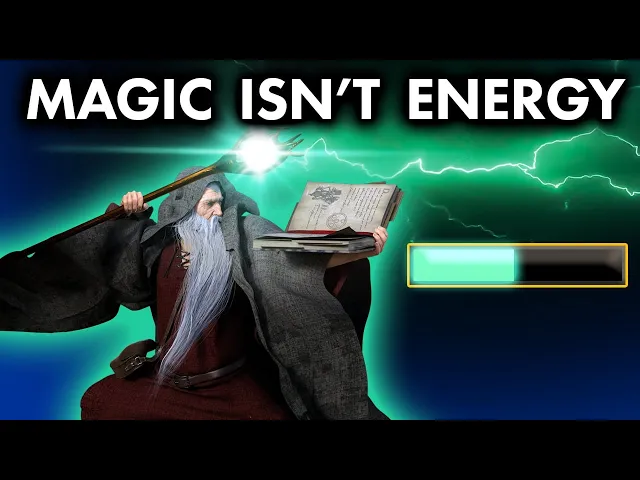
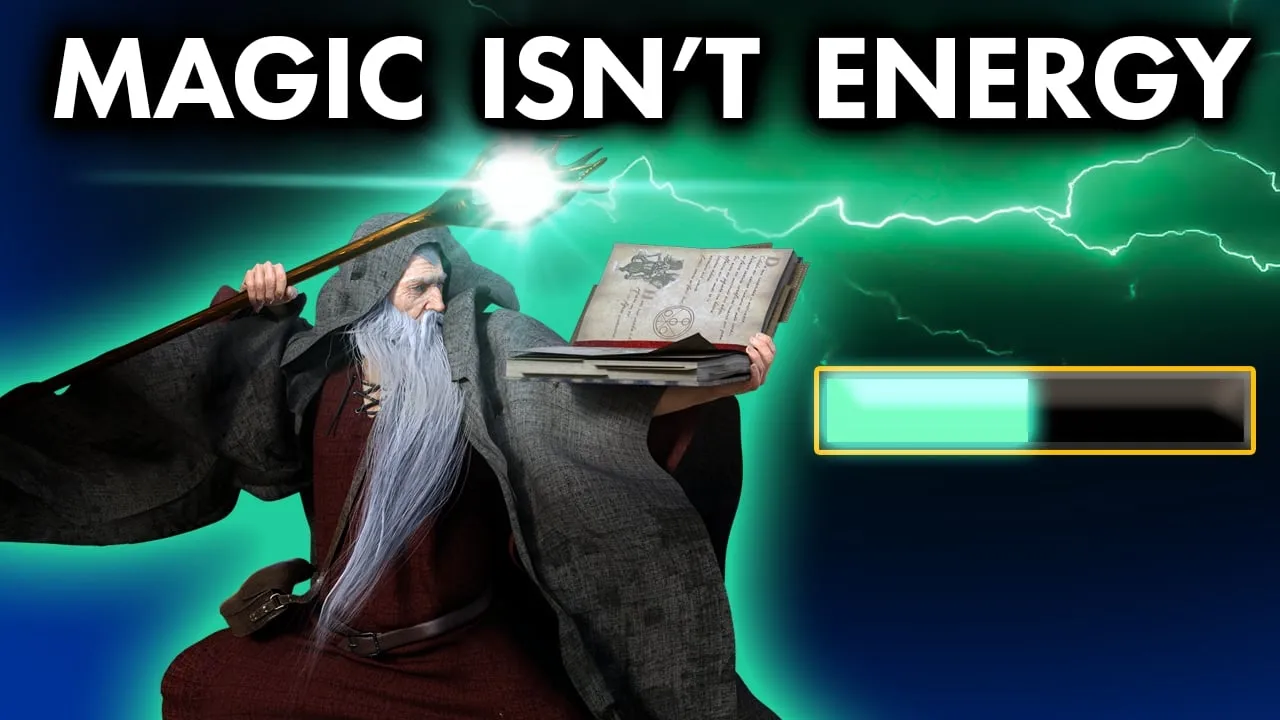
Nearly every major fantasy franchise today treats magic as a kind of physics or impersonal energy, something that is measurable, rulebound, and something you can manipulate. RPG and fighting games use various forms of magical resource management, like mana points. Franchises like The Witcher and Drgon Age describe magic as a volatile energy field, something you can harness or overdraw if you're not careful.
In the Wheel of Time, the cosmos runs on the one power flowing through male and female channels that can be tapped and exhausted. In Star Wars, the Force is what gives a Jedi their power. It's an energy field created by all living things.
It surrounds us and penetrates us. It binds the galaxy together. Notice it's energy.
And in video games and movies, the metaphor of magic as energy becomes literal. Magic looks like energy. It's glowing plasma, lightning or fire, arcs of light bursting from wands in Harry Potter, geometric energy in the Marvel movies.
In these worlds, magic is tantamount to energy manipulation, and magic systems are often forms of resource management, complete with resource costs, cool downs, and recharging mechanics. And this idea has a history. The modern picture of magic as an impersonal energy draws on a mix of influences.
early 20th century physics, loose borrowings from concepts likeqi and Chinese religion, or older spiritual ideas like vitalism, the notion that living beings share some vital energy that flows through everything. But one of the most important roots comes from the colonial Pacific, where European missionaries and anthropologists first describe the Polynesian word mana as a kind of invisible transferable power. In 1891, the Anglican missionary RH Codrington published the Melanesians in which he describes a mysterious force called mana, a kind of invisible power that could be possessed, transmitted, or stored.
He writes, "There's a belief in a force altogether distinct from physical power, which acts in all kinds of ways for good and evil, and which it is of the greatest advantage to possess or control. This is mana. It is a power or influence not physical and in a way supernatural but it shows itself in physical force or in any kind of power or excellence which a man possesses.
It essentially belongs to personal beings to originate it though it may act through the medium of water or a stone or a bone. All Melanesian religion in fact consists in getting this mana for oneself. Later anthropologists like Emil Durkheim and Marcel Mouse took up the term as a key to so-called primitive religion.
Durkheim called mana the totemic principle. For him, totemism was the religion of an anonymous and impersonal force, and mana was one name for this force. Later in the 20th century, the fantasy writer Larry Nan popularized mana after publishing his 1969 short story, not long before the end.
In Nan's literary world, sorcerers draw their power from a natural energy source called mana. But just like fossil fuels, mana is a finite resource. If magicians spend too much time in one land, they exhaust the land's mana and their magical spells stop working.
What's striking is that nearly all of these theories from Durkheim to Nan were building on the same source. They all trace back to Codington's initial definition. In other words, the entire Western idea of mana as a free floating impersonal power that you can possess comes from one missionary's attempt to describe what he heard from his parishioners in the Solomon Islands.
But his idea of mana flattened an intricate landscape of meanings across Polynesian cultures. Even in his own lifetime, other anthropologists were already criticizing him for making his own superficial generalization of the concept. And nearly a century later in the 1980s, the linguist and anthropologist Roger Keys published a huge takedown of Kodington's definition, arguing that in Aranesian languages, mana was not a thing or a substance at all.
It was more like a verb, meaning to be effective or to succeed or to work. And when used as a noun, it was more abstract, like efficacy, success, or potency. Later linguistic studies argue that across dozens of oceanic languages, mana means something like thunder or wind, which it still does in some modern Polynesian languages.
This sense of natural power was gradually applied to human beings, especially ritual specialists or chiefs believed to possess extraordinary efficacy. In other words, mana originally referred to the awe inspiring power of the natural environment, which was later reinterpreted as the kind of potency or authority that humans could embody. Sometimes understood supernaturally and sometimes understood in a more downto-earth sense, almost like charisma.
So, one reason the energy model of magic became so dominant is to see it as the product of this intellectual lineage. Codrington's version of mana gave Western thinkers a language for imagining unseen power as something impersonal and transferable. And that idea proved incredibly influential and it shaped how later scholars, novelists, and game designers imagined magic systems.
But it's only one way of conceiving magical power. Many cultures, including some of the same Polynesian cultures Kodington was writing about, understand supernatural power not as an energy you store or control, but as something relational. Power moves through correct relationships between humans, ancestors, deities, and other spirits.
So returning to the ancient Mediterranean, we find a similar pattern. Whether invoking a god, a spirit, or an angel, ancient magic users rarely claimed to command power directly. They negotiated with it, petitioning, flattering, and even threatening the beings who govern that power.
Consider this spell from the Greek magical papyrie, which illustrates this relational logic of power. The speaker addresses a cosmic being called the bear. A name probably connected with the constellation Ursa Major or an astral deity linked with the cosmic axis.
Bear. Bear. You who rule the heaven, the stars, and the whole world.
You who make the axis turn and control the whole cosmic system by force and compulsion. I appeal to you imploring and supplicating that you may do the thing because I call upon you with your holy names at which your deity rejoices. names which you are unable to ignore.
Notice the user doesn't channel power like an energy source. They appeal to a being who wields it. Every line of this invocation is rhetorical praise, flattery, and pressure.
It's more like a negotiation than energy manipulation. You're working a relationship in which the human speaker seeks to bind a divine being through praise, invocation, and obligation. Also consider this remarkable inscription found in Myitus in western Turkey carved on the northwest corner of the city's theater.
The text calls upon the seven archangels to protect the city of the Myleians and all its inhabitants. It concludes with a collective invocation. Holy ones, guard the city of the Myleians and all who dwell in it.
These ovals resemble the protective amulets that people wore on their bodies. And here the same logic of protection was expanded to civic scale. The city itself was effectively given a mega amulet, a monumental invocation binding the archangels into a protective relationship with the city.
So, if you're building a fictional world, try reimagining your magic not as physics or energy, but as diplomacy instead of characters manipulating impersonal energies, let them navigate social relationships with gods, spirits, ancestors, or even sensient forces of nature. Every spell could be a conversation, a bargain, or a gamble. A curse might depend on whether the summoned spirit feels insulted.
A healing might fail because a household god was previously neglected. Imagine apprentices learning the right tone of voice and not just the right words. Studying the etiquette for demons or hymns that could double as legal contracts.
In fact, a lot of exorcisms actually draw from the language of lawsuits. A magician's power level could hinge on who owes them favors in the spirit world and not just their level of mana. If you design your rituals this way, magic becomes less about resource management and more about relationship management, a network of obligations, rivalries, and alliances with supernatural beings.
All right, the next trope I'd love to see challenged is the idea of moral polarity. In a lot of fantasy worlds, magic and magic users are morally polarized. The force has its light and dark sides, the Jedi and the Sith.
Wizards and Harry Potter have the dark arts with the Death Eaters versus the Order of the Phoenix. And I know this is not a particularly unique observation. To be fair, in the last few decades, writers and showrunners have worked hard to complicate this old evil versus good binary.
Morally gray story lines and morally gray characters are kind of a hallmark of 21st century storytelling. But stories built on clear moral dualism like The Lord of the Rings or Star Wars and their many descendants still cast a very long shadow over how fantasy and sci-fi imagine magic. But in the real world, magic has almost never been so neatly moralized.
It's more often ambiguous. And by that I don't mean we don't know if it's good or bad. I mean that the moral value of a ritual doesn't live in the act itself.
It's assigned by the people interpreting it. A perfect example comes from the sermons of John Chrysstm, the fiery 4th century bishop of Antioch and later Constantinople. And his writings reveal just how unstable these boundaries between good and bad ritual could be.
In one sermon, Chrysm scolds his congregation for wearing amulets, charms, and even coins of Alexander the Great to ward off illness or misfortune. And what is one to say about them who use charms and amulets and encircle their heads and feet with golden coins of Alexander of Macedon? Are these our hopes that after the cross and death of our master, we should place our hopes of salvation on an image of a Greek king?
You not only have amulets always with you, but incantations bringing drunken and half-witted old women into your house? To him, these practices were heathen abominations, the product of drunken old witches, and evidence that his flock still trusted in idols rather than Christ. And yet, in other sermons, he praises the protective power of scripture in almost identical terms.
He says, "For if the devil will not dare to approach a house where a gospel is lying, much less will any evil spirit or any sinful nature. The scriptures are divine charms. Let us then apply to ourselves and to the passions of our souls the remedies to be derived from them.
Criticism here seems to imply that a gospel codeex, the actual physical object, might be able to ward away satanic power. And elsewhere, he seems ambivalent about people wearing gospel amulets, perhaps similar to the one we saw earlier. And criticism doesn't stop there.
In another sermon, he urges his congregation to keep a small box for donations to the poor beside their bed. He says that by depositing charity into the box before praying, their house will not be troubled with demonic dreams or attacks. He explains, "But if you have this little box, you have a defense against the devil.
You give wings to your prayer. " And in another sermon, Chrysum asks his listeners why they would never trust in amulets when they could instead inscribe the cross on the forehead, which affords invincible security. Do you forgo this and cast yourself into the madness of Satan?
Elsewhere, he warns that failing to do the sign of the cross on your forehead renders you vulnerable to demonic attack. If you fail to sign your forehead, you have immediately thrown away your weapon at the doors. Then the devil will lay hold of you, naked and unarmed as you are, and he will overwhelm you with 10,000 terrible wounds.
Here, the sign of the cross functions exactly like an amulet, an embodied protective sign that shields the believer from misfortune. But because it's sanctioned by church teaching, it becomes a defensive weapon of faith rather than a demonic superstition. What mattered wasn't simply using ritual power for protection, but using the right kind of ritual power.
In effect, Chrysum has replaced the amulet with the gospel codeex, the charity box, and the sign of the cross. The same logic or mechanics of protective magical power remains. The idea that a consecrated object or gesture can ward off harm.
But he Christianizes the idea. a gospel codeex in your house or a gospel amulet folded up in your pocket. Both are ritual technologies meant to repel evil.
The difference isn't in the method, but in the authority behind it. So, Chrysum's double standard shows how the moral value of a particular ritual is socially contingent. It's not about what the ritual did, but about who performed it and under whose sanction.
What counted as illicit or licit magic depended on who performed it, for whom, and against whom. The scholar of early Christianity, David Frankfforter, calls this the ambiguous sphere of ritual. A lot of rituals are ambiguous and the boundaries between blessing and sorcery, priest and sorcerer are constantly being negotiated.
So, if you're a worldbuer, consider highlighting the moral ambiguity and social contingency of magic rather than having moral dualism baked into the universe. Now, of course, not every spell in your world needs to be morally gray. Some acts should feel cruel and abhorentt.
Avatar: The Last Airbender and The Legend of Kora actually handled this with nuance with blood bending, a subs skill of water bending that lets a person control another's body by manipulating the water in their blood. It's horrifying, it's invasive, and the show treats it that way. But even then, think about who gets to say so.
The point is not that all magic is neutral. It's that its morality is socially contingent. Let accusations of black magic or forbidden arts say more about the power of the institution making that accusation.
Imagine a kingdom where the same healing spell recited by a temple priest is called divine, but if a midwife chants it out in the countryside, it's called sorcery. Or imagine a city where curse tablets are perfectly legal, so long as you pay the temple scribe and dedicate them to the right god. Maybe your protagonist is a royal magic user whose protective spells become evidence for their demonic collusion when the regime changes.
basically show how institutions claim moral authority over ritual power and that accusations of sorcery often tell us more about the accuser than the ritual itself. Okay, what I've given you here is not meant to be a grand unified theory of magic. It's a set of observations from the history of magical practice that you can use to make your worlds feel closer to the textures of magic in the ancient world.
Of course, there are always going to be counter examples and diversity. If we shifted our attention to West African divination or Islamic talismanic traditions or Buddhist amulets, we'd have to adjust some of the details. Again, you can always find counter examples.
Chi manipulation and dowoism, for example, does look a lot like energy resource management. My point isn't so much that fantasy is wrong, it's that fantasy tends to reuse the same assumptions about magic. Magic is a rare gift.
Wizarding is a profession. Magic is energy and light versus dark. But history gives you way more options than that.
So, if you're world building, consider asking, "Can my magic be mundane? " Let shopkeepers, jealous lovers, and anxious parents use magic, too. Can expertise be distributed?
Let monks, midwives, scribes, gem cutters, and temple staff all know a bit of magical practice and not just graduates from a genetically special prep school. Can power be relational? Make spells work because spirits were properly addressed, not because your mana bar was full.
And can morality be social, not baked into the cosmos? Let rival factions brand each other's rituals as forbidden while doing basically the same thing. If you do even one or two of these things, you'll end up with a magic system that looks a lot more like the ones we actually see in the archaeological record.
Messy, creative, locally improvised, and always ambiguous. The archaeology of ancient magic reveals that magical practice was all about what can I do right now with what I have? A little bit of ritual technology for when the world felt too big and the levers of power were out of reach.
And that's how I sometimes feel about the environmental crisis. It's enormous. It's structural.
And it's way bigger than any one person can fix alone. Fixing it means working at the human scale. Small actions in the face of vast systems.
And that's how I think about Planet Wild and why I'm a member. Planet Wild is like crowdfunding for nature. It's a community-based organization of 20,000 members coming together to fund a whole bunch of carefully selected conservation missions.
And there's also built-in accountability. In less than a month after joining, Planet Wild releases a video report on YouTube documenting what our memberships helped fund. Their app also includes written reports if you want the deeper dive.
They funded missions like building wildlife crossings in the Canadian Rockies so animals aren't killed trying to cross highways, restoring habitat for monarch butterflies in Mexico so their migration can continue, and installing nesting boxes to help endangered little owls rebound in Europe. And yeah, the official name is really the little owl. Very descriptive.
One mission that jumped out at me funded indigenous protection of the Amazon. The Planet Wild community invested over €370,000 euros to support 16 indigenous communities across 150 villages in Brazil's Shingu region. That funding secured three years of organized forest patrols, including salaries, transport, and field equipment to prevent illegal logging.
It also strengthened community-led fire teams with tools and satellite internet to stop fires before they spread, and supported the legal effort to have the region recognized as a UNESCO biosphere reserve and world heritage site. Now, as I mentioned, I'm a Planet Wild member myself, and this mission jumped out at me because a lot of my recent videos have touched on indigenous sacred landscapes. And it's one thing to explain indigenous traditions in a video, and it's another thing entirely to secure land rights, fund anti-logging patrols, and support the legal autonomy that allows these communities to keep doing what they've been doing for generations.
For me, Planet Wild is a way to stand behind the people whose sacred landscapes and ritual traditions depend on actual protected territory. So, if you want to join a growing community that's actually funding practical conservation work around the world, consider becoming a Planet Wild member yourself. The first 100 people who sign up using my code religion 2 will get their first month paid by me.
Just scan the QR code on screen or click the link in the description below. You'll have an immediate impact. You'll see a video update in under 30 days showing what the community has accomplished, and you can cancel anytime, no questions asked.