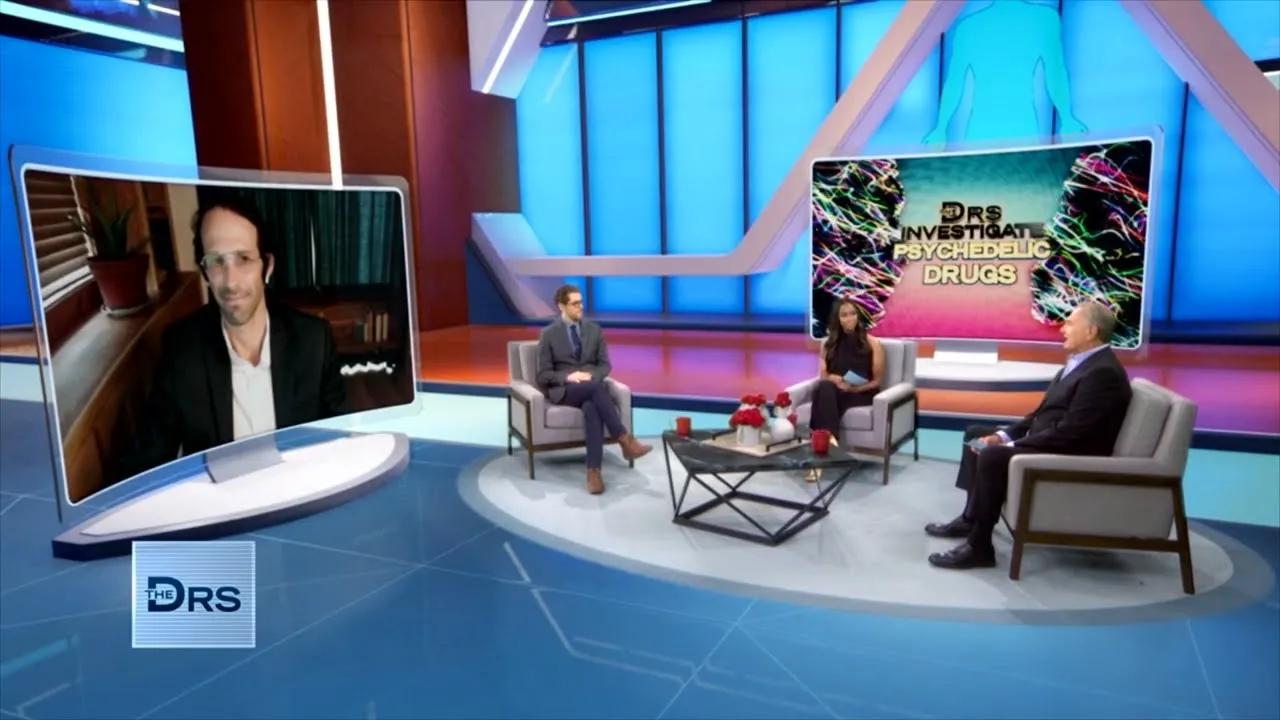
- The psychedelic drug, MDMA was popular in couples therapy before it was made illegal in 1985. So, can MDMA help heal fractured relationships? Well, joining us to explore this topic is Board Certified Psychiatrist and Psychedelic Drg Proponent, Dr David Rabin.
And Bioethicist and Co-author of "Love Drgs. " The Chemical Future of Relationships, Brian EARP. So, welcome to the show, Brian.
- Thanks for having me on. - Thanks for coming. - Yeah.
- What led you to start the research on psychedelics vis-a-vis improving relationships? - Well, this psychedelic renaissance in medicine that we've been talking about has shown a lot of promise for helping people with individual level issues. They go to the doctor, they get a diagnosis of some sort of clinical disorder, but there hasn't been as much work on how do these really powerful consciousness altering drugs affect our relationships, including our romantic relationships.
- You know, we're dealing with couples therapy. So often, each one of the participants is just so stuck on one side and the other, they don't wanna meet halfway. It sounds that when you add something that sort of, opens up the gate, then it's a game changer.
- Yeah. Part of what MDMA does, is it just directly and temporarily suppresses this automatic fear response, this hair trigger defensiveness that you might have. Also, including with respect to your own emotions, there might be certain things that you don't feel comfortable talking about, or you're afraid to bring up with your partner.
And so, as a consequence, people can get in long-term relationships in these loops where they get defensive in response to something their partner says, they can't seem to break out of it and talk therapy isn't really going anywhere. But if you can help a person get into a state of mind where they're more open to what the goal of the therapy is, you know, a genuine connection with their partner, working through the underlying issues. Then for some people, this can be the difference between effective talk therapy and talk therapy that just doesn't lead anywhere.
- Real kickstart. - Yeah. - Yeah.
- Yeah. - And tell us how MDMA could play a role in what you call, Grey Marriages. - Right.
So, the reason we focus on these grey marriages is because you want to identify those couples who have a good reason to want to keep working on the relationship. If you have a really toxic, or abusive situation, or the couple just has fundamentally different values, the last thing you would want is to turn to some kind of chemical bandaid to just help them limp along when really the relationship should end. But these grey relationships refer to those cases where you have a couple that has shared values.
They have maybe a shared vision for their life. They have children they're raising together, but they've just slipped over the years into this kind of autopilot, where they can't really see each other anymore. And maybe, they have these defensive loops that they get stuck into.
So they have a reason to wanna work on the relationship. They'd like to bring a feeling of love and intimacy back into it, but they've tried other measures that haven't worked. And so, because of the effects of MDMA that I just mentioned, this is the sort of couple that we think would be good candidate for this kind of research going forward.
- It sounds like a game changer. - I tell you what, I know a lot of people who are watching right now are leaning in like this while you're talking, a lot of people. Can you tell us how this usually plays out?
Like, how does it work? - The couple would come in together and they would lay out a plan with the Psychiatrist or the Psychotherapist to make sure that they know what they wanna work through, and that they understand what the effects of the drug may be like. They can have medical staff on hand to monitor heart rate and so forth to make sure everything is okay.
And then, under the influence of the drug, they'll undergo what basically looks like, normal psychotherapy. They're talking about things, but they may find that they're able to do so without so much clamming up and with a sense of compassion toward themselves and their partner. And afterwards, what's really important is that there's a consolidation period, where the effect of the drug wears off after maybe two or three hours.
And you, you debrief about what happened, what did we learn? And then the point is then to take those lessons and implement them in your everyday life. So you're not constantly on the effect of this drug.
You're not re-upping all the time. You're trying to actually learn something to deal with fundamental problems, so that you can then implement those lessons as you go forward. - So it may just be once?
- For many people could be just once, or once every two years or something like that. It's a pretty intense experience when it's done properly. It's not the sort of thing people would want to repeat very often because, you know, you wanna take those lessons and bring them into your life without having to keep going back to the drug.
- What are the risks? - The risks of MDMA are very low in a controlled therapeutic setting. This idea people have of MDMA as a dangerous party drug comes out of this use in the 1980s and still today, where people aren't doing it in a controlled or a safe environment.
And so, it's really important not to conflate the kinds of risks and dangers that may happen in a rave or a dance club, where people are staying up all night and drinking alcohol and doing a whole bunch of other things with these controlled, careful doses with therapeutic aid in a kind of controlled setting, the risks are just not at all comparable. In this case, there's pretty good evidence that the risks are very low.