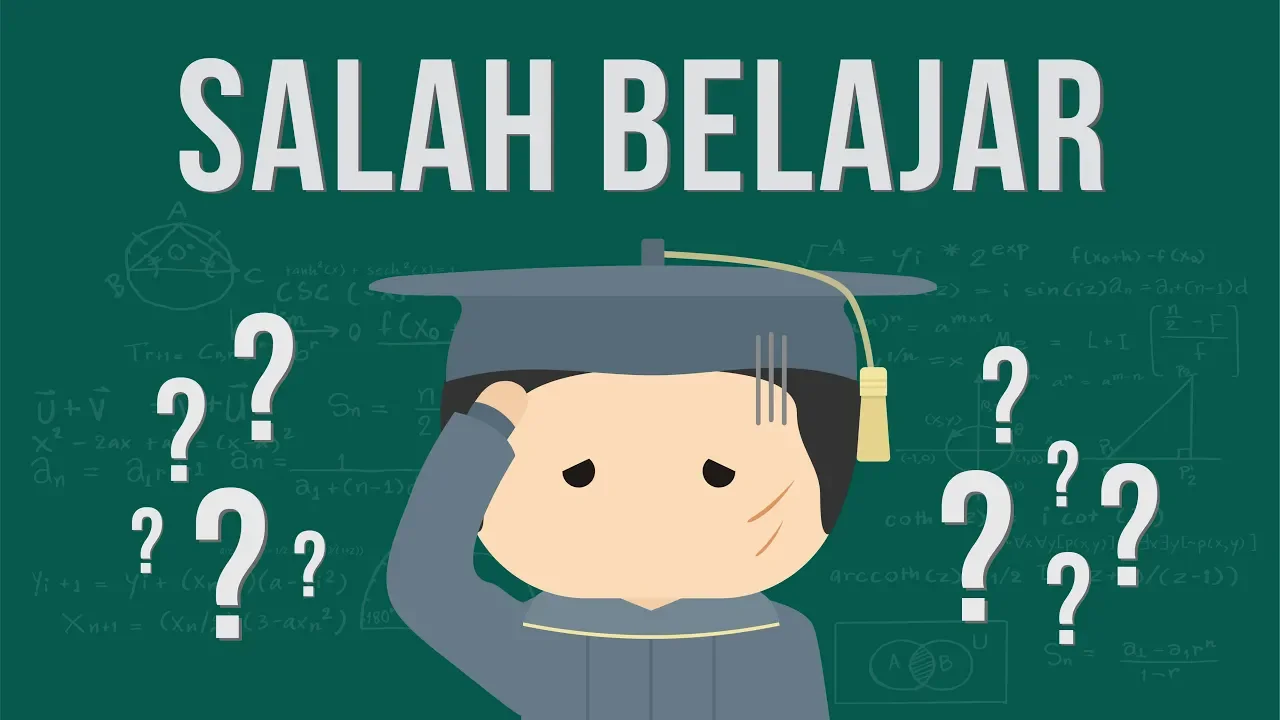
Did you notice? We learned so much at school But what is it for? Is all that useful?
That's what we will find out in this video. Unfortunately, often we are too focused on memorizing at school instead of trying to really understand. That's what makes we, even though we might get good grades, suddenly forgot all the lessons we've learned after graduation We have no idea how all the knowledge we've learned so far might be used for Even so, our world has been built by great people throughout history.
They attempted to understand various complicated things in this world Therefore, the biggest mistake we made on learning is that we are too focused on memorizing. It doesn't mean memorizing is not important, but memorizing by itself is not enough. If you see out there, our world has changed so fast.
We can't just rely on memorization to face this kind of world We should be able to keep up with the changes in our civilization That's the reason this video series was made -- to accomplish one objective: To help you understand all these various fields of knowledge. . .
. . .
by looking at them from different lenses We will look at how it is used in real life the origin of how it came to be the influential people behind it and your affinity with it Afterwards, you can follow their footsteps yourself So, what are we waiting for? Let's discuss about good learning methods so we can have deeper understanding on these subjects and how they can be useful in our lives Part 1: The First Step in Learning We often encounter complicated formulae and terminologies at school or college But remember -- try to hold yourself back from just memorizing and guessing the answers Try this instead: Be honest to yourself if you don't understand something because that's the first and MOST important step in learning process If you feel like you have known about everything, we will NEVER truly learn anymore So, if you don't understand this difficult terminology. .
. don't pretend you know it and guess the answer But look up what it means If you don't know why you should use this formula to find the answer, find out why is that so Keep practicing and try understanding the concept If you don't understand what the subject is for, even you don't know why you go to school to begin with, then don't study just to graduate Look up why you study these subjects and how you can use them in your life later So, never feel ashamed if you don't know everything Be ashamed if you feel like you know everything Part 2: Want to Understand It? Start from the Basics Our world is filled with new knowledge that keep emerging every single day With how vast knowledge is in the world, in order to learn something at a faster rate it's important to look at knowledge as if it's the branches of a tree You heard right, branches of a tree Make sure you have understood all the basic principles Those are the trunk and the branches before you move on to the twigs and the leaves or else, they won't have anything to hang onto and collapse As a result, we won't understand Therefore, it's important to, for example, understand the basics in math before we proceed to the branches because what often happens when we learn at school.
. . .
. . is that we fail to understand since we missed the important details in the basics .
. . or we just never looked at the bigger picture It's tough to learn something if we haven't grasped the basics It's difficult to learn something if we don't know at which "level" we are on That's why if you're still confused what this terminology or that terminology means, then look them up and try to understand them Whether it's playing piano, learning foreign language, or playing games, please remember -- we all begin from Level 1 Keep repeating the previous level if you haven't understood it yet It's okay to take several steps backwards so you can truly understand it Don't feel ashamed to relearn from the basics Part 3: Don't Stop Figuring Out Things You Like So, all the subjects we learn at school are basic knowledge But the question, as stated in the beginning of this video, is.
. . "Is it important that we learn them all?
" The short answer is. . .
VERY important! because you need all of these basic skills to survive in this era of rapid development like now You also need to figure out which ones you like so you can contribute to this world's progress Alright, let's not use big words Now imagine that you're a character in an RPG game You certainly will learn the basic skills first However, in the next level, you have to decide what kind of character you want to build . .
. and you might be confused, but it's okay There's no character who's obviously better than than any other character This is your choice to decide what kind of role you want to play as Even if everybody has his or her own opinion, there is no wrong choice You may choose one or a combination of several of them You must choose what kind of character you want to be . .
. because as the level goes up, you must cooperate with other characters to complement each other There's no character who's able to do everything . .
. because it takes a long time and huge effort to master something Even Harry Potter and Captain America needed to work with others because they were not able to do everything by themselves That's why all characters have their own roles and work together to defeat this monster The same thing applies to the lessons at school All characters must start by learning how to swing their blades because whatever our character turns out to be, we must have the basics to survive against the monsters It works the same way in learning math Calculating and training your logic are basic skills for us to face challenges in real life later because what we will face in real life is no longer exams, but "The Monster" That means challenges in the world and in our lives later Therefore, all these subjects are not only theories to memorize, . .
. but they are also useful and can be applied in our lives All these subjects we learn at school are like weapons that we can use to face daily, real life challenges later Okay, you might think it does not make much sense because all those lessons contain too many theories So, for the sake of you to be able to imagine and understand these things. .
. . .
. let's rewind the time to look at our ancestors in the ancient times Let's take a look at them Not too long ago from today, if we turn the time back to the old times, our ancestors lived only with the stars above them as their roof Many kinds of danger awaited them But just from a simple question: "How could they warm themselves up? ", our ancestors learned how to make fire, a chemical reaction They used it to protect themselves and to survive In the morning, they continued their journey, using geography so they were not lost and knew where to go Then, as more descendants were born and more mouths to feed, our ancestors chose to settle down, getting to know plants and animals with biology The abundance of foods pushed them to rethink their situation - "How could they ease their workload?
" Wheels were invented, based on the laws of physics As they got more prosperous, they need mathematics to manage and prepare their foods Trade was then born, and there was a need of medium of exchange, like money in order to ease the exchange of goods like foods and clothes, keeping the economy going As life became more complex, our ancestors thus built a society that functionally complemented each other, encouraging them to develop further but also learned how to manage and maintain the social order, building a government to rule over many people Nevertheless, many things were inevitable --- for example, swords But by learning about their own bodies, there were no wounds and injuries that could not be healed . . .
including understanding the remaining, aching scars in our minds Slowly, days came to pass as if nothing happened However, they would never forget those stories, remembering those historic days as important knowledge to be passed onto future generations They recorded them on writings and preserved them to be remembered for millenia to come. . .
. . .
and interpreted it with emotions and expressions, inciting tears and laughter, something that could spark life in their own lives Then, everything returned to become reflections of basic questions. . .
. . .
that capable to give birth to new knowledge Knowledge is not merely achievements of great people . . .
but the joint forces of everybody -- the joint forces across generations It's an effort carrying the torch from teachers, to students, then back to teachers again It's a joint effort from before civilization until far into the future Everything starts from our school By being fearless of admitting that we have not understood something. . .
by being unafraid to find out about everything until its most basic essence. . .
by not viewing knowledge within any limit, but as a whole picture. . .
working together to survive against uncertain future that's full of challenges ahead So, are you ready? Now, let's explore the fundamentals of these knowledge Our story has just begun. .
.