Rome at its height is supposed to be the safest place in the world. The empire is rich. The borders are stable.
Roads stretch across continents. Grain ships arrive from distant provinces. Law, order, and spectacle hold society together.
And yet, for the average Roman, survival is never guaranteed. This is the contradiction at the heart of ancient Rome. From the outside, this world looks confident, disciplined, even prosperous.
But step away from emperors and marble statues, and daily life becomes fragile. One injury, one bad season, one fire, one illness, and everything can unravel. To be clear, this is not a story about a collapsing civilization.
For many, Rome works. People laugh, work, eat, raise families, attend games, and live full lives. But beneath that surface is a quieter reality.
Ordinary Romans live close to the edge, supported by systems they do not control and cannot repair when they fail. In this film, we focus on that hidden layer of Roman life. Not senators, not generals, not emperors.
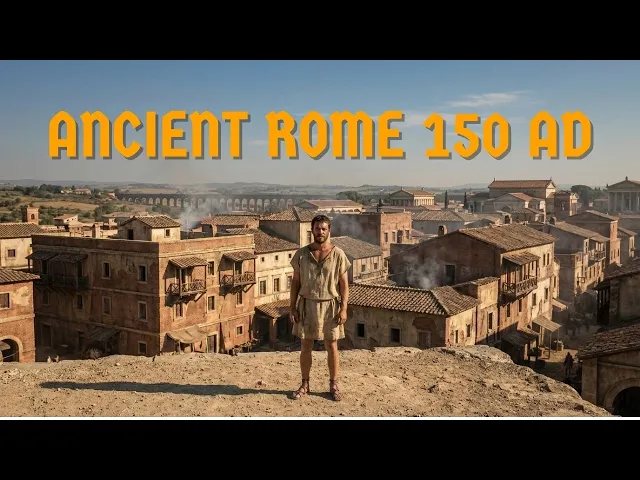
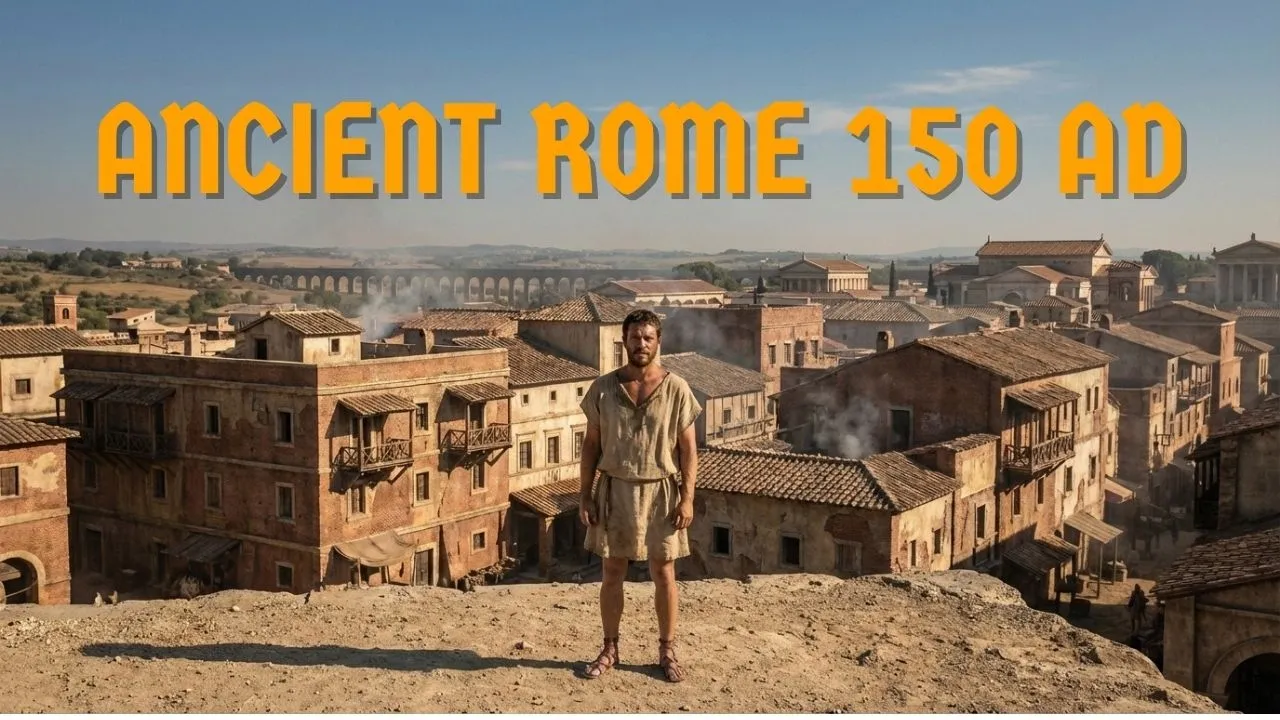
But the people who carried water, baked bread, raised children in cramped rooms, worked until their bodies failed, and trusted that tomorrow would still function. Using archaeological evidence, ancient texts, and AI based historical reconstruction, we rebuild what daily life felt like around 150 AD. not as legend, not as spectacle, but as lived experience.
Because Rome was powerful and ordinary Romans were vulnerable. And understanding that tension is the only way to understand this world at all. Most Romans do not live in villas.
They live in insul, crowded apartment blocks packed into narrow city streets. From the outside, these buildings look solid. From the inside, they are fragile.
A single room is common. Sometimes, too, if you are lucky. Families sleep, eat, store tools, cook, and raise children in the same confined space.
There is no privacy here, no quiet. The higher you live, the cheaper and more dangerous it becomes. Upper floors are poorly built, supported by wood, not stone.
Fires spread quickly. Collapse is a constant risk. Roman writers openly warn people not to rent above certain levels.
Beds are simple wooden frames or straw pallets. Blankets are thin. In winter, cold creeps through walls and floors.
Cooking is done over small brazes or portable stoves. Smoke lingers. Sparks fall.
Entire neighborhoods can burn from a single accident. This is not rare. It is expected.
Water does not flow into most homes. Someone must fetch it. Often women or children carrying heavy jars up staircases slick with filth.
There is no sewage system inside these apartments. Waste is dumped into streets, drains, or shared latrines. Disease spreads easily.
Smells never fully disappear. This is not misery. It is normality.
Romans adapt. They socialize outside. They eat simply.
They rely on neighbors. But life inside an insula is always provisional. You are housed but never secure, sheltered but never safe.
And this fragile domestic world shapes everything that comes next. Rome feeds its people, but just barely. Most ordinary Romans do not eat what we imagine as Roman food.
No endless feasts, no exotic banquetss, no luxury. Daily survival depends on grain. Bread is the foundation of life.
Coarse, heavy loaves made from wheat or barley. Often dark, often gritty, sometimes mixed with cheaper fillers when supplies are tight. For the urban poor, food is not earned.
It is managed. The state distributes subsidized grain through the anona. Without it, Rome cannot function.
This system is not generosity. It is control. A hungry city riots.
Meals are repetitive. Bread, porridge, olives, he if affordable beans or lentils. Occasionally vegetables.
Meat is rare. Fresh fish is expensive. Cheese and eggs appear only when luck allows.
Most cooking happens quickly and cheaply. Street vendors sell hot food because many apartments are too dangerous or too cramped to cook in regularly. Soup, stews, bread soaked in oil or broth.
Enough to keep going, not enough to feel full. Hunger is familiar even in good times. a bad shipment, a delayed convoy, a political disruption, and prices rise overnight.
And when prices rise, wages do not. Families stretch meals thinner. Children eat less so adults can work.
People skip meals without calling it fasting. This is the quiet reality beneath Rome's grandeur. A city fed by logistics so complex that failure is always one storm, one war, one decision away.
And food is only the beginning. Because what happens to a Roman body when it breaks, when it sickens, matters just as much as what goes into it. Roman life looks orderly from the outside.
Inside the body, it is fragile. Disease is everywhere, constant, expected, unavoidable. Cities like Rome are crowded beyond anything most people can imagine.
Narrow streets, shared water sources, open drains. Human waste dumped where it can be. Animals live alongside people.
Rats move freely. Clean water exists, but access is unequal. Aqueducts feed fountains and baths.
Not every household. Many people rely on wells, systems, or polluted streams. Contamination is invisible and unknowable.
When sickness comes, it feels sudden. Fever, weakness, pain, and then fear. Roman medicine is advanced for its time, but limited.
Doctors exist, but they are expensive. Many are slaves or freed men trained through apprenticeships, not formal science. Treatments rely on herbal remedies.
Bloodletting diet changes superstition mixed with observation. There is no understanding of bacteria. No antiseptics, no antibiotics.
Infections that would be minor today can kill within days. A small wound can turn fatal. Child birth is especially dangerous.
Many women die not during labor but days later from fever. Public baths meant for hygiene and health also spread disease. Crowded warm reused water becomes a perfect environment for illness.
Most people expect sickness to strike eventually. They plan around it. They fear it but accept it.
Death is not dramatic. It is routine. And this constant proximity to illness shapes everything.
How families live, how they raise children, how much risk they accept. Because in Rome, survival is not about avoiding danger. It is about enduring it.
And when health fails, law does not protect you. Rome is famous for its laws. But for ordinary people, the law is not protection.
It is pressure. Roman law is detailed, written, and extensive, but it is not equal. Your experience of justice depends entirely on who you are, your gender, your wealth, your legal status.
Citizens have rights. Non-citizens have fewer. Slaves have almost none.
>> And most people live very close to that bottom. Punishment is public by design. Beatings, whipping, forced labor, executions.
The goal is not justice. It is deterrence. Fear is the system's fuel.
Trials exist, but evidence matters less than status. A poor man accusing a wealthy one rarely wins. Testimony from slaves is only accepted if extracted under torture, because truth in Roman thinking requires pain.
For minor crimes, penalties are swift. For serious ones, they are brutal. Prisons are not places for long-term sentences.
They are holding cells, dark, crowded, unsanitary, where people wait for punishment or execution. Survival inside them is uncertain. For women, the law is even narrower.
They remain under male authority. first their fathers, then their husbands. Legal independence is rare.
Abuse inside the household is often ignored unless it disrupts public order. And for slaves, the law is a weapon. Masters can punish at will.
Killing a slave is discouraged, but not always punished. If a master is murdered, all slaves in the household can be executed regardless of guilt. This creates a society that functions not on trust but on fear of consequences.
People obey not because they believe in justice but because the cost of disobedience is unbearable. And when law governs every movement, every word, every mistake, private life becomes narrow. Which brings us to where most Roman lives are actually lived inside the home.
Rome does not run on marble, law, or spectacle. It runs on bodies. For ordinary Romans, work is not a phase of life.
It is life itself. From before sunrise until light fails, people labor. Not occasionally, not seasonally.
Every day they are able. Men haul stone, unload ships, carry water, dig foundations, repair roads. Women grind grain, wash clothes, cook, sew, care for children, manage households, and often work outside the home as vendors or laborers.
Children help early, carrying, selling, fetching, assisting because extra hands means survival. There are no safety standards, no compensation for injury, no concept of workplace protection. If you are strong, you work.
If you are injured, you stop earning. And if you stop earning, everything begins to unravel. A twisted ankle can end a livelihood.
A crushed finger can mean hunger. A fall from scaffolding can mean death. Or worse, survival without usefulness.
Most laborers age quickly. By their 30s or 40s. Bodies are already worn down.
Backs bent, joints swollen, hands scarred and stiff. Rome appears eternal, but the people holding it up are replaceable. There is always someone poorer, always someone desperate enough to take your place.
And this reality shapes how people think about risk. They do not avoid danger. They accept it.
Because refusing work is often more dangerous than taking it. This is how Rome survives. Not through stability, but through constant replacement.
Slavery in Rome is not a background detail. It is not a moral footnote. It is infrastructure.
Nearly every system that keeps Roman society functioning depends on enslaved labor. Slaves cook food, clean streets, carry water, work fields, build roads, run workshops, care for the sick, remove slavery, and the city stops. This is not exaggeration.
It is design. Rome does not run despite slavery. It runs because of it.
For ordinary free Romans, this creates a strange contradiction. They are not slaves, but they live beside them constantly. They compete with them for work.
They depend on them for services. A free laborer can be replaced by a slave overnight, which keeps wages low and fear high. Slaves are everywhere, but legally invisible.
They are property, not people. They can be bought, sold, rented, punished, or separated from family at will. Most slaves are not chained in mines or galleys.
Many live inside households. They sleep near their owners, raise their children. Here, private conversations.
This intimacy does not create safety. It creates tension. Owners fear rebellion.
Slaves fear punishment. Both live under constant surveillance. Violence is built into the system.
Not always dramatic, but always present. A master can beat a slave legally, severely injure them, sometimes kill them with limited consequence. And if a master is murdered, Roman law allows every slave in that household to be executed, not because they are guilty, but because fear must be maintained.
This shapes behavior across society. Obedience becomes survival. Silence becomes protection.
Trust becomes rare. Slavery also blurs moral boundaries. Romans justify it as natural.
Children grow up seeing human beings treated as tools and learn that power defines humanity. Even freedom is unstable. A freed slave gains legal status but never equality.
Their past follows them. Their children inherit suspicion. Slavery is not just an institution.
It is the logic beneath Roman life. And when a society is built this way, everyone lives closer to collapse than they realize. Because when labor is owned, human life becomes expendable.
The Roman family is not built around love. It is built around control, continuity, and survival. At its center stands one figure, the putter familas.
The male head of household holds legal authority over everyone beneath him. His wife, his children, freed men and slaves. This power is not symbolic.
It is absolute. He controls property, marriage decisions, punishments. Even in extreme cases, life and death.
Marriage in Rome is practical, not romantic. Families arrange unions to secure alliances, property, or stability. Love may come later or not at all.
Girls often marry in their early teens. Men are usually older. Experience and authority flow in one direction.
A wife moves into her husband's household and authority. Legally she remains under male control either her fathers or her husbands. Her role is clear.
Manage the household, produce heirs, maintain order. Child birth is expected and feared. Pregnancy is constant.
Death is familiar. Many women survive multiple births. Many do not survive even one.
Children arrive into a world that does not promise protection. Infant mortality is high. Illness is common.
Accidents are fatal. Parents learn not to assume survival. Children are raised with discipline, not indulgence.
Affection exists, but it is restrained. Obedience matters more than comfort. From a young age, boys are prepared for work, labor, or military service.
Girls are trained in domestic responsibility. Play exists but briefly. Childhood is short.
Family life takes place in cramped spaces. Apartments are crowded. Privacy is rare.
Noise is constant. Multiple generations may share a few rooms. Sleep is light.
Stress is normal. Despite this, families persist. Meals are shared.
Stories are told. Rituals mark births, marriages, and deaths. The family is not a place of safety, but it is a place of belonging.
And for ordinary Romans, that matters because outside the household lies a city that offers opportunity, but no mercy. And inside the household lies the only support system most people will ever know. Which brings us to another fragile pillar of Roman life, work.
and the constant pressure to earn enough to survive. Religion in Rome is everywhere, but it is not gentle. It does not exist to reassure people that life will improve.
It exists to explain why suffering happens and why it must be endured. Romans do not worship one god. They navigate a dense web of gods, spirits, household deities, and ancestral forces.
Every action carries risk. Every mistake may offend something unseen. Religion is transactional.
If you honor the gods correctly, life may continue. If you fail, disaster is your fault. Illness is not random.
Fire is not chance. Death is not meaningless. Everything has a cause.
And that cause is human failure. Households maintain shrines to the layers and peanuts. Spirits believed to guard the home.
Offerings are small. Bread, wine, incense, not devotion, maintenance. Public religion is even more rigid.
Festivals, sacrifices, and rituals are performed not for joy, but to keep the gods satisfied and the city stable. Temples are crowded during crisis, not with hope but with anxiety. People pray for survival, not salvation, for relief, not transformation.
And when prayers fail, which they often do, faith does not disappear. It hardens. People assume they did something wrong.
They repeat rituals. They give more offerings. And religion becomes routine endurance.
Priests do not challenge suffering. They interpret it. A plague means ritual error.
A famine means divine displeasure. A death means fate fulfilled. There is no promise that virtue will be rewarded in life.
Only that order must be preserved. For ordinary Romans, religion offers structure in a world that feels unstable, not comfort in a world that feels cruel. It teaches people how to live with uncertainty, how to accept loss without rebellion, how to endure without asking why.
And that endurance matters because when faith stops offering reassurance and family support reaches its limit and work fails to provide security, the only thing left is the body itself. And what happens when that body can no longer endure is the next fracture in Roman life. >> Rome is exhausting to live in.
So Rome provides distraction, not kindness control. For ordinary people, entertainment is not leisure in the modern sense. It is pressure release in a system that cannot afford revolt.
The city offers spectacle on a chariot races, gladiatorial games, massive scale, public executions folded into entertainment. These events are free or heavily subsidized because a bored population thinks an entertained one watches. The circus maximus holds hundreds of thousands.
It is louder than hunger, more absorbing than fear. People cheer teams the way later generations cheer nations. Identity shifts from survival to allegiance.
For a few hours, life feels larger than work and illness. But spectacle is not neutral. Gladiators are not heroes.
They are reminders. Most are slaves, prisoners, or condemned men. Their deaths are ritualized violence.
A message written in blood. This is what happens to bodies the system no longer needs. Crowds cheer not because they are cruel, but because watching gives them distance from their own vulnerability.
If it's them, it isn't me. Executions serve the same function. Punishment becomes performance.
Justice becomes theater. Fear is made visible and normalized. Even festivals follow this logic.
Feasts, games, and holidays arrive not randomly, but strategically. After hardship, unrest, or tension, entertainment is deployed. Rome understands something deeply modern.
People can endure almost anything if they are periodically distracted from it. But this escape has limits. When food shortages stretch too long, when disease overwhelms distraction, when work leaves nothing left to recover, spectacle stops working.
And when it stops working, Rome does not collapse, but the illusion of safety does. Because beneath the games, the cheers, and the noise, ordinary Romans return to cramped rooms, fragile bodies, and uncertain futures. And that uncertainty shapes the most personal part of Roman life.
How people form relationships, how they marry, and how they raise children who may not survive. Rome is built for the strong. Its streets are steep and uneven.
Its work is physical. Its economy rewards bodies that can labor, carry, endure. There is no concept of retirement.
If you cannot work, you must be supported by family, by patronage, or by luck. And luck runs out quickly. Injury is common.
A fall from scaffolding, a crushed hand at a mill, a back broken under years of hauling stone or water. Once injured, recovery is uncertain. Medical care is expensive.
Rest means no income. Many people never fully heal. Disability does not remove expectations.
You are still expected to eat, but no longer expected to earn. Families absorb this burden first. Elderly parents share rooms with children and grandchildren.
The sick are kept inside out of sight if possible. But space is limited. Food is limited.
Patience is limited. Those without family face harder choices. Some beg.
Some attach themselves to temples or bath complexes. Some sell what remains of their labor, guarding doors, watching goods, performing menial tasks. Others simply vanish from records.
Old age is not respected by default. Respect must be earned earlier through status, wealth or connections. Without those, aging is exposure.
Women face this more sharply. Widows without sons lose protection. Disabled women lose marriage prospects.
Older women often survive only through informal networks, favors, gossip, shared childare. Slaves fare worst. An injured slave loses value.
An elderly slave becomes a cost. Some are freed when they can no longer work, not as mercy, but as release from obligation. Freedom in that moment is abandonment.
Rome does not plan for decline. It assumes continuity. That bodies will keep functioning.
That families will keep absorbing loss. That those who fall behind will quietly disappear. Most people understand this early.
They work while they can. They save when possible. They invest in children, patrons, and alliances.
Because in Rome, survival is not just about today. It is about what happens when your strength fails and the system keeps moving without you. And nowhere is that more visible than in the final space where Roman lives converge.
Death. And what if anything follows it? Rome does not collapse in this story.
That is the uncomfortable truth. The empire endures. Its roads stay busy.
Its laws continue. Its monuments rise higher. What fails is not Rome.
It is the people inside it. For ordinary Romans, life is not defined by glory or decay, but by proximity to risk. You live well enough until you don't.
You work until your body fails. You eat until supply breaks. You obey because disobedience costs too much.
Rome functions because it absorbs loss. The sick disappear quietly. The injured fade from records.
The old are folded into households or pushed aside. Slaves are replaced. The poor are endured, not rescued.
Nothing here is accidental. This is not cruelty born of chaos. It is order designed for scale.
Rome does not promise safety. It promises stability as long as individuals remain replaceable. And most people understand this.
They build meaning small in family meals, in shared rooms, in favors owed and repaid, in gods asked for endurance, not rescue. They laugh. They celebrate festivals.
They attend games. They fall in love. Not because life is easy, but because it is fragile.
That is the real lesson of Rome. Not marble, not legions, not emperors, but a society so powerful that it could keep functioning while millions lived close to the edge and learned to survive without expecting protection. Rome was not cruel by accident.
It was efficient by design. And understanding that is the only way to truly understand how ordinary people lived inside the greatest empire the ancient world ever built. >> This was Rome not as legend, not as spectacle, but as lived reality.
If you want to continue this journey through history as it was actually experienced by ordinary people, not elites, subscribe. Because the past didn't feel like a story, it felt like life.