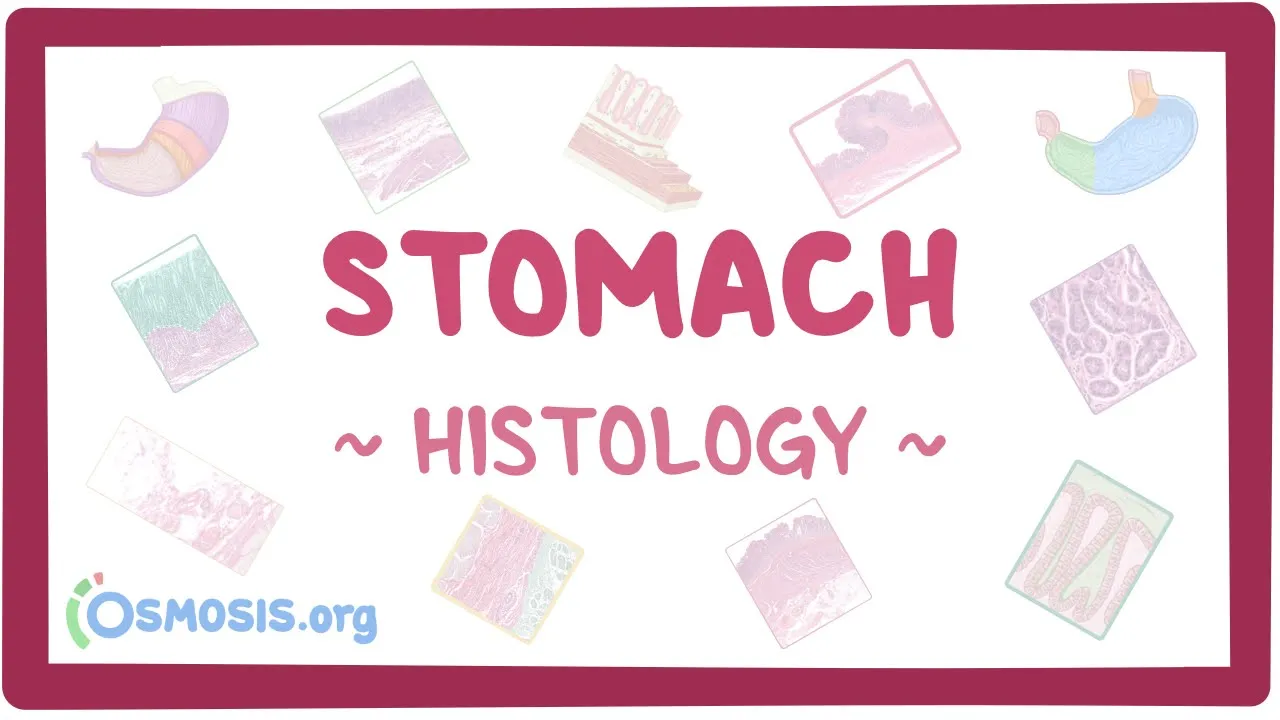
the stomach is an expanded portion of the gastrointestinal tract or GI tract that partially digests food by breaking it down mechanically and chemically in order to form a pulpy acidic fluid called Kim the stomach is divided into four anatomical regions the cardia fundus body and pyloris but the stomach is only divided into three histological regions the cardia fundus and pyloris that's because the fundus and the body are histologically identical so both regions are called the fundus when referring to their histology the cardia is a small area surrounding the opening to the esophagus which contains cardiac
glands that secrete mucus the fundus is the largest region histologically since it also includes the body of the stomach as well this region of the stomach has fundic or gastric glands that secrete digestive enzymes such as peps and a protective layer of mucus the pylorus is the most distal region of the stomach before reaching the pyloric sphincter this region will have a combination of pyloric glands that secrete mucus and neuroendocrine cells that secrete gastron similar to the rest of the GI tract the wall of the stomach has four main layers the inner mucosa sub mucosa
muscularis propria and outer Sosa although some portions of the GI tract have an outer layer of adventia instead of Sosa this low power longitudinal section of the stomach was taken from the cardia of the stomach now if we take a closer look at the mucosa of the cardia we can see that the surface of the mucosa has a simple columnar epithelium with many invaginations that form millions of gastric pits the gastric pits will comprise about a quarter of the mucose thickness at the base of these pits they join with multiple tubular cardiac glands that secrete
mucus that protects the esophagus from gastric reflux and is also a part of the stomach's gastric juice the cardiac glands extend all the way to its underlying layer called the muscularis mucosa which is a thin layer of smooth muscle that is still a part of the mucosal layer the next main layer of the cardia is the sub mucosa which consists mostly of dense irregular connective tissue but also contains larger blood vessels like the ones we can see in this image on the right of this image we can see a portion of the overlying mucosa and
on the left is a portion of the next main layer called the muscularis propria the entire stomach's muscularis propria is unique when compared to the rest of the GI tract because it has three layers of smooth muscle instead of only two layers in this image image we can see portions of the inner oblique layer on the right side of the muscularis propria closest to the sub mucosa the middle layer is the circular layer and the outer layer is a longitudinal layer of smooth muscle because this tissue sample was sectioned longitudinally the outer layer of smooth
muscle is the layer that shows the long shape of the muscle fibers the best and the middle layer will have muscle cells that appear the most circular the outermost layer of the cardiac stomach is the Sosa which consists of loose connective tissue with large blood vessels atopos tissue lymphatic vessels and nerves in this image the large blood vessels are easy to identify because of the red blood cells that can be seen within their lumens all right let's move on to the fundic stomach this low power image allows us to see three of the main layers
the mucosa at the top the sub mucosa and the muscularis propria at the bottom the outer Sosa isn't present in this image though the prominent fold in this image is called aruga which is formed by both the mucosa and sub mucosa the rugi allow the stomach to expand after food or liquid is consumed the submucosa muscularis propria and Sosa are very similar to the cardiac stomach the fundic mucosa may look similar to the cardiac mucosa but the glands present in the mucosa are different instead of cardiac glands the gastric pits join with fundic or gastric
glands which consists of three major cell types parietal cells mucous neck cells and chief cells the gastric glands are also broken down into three regions the ismus neck and base of the glands the ismus consists mostly of parietal cells which can be identified in this high power image by their very eosinophilic or pink cytoplasm and their large round nuclei that are centrally located parietal cells can also be found in the neck and base of the glands but overall there are more present in the ismus and neck these cells are responsible for secreting gastric acid as
well as intrinsic factor which is a glycoprotein required for the uptake of vitamin B12 in the small intestine the neck of the gastric glands consists mostly of parietal cells and mucus neck cells the mucus neck cells can be found in between the parietal cells as smaller pale basophilic cells that are also seen in the base region of the gastric glands in addition to parietal cells and mucous neck cells the neck also has stem cells but they can be difficult to identify using only an h& e stain although when mucosal cells are damaged the stem cells
will multiply in order to replace the damaged cells making the stem cells easier to find histologically for example gastritis and peptic ulcers are common conditions that can cause significant mucosal damage resulting in an increased number of stem cells within the mucosa if we move down to the base of the gastric glands parietal cells and mucus neck cells will still be present but the base also has very prominent peptic or chief cells which are responsible for secreting digestive enzymes such as pepsinogen these cells have a granular cytoplasm and are very basophilic resulting in their dark purple
appearance enteroendocrine cells such as G cells are also present at the base these cells are responsible for secreting hormones including gastron but they aren't easily identified with an h& stain all right let's move on to the last and most distal region of the stomach the pylorus although the Sosa can't be seen in this image the Sosa muscularis propria and sub mucosa are all very similar to the fundus and cardia but the mucosa of the pyloris does have quite a few unique characteristics the mucosa of the pyloris has more prominent gastric pits that comprise about half
the thickness of the mucosa instead of only a quarter or less as a result the pyloric glands are generally shorter have more branches and more coils when compared to the glands of the fundus or cardia the majority of the pyloric glands are mucus secreting cells that are similar to the mucus neck cells the glands also contain cells that are not as easy to identify such as a smaller number of parietal cells stem cells and G cells which secrete gastrin helping current and future clinicians Focus learn retain and Thrive learn more