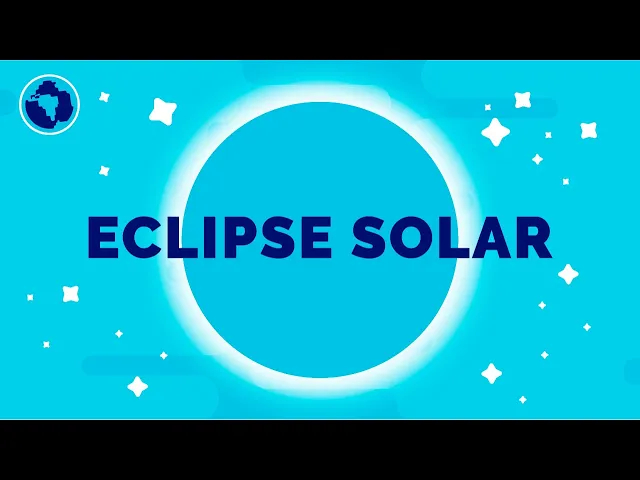
Solar eclipses occur when the moon interposes between the sun and the Earth, which generates a unique effect: that it looks like night in broad daylight. And it's so weird that if an eclipse happens in a place in the world, there will be another one there after 360 years. Up next, we will tell you why they are so special, which will be the next ones and even why they served Einstein to prove his theory of relativity.
But before don't stop subscribing to our channel and enable notifications. First, it is considered that there is a solar eclipse when the moon interpose between the Earth and the sun and prevents the light reach our surface. As we know, and despite what flat earthers think, our planet orbits around the sun.
In the same way, the moon rotates on Earth's axis. If these orbits were perfectly aligned, every time the moon makes a complete turn on Earth we would have a solar eclipse. That is, approximately once per month.
However, the moon's orbit is tilted about 5 degrees, so they don't always match, and most of the times the moon passes over or below the light that reaches Earth. That is what prevents every month from having a solar eclipse and actually occur every year and a half. But if the phenomenon occurs every 18 months, it doesn't seem so strange either, does it?
Well, it happens every that often in some place in the world. But solar eclipses focus on a very specific place. That's why a total solar eclipse in the same place happens every 360 years or so.
That is, most likely during all your life you will not live a solar eclipse. But if you have the opportunity, don't let it go. On the other hand, this phenomenon is so special for the link between size and distance between the two elements we observe.
It's just that the sun is about 400 times larger than the moon. But the moon is 400 times closer to Earth than the sun. That's why, almost at first sight, they seem to us the same size.
In this way, when the orbits happen to meet, solar eclipse occurs, but it has to be a very precise coincidence. In fact, when it is totally happening it is called total solar eclipse, and there, for a couple of minutes, the day gets dark. But sometimes the moon covers a part of the sun without doing it completely.
In this case, we talk about partial solar eclipses. Finally, we have a third type of eclipse solar: the annular. In this case the orbits coincide, but the moon is not so close of the Earth as to completely cover the sun.
So what we observe is a kind of ring of fire. That is, we see the outline of the sun and in the center appears the moon. But the study of solar eclipses it is not new, it goes back to ancient times.
One of the first civilizations that detected it were the Babylonians, since they were pioneers in astronomy. In fact, that's why they set the bases of astrology as we know it today. Already at that time they detected a constant which allows to predict when an eclipse will happen.
This is the Saros period. They realized that every 18 years and 11 days or so the moon and the Earth are back in the same relative positions, so the eclipses are repeated with that periodicity although with some variations. Currently, solar eclipses have a great importance for science.
Especially for those who are in charge of studying the sun, since they still exist many unknowns to unveil. It is just that in the period of a solar eclipse the moon covers the central part, so we can observe better the sun from Earth with telescopes. Above all you can see the crown better.
That is, the outer part of the sun. By observing in a more isolated way the crown we can know, for example, which materials is the sun made of and try to predict what changes can be produced there. Is that any heat modification that the sun emanates, affects directly to the Earth.
However, one of the most surprising curiosities of solar eclipses has to do with Albert Einstein. The physicist had developed his theory of relativity at the beginning of the 20th century. However, it seemed that it could not be demonstrated empirically and that it was going to be simply in the theoretical plane.
Instead, the British astronomer Frank Watson Dyson came up with the idea that it was possible an experiment that could prove the theory during an eclipse. Basically, Einstein predicted that when light travels and passes through gravitational fields, it curves. This differs from the previous theory, Newton's, according to which the light had no mass.
What the eclipse allowed was to see the a dark sky during the day and in this way to observe the stars. So, they warned that the ones that were closer to the sun they were more displaced, due, precisely, to the gravitational field of the sun. This could be confirmed during 1919, after a total eclipse.
Several months of data analysis passed and then Einstein's theory gained great relevance and he became in the most important physicist of the 20th century. Among other things, thanks to an eclipse. Now, finally, a review of the next total solar eclipses that we will have in America and Spain.
The next one will be July 2nd, 2019 and will cross Chile and Argentina from west to east in the central part of those countries. It will be total in cities like La Serena, Coquimbo, San Juan and very close to Buenos Aires. It will be partial in almost all of South America.
In December 2020 there will be another total eclipse that also will cross these two countries, although further south. It will pass through cities like Temuco and Bariloche. In April 2024 there will be one in Mexico, United States and Canada, that will cross, for example, through Sinaloa in a total way.
In August 2026 it will be the turn of Spain, since it will pass through the north of the Iberian Peninsula. The following year, however, there will be one in the south of the country Only in 2045 will be one for enjoy in Venezuela, the Dominican Republic, Haiti and northern Brazil. And if you are in a Latin American country and we didn't name it it's because there is still a long way to go for a total solar eclipse.
Would you like to observe one? How far would you travel to do it? Leave your comment below.