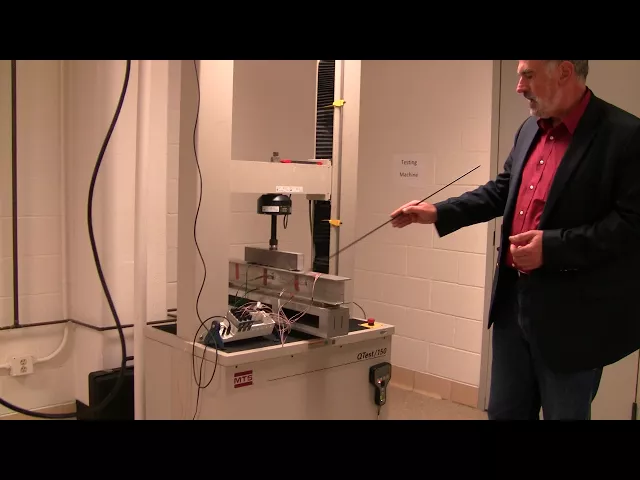
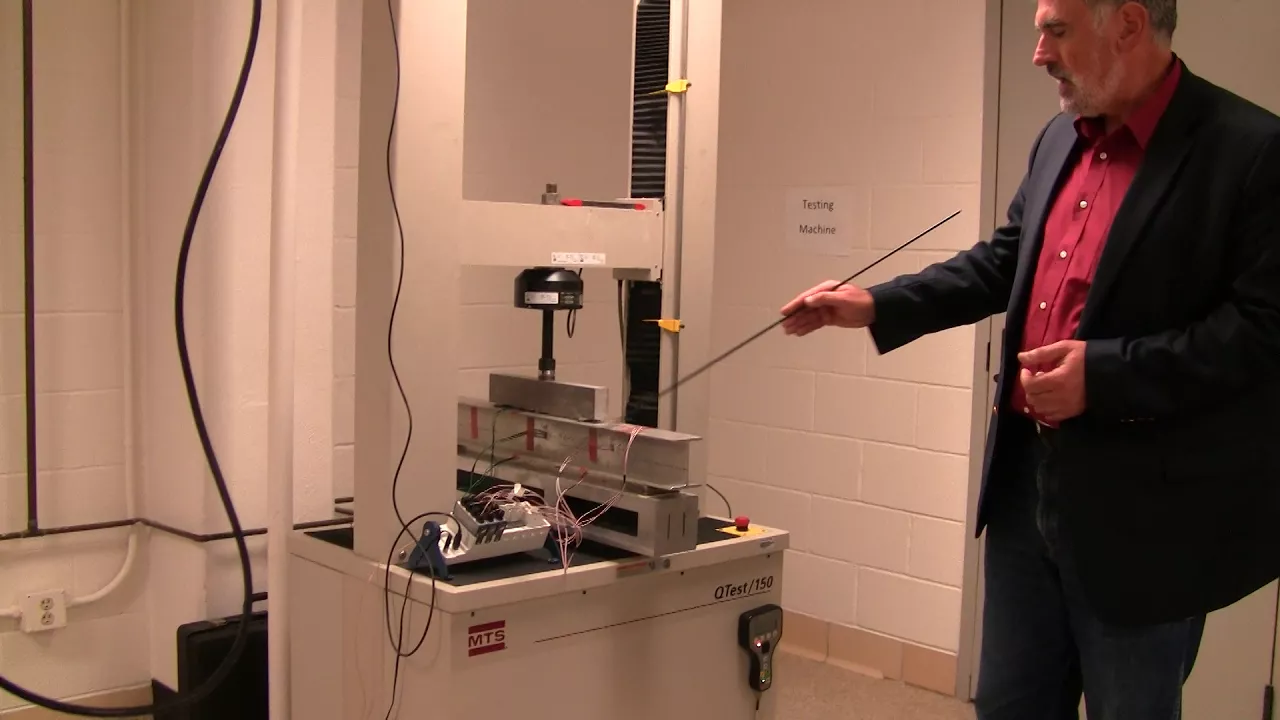
all right so now for the last part of the lecture so here's the experiment that you're going to be performed you have the i-beams which is here in the testing machine again crosshead the load cell the base of the machine the columns now the load cell is instrumented with the bar is equipped with a bar that applies load we have a spherical bearing here that transfers load to a bar which in turn applies the load device that divides the load P that is measured by the low cell into two equal PI over two loads here
and here at these rollers so there is a system of a spherical joint a crossbar and two rollers that divide search to divide the force P that is applied through the load cell into P over 2 and P or to apply to these location that these cross-sections of the IP now the i-beam is supported on the bottom at this cross section on the roller and in the back on a similar roller and again the distances are measured such as to be equal therefore this is indeed the four point bending experiment again the load P that
is measured by the load cell is applied into divided into PI over 2 and PI over 2 PI over 2 here for support and PI over 2 here on the bottom in between these supports you have pure bending in between this support and that one and this support in the end one you have been English here at one cross section here you have the top strain gage but rosette the Center one which is located here and the bottom each of which is instrumented and connected with wires to the readout unit now this readout unit is
manufactured by National Instruments and it is accessible by love you the program that runs on the PC that you can see here so the data acquisition for the experiment will be performed by a computer that runs the program that we wrote in LabVIEW the LabVIEW program running on this computer is going to access and control and read information via a USB port from this particular strain gauge readout unit and this strain gauge about unit excuse me consists of three units three modules each of which has four channels each of these four channels has inside the
resistor completion circuit that serves to be able to read in quarter bridge strain gauge connections so we can connect each strain gauge directly to one of the channels of one of these modules and the LabVIEW program is going to be able to perform a reading of strain because in here the Westone bridge is available on each module and again the USB access provides LabVIEW with direct connection for reading def acquisition there's a analog to digital data acquisition conversion that is taking place there's more detail to that you probably have learned something about LabVIEW and data
acquisition love you in measurements one I'm not sure if you did but if you didn't I can tell you more about it if you're interested to know bottom line we have a total of one two three four times three twelve channels available we have a total of three strain gauges per rosette times three points per cross section nine strain gauges per cross section so a total of nine plus nine eighteen strain gauges in that provide information that's more than the channels available in so that for that reason we're going to perform the test in two
separate stages in one test in one stage we're going to perform a test and measure the strain gauges the strains using the strain gauges on one cross section for bending which shear and then we repeat we reconnect the other strain gauges for the other cross section and perform the experiments for the section that that the subject bending the pure bending now the program in order for the information that is read by the LabVIEW program to be useful it is not sufficient to measure strengths but it is also important to measure the load at which those
strains occurred so that you can correlate the load apply with the strength so there is a particular connection there's this wire that comes from the digital controller of the testing machine and over this pair of wires or this two wire cable the testing machine the digital controller with testing machine provides an electronic signal that is proportional to load so the load from the load cell is read by the digital controller which in turn converts it to an analog voltage which analog voltage is put out over those two wires brought over and connect it to one
of the channels of the data acquisition module so during each of the runs there are gonna be nine strain gauges corresponding to the three here three here and three on the bottom plus another tenth channel that provides reading of load from the load cell the experiment will consists in applying an increasing load by lowering the commanding the cross had to come down at the spur certain rate and throughout all this process the increasing load is going to be applied the value of P applied load is going to increase therefore the magnitude of the load the
bending and shear and as a consequence the maddening mass the magnitude of each shear strain measured in each strain gauge is going to increase the behavior of the system is linear so in principle all quantities will be a function of load in a linear fashion however whenever you have data measurement you have already seen that there is some uncertainty taking place getting in the way some noise that comes into into the measurements so there will be some needs to do some data processing and I will discuss that in a second but fundamentally this is the
experiment again you are going to be performing the TAS are going to be performing for you two runs one for the middle cross section one for the side cross section for each of these runs you're gonna have nine sets of strain measurements and one voltage corresponding to load measurement and that's the data that you're going to be needing to process information about the geometry of the set up the cross section and so on will be provided during the lab by the th you don't need to measure yourselves the glob guidance report plus the TA information
in the class will prepare you for your calculations so we'll stop here and we're gonna go back to discuss a little bit data processing Network