Training. A new large language model is a bit like launching a rocket. Five.
It's exciting. Four. It's resource intensive.
Three. It requires an enormous amount of compute power. Two.
And the training process takes months. One. So you need intensive planning and preparation to make sure you've got the latest and best technologies in place.
Because once you press go and the GPUs fire up and start training, the rocket has liftoff. You can no longer tweak the design. Any new innovation has to wait until the next launch.
And just like rocket launches change the frontier of science, large language models and the broader class of generative AI that they belong to called foundation models represent a paradigm shift in how the world is going to leverage AI. Zero. All engines running.
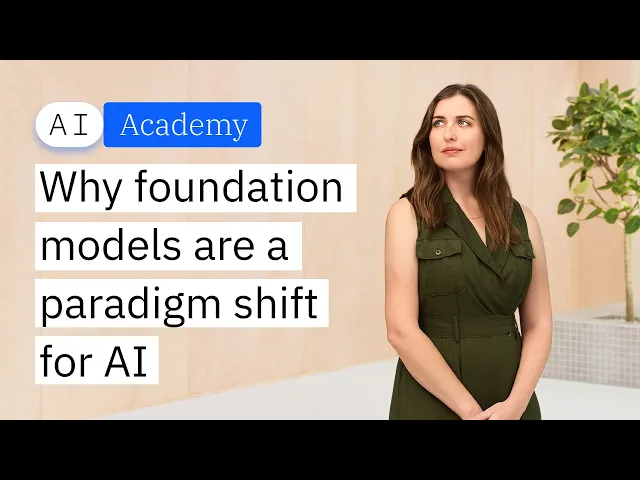
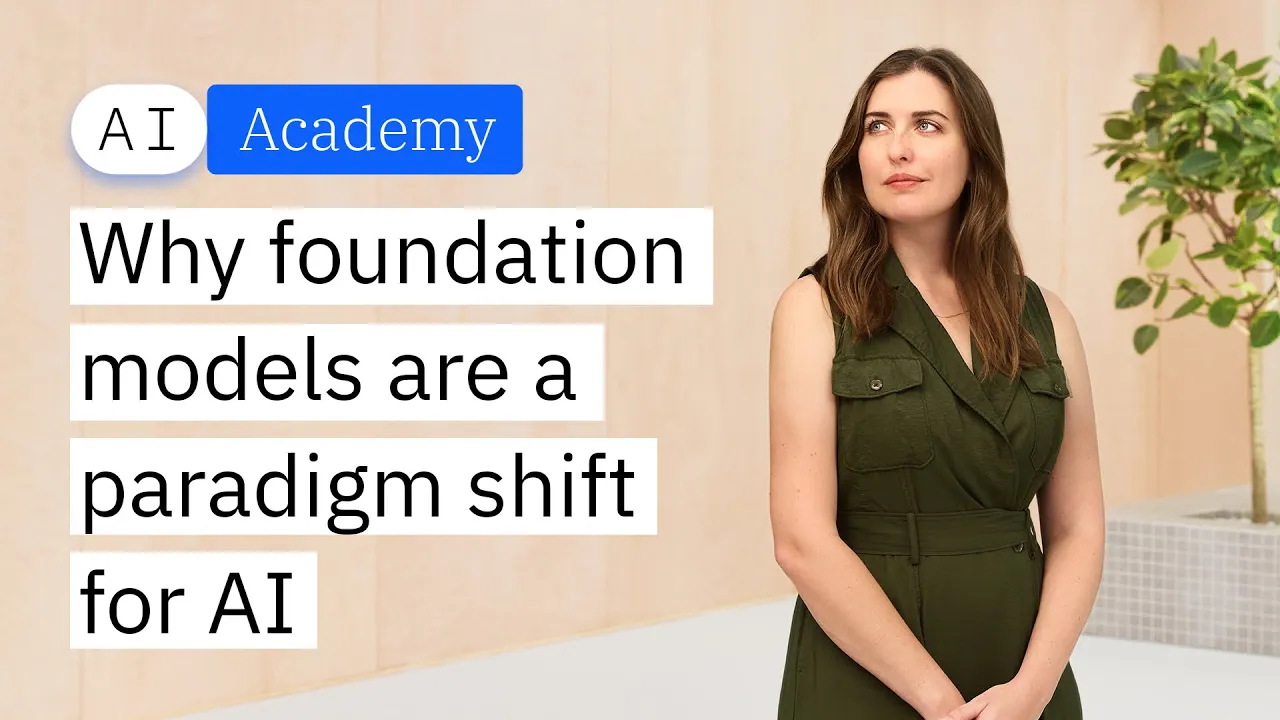
Welcome to AI Academy. I'm Kate Soule, Senior Manager of Business Strategy at IBM Research and the MIT-IBM Watson AI Lab. And in that analogy, I work at mission control.
My job is to oversee at a program level the training and development of all the large language models for IBM's AI and data platform. And I come at that role from a business and consulting background rather than a pure technical one. But it means that I approach my job and the work that we do with a focus on trying to make sure that our research has impact on the world, that what we're doing is solving real business problems and generating real, tangible value for our clients.
And in terms of real value, the opportunities with generative AI are extraordinary. While traditional AI can analyze data and tell you what it sees, generative AI can use that same data to create something new. And that's a vital tool for businesses to have because that same power can be applied to customer service and support, code generation for developers, extracting key information from complex documents.
More use cases are being developed every day. Companies can increase productivity, reduce costs and open up new lines of business, while traditional machine learning is narrowly focused and purpose-built for a specific task and takes a lot of human intervention. Foundation models are bigger, broader general purpose models that benefit from unsupervised learning, which means they can be trained on large, unlabeled data sets.
And then afterwards, this general purpose model can be further tailored for an array of applications. The types of things these models can do is evolving incredibly quickly. So now is the time to start building your expertise.
As generative AI becomes a business differentiator, you're going to want the ability to innovate so that you're not just following what other companies have done, and you're going to want to be part of the broader conversation about what AI is and where the field is going in building that muscle mass in your organization for how to build and experiment with generative AI. When looking to get started, building expertise is critical. First, you need to establish a team of people who can become comfortable and fluent working with foundation models so that they can experiment, testing out new models as they become available, prototyping on example use cases and so on.
The second step is to pick an internal low risk use case that you can use as a testing ground. You could build a prototype and test out deployment. Then use what you learn as your team gains more experience.
Third, you need to have an in-depth conversation about what you require to get those real value drivers and revenue drivers. That generative AI can help you unlock. For example, you need to determine what requirements around trustworthiness and other regulatory issues your models need to meet to be deployed in production.
And all those questions only become more relevant as you leave the experimentation phase and get into the actual building of a model for real on an application that can drive business impact. And finally, you need to be able to operate with a level of responsibility and transparency. You've got to be transparent regarding data collection, showing what is and isn't in your data and how it all gets filtered and managed.
You need to be able to explain how your AI is making decisions. You want it to be fair and trustworthy and ready for compliance with upcoming regulations. The number one success factor in each of these steps is choosing the right evaluation metrics that reflect your business tasks and measure the model's robustness, fairness, scalability and cost for deployment across your business.
And even though that evaluation can be quite difficult for generative AI, when the right answer could be subjective, when you evaluate across all these dimensions, you may find that some use cases don't justify the cost or risk of leveraging a huge model on the cloud. That's why one model doesn't have to rule them all. Within IBM research, we are seeing that smaller specialized models.
Now, when I say smaller, I'm still talking billions, not trillions of parameters and size can be as proficient as those giant trillion plus language models when they are evaluated on specialized tasks. These smaller models are significantly more cost efficient and can be run more easily on prem to reduce your deployment risk. When you're getting started on your journey with generative AI and looking at all the options available.
My recommendation is to start simple, start with a pre-trained model and try to do light customizations with your own data through a process called tuning. This way you can tailor the model for your specific use cases while taking advantage of the large general purpose capabilities that other providers have developed. It's important, though, to update those pre-trained models every couple of months.
Going back to the rocket ship analogy. IBM Research has a regular launch cadence, retraining all of our foundation models multiple times a year as more information is made available in the world continues to progress. We want our models to be able to reflect changes.
We also want to make sure that our models consider the latest regulatory guidance and risk management best practices. The field and the regulatory guidance around it is constantly evolving. So models that aren't regularly retrained with the latest best practices will quickly become stale.
That's why the right AI and data platform is so important. You should look for a platform that has proven expertise in foundation models, the governance tools in place to help you address potential ethical concerns and can help you transition from experimentation to deployment. Then, as you get better and more confident over time and training and owning the models, you'll eventually be able to maintain and build them out on your own.
There's a lot of complexity to AI in foundation models, but working through all that complexity truly is worth it for where it's going to take us, both in terms of our business successes and our progress as a society. Think about those NASA scientists and engineers. Doing something new is never easy, but because they did the work, we've set foot on the moon and sent probes beyond our solar system.
We can now explore our universe. Generative AI may not literally be a rocket, but it will help us do more to travel farther and faster to unlock new possibilities and explore new frontiers. And I'm so excited to see where it will take us.
Thank you for watching. Please join us again for more episodes of AI Academy as we explore some of the most important topics in AI for business.