These are the saltiest lakes in the world. Saltier than the Dead Sea, saltier than any ocean you've ever swam in. They're called brine pools, and they might just be the worst thing you could possibly encounter in the ocean, which is weird because they aren't alive, so they can't eat you.
They aren't made of lava, so they can't burn you. They're just salt. Salt that sits there, doesn't move, and kills anything it touches instantly.
How are these underwater death pools forming in the ocean? Why are they so deadly? And what is actually happening to the animals who die from touching them?
Before we figure out why these pools are so deadly, we first have to understand how they're even created. These death pools are old, like millions of years old. They were here before the first humans ever saw or even touched an ocean, and they'll still be around long after we're gone.
That being said, how is a pool inside a bigger pool? Isn't the ocean a giant pool itself? A pool of water existing in a pool of water is kind of contradictory.
Well, while we usually think of the ocean as one continuous mass of water, it's much, much more than that. See, layers of the ocean exist. But if someone says the misopalagic zone starts at 200 m, it doesn't mean that meter 199 is somehow vastly different than meter 201.
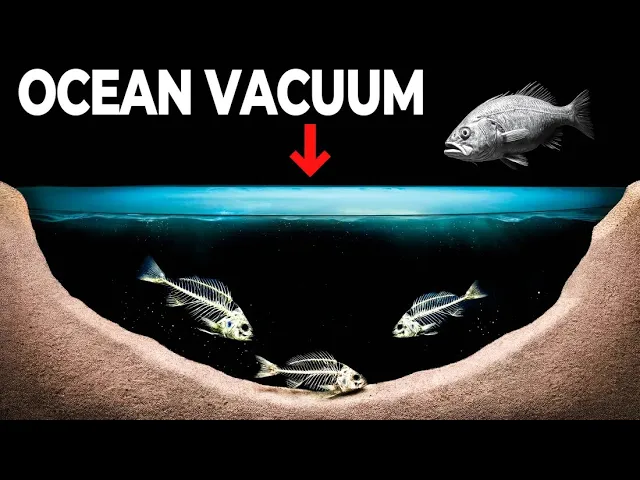
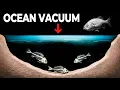
It's only in a few specific location where the ocean actually has layers and it's basically just these brine pools. These pockets of water get so dense, so salty and teeming with so many chemicals that they just separate themselves from the rest of the sea. They don't blend.
They don't mix. They just sink into the seafloor depressions [music] and sit there like their own separate alien lakes complete with shorelines, waves, and surfaces you can break through. The problem is once you do break through, it's almost certain death.
So, it's a lake inside of an ocean. Cool. But why are they so horrendously deadly?
The answer is in the salt itself. [music] Brine pools are basically just pools of salt water, but with 10 times the amount of salt in the rest of the seawater around them. And that means they're heavier, much heavier.
Still, if the threat is just salt, why are these pools so deadly? Turns out the salt causes the pool to develop some ridiculous [music] traits. Since brine pools are so thick, they never mix with the rest of the seawater.
And because they don't mix, oxygen can't get in. And that makes them an oxic, meaning there's almost zero oxygen in any of the water. So any fish that swims here would suffocate in seconds from lack of breathable water.
It's terrifying biology. An organism enters the pool, tries to breathe, and then its brain shuts down. Fish brains, no matter how small they are, need oxygen to function, and when they suddenly can't get enough of it from the fish's gills, the brains start to suffocate in a process called cerebral hypoxia.
Couple that with the toxic shock from all the hypers salinity and you've got an instant death pool. These waters are also loaded with hydrogen sulfide, a chemical that's as toxic as raw battery acid. For many [music] animals, coming here is effectively the same thing as swimming in bleach.
And if that's not enough, some of the brine pools also contain methylene, which burns through any remaining oxygen that could have potentially slipped through. These fishes never know what they're swimming into. One moment they're gliding across the seafloor, the next they cross [music] an invisible line and their body chemistry just collapses.
Osmosis causes the cells to dehydrate from all the salt. Gills fail since there's no oxygen. Toxins shut down nervous systems and within seconds the animal sinks just as others like it have by the lake's edge.
In the ocean, [music] the brine pools don't actually look that scary. Besides a graveyard of animals around them, the lake itself kind of just looks like a shimmering mirror-l like pool of water. Most fish would only detect its danger from cheosensory systems that could detect high salinity nearby and make them turn away before they actually enter.
So, when would a fish actually fall into one? A fish usually has to be distracted or desperate for things to go wrong. Healthy animals almost always peel away before crossing the boundary.
But the deep sea [music] is full of situations where instincts fail. Sometimes a fish is already injured or sick, and its sensory systems aren't sharp enough to register the rising salinity. Other times, a predator prey chase forces a split-second decision.
The prey bolts towards the pool's edge. The predator follows, and the momentum carries [music] one of them, or both, just a little too far. By the time they realize the water has changed, their gills are already collapsing.
There are also cases where slowmoving bottom [music] dwellers like crabs or eels simply misjudge the surface, slipping down the slope and letting gravity do the rest. The brine's density makes the boundary behave almost like a physical barrier. But once an animal breaks it, even slightly, the water seizes control and drags them under.
And sometimes it's just bad luck. A current pushes wrong, a fish takes a turn too close, or a young animal that's never encountered hypers saline water drifts over the edge. One single mistake will cost the animal its life.
So, what happens after they die? I know what you're thinking. Uh, well, they're dead, obviously, nothing, which is true, but there is one weird effect that happens to their bodies.
The animals that die here never decay. They end up like this basically forever. So, how does this actually work?
Instead of tissues breaking down rapidly like they would in normal water, the salt makes them get destroyed slowly. Very slowly. We're talking about decay that takes years to centuries instead of weeks.
When a fish, or well, any creature really swims into the brine with a wound on its side, the salt doesn't just sit there. Instead, it immediately starts working to preserve the body. The insanely high salt concentration immediately starts pulling water out the wound through osmosis.
And as that water gets drawn out, it leaves behind salt. The extreme salinity acts like a natural preservative. And we see this with things in real life, too.
Like salted butter will take forever to expire, and you can eat pizza that's been sitting out for a few days because fast food has tons of sodium in it. But now, instead of preserving pizza, the salt is preserving the full body of the animal. It's like watching the brine mummify the creature in real time, except you'll never get close enough to see it.
But here's the really weird part. The crystals don't just form on the outside. They can actually penetrate into the tissues, replacing the moisture inside with solid mineral deposits.
Over time, parts of the body can become partially mineralized. Not exactly stone, but not quite flesh either. So, if a fish swims into the brine with a gash on its side, the salt literally crystallizes over it, sealing it shut like some kind of natural tomb.
The wound is now shut tight, frozen in salt, preserved forever. This is like nature inventing its own version of taxiderermy, except way more efficient and infinitely more disturbing. And since the temperatures in the lakes are quite stable, biological and chemical reactions are heavily reduced.
There's no heat to speed up decomposition. No oxygen to fuel bacteria. It's just cold, salty stillness.
Plus, the pools are so deep beneath the ocean floor, so currents hardly ever reach them. So, they're terrifying. But how did they form?
Brine pools didn't just show up under our oceans one day. Let's start with the very deepest ones at the bottom of the Gulf of Mexico. During the Middle Jurassic period, the Gulf of Mexico was one of the many shallow seas that dried out.
And back then the water was loaded with dissolved salts. So over time when climate shifts happened the seas evolved faster than rainfall could fill them. But keep in mind these seas were absolutely massive.
And you know what else was massive? The salt sheets that were left behind. Obviously each time the water evaporated these gigantic piles of salt would be the only things left.
Some would grow up to 8 km thick and stacked on top of each other. The Gulf finally refilled with water. And of course, all that ancient salt didn't just wash away.
Instead, new layers of mud, sand, and sediment piled on top of it. And when the planet kept shifting, pressing, and folding, those giant slabs got squeezed deeper and deeper until they were trapped thousands of feet below. But there's one thing about salt.
It's that it never stays buried. Salt is buoyant. [music] It wants to float.
And when it's underground, it behaves like plastic. So if you put it under enough pressure, it starts to ooze and stretch, squirting upwards through weaknesses. So as more and more sediment accumulated, the pressure actually made the salt layer below start deforming and moving.
[music] In some places, it pushed up through cracks in the overlying rock, forming these massive rising salt domes. And as seaater seeped down into cracks around the domes, it came into contact with the exposed salt. The salt dissolved fast, creating these super concentrated salt and water mixtures.
The liquids here were so dense they'd sink right back down into the seabed the moment they formed. Now, whenever that dense brine found a depression or hollow on the ocean floor, it' start pooling slowly and steadily until over time you'd get a full-on brine pool, a whole separate body of water sitting inside the ocean, complete with its own shoreline and currents. That's how Mediterranean brine lakes such as the Bano and Tyro Basin formed.
ghosts of ancient oceans turning into the ocean's version of a booby trap backyard. This is the main process for how the majority of brine pools form. But interestingly, a few brine lakes came about in a different way.
In the cold Antarctic waters, when seawater freezes, the salts in it can't fit into the ice crystal structure, so they're forced out in a process called brine rejection. The expelled brine becomes extremely cold, dense, and heavy, and it usually sinks and disperses into the surrounding ocean. Sometimes though, those shrinking brines find their way into a natural depression on the seafloor.
When that happens, they can collect and settle instead of mixing away. Once they're pulled and isolated, the water becomes an oxic in a matter of weeks, creating a miniature brine lake. And yet, there's a third final way these pools can form.
At tectonic spreading centers, the seafloor is practically ripping open. Magma rises, rock fractures, [music] water seeps downward into the cracks. In the Red Sea, this sinking water dissolves older salt deposits locked inside the Earth's crust from millions of years ago.
The water becomes supercharged with minerals. Then it hits the magma chamber and gets superheated. After this, the water gets blasted back upwards.
When it reaches the ocean floor, the brine cools, settles, and forms a lake thick with poisonous chemicals. These formation processes do take an extraordinarily long amount of time just to make something that kills in seconds. So, what is the saltiest brine pool on Earth?
Well, we haven't actually found every brine pool in the world due to how deep they are and how hard it is to explore the ocean, but it's suspected that the hot tub of despair in the Gulf of Mexico is likely the saltiest. Yes, its name is literally the hot tub of doom and despair meme, but they obviously didn't name it that for no reason. It's only about 100 ft wide, about the size of a backyard swimming pool, but it is brutal.
Most other brines are extremely salty. This one, 1,000 m beneath the ocean's floor, is estimated [music] to be about 40% salt. So, the very instant an unlucky fish or crab crosses this brine surface, it wraps.
Needless to say, the fish dies and joins the rest of the brine's victims in a literal ring of corpses at the jacuzzi's edge. But why can't pools get any saltier than this? Well, there's actually a hard chemical ceiling on how salty a liquid can get, and the hot tub is already brushing right up against it.
Once water reaches that level of saturation, it can't dissolve any more salt. The molecules are maxed out. Any extra salt just crystallizes and drops out instead of mixing in.
In other words, a brine pool can't hit 60, 80, or some insane 90% concentration because at that point, it wouldn't be a liquid anymore. It would just be salt. Water simply doesn't have enough space at the molecule level to keep that much salt separated and dissolved.
Even the wildest brines in the Red Sea, superheated, metalrich, hydrothermal monsters, top out below the hot tub's range. No matter how extreme the environment is, the laws of solubility stop these pools from becoming anything more concentrated than a dense, lethal 30 to 40% salt solution. It's interesting because a solid block of salt [music] wouldn't actually be dangerous unless you smacked your head on it.
The real issue is the fact that you can swim in these pools by accident. Oddly enough, as deadly as these are, the life always finds a way quote is still true. There is actually something that lives in these pools.
But to be honest, it's not some giant salty monster because nothing giant could live in here. These organisms aren't like any of the other fish in the ocean. They're chemosynthetic organisms and have adapted their biology to crazy levels just to find ways of surviving.
We call them extreophiles. A large percentage of them are microorganisms, mainly bacteria and ara. Instead of using oxygen and sunlight for energy, these guys rely on chemical reactions such as sulfur or methane oxidation.
It's like photosynthesis, but then sunlight gets replaced with toxic fumes. Because of this ability, they form thick white mats around the edges of brine lakes like fuzzy carpets marking the boundary between safe ocean and liquid death. In this way, these organisms, although very microscopic, have been able to form complex microecosystems where each species plays a crucial role in keeping the other species alive.
Cool. But I think I'd rather just give up than have to eat death fumes for a living. Scientists are starting to find newer evidence of small crustations and polyhate worms feeding near the edges of brine pools.
Their survival is 100% based off the resources generated by extreophiles. Tube worms are also able to survive around the edges. And if you saw my video on aquatic worms, you'd know these worms are basically no more sentient than a rock.
They can't eat because they have no mouth, no stomach, and no gut. So, their entire survival depends on the microbes living inside a special organ called the trophosone. Now, if you've really been paying attention, you'll notice that none of the life we've mentioned besides the microorganisms actually exists inside the brain.
Really nothing with any real size can. The salinity and toxicity here are too intense. But right at the boundary, that razor thin line where normal sea water hovers over the deadly brine is a sort of sweet spot.
It's stable, rich in chemical energy and untouched by predators. And that's where these anomalies have decided to call home. So we have toxic, salty murder pools filled with bacteria that can eat battery acid.
Lovely. But why are scientists so obsessed with studying them? I mean, besides the fact they sound cool, it's not like they're any real danger to us.
Well, it turns out these pools are basically practice runs for finding aliens. See, the conditions inside these brine pools, the high pressure, the lack of oxygen, the insane chemical toxicity, are actually surprisingly similar to the conditions we expect to find on ocean worlds in outer space. This includes things like Jupiter's moon Europa or Saturn's moon Enceladus.
Astronomers are almost 100% sure that vast salty oceans exist beneath the icy shells of those moons. And if life can find a way to survive in the hot tub of despair down here on Earth, there is a nonzero chance that something is swimming around in the dark oceans of Jupiter right now. The brine pools may not guarantee accuracy, but they are able to help answer if we're alone in the universe.
Maybe not. But if the aliens are anything like the things living in our brine pools, they aren't going to be little green men in sauces. They're going to be microscopic slime living in toxic slush.
Whether that's better or worse, the aliens likely won't be much of anything, it just goes to show how extreme these pools are. Still, these weird organisms just might not be the only ones who stand a chance of profiting off these pools. For all their danger, these brine pools might actually hold the keys to some incredible usages still on our planet.
One of the big ideas floating around is that we could use their insane salt levels as a power source. The concept is simple. Build a sort of osmotic engine that pulls in ordinary seawater, presses it against the ultra salty brine, and lets osmotic pressure do the work.
That pressure would force the water to move in one direction, pushing a lighter, less salty stream the other way, and the whole exchange spins a turbine. Basically, we'd be harnessing the deadly chemistry of those brines to create electricity. Brine pools also function as incredible time capsules.
Since there's almost no oxygen down there, nothing stirs up the sediment. That means the layers on the bottom stay perfectly preserved, almost like geological tree rings. Inside those layers could be quiet records of ancient rainfall patterns, volcanic eruptions, earthquakes, and tsunamis that happened thousands of years ago.
Basically, if anyone were to try and reconstruct Earth's environmental past, a brine pool would be [music] the perfect archive to start their search. And so, the paradox presents itself. Get too close to these pools and they become a death trap that could end you in moments.
Study them from afar and you stand the chance of gaining otherworldly knowledge. But if you learned anything from this video, this is not a pool for you to swim in. I hope you enjoyed and if you did, please let me know in the comments.
If you want to watch our video on a creature that doesn't seem to be able to die, check it out here. Oh, and last note, thank you to Integral King for suggesting this video. I promise I do actually read the comments, so if you had any ideas, just let me know and it could be next.