Today I'm going to talk about what it is that we do these are this what is lct what does it mean to explore legitimation codes why should we bother with this framework these are the sorts of questions asked by newcomers to the approach as well as by the academics and managers who fund our research and payers to teach and sometimes we can struggle to get across to others why we choose to work with lct now parley this Is a product of something very positive as you've just heard LC T is growing fast so fast that
though it's a very young field we already need textbooks and introductions to the framework they're coming but that's not the whole story it's not just a lack of simpler answers to these questions we also need the right kind of answers for the fields that we work in now as you know LC T tells us that we are located in social Fields of practice in which actors cooperate and struggle for status and resources so we must justify our existence LC t legitamate thyself but as we know the kinds of answers that are acceptable that are seen
as legitimate depend upon the nature of these fields and right there right now those fields are structured in ways that can make it difficult to to explain what LC T is all about and in fact I'm going to argue that it's likely we will be increasingly Portrayed in ways that we don't recognize and associated with positions we don't hold that is unless we develop answers that make sense to those fields now luckily we have a framework that allows us to analyze and solve those kinds of problems so today I'm going to use LC t to
discuss why we choose to work with LC T and I'll do that in three main stages firstly I'll briefly discuss how we're likely to be positioned by the ways of thinking that dominate the Fields we work in and I'll highlight how we can offer a different picture of what we do second I'll argue that what makes LC t fundamentally different to other approaches is that it allows us to make the invisible visible and in the main part of my talk I'll illustrate how we do that and why it's important by looking at examples of teaching
practice and third I'll end by briefly arguing than what we do is crucial for the wider world we live in and quite possibly the Future of life on earth so I'm going to start the conference with humble and modest claims in the course of all this I'll introduce some new concepts to look of focus I'll develop the concepts of autonomy codes and show how to use those here by analyzing examples of classroom practice I'll offer a model for successfully teaching with media that are not designed for education and I'll hopefully make visible something about lct
itself which is how it can make the World a better place so hopefully there's something for everyone and if that can't hold your attention then while you're talking you can use lct to analyze how the talk itself embodies autonomy to us it'll embody a number of semantic waves and a giant big specialization wave as well and if you're still not entertained seriously you're at the wrong conference so I started by looking at how the problem of how to legitimate lct now There's an old joke about driving along and pedestrian asking you for directions and to
say Wollongong and you say well I wouldn't start from here they say I wouldn't start from here and I sometimes feel that way when trying to describe elseit or explain lct to scholars steeped in other approaches to education and society our city can be so different to their ways of thinking it can can be difficult to know where to start understand what I don't want to start From me from here and I'm not just talking about the problem of knowledge blindness that's difficult enough to overcome this is deeper still and our first conference two years
ago I said those who work with lct were benevolent misfits who don't fit into the existing categories and that's the problem I'm I'm again pointing to here lct doesn't fit into the existing categories created by a way of thinking that dominates the the fields we work in What is that dominant mindset well those who are the first who were at the first conference may remember I showed this painting which is the School of Athens painted by Fi in the early 16th century and it includes every major figure of ancient Greek culture and I argued that
it portrays two constellations at the center of the painting you have Plato and Aristotle and they're demonstrating their differences Plato on the left is Arguing for example an abstract deductive top-down account of the world he wants to go up into the clouds and Aristotle on the right is saying that we need to start from the facts on the ground and everyone in this painting is associated with one or other of these positions arranged into two big groups so referals painting in vatican portrays to binary constant is at binary constellation of practices and beliefs and these
constellations out of just Historical interest these constellations have evolved over the centuries and particular ideas have been added and others have been removed and still others have shifted between the two but thousands of years after the ancient Greeks we're still regularly faced with what Ernest Gellner called the old familiar confrontation between a cold abstract reductionist and scientistic constellation and a warm grounded experiential and humanistic one there Are many more attributes that can be added to the list on this slide but as I've argued elsewhere we find these opposition's in a whole range of places we
find them in the two cultures to bait between sciences and Humanities we find them in claims made for student-centered learning over instruction we find them in the ways theories are described so for example the way in which Bernstein's Bernstein is described as being much more technosystem Bulger and I've Written about all of those showing these constellations the fields we work in seem to be bewitched by this opposition now two attributes of this big dichotomy are key for what I'm going to be discussing today first is the either/or way of thinking and embodies this mindset gathers
up a group of practices as a single constellation that then is positively charged as progressive and grounded and in touch with subjective lived human experience then groups up All other practices into a separate constellation there's then is negatively charged as conservative detached from lived reality experience that's seen as techno cyst and so on in other words the big dichotomy is a binary constellation as I've said that axial logically charged using LC t1 generated by either-or thinking and a separate attribute is that the big dichotomy demands you choose one or the other it asks which Side
do you want you're on our side are you one of them and your answer is universal you're on that side for everything I don't just mean that once you're associated with one part of it you're associated with all parts of it which I've written about before that's true but also that once you've chosen a constellation when someone has they have a tendency often to believe that's the answer for everything like a child with a hammer thinking everything's a nail They believe the solution is that set of codes whatever the question is and we see this
in education for example with the universal solutions universal solutions in the 70s progressivism since the 90s constructivism and student-centered learning each time it's offered as a universal solution to everything so for example constructivism began as a theory as a model of learning and then it became a model of research and a theory Of curriculum design and teaching across the whole disciplinary map and across every kind of institution so how will having painted that very big broad brushstrokes how will lct be positioned within this big big dichotomy well you don't just write endless prose you draw
diagrams that's not good worse you draw Cartesian planes with plus and minus signs on them that mmm looks a little dodgy you draw profiles like this that looks a bit like Mathematics or or engineering and your approach isn't named after a person you're not mate onehans you're not mating it's you work with something called legitimation code theory which sounds very complex and impersonal and it's described as a multi-dimensional conceptual toolkit which sounds a bit technical to me there are many more exhibits I could draw on to make a damming a case against you lot now
of course we know that LC t includes Attributes from both sides of the big dichotomy it includes both knowledge and knowers it waves between it talks about waving and weaving between abstract and concrete ideas it involves quantitative and qualitative methods and so on but when faced with fields underpinned by our codes underpinned by axial logical cosmologies and either-or thinking then having any attributes from the negative constellation is enough to be positioned in their constellation because you must Be on only one side of the big dichotomy so we're screwed basically unless there's something that we can
do about that and there are at least two things the first is a strategic move to use the language of the positive constellation which values Axia logical meanings now we normally describe lct in very epistemic terms for obvious reasons we're trying to make our empirical reference as clear as we can we're trying to ensure arguments are logical And consistent so that we can generate as much explanatory power as we possibly can but we can also describe lct in more axia logical terms let's take for example what I consider to be the biggest leap forward from
bounce time to lct which wasn't specialization it wasn't semantics it was the breaking away from types and boxes this was how knowledge was discussed previously it tended to be discussed as a bunch of boxes often for each strongly bounded From each other no way of seeing differences within each type no way of analyzing change between them and nothing really imp nothing nothing empirical really fitted into any box and that's true not just of how Bernstein's work was often discussed and used less so his actual ideas but often how it was used there's also most models
of education or knowledge and using Cartesian planes was a really big breakthrough now we could See the empirical in its multiplicity in its in its complexity we can see competing codes within an object of study we can see that there's all four codes of whatever that might be it's going on here we can chart change over time within a code and across codes you've seen me use those sides a lot now I normally describe all this sort of thing as by saying lct combines a typology of four principal modalities with the topological space of infinite
Positions well that might be catnip to mathematicians and linguists and engineers but not too many others funnily enough but we can also read ascribe that as lct helps you think outside the box because that's true lct embraces change similarly I often describe lct as excavating beneath surface empirical features to explore the organizing principles underlying practices again yum-yum-yum to knowledge code people but yeah yeah up to many Others we can put that another way lct enables deeper understanding or and I have Alan McConnell to thank for this one lct reveals the DNA of practice I'll take
translation devices they don't just traverse the distance between abstract context concepts and the concrete particularity of each empirical object of study to enable data to speak back to theory that also means lct embraces difference it puts his concepts at risk or because it doesn't tell you what the Concepts look like in your object of study you have to enact them lct empowers people now I'm not saying that we have to abandon epistemic meanings for Axia logical ones because I don't believe in the either/or we can have both and my point is that we don't have
to sit and wait to be positioned negatively by the Academy in any case that's just one way forward the other more important way is to deny defy and dissolve the big Dichotomy and we do that by making the invisible visible in other words by what we do we show that I cut to me is false and we model a different way of doing things how do we do that that's what I'm going to illustrate and I'm going to do that by looking at examples of classroom practice and that's going to be the main part of
my talk and I'll return right at the end when you're actually fatigued to dissolve the big dichotomy and it'll Come around in a circle so the data I'm going to analyze was collected for the peak project into knowledge building run by Sarah Howard Jim Martin and Unsworth and myself we focused on secondary schools and we recorded whole units of study that's about six to eight hours of video in history and science classrooms in years seven eight and nine at three schools with different social profiles that's a lot of data and we've been analyzing all that
data using four Dimensions of lct that's a lot of analysis some of which are being presented as papers at this conference for the first time and here I'm going to focus on a history class in year eight at a school whose student population was relatively low socioeconomic status to set the context to what I'm going to discuss we'd already analyzed a unit of study in year 7 history at the same school and that teacher expended a lot of energy in maintaining order she Shh Shira Shira Peter Shh she repeatedly said Shh a lot and she
moved students around in order to deal with noise shouting and an awful lot of low-level constant disruption she spent a lot of time dealing with students who didn't know what they were meant to be doing even well into an activity twenty minutes into an activity and they she has to explain it again toward the to them and as a consequence there was relatively little time spent discussing History content in that class the next year we studied to year eight history at the same school with many of the same students but a different teacher though no
longer disrupting lessons they were no longer lost and asking questions about what they should be doing instead they were attentive focused and asking questions about history tenth so much more history was being covered in these lessons this raised a question what happened we considered the Obvious reasons but once we start rule you started ruling them out I was sad to see the first one go we were left with the possibility that the teacher had something to do with it however if you watched him teach you might think otherwise and you may think otherwise he's softly
spoken he's unhurried he's laid-back he's the opposite to the common perception that a student engagement comes from teachers being animated and excited indeed several Scholars have seen him teach thought he was disengaged and I'm interested in an example of the worst kind of uncaring teacher so the question is how did this seemingly nonchalant teacher create a space where the students are on task and learning content and what the hell is this got to do with legitimating lct now teaching is a fiendishly complex complex business so the first question actually involves a whole range of legitimation
codes and I'm only going to focus on one Aspect of the petofi's pedagogy which is how he moves around the autonomy plane the second question is that I'll argue at the end that lct enables us to see this practice and which is invisible to many to do that I need to briefly introduce two sets of concepts to the first set of concepts are about the focus of discourse now I've always distinguished focus from basis where the focus refers to what's being written or spoken about and the basis refers to the Principles underlying the practice how
it's being legitimated so say I'm talking about a problem with my back that's my focus and I can lead you to mate that by saying a number of things in any number of ways for example I know I've got a problem because I feel pain there might be a NOAA code or I know because I've had a medical scan that might be a knowledge code and legitimation codes are always about the basis not the focus so basis is all and All the attention in lct and rightly so it does the heavy lifting and explanations but
when studying classrooms we founded we need to distinguish three different things that are being discussed in class so we distinguish between content focus when content knowledge is being discussed such as medieval Europe or the so in history or the solar system in science directional focus when students are under discussing how to Undertake an activity such as watching a video or conducting an experiment and behavioral focus when they're discussing behavior such as classroom management or how one should behave in general those at the classroom data if you're studying other phenomenon you might need different distinctions though
I should add the point is not to try and list everything that could be a focus because at least it's infinite it's just about what's useful for your question how a Question is why does this teacher spend a lot less time repeating instructions and maintaining order and more time teaching content so those three were useful for us and I'll use those concepts to analyze the focus of did classroom discourse and to analyze the basis of that discourse I'll use autonomy codes and those concepts have been fundamentally reworked over the past few years and we'll finish
writing those papers up and make them available As soon as we've finished running this conference for now our briefly outline the main things you need to know for this talk autonomy begins from the very simple premise that a set of practices is made up of constituents or parts that are related together in particular ways that's it those constituents could be actors they could be ideas they could be machine parts they could be body movements they could be sounds anything How they're related could be based on explicit procedures formal rules tacit ways of working how we
do stuff around here among others autonomy explores the issue of insulation how insulated are a set of practices from others and he answers that by considering how insulated are the constituents and how insulated of the ways they're being related together so positional autonomy refers to the strength of insulation between constituents within a context or Category and those positioned elsewhere for example if my actions effectively say there should be stronger insulation between what's positioned here and what's positioned somewhere else that would be stronger positional autonomy and relational autonomy is about how those constituents are related together
so for example if my actions say there should be stronger insulation between how we do things here and how they do think somewhere else that stronger Relation autonomy there are very general definitions for analyzing all kinds of data in this paper I'm analyzing knowledge expressed by teachers and students in classrooms and for that we can enact these concepts by simply asking where things come from so for here positional autonomy is about where constituent and content knowledge comes from because that's my focus here if It's from within what we call the target it's stronger positional autonomy
if it's if that content knowledge is from somewhere else it's weaker and relational autonomy is the purposes to which that knowledge is being put if it's for teaching and learning the target knowledge it's stronger relational autonomy and if it's for some other purpose it's weaker and I'll come back to how we define the target shortly as usual we can and for those who are Doing a semantic waves at all we are really a high up at this point but we will be coming back down again later shortly don't worry as usual we can describe a
continuum of strengths of each which gives us four main codes I'll briefly introduce these but don't worry because I'm going to also illustrate them sovereign codes where positional and relational autonomy are both strong and eval arises from within and oriented towards within so using stuff from Inside the context of category for purposes associated with it the motto here is home is where the heart is exotic codes are the opposite they draw wrong practices from somewhere else weaker position autonomy and they put them to other purposes we can relational autonomy the motto here would be status
lies elsewhere Roman codes where practices have weakly insulated positions they use practices from somewhere else but they turn them To purposes that come from within so their motto is even if you're coming from elsewhere when you're in Rome you do as the Romans do and Trojan codes are the other way around things maybe inside the city walls but they're used for other purposes what you're doing is within but it's for some other reason don't worry if you didn't follow that I'll be illustrating those again and again now like all lct planes this isn't for boxes
it's a topology of Infinite positions or as I can also say now it helps you think outside the box and it embraces change so we can analyze practices such as parts of a lesson or so the text or whatever it might be and you can see there's more than one code here it's dominated by a sovereign code but that's it's not all the same so lct embraces difference we might say analyze a lesson in another discipline or at another time in another classroom or the dispositions actors bring and then we Can compare their autonomy codes
in that way but today I'm going to be doing something exciting for now going to be tracking pathways around the plane over time so this is one pathway it's moving between codes or it can be simple could be like that now I should add that this first pathway that I did that's called an autonomy tour again I will be illustrating it but it starts in the sovereign code it goes out to somewhere else to another code And it comes back and as I'm going to show a believe autonomy tours are a key to integrating knowledge
from other sources from different sources they involve leaving your target leaving home as it were going out to embrace other knowledge and other purposes and then bringing it all back home to your target and in contrast this is a one-way trip so for example as you'll see one as well but an example now is for now as a teacher may start by teaching history And then go out to include say everyday experience and they never come back to history if those are new to you as I say don't worry I'll be discussing examples as I
go finally how do we where do we how we get these things on a plane how do we place them so as you know lct concepts can be used to analyze many things so translation devices come in handy Sarah and myself with Jody and Eleanor have created one that works for all kinds of data and for both Positional and relational autonomy at the same time and here I've filled it out with some examples from what I'm going to discuss in black is the first level for deciding what's stronger and what's weaker plus or minus and
the target is simply what makes a context or category distinctive and today I'm discussing knowledge the teaching of knowledge in classrooms and here the target we decided was the the what the teacher intends to teach in our examples Is secondary school history curriculum specifically the New South Wales stage for Key Stage four history syllabus that's what the teacher said was his target knowledge in these lessons and teaching that knowledge was his target / so stronger positional autonomy is when he's discussing knowledge from that syllabus and anything weaker position autonomy is when he's discussing something else
and stronger relational autonomy is when he's using whatever He's discussing for the purpose of teaching that syllabus and yes you guessed a weaker is when he's using it for some other purpose again I'm going to be illustrating this with examples I just need to expand on that just a little bit just to distinguish because I'm going to need this two parts of the target core or double plus that's the specific unit of study in this case it's going to be the medieval world and that's the core in the ancillary is just A single places topics
from other parts of the target from other parts of that Key Stage four syllabus so I think st. should Rome I'll use that distinction for completists who are thinking about what about the non target usually anything that's not what you're looking at tends to be just neglected as a big blob but we have distinguished this obviously it's a lot of different things if it's not the target so but we've distinguish between some near or some a Further away so we distinguish between associated or single- that's closer to the target in this case it's other educational
knowledge and unassociated or double- this further away here is knowledge from beyond education I'm not going to use those today the main thing though just to take away at this point is simply we have a translation device between moving between our data and the codings I'm going to give so I'm not just pulling These out of my arse as I go and a general sense of what gives those codings so as I said I'll be illustrating them through the rest so I'm going to use these concepts of focus and autonomy codes and I'm going to
suggest that the teach I'll discuss engaged achieves an engaged in focus classroom by making explicit what other teachers often leave tacit doing so for both what and for why across all three kinds of focus he doesn't just convey Facts from history he also complies X conveys explanations of those facts the what and the why he makes clear both what the students should be doing and why they should be doing in terms of activities and he makes clear to students both what is good or bad behavior and why that matters in terms of their learning and
he does all that through taking autonomy to us that select recontextualize and integrate Knowledge from various sources and bring them home to his target and to show this I'm going to focus on tweaks examples analyzed by Sarah Howard and myself and Ellen lamprey notes and Jodi Martin there's a team effort not just me so anything is unclear at the end please to ask any of them not me in one the teacher elaborates on the textbook they're reading in class in the second he uses a video and I'll be showing some video myself as I said
for analyzing These things we need to discuss what you know to show what's the plus I said his target New South Wales just reminding you Key Stage four syllabus history syllabus the core the unit is on the medieval world there's a third level to the device I've not mentioned I'll just say that in both these examples I'm going to give his inner core his focus of this specific lesson is weaponry and warfare now in this first example the students reading aloud from a textbook About castles and sieges I'll just read that bit first the student
reads this gaining control of a castle was an important way for a king or a lord to extend his power influence and territory and to defeat his enemies today siege to a Carson and army surrounded it with soldiers trapping its inhabitants inside sieges lasted for months or even years during which time people used all possible means to defend themselves in most cases starvation and disease to Force the castles inhabitants to surrender if these methods failed attackers then tried to capture the castle by force I'm now going to show you a video of the teacher elaborating
on that reading and then I'm going to track his path his yes attract his pathways across the plain video is about two minutes long so don't own out oh hang on so don't zone out if you don't for if you don't if you don't follow this you won't follow the Analysis you won't understand the key points so you won't get the take-home message and you will be condemned to wander in ignorance forever why I'm saying this will become clear when I get to how he does videos what is the importance of the castle okay now
for those yet so for defense talk about what happens when the attackers just sit back and wait for starvation and disease to happen okay the significance of the board I just keep kind of me Another thing you have a little idea like with these days okay now remember what I showed you here sub bad boy stroke in history and many what's all that people basically well there was the toilet I care that having a basin boat all right and then I just throw it up under the street okay that would cause disease just like you
say so because of the lack of hiding back there disease freeze very quickly now you think about yourself you guys attention you're going Through the best time of your life something to it basically because of what's happening to you now a high teens an issue right I did it make sure we do the right thing otherwise you don't have any popular the sexuality it'll happen as a result if you don't you know have your heart in it you know you can start citic seemed like it was another paper you might have a bad video you
might you know you fake my starts in here so like bottles and Stuff yeah like your skin will start to peel that's because Paul I think that's today modern day yeah back then Tom's at for like 20 ok sable worse and that was a common thing no I'm really cared about it alright nonetheless you were nobility okay the king quick you know the family the royal family stuff like that but once all use these you can start to understand because at large a disease spreads quickly really gonna pause it there and I'm going to come
Back to him in a minute just to see what he's done so far so what's happened so far in terms of autonomy coats so it began with the teacher summarizing what the textbook is talking about importance of castles what happens when the castles put to siege how attackers sit back and wait for starvation and disease to happen so we're deeply in the sovereign code here is not only inside his target he's in his core he's in double plus at least he's in medieval world he's in Warp warfare and weaponry is probably triple plus but he
decides to pick up on something from that abstract from that extract which is disease and he says it's not in this unit but they will come to it later so it's in the target of Key Stage four history but it's not caught it's not this unit of study it's in the sovereign code but now it's still just it's gone down to single plusses I knew then stays here for a while and he discusses a video they did prior to this Unit on worst jobs in history using that memory to describe a link between Hygiene and
disease people using base and bowls throwing them in the street so because of that alone because of a lack of Hygiene back then disease spreads quickly then he moves to students everyday experiences that they're teenagers that hygiene is an issue that ignoring their thai gene has consequences and it goes on to describe how poor hygiene causes Pimples BIOS boils and so on we're a long way from medieval history at this point but then he does two things the good teachers often do it shifts what he's discussing back to history strengthens positional autonomy he comes back
to the Black Death in the past and at the same time he turns that to purpose he strengthens relational autonomy explains why we're talking about these various examples we're back to the topic of disease an explicit Signal it explicitly signals this shift by saying why I'm telling you this is and some writing the point because of poor hygiene disease spreads quickly but we're not totally home yet he's not brought that knowledge of disease back to the topic of castles and sieges so let's have a look at how he gets all the way back hello thinking
about a black death remember the place that five people that spread the disease they throw in the Rats okay thank you hi James turn ok the condition is that living in South Side creates human think of a bad soil today humidity gets to see there's no ucx brain I want to see at the moment ok all right because of the conditions now inside the castle imagine a baby that stage you've made in the console for a month or two foods running out of orders right yeah okay and then someone gets the black death you need
to go to survive you're In serious trouble because you can't go outside you guys saw they've been actuated okay that's the idea trapped wall not telling you this one weapon that they use on the enemy appear inside the console the attackers would actually launch a couple of things out of the walls metallic catapults you know okay basically what that law said launched a dead boy that sometimes that launched people's heads of the people that were killed so imagine if your best Mate all right it's home played outside the fight you've got killed you're inside the
wall going oh my God he's dead and today buddy sees him fly rule now it's basically it's a certain things it has to create feel and also disease okay if you have dead bodies lying around does this change them to say spreading a very hot there's a reason why when it's that fun to go we get very on the ground okay suddenly think about it I wasn't just Conventional wolf in it you know like but as an air is kind of pulse a lot sort of stuff it was like almost chemical wolf it's a diseases
new this yeah use it to Train feed they're also fly get account helps with oil and fire so good the building so let me go down so they're trying to basically eradicate everyone inside and they get uncomfortable so when you think about if you're at stage of here inside the castle near in trouble okay you've Probably wouldn't survive unless it's a friend of yours another part of the army came to you know free their free from the siege put your head up if you understand important lane to putting facial Castleman's put your hands straight up
did not be lazy so what he does to start with is he uses the same autonomy pathway to reinforce his point goes out of everyday experience to humidity today as a result of mosquitoes breed you get More bites he then does the same thing against try shifting back to historical knowledge he describes what conditions inside the castle would be like foods running out waters running out someone gets the Black Death and the fact that you're trapped when you're under siege you can't go outside you're in serious trouble and now he's back he's ready now to
to nail to drive it right home get back to the starting point he brings it back to where he wants to be right now By bringing disease back to siege warfare and showing how disease was a weapon attackers would launch their bodies if you have their boys lying around chances of disease spreading a very high it's not just conventional warfare it's almost chemical warfare to diseases moreover he does that explicitly he again begins by saying now why am I telling you this ok that might seem long and complex There's only 5 minutes of lesson and
key points and actually quite simple he took them on an autonomy tour he didn't stay inside medieval warfare because he had to explain why disease could be a weapon but he didn't vanish off into everyday examples of Hygiene and never return he brought it back home I called the pathway he took a return trip it was a staged return trip in this case he first moved within the sovereign code from warfare to disease from the content of That lesson to other history lessons a code drift from core to ancillary parts of his target he did
a code shift to the exotic code way out ashle into these Jatakas own codes of students everyday experiences and he returned the same way the code shift back to the issue that they'll cover in another unit disease and then a code drift back to the core content of that lesson warfare in medieval world so first he went on an autonomy tour Second he made explicit both the what and why he presently pointed to disease as force needs discussion and twice he explicitly said why he's discussing him and thirdly I've been talking about content focus or
history knowledge but he also makes explicit directional focus and behavioral focus this quote comes immediately before the student reads the textbook he begins by reassuring those who don't have a textbook with them this is why saying These things he says if you don't have a textbook that's okay you just gotta listen alright how this is going to work I'm gonna ask you to read I don't have a textbook so it's no big deal I'll just listen to you as well now if you're not paying attention we're gonna ask you the word that we're up to
the exact word and if you get it wrong that's five minutes of your res s con so he says what they need to do listen carefully or they might stay behind that Seems really obvious but you we've seen many teachers not telling students they're meant to be reading along or listening and then they don't so he makes the what explicit for both directional focus about the activity and the behavioral focus of the potential consequences of the misbehavior and it also makes explicit why they're doing this activity says the reason we do this is because some
people are visual learners now it doesn't matter whether Ideas of visual learners and aural learners are nonsense or not the point here is that he's making explicit noting the weapon also the why he says they will read and they will use videos in order to try and capture and cover everyone okay I'm going to come back to what all that means for my first question after the first a second example of a different kind of activity I'll just say now he never has to carry out his threat by the way of keeping Anyone behind they
are really on task the second example comes from using a YouTube video and it's from earlier in the same lesson now videos are a common part of the multimodal multimedia modern classroom they're often not educational either in content or purpose so if we use our anima codes we can start to see how complex using them is typically their content is a mixture of stronger or weaker positional autonomy they contain some of the knowledge some of What they contain is the knowledge though the teacher wants to get across but there's also a lot of other stuff
too so both those codes both they're in both those parts of the plane and they're rarely custom-made for a teacher's target purpose they don't go they don't go on YouTube and look up New South Wales cue stage for Chris Street curriculum entertaining in you know thing about the medieval world it's often for some other purpose it's either For entertainment or in the general sense of being educational it's weaker relational autonomy so we have knowledge expressed in these videos appearing across these two codes moving back and forward around in there as it goes along we have
what the teachers want the students to learn in the sovereign code that's their content folks that's what they want them to learn and why they want them to learn it and there's another code to when they're doing these Things when they're using videos because watching videos that's an activity and that often involves directional focus it involves telling the students what they're meant to be doing and that's a Roman Code why well the directions may be turned to purpose they might be what the teacher hopes to achieve they might be oriented towards learning target knowledge stronger
relational autonomy but the directions themselves you're going to be doing this you can write This down and watch this what they're telling them to do are a means to an end they're not the end in itself the discourse that's directed towards learning that content knowledge is not itself that content knowledge so they're weaker positional autonomy if you're actually analyzing what they're saying when they're telling them what to do so it makes it a Roman code so in other words teachers using videos it's really bloody complex and they have to Articulate and deal with the four
four codes at once if they want to integrate these resources successfully how do you do that this is how this is how this teacher doesn't we begin at the start of the lesson first he writes the directions on the whiteboard from the short video one paragraph write one paragraph describing what castles were built where they were built who built them the quote marks are from literacy skills that are integrated into Curriculum at this key stage I'm going to show you a brief video it lasts only two and a half minutes and then I'm going to
track his pathways okay so pay attention and they asked exactly where we are exactly what he said to the word and if you don't get it you may have to stay behind at the end of the conference paulownia clinical watch after you watch it we'll talk about a little bit and then you're going to answer this Question okay so in your answer you looking so right down over the castle prefer to fight what was that purpose we were those votes yeah well that build a villa no in the desert on a hill well and finally
hit open okay so you know was it India source of Americans was a British etc in case of signal questions just to get us out so the next waking are two weeks this is a topic will be done okay we've got only a little were complicit what they're gonna Be photocopied hopefully today so next week on Tuesday but I have you forget your book and the focus is on attacking a castle and also be perfect okay so what would you have to do if you were in charge I would take no defending when he finishes
which appendix I know we're up to okay so and for the video I know I wish that I were taking a nice today just watching closely goes upon this probably every day but it gives you a rough idea and It's a click in there okay I'll ask the door you start to ask the question yes so where were they built where they built on my splatling it isn't this enough so he'll watch right gives you an advantage all right so you're looking what the secretary answer saying hi to right okay so rocky outcrops basically this
is enabled you will see an inch yes and the bag position they can overlook The log ramp and you think about the good offices on some of the console which is our actual video okay J gravity she'll turn up on the bench okay it's less if you dance already going to climb out at the farm the wolves once I gave you talking about okay so so he began by explaining the activity directional focus you said they'd watch a video discuss it answer the questions and explained why they're simple Questions because we're just starting this topic
so it's directional focus both what and why I made explicit then he starts playing a YouTube video on the design of the video from YouTube on the design of Roman and medieval castles as I said it's a mixture of Trojan and exotic codes he stopped the video he found some target content knowledge about the placement of forts and he prompted the students to answer the question about where they were built he Suggested the wrong answer of nice flat land like a desert which is solicited on top of Hills from a student so he's identified and
he selected content that stronger positional autonomy from what he wants to teach and he strengthened relational autonomy by turning it to the purpose of answering the question learning of what they're supposed to be learning but as usually he doesn't just do what he also does why why would they build their what was the advantage Students give some suggestions and then he elaborates other examples as well arches on top of a hill could shoot further people running up the hill would be slowed down that's all content focus and he's bored he's identified as content he's brought
it home nicely but he doesn't just go and turn the video back on at this point he does something else which I'm going to show you it only takes 40 seconds here we go And one of the phrases was the case is love [Music] so he doesn't just I'd shown that he brings content home but he doesn't just restart the video he prepares the students to repeat the move he switches to directional focus and he explicitly relates the knowledge they've just done to the task of the three questions on the whiteboard he discusses how they've
done one question they've started on Answers for another so he's making clear in terms of the activity as an activity both the what they've just discussed and the why that matters and having set them up to repeat the content moves he restarts the video so to summarise he establishes what they're doing and why watch the video he then selects target knowledge that's got stronger positional autonomy he strengthens the relational autonomy he brings home this content he turns it to the target purpose and Finally he connects that knowledge to the task he switches to directional focus
and discusses how they're answering questions which prepares them to return to the video again so what does that tell us well first it shows that integrating knowledge from videos demands a lot from teachers it's not just ikemen when they do it well it's not just a case of click on the video and bugger off if they're gonna do it well they have to select appropriate Content they have to recontextualize that content for a new purpose connecting it both to the activity of engaging with the video and to the knowledge the students are meant to be
learning through it which involves both code shifting and focus shifting and secondly I've Illustrated that this teacher has a signature pathway which he does versions of repeatedly through this activity until they've answered all the questions and the whiteboard to repeat Myself that pathway can be summarized as set up start activity select target knowledge pedagogy is that knowledge - its purpose and task afire back to the sending them up for another time cycle and by using that pathway students always know what they're meant to be learning and why what they're meant to be doing and why
and how they're meant to behave from why in fact the teacher doesn't mention behavior very much because the students are actually Engaged through all these classes with the activities the result is that there's actually was a lot more content tool in the stillness in these classes that we were studying than in many other classes and by repeating this pathway he isn't just teaching the students history he's teaching them principles for selecting recontextualizing and enacting knowledge from non-academic media he's teaching them how to integrate knowledge from diverse sources okay so for fun Let's see what happens
when you don't follow this pathway to make my point this is a class in the same year in the same subject in the same unit it involves a video just like before and it involves a digression about disease just like the earlier example the main difference is this student has students this school has students from higher social backgrounds now before showing the students a video this teacher gets the students to write down everything They know about medieval Europe which she then turns writes up on the interactive whiteboard that takes 40 minutes she then sets up
the task of watching a video she tells the students to highlight on their list what's right in one color what's wrong on the other when they're doing watching video and what needs clarifying which she says they'll research next so her directional focus is there She's explicit about what and why I'll come back to that later the video is the same two codes as the previous example it's a mixture of target knowledge and non target knowledge is for the purposes of edutainment and she shows the video for 45 minutes offering interjections example here is a video
is discussing the ordeal and that's where someone on trial places their hand in a cauldron of boiling water It's bandaged and after two or three days a priest looks to see if it's healing so you're innocent or if it's not which means you're guilty so so I can medieval version of applying for research funding at this point the teacher interjects to ask what don't they have in medieval Europe that could help healing which might be highlighting some knowledge of stronger positional autonomy it's not clear as yet the student and don't ever Feel like putting a
question mark and not knowing where you are on the plane we're not quite sure where we are yet students then have to play a game of what Jim calls guessing what's in the teachers head and they suggest good health care they have a stab at medicine but she wants South Pacific which one student guesses as antibiotics so the teachers moved to the exotic code that knowledge is not in the syllabus for the medieval Europe or a key stage for History and it's not here yet turned to the purpose of learning that curriculum it might be
but it's not here she then talks about how people in the past had poor hygiene they didn't bathe very often they didn't wash their clothes regularly so that they were more prone to infection now superficially that sounds really similar to my earlier example and she's almost linking it back to the audio by saying it's not the most effective method so it's heading towards That direction but it doesn't get there because this is when the wheels really fall off I'm gonna read this out she says there's also been some historical sources that have come out now
and tried to replicate some of these medieval European ointments and things and they found that they do have some antibacterial properties some of them have garlic in it well garlic has been proven by science today to have an antibacterial element to it which is Probably white chicken soup is you know the go-to thing for when you're sick I think it's got more to do with the garlic and their the antibacterial elements to it however for it to actually work it would probably depend on the bug that you're treating and how much you've got so I
don't know how much garlic you need in order for it to be totally effective against everything so keep that in mind because we will just look at that later did we watch some of This you want me to skip forward inside the heads of the students I think they're all going yes so in terms of the autonomy plane she's headed on a one-way trip and out of medieval Europe and she doesn't come back after an hour and 17 minutes of this lesson because I'm not cherry-picking here she returns to the purpose of the activity identifying
what on their brainstorm list was neither right nor wrong and so needs research And for research you tell students to google it as it's smarter than anyone I know a student points out that it's just a search engine and her response is to say well it's better than being the wheels oh if the wheels have fallen off they go so I like both the previous examples the content focus doesn't bring any knowledge home and she doesn't teach them any principles for selecting and recontextualizing knowledge from other sources So when faced with whatever Google throws up
they've been taught no basis for selecting knowledge of stronger positional autonomy they have no means of strengthening the relational autonomy by turning that to the purpose of what they're supposed to be doing they've been given no modeling for how to bring knowledge back home Sarah and Eleanor who spent some time in this classroom described the students looking pleadingly at them and even mouthing the Words what are we supposed to be doing so what are the key points from all that well my first question was what was the first teacher doing that enables students to focus
on learning knowledge and I've argued that one way is by making explicit not only the war but also the why and doing it across content direction and behavioral focus and I showed how he took he takes return trips to explain and elaborate ideas from materials like textbooks and tours that Selectively contextualize and integrate knowledge from videos in both cases he brings that knowledge back home what the hell's that got to do with the generating lct well first it illustrates how lct makes good practice visible much of what that teacher does might not seem might not
be seen they might not be seen might not seem good it might not be seen as good teaching some see a disengaged or uninterested teacher who lacks passion that he's successfully building And integrating knowledge is not necessarily visible that the fact that he's so laid back is actually part of a wider thing that he does about reassuring them all the time when he says there's only five minutes in ten minutes of the lesson don't worry about it he's not sitting there trying to get home he's trying to keep them calm and relaxed them so we
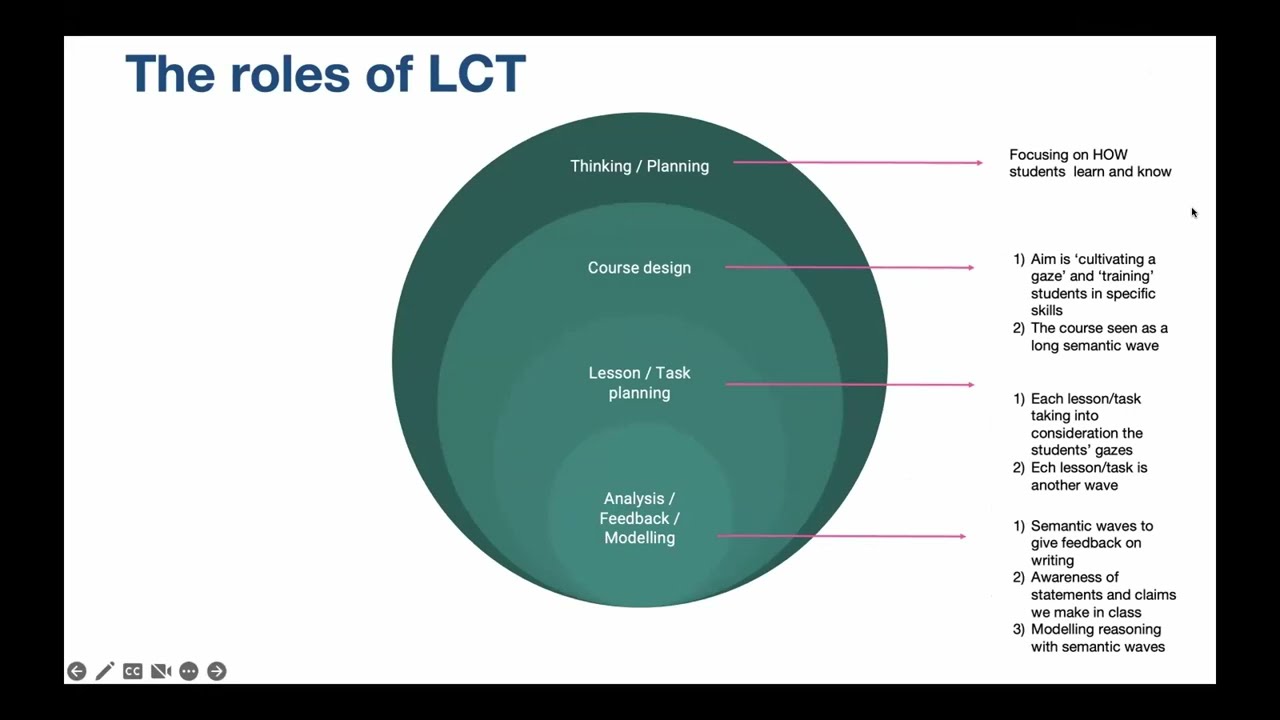
often talk about lct overcoming knowledge blindness to make knowledge visible but it also Makes visible what people do with knowledge in this case it makes what it makes good teaching visible so we can teach it to others second lct makes the principles for building and integrating knowledge visible this is important because it's not enough to identify a strategy or a trick of the trade and teach that to others for example I've repeatedly I've set this up by repeatedly saying he's explicit about the both of what and the Why and that's just a kind of simple
slogan that takes off really nicely in education but without things like lct it's not going to work it's going to become a cargo cult solution that people imitate with no understanding of why it does or doesn't work in this case and the other example I gave you showed it that teacher was explicit about what the students should be doing and why but then she went on a one-way trip out of history into garlic and Google and Didn't return the point here is his being split is not enough the codes matter it wasn't just that he
was explicit that does help students it was that he shifted codes and he did in a particular way when using that video he selected Trojan code knowledge he turned it into sovereign code knowledge and he connected it back to the Roman code activity he moved around the plane he moved through autonomy codes and that's what the Garlic teacher didn't do So the real key to what he's doing is shown by using pathways to reveal his autonomy tools and how he brings knowledge back home and because lct gets beneath the surface features to these underlying principles
because it allows deeper understanding deeper analysis we can adapt those points to different contexts we can show what autonomy tours look like in different subjects different years different topics and so on so we're not saying always do these Practices we're saying adopt these principles to you to your practice they may look different in your contexts which is again to say lct empowers people to translate principles like autonomy tools into their own practice using their own expertise third lct dissolves dichotomous what I've discussed there doesn't take sides in the old tedious big dichotomy it's not about
teacher-centered or student-centered tradition or Constructivist and it's true for all the binary choices of positivism and post theory and qualitative and quantitative and so on they're based on a either-or thinking that sets out a single code or set of codes that will solve everything and paints another set of codes as the problem instead as I've been saying the answer is always negotiating many codes moving around planes being able to take different pathways as and when needed for example in the rest of the lessons That the first teacher didn't just grind out the same pathway over
and over sometimes the students didn't follow him he turned back he retraced his steps or he took a different path but he always came home in the end and that point is true for all the Judah Mason codes whenever you use semantic waves say that we must show that we must move between and weave together different semantic codes it doesn't valorize theoretical knowledge over practical knowledge Similarly specialization doesn't say knowledge code good noah code bad or ali code is the answer all codes have attributes that are useful for something the point is to figure out
what they can do so that we can say to others given what you want to do these codes will help you these codes will not or weaving this way will will help or this pathway will get you to where you want to go the fields we work in often believe that there is one cool code to rule them all But autonomy go as a shows that you have to go there and back again across a bunch of different coats so lct allows us to refuse to choose the lesser of two evils in fields where the
good is not visible because binary constellations are obscuring everything but two bad choices we can make the invisible visible we can empower people to see and choose a different way of doing things and I'm going to finish off by saying why that matters more broadly in our Lifetimes there's never been more need for a different way of doing things than now we are witnessing everywhere the rapid rise of a rationalism of every stripe populism fascism racism fundamentalism climate change denial the list goes on and we've come together at this cold conference from dozens of countries
in which these are wrecking havock for example in the most powerful country in the world A bankrupt celebrity is now the dumbest president of all time and the country of my birth has committed economic and political suicide by voting for braixen slugs for salt the people most hurt by those decisions are the people who voted for them this rationalism is often being undermined by the tools of the trade of so-called critical theories all claims are equally valid it's just perspective you can have your own alternative facts now against this We are beginning to see a
reaction events such as Marsh for science lots of books are now going to be coming out and they're already coming out saying we need experts we need facts we need reason and so on and these are obviously important but they're not enough because we are on the verge of repeating the same old big dichotomy underpinned by the same old binary cosmology reproducing that either/or reproducing that which side are you one Universalizing mindset now what I'm pointing to isn't new how these opposition's play out in the wider world has been theorized regularly in sociology so for
example Manuel Castells synthesized a range of theories to argue that the chief dynamic of the modern world is what he called the but not bipolar opposition of the net and the self he wrote that the new forms taken by neoliberal capitalism or the net mean people experience power as faceless and Placeless as pond stantly shifting and abstract and distant from their experience or world and he said against this people are asserting what he called the self identities that are more personal concrete grounded and less changing like nationalism and tribalism and that opposition resonates with what
many commentators argue that people feel power has shifted to an impersonal abstract complex realm in which for example corporations are unaccountable To anyone but other corporations who are their shareholders and they're located nowhere but everywhere and people are often the commentators say that people are now being attracted very much to local simple solutions make America great again Pope Britain first however commentators and theorists like Castells cannot analyze the principles of these positions because they can't see knowledge so for example Three-volume work modern classic called the Information Age and Costello finds information and knowledge in a
footnote in which he distinguishes knowledge from news and entertainment that doesn't help when those three are becoming interchangeable but lct does make knowledge visible most so we can see more of what's happening we can use specialization and semantics and see that what we're witnessing is a double code clash between the rhizomatic Knowledge code of the net the complex abstract impersonal and the prosaic noah code of the self the simpler the concrete the personal which is it's the same old big dichotomy again and we can use a constellation analysis to show that what happens with what
happened what will happen with notions of truth and evidence and expertise and science and so on are constructed is also being rhizomatic knowledge code basically to use a technical term it's technical it's In a book rationality is cluster by our association is the same codes by association science evidence facts are associated with neoliberalism corporations globalization unaccountable bureaucracies and so on and opposed to the everyday experiences of people and their identities so the big dichotomy has reached out and is now including from academia as including the economic and political realms now of course we need far
more detailed and careful Analysis of this than I've just given but findings of Ellen and Glenn's PhD on how people understand climbing chained climate change at least suggests that this might be plausible the question this raises is how can l SI t help us move forward how can we make a small contribution three ways first it highlights the need to understand and speak in the language too prosaic noah codes it can help us express what we do for example in ways less easily Caricatured as part of that texas cold inhuman scientistic constellation so that we
can fight against being associated with reactionary economic and political forces second lct can help with teaching people other codes as many papers of this conference will show note the notion of semantic waves helps to expand people's semantic range beyond the concrete and simple it also helps peoples expand people's specialization range beyond their personal experience To embrace specialized procedures specialized skills this raises a question that you might be having which is if you keep talking about in this big dichotomy and I'm looking at it and it looks like it's specialization semantics why did you just do
15 minutes on autonomy to us well it's simple thank you for asking to help people expand their range requires autonomy to us what's forgotten by scholars who Valorize academic knowledge over everyday knowledge and everyday experience so we live in the everyday we spend a lot of our lives in prosaic our codes in concrete simple and personal meanings and for many people those codes are all they ever experienced at least positively an lct can help us shape teaching or public interventions to encourage people to take autonomy to us in which they can have positive experiences of
more abstract specialized And complex knowledge and then bring that knowledge back home to their everyday experience because I saw worth noting I never said I never said autonomy to a start and end in academic knowledge they did in my examples because the teachers target was that the targets of other people might be doing their best for their kids or trying to get secure employment or making a relationship work or something like that and we can use lct to shape autonomy Towards the begin and end in those targets where people live and that brings me to
my last point all codes matter who all have value your personal experience is valuable for some things but not quite so good for understanding the open complex system of climate change scientific theories can explain that pretty well but they're ineffective often and in connecting with your felt experience that idea that their codes have value for different things is often Made invisible by the big dichotomy which demands you choose a side and valorizing one set of codes by condemning another is what underpins our current political disaster and in contrast lct points to semantic waves they move
up and down and autonomy to us and they don't say one codes the answer they argue for moving between codes they show that being under negotiate all the codes is crucial to knowledge building and to empowering Knowers they deny the big dichotomy and they make that different way of thinking visible so to end where I began what is lct what's the point well addition in addition to what I've already argued we'll see this week how else you can be used to analyze a wide range of topics across a whole plethora of different national and institutional
contexts we're here papers that are building on previous work to develop Ideas with greater explanatory power and greater emancipatory potential and those papers will use lct and both for teaching both research and teaching practice and there are ultimately all be aimed at making the invisible visible so people can understand change and improve their lives on the lives of others which means that you are indeed a bunch of benevolent misfits reshaping what's possible with the status quo thinking the unthinkable denying those Dichotomies those dichotomies that separate us from each other and from ourselves so as you
spend the next day the next few days waving and weaving and touring and aiming to make the world a better place I have to say it really is a privilege to be among you thank you very much you [Applause]