The Father, we thank You for today. Thank You for those who were able to be with us this morning. We pray for those who were on the road or visiting family members on this special day, and we pray for those who aren't able to be with us because of illness or other physical ailments.
We thank You for those who will be watching online later and pray that You would be with them too, that we would all be one together in our worship as we sit under the teaching of Your Word. We thank You for Your Word; we thank You that it is living and active. It cuts us to the quick; it lays bare everything before You because You see everything to begin with.
Lord, we thank You that not only do You see everything about who we are, but You love us anyway, and You've given us Your Holy Spirit to transform us, change us, and bring us more in line with Your standards, Your Word, and who Your Son is. So Lord, I pray that You bless this time we have together looking at this eternal Word, and I pray all these things in Jesus' name. Amen.
When I was a kid, every Father's Day my dad would take my brother and me, and we would join another dad from our church with his two sons, and we would all go to the annual classic car show at our local park. There would be guys from all over the Central New York area who would bring these old cars that they had spent years restoring, and they would bring them to show off to everybody. A lot of guys here today, or watching online, enjoy that kind of thing—restoring old cars or even just cars in general—me, not so much.
But everybody has their own interests. It doesn't hold much interest for me, but I enjoyed spending that time with my dad doing that every year. Regardless of your interest in classic cars, we're all completely dependent on vehicles taking us from one place to another—where we need to go and back again.
We drive vehicles all over the place; they have cup holders, seat warmers, and any option of audio or video capabilities you want. In fact, some places you just can’t get to without a vehicle: cars, trucks, SUVs, and about ten years ago, Hummers that were so ridiculously huge to drive and park. I have no clue why anyone bought one.
We're completely dependent on vehicles; even if your main form of transportation is the city bus, we can't imagine our lives without gasoline, diesel, or electric-powered vehicles. But can anyone here tell me who invented the first automobile? Ah, see, that's what I thought!
My first guess, like many of you, would be Henry Ford. He's really the only name that comes to mind when it comes to anything having to do with the first cars on the road. But he's not the one who invented automobiles.
In fact, depending on which historian you ask, you'll get a different answer. According to History. com, there were actually a hundred thousand patents that were filed that led up to the invention of the automobile.
The first steam-powered automobile was invented by a French military engineer years before the American Revolutionary War even started, in 1769. It was a steam-powered tricycle, basically looking like this. Look at that monster!
How'd you like to drive that thing around? It weighed 8,000 pounds and kept tipping forward. If it wasn't pulling heavy artillery, it had to rest after about fifteen minutes of use too, so it wasn't very useful.
The first gasoline-powered automobile was actually invented by two different German guys who had never met, but who filed patents for two different gas-powered vehicles in two different German cities on the same exact day in 1886. But for a while, these gas-powered cars were so expensive that only the super, super, super rich could afford one because each one had to be made one at a time. But something else was invented in the early 1900s that changed everything, and that's where Henry Ford comes in.
In 1913, Ford installed the very first assembly line in one of his factories, mass-producing his famous car, the Model T. Suddenly, a car that took twelve hours to make now only took one and a half hours to make, drastically reducing the price and making it affordable to basically everyone. Some of you are sitting here and you're wondering, why in the world is this guy spending so much time talking about cars?
This is why: it was all well and good that people had invented different versions of the automobile, but it wasn't until Henry Ford's invention of the assembly line that the entire market was revolutionized and made it possible for everyone to buy one in a real way. Ford's assembly line is the only thing that made having a car a reality for everyone. When we think of the creation of everything that's in existence—I know some of you at some point or the other, when I'm talking, start to look out the window.
I see it; it's okay, but you can look out the way—when we think of the creation of everything that's in existence, in short, the entire universe, there was only one way that made all of this a reality. And really, with no exaggeration whatsoever, all of who we are as human beings and all that we experience is traced to this one way. Last week, in our first message on the Gospel of John, we talked about John’s establishment of Jesus as the Word and all that that entailed.
If. . .
You missed that message. I highly encourage you to check that out; it's up on our website at fellowshipch. org in both video and podcast audio forms.
In short, by the time John wrote this Gospel, both everyone of Jewish background and everyone of Greek or Gentile background in the Roman Empire had an understanding of what was referred to as the Word. And that was this: by 85 to 95 A. D.
, when John wrote this Gospel, basically everyone had the concept in their minds of a personified figure of wisdom, reason, or logic that held the whole universe together and, therefore, dictated what happened in that universe. The Jewish rabbis called it the Law or the Word of God, and the Greek philosophers called it reason. John took that already known concept of the personification of all of this and declared that it does exist, and it's not some mindless force of reason; it is a person.
This person, entitled the Word, holds the universe together because he had a major role to play in the universe's creation. As John opens with, "In the beginning," the very first few words of his Gospel, this person, or the Word, created the heavens and the earth. Remember last week I said look at the beginning of the Gospel of John?
Here is that look eerily similar to something else, and everybody said, “Yeah, Genesis 1:1,” the very first verse of the entire Bible: “In the beginning, God created the heavens and the earth. ” That was no accident; that was no mistake. John did that entirely on purpose to be very clear that the Word, this person, had everything to do with the creation of the heavens and the earth, the entire universe.
Not only that, but as we discussed in John 1:1, this person existed in perfect communion with the other two members of the Trinity, and the Word was with God. And on top of that, to leave no doubt whatsoever, John comes right out and clearly declares this person as also being God. You see that at the very end of verse 1: “And the Word was God,” of the very same nature, essence, being, will, and eternality as God the Father.
We know, as we read through the rest of this Gospel, that this person is Jesus; that this Word is Jesus. But like I reiterated over and over again last week, John wanted to reveal who this Jesus—this one he would spend the rest of this Gospel describing the ministry of—this Jesus of Nazareth—truly is. He wasn't just born as a human being in Bethlehem; he wasn't just a human man that walked around getting dirty feet and telling people about the Kingdom of God.
He has always existed within the Trinity. Because why? Because he is God.
That was the very first foundational truth that John had to establish before he could go any further. And this is why, if it wasn't established that Jesus is God, then he would not have been absolutely perfect in any way, for Scripture says that no human being can measure up to God's perfect standard of righteousness. And if Jesus had not been perfect in every way, because he is God, then his death on the cross would have meant absolutely nothing for us.
It would have just been another human executed on a Roman cross, which had happened hundreds, if not thousands, of times before, and would continue for hundreds more years after that. And since John’s whole point in writing this book, like we talked about last week, was to provide the clearest of cases for people reading it to repent of their sin and put their faith in Jesus's death and resurrection for their salvation from their sins, establishing Jesus’s deity first was a must. That primary establishment then flows seamlessly into what John explains next.
So, if you brought your Bible with you, please turn to the Gospel of John. It's the fourth book in the New Testament. You can look it up in the table of contents or ask a neighbor.
You don't have to get very far in the book of John; we're in the second. I'll be reading the second and third verses at this point: Fourth book in the New Testament, Gospel of John, chapter one, verses two and three. We read: "He was in the beginning with God; all things came into being through him, and apart from him nothing came into being that has come into being.
" What does John again connect to the beginning? Right, the beginning of the heavens and the earth. That's all well and good, but John wants to be even more specific than that.
See, a lot of people can believe there's kind of a higher power out there but never narrow it down to anything or anyone more than that. The Greek philosophers could not or would not narrow it down any more than that. In fact, when the Apostle Paul has a discussion with some of them in Acts chapter 17, he notes that they had a pagan altar built with the inscription "To an unknown God.
" They wanted to have all their bases covered; they didn't want to forget anybody or let anybody fall through the cracks, so they included an altar to deities they hadn't even thought of yet. See, this world that John is writing this Gospel in and to wasn't any different than the way things are now, and I'll get into that in a minute. In verse 3, John writes that the Word, as God, was the way that God created the universe, just like the assembly line was the way that everyone could now have a car.
You'll see that John says "through him," through the Word. As we talked about last week, Jesus is the embodiment of God's Word. God did indeed speak everything into existence.
All but the land animals and humankind, which He made out of the dirt. But as Jesus is the embodiment of the Word of God, all of creation, as John declares in verse 3, came into existence through Him. Just as Henry Ford's assembly line invention was the way that made cars a reality for everyone, Jesus was the way that made all of creation a reality.
We don't really need to understand the relationship between God speaking words into creation and Jesus also being the way of the creation becoming a reality, but what we do have to understand is what John goes on to say in the rest of verse 3. Apart from Him, nothing that exists would exist. Apart from Him, nothing that exists would exist.
In fact, John takes it even one step further; it makes the audacious statement beginning part of verse 4: in Him was life. He is also the author of life—all that life is. So everything that is, that exists, and even life itself has Jesus as its originator and source.
Let's think about that for a second. What does all this include? This includes everything we can see and everything we can't see.
This includes all the atoms and molecules that make up everything that we can see and touch, like a tree and its bark. This includes the micro-forces that hold all of these atoms and molecules together so that their shape and form create everything you know—all this basic stuff you learn in middle school science class. This includes everything from single-celled organisms to you and me—that's just the tiny stuff.
Expand out from that. This includes the tectonic plates that shift; this includes volcanic eruptions; this includes the very makeup and different levels of the earth; this includes wind patterns and ocean currents; this includes Earth's atmosphere; this includes gravity and planetary orbits and how perfectly far away our sun is from us; this includes planets and stars that are thousands of times bigger than our sun. This includes all of that.
As John says in verse 4, this includes life itself. This includes plants photosynthesizing to make their own food out of water and sunlight—just think about that; that in and of itself is a miracle. This includes living things reproducing after their own species—think about how a human reproduces: two cells coming together and creating a whole, complicated human being out of that.
That's a miracle! This includes how everything in our human bodies works together—from our hearts beating and lungs inhaling and exhaling to different kinds of cells in our bodies regenerating and rebuilding to our body healing itself from thousands of attacks every day, to our brains controlling language, thought, action, feelings, dreams, acquiring knowledge, and making changes based on that knowledge, and involuntary bodily functions—to consciousness and having some understanding of some kind of moral code. All of that is included in Jesus being life and the originator of life.
What this also includes is the human soul— that which Jesus creates, died for, rose again for, and which then lasts for all of eternity. That which we must make a decision about that will affect the entire rest of our eternal afterlife. As John says in verses 2 through the beginning part of verse 4, everything that exists—from material things that can be sensed with our five senses to immaterial things like love, the soul, and life itself—all of it, all owes its existence to Jesus and Jesus alone.
Amen! That puts Jesus in a whole new light, doesn't it? A whole new light that should dramatically affect our worship of Him.
He's not just a guy who spouted off good sayings; He's not even just the sacrifice for our sins. He is the very originator of everything that exists, and life and the soul itself—all of it. I referenced Paul speaking to the Greek philosophers in Athens already, but Paul details this a little bit more to those philosophers in Acts chapter 17.
He is the God who made the world and everything in it. We already talked about everything in our— well, we just barely scratched the surface on it, though. Since He is Lord of heaven and earth, He does not live in man-made temples, and human hands can’t serve His needs, for He has no needs.
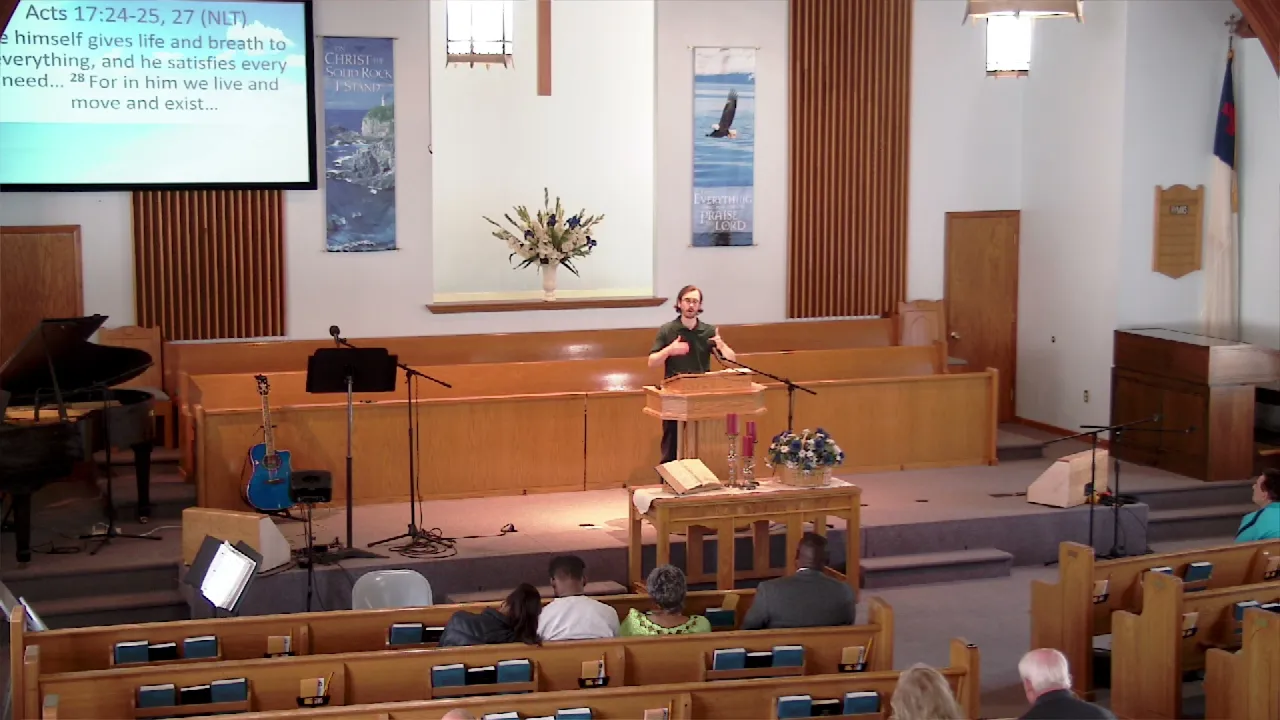
So what is our relationship to God then? He Himself gives life and breath to everything, and He satisfies every need, for in Him we live and move and even exist. Not only did Jesus create the universe, but He holds it together, and not only did Jesus create each and every one of us, but He holds each and every one of us together in every way.
In Him we live and move and exist. Everything that we are—the way that we’re built, the way we see things, the way that we feel about things—is created by Jesus. When we repent of our sin and come to God based solely on Jesus taking our place for our sin and death and then rising again from the dead, we immediately become one of God’s children.
And as such, not only is our existence owed to Jesus, but He then holds all of who we are—the way we’re built, the way we see things, the way we feel about things—all of that. He then holds that all together, and He then transforms all of that. In short, as a basic human being and especially as a believer in Jesus and a child of God, we owe all of who we are, and continue to be every single day for the rest of our lives, to Jesus.
As much as someone might want to believe and declare, not one person can sever the dependence of their existence and continued existence from God. Think they can, but in reality and truth, you can't. To hold that belief is woefully ignorant and extremely egotistical and narcissistic.
The only one you can thank for each breath you take is Jesus. It has nothing to do with you, nothing to do with you pulling yourself up by your bootstraps. It is everything to do with Jesus.
These verses that we just read are just as relevant today. How many times have you heard a person say this: "I'm not a religious person, but I'd say I'm a spiritual person. I believe there's something out there.
I believe there's some kind of higher power. " How many times have you heard that? And maybe you thought that at one point in your life, but that's as far as they go, and that's as far as their beliefs go.
What I'm about to say is politically incorrect, but I'm gonna call that out for what it really is. You know what that is? It's lazy.
It's a cop-out; that's all that is. You need to care enough about what happens to you in this life and what happens to you when you die to look more into that—look more into what or who that higher power really is. When you start doing that, what is going to happen is that you're going to come to a crossroads at some point, and you're going to have to make a decision.
That's why people don't do it; they don't want to make that decision. You have to care enough about your life and what happens to you when you die to make that decision. Sooner or later, you're going to come to a crossroads, and you have to make a decision.
It may start with a very basic question: Does God exist? As we already talked about, the very fact that you exist proves that God exists. The nonsensical leap of faith theory that a random explosion billions of years ago resulted in a conscious human being who has an inherent understanding of right and wrong is just that—a nonsensical leap of faith; that's all that is.
If one really does subscribe to that, then where did all the elements that went into that big bang come from? Here's the kicker: those who are die-hard believers in atheistic and naturalistic evolution believe that those elements that went into the big bang and the very universe that those elements were in have always existed. That's the only conclusion they can come to.
I'm sorry, but how does that make any more sense than believing that God created everything—that a God who has always existed then created everything in the universe? If there's a higher power, then sooner or later you're going to have to make a decision about biblical Christianity. You can start wherever you want: New Ageism, nature, Buddhism, etc.
, but sooner or later you're going to have to come to biblical Christianity—not a specific church, not a denomination, but what is only written in Scripture. God's word— is it true or not? Did you know that there is overwhelmingly more evidence of the authenticity of the entirety of the Bible, both Old and New Testaments, their human authorship, and everything included in them than any other written source in all of human history?
So if there's overwhelmingly more evidence to the historical authenticity of, say, the gospel accounts of what Jesus did on earth (and John's gospel specifically was written by an eyewitness), all of us are forced to have to make a decision on what's in John's gospel. You can't say that Jesus was a mere man, albeit a good religious teacher who gave some good advice on how to live a good life, for John has already made the audacious statement that Jesus is God. He made that in the very first verse of his gospel.
So either Jesus and John are liars or crazy people, which doesn't make Jesus a good religious teacher in any way, or John is telling the truth—that all of these things actually happened, including the death and resurrection of Jesus from the dead after he'd been dead for days. Furthermore, you have to make a decision on what John says next in verses 2 through the beginning part of verse 4 and how that particularly pertains to you. See, in our passage this morning, John takes this general truth of Jesus being God and connects it personally to anyone reading or listening to his book.
How does Jesus as God pertain to you personally? You can't help that he's your creator; you can't change that; you can't escape that, just like you can't escape who your parents were. He is the author of your physical, emotional, psychological, mental, and spiritual life.
He is the originator; he is the creator of them. But see, our ancestors, the very first two human beings, were the first ones to take their spiritual lives into their own hands. They made the decision to want to be like God.
That's taking your spiritual life into your own hands. That decision about taking their spiritual life into their own hands then directly affected all the rest of who they are. Sin had entered the world, and sin now affects everything about who humans would be, all the way up through today.
That's why we continue to deal with that curse on our physical, emotional, psychological, and mental lives, ranging from all sorts of sicknesses, pain, and torment that will all eventually end in death. Our spiritual lives, or our souls, is the one thing—the only thing—that will live on for eternity. But there is such a thing as death for a spiritual life or a soul as well.
That's known in the Bible as the second death; that's what it's called, or ultimate banishment from God's presence in a place of torment called hell. As hard as. .
. A pill, as it is to swallow, it's the fitting judgment for a person who continually keeps taking their spiritual lives into their own hands, either to do nothing with it and just loosely hold to some kind of lazy "I believe in a higher power," or actively adhere it to some false and man-made religion. Both actions are the same: a rejection of Jesus as the originator and, therefore, owner of our spiritual lives.
The good news is that there's hope. God's word says that when we no longer take our spiritual lives into our own hands, but rather give it over to the originator of it in the first place, Jesus, we then gain God as our Father and heaven as our future home. Father's Day means different things to a lot of different people.
It can be a joyful day of celebration; it can be a day filled with anger; it can be a downright excruciatingly painful day for multiple different reasons. But there is a being who longs to be your good and perfect heavenly Father. There's only one problem, though: there's only one thing that stands between us and that being, and that's our sin.
Our sin continually forces us to take our spiritual lives into our own hands. It may be to sit on the fence with it and never make a decision about—also known as agnosticism—which is just sort of a cop-out as a general belief in a higher power. This will result in the same place—hell—as those who live their entire lives actively rejecting Jesus.
It's a hard pill to swallow, but it's the truth. We may live our entire lives never recognizing that our sin created a chasm between us and most holy God that we can never bridge ourselves. We may live our entire lives believing that we can just generally be a good person, and as long as we never kill anyone, we automatically gain entrance into heaven.
But you see, what all that really is, when you peel back everything that it pretends to be, all of that really is just us trying to take our spiritual lives into our own hands once again, either to do nothing with or to try to do enough good things with it or try to earn heaven. The only way to have Jesus is to let go of your spiritual life, let go of thinking you have any control over your spiritual life, and give it over to Jesus, who it belongs to in the first place, since he's the creator of it. The only way to have Jesus is to entrust all of who you are, starting with your spiritual life, to Jesus.
See, that's what it all boils down to: when we recognize that we're sinners, as we all are; that our sin separates us from God; and that our sin forces us to continually take our spiritual lives into our own hands, that's where it begins. When we also recognize that Jesus is God and therefore the perfect sacrifice for the fitting consequence of our sin—which is death—and ultimately the second death. He took our place as a substitution for what we deserved, and we then use that recognition to repent or turn away from our sin.
Our spiritual lives get transferred over to Jesus's care. That transfer of our spiritual lives into Jesus's hands automatically must make us also take Him as King over all of who we are because our spiritual lives are now returned back to Jesus's hands. We can then be confident that when God the Father looks at us, all that He sees is us as His children.
Amen. Redeemed and forgiven because of what Jesus did for us. Some people have been searching their entire lives for a good earthly father.
There is a good and perfect heavenly Father who is waiting right here for you to entrust all of who you are into Jesus's care through repentance. When we do that, God's word promises that He, as our perfect heavenly Father, will never leave us, He will never forsake us, He will always provide for us, He will always teach us and convict us of residual sin in our lives, He will always comfort us, He will always give us His peace and His joy, and He will welcome us into His heavenly home when He has determined it's time for Him to do that. See, John says in our passage this morning, and as Paul says in Acts, God is not only our heavenly Father, but He is our beginning and our end.
He is the creator of our souls and all of who we are, and He is the only way to the eternal home of our souls. Jesus is the only way—the only way—to have God the Father as our Father and heaven as our future home to look forward to. When we become one of God's children, the Holy Spirit comes and makes a home within us, transforming us into becoming more and more like Jesus and giving us, from within, through His Holy Spirit, His never-ending peace, joy, and love.
When we become one of God's children, He is our Father, holds us all together. In Him, we live and move and exist. So when we're completely falling apart, Jesus is the one holding us together.
He's the one who gives our lives meaning and purpose, which will never disappoint and will never fail. When we feel like we're about to fall apart, He's the one who will lift us up and fill us with His overwhelming power. When we feel like we have nothing left, He's the one who will remind us that we're His children and He will never give up on us.
Without God, all that we have and all that we are is nothing. With God, all that we have. .
. And all that we are is everything that He wants. So, if you've never come to the place in your life where you've made that decision about what to do with this Jesus, if you're going to accept Him as God and as the sacrifice on your behalf for your sin, rising again three days later to prove that He is God, make that decision right now.
Talk to God and tell Him that you recognize that you're a sinner and that your sin separates you from God and that nothing you can do can change that. Tell Him that you take Jesus as God and, therefore, perfect, as having paid the price of death for your sin on your behalf. Tell Him that you're sorry for your sin and that you turn away from that life anymore, that you're living your life for Jesus as your King from now on.
Make today the day that you finally make a decision and can have 100% assurance that you have God as your Father and that heaven is your home waiting for you. If you have made this decision, or if you made this decision a long time ago, be reminded of all of who Jesus is to you: as your beginning, as your Creator, as the originator of all of who you are. Let that drive you to deeper worship of Him—not only as your Savior, not only as your King, but as the originator of your life, the originator of your soul, and the one who keeps holding you together through every season, every valley, and every mountain.
May we all take the hope of this message to this world that is wracked with so many lies, so many complications, and so many deceptions. The way to God is really very simple. It's simply taking all of who you are and giving it, and entrusting it, to Jesus.
That's all it is. May we bring the joy and peace of that simple, yet overwhelmingly powerful message to this dark and hurting world, that on this Father's Day, we may give one more person in this world deceived by the father of lies the hope of salvation found in the Father of life. Let's pray: Heavenly Father, we thank You once again for just a few more verses that reveal tremendous truth of who You are, who You are to us personally, who You are in our lives.
I pray that if there's anybody here that has never made a decision about what to do with You, I pray that they would make that today, that they would accept You as the Savior of their sins, repent of that sin, and make You their King. And if there are people here who have made that decision even a long time ago, I pray that this truth of all of who You are to us will drive us to deeper and deeper worship of You, deeper and deeper levels of giving thanks to You, and enjoying time with You, and allowing You to transform us and fill us with Your peace, Your joy, and Your strength. May we take this very simple message to this dark and hurting world that's filled with so many lies and say, "Hey, here is the one way you can have God as your Father and heaven as your home—it's Jesus.
" I pray all these things in Jesus' name. Amen.