[Music] hi this is Jim so I just started shooting nrl22 quite recently and suddenly I got very interested in the ballistics of 22 uh bullets because in nrl22 you're shooting targets from 40 to say 200 yards at all sorts of different distances and the targets are pretty small and so to do it all well you you really have to know the ballistics of your bullets and unfortunately um books on textbooks on ballistics like Brian litz's wonderful book Applied Ballistics for long range shooting these books really focus on supersonic bullets and pretty much ignore the 22
and and anything subsonic now I can hope that Brian will will fix that in the future edition of his book but in the meantime I thought it'd be interesting to use some public domain flu dnamic software and just see what our bullets are doing and so that's what I'll be sharing with you today now I'm going to be mostly focusing on these El match bullets just because that's what I normally shoot um but I'll show you some other bullet shapes uh in a bit now you may be surprised when you see the shape of the
bullet because uh 22s are sort of weird they have a well well the the bullet diameter is the same as the outside diameter of the casing which means there has to be an inner part of the bullet um which is called the the heel that sits inside of the casing and that's the part we don't normally see but you'll see in all of these pictures of the bullets that there's a heel at the back end now the El match bullet which is a patented design is is pretty interesting it's a very short and stubby um
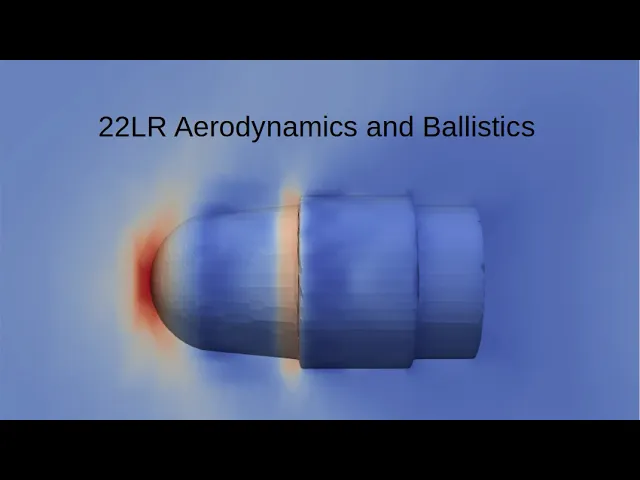
bullet with a with a blunt front end here's a cad um drawing of the bullet and um I can't help but be reminded that front end reminds me a lot of of the some of the planes in World War II that of course were subsonic they had very blunt noses um but we'll see how that performs in the simulations so here's the first picture is uh the eely bullet um going along very subsonic here and the colorization is based on the speed of the air and so the blue colors represent um slowly moving air and
the more reddish colors are uh faster moving air and you can see right in the front there's a a patch of of slow air that's filling in the front of the of the bullet and there's also um a boundary layer um next to the bullet of of relatively slow air and of course a a wake of disturbed air behind the bullet if you take a look instead of velocity if you look at pressure the front of the bullet has a a high pressure region and that's you know air that's been pressurized as it's hitting that
very blunt front end and it's interesting when you zoom in on that front end um the the pressurizing a basically makes a little cushion right there that has a streamline shape and the streamlines those are those white lines you can see that the air is smoothly flowing around the front of the bullet because of that cushion of pressurized air so my mind that's pretty very pretty clever it's almost like the bullet were longer than it is but we're making up the length with with air just for completeness here's what the temperature of the air looks
like that pressurized air in the front of course is heated up by compression but there's also a hot wake of air behind the bullet and that's basically energy that the bullet is giving up to the atmosphere is slightly heating up the air as it goes through and of course the bullet slows down because of that energy transfer okay that was subsonic let's switch over imagine we shot that bullet at Mach One .45 so 1,650 ft per second um now things are a lot more Dynamic here there's a again a very high pressure region right in
the front of the bullet which extends away from the from the front and also off to the sides that's because we're starting to create shock waves here and it's a little easier to see when you look at the velocity of the air so again there's a there's decelerated air right in the front of the bullet and of course a little bit behind it as well but you notice that the the effects of that on velocity extend away from the bullet and those are little shock waves that are being created as our bullet crashes through at
at more than the speed of sound now we actually launch our bullets for everybody I know of is is shooting bullets that are quote unquote subsonic but that's not technically quite right because aerodynamically the region from about 8/10 of the speed of sound to 1.2 times the speed of sound that's mack8 to Mach 1.2 um that's the transonic region and that's a region that airplanes typically avoid because although let's say the plane's going just below the speed of sound as the air goes around the airframe um it's accelerated and so you can have air going
faster than speed of sound even though the plane as a whole is isn't and that results in little flickering shock wavs all around the airlan and it's quite unstable so usually what supersonic Pilots will do is is blast through the transonic region as quickly as they can and and Life's good on the other side although it's got a lot of drag because of the shock waves you're making well the same thing is true with our little bullets um here's the velocity profiles at 1075 ft per second sort of a typical muzzle velocity of of 22
quote unquote subsonic round and um this isn't a stable situation you I'll show you a little animation as you watch the um the shock wavs are basically progressing down the bullet and and constantly changing so ideally we wouldn't want to launcher Bullet at the speed but we sort of need to to get it to where it it's going and of course the bullet is going to decelerate fairly rapidly as it goes down range um if you want to see a a really neat um physical video of this transonic shock um situation there's a YouTube channel
called smarter every day which I highly recommend and in one of the episodes he does schur and photography of bullets most of them are are supersonic but in towards the end of the video he shoots a sub sub Sonic round and sees these um these shock waves appearing even though the bullet is subsonic it's pretty cool I highly recommend it okay enough of those pictures so let's uh start thinking about the performance of the bullet and a good way to start is to plot the amount of drag the bullet has versus how fast the bullets
going and you typically this is done not versus speed of in feet per second or meters per second but in terms of mock number because everything interesting seems to happen right about in mock one and that's the case with this simulation here the drag is basically stable or slightly increasing to get fairly close to mach one and then it jumps way up and that's because we're all the energy it takes to generate the shock waves you know basically is drag um and so that's a very typical drag curve um nothing magic about the eely bullet
um now the part of the drag curve we're most interested is is the subsonic region um and you can see it it's not it's not one drag value we in order to model the bullet well we're going to need some sort of a curve there to account for the change and drag as the the bullet slows down before we get to that let's let me just fool around with with the shape of the bullet a bit I think you'll find this interesting um one thing I did is I I modified the elely shape and made
the nose more pointy which sort of looks more streamlined at least to my eye um so this is an imaginary bullet it doesn't exist but just what would happen if if that was the case and you lo and behold the drag goes up at least in the subsonic uh region so you know again the the shape of the E bullet is patented for a reason they've got something pretty clever there by the way I'm not a spokesman for elely I just happen to shoot their ammo um now another thing I tried was what if we
got rid of the heel it's sort of an unusual aspect of these bullets and so what if they're we just extended the the elely bullet uh as if the casing were a larger diameter and this turns out to be really bad it's worse in both the subsonic and supersonic regimes so although it's funky that that little heel is actually helping us out um so I couldn't resist I mean I I can come up with a bullet which is lower drag than the the basic elely shape the problem with this is the this pointy bullet design
would be uh quite unstable the longer and skinnier you make a bullet the less centrical stability you have and so I don't know what what distance this thing would start to Tumble but I don't recommend anybody go out and cast some but anyway it's sort of fun to simulate this thing and one thing about that uh bullet shape is when you do a supersonic simulation you get a nice bow shock off the bullet there's no cushion of air extending in front of the bullet anymore so now you get a regular shock wave like you'd expect
to see with a supersonic airplane or or any supersonic bullet and yes indeed this shape would have a lower drag um than the eely which I'm glad I could come up with something um so if it wasn't so unstable you might be tempted to use it but it turns out it's really not very useful at least in the ranges I shoot because here's a comparison of the drop um of the regular Elite Bullet versus this modified bullet and it's hardly worth paying attention to so unless you were shooting really long distances this kind of improvement
really doesn't matter to us which I found pretty interesting okay just for fun I I simulated a CCI bullet I I mostly shoot this ammo in my pistol but um I've shot at my rifle and it works fine I it does have a different shape obviously and um it doesn't have that blunt front end and it also has a sharper transition from the front of the bullet to the portion of the bullet that seats with the rifling um and it the simulation suggests that transition uh generates shock wavs fairly early and so here's the um
in comparison of the simulations this isn't real data it's simulated data but i' suggest that the drag curves are almost identical between the two bullets until you start getting close to the speed of sound and then the CCI shape um would end up generating those shocks a bit earlier and stronger than the elely and and so that Curve Kicks up uh a bit sooner okay enough on on bullets let's get to um to ballistics now the the basic idea ballistic calculation is that the bullet is slowing down throughout its entire flight and so we need
to know the drag of the bullet um which is changing as the bullet you know moves down range so you don't want to use a single drag coefficient for the calculation now ideally for every bullet we shot we would have the drag at every single velocity and we'd be all set to go but you know that'd be extremely expensive to get that data and so the approach people have taken is to use a model bullet where they do take a lot of data and then use that model as the basis for any other bullet which
is similar and so you know let's say our bullet is 10% higher drag than the model bullet you just take the drag curve from the model bullet and and drag it up and now you've got an estimate of the drag of the bullet at all speeds and that works well as long as the the drag curve of the model bullet and yours are pretty similar at least in the range we're interested in and so let's look at some some drag curves um I'll start out with the the G7 um model and by the way I'm
getting the values for these drers right out of Brian litz's book he has them in the um in the appendix or in the back of the book so the the G7 model is based on a a modern supersonic round that has a boattail shape and um which is quite different than the bullets we're shooting but actually the Dragon are pretty similar and particularly if you look at the subsonic region we're interested in um you imagine sliding the G7 up to match the um elely bullet it's a pretty darn good match and so I've used that
with good results and works just fine now elely also uh in their in their documentation on their Tech data sheet um mentions an ra4 ballistic model and this is a model model based on a healed bullet and it's just spoton if you compare the ra4 to the El match data it's higher drag but the shape's identical so if you imagine dragging that ra4 shape down to the elely match um that would be essentially a perfect fit and so if your calculator or whatever you're using to do your your dope uh has the ra4 model that's
a really good choice for 22 unfortunately the I tend to use my Kestrel it's super convenient and has all sorts of other features uh so it doesn't have the ra4 so I've been using the the G7 model works just fine the one model which is um prevalent but frankly I just don't understand is this old G1 model and that's shown on the red here and this is supposed to be the curve for this conventionally shaped bullet but um I don't think it's real uh I suspect now somebody may not know the history of that and
can fill it in in the comments but my suspicion is this is prior to Modern measurement techniques and modern understanding of shock waves and whatnot and uh it's not close enough so I one thing I've learned from this is I won't use the G1 uh ballistic model for anything supersonic or subsonic regardless of what the bullet looks like I just just don't think it's realistic anyway um so the the approach I've taken for my dope which is seems to work quite well is first I measure the the um muzzle velocity of my my gun using
a a chronograph um and then um look up the um in my case the G7 um ballistic coefficient for the elely bullet which is published online when I plug those two things into the krol OR into any ballistic software it seems to match my my own measurements um within a click at every distance um and if it didn't you know if it was a little off I would probably just adjust the the ballistic coefficient um a little bit to make it fit but so far I haven't needed to do that um now one thing I
I don't want to you know wish your money but I resisted buying a a chronograph and U number of people told me I had to buy one and they were right um you give you for the two bullets I mentioned here I've just written down what's written on the Box in terms of velocity and then what I've actually measured using this chronograph and they're so far apart it's just amazing um and you know that's just because every gun is different it's not a fault on the manufacturer or anything um so you really don't know your
um your ballistic without knowing your muscle velocity which is pretty obvious but it took me a while to figure it out okay well anyway that's all I've got for you I I hope you enjoyed this and found it a little bit useful um I'd welcome any comments and you have um down below and hope to see you at the range PA [Music]