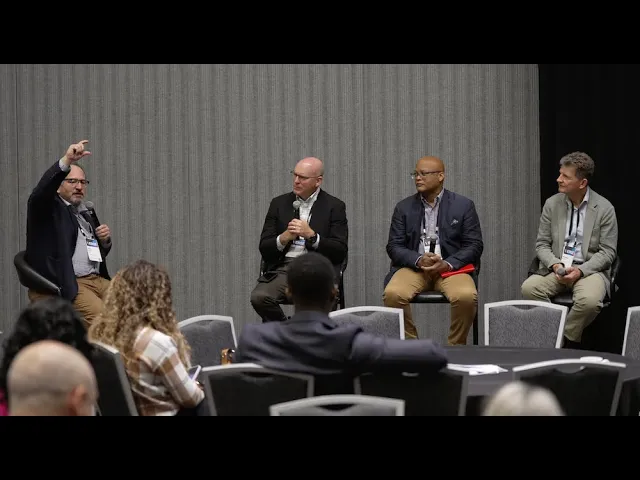
[Music] welcome everyone I have the pleasure of welcoming you to sustainability data hell if you've read the program but Dam Nation aside we expect a very interesting conversation I'm Peter Tas I'm the founder and president of the institute for Innovation and large organizations uh we are known as ILO we also run the ILO decarbonization Strategy community and we're here with a wonderful set of folks we've got japen from sap uh Brian from PWC Christian from sap and me and I think the first order of business is introductions please thanks for coming can you hear me
in the back don't have to use a drill sard voice there we go great thanks um I'm japen hollist I uh I have the privilege of being the head of our sustainability go to market activities At sap I work in customer advisory um in North America um I think we were going to comment kind of on our on our um kind of what brought us here should I do that please do okay um I I was a young infantry officer um uh when Bush uh pushed for a surge in Iraq and um and I got
assigned to drill sardon Duty um and and running basic training and um for a couple of years and and I read an article on sustainability and it captivated me and I thought that that Was the was the Mega Trend that I wanted to connect my career to as I got out of the army and so I come from a very very conservative background Into Climate interests and and the environment which is a very different route than most um but it was a fantastic route for me um it's made an enormous difference in um in my
career um and and so that's that's my background and why I came to sustainability Brian Thanks Jen uh Brian Henry uh with PWC um my era responsibility is around working very closely with technical alliances uh with uh with a focus on how clients can use technology to help Advance their sustainability Journeys uh believe a lot of the answers that we're looking for at some point can be found in data and the systems that we use to collect and process and report that data are going to be critical to Our Success how did I come to
sustainability um started out my career In is and gas not surprisingly in our energy industry which which is much malign but which we all need so dearly we see that uh an environment under transition the energy transition is pretty critical but the more I worked in that environment is more I realized uh how much more we needed to do at scale to be successful uh ultimately found myself to PWC where I'm working with um a lot of very talented highly motivated people to assist our clients to get to Where they need to go and so
it's great to be with you um seeing a lot more younger faces we're looking at than maybe the ones you're looking at and that's excellent that that needs to happen and we look forward to a great discussion thank you does that work yeah so chrisan BSL um also with sap um I'm a solution architect for sustainability for North America I'm uh physicist by training uh when I went to college right I was more Like in in BIO um bi anorganic chemistry but we also had the first um data center there doing like really the first
climate simulation models there in Hamburg so I still remember those days uh when you know the first climate change was really predicted there so um now in within sap I had multiple roles in engineering then I went more customer facing uh and then since almost like four years I'm I'm working the sustainability space um what what G got Me there um to be honest in 2020 those who are here from the from the Bay Area might remember the CZ czu fire uh which basically burned 90,000 Acres all the way from Skyline to the coast um
and I was hiking that area like a week before the fire started and that really got me thinking right and then I thought I want to do something which is really more meaningful so I moved into the sustainability space with an sa thanks hello hello awesome wonderful and We did just have a pretty terrific pregame conversation um if you're a Yankees fan by the way pregame is kind of good the World Series officially started yesterday I think I think new York's looking good but we'll have that conversation separately I yeah nothing like watching the World
Series at a bar at the Marriott Residence in but that's a whole other story um so we've got a few points that we want to cover I'm going to ask These gentlemen some specific questions they've got a lot to say my job is also to push them a little bit so that we talk about data practices processes tools but we talk about the underlying issues that the data represents we talk about changes that have to happen in order for us to get where all of our organizations want and need to go so that's kind of
my role but the next slide has a QR code on it those of you already talking on your phones have an Advantage um but if you have a device with you pull it out please and scan that code you're going to be asked about what degree or if we want to follow Dante what circle of data hell you're in thank you thank you to the English and Italian Majors um I you know I'm not going to quote The Inferno in in Italian but I can't um so who's in sustainability day to hell right now to
what degree when you click on that you'll see you have a button option Choose the option that describes you best thriving I have a solid data strategy in place steady on track moderate facing some challenges challenged struggling with inconsistencies or overwhelmed I am seriously struggling to pull data from multiple sources and I'd add if you're in the category of we don't do it at all I would say choose overwhelmed once you click the button you'll be asked to sign up for a third party service don't do That just just shut it down and we'll be
fine um I think we can go to the next slide has everybody got it if you're going to get it okay why don't we do that oh look at that the consensus is challenged not I think a shock so we have a lot of work to do I'm going to begin with a question to J and after we do the round of questions by the way we will open this up to questions from the floor and to some Discussion before we conclude so japen why does data matter so much for sustainability and why is it
reaching a feeling of criticality for some even though most people feel challenged yeah um great question so you know you've you've heard heard the sayings that data is the new oil you've heard the sayings that that uh you know it's the lifeblood of organizations and we certainly see that particularly in an AI driven economy if you don't have good data how Many here have used chat GT GTP four anybody people on four yeah everybody right everybody's using it right um I'm amazed I've got a I've got a I've got a son who who is finishing
or just finished his freshman year into his sophomore year um in college and and to watch him use data in ways that I never thought possible as as a freshman he's so much faster so much more effective made the Deans List like a freshman year how do You do that I didn't do that um so I think data is just revolutionizing our world and it is key for sustainability we talk about it as sustainability is all about data data data um but that that data has attributes right and and we talk about it it needs
to be it needs to have the 5as right it it needs to be automated you you want it to come in automated ways you want it to be accurate you want it to be assured you want it to be auditable and then you Need that data as we see this data trend for sustainability you need it to be attestable meaning the CFO in your organization is going to need need to sign off on the ESG data just like they do on the financial data and so now where do you want when do you want the
data well you want it at period close intervals right it used to take when I was a practitioner in sustainability in a fortune 200 insurance company it would take us 15 months to gather 12 months of Data right in today's world at the rate at which regulations are impacting us at the speed at which they are impacting us you that is insufficient it does not work you must have that data at a far faster clip and it's got to be synced back into who's starting to control it right we I see CFOs hiring ESG controllers
that sit right next to their financial controllers and their accountants right with a sustainability interest in background so you know when I started I was working with our senior vice president for corporate Communications and that was where sustainability began it began as a good news story a PR play to drive brand Improvement and recognition for all the good things that our company was doing that is no longer the case right PR is very very different than Finance very different right the rules are different and so the rules around data are different and I think with
that as the Backdrop I think we begin our conversation on how do you solve the data problem right hopefully that's helpful I think it is helpful I want to give you one quick followup how should we be thinking about the underlying issues that the data collection is pointing to you know which is to say we've got moving Targets in terms of what sustainability really is my concern is we're going to dial in and have a lot of investment in systems that Give us the kinds of data we're looking for and thenal shifts happen and the
more important data is not in that collection how do we have that generative notion of collecting sustainability data no it's a great it's it's a great point I we we talk about it and it may be a little bit Market you know marketing or too much marketing but I I think about it in terms of I need I need to record right the data I so so that I can report the data that seems to Be the compelling event right everybody says get me my report right give me my csrd report give me my CDP
report give me my ts right just name name the three to fourl acronym and there's a report at the end of it so record so that you can report but what people forget is and there's all kinds of problems in that data collection where is that data and I think that's what you're alluding to is where is that data how do I get it and where we find is that sometimes you Don't you you don't have it because you have you don't have a business process that surrounds it yeah right and that's part of the
problem is that many companies don't they don't do that and the other problem is is that they tend because I've got to record and Report the focus becomes on the reporting and so the F and and because it's so painful to gather the data you end up wanting to gather it as a sustainability team and put it over in a Silo problem right when sustainability gets divorced and siloed and separate from the business it can't influence the business anymore and what are we trying to do we're trying to change the business right and I think
that's the problem so it's becomes very hard to do the next step in the journey which is to act you've done the first start right which Which the regulator the Regulatory Agencies require you to do and that's report but you're not ready to act and you can't go influence that business that's operating unsustainably as they always have and you're trying to send them reports and get them to change and you're going to have problems yeah I think that's great let's move on to Christian Christian how can you overcome in a large firm the challenge of
of disperate Separate sometimes contradictory streams of data around sustainability so yeah let me let me do it once get a step back and kind of build on what what jpen was saying right uh in terms of the data so ultimately um yes we have to create a report that becomes more and more you know requirement legal requirement but actually what we really want to do is we want to become a sustainable company right so we want to change our business Processes to become sustainable and that I can not do if I have a yearly report
because things have changed I mean things are just changing too fast right so I have to be really be close to the data on the from a Time perspective but also from an accuracy perspective right so if I buy something right if I buy something from A supplier um today I look at you know from a financial perspective I look at who was the supplier what did I buy how much did I Pay and I really want to know how much I paid I don't want to have like an average industry price right I want
to know exactly how much I paid for that for that item now from a sustainability perspective I also want to know for example what is the carbon footprint associated with that now I don't necessarily want to have an average carbon footprint I want to have the exact carbon footprint of that of that particular purchase so um so that will Allow me this inside will allow me then also in for future purchases to really Drive change right having the procurement manager looking into not only price quality availability but also carbon footprint as an example and other
attributes right from from the supp supper so we have to be close to the data it's not about just extracting the data and then creating a report we have to be close to the data from a time and granular perspective so that means what We actually would have to do is we have to first of all look at where are the data and quite honestly a lot of the data are in our Erp systems right this is where our business processes run this is where I do procurement this is where I do sourcing where I
will collaborate with my suppliers this is where I have my HR processes running right when I look into things like equal pay so sustainability is not carbon right it's a broad broad spectrum of of topics so It's really in the Erp system where I run the business processes and ultimately have the data so this provides me like a data model which I want to need to leverage where I can Define targets and then measure against the targets and take action right to become more sustainable and ultimately once I have this data model and canot bring
in all the data then I can also basically use this to support all kind of regulatory requirements I have the Rigor ultimately I have the same rigor and accuracy Assurance Jen alluded on that which I need for finance right I will also need that for sustainability because we are moving from a voluntary World voluntary reporting world to a mandatary world where the CFO has to sign off on it and ultimately might go to jail if you know if it's if it's not correct so so we need to really have have the same rigor and sustainability
than we have in finance um and um and Once I have this and get get these data then I can create the reporting I need same then in finance and I can create all kind of reporting whether that is csid reporting you know as you see here issb you know um BSR bsrs I think in India uh China the main um three um stock exchanges just announced or just release their requirements for reporting so all kind of global and Regional um requirements so we look here like like plastic or packaging you know Regulations which come
up in Oregon and and California so I have all these data I have in my Erp system and this is what I need to leverage right and this what I need to build on so that's would be my answer right to that so really kind of collect that I think it's a great answer I I want to push a little bit you're talking about mostly what the data that we're collecting and Reporting and doing it well doing Thoroughly doing it with a lot of Engagement from folks across the organization is there another level in which
you're talking about principles and values and you're not looking for answers to questions that the regulatory demands create or that articulated company goals create but you're looking for new questions you're looking for how the game has shifted in some way does that make sense as a question yeah I mean I would say when I understand it Correctly right so beyond regulation and a lot of things are are driven by regulations right because as a as a corporation I want to be compliant I have to be compliant because I don't want to use fins but there's
also like an advantage right if you look at fashion for instance fashion industry Right End consumers want to know where their clothing has been produce right they want to Beyond any kind of regulations they also want to you know Make sure that there's no child labor whether there's a law in place or not you know people want to look at that and that is that is really important for the brands right if you look at there are certain brands particular in fashion industry right which really built their business model on the assumption that they are
sustainable right um and that's kind of is the the whole value of of that company and and some of those companies even don't create a Sustainability report yeah right they just brand themselves as being very sustainable um and have huge success with that so there's a lot of value Beyond regulations um for for Brands and and for for the and consumer awareness yeah it's interesting we we've had convers ations recently with a very large european-based uh fashion label and one of the things that they're beginning to look at in their supply chain uh is unexpected
lower costs which In theory is great but they're beginning to see that as an indicator of non-sustainable practices and variation from standards if suddenly we have a lower cost that's meaningfully lower and unexpected is there a kind of off- thee grid subcontractor they're pulling in do we have the ability to go deep deeper than just saying super you know will'll pay the lower price yeah that that is actually an excellent point right because um you know we we can all say Yeah we want to have a sustainable supply chain we don't want to have forced
labor in our supply chain particular in that industry right where you have multiple layers and so many kind of you know third fifth sixth tier suppliers how do you really know that right how do you really find that out so using these kind of you know data using AI at the end as well right to really find out where are the hotpots where I might want to have to look at right Deeper to find to make sure that I don't have that well let's let's continue this I I know Brian is a a deep thinker
about the things that are not on the surface around sustainability data so how can how can you use measures of sustainability both explicit consensus oriented measures and maybe some of these hardto find measures how do you use them to make really strategic change in large organizations uh yeah thanks for showing Throwing me a softball there Peter I appreciate that um first of all um as everyone here has said sustainability at its fundamental core is a data challenge that's really all it is um the challenge is getting to it and we've seen especially in the regulatory
environment as folks have commented on we're moving from voluntary to mandatory and some of the requirements are coming thick and fast I think with the csrd uh 11 1200 metrics need probably 128 there you go um and you're looking at the data you need to support those metrics and to have that assured we're talking about a massive amount of work the issb is also has its own own thing going on um uh we're beginning to see a little bit of convergence um around some of those um maybe some folks in the room have dealt with
the CSR and its requirement uh some of those the dma the double materiality uh and the Gap analysis I see some nodding heads and some sleepless nights um the key for corporations is to understand why they're doing sustainability what's their strategy around sustainability is your strategy to merely respond to regulatory requirements and to continue to respond to as minimally as you can to those evolving requirements is the very Definition of data hell itself a Purgatory from which you will never emerge so that shouldn't be the strategy um that friends allow friends to adopt uh a
more sustainable strategy is understanding um from that double materiality analysis um and from The Gap analysis is maybe where the largest risks and opportunities are uh for companies because in addition to being a data problem sustainability is about Risk also at its core it's uh sustainability is a business risk to be assessed and measured and mitigated like any other business risk that we face do we have the abilities in our companies to measure sustainability risks in the same way and evaluate those risks in the same way that we evaluate any other business risk and that's
an interesting question because a lot of the struggles uh that we are seeing our Clients have and I suspect on that survey folks didn't pick overwhelmed because no one wants to admit to being overwhelmed so they pick the one one away from over overwhelmed and that's okay the fact of the matter is in order to do sustainability right you need governance you need the right governance you need the right attention you need the right Focus so you're sea Suite you're bored from a from a um oversight perspective From a governance perspective from a funding perspective
from driving the right behaviors needs to be engaged so that other folks in the organization have a chance of being being successful um at delivering on it and then for the reporting critically important but as has been eloquently described uh by Jen and by Christian is the reporting is a snapshot of the past it's useless for the future it can't be used as a planning tool you Can't do what if analyses with a csrd report that you pulled a crew of 80 people together spent millions of dollars to compile and then you report it but
you can't do anything with it around the next transaction the next set of business so the key here is to use the sustainability reporting process to actually drive real transformation in the business um we've talk we've heard about Costs as well and pricing is the price of your raw material the true cost of your raw material when manufactur in carbon taxes is the lowest price supplier the lowest cost supplier and when do you find that out 15 months after the fact and so there's an opportunity here which we'll talk about more um three quick examples
of things I read recently where folks are actually taking sustainability and Making it real uh utility in the UK that is now pinging clients when there's an excess of wind they're using wind turbines and they're saying 50% off power for the next four hours it's driving people to then do their washing their drying they're charging their their EVS they're doing other energy dependent task it's is actually driving consumption changes so it they're actually saving money uh a second one is a is a Cooperative that in change for lower bills is having clients invest in a
little bit of they're buying a little piece of the turbine so now individuals who are paying their bills who are consumers like you and I actually own a piece of the turbine and so now are interested in making sure that that continues and then last but not least there's the one that really intrigued me is that you have a builder of sustainable affordable homes who when You buy the home guarantees which is an all electric home you will have no electricity bill for 5 years why because those homes actually generate more electricity than they use
and so now you have the opportunity to make sustainability real so on the one side you have the approach where you can do as minimum as you want and you report the things you have to report and you live in Daya hell go across to the far side now You've taken sustainability and made it real and fungible you're saving folks money you're changing consumption patterns which one of those two approaches do you think your company wants to adopt all right let me let me respond with a an even softer softball I say that ironically um
when you look at those current exemplary practices how far can they really scale I mean can I really build an energy Neutral or energy positive home in the in the 60% of the country that's not friendly to wind or solar in the US are are some of these practices and some is some of the conversation more about getting people excited by an extreme that we might not Implement and how do you tell the difference between the real steady dirty small step forward perhaps so I'd respond in this way um and there's a reason I use
the UK The the home of the Industrial Revolution a couple hundred years ago uh as the place that is one of the places where we're seeing some of these efforts change is it's going to take all of us working together to get to where we need to go it's going to be a combination of of smaller local efforts and maybe centrally driven large efforts like like we're seeing with the IRA and other um policy efforts to drive tax incentives Etc um to move investment we know how to Move investment to where it's needed uh that's
something we've had hundreds of years of doing very successfully so it's going to take a combination of large and smaller efforts the key is our why and the reason I'm going to go back to our why is climate change doesn't care about politics it doesn't care whether or not you believe in uh climate science says it exists um it doesn't care who wins an Election any election it's going to continue to exert its influence and it's now heavily a financial influence on individuals if you try to get an insurance policy in certain States like the
one we're sitting in um that's a material effect we're talking about dislocating people there's there's a material cost so whatever we can do from a macro perspective or from the perspective of our firms to continue to drive down that carbon footprint or to Be better about um preserving our environment regenerative practices Etc each of us make that impact now at scale I think at events like the ones that we're at here today where we see our future literally sitting in front of us it's events like this that will generate the connectivity that we need to
drive those big ideas and to have them adopted fair enough um I want to put a question as kind of a jump ball before we go to questions from the floor in a minute um I mentioned in our conversation earlier uh the Nobel prize winning Economist Lars Peter Hansen if you don't know his work check it out it's really smart he won the Nobel Prize for kind of mathematical models of risk but for the last 10 years he's focused all his work in a in a lab at University of Chicago on quantifying environmental risk which
is really helpful because now we can get closer to doing a profit and loss when we go firm to firm if we understand the Dollar and sense of that and in the room we had a small number of of folks we work with talking with him and the last question he got was what's the one thing you as as the world's expert in this want our firms to do that they're not doing and he said we I want you to measure the same things in the same ways right which includes how do you measure carbon
footprint and if you all have been at meetings like this and people say 18% of carbon emissions come from buildings and then 11% come from transport but actually some of the 18% was transport in and out of buildings you wind up with a 300% bubble right because we're all measuring different things different ways how close are the firms you work with and advise to being on the same standard around sustainability measures they're not they're not Um but but they want to H they want to and is that new yeah and that I think that is
fairly new um I I I mean people it's a spectrum people are people are at different stages in their sustainability Journey for sure right um but but they do realize you know you have to measure so that you can manage and and then conversations around measurement are all about uh are we measuring the same things and can we then have the same set Of definitions so that we can communicate and where I see that being very important is particularly around definitions of scope 3 emissions at a very detailed granular level so that I can communicate
with my supplier to please provide me the most granular set of emissions data right and and so being able to pull that in from suppliers and to be able to do it in digital ways right that that's where we get a we get some traction with Clients because they want to be able to influence that supply chain because the the suppliers scope one and scope two is their scope three and so there is a tie purposely according to greenhouse gas port protocol for positive prer pressure for everyone to reduce right and that's good we double
count in one sense but we also create positive social mechanisms to drive collaboration and that's very powerful I don't know that that's talked enough about in terms of greenhouse gas Protocol but that's the reason why it was organized the way it was to to create action so that we don't just report all the time and say we're done and celebrate but we're actually changing the nature of how we of how we think about sustainability right and you know I joke I I joke with people that sustainability is a first goal not an end goal think
about that for a minute it's a first goal not an end goal if you were to ask Me I've been married 32 years if you were to ask me japen um how's your marriage and I were to tell you well it's sustainable um what would the follow on you know hollist you probably ought to go seek some counseling you're probably not where you need to be you know what do we want the things that we value our jobs the corporations we're in our families our relationships our marriages we don't want them to be Sustainable that's
the minimum that's the minimum the problem that we focus so much on sustainability is because it takes so much effort just to get there but where are we going we want thriving right we want flourishing we want we want homes in the UK and the United States in red States right that produce more energy than they use that's thriving that's flourishing that's a new level right and what we're seeing is Clients starting to connect the dots everyone is so focused on record and Report record and Report record report recording report and I'm like guys what
about acting what about taking it to the next level we're just trying to get to sustainable and we're forgetting that the vision that's going to drive people for a common good right is is the acting that takes us to flourishing my two cents sorry I'll get off the Soap Box well said Christian That was so great I don't even know to there but um you know coming more like to the um little bit like a boring thing in terms of you know how do we meure me making sure that we measure in the same way
measure making sure that we account in the same way right so I don't I want to make the the comparison which I made earlier right with financials again right so there's no question in the financial side that I can compare the numbers of company a with Company B Right right everyone has agreed on a certain standard everyone knows how to calculate their revenue their expenses um so that that's a that's a great framework that's where we have to go with s come with sustainability again and we have to basically come come to a common framework
in the same way than we do financials right with the same governance uh same accuracy as I eluded earlier but also on the same structures because ultimately you know there is a Cost associated with that um and I need to know you know need to make um um um you know decisions whether you know I buy something here or there is it more expensive yes but maybe the carbon footprint is lower right so what is my cost of good salt what is my carbon of good salt right so I want to have the same kind
of measures which I have on the financial side I also want to have them with the carbon so that means I have to really move the financial world And the carbon world together from a reporting perspective being able to report on the same side being able to Define budgets on the carbon just think about a budget on travel right all of us probably have a travel budget right so what happens if we are don't have money anymore we cannot travel so what happens if I also have a carbon Budget on travel and then how do
we react if we still have money but no carbon budget left do we still travel or not so these kind of Things will drive change um and that's kind of what we have to get to Great Brian any final thoughts on this uh yeah so um the one thing I would say uh as a plug for systems because I think back to systems and data is is so important um as everyone knows that if you can't measure it you can't fix it so I think being able to measure um in the same ways that we
measure the financial flows being able to measure carbon flows across our Enterprise to understand Where the opportunities are and maybe aren't is critical because that helps our our plan I'll go back to the csrd double materiality assessment because it's it's so important and what does double materiality mean it does two things it looks at your company's impact on the environment and then it looks at the environment's impact on your company those are two completely different perspectives but both in critical for The future viability of your operations and by looking at both of those sets of
impacts and opportunities you're then able to drive along with your risk framework where you should be spending your time energy and money resources to mitigate risks and to maximize opportunities because this challenge this sustainability challenge is a massive opportunity for new business models for growth top and Bottom line growth we're seeing companies already beginning to experience those impacts and so it's really really important that our company sustainability strategies take that into account to get beyond the reporting only mindset and to get to the business value perspective that there always is um since the Industrial Revolution
began the silent stakeholder in mankind success has been our planet and it hasn't asked us for very Much but now it's beginning to clear its throat and make its voice heard and uh from a very human perspective who can only really use systems to accurately measure and understand the impact that we are having and the impact that we can have we should really pay attention because as long as that silent stakeholder stays healthy so do we it doesn't happen the other way around and so while that's kind of a Broader General call there is a
way to use our current systems to measure our carbon activities to understand the impact our operations are having again so that we can operate in a in a very circular way we can think about di biodiversity and all those other aspects of life that we depend on outside of the office and to be able to understand where we sit as companies and what our next step should be and can be and then to be able to use the data that is been Collected by regulatory agences to Benchmark our performance against our peers and others to
see are we really doing as well as we can or are there learnings we can get from others and that is collectively how we how we move um uh at scale to solve the problem it's very well said it's a great note to end this section of our conversation on and it reminds me of a conversation I had about 20 years ago with an evolutionary geologist named Linn Margy wonderful Woman by the way first wife of Carl Sean if you remember that Cosmos series uh mother of the of Dorian Sean interesting writer on all this
stuff um I just frankly said Lynn how worried 20 years ago should I and we be about climate change and she said well don't worry about the earth the earth is great at self-healing it's going to be fine worry about the impact on people that's the real fragility and and I would add today maybe we also worry about the impact on Corporations governments and other large organizations now two of you in this audience said you're doing awesome around sustainability data are you willing to come out and reveal who you are you don't have to but
I'm really curious we need the Jeopardy [Laughter] music yes Thompson with Oracle yeah sure I'm a little so I appreciate that um hi so I'm I'm Jen Thompson I work with Oracle um I'm on the sustainability it's sensitive um I'm on the sustainability applications team um we just launched a fusion product that um you know I heard all the buzzwords it mirrors the financial rigor um it it gets down to the granular level um it'll lift data from accounts payable invoices um we can have suppliers give us their specific emission factors and you can rank
them and say we always want to use these specific ones so that you get the Most accurate calculations um all the time so um we're we're working on um not creating products but creating sustainability solutions to solve problems um and I think that requires collaboration um it requires uh everyone to to share what information they have um so uh yeah I wouldn't say that we're doing amazing um but I think that we are we're getting there try we're trying to really help the market and customers can I can I ask you In getting to the
level that you're at were there one or two hard decisions thank you um hard decisions um I I I don't know because I I'm fairly newer in the space I wasn't there for all of the um going Going Through Hell so to speak um but I I know that um like all of us we're living in a Universe of spreadsheets and data that's sort of all over the place and then trying to figure out how to pull that in um to get all of your information in one place has been I Think one of the
biggest challenges um and instead of siloing and saying we're only going to read Oracle applications and nothing else so you have to buy our product to um be able to get this level of granular data we're saying you know what give us everything that you have give us your spreadsheets give us all of your other applications that you're running um feed data into our system from everything because we think that's the way to solve the problem instead of Saying no you just have to buy our product so that's what I mean when I said earlier
we're trying to sell sell a solution to a problem we're not we're not just selling product for the sake of selling product great thank you very much who else has a question or a comment I can bring you the mic yes sir well I want to say thank you to the the panel great some really great points I had a question around we use a lot of analogies around financial andg Reporting and as we know in financial reporting there is what we call Creative Accounting and interesting opinions that get formed on things that feel like
they should be standardized so you know what is your sort of response to some of the Creative Accounting practices that could occur or may occur in sustainability reporting and how do we tackle those cuz it comes back to that sort of compar comparability perspective of true transparency versus pseudo Transparency good great question yeah I agreed um so the best we have right now for corporations is third party independent validation verification um that's how we know when a company issues its financial report we can trust it or not so when that level of rigor is now
being applied to sustainability reporting which it is uh the csrd requires shortly after that you you go from uh basic compliance to having it assured reasonable Assurance Being written into that law which means the the folks who typically help you do the implementation they can't audit their own work there needs to be an independent third party auditor to look at your numbers look at your systems looks at your control trolls and then offers an opinion which their reputation sits on that this is accurate and complete I think that's as well as we can do to
begin to drive folks to being Transparent and to having the standardized systems and uh that we need to actually trust what folks are doing and it's one of the things that drove kind of the the regulatory authorities to move from let's do some of that Feelgood report let's talk about some of the things you're doing in the community to these 1180 metrics that is now being required at least by the csrd um so we've gone from the pendulum Has swung it's going to take companies time to catch up to understand that this is something they
want to do maybe companies don't want to do business in the EU they don't want to do business in Europe so it may not matter but that goes back to the why if if whether or not your company does business in the EU where the csrd has requirements what is your why what is your stance on sustainability how do your stakeholders how do your financiers Feel about that how do your employees feel about it how do your customers feel about it that still needs to be considered so I believe we're headed on the right track
by requiring the same levels of of transparency that we have on the financial side as well I would well said um I'm no accountant I by purpose right I didn't uh but I have taken a couple accounting courses and I'm interested in in how we Throw That term around right We we throw around a greenhouse gas protocol talks about that they they do carbon accounting now not debits and credits right it's carbon counting right it's inventories but what I heard your question was true accounting so we kind of we need to understand the definitions right
greenhouse gas puts together an inventory that oh by the way it has some really great attributes we talked about The positive peer pressure right but it also has some significant limitations because it does double counting it doesn't align itself with debits and credits right it doesn't now there are some emerging technologies that do right or we'll call them you guys know Robert um uh Kaplan who did balance scorecarding the the Harvard business professor he came out with El liability Institute how many of you are in are know about El liability Institute okay check it out
e El liability institute.com an amazing article in Harvard Business review from him and another professor out of Oxford that in essence say the future is to have green ledgers where we can actually count the carbon like you count cash with debits and credits at the car at the transaction level right now there are critics that I talk to particularly at some oil and gas companies that I know Say hey look how can you go do accounting true debits and credits counting carbon like you would count cash how can you do that sap right because we've
got a product that's coming out in December that does that it starts to do that okay how can you do that um if you know unless you and unless you're using um oh unless you have standards right like for for us Gap right we don't have those we don't have carbon Accounting Standards right Well people were doing double entry bookkeeping for hundreds of years before Gap right and accounting is a practice Guided by Theory right so my belief is that what will happen is that we will foray into the art of practice with our clients
what works what doesn't and we have this us Gap and IFRS rules that will guide the practice of operating carbon accounting and what you will see is our ability to truly count carbon like you Count cash and we will morph it as we learn right that's how humans operate we get better right and so I think the creativity you will see a lot of it there as the accountants determine not only are we going to create counting of inventory and Emissions but we're going to sink it back and we'll know exactly we'll have carbon budgets
like Christian talked about right in ways that that will be very meaningful for us to take action Right remember your how many people have enormous sustainability teams in your companies like 50 100 people anybody got that no like two like five right it's it's a handful so you have to as an organization be a force multiplier within your I mean you as a team as a sustainability team have got to go get like-minded individuals acting on sustainability so that the procurement people and the planners and the schedulers are out There evaluating emissions data you've provided
to them because you've got an Erp system that calculated it and put it back in a material master and sent it out and Infused it throughout the business process so it so sustainability is embedded and they can act so a planner and scheduler can say hm while I'm evaluating cost of Supply availability of Supply um price of Supply now I can evaluate my supplier on their emissions and it's embedded in My workflow that's how we get to act that's the power and we're so glad that Oracle is is entering that Marketplace because we were alone
for a long time right and and so that's important right that others start to use that Erp data right to drive change because we won't ever get to act we don't we won't we won't even get to Creative Accounting if we can't use data in business Process can I mention please can I mention a quick point on that just from a business process perspective small thing but it it kind of is kind of emblematic of the change that needs to happen in corporations uh we have some of our clients here who do um who hopefully
pay their bills every month let's use a utility bill they pay their utility bills every month for their buildings their manufacturing facilities Etc most of them use a third party to Gather that information uh yet when it's time to figure out to do your reporting for for regulatory reporting you need um kilowatt hours on electricity used and guess what you do you ask indiv indviduals you ask your third party processor to go back over those same bills and pull the kilowatt offs those same bills you paid every month on time so because it wasn't being
looked At from a sustainability perspective it was being seen from an accounts payable perspective so think of how many activities which are not kind of thought of as being sustainability activities in your company that really are they all are to be honest with you from R&D through to shipping it they're all they all have sustainability components so can you imagine if when you captured your your accounts payable bill you also captured The kilowatt hours which speciated the exact of your greenhouse gases at your so all of a sudden you don't need to pull a team
together to do that there are multiple opportunities to begin to converge business processes and operationalize the Gathering of sustainability data so it's not a project at the end of the year great quick yeah yeah very quick comment on on on the question you had right so so I mean even in the financial on the Financial side which is like hundreds of years old right we have evolved otherwise we wouldn't have a subance oxy act right so and the same thing will happen in sustainability right we we talk about internally a sexification of of sustainability right
so these regulations will involve and will put more rigor uh to the process onto onto the data so that they're also more comp comparable uh earlier we talked about Fashion right um and and taking this this example you know a lot of fashion companies or some fashion companies have been accused of greenwashing um now the EU is looking into a a green green uh green labeling uh directive which really requires company to put data behind it so that it can be proven that you have a certain you amount of recycled material in your in your
in your clothing or or organic material and things like that see this evolving yeah I mean I think I Think we're all attuned to the to the risk side of this how did we get sarbanes Oxley economic disaster followed by sarban Oxley how do we get to the next big Landmark around decarbonization and sustainability standards I think all of us in this room are in the business of trying to make sure we don't have the ecological disaster to make that happen happen I I can tell you we started doing work in in this sphere about
two and a half years Ago at that point all the big accounting firms were spending a lot of money uh to understand to do thought leadership around sustainability and decarbonization because they saw the scope three mandatory requirements coming soon and they want to own that audit space right they want to charge a lot of money for the financial audit they want to charge a lot of money for the the environmental audit for the scope 3 audit it's about a year year ago The chairman of the SEC announced to many people's surprise that they were going
to pull back on the mandatory scope 3 reporting because the process there it's not a law it's a rule all the the prep work had been done in terms of soliciting comment putting out different drafts it was not much more than the flip of a switch and the consensus was that appointed political and um administrative leader is waiting until November And here we are we're we're less than a week away this is the third rail topic for a conversation like this we've managed to avoid talking about politics which is largely a good thing but I
think we all know that's hovering in the background part of what we discussed in in the pregame conversation was it matters a great deal in terms of rhetoric but there are unstoppable points of necessity there are things in motion that no one's going to be able to Stop and I think the harm that politics has done has been more of too much holding of breath too much pausing and we will probably see regardless of who wins and regardless of the rhetoric a lot of change and and most likely some real progress continuing uh when we
hit 2025 having said that we have time for one more question or comment no we don't we don't all right raise your hand if you're an optimist about these issues good Enough and shoot that QR code you've got pieces of paper in front of you um you'll get a really substantial report from some of these folks and the host of the conference they will ask you for your name and contact info so that's up to you thank you all for being a great audience and thank the panel for a really great conversation and thank you
Dania for all your help [Music] Oh