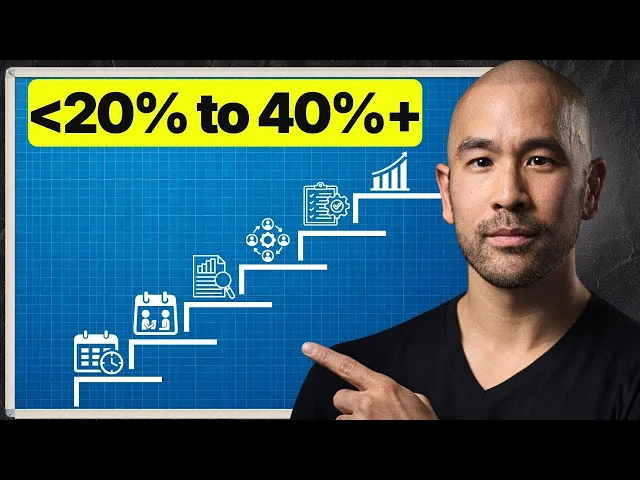
If you are CRO or VP of sales and your team is sitting in that sub 20 25% disco to close win rate range, this is for you. I'm going to walk you through the exact revenue engine operating system we use with clients to raise their win rates 5 to 9 percentage points, if not more. Cut sales tax about 25 to 50% and increase revenue per rep without adding headcount or stuffing more junk into the top of the funnel. Now, we've worked With teams and restaurant companies like Salesforce, Google, Workday, Deal, Microsoft, Tableau, and close to
800 clients in 6 years. So, here's what I mean in real numbers. One 58 AE SAS team went from a 21% win rate to 28% win rate in 90 days. Another enterprise org with over 100 AES cut their average time in stage by 11 days and improved their forecast accuracy from 63% to 82%. An MSP firm went from a 5% win rate to 25% in 6 months while going up market to Enterprise. So, if your reality looks more like deals are stalling the same two, three stages for months on end, you have a few hero
reps carrying the number while everyone else pretty much is just winging it and the forecast calls feel more like an educated guess with a spreadsheet and you're worried about hitting your org sales numbers, then you don't have a leads problem, you have a system problem. And in today's breakdown, I'm going to walk you through A full case study and show you why most B2B orgs are stuck at that sub 20 25% disco to close rate. How the powerful methodology changes the way reps and managers actually run their deals, and how we can install it through
a 10day diagnostic and 6 week sprint, and what actually changes in your numbers when you do. So, if you lead a team and you know your win rate should be far higher than what it's already at right now, stick around. Let's get into it. Now, First, let me go ahead and introduce myself. So, first off, my name is Marcus Chan and I'm the CEO of a company called Venley Consulting Group. Now, before I started my company, I spent over 13 years in the field in sales and leadership running B2B sales organization. Now, I started B2B
sales back in 2008, actually pre208, right before the recession hit, right? Right? And this was with a startup division. There was no real training. There was no Uh marketing. There's no support. It was completely 100% cold outbound to close. And frankly, I wish I could say I was absolutely amazing. I was not. I was actually first almost fired in my first role after going eight weeks without closing a single deal. Now, eventually I did figure it out. I started having some success and I stayed in my corporate career for well over a decade. And I
hadn't exceeded my quota 100 to 250% 13 years in a row. This is even through the Last recession. All right. Uh in my first eight years, I actually was promoted 12 different times, hitting number one in every single role. This is into Fortune 500 companies, which were highly highly competitive to tons of pressure. Now, in that time frame, I also closed over 700 million TCV as total contract value, which equates to about 140 million AR roughly. Now, uh in my last several years, I actually ran a 195 person sales org with over 100 plus Reps.
This is over 13 different operations and I also had dotted line to me thousands of also other employees and other functions such as you know CS and other roles like that too. Uh and because I was pretty fortunate to have some pretty good success across the board where you know even my own personal income as a sales leader I was averaging over $600,000 a year that's in total comp from you know base bonuses equity etc in my early 30s. Now by 2019 I decided at that point I wanted to make a move right actually went
and launched my own company Benley Consulting which we're focused specifically on helping B2B teams and reps really ultimately crush their numbers but really using systems from a true practitioner from someone who's actually been in the field sold in tough markets in high competitive markets in areas are hard for most people actually sell successfully in. And we're turning Rookies into record-breaking reps in under 90 days. We're helping teams cut ramp time literally in half and helping build and scale a lot of teams with other organizations are really helping them hit their number 250% like year after
year after year. Since then we've gone to work with close to 800 clients uh that are selling into primarily using mid-market enterprise and these were companies you probably heard of like Salesforce, Microsoft, Zoom, Google, HubSpot, Qualrix uh as well but also dozens of other lesser known but equally intense B2B or here's an example. You can kind of see a picture here. We're working with a large group right here. And across the portfolio of organizations we've worked, we've seen across the board win rates going 5 to 9 percentage points at the very minimum, if not way
more than that. We've seen stage cycle times shrink by 25 to 50%. Um, we've seen new AR increase Drastically without the like increases to actual headcount. Um, we've also seen first year survival rate and manager productivity improve drastically. As you can imagine, when you're able to increase your first year survival rate, get people producing at a faster rate. They stay longer, they produce more, and obviously reduce your overall cost as well. So, and across the board, we've seen a lot of impacts organizations. You can see here, Brandon Lock here. He's Over he's sales senior sales
director over at company called Beimo. We helped increase his enterprise enterprise win rate pretty much 5x four to 5x, right? And his average deal size went from about 10K to over a quarter million dollars in about six months. And of course, we have tons of other examples as well. For example, with Dmitri, they're enjoying more predictable revenue. Uh Dave Jones with his team, uh after 8 months, 300% to goal, but also Their new high retention when would skyrocket as a result of that as well, which is kind of crazy. Work with teams like Fischer. I
mean, with Tom Wland, we've seen his team drastically turn around their whole performance and engagement as a result of it as well, which was very, very cool to see. I mean, of course, we see tons of really really insane results, but anyways, that's that's not why you're here, right? um you're here to talk about like How can we get results for our organization but I think what's relatively key though as we discuss that is it's not just the orgs but it's also the reps as well. So like as you as you know as a sales
leader it's one thing to impact the sales the CRO sales VPs and the manager level and direct levels etc but also what do reps do as well. So you can see some examples here that I just kind of pulled up really quick. But even on our site, we know we have thousands Of examples of reps that are earning more money ever done, closing deals they ever closing bigger deals than they've ever done before, getting fast results, becoming the top reps of their company. So we can see we have tons of examples here as well. So
um I don't share this to impress you, but to impress upon you. This is the power of a system. And the reality is is, you know, some people think, well, hey, maybe it's maybe so, you know, now you're kind of retired From like corporate sales life. You know, you're just a talking head. Here's reality. Still, every single week, I still sit in deal reviews. I listen in call reviews every single week, right? I'm also working very closely with CRO's, salesp, revops, and frontline managers help really fix real deals and real funnels, right? So, my team
and I are heavily invested as part of that to change your results. And ultimately the powerful methology and the revenue Engine operating system which we'll walk through today came out all that hard work. I mean I personally have run 10,000 plus sales on my own before I built this whole system out. I have lost thousands of deals as well. Um but I've also have rolled out those out to hundreds of teams, right? And there's been a lot of scar tissue. So my goal with today is to walk you through the learnings I've had so you
can implement for yourself as well to turn your team's Results around. So, first off, the important thing you have to really internalize is you don't have a leads problem, you have a system problem. I'm going say again, you don't have a leads problem, you have a system problem. This is hard for a lot of people to internalize, but reality is is, you know, if you have low win rates, long sales cycles, uh poor forecast accuracy, those are symptoms. Okay, those are symptoms of a greater problem. So, let Me give you an example. So I pulled
up on RepView which is uh they have p they pull a lot of data and they said the average attainment across the board is about 43%. I want you that to sink in for a second. The average attainment across the board about 43%. This is and again this is over uh 249 organizations about 49,000 quota carrying sales reps and over 2 million data points and that means average payment is about 43%. Right? which means over half about 56% Of organizations out there are missing their number. That's pretty scary, right? But on top of that, across
the board, you know, deal cycles have taken longer to close. You can kind of see this is the most recent data points. And this is at, you know, any anywhere from more, you know, smaller deals under 10K to larger, you know, 200k plus deals. They've all have taken longer to close based on the most recent data, right? But I want you to really internalize This. These are symptoms of a greater problem. All right. And I want you to imagine it's kind of like if you went to go see a doctor. If you went to go
see a doctor, they wouldn't just want I mean a good doctor I should say specifically. They wouldn't want to treat just your symptoms. They want to find the root causes and fix that instead. So here's what you know the underlying what's called disease looks like for most organizations which is every AE runs Their own version of the sales process. Uh pipeline reviews are essentially stats updates are not coaching sessions. Enablement measures events delivered not behaviors changed. to see is quite often unfortunately um managers spend hours in CRM and still don't know why deals die you
know there's probably frameworks in place maybe there's medic or medic or similar things already put in place exists on paper but not in practice so what are the results that we see well we See low win rates so usually you know this and I'm talking about specifically disco to close win rates right so disco closed win rates are hovering in the low 20s okay we're seeing deals stall in the same two three stages we're seeing execs sponsors, they appear late or not at all. We don't even have the right executive buyers in the deal at
all. Right? And most forecasts are just best guesses with tons of optimism. So ultimately, you have to remember this. It's not your fault. First off, you're not broken. Your reps are not broken. It's the system that is broken. So let me walk through some examples of different case studies so you can understand how we can make some of these changes. So the first one I'm just going to talk about is even my own business, right? So for example, my own business. Now just little heads up, we've been obviously because I I made the mistakes. I
had a scar tissue when I started my Business over six years ago. We already were implementing the powerful framework, right? We're already implement these systems already and we continue to improve it over time, right? That's really key. So you I take a look at even our data points from 2023 to 2024. You know, we went from a we had about a 54% disco to close win rate. So that's a 54.7% discount close win rate and a 97.7% show up rate. This is this is in 2023 through 2024. So already pretty good already, right? Because we
already have been implementing the system across the board. Now I've continued to get better and refine more and more and more the system develop the team even better over time right and now to I took a look at in 2025 we just got our final numbers. We had a 58% win rate and 100% show up rate in 2025. So even at that point we still increasing even more and we're selling primarily to the mid-market Enterprise as well. So pretty cool to see that's our first case uh case study. The second one's going to be uh
a mid-market SAS company. It's it's a fintech company. Now I can't name some of these companies because we do some some companies require to sign disclosure agreements, right? So you know NDAs. So they're they're okay with me sharing the result but they don't want me to share uh exactly which companies are because of for obvious Reasons. Anyways, so this is this is a mid-market SAS company at FinTech, right? They're fast growing, right? Um, at the time they have about 58 AES. They're based in Austin, Texas. And they had an okay win rate about 21%. But
in about 90 days, we drove up to 28%. So a plus 7% 7 percentage points bump, right? And really an extra $1.4 million. We improved the demo closing conversion by 12 points and their sales cycle we cut down from 89 days to 68 days about 24% Faster. So what's been really cool because of that predictability and the results they're getting. They actually just raised another round which is actually really cool to see. So uh another example is as this is an SMB motion. This is professional services. It's kind of cool. So we work with other
industries as well. So in professional services they're based on the east coast. So over in New York uh 32 AES at the time. Win rate went from 24% to 38% In 60 days. So it's extra you know over $2 million in revenue. Uh the also the op quality improved drastically as well. very very cool as well. Um but on on top of that the issue they're also running into as well was because because those they were you know in in the SMB motion I mean they had obviously more deals but reps are spending a lot
of time on the wrong types of deals. So we we found after making these changes they had better ways actually running their deal Cycles. So there spent more time with the better quality deals that are worth it to actually have increased you know overall deal size too. So uh case number number four is an enterprise ass company. Uh this is based in the Bay Area so over 100 100 AES at the time. So win rate was 26%. So not too bad. Uh and we increased to 34% in about six months 180 days. So in because
obviously they're enterprise deals were much bigger. So that's an extra 11.8 million Revenue as a result of deploying these proper changes. Uh we we found deals move much faster as well through the sales cycle and forecast actually improved drastically as well. But also more importantly, the exec team finally trusted the pipeline to actually plan around it. And you know how important it is as an exec to be able to look at your pipeline to be able to forecast what's what things are going to look like for the next several years in your planning Cycle. So
again, these aren't flukes, okay? This is what happens when you actually give reps when you give like, you know, even average reps and managers a consistent way to run what's we call powerful discovery. And you also build what we call SPO alignment which is solution problem objective alignment which basically means we're showing them how to take a solution help them solve that department level problem and align to the biggest core objective of the Company which a lot of a lot of reps struggle to do right so we're solving real business problems but on top of
that then we also coach the deals using the same language and tools. So now before we go into what actually works, um I want to be really I want you to hopefully avoid some mistakes I was making, right? And what I see a lot of CRO making as well that they've tried to do to fix win rates. So here's five things that we tried that did not fix The win rate. So number one is well we let's just add more headcount. So we added more reps, right? So sometimes it's like when win rates are low,
it's like the easiest thing is like we just need more capacity, right? So you know we I started adding more headcount, start to basically cut up territories, right? um the team size started getting bigger, right? And immediately as you as you know your cost basis goes up. So now you're deploying all this cash to Basically have more cost and you don't get the the result that you want up front, right? Um but here's what I found. This is what I realized, right? Because I wasn't smart about especially early as in a regional type of role
is when your team if they're already doing sub 20% win rates, right? Just Cisco close to be specific. More reps means more inconsistent execution. Again, weak discovery, shallow multi-threading, poor internal business cases. So, I'm I'm Actually getting um more cost, more false pipeline with the same, if not worse win rates. And ultimately, you know, your CAC per dollar new AR actually goes up and not down. So, the first big mistake I real, you know, I I I've made in the past. The second thing I've also done as well, the big mistake is I poured more
on top of funnel. So, I'm like, okay, this feels really safe. I'm just going to we just need to amp it up more. we need to get more pipeline, Book more meetings, etc. So, and it feels safe because we can measure like how many calls, how many emails, all those things. So, um that's what we did. And ultimately, you can also, you know, you can land more paid, add more partners, add more channels, and we're celebrating like MQLs and SQOs, right? Um but here here's what I found. If you have more MQLs, if you're I
mean, if your deals already leak in multiple stages, more MQLs just means more Stalled ops, right? More means means more circle back next quarter, right? And reps spend more time chasing and not more time winning. And it's like turning the hose up on a leaky bucket. I'll give you another example, right? So, you know, working where, you know, I was talking to the CRO and they have about 100 100 reps and they it's a PEO company and 100 reps and they have done okay, but the last year or so they basically missed their number and
they wanted to Drive more pipeline. So, they actually wanted to hire more STRs. U they want to invest more into marketing and all all that jazz. And we took a look at their numbers. They had an 8% disco win win rate. So what they would do, right, if you think about this is like if we had an 8% win rate, that means like for simple math, like if they talk if if a rep talks to 10 prospects or has 10 discovery calls, only one's going to close. The other not going to fall to The wayside,
right? So this is like a huge miss because now they're going to like try to add more pipeline, right? And ultimately when you already have, you know, basic crap metrics, you're only scaling crap when you try to add more pipeline. And so that was definitely a huge opportunity there. So another third mistake I I have seen happen quite often too is one day training on SKO hype. So you know companies will bring in a big name they Run a workshop and everybody loves the time right for about a week. Okay. And then what happens? So
the slide they stay in the shared drive the call records not exactly the same and deals essentially still at the same stages right and you know reality is events are inputs not systems. It's kind of like if you want to get in really great shape and you want to maybe, you know, maybe add some muscle on, lose a little bit of body fat, you know, get in great shape, You can if you have a oneweek boot camp and you, you know, eat really great and you work out really heavily. But then after that, what happens?
You fall back to old patterns and you go back to the old way eating, the old way of doing things because that was an event. It was an ongoing system, right? So reality is without a shared methodology without magic coaching frameworks without a CR fields and views that align that methodology training becomes a very very Expensive pep rally. So according to Gardner and some people knows don't don't know this but most sellers tend to forget about 70% information they learn within a week of training within and within a month 87%'s already forgotten. So think about
that for a second. So you when you bring somebody in for that SKO, you hype them up or you have, you know, one or two day workshop, what happens one week later, one month later, 9 days later, the data shows majority of people Go back to old habits and they don't make meaningful change. The fourth mistake I see a lot of people make as well is buying more tools. So you know, we've seen this where they have a great tech stack. So they got like, you know, Salesforce, they got Kong, they got Chorus, um they
have, you know, three, five or more enablement tools. Um they have 10 or more dashboards, but they can't when you ask them simple questions like, hey, why are these deals stalling? They have no idea, right? Or hey, what's the difference between the deals we we win or lose at, you know, stage three or what exactly are best reps doing differently in discovery and multi-threading? And they're not able to answer that. And here's the reality. Tools ultimately magnify the process you have. So if what your magline is random, you get pretty reports on bad habits. Uh
so your managers end up drowning in data, but they starve for true insight To actually make meaningful change. Okay, here's mistake number five, which is hiring rockstar AES and managers and hoping they fix it. So I'm sure you have probably seen this movie yourself, which is you hire a quoteunquote rockstar from a big local company. U maybe you promote your top AE in management and then hope they elevate everybody else. But here's the reality. Without a consistent operating system that everyone's running, running together, your best Reps are essentially accidental outliers, right? They can't explain what
they do beyond, hey, we work really hard, uh, we qualify really well, we follow up, you know, we're pleasantly persistent, whatever. So ultimately what ends up happening is your best, your new managers turn into what we call super reps, right? So they're like they basically close the deals themselves and they can't multiply themselves, right? So they're closing deals and they're not Actually coaching. And here's the reality. Good people don't fix broken systems. Broken systems break good people. Now, here's the reality. Um, after watching these five fail in my own org and in many other orgs
as well, we stop asking the question of who else can we hire, what else can we add? And we start asking this question said, which is, what would it look like if every rep and manager in this org sold like our best on purpose? I'm gonna say it again. What would it look like if every rep and every frontline manager in this org sold like our very best reps on purpose? So that's where the powerful mythology and the revenue engine operating system came from. Right? So let me first walk through um the old way that
a lot of teams are still running versus the new way, the hard methodology. So most teams run a version of you know light discovery, a heavy demo, then proposal, then they chase, they discount and they Pray. And it kind of looks like what you see, you know, on on the screen here if you're watching this, you know, on the video. So, which is that discovery, demo, proposal, handle object, and follow-up. And we don't know what the end result is going to be, but it usually leads into, you know, that sub 20% win rate, right? But
here's the reality that processing itself is very product. It's very company ccentric. And we have Seen this heavily, especially for a lot of organizations who have been, you know, grown heavily through productled growth. And that this is kind of what they have done which is actually a very old school way of selling as part of their sales process. Now the issue is with this process as well this is also assuming buying buying is very linear and rational like real deals don't look like that. So re here's real especially when they're more complex is they Usually
see multiple stakeholders all with different agendas. I mean half the time they can't agree on what the core problem is and the impact and the data has shown that majority of more complex deals have at least six to seven stakeholders that influence the decision to actually make it happen. Um there's also internal politics and resource fights. You know there's competing priorities and vendors and there's a ton of internal selling you never see. So You can kind of see on screen here this this this garden this image here this image is actually at the time of
this recording is uh over seven years old right and it shows on screen you see the the the how how complex it is where there are you know we'll call it dozens of substeps within a process that go from you know getting aligned on the problem getting the group to get aligned talking with different you know different like you know vendors you know Looking online doing research talking to former colleagues, checking feasibility, checking suppliers, looking at business cases, looking more data online, working with the RA. It's very complex from that very start all the way
to the close. And it's different every single time for every single organization. In reality, this is how this is how buying has really become over time, right? So, you can't brute force your way through a process where it's more complex by let's Do better demo, let's do better followup, right? Ultimately, you need a mythology that recognizes the binds very messy and nonlinear that systematically builds trust and align across stakeholders, but can be taught to average reps and coach by average members. This is really important because in the perfect world as a sales leader, we all
wish we had a top 1% rep for everyone and we the top 1% manager across the board, but that's just not The case, right? So, we have to be able to build system to raise the bar across the board. Okay, so let's talk about the powerful mythology in or language. Now, here's reality. The powerful mythology is not a script. It's a lens your team uses to run discovery, deal strategy, multi-threading, late stage control, more this is across every stakeholder on the deal. All right. So, if you can see on the screen here, you'll see that
we we leverage discovery, mult across the Whole sales process. We're deploying the powerful methodology across all the stakeholders. And we're uncovering eight core pieces of information from every single stakeholder. And here's reality. Powerful exists because most deals don't die from competition. They actually die from information that never gets uncovered. I'm going to say it again. Most deals die from missing information that never gets uncovered. And this powerful methodology gives your team a Consistent way to surf that information early, pressure test it often, and close gaps before the deal stalls. So, as you probably can imagine,
powerful is an acronym. It stands for something. So, here's what actually covers. So, first off, the first P is pain. So, we're not looking for surface level complaints. We're not looking for like a feature dissatisfaction. We're looking for true business pain tied to measurable outcomes. core business KPIs with Impact. So for example, that could be missed targets, slipping forecasts, pipeline risk, right? That might also lead to board pressure and career exposure. So if if one of your reps, they cannot clearly articulate the business consequence of a problem in the customer's language, discovery hasn't happened. The
second thing you want to uncover is what we call O, the opportunity cost or also known as the cost of an action. If that prospect does nothing, what does it cost the organization in specific business metrics? Is it a loss revenue, delay growth, productivity drag? Is it increased risk? And what's that look like quarter by quarter, year by year? And ultimately, if staying the same feels safer than changing, the deal will stall or die quickly. So, this is where nice becomes non nonoptional. So, we have to uncover not just that level of pain, but what's
the opportunity cost of Not changing? What's a cost of not taking action? Then we want to go into the W, which are the wants, needs, and desires. So, you know, finding out company goals is pretty easy. That's that's one core piece we want to uncover. But we also want to cover what are the personal wins for each stakeholder. So, what does the success look like for each stakeholder personally and professionally? Remember, when we're selling in these complex Deals, we're still working with human beings. What's important for each person, right? Do they want to increase their
credibility? They want to get promoted. They want to increase their influence. They want to avoid risk. They want to increase the political capital. Like if your team doesn't understand what winning means at the human level for every single stakeholder in a deal, alignment is assumed, not actually earned. So next we want to go to E, the Executive influence. So as you know, the decision maker is rarely the signer, right? So like you might have someone that says, "Yep, thumbs up." And then maybe the technical actually signs off on, right? But we want to find out
who defines success, who frames risk, who can veto progress without ever joining a meeting. And if executive influence discovered too late, the deal becomes reactive instead of controlled. So we're looking here for specifically what's Called the economic buyer. The only person that can say yes when everyone else says no, but they can say no when everyone else says yes. Again, they're not always a signer, but they have true economic power. It can shift budget and funds very easily and completely cause you to lose your deal by a snap of their fingers. Then we also want
to cover our resources. So budget is not just money. This is a mistake a lot of people make when they ask about budget questions. It's also timing. It's attention. It's internal capacity, right? It's political bandwidth. So what initiatives are competing for the same dollars and leadership focus? Who can improve? Who can stall? Who can quietly block? And if we don't have this level of clarity to that deep level, you will lose your deal. And unfortunately, I've seen this happen far too often where we'll see reps get really vested into the deal, but they didn't uncover
the proper Resourcing to actually deploy the solution. And you get to the very end, they spent six to 12 months with this opportunity and suddenly deal stalls out because there aren't the proper resources deploy at the company level. And then we have F, which is fear of failure. So every or this applies a couple different ways. So first off, every org has scar tissue. So maybe they had past vendors, a failed implementations, maybe internal Initiatives that went sideways, right? And that's real fear where they're like, we might mess up. That is a big thing we
want to uncover. The second thing we also want to cover with fear of failure is we also want them to realize, man, if we don't solve this problem, if we try to do on our own, we're not going to do a good job as well. And this is really key because we also know status quo is a big deal killer. So we want to uncover these things from a feel or failure Perspective in a couple different facets, right? And powerful helps force that fear into the open so we can address it up front and not
avoid it. And then we have also you unequivocal trust. So trust is not just hey build really good rapport. We both went to this, you know, went to the same college whatever, right? It's confidence that the decision is actually safe. Okay? It's safe for the business. It's safe for that individual. It's safe if things Don't go perfectly. So trust is really shallow like no amount of like discounting and faults actually going to fix this and then we go to L what's called the little stuff right so this is like this could be you know procurement
uh legal infosc integrations SLAs's right um it could be things that they need need at the very minimum to you know to put forth proposal right so these oftentimes these are also some of the details that some people will also Handle later that can kill deals late in the cycle so ultimately powerful treats them as risk variables not administrative afterthoughts. And here's the reality. Most teams with a powerful framework, they collect maybe a little bit of P, some L, and a hint of E for each stakeholder. But when we actually deploy powerful as a mythology
for a team, it gives your AEES in your managers a shared way to uncover all the eight elements for every important Stakeholder. It also allows you to score the strength of each one to 10 because reality is is pain can be level one, it can be level 10. There's a big difference right here, right? So, for example, like a level a level one pain is it might the impact might only be like let's call it 500k, right? And depending on the size of the or might be big or small. Say it's small here, but maybe
what they care about is level 10 pain, which is, you know, $10 million Pain. So, we want to cover level of, you know, one to 10 for every single component of the powerful framework. It also helps gives you a way to identify deal risk early instead of reacting late. This is really powerful. So if you can identify the risk early, you can take different actions or guide your team to do different things to help increase your chances of them actually moving the deal forward. It also helps you build a strategy, close a gap before It's
too late. This is absolutely vital. Often times we're I've seen, you know, I've been brought on to work with the team where the deals are in the late stages. They're already past proposal and at that point it's so much harder to close that deal because often times we have missed so much on the front end that we could have leveraged on the back end. And here's reality because of what we focus on here. This is not a script, okay? It's designed around human Behavior and deal reality. So it feels very natural to run. All right?
And what I've seen across the board is when teams don't do this consistently, win rates suffer, cycles stretch, forecast turn into guesswork, teams miss their number, orgs miss their number. And this is probably what's not really surprising why most sales VPs and CRO's generally are in that role. maybe 18 or so months before they're on to their next thing because they're getting pushed out Because of the level of pressure because the results are not shown quite yet. And ultimately, that's not a rep problem. It's not a manager problem. It's not it's not a you problem.
It's a system problem. Okay. Next, let's talk about how do we actually install Powerful as an operating system. So, not a one-off train. This is not just a one-off training. Okay? So, we don't just come in and teach Powerful, then we leave, right? So, we actually stall as a core Part of your revenue engine operating system. And we do it in three steps. Now before we go into that, let's define what a business operating system is because this helps us have a shared definition. So according to Google, you know, a business operating system is a
company's internal framework, its playbook define the processes, tools and principles for how it runs, achieve goals and manages people, ensuring everyone has shares a vision for Consistent, efficient and scalable performance covering strategy, meetings, communication, and daily tasks. It turns chaos into predictable success by clarifying roles, processes. That's the what, the how, the why, and accountability. Moving a business beyond reliance on just the founders, right? So it may not be the founders situation, but it goes beyond just the main exact team, if you will. So that's a lot, but to make it very very simple, that
means There's three core things we want to look at for your operating system, which is number one, the KPIs and metrics. Okay? So the vision and goals that's the people is number two which is that's executive leadership that's management that's your IC's individual contributors and then number three the processes so that's leadership and IC playbooks the processes the tools the principles right and within within these core areas we look at approximately 23 different areas Where revenue leaks may occur all right so you can kind of see here on the screen here I'm kind of zoom
in a little Okay, so you can see a little better. So they feeds into each other just like this where we're looking at 23 core areas or 23 sub areas within these three core buckets of the KPIs, the processes and the people. All right. And in order for us to take your current operating system and we transform into a high performing revenue engine operating System, we execute in three steps. I like to be radically transparent. So step number one, we do the executive revenue snapshot. is completely free. It's 45 minutes which will go in more
detail in a second. If it makes sense then we'll go into a number two which is a revenue diagnostic which is $10,000 and that takes approximately 10 days. And then number three if it makes sense from there we'll go to revenue engine operating system sprint which is uh 72,500 and takes approximately 6 to 8 weeks depending on the team size. So let's break that down step by step. So the first piece is is we're going to do the uh the executive snapshot and essentially this is this is a really really key key step to start
because this is a front door throw. It's completely free. It's 45 minutes, right? So you know before we actually meet uh your you know we get access to all your stuff such as you know 12 to you know 12 To 24 months of pipeline stages. This is your your sales data from your CRM. So we can take a look at conversion cycle time leakage right you'll send us over also three to five rep call recordings right by discovery late stage so we can start looking at all those things we'll look at your current stage definition
scorecard existing methodology right you kind of see that right here right and ultimately on the snapshot call which I highly recommend um you know you're Coming you're bringing someone from revops as well um any other executive leadership you may want on that call as well because it's going to be a very robust session where we're diving deep into your situation okay because on there we'll we'll come prepared where we'll take a look at your top three revenue links based on your actual data. We'll take a look at what's the actual potential upside like is this
a 500k problem or a $5 million plus problem That can have real impact, right? Uh and then of course we'll align whether a full diagnostic makes sense now, later or not at all. And within 72 hours, we you'll get a one-page, you know, memo like this that you can share with your CEO and leadership team, right? So even let's say if we never ever talk again at the very least you'll have more clarity you know from that conversation together that you can go and deploy and solve your core problems with that most CRO Most sales
don't ever ever get because most time they're kind of stuck in their own head and they're kind of guessing what to actually fix. Okay. Now if it makes sense then we'll you know to do a diagnostic. It's only if if you and I both agree there's a very good strong ROI case we can move into a structured diagnostic which is step two and again I can be very very upfront this is typically $10,000 for majority of sales organizations right takes about 10 days So you know in 10 days you know we're going to do quite
a bit of work if you will right so we're going to go ahead we're going to quantify stage by stage conversion and cycle time by segment deal size and rep band we're analyze more call records with powerful right so you We're taking a look at, you know, um, uh, you know, uh, you know, where essentially are your reps overall consistently weak on the powerful methodology, right? We'll take a look at Manager behavior as well. So, we want to take a look at their pipeline reviews, how they do one-on- ones, call reviews, right, against best practices.
We'll identify scale versus process gaps, right? And ultimately build a 90-day decision plan what to fix and what we might expect to lift, right? So what ends up happening because of this right you'll walk away number one you'll have a very clear board ready acceleration obviously I had to blur this out for for Obvious reasons right and then what you'll also do is you'll be able to know exactly what's causing us what at what stage we'll be able to get very very clear the exact revenue leaks right so we know okay cool like if we
fix you know stage one or stage two or stage three stage etc right it's going to be worth x amount of dollars so you you can know exactly the true actual dollar impact Right? And then of course we'll also put together a proposed actual uh Revenue engine operating sprint plan for you to deploy with your org. Right? So you can just kind of see some examples kind of like this the work that we're actually doing right up front. You know we're actually working with you see right here we're mapping it out together or walking it
through together with execs. Right? So that that's how that looks right from there. Okay. So, and then at that point, you'll have even even more crystal clear detailed plan Exactly what to fix next of your top three priorities to deploy ASAP. Okay. Now, at that point, you know, you have a choice as well. You can obviously do it on your own to do all those things to solve it, right? Or if you choose to do a 6 to 8 week sprint with our team, you know, if you do it within 14 days of the diagnostic
readout, then we'll actually credit the whole $10,000 towards the next uh segment, which is step three, which is a sprint. you apply it towards The 72500 sprint for that too. So, so let's just say for example, you're like, "Hey, that sounds great. What does that look like next?" So, this is where we take all those core insights we have already uncovered to change behaviors, right? So, over the next six weeks, we're going to deploy a couple different ways. So, number one, we'll deploy let's focus on AE section first. So, we're going to focus first on
the AE. So, this could be six to 12 targeted AE Workshops, okay? Over six weeks. focus on the core things we uncover. So for example, you know, it could be prospecting force meetings, running powerful discovery across uh stakeholders, uh multi-threading and and building internal champions, late stage control and d-risking deals, right? So we're we're focused heavily on making sure the reps are properly trained with the right things, not not in a one-day event, but segmented into multiple Workshops so we can reinforce skills and stack on top of that. But on top of that, we want
to make sure your leaders are also enabled as well. So working directly with the you know six well we run six leadership uh enablement sessions. So typically we'll see the CRO and VPs of 10 for sure the frontline managers and using revops are enabled also be on there as well. So here we're focused on you know writing powerful you know powerful driven pipeline reviews How to coach call how to do coaching calls and deals using our deal tools enforcing the operating system in one ones and team meetings right and of course as part of the
process we'll deploy different tools based off what we uncover in the diagnostic to help with deployment and also making sure we're turning to a system right so as some examples right here so you can kind of see it right so like you know for instance here like you know here we're This this is part of the AE the AE workshop, but we're also showing them, hey, what what does great look like from what your routine should look like from high performance, right? Making sure they know exactly what to deploy of the right IPAs in activities
to how do we actually do structure, you know, mutual action plans. That's an example to right here. Um to using tools like the advanced deal tracker and pipeline summary as well, right? You know, just Some examples right there of its leaders, right? So for example a lot of times you know leaders we found generally speaking you know like yes we're working on them here as well but a lot of times they're not using proper tools like most of them are being sadly ineffective you know what's the structure of how do they do one-on- ones what's
what actually drive results and how you do oneon-one effectively what's a tool you use for something like that To measure the right things uh to you know like how do you run effective a sales meeting so a lot of time we found that a lot of these sales leaders they don't know how to run a sales meeting that number one has high accountability is highly motivating, increases skills, and drives performance. Right? There's a specific methodology behind this as well. So, it's walking through making sure they know exactly how to do that, walking the proper tools
for actually Doing it properly. Do how do you do actual effective MBRS that change behaviors, right? This is an example tool that we deploy as well that a monthly business review to actually drive results, right? um to clear scorecards for how you actually deploying the powerful framework and managing scoring deals across the board in a consistent way. So this way we actually drive performance across the board. So, and ultimately, you know, When we're taking all these things, right? You know, you can be able to take this this methodology and just shift into your CRM if
you like to, which a lot of people will end up doing, which is they're going to change their fields and views reflect powerful and the SPO alignment. They'll stage that actually match how deals tr they truly want deals to move. They'll set up you lightweight scorecards and mean rhythm. So, the operating system lives beyond just a Sprint. So, the goal is not just we come in and for 6 to 8 weeks after the diagnostic and then you go back to old habits. We're making changes in systems and behaviors for long-term performance. Right? This is like
really, really, really key because at the end of the sprint, you'll have a team running consistent customer-centric sales methodology. Managers will be able to diagnose deals and coach next steps in 10 15 minutes. You'll have a pipeline Reflects reality, not fiction. And you have a repeatable engine oper call quality deal quality within weeks. Measurable win rate and cycle time shifts within one to two quarters. improve forecast accuracy of it as well as deals measured consistently. And here's the reality. It's not just for like a couple weeks or a couple months after when the system is
put in place, it's done consistently. It allows you to last far beyond even you being in that Role. Let me give you a really really simple example, right? So, you know, back in 2012, it took over a sales or was back in corporate still, right? Underperforming sales team. It was the worst team in the region, worst region in the company. So, you know, one of the not great place to be to basically be the sales manager, if you will, of a sales team of six reps. That was basically the worst team in a Fortune 500
company. Not not a great feeling. Anyways, deployed a lot of these things we talked about here about we basically rebuilt the operating system, put things properly, right? The first my first year, you know, hit presence club. We hit our number. We set a number up presence club and people were shocked because the no one had hit presence club or been a top performing manager or rep in this market for like literally years. What's really interesting was I ran that sales role directly for another four Years heading and private club every single year. All right, got
promoted to a regional role. So I went from having so I I scale that team from six to 20. Then I went to a regional role with 85 reps, right? It was middle of the pack, right? And took that team all right to the top as well. Hit presence club every single year as well. Here's what's really really interesting. So even that specific Portland market. So I left that market I think it was 2000. Yeah. From 2015. Even after that and even at the time of this recording it's been uh over a decade now. Since
then because with the right systems in place now we've had a couple different managers but by way they're all my former reps they have hit presence club in that market every single year since even after I was gone from running that specific market by itself. Right? So it's 10 years past they're still hitting presence because they have right systems in place. Right? High win rates, high deals as continued growth, right? the region I took over right I ran for you know four years as well hit practical club every single year became one top you know
top leaders as well I left in 2019 okay so even after hitting practical myself every single year in that role became a top top leader there I went start my own business right over the last six years that director has still they had two different directors all my prior back Fields because they're they're properly developed as well they have hit presence I've been a top director every single year since and I share this with you not to impress impress you but impress upon you. This is what happens when you install an operating system. Results continue
to produce at a very high level across the board. All right. So let's also now let's walk through now the math because some of you might be thinking like that sounds great like you know Like I I want I would like to increase my my win rate but you know what I think maybe I just want more pipeline. Okay so let's let's just do the math okay because unfortunately some people still think this way. So let's just say for example if you have a 25% win rate. Okay so not bad. Okay kind of average if
you will. Let's say your team runs 5,000 discovery calls per year. If we assume that 25% win rate that's disco to close that's 1,250 deals. If your average deal Size ACV in this example is $50,000 that means that's 62.5 million in new ARR. That's that's an example right there. Again, your number might be high or low. We're just use for an example perspective. So, let's just say here's scenario number two. Let's just say we get the the win rate up to 40%. Okay? So, same inputs, 5,000 discovery calls, 40% win rate, 2,000 at the 4%
win rate, you'll close 2,000 deals. Okay? So, you're closing 750 more deals with the Same ACV of 50K. That's 100 mil in new A RR. So that net difference is 37.5 million additional ARR. So I want you to sink let that sink in for a second to increase that win level. You're going to generate 37.5 million in additional over the prior. That's without extra reps. That's without extra meetings. That's not extra trans. You're not spending more on opening channels. You're not sending people to events. You're not hiring more STRs and BDRs. You're not investing in
expanding the marketing team. You're not ha adding more people to revops. You're not adding people enablement. We're simply improving the core skill set by putting the right system in place. So, not only you generate more revenue, but you generate more margin as a result as well. So, this is actually why we care more about win rate more than we booked more meetings, right? And because here's the reality. Because cycle time and Pipeline code also improve, you need few reps at the same number. Your rep cost per closure goes down. Your manager time per dollar of
new AR goes down as well. Your CAC improves obviously and your risk around the number drops drastically as well. And we have seen across the board because of how we teach this and the effectiveness of the process. The deal sizes also increases too because they have become far better sales professionals who have higher business Acumen because they're they're writing a structured process versus winging it and hoping they can uncover some information to close the deal. So ultimately here's what changed for reps manuals for you, right? So for AE, this is really big. So first off,
number one, they show up to calls with a clear map of what to uncover and how deep to go. Okay? They stop showing product and start leading business conversations. You unfortunately I've seen far too many Reps who they get so trained heavily on product knowledge they lack the business acumen to be effective with execs at the highest level. Uh the objections become checkbooks we've already addressed versus no surprise at the end. So with the power of mythology, we actually uncovering many things that become that are essentially eliminating those future objections or at least arming you.
So they can have better conversations on the back end because they cover the Information. They get more support from managers actually help them win deals. More importantly, they know what great looks like as a top 1% AE. This is this is absolutely wild. And here's the reality. You know, we have another part of our business that we ran for for several several years where we had a specific program that we sold specifically to the account executives. And these account executives would invest in their own money between $8,000 To $30,000 a year to join our coaching
programs. And majority of them simply did not have a good indicator of what good looks like. They tried talking to their managers, tried to talk to their leaders, and they had no idea. So they invest their own hard-earned dollars to get coached and get insane results because of that. And it it's become quite clear a majority of AES they want to do a great job. They want to be successful. They often just not given The clear blueprint for success. And at the end of the day that is a system problem, not a rep problem. For
managers, you know, pipeline reviews become, hey, where are we missing an element of the powerful framework and to what level? Is this truly aligned to exec objectives? What's the next best move? And one oneonone become actually deal and skill coaching, not update meetings. And this is a big thing I see for a lot of managers is it's just a Quick update. Where are we at with this? You know, like how can I help you? You know, where are you struggling? And reps have no idea, right? There's no real deal in skill coaching. And that is
a true issue as well. managers also have now have consistent language and toolkit to coach too, right? And they know what great looks like as a top 1% leader. This is absolutely vital, right? That's why I think I shared an example with Tom you know Tom W over H high terror like We focus actually first with with their organization with developing all their sales VPs give that common language and skills and literally because we worked specifically on that component across the board of basic basic basically building a worldclass executive oper operating system for their for
their leaders they start hitting their number without even training and working on the reps. It's kind of wild right? So this is the power of when you show and teach Them what great looks like as a top 1% leader. Now as an exec that you're if you're watching as an exec right now you have a credible quantifiable win rate and cycle type story for your CEO on board and your forecast call actually shift from hey what's going to close to where are we exposed and what's the plan and the third b this is really important
is you no longer have that dependency on your one or two hero reps or one or two hero managers because you're raising the Bar for everyone you know it's like it's like the saying a rising tide lifts all ships really key and now you can you tie investment requests like for example you know more heads no more spend do concrete improvements in win rate and CAC that will work harder right whenever you're trying to ask for more funds more budget you need to be able to back it up it's really I mean as you know
I'm sure when your team is underperforming and you have poor pipeline low win rates Long sales cycles you're missing your number and you're trying to ask for more money really hard to get that approved really really hard to get that approved so let's talk about who this is for and who this isn't for. So this system does not work for every organization, does not work for every exec, does not work for every team. So, this system makes sense if if you lead a B2B sales or that's doing at least 10 to 500 million annual revenue.
Okay? You're selling What's called the low-end $50,000 deals up to $5 million plus dollar deals often with multiple stakeholders uh what's called at least a 30 to 180day plus sales cycles or perhaps maybe you're going up market which could be your situation, right? you have at minimum at least 10 AES and at least one layer of frontline management, but you really care about win rate, your sales cycle, your revenue per rep, your forecast accuracy, uh, and your CAC and Efficiency. So, this is for you if you fall into those categories. Now, this is not for
you, okay? If you're primarily running a low ticket transactional sales process, okay, with like day, you know, maybe a dayong sales, like more of like like a one call close culture. That's kind of like what you what you sell primarily, right? Uh or you have less than five reps, there's no manager later. Um ultimately, you can get far more leverage working with them directly For now. Okay. Um if you don't have basic data and call record we can access. Like if we we can't see your core challenges, then we're essentially guessing what we're trying to
solve. And what we don't want to do is be like a doctor who doesn't do doesn't do a di diagnosis, doesn't look your day, doesn't do any testing, and says, "Hey, you know what? Let's try this pill. Let's try that pill. Let's try this surgery. Let's try that surgery." That's Called malpractice. Okay? We definitely don't want to do that because that'll be a waste of your resources and it could hurt you more than actually help you. So, if you're a CRO or VP of sales and you see your or in what we just walked through,
that's a low 20s, disco to close rate, stall deals, forecast uncertainty, the next step is really simple. Book a free 45minute executive revenue leak snapshot. On that call, we will review your pipeline three to five Key call recordings in advance, show you your top three revenue leaks using your own data, sanity check the economic upside of fixing them, and walk you through what a 10day revenue diagnostic and six week revenue engine operating system sprint will look like for your org. If we both agree there's a strong case, we'll talk timing, scope, and the 10k credit
from the diagnostic toward the sprint. And if not, you'll still walk away with a clearer picture of your Funnel and leaks than most execs ever get. Either way, you've already paid for those revenue leaks with your current performance. Our job is to help you find them and fix them. So, hit the link below, book your snapshot, and we'll talk soon.