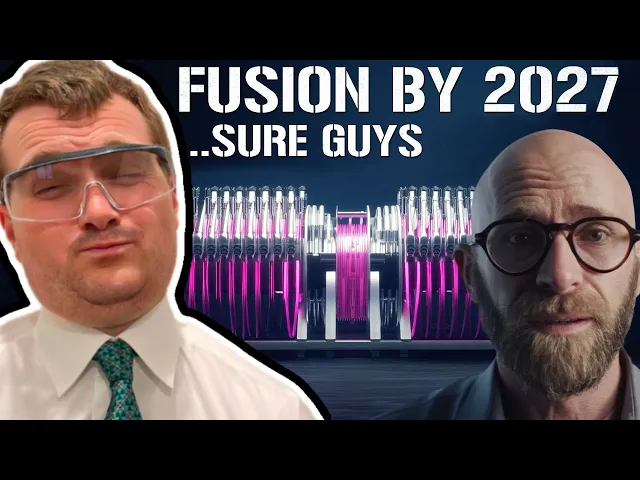
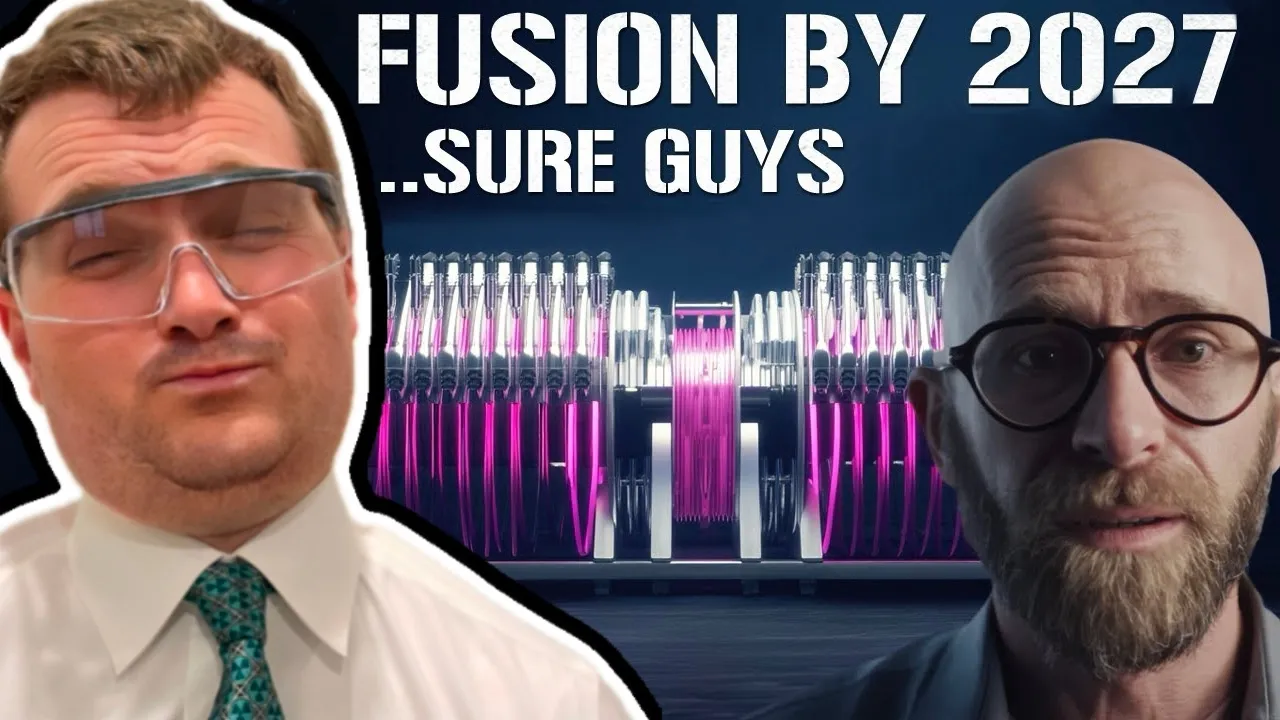
Of a linear chamber. As they collide, they merge into a single. >> It's a fusion shake weight. It's time for some more mega projects. Specifically, fusion by 2027. Yes, these guys again. I remember when they said fusion by 2025. For those of you who don't know me, I'm Tyler F. I'm a nuclear engineer with a little over 10 years of experience in the commercial nuclear power industry. From engineering To operations to emergency response. I'm claiming to never think there is nuclear, but I can certainly share some knowledge. The dream of fusion energy has always sounded
like something just out of reach. Clean, limitless power without the downsides of fossil fuels or the dangers of nuclear waste. And for >> all right, the whole limitless thing. Yes, it is a dream and nothing more than marketing exaggeration. Fusion isn't limitless. It's abundant, but not Limitless. Dutium from seawater and leth and lithium which could be used to breed tridium is abundant could potentially last for millions of years but you still have huge materials engineering and regulatory limit and the whole no nuclear waste thing is simply not true. I've heard the term no fision products
thrown around, which is true cuz after all, there's no fision, no fision products. But fusion reactors are going to bombard the reactor walls with high Energy neutrons, transmuting and activating the structure. It's shorter lived waste than fision, but it is nuclear waste, typically on the order of 30 to 100year half-life range. That in and of itself isn't a reason not to pursue fusion. Let's just be honest and say it still has limitations even if we had commercial fusion reactors right now. >> Decades the world's brightest minds have been chasing it. Governments have Invested billions in
ITA, a colossal machine being built in southern France. $50 billion to be exact. Plus >> so ID or as I usually say I mean it's it doesn't matter how you pronounce it. It's not a power plant. It's an experimental burning plasma test bed, not meant to directly feed electricity to a grid. >> Decades of effort and scientists are all over the globe. You see, with that much money and brain power, the lights would Already be on. But it is still years away from producing a single watt of usable electricity. [music] >> That's true, but that's
was not the goal of it. It's not supposed to produce electricity at all. Its goal is to prove physics viability, not commercial viability. I would compare it more to say the large hydron collider than a power plant. It's more about research and science. >> And that's where Hon comes in. An American startup claiming it can beat it to the finish line [music] by a wide margin. >> Kind of easy to beat someone to the finish line when the other is running a completely different race to begin with. They say they'll be generating fusion electricity and
selling it to the grid by 2028. That's >> man 2028 now. And the thumbnail said 2027. Just a few minutes year in just a few minutes into this video and we've Already delayed it another year. But seriously, that's where the hype is coming from. Even if their physics worked, you still have licensing, you still have grid integration, and then you have sustainable material endurance. Now, maybe sustainable wasn't part of their 2028 goal. I I don't know cuz you could connect it to the grid and connect it to the grid for not very long, just like
the EBR um experimental greater reactor that was done. It it did not pro Provide large scale fision power for an extended period of time. Best case scenario, late 2030s, maybe 2040, maybe. >> It's not just ambitious, it feels almost reckless. You can't help but wonder if governments have been struggling for half a century, how is a private company going to leaprog them in just a few years? And well, >> as far as grid connection, well, their goal is different than either. But yeah, uh this is very aggressive and does not Seem realistic in the slight.
>> That's exactly what this video today is about. It's about the real story of Helon. What makes them think that they can stop the 30 years into the future curse and why does this race matter? Well, we've gone from 30 years out to 20 years out saying that repeatedly. So, I've never actually heard 30 years out anytime in my career. So, maybe 30 years out is what people said back in the 1950s. >> And not just for the science of fusion, but for the future of energy, climate, and possibly even civilization itself. >> How dramatic.
>> What is fusion and why is it hard? >> Let's see how he does. >> Now, when people hear the word nuclear, [music] most think of fishing, splitting atoms apart. That's how every nuclear power plant works today. [music] Yeah. And generally when I say nuclear, I'm meaning fision. It's only I only Really make the distinction between fision and fusion when I'm in a video about fusion. To take heavy atoms such as uranium, you split them which releases energy in the process. >> Interesting. They actually showed this intermediate step of it becoming uranium 236. Doesn't stay
uranium 236 for very long. >> It's powerful, but it's also messy. you end up with longived radioactive waste and you always carry the risk however Small of a meltdown. Fusion's the opposite. Instead, >> I mean, he's very dismissive that yes, you do carry the risk, but the risk of core damage. Unacceptable risk, at least at the plant I worked at, was one in a million per year. That's considered unacceptable risk, a one in a million shot per year. And there's various risk measures you run when you have a probabilistic risk assessment maintenance model. say when
you take Certain safety equipment out of service that increases your odds of core damage. Core damage is the industry term rather than meltdown. And then there's the other term that's large early release which is lower than that of a meltdown, but that's where the actual impact to the environment occurred as an impact to the public. But that should give you a sense of scale. Low risk, which is where most power plants operate, is on the order of a chance of meltdown of one in A billion per year. >> Instead of splitting heavy atoms, you fuse
light ones. That's the kind of reaction that powers stars. [music] Hydrogen atoms smash into each other, stick, and release incredible amounts of energy. Ideally, it is the perfect energy source. >> Don't see what he means by perfect energy source. But yes, in principle it you're going in the opposite direction, but it's really the same physics. Um, E= MC^2. You're using delta MC² or a mass defect term. Though, when combining these small atoms, you get that energy left over from fision. As opposed to splitting heavy atoms, you get that energy left. But as opposed to getting
that little bit of energy left over from fision, when you split heavy atoms, you get that little bit of energy left over from fusion. Fision uses a downhill slope and fusion uses an uphill slope. >> The carbon emissions, no meltdown risk, No centuries of radioactive waste. >> So no meltdown risk. That that is true. It is actually zero. You cannot have a runaway fusion chain reaction because plasma confinement will fail instantly if conditions aren't perfect and its method of failure is the reactor will turn off. Think of it kind of like a reactor trip or
a scram. But again, it does produce radioactive waste. Um it's a shorter time scale, but it does still produce radioactive waste that does need To be managed. And it will require decommissioning management because while it doesn't it won't last as long as waste from uh nuclear fision plants, it will still last long than the expected life of a power plant. So half lives of 30 to 100 years. Most radiation protection standards consider something to be gone after 7 to 10 half lives. So still a while >> just clean power with the main byproduct being helium
[music] which is >> so again it's a byproduct but it's still it's the vessel itself is the main source of waste rather than a fusion product. >> The same harmless gas that you find in balloons. It sounds too good to be true, doesn't it? Which is why people have been chasing it for more than half a century. Making atoms fuse on Earth is far harder than you might think. The fuels themselves are tricky. Most designs rely on two isotopes of Hydrogen, dutyium [music] and tritium. Dutium is abundant. You can literally pull it out of seawater.
Tritium, on the other hand, [music] is scarce and radioactive, so reactors have to breed it inside the machine itself using lithium. Another option is helium 3, a cleaner fuel with fewer neutron problems, but it's rare on Earth. People sometimes joke about mining it from the moon, which tells you how impractical it is. Yeah, joke's going to be the right Word there. Moon's helium 3 concentrations in the parts per billion range. So, you're going to need to set up a processing plant to get you through billions of tons of lunar regalith to get you a few
kg. Not competitive in the slightest. >> And then there's the physics. To get a fusion, you need to overcome the natural repulsion between positively charged nuclei. That means temperatures more than 100 million degrees C, which is Several times hotter than the core of the sun containing that plasma. >> You need to get that hot on Earth. The reason why the sun does not have to get that hot is there's enough gravitational pressure because you really need three things. High temperature, high pressure, and confinement time. The sun's gravity makes it relatively easy to do that on
the sun. So you can get it at the relatively cold 15 million° C, but we don't have those kind of conditions on Earth. >> Which is essentially a soup of charged particles, is where the real engineering nightmare begins because apparently we [music] weren't there already. Scientists have a few ways of measuring progress. And the most famous is Q. That's the ratio of energy out to energy [music] in. A Q of one means the fusion reaction produced as much energy as it took to sustain it. A Q of 10 means you're getting 10 times more energy
out [music] than you put in, which is the level you need to make commercial power a real possibility. >> That's still understating it. It's often and there are various levels of Q. There's Q for the plasma, energy out versus heating energy in, which is what Eater uses. Then there's total Q, all of the house loads, if you will. So that would include the entire system. So lasers, magnets, compressors, mainly lasers in the case of the inertial Confinement, but it it includes all of the house loads, if you will, that would you would be using to
operate the fusion reactor, not just the plasma part. And then there's Q electric, which is what you would be looking for in the case of power plants. And helium's less than one for this total Q number. So man, producing by 2028, that's crazy. Now, if you were to use that logic for operating plants, uh, say anything that is not a fusion reactor, the Q numbers are not 10. They're going to be anywhere from say 50, they're going to be at least 50, maybe a 100 if you're talking say a fision reactor that's house loads are
on the order of 20 40 [snorts] megawws at most for a 1,000 megawatt electric reactor or over 3,000 megawws thermal. So depending on which Q you're looking at, you could call that you'd call that 50, 100, 100 plus, if you're just looking at thermal versus how much in terms of how much energy you need to run All your systems versus how much if you're looking at how much power you need to run all your systems versus how much power you actually produce. So the reason why you're using a number like Q, it should give you
a sense of how far away you are from commercial operations. >> Q alone doesn't solve the problem. You need to hold the plasma steady for a [music] long time and it can't just be hot for a split second. >> Yeah, it doesn't take sustainability Into account. >> Plants require continuous and reliable operation. Some [music] systems pulse their plasmas, others aim for a steady burn, but either way, you have to manage the materials around the [music] plasma. Usually, neutrons produced in the reaction are absorbed by the reactor walls, which in turn makes them brittle and radioactive.
So even if you get the physics right, you still need materials that can survive years of that sort of Punishment. >> Okay, so he got that part right, but he didn't he mentioned the whole thing about no waste products. I guess you're not he's not viewing the reactor as a product. >> None of this stops scientists from trying early on in [music] the 50s. Fusion was a hot bet. Z Pinch machines, devices that tried to squeeze plasma with bursts of electric current look like they might deliver quick results. And for all >> Oh, those are
fun. Actually, not unlike some of the things you've seen Styro pyro used, at least as far as the basic physics are concerned. >> While people thought practical fusion power was just around the corner, but the plasma proved unstable, constantly collapsing before any meaningful energy could be extracted. By the 70s, one design pulled ahead. The Tamac [music] developed in the Soviet Union. It uses a Donut-shaped chamber and a combination of magnetic fields to trap plasma. Tamax still dominate fusion research today. >> That's a stellarator. Yeah, you can tell that right away. Tokamax are your very smooth
round typical tooid. Whereas stellerators are you get the twisky kind to make your magnetic field stable. But the problem is it's harder to build because it's a twisty kind. It's making something that looks like that has engineering and materials and Manufacturing challenges. But yeah, that's definitely accelerator. >> A from small experimental reactors to itself. They've achieved record temperatures, record confinement times, and steadily improved performance. But still, no TOKAC has ever produced net electrical energy. Now, if you've ever wonder why people >> Same with stellar raiders, too. But again, it you're never going to see that
because that's not their goal. [laughter] >> Joke that fusion is always 30 years away. It's because every time there's a breakthrough in Fusion, it's always followed by new obstacles and revised timelines. [music] And yet, nobody has given up. Which brings us to iter. If fusion is the holy grail of energy, iter is kind of like the cathedral that's been built to house it. It is the world's flagship attempt to solve fusion in one massive leap. It was built in Southern France and is an international collaboration among Europe, the United States, Russia, China, Japan, India, and
South Korea. All pooling resources, technology, and funding. Its price tag now exceeds [music] $50 billion and its size is about 23,000 tonsy. It's goals are just as big in size. It isn't designed to be a power plant. It's more a demonstration machine and its central premise is to achieve a Q of 10. That would make it the first machine to truly create a burning plasma. A burning plasma mean >> that's plasma Q of 10 because again it matters when you're looking at scales like this like being the first. There's a difference between Q for plasma
versus Q for your house load for all of your house loads and then Q for electrical. >> The fusion reaction produces so much energy that it sustains itself no longer requiring constant external heating. Iter is also supposed to test tritium breeding systems to integrate technologies that could later be transferred into actual commercial reactors. In other words, this is all the standard bearer. The project that if successful will prove fusion is more than a scientific curiosity. It will demonstrate that the physics works, that engineering challenges can be effectively managed, and the humanity can realistically plan for
future fusion Power plants. Unfortunately, iter has been perpetually delayed. Its original schedule had it producing first plasma years ago. Now, the new milestone has been pushed back to 2030. actual dutyium tritium operations. The real fusion fuel mix may not happen until the mid 2030s. Add in cost overruns, construction challenges, and the sheer difficulty of coordinating dozens of countries. And it's no surprise has become both a symbol of hope and of frustration. [music] And yet, you can't simply write it off. If it succeeds, it will settle arguments that have been raging for decades. It will show
fusion can work at scale and not just for seconds at a time like in lab experiments. For governments, it remains the best opportunity to prove the concept. >> It's still an experiment though. And he mentions at scale their goal is 500 megawatt thermal, which is would be the largest any fusion reactor has ever Done. But the nuclear power plant that I worked at was over 3,800 megawatt thermal. And 500 megawatt thermal isn't really that much power. So it's at scale in that you're on power operation scale in that yeah you could use it to power
something if that was its goal but it's just not on the same scale compared to vision react but again if it works it'll show that it's at least possible to make one you're just going to have to make a bigger one >> to beyond a doubt but it also creates space for the audacious claim of companies like Hon because when people look at ITA with its vast budget, decades of construction, and a timeline stretching into 2030. They wonder if there's a faster way. >> Helium, [music] what they claim, and how they work. >> Helion was
founded in 2013 in Redmond. >> How they attempt to work, I should say, >> its co-founders, David Curtley and Chris Pill, both have backgrounds in plasma [music] physics and propulsion. And they set themselves apart from the outset by building Helon to sell electricity rather than just proving that fusion works as [music] it aims to do. Fast forward to today and Helon has raised more than a billion dollars from backers like Sam Alman the CEO of Open AI along with big players like Myithil Capital, Capricorn Investment Group and Y Combinator. The valuation exceeds $5 Billion which
is essentially unicorn territory for a company whose product doesn't even exist yet. But then again, isn't that the story of most disruptive startups? You sell the vision before you sell the product, don't you? In 2023, the company signed a power purchase deal with Microsoft promising electricity from Fusion by 2028. Let's pause for a second here. We're not talking of anou or even a let's explore letter, but an actual commercial agreement for Electricity from a reactor that doesn't yet exist. >> That man, there's all kinds of things wrong with that. That's almost like paying for a
meal at a restaurant that hasn't even been built yet because the chef is still experimenting in the lab. But then again, it's Microsoft. They run some of the most >> or a type of food that doesn't exist yet. I'd take it a step further. Say they're making food from a planet in the Andromeda galaxy. >> Most energy hungry data centers in the world. And if Fusion works, it would be like finding gold under their server farms. So maybe it does make sense to lock it early. Helon calls their upcoming machine Polaris and it's supposed to
be the first in the world. >> A lot of them are using actual existing fision reactors such as Microsoft again with the restart of 3M island. That makes more sense cuz here it's like okay We have a reactor that did work. We just need to restart it. >> Just achieve fusion but actually [music] generate net electricity delivered to the grid. They plan to achieve this by being as different as possible from it and other large fusion projects. Starting with the shape of their reactor. [music] Helon uses something called a field reversed configuration or FRC. Picture
two blobs of plasma being fired at each other from opposite ends Of a linear chamber. As they collide, they merge into a single >> it's a fusion shake weight >> plasma ball which is [music] then squeezed tighter and tighter by massive magnetic fields. The compression drives up the temperature and the pressure until fusion reactions ignite. Their choice of fuel is also unusual. While it uses a dutyium tritium mix, Helon aims for a dutyium [music] and helium 3 mix. And that's so out of the box because as We mentioned, helium 3 is scarce. And like we
said before, it's pretty impractical. According to them, helium is the better choice since it produces fewer neutrons. Neutrons make reactor walls brittle and radioactive. So, reducing their presence makes the reactor easier to maintain and cheaper to operate. It's a gamble, but if it works, it's a clever way to sidestep [music] one of Fusion's nastiest engineering headaches. The most Fascinating part of all of this is that they plan to convert the plasma's energy directly into [music] electricity without the traditional thermodynamic method of spinning turbines and heating water into steam. If it works, it would certainly make
fusion more efficient. However, many physicists point out that Helon has yet to publicly [music] demonstrate net energy from any of its machines. They've built and tested seven prototypes, each more powerful than the Last, but none have achieved that net energy that they're looking for. [music] It's one, >> not any form of it. Whether you're talking plasma or you're talking their not turbine, but yes, two plasmoids merge in the shake wave. Doesn't actually shake, but it's what it looks like. At least it's not supposed to. Then they magnetically compress to achieve fusion. So there's your your
heat and your pressure. And it does Operate in pulses, so not a steady state thing that you would see in a tokamac, which is also weird. So trying to sustain that is going to be interesting. And dutyium and helium 3 to reduce neutron flux and they claim they can somehow breed it on site. Okay. And then direct electrical energy conversion which you don't see in any type of large scale thermal plant whether it be fision fusion coal natural gas but yes just good old school induction right into Powered electronics. So something with pulses and straight
into induction, not sustained, which okay. And they're somehow breaking all these new grounds and going to have electricity production by 2020. And this isn't just what um what Simon Whistler is saying. This is these were claims actually made by by Helen. thing entirely to achieve fusion reactions which helon has but another thing entirely to sustain [music] them at scale and actually extract useful Power. Still, the company is promising. Its valuation is in the billions and it's one of the very few [music] private fusion startups with a major corporate customer on the hook. The question ever
is whether we're watching the rise of Fusion's first commercial player or if this is just another [music] chapter in bold promises that are just out of reach. [snorts] >> Helon's challenges and risks. >> Let's see. Before anyone gets too carried away with Helon's promises, let's pause for a bit of a reality check, shall we? Because the [music] physics, the engineering, and the timelines are all packed with more uncertainty than Helon's slick [music] pitch suggests. Let's start with the physics, shall we? Helon's entire approach rests on FRC's. Imagine a smoke ring of plasma, only instead of
drifting lazily through the air, it's a 100 Million degree cloud of charged particles trying to tear itself apart. Helon's [music] trick is to form two of these plasmoids, smash them together at high speeds, and then squeeze them with magnetic fields until fusion happens. It sounds [music] elegant when you imagine it, but anyone who's worked with plasmas will tell you they're slippery, unstable, and unpredictable. And keeping them confined is like trying to hold jelly with rubber bands. So, the potential advantages, let's give them some credit here with FRC, is they're smaller, they're linear. So you don't
need to make a circular structure or a circular bendy structure in the case of a stellerator. So simpler geometry and potentially less complicated magnets. So you might be able to get cheaper magnets but by definition they are less stable than tok plasmas because of magnetic reconnection turbulence and rapid losses unless the Confinement physics are the confinement physics is just harder. There's sheer flows, there's end plugging and line tie. So trying to compress this without disruptive energy loss is is not easy. Also, the whole pulse thing. So you're going to need extremely high repetition rate. That
is to say, how many plasma shots per second. So that's going to require a lot of high energy capacitors to store the things. a lot of electronics to survive each individual Pulse as well as your mechanical structural systems to survive a cyclic pulse. I mean, yes, you need that sort of stuff in tokamax as well, but it's pulse. It's a transient, many, many transients per second. So, big maintenance concerns there. You might have to have a lot of outages to replace some of these components, these electronics. I mean, I guess the good thing about pulses
is by definition less confinement time is required because They're each individual events. You're just doing a whole bunch of them. >> Helon's trick is that instead of trying to hold plasma steady like a tokamac, they fire it in independent short bursts. >> That looked >> That avoids the problem stable for minutes at a time. However, it also [clears throat] presents a different challenge where every single burst must work. If the plasma doesn't compress Tightly enough, the reaction just fizzles before it can make any useful energy. And then there's the fuel. Helon's big selling point is
helium 3. It's a rare isotope that doesn't throw off nearly as much damaging nutrinos as the standard dutarium >> neutrons, less so nutrinos. Nutrinos simply, they're just pure energy that passes through. >> Prettyium mix. That's good news if you want a reactor that lasts more than a Few years before the walls start crumbling. But helium 3 is rare. Most of the usable supply comes from tritium decay, a very slow process, or tiny amounts of it in natural gas. [music] Helium claims that they can generate helium 3 in the reactor itself as a side reaction when
duty atoms fuse, but that >> that's highly inefficient. That's highly in inefficient breeding helium 3 from dutyium dutyium fusion. Going to be better off with regular and when I say Regular dutyium tridium fusion, it's going to be way easier to achieve. I mean the drawback is the neutrons are going out at 14.1me which is pretty high energy for a neutron and that's going to cause the activation damage to walls that sort of thing. Now it's gradual. It's not like it'll immediately fall apart. But the other thing is the dutarium dutarium reaction is still going to
create neutrons though at a lesser energy Level. So you still have some of that and you're going to need enough of that if you're going to breed enough helium 3 to ultimately have this thing work on helium 3 with deterior. >> That's still unproven at scale. [music] It sounds like building a car that can run on fuel you promise the car itself will produce once it's running might work in principle but it is easy to see why physicists are a little bit skeptical about this one. And then There's the pulseed system [music] itself. Continuous reactors
such as ITA aim for a steady burn similar to keeping a campfire going. Helon by contrast fires [music] in bursts like a car >> or just any other steady state operations whether it's fision tokamac fusion coal natural gas geothermal hydro. It's generally good to have your power plants continuously operate and cycle so they would continue to produce electricity, especially if they're going To go with some exotic direct energy conversion, >> just with really a lot higher stakes. That means you need precise timing, high power capacitors that can discharge energy in micros secondsonds, and electronics that
can withstand the abuse. How long those components last, nobody knows. It's one thing to fire off a few hundred shots in a lab. It's another to do it day after day for years without the system tearing itself apart. And let's not forget the neutrons. Helon's pitch is that by leaning on helium 3, they avoid the destructive neutron flux that makes tacamax so hard to maintain. But in reality, side reactions >> that is also a stellarator >> still generate neutrons. Not as many as it will have to deal with, but enough. >> I don't think he's
mentioned stellarator once in his video. That's it's interesting that he showed pictures of That >> to cause the materials to degrade over time. So the no neutron problem claim, it's not entirely honest. It's more like a smaller neutron problem. But look, physics >> lesser energy neutrons for sure >> is only half the battle. Even if helon nails the plasma stability and their capacitors hold up, they still have to build and connect a power plant. And this is where the romance of startups Crashes into the brick wall of bureaucracy. It benefits from government backing and frameworks
that treat it as a scientific project. Okay, so before the bureaucracy, let's talk this whole direct electrical conversion claim. So they claim that the changing magnetic flux current from the plasma collapse and converting to your DC electricity via inductive coupling or some type of high voltage switching. I mean, in principle, the goal of this is To avoid the carno losses, which is your ideal heat engine from a steam cycle that you see on every type of nuclear power or every type of power plant that's existed in a thermal cycle that's a couple hundred years old.
Here's the problem with that. Plasma is messy and less predictable. Energetic particle distributions, impurity radiation and nonuniform flux and nonuniform repeat pulses make this conversion efficiency uncertain. Again, this sort Of thing is physically possible, but anything that produces electricity and especially if you're going to connect the grid, you need a reliable 60 Hz that needs to be sustained. And you do that with a turbine by spinning it at one speed. So, how you're going to do this with something that varies a bit because 60 Hz is spot on. 59 Hz or 61 Hz, you're tripping
your unit. Even a 59.99 Hz is still looking not too good. The point is needs to be very stable and Repeatable for any sort of grid operations, which would be easier to do with something like a token. So this potential costsaving, I don't see how he's going to get there sustainably. I don't know. Maybe he claims this runs on unoptanium that is like the most electrically stable superconducting whatever. I don't know. >> Meanwhile, has to navigate permits, environmental reviews, safety Regulations, and grid integration like any other power plant. >> Yeah. And you still have to
deal with the Nuclear Regulatory Commission. I mean, reduced neutrons still matter. It's still a radiological environment and you're going to be breeding tridium using lithium blankets in the event of dutium tridium or you're going to be very inefficiently breeding helium 3 with lower energy neutrons but you might even I don't know I haven't I don't know What the exact claim but you could end up with more neutrons somehow because it's less efficient at producing helium 3. Maybe it's close and and maybe and I know the neutrons are lesser energy, but it's not going to save
you a whole lot if you're going to try to do the helium 3 shenanigans. The point being, it's not going to be zero. And yes, you will still have to enter the radiological physics aspect of licensing, of sustainability, and of licensing and and Of compliance. If you've ever followed the permitting battles for wind farms or transmission lines, you know how easily these projects can get bogged down. >> Forget wind farms. How about new build nuclear power plants? Need to have nuclear regulatory commission approval long before you get the regular permit for land use that you
would get with the local authorities. >> And then we come to the timeline 2028. [music] This date can either be a curse or a blessing for Helon. deliver electricity by then and they will be hailed as visionaries who leapfrogged the world's biggest science project. >> That's extremely unlikely. >> Miss it and they'll join the long line of fusion promises that never quite materialized. Experts think that Helon's undertaking is high-risk, aggressive, and ambitious to the point of absurdity. And >> if you know what I I'm saying all this, if they prove me wrong, I would be
indeed happy cuz it would be really cool to see. But man, [laughter] >> they do have a point. Building a novel reactor, proving it works, getting it licensed, and hooking it up to the grid in the space of 5 years. Most conventional nuclear plants take longer than that just to clear [music] paperwork. Even if helon's physics, >> that's true, and that's something that The Nuclear Regulatory Commission recognizes and is actively working toward. But yeah, >> works perfectly. The logistics alone could trip them up. And there's the risk that if Helon misses their date, it would
sour public opinion on Fusion even further. Investors might become more hesitant and governments might become [music] more skeptical. In trying to move fast, Helion could inadvertently set the field back. Rivals politics and global stakes. Helon's not alone in Chasing Fusion. In fact, might not even be fair to call them the front runner because the >> So, before we even get into that, there's a few major categories that [snorts] can just kill this whole thing. One is sustainable pulses. If only a small fraction of them actually produce useful fusion, then that's going to kill it economically.
Number two, this whole direct conversion of plasma into Efficient into energy onto the grid. If you can't convert most of that, it's not even going to be compatible with things that have turbo. Another thing is component fatigue. Everything about all of the electronics, the capacitors, the switches, the coils, all the vacuum seals you have in the shake weight or the reactor, is it sustainable? Number four, the neutron flux concern. Even if you're making helium 3 instead of number five, helium 3 in general, Are you going to make enough of it? And there's going to be
some level of regulatory hurdle because nobody else is using the stuff. So that's another regulator you have to convince. And then the last big one I can see is integrated plant operations with the reactor, the grid, any safety concerns and people's acceptance of this product. Some of those are not insurmountable, but some of them might be or at least they might not get exactly what they're saying. Like again, they might have to use they might have to use a turban. They might have to use tridium instead of helium 3 for instance. >> Is a lot
more crowded than most people realize. The headlines often focus on it. But on the private side, there's a whole ecosystem of startups, each convinced it has found the shortcut to the energy of the stars. Take Commonwealth Fusion Systems. They spun out of MIT and their machine spark is Based on the same tokamac design as it but it's miniaturaturized and supercharged with high temperature superconducting magnets. They raised billions on that their reactor would be smaller, cheaper, and online faster. It's sort of like they were saying, "Yes, ITA [music] is building the jumbo jet, but we're going
to build the private jet version." And then there's TAE Technologies in California. I actually think that one seems more Reliable, more incremental than what Helen is claiming. It's based on real technology. The uh well, not that not that the uh Helen concept is fake, but more of proven to technology that people have been using. The magnets are interesting and this Commonwealth Fusion could really be a more of a tokome scaling strategy. I still don't agree with their timelines with Q over than one greater than 2027. I mean that they might get there, but that they're
not Claiming to be on the grid in 2027. That they're at least Q greater than one for plasma grid operations. I think they estimated sometime in the 2030s. I mean, that could be 2039. To me, that makes a little bit more sense. >> They've been at it since the 1990s, burning through more than a billion dollars in funding. Their approach is a field reversed configuration, a cousin to helon's idea, but optimized for proton boron fusion, a fuel that doesn't Produce neutrons. And that sounds almost too good to be true, doesn't it? Clean a neutronic power,
no radioactive waste. >> So, they're going to need to make this how many billions of degrees. [laughter] >> The catch though is that you would need temperatures north of 3 billion°. Putting it oddly, that's a lot. And they're still working on it. General Fusion backed by >> It's interesting that they're in kind of the same idea behind we don't want as Many neutrons, but they're just going to need to make the reactor that much hotter, making the sun look cold with 3 billion. >> F Bezos wants to smash plasma with pistons, literally compressing it in
a liquid metal sphere. It's [music] a bold concept, though it sometimes feels like one of those ideas that sounds great in a TED talk, but faces nasty engineering headaches in reality. Good luck getting all those pistons to be timed properly And again you're working with liquid metals. But this does have the potential to have an even simpler concept than the helium design. But I guess it's a different approach where you try to make the tape you try to make the pistons replaceable parts and like yeah let the neutrons tear this thing to pieces. We'll just
plop in another one. >> And then there's first light fusion in the UK which uses projectiles to shoot at targets for inertial confinement. [music] Essentially fusion by bullet. Again, it makes you pause. Is this going to line up or is it destined to be just another promising demo? >> Now, that could potentially give you a higher queue, but it's more risky to repeat. Also, just the fuel fabrication challenges of those little fusion pellets, but that's a whole different ball game. Um, we're not you they're not using u magnetic confinement. It's closer to what you see
in the sun. You're just using really really big lasers >> that never scales. Now, what is striking is that everyone is playing the same game, but with completely different sets of rules. One is a centralized multinational bureaucracy throwing decades and billions of dollars at the problem. The other is a swarm of private firms chasing a first mover advantage. And this is where things get even more interesting because whoever cracks Fusion first will also gain a significant advantage. [music] Access to an energy source that's abundant, carbon-f free, and not tied to fossil fuel. >> Again, I
wouldn't put eater in the same category. They're closer to the large hatron collider than a power plant cuz again it's a >> unstable supply chains will pull a lot of geopolitical muscle and grant [music] an edge politically. The US wants to Lead naturally. Billions are flowing into American startups and the department of energy is increasingly getting cozy with the private sector. China on the other hand is investing heavily in Tacoax trying its best to build machines at breakneck speed. Their East reactor has already set world records for plasma duration. Europe's betting on it with France
hosting the world's fusion gamble on its soil. Japan 2 has its own program, though theirs is Less flashy and more methodical. So, the fusion race isn't just hype, [music] it's very real, and it reminds us of the space race in the '60s, but with probably higher stakes. Because while space was about prestige and exploration, fusion is about energy security. Whoever nails it first won't [music] just plant a flag, they will hold the keys to the world's energy future. So if any fusion concept does succeed, Yes. But even after that, that's decades of infrastructure development that
arguably matter even more than whoever made the first fusion react because you'd have to build factories, standardized fuel processing plants, licensing, creating a global economy around tridium. I'm not even going to entertain the helium 3 economy. That is arguably going to be just as important to seeing mass fusion react cuz that's Really what it took when nuclear fision was first introduced. During the time of the Manhattan project, the Manhattan project had 90% of the world's supply of uranium 235 cuz nobody ever used uranium 235. [laughter] Let's imagine for a second that helon or maybe one
of its rivals actually pulls off fusion in the next decade or two. What would the world look like? Well, the first giant change is obvious climate. If fusion becomes a real base Load power source, the carbon maths would change overnight. There would be no longive >> No, no, it would not. It would take decades, maybe even a full century to replace everything. And that's assuming this thing was a perfectly competitive thing that would make any other power plant, including fision, not worth it. So you would have to have not just a working reactor, but a
working supply chain, a construction chain, a Regulatory um machine, if you will, capable of cranking out licenses for this sort of thing. It would. There's no way this sort of thing comes out of nowhere. >> Radioactive waste, no risk of meltdowns, and no concerns about uranium enrichment. Instead, we'd [music] get power clean and steady with none of the headaches that turned Chernobyl and >> the whole overnight. And again, this is getting into the standard Case for against nuclear power. I guess I should say against nuclear fision power by always bringing up Chernobyl and Fukushima. It's
not going to replace it this quickly. for Kushima into household names. We also have to wonder what would happen to the oil states. If you're Saudi Arabia or Russia or any country whose budget depends on hydrocarbons, fusions an existential threat. Oil markets are affected when EV >> and that's assuming no one is trying to Stop it, even if it somehow came out of nowhere. >> Sales tick up by just a few percentage points. Imagine what happens when a city can flip a switch and draw all the energy it needs from a compact fusion plant. That
would mark the be. There's no way any city of size could get all of its energy from anything compact. You would need a whole bunch of these things. Whether you're if you're talking any design like Helen >> of a collapse and a total shift in power. Whoever holds the patents, the supply chain, and the manufacturing capacity wouldn't just be selling power plants, they would be selling sovereignty because a >> which usually isn't necessarily one person. >> Country that controls fusion exports controls the future of energy. it, >> man. You This whole thing is is all
kind of falling apart into sci-fi fantasy. Um, I mean, forget the nuclear engineering and physics stuff. The economic gaps are are what debunks this. [laughter] I mean, come on. Overnight largecale infrastructure. No. >> And with semiconductors. Look at how much leverage Taiwan has over the global economy because of TSMC. Now imagine that but for the thing the power. >> Let's take a step back from this ridiculous claim for a minute. The Global electrical system contains over 8 terowatt of installed generation capacity over 70,000 power plants and millions maybe in the order of billions of kilometers
of high voltage lines. So, even if let's let's go with Helen since we're, you know, going well into sci-fi territory. Their fusion reactor worked. As they said, it's it's 2028. They have it connected to the grid, and it's awesome. It's the best thing ever. Factories do not magically appear to Massproduce your superconducting magnets, your tridium handling systems, your vacuum vessels, your gigawatt scale heat exchangers, and your radiation hard components. Even so, all let's say all that technology exists. Um cuz we see that with vision. It takes 6 to 10 years aggressively from planning to operation
to build a brand new one. The tridium problem or the helium 3 problem would not solve itself overnight. One power plant's going to need hundreds of grams Of tridium a day and that's going to translate to tens of kilograms a year. So multiply that times 70,000. No. [laughter] You're also going to need grid impact studies, transformer yards, new transmission lines. And by the way, transmission lines, if you think making nuclear plants, getting permits for those are hard, they still are, but it's comparable. Can get take upwards of 5 10 years for getting new permitting plants
or transmission lines. In the US, you're Going to have to electrify everything, including things like steel production, concrete production, transportation, replacing gas turbines, and I I I think you're starting to get the idea. I I I could go on and on. Um, what he's talking about in overnight switch is closer to a sudden uplift by a sufficiently advanced alien civilization. Not my shake weight actually works and if I shake it hard enough, I can power My house. No, >> every home, every data center, every factory. And let's talk economics for a second. If power suddenly
becomes cheap and effectively limitless, what industries are unlocked? I mean AI is the >> limitless huh >> obvious one data centers are already >> so now we are getting into sci-fi territory let's go ahead and dyen up the sun plug everyone in to the master brain And have a party >> consuming electricity at terrifying rates and entire states are rethinking their power grids >> oh this one's from CERN looks old >> just to accommodate server farms fusion could turn that into a non-issue the same applies to industries such as steel aluminium and cement these are
some of the hardest sectors to decarbonize and >> fusion is Not a magic bullet, buddy. >> Fusion would make them clean by default. And there's also a human angle. What happens to the parts of the world that are still underpowered? Villages without reliable electricity, hospitals running diesel generators. If fusion is modular enough, small enough, and >> the boy that harnessed the wind turns to the boy that harness the shakeway. >> Could plant reactors anywhere from remote communities to mining operations and even on ships at sea. For the first time in history, abundant energy Wouldn't be
limited to where you were born or whether your government could build a power plant. That is going to be revolutionary. And then there are the spillovers. Every time we pursue something ambitious, we often end up with unexpected benefits. The space race gave us GPS, satellite communications, and other science breakthroughs. [music] The Manhattan project, as destructive as it was, brought with it nuclear medicine, and modern computing. Fusion Is already pushing advancements in capacitors, superconductors, plasma physics, and solid state switching. The truth is, even if we never develop a commercial reactor, the technologies will still bleed into
other industries. [music] And if we do get it there, >> that part is actually true, but again, he's this is all part of the exaggeration fantasy. Let's go ahead and throw in weather control. Why not? Let's get in uh saying it's going to solve the Climate so it's going to somehow scrub the CO2 that's up there. Whatever. >> The spillover could rival the internet. Of course, Fusion success would also reshape the finance industry. If Helon or any other startup crosses the finish line first, we can expect an investment boom like we've never seen. trillions would
flood into the sector almost overnight. >> All right, so now we're bridging over into finance. What's next? Uh Healthcare. Let's go back. Let's talk about uh space exploration. >> Skeptical governments would scramble to subsidize, regulate, and inevitably weaponize the technology. That's the sobering part. An energy revolution of this scale. >> Um technically the fusion's been weaponized since the 1950s. That's what a thermonuclear bomb is. But maybe he's talking about something else. I don't know. >> Wouldn't just make the world cleaner. It would also increase rivalries. There's a very slim chance that whoever gets to control
fusion would want to share. In the real world, limitless energy is also limitless leverage. >> There's also almost zero chance that only one person will have fusion power for very long. >> Would the US really just hand the keys of a working reactor to every country? Would China? Or would fusion plants Become bargaining chips in [music] a new kind of cold war? So yeah, >> if it's anything like the Cold War, the designs can just get stolen just like designs for fighters and missiles and various things. Uh I don't even know why >> Helon succeeds.
It's the dawn of something extraordinary. A climate solution, an economic reset, maybe even the first step toward a multilanetary future. But it all >> Oh, here here we go. Yes. So we are Talking about space travel in here, too. All right. So let's let's go ahead and go back to reality. So, if Helen does succeed aggressively, and I'm and I'm not talking 2028, I'm talking just the Q greater than one plasma as in the the easier one to reach within the next 3 to 10 years. That's plausible. And I think it's more realistic for some
of the tokome designs, but okay. Demonstrative net electricity to the grid. Assuming that all goes off without a hitch, no New problems are disco discovered. Maybe 2040s. um the first commercial fusion plant shows up with no major showstoppers. And this is all if and this is assuming again the ideal golden age case for fusion widespread commercial deployment. And I'm not talking about replacing everything. I'm talking about it eating up a decentsized chunk of energy production like north of 5% of any one industrialized country cuz and this is going to depend so much on Manufacturing scale
cost production and regulatory framework maybe 2040s possibly [snorts] 2060s I think that's about as good of an estimate I can get I'm uh I could be wrong hopefully I'm wrong in the I uh was underestimating this stuff, but I don't know. Let me know what you think in the comments. >> Also means rewriting the rules of political, industrial, and military power. >> Verdict. >> Yes, fusion will literally change everything. It'll even change how humans work cuz Yeah. >> And what to watch. >> So, after all that, where's it leave us? Is Elon actually going to
power a Microsoft data center by 2028? or is >> no, >> it's just another entry in the long line of fusion is almost here situations. Now, if we're being honest, the right Answer is probably somewhere in between. On the one hand, Helion has done more than just talk. They've raised over a billion dollars. They've convinced Microsoft, a company that doesn't exactly gamble its cloud infrastructure on Pipe Dreams to sign a purchase agreement. They've hit technical milestones like producing plasma at over 100 million degrees C, which is no small feat. That's >> yeah that's what that's
why I said Within 3 to 10 years for the Q plasma. I didn't say never assuming they haven't found any new problems. >> The kind of physics benchmark fusion researchers usually celebrate with champagne. But hitting 100 million degrees in a test shot is one thing. [music] Sustaining it, confining it, and actually turning it into net electricity, that is quite another. And we have to think back to all those Promises that fusion scientists have made over the last 70 years. Every decade someone says, "We're 20 years away." Maybe Helon finally breaks that curse. Or maybe 2028
is just the latest in a long string of hopeful dates that slip quietly into the rear view mirror. Thank you for watching. >> I still see it as a shake weight. Thanks so much for the recommendation and thanks so much for watching. I'll see you next time.