He Gave Water to a Giant Orc Woman — And Next Day 100 Warriors Surrounded His House! Morris Brennan learned three important lessons living alone on the frontier. First: never leave the well uncovered during storm season.
Second: always keep an axe within arm's reach. Third: when you see something green and seven feet tall bleeding in your wheat field at midnight, the smart thing to do is go back inside, bar the door, and pretend you saw nothing. Morris did not do the smart thing.
The creature—because that's what his mind insisted on calling it, even though he knew exactly what it was—had collapsed near his water well. Not the graceful kind of collapse you see in paintings. The kind where a body just.
. . stops working.
Where bones that shouldn't bend suddenly do, and where the only sound is the wet thud of armor hitting dirt. He stood there for forty-seven seconds. He counted.
Because counting made the fear manageable, turned it into numbers instead of the screaming in the back of his skull that reminded him what orcs did to human villages. What they'd done to his village. What they'd done to Sarah.
But then the creature—the orc—made a sound. Not a roar. Not a battle cry.
A whimper. The kind of sound that doesn't belong to monsters. The kind that belongs to things that hurt.
Morris picked up his axe anyway. Because he wasn't stupid. Just.
. . apparently not smart enough.
When he got close, three things became immediately clear. First, this wasn't just any orc. This was an orc the way mountains are just hills—technically accurate but wildly insufficient.
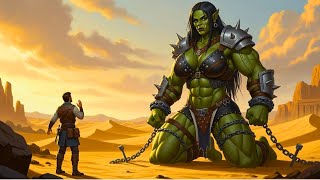
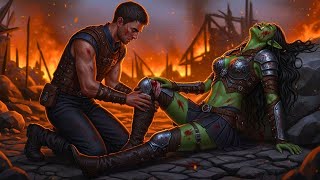
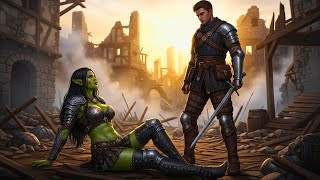
She had to be at least ten feet tall, maybe more, with shoulders broader than his doorframe and arms thick enough to uproot trees. Her armor alone probably weighed more than he did. Second, she was dying.
The wound in her side leaked green blood that looked black in the moonlight, pooling around her in a way that made his stomach turn. He'd seen men die from wounds like that. It took hours.
Painful hours. Third, and this was the part that made his hands shake, her eyes were open. And she was looking at him.
Not with hatred. Not with hunger. With something worse.
Hope. "Water," she rasped. The word came out wrong, shaped by a mouth not built for human language.
"Please. " Sarah's voice echoed in his memory. "They're monsters, Morris.
They don't feel. They don't think. They just destroy.
" The orc's hand moved—slowly, painfully—reaching toward the well. Not toward him. Toward water.
Toward something to drink before she died. Morris made his choice. The kind you can't unmake.
The kind that divides your life into before and after. He filled his wooden bowl—the one Sarah had carved for him before the raid, before the fire, before everything ended—and knelt beside the orc. Up close, she was even bigger.
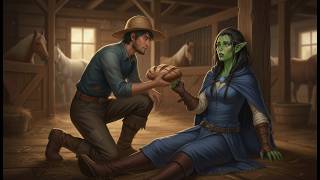
He had to tilt the bowl up, way up, to reach her mouth. She drank like someone who'd forgotten what water tasted like. Like someone who'd been walking through hell and just found out that heaven was real and wet and blessedly cold.
When the bowl was empty, she looked at him again. Really looked. And he saw something in her eyes that made his chest tight.
Recognition. Understanding. The weight of debt.
Her hand moved to her mouth. For a second he thought she was going to be sick, but then he heard it. The crack.
The wet snap of bone breaking. She'd torn out one of her own tusks. The pain must have been immense.
Her whole body shuddered, her green skin going pale. But her hand stayed steady as she pressed the bloody tusk into his palm. "Blood oath," she whispered.
"Will return. Will repay. " Then she passed out.
Morris stood there holding a tusk the size of his forearm, watching green blood drip from its root, and realized he'd just done something incredibly stupid or incredibly important. He wasn't sure which. Maybe both.
He dragged her to his barn—and dragging someone who weighed approximately the same as a horse is exactly as difficult as it sounds—bandaged the wound with every clean cloth he owned, and spent the night watching her breathe. Each breath rattled. Each one sounded like it might be the last.
By dawn, she was gone. Just. .
. gone. No trail.
No sign she'd ever been there except for the massive indent in his hay pile and the barn door that would never quite close right again. Morris hung the tusk on a leather cord around his neck because he didn't know what else to do with it. It was heavy.
Heavier than bone should be. He went about his day. Fed the chickens.
Checked the wheat. Fixed the fence post that had been wobbling since spring. Normal things.
The kind of things you do when you're pretending your life hasn't just tilted sideways. The thunder started at dawn the next day. Not weather thunder.
The other kind. The kind that comes from a hundred pairs of boots hitting ground in perfect rhythm. The kind that makes your bones vibrate and your livestock lose their minds with fear.
Morris walked to his window and looked out at his front yard. There were orcs everywhere. Not scattered.
Not random. In perfect formation. A hundred warriors, maybe more, arranged in concentric circles around his house.
All armed. All armored. All absolutely, terrifyingly silent.
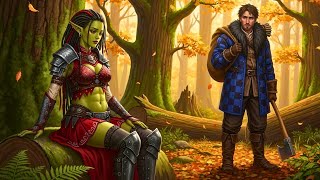
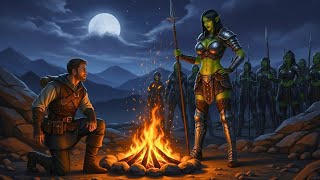
And in the center, taller than all of them, stood the orc woman from last night. Alive. Healthy.
And looking at his house like it was the most important building in the world. The second-in-command—a massive orc male with a jaw that looked like it had been chiseled from granite and a scar that split his face from ear to mouth—stepped forward. His voice could have shaken walls.
"HUMAN! Show yourself! Commander Zugra Bloodmark demands audience!
" Morris's hands shook as he unbarred the door. Because there was no running. No hiding.
No way out that didn't end with him as a green smear on his own doorstep. He stepped outside into the morning sun, squinting up at the army that had decided to show up for breakfast. Zugra—apparently that was her name—looked at him with an expression he couldn't read.
Then she saw it. The tusk hanging around his neck. Every single orc in the circle went rigid.
The scarred commander—Grath, he'd learn later—took three steps back and dropped to one knee. Then another orc did the same. Then another.
Like dominoes made of muscle and steel, the entire army knelt. Morris stood there, five foot nine inches of confused farmer, surrounded by a hundred kneeling killing machines, and wondered if this was what having a heart attack felt like. Zugra walked forward.
Each step left prints in the dirt deep enough to plant crops in. She stopped three feet away, towering over him like a cathedral towers over a candle. Then she knelt too.
"You saved my life," she said. Her voice was different now. Stronger.
But still carrying something soft underneath. "In my clan, life debt is absolute. You are owed blood price.
Name your demand. " Morris's brain, which had been mostly screaming since the thunder started, finally formed a coherent thought. "I don't.
. . I don't want anything.
You were hurt. Anyone would have—" "No. " Zugra's interruption was gentle but immovable.
Like being contradicted by a mountain. "No human helps orc. No human sees us as anything but monster.
You gave water when you could have given death. You gave kindness when you could have given silence. You.
. . " She paused, and he saw something that couldn't possibly be what it looked like.
Her eyes were wet. "You saw me as person. Not beast.
Person. " Grath spoke from his kneeling position. "Commander bears your mark now.
" He gestured to the tusk. "She is bound. We are bound.
Hundred warriors, sworn to your service until debt is paid. " Morris looked at the tusk around his neck. At Zugra's face, still bearing the gap where her tooth had been.
At the army of orcs kneeling in his wheat field. "I don't need an army," he said quietly. "I just.
. . I just need people to stop dying in my fields.
" Something shifted in Zugra's expression. Like clouds parting. Like understanding dawning.
"Then that is what you will have," she said. "Peace. In your fields.
In your life. " She stood, and the weight of her decision radiated outward like heat from a forge. "Grath.
Send runners. Brennan's Farm is now sacred ground. Any orc who spills blood here answers to me personally.
" Grath's grin was terrifying and delighted in equal measure. "With pleasure, Commander. " The orcs started to disperse, but Zugra remained.
She looked at Morris with an expression that might have been curiosity. "Why did you help me? " Morris thought about Sarah.
About the raid. About the years of hating the color green and the sound of war drums. About how easy it would have been to let one more orc die and call it justice.
"Because," he said slowly, "I'm tired of living in a world where kindness is stupid. I'm tired of hate being the smart choice. " Zugra nodded once.
A warrior's nod. The kind that seals oaths and ends arguments. "Then we will build new world.
Where kindness is strength. " She turned to leave, then paused. "I will return, Morris Brennan.
Debt is not yet paid. " She left with her army, and Morris stood alone in his ruined wheat field, holding a tusk that had just rewritten the rules of his entire existence. Horace found him three hours later, still standing there.
"Saw the army," the old man said, leaning on his cane—the one he'd carved himself after an orc took his leg twenty years ago. "Figured you were dead. Pleased to see I was wrong.
" "They knelt," Morris said numbly. "All of them. Hundred warriors.
They knelt. " Horace studied the tusk around Morris's neck. Then he started laughing.
The kind of laugh that comes from deep in the belly and doesn't care about being appropriate. "Boy," he wheezed, "you just became the first human in three hundred years to have an orc life debt. You're either the luckiest fool alive or the unluckiest.
Possibly both. " "What does it mean? " Morris asked.
"Really mean? " Horace's smile faded into something more serious. "Means your life just got complicated.
Means every orc in the Northern Horde knows your name now. Means Zugra will be back, and she'll bring the weight of her honor with her. " He paused.
"Also means the humans in town are gonna lose their minds when they find out. " He was right about that last part. The village of Millbrook—population two hundred and forty-seven, all of whom had very strong opinions about orcs—lost their collective minds.
Duncan, the village priest, showed up first. He stood in Morris's kitchen, staring at the tusk, looking like someone had just told him the sky was actually purple. "She gave you her tusk," he said flatly.
"Zugra Bloodmark. Commander of the Northern Horde. She gave you her tusk.
" "You know her? " Morris asked. Duncan sat down heavily.
"Everyone knows her. She's. .
. Morris, she's the reason the northern territories haven't been overrun. She's the wall between human lands and the wild clans.
She's. . .
" He struggled for words. "She's important. Really, really important.
And you saved her life. " "I gave her water. " "You gave the most powerful orc in five hundred miles a life debt.
Do you understand what that means politically? " Morris made tea because he didn't know what else to do. "I'm a farmer.
I don't do politics. " "Well," Duncan said, accepting the cup, "politics is about to do you. " He was right again.
Three days later, a royal messenger arrived from the capital. Young man, fancy armor, expression that suggested he'd swallowed something sour. "His Majesty King Aldwin requests—" the messenger paused, corrected himself "—demands your presence at court.
Immediately. " Morris looked at his half-planted field. At his chickens that needed feeding.
At his life that had been pleasantly boring before he'd decided to have opinions about dying orcs. "Can it wait until after harvest? " he asked.
The messenger's eye twitched. "No. It cannot.
" The journey to the capital took four days. Morris spent most of it trying not to think about what happened to farmers who accidentally created international incidents. The royal court was exactly as uncomfortable as he'd imagined.
Lots of people in expensive clothes looking at him like he was something unpleasant they'd stepped in. King Aldwin was old, tired, and very, very angry. "You," he said, pointing at Morris with a ringed finger, "have created a problem.
" "I gave someone water, Your Majesty. " "You gave a life debt to an orc commander! Do you have any idea what you've done?
" Morris thought about Zugra's eyes. About the hope in them. About the whimper that had sounded too human to ignore.
"I saved a life," he said quietly. The king's advisor—a thin man with a voice like dried paper—leaned forward. "You've created a vulnerability.
The orcs now have leverage. Zugra Bloodmark can use this debt to infiltrate human territories, to—" "She declared my farm sacred ground," Morris interrupted. "She banned violence there.
How is that leverage? " The room fell silent. "What?
" the king asked. Morris pulled out the hastily written letter Duncan had helped him compose. "She sent this yesterday.
Says any orc who harms humans near Brennan's Farm answers to her personally. Says she's extending protection to all of Millbrook. " The king read the letter.
Then read it again. Then handed it to his advisor, who read it three times before looking up with an expression of profound confusion. "This is," the advisor said slowly, "unprecedented.
Zugra Bloodmark is offering peace terms. Real ones. Backed by her personal honor.
" He looked at Morris. "Because you gave her water. " "Because I saw her as a person," Morris corrected.
"Not a monster. A person. " King Aldwin stood.
He was shorter than Morris expected. And older. And sadder.
"Farmer Brennan," he said formally, "you have done something no diplomat, no warrior, no king has managed in three hundred years. You've made an orc care about human life. " He paused.
"I don't know if you're brave or stupid. But you're officially under royal protection. If any harm comes to you, it becomes an act of war against the crown.
" Morris blinked. "Does that mean I can go home? " The king actually smiled.
"Yes. You can go home. Just.
. . try not to accidentally change the world again before harvest.
" Morris went home. The wheat needed attention. The chickens had opinions about his absence.
Life returned to something resembling normal. Except it wasn't normal at all. Zugra came back a week later.
This time alone, without the army. She looked smaller without a hundred warriors behind her. Still massive.
Still terrifying. But somehow. .
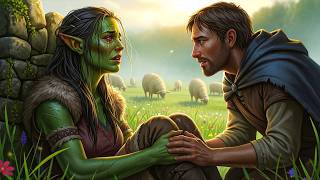
. more approachable. "Need help with fence," she said, pointing at the section that had been wobbling since spring.
Morris stared at her. "You came back to fix my fence? " "Debt not paid," she said simply.
"Also, fence is insult to wood. Is suffering. I fix.
" She did fix it. And rebuilt his barn wall. And cleared the stumps he'd been meaning to deal with for two years.
She worked with the efficiency of someone who'd spent a lifetime moving earth and breaking things in organized fashion. When she finished, Morris made dinner. Stew.
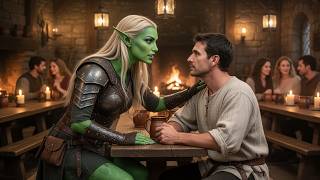
He wasn't sure if orcs ate stew, but she did. Three bowls worth. They sat in silence for a while.
Then Zugra spoke. "In my culture," she said slowly, "we teach children that humans are weak. That they break easily.
That they feel nothing but fear and hatred. " She looked at her hands. "I believed this for twenty-eight years.
Then you gave me water. " "What changed? " Morris asked.
"Everything. " She met his eyes. "You had every reason to kill me.
Every reason to let me die. Your people and mine, we have hurt each other for centuries. But you chose different.
You chose to see me. To help me. " She touched the gap in her tusks.
"This pain reminds me every day. Reminds me that maybe we are wrong. Maybe humans are not weak.
Maybe we are not monsters. Maybe. .
. " "Maybe we're just people," Morris finished. "Yes.
" Her voice was soft. Wondering. "People.
" Weeks turned into months. Zugra kept returning. Sometimes with warriors who needed to see that humans could be something other than enemies.
Sometimes alone, to talk about orc philosophy and human farming and the thousand small differences between their peoples. Horace took to joining them, his wooden leg creaking as he sat. Duncan brought books about orc prayer traditions, his secret shame now public knowledge.
Even some of the villagers started to come around, drawn by curiosity and Zugra's patient willingness to answer questions. "Why do you fight? " a young mother asked once, clutching her daughter close but no longer running away.
Zugra thought carefully. "Because we are taught that strength is survival. That softness is death.
That the world respects only power. " She looked at Morris. "But farmer with water bowl showed me different truth.
Showed me that kindness is also strength. That mercy is also power. That maybe.
. . maybe we fight because we are afraid to stop.
" The daughter wiggled free and walked up to Zugra. She held up a daisy. "You're pretty," the girl said with the casual honesty of children.
"You're green and pretty. " Zugra took the flower with fingers that could crush stone. She held it like it was made of spider silk and morning dew.
"Thank you," she whispered. "Is most beautiful thing anyone ever gives me. " The mother started crying.
Not from fear. From something else entirely. Change came slowly after that.
Like water eroding stone—imperceptible day by day, but inevitable over time. Millbrook became known as the place where humans and orcs could meet without bloodshed. Trade routes began to shift.
Curious orcs came to see the legendary Brennan's Farm. Merchants realized that green gold spent just as well as human gold. Not everyone was happy about it.
There were humans who called Morris traitor. Orcs who called Zugra weak. Letters came from the capital—some praising, some condemning, all confused.
Morris kept farming. Zugra kept visiting. The world kept turning.
One year after the night at the well, Zugra arrived at dawn. But this time something was different. She looked.
. . uncertain.
An expression that sat strangely on a face built for certainty. "Debt is paid," she said formally. "I have given protection.
I have given service. I have given friendship. " She paused.
"Blood oath is complete. Tusk can be returned. " Morris touched the tusk around his neck.
He'd worn it so long it felt like part of him now. "What happens if I don't return it? " he asked.
Zugra's eyes widened. "Then. .
. then oath continues. Becomes permanent bond.
Becomes. . .
" She struggled with the word. "Family. " "Good," Morris said.
"Because I'm tired of temporary. I'm tired of debts and obligations and diplomatic incidents. I want something real.
" "Real is complicated," Zugra warned. "Everything worth having is. " She smiled then.
A real smile, gap-tusked and genuine. "Then family you are. And family you remain.
" Horace found them an hour later, sitting on the porch, sharing bread and talking about nothing important. The old man's grin was absolutely insufferable. "You've gone and done it again," he said to Morris.
"First human with an orc sister. The historians are going to have field day with you. " "Sister," Zugra tested the word.
"Yes. Is good word. Is true word.
" Morris looked at the tusk around his neck. At the gap in Zugra's mouth. At the impossible, improbable, absolutely ridiculous family he'd accidentally acquired by the simple act of giving water to someone who needed it.
"Yeah," he said. "Sister works. " The world didn't change overnight.
Wars still raged in the far territories. Hatred still festered in hearts that preferred old wounds to new healing. But in one small corner of the frontier, on a farm that shouldn't have mattered, something impossible took root.
Not peace exactly. Not yet. But the beginning of it.
The first green shoots of something that might, eventually, grow into understanding. Morris planted that spring with Zugra's help. She had opinions about crop rotation.
Strong opinions. They argued about fertilizer while Duncan read orc poetry aloud and Horace made increasingly creative suggestions that helped nobody. The wheat grew tall that year.
The chickens remained judgemental but productive. Life continued with the stubborn persistence of things that refuse to die just because the odds say they should. Some nights, when the stars were bright and the world was quiet, Morris would sit on his porch and think about that night at the well.
About the choice that divided his life into before and after. He never regretted it. Not once.
Because kindness, he'd learned, was not weakness. Mercy was not foolishness. And sometimes the bravest thing a person could do was see another person—really see them—and choose to help anyway.
Even when they were green. Even when they were terrifying. Even when every instinct screamed to do something else.
Especially then. Years from now, historians would debate the Brennan Accord that started in a wheat field with a bowl of water. Scholars would analyze the socio-political implications of cross-species life debts.
Politicians would argue about the precedent it set. But Morris didn't care about any of that. He cared about the sound of Zugra's laugh—like thunder that had learned how to be gentle.
He cared about the way she'd started teaching orc children about human farming, creating a generation that knew humans as teachers instead of enemies. He cared about the small, stubborn hope that maybe, just maybe, the world could be different. Not perfect.
Never perfect. There were still villages that barred their gates when orcs approached. Still clans that taught their children that humans were prey.
Still wounds too deep to heal in one lifetime. But wounds do heal. Slowly.
Painfully. Imperfectly. And sometimes they heal because one stubborn farmer decided that dying creatures deserved water, regardless of their color.
Sometimes that's enough. Sometimes that's everything. Morris looked up at the stars and thought about Sarah.
About what she would think of all this. He liked to believe she'd understand. That maybe, somewhere, she was proud of him for choosing kindness over the easier path of continued hatred.
Zugra emerged from the barn, her massive form silhouetted against the moonlight. She sat beside him on the porch—the porch he'd reinforced three times because apparently orc-weight was a very real engineering challenge. "Good day?
" she asked. "Good day," he agreed. They sat in comfortable silence, watching the wheat field sway in the night breeze.
Two people from two worlds, connected by a tusk and a choice and the stubborn belief that maybe, just maybe, people were worth saving. Even when it was inconvenient. Even when it was dangerous.
Even when every lesson you'd ever learned said to walk away. Because in the end, the world didn't change through grand gestures or sweeping declarations. It changed through small moments.
Through bowls of water offered to strangers. Through choices to see people instead of monsters. Through farmers and warriors sitting on porches, building something new from the broken pieces of something old.
That was enough. That was everything. And if you're hearing this story now, sitting somewhere comfortable and safe, maybe think about your own well.
About who you'd help if they stumbled into your life bleeding and desperate. About what kind of world you want to live in. Because we're all just farmers, really.
Tending our own small patches of earth. Choosing, every day, what kind of seeds we plant. Choose kindness.
Choose mercy. Choose to see people, even when it's hard. Especially when it's hard.
The world needs more wells. More water. More stubborn fools willing to offer help when wisdom says to lock the door.
Be that fool. Be the one who changes everything with a simple bowl of water. And if you liked this story, if it made you think or feel or believe in impossible things, do me a favor.
Like this video, subscribe to the channel, and share it with someone who needs to remember that kindness is strength, not weakness. Because these stories? They're more than entertainment.
They're reminders. They're possibilities. They're proof that sometimes, against all odds, love and mercy and stubborn human decency can crack open even the hardest hearts.
Thanks for listening. And remember—we're all just people under the skin. Green or not.
Maybe it's time we started acting like it. And if this story touched something in you—if it made you think differently about monsters and mercy, about walls we build and bridges we burn—then maybe you're exactly the kind of person who belongs here at Orcbound Tales. This channel exists because we believe the best stories aren't about perfect heroes.
They're about broken people choosing to be better. About worlds divided learning to be whole. About kindness being brave enough to exist in places where hatred makes more sense.
If you want more stories like this—stories where orcs are people, where humans are flawed, where love doesn't follow the easy path—hit that subscribe button. Join this community of people who believe fantasy should make us feel something real. And leave a comment telling me: what would you do if you found someone like Zugra at your well?
Would you offer water? Would you walk away? I read every single comment, and your answers help shape the stories I tell.
If this story moved you, drop a like. It genuinely helps the algorithm show these tales to people who need them. People like you who showed up today.
People searching for stories that remind them the world can be different. And if you know someone—just one person—who needs to hear that kindness is strength, that mercy is power, that we're all just people trying to survive in a complicated world. .
. share this with them. Sometimes one story is enough to change how someone sees the world.
Next week, we've got another tale from the frontier. Another impossible bond. Another reminder that the bravest thing we can do is see each other as human.
Even when we're not. Thanks for being here. Thanks for listening.
Thanks for believing that stories about green-skinned warriors and stubborn farmers matter. Welcome to Orcbound Tales. Where monsters are people, and people are complicated, and every story asks you to choose what kind of world you want to build.
See you in the next one.