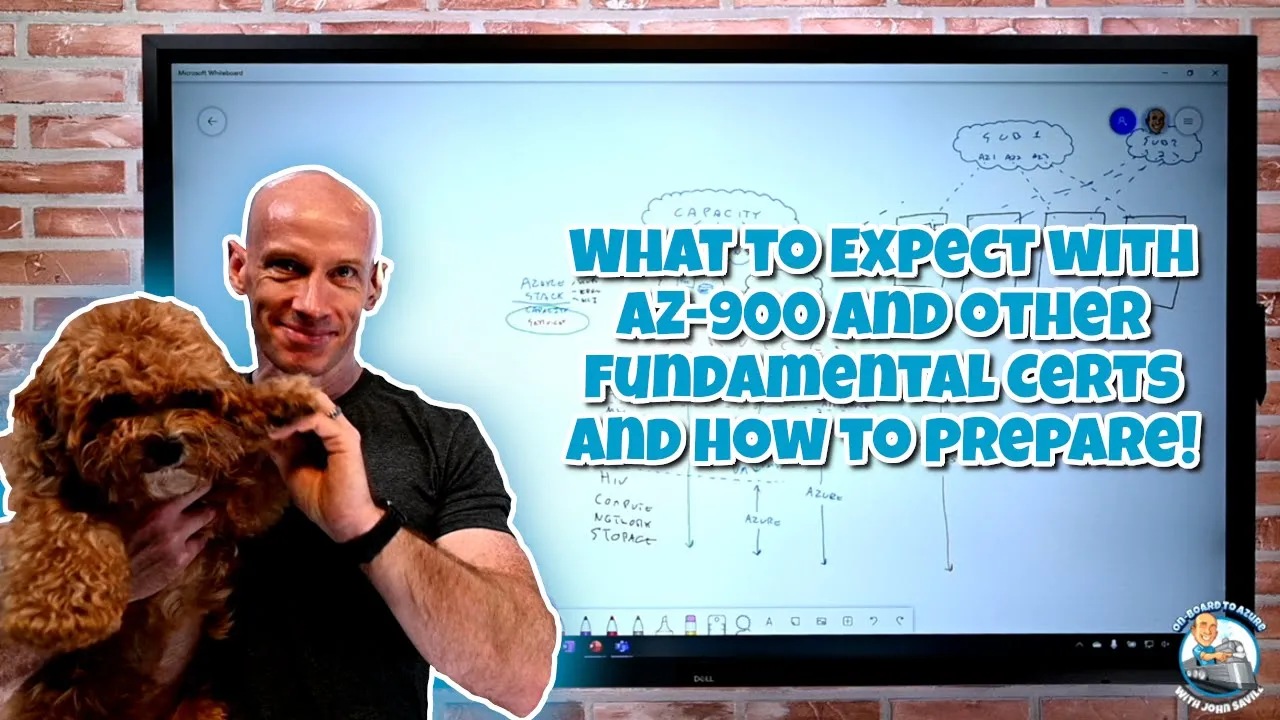
cool well thank you everyone for joining this and really my goal for this session is to really just walk through a little bit about how to think about the az900 but what i talk about also applies to the other fundamentals exams be it kind of the dp900 the ai 900 the ms-900 and they're all really similar in structure so i wanted to kind of just walk through the basics of kind of what you're going to see and what to expect so from a a basics level when i think about this it is a fundamentals exam it's 60 minutes long to actually answer questions now what you'll see is it says kind of it's a 90 minutes exam but that 90 minutes includes kind of some upfront preparation kind of a questionnaire at the end so the actual time you're actually answering questions is 60 minutes that that's it so yes it's 90 minutes total but only 60 minutes actually answering the questions and it's gonna be around 30 questions i've seen some people have slightly less some people have slightly more but it's a fairly rapid set of questions but they're all multiple choice that's really the key thing here is there's no complex case studies you don't have to read a case study and then answer questions about it there's no hands-on labs those sorts of things are for some of the other types of exams like the associates exams the architect exams the expert exams for the fundamentals it's literally just testing your knowledge about certain areas the way it's testing that it's just hey here's a question here's the possible answers which of them is it it's really nothing more than that now what is in when i think about like the az900 and the key part here is go and look at the certification page at microsoft so again i'm kind of focusing on az 900 here but there's a version of this document for the dp900 ai 900 ms 900 the front the power platform ones and it walks through here are the skills that are going to be tested so definitely go and look at well what's actually in the exam additionally microsoft have kind of free online learnings you can actually go through the calls and it will walk through hey here's what it's testing um here are the answers here are the skills you need to actually take part in that test when we think about the az900 it's talking about basic cloud concepts so what is azure as a cloud what is an is service what is a infrastructure as a service what is platform as a service um what do those actually mean what software is a service what are regions what are the resiliency options then what are the core azure services then you get into things like well hey there's storage accounts there's virtual machines there's app services there's database offerings and it's really just understanding what are the core types of service and what's their value proposition when would i use this thing understand sort of differences between them and we'll kind of walk through some of this in a second it wants to understand security privacy compliance trust so understand azure ad is the identity provider for azure and there are ways that i can hook into my existing active directory to replicate accounts how i think about well there's various compliance offerings and regulatory requirements that azure adheres to and i can go to trust centers to see what exactly those are how i think about trust how i think about privacy and then there's things like pricing what are the service level agreements what are the life cycles of the services and so all of these things are kind of called out as it breaks those down into detail if you go and look at the page now what i did is i created kind of a 60 minute summary and this is what was kind of being referred to at the start so if i kind of quickly just jumped over so i run a youtube channel and one of the things i did if i just showed in a bit more detail so i have a bunch of different content on this and i actually just created a special playlist if you go to playlists i actually added one all about microsoft certification exam prep and what i've got on here is kind of this is the ms900 but you see here up here there's actually one for ms900 one for dp900 and one for az 900. and if you kind of look at the comments of what people have said what they tend to do is they'll watch these videos at the start depending on which exam you're going to do and then it's the last thing they'll watch just before the exam because i basically i i go through and i whiteboard out all of the key comments the content you're going to need to know about in the exam so it really goes through everything that is going to come up so just as a kind of quick refresh for the things that hey we really might need to understand and know about this so all of that's kind of on my youtube channel it's just youtube. com ntfaqguy and you can obviously go ahead i'd love you to go and subscribe to that and then you'll see all the kind of updates i do i have deep dive videos i have weekly updates as well where i talk about what's new in the world of azure just to kind of keep you up to date right now i'm actually an azure master class i'm posting like a one and a half to two hour video every single week going through the complete azure kind of ecosystems if you want to know azure in more detail um what the actual master class is going through and there's a whole playlist around that is it will actually cover a lot more detail so here if i actually go and look at this thing hey everyone you can see on the left i've got all these different videos that go through cloud foundations identity governance resiliency storage networking vms and vm skill sets app service again this is way more detail than you need for this exam so that that's like another level but definitely those kind of exam certification and review videos a lot of people will go and watch that kind of just before they go and actually take the exam so that that would kind of help get you ready so in terms of preparing um let's go away that's a weird youtube thing does that sometimes it pop something up it gets stuck on the screen there we go it's back again um so this is kind of the links to the free online training um review my summary video and just go pass um and i kind of say it it's that easy people are always scared of trying these things in case they fail um ultimately so what if you take it and you fail you've learned the areas you're weaking it will actually tell you hey these were where you kind of a weakest in terms of the different skill sets involved you can go back and study that more so you've learned something you've gained experience of hey this is where i need to focus and then just go and take it again so i would never be don't take it because i'm afraid of failing so what i found tons of these things but you learn something you learn where you're weak and you can go and take it again so in terms of exam day um most people are going to take these online especially if everything going on with covid right now will take the exams online so what does that really mean if you've never taken one of these exams before what do you actually expect so for exam day you need a clear room ideally closed it's a segregate it's not some open area what the people that are proctoring the exam are looking for is to make sure you're not cheating they're making sure there's not some materials you can go and get access to there's not someone hidden away in the corner signaling you the answers so you want a clear space that you can kind of demonstrate hey look no one can interfere while i'm taking this exam so you need a laptop or computer the key point is it needs to have a single display they don't like you having multiple monitors set up because again i could be running something on the other monitor that's showing me lots of helpful information so if you're using your regular desktop if it has multiple monitors they're going to want you to kind of prove that it's disconnected it's kind of a hassle so in an ideal world for the exam just have a single display if you have a laptop that's ideal so i could go and take the laptop to a clear space where there's nothing around me that i can demonstrate because what you're going to do is you kind of need a camera ideally your phone and a microphone so the laptop itself needs a camera so they can watch you as you're taking the exam it needs a microphone so they can hear to make sure there's not someone whispering answers in your ear and i again that could be part of the laptop most laptops have kind of a camera and a microphone and then you're going to need your phone as well the reason we need the phone is what's actually going to happen is you're going to take pictures of the room and i'll talk about this in a second but essentially as an onboarding process it will send you a link you open the link on your phone and it's going to ask you to take a bunch of pictures and you're going to need your government id as well so on the actual exam you're going to go to the exam site up to 30 minutes before your time so you've scheduled a time 30 minutes before that time you can connect via the portal and actually start you can start early so i'm going to click that hey i want to start the exam it's going to launch the application that will guide you through the entire process step by step so you sign in you click the link it's going to kind of kick things off and get going now as part of that as i mentioned it's going to want pictures you're going to say cheese take a picture of yourself you're going to take a picture of the front and back of your government issued id and then you're going to take four pictures of the room you're in taking the exam so if i think about if this was kind of my desk and my laptop and my chair they want a view kind of of the front they want a view of the back of view of the left looking right and a view of the right looking left again the purpose of this is they want to know there's nothing around you so that you can cheat that that's all this is now the proctor who receives these pictures remotely if they're not sure about something they might actually get on the line and say hey can you also use your camera on the laptop show me the ceiling show me the floor hey show me over here for a second i wasn't sure about something they're just checking they're just doing their job don't worry about it it's happened to me a few times it's not consistent sometimes you'll never hear from the proctor they'll look at the pictures and you're done sometimes they'll say hey can you just show me this or that and i always take it in the same place but they ask for different things so there's not a great consistency there but they're just checking the work environment so again you want a clear space if you have a whole bunch of papers on the space they're not going to like that because you could have answers written on them you want a clear area when you actually take the exam the phone shouldn't be in reach nothing should be reachable and ideally it's an empty space your laptop and nothing else that that's the ideal scenario or again it could be your desktop computer with a monitor but don't have multiple displays so what are the questions what are you going to get asked again the style is multiple choice here's the question very short again you've got quite a few you've got maybe 30 questions in 60 minutes you've got think about it a minute and a half maybe with some spare time per question these are not super complicated it's just testing fundamentally do you know this so it's going to be a very basic question one or two lines it's going to give you a bunch of possible answers maybe four different answers now do read carefully sometimes it wants you to pick the right answer sometimes it might say pick the one that doesn't meet the set of capabilities sometimes it might say pick a couple of them so make sure you read carefully what it's actually asking for there are no labs there are no case studies there's nothing more complicated than question pick the right answer try every question you don't lose points for getting something wrong that's kind of a key point i obviously don't get points if i get it wrong but there's a negative effect of it it's much better to try and guess than just don't even try so always answer every single question even if you're not sure it's multiple choice um you have a chance of getting it right anyway and just eliminate obviously wrong ones if you're not sure then hey there's maybe four possible answers i'll eliminate these ones they're obviously not correct and then i'll just try and answer out of the ones that i think is most likely remember it's not designed to trick you there's no trick questions here and azure doesn't name its capabilities to try and hide what it really does from you that would be bad for the customers so often when you get a question think logically well what would make the most sense here that's probably the right answer so give an example uh what would you use to ensure that your application is resilient against a data center level failure so it's asking you about resiliency so i think about resiliency is well this is where i put my workload and if i think about azure remember what i can see they're giving me kind of multiple options here well i know a resource group is where everything gets created in a resource group but that's just for management that has nothing to do with resiliency availability set well availability say okay that's about resiliency it's about spreading workloads over different physical racks availability zone hey i know that's different physical facilities with independent calling power communications and then cheese i'm pretty sure cheese will not help my resiliency so i would say well i know it's not cheese i'm pretty now it probably won't have the word cheese but they do have some pretty off the wall what does that have to do with anything like it might say oh public ip standard well there's nothing to do with anything about this i also know resource group or resource group is nothing to do with resiliency it's just a management construct i can apply policy there i can apply role-based access control there i can apply budgets there but it's got nothing to do with making my resource resilient against certain types of failure so i'm left with availability set an availability zone well okay well i want resiliency against a data center level failure well availability set is resiliency against a rack level failure but those racks are all in the same data center so i know it's not availability set then availability zone is the answer so that's how you kind of think about going through that if you weren't just sure of the answer i can eliminate things that i know obviously wrong cheese and resource group and i've got 50 50 chance and you may have actually guessed that well zone sounds like a bigger area than set and that's probably the answer and again don't worry about failing everyone's exam is different and that's kind of a key point here 700 is the passing mark if you maybe get 701 and someone else says well i got 850 it's really meaningless they got a completely different set of questions than you you may have got a harder set of questions than them i remember i took an exam once and i failed i got like 695.
now did nothing different i just reset it again the next day and i got 8. 75 it's just the lack of the draw of the questions i got super unlucky it's saying i didn't know really anything about i just took it cold cause i was curious to see what was in it and i was like well that was unlucky because i knew this types of areas that should have got covered and it only just hit this one area i was weak on so i took it again the next day i got lucky it was all stuff i was strong on so your score is in a lot of ways meaningless compared to anyone else if someone says ah i got 850 you only got 701 it doesn't mean anything they may have got a much easier exam than you got the key is it's 700 to pass i hear a lot of people to say oh i don't want to take the exam what if i fail i don't want to fail the exam and i always really am so what so what if you fail um the only real failure is not trying something or hey i don't pass and i give up the way we learn the most is when things don't work when i'm learning a technology if it works first time i don't really learn it very well if i try it and it doesn't work then i have to go and dive into it and analyze it and really work out okay well this is how it ticks and i learn i really learn the thing so if you try taking an exam and you don't pass the first time again there's a full score report at the end it will show you all the key areas and it will show you where you were strong and where you were weak so now i've learned okay these are the areas i should focus on i'll go and redouble my efforts on those kind of weaker parts and i'll know i'll go and pass next time one of the things you could always do mentally to get past kind of that fear of failing is just take it the first time as a test run have no intention have no expectations of passing i'm just going to say hey i'm going to take it so i get an idea of what the questions are like so i get used to the exam experience this is just a discovery now if you happen to pass fantastic you passed you're all good if you don't happen to pass no big deal again you've got that experience you won't have maybe those uh shutters about taking an exam for the first time and you've learned where you're weak and where you should really kind of go and focus on so that's what i kind of think of in terms of framing the overall exam experience it's multiple choice it's going to give you the list of possible answers pick the one that you think makes the most sense don't leave any question unanswered just try them all so that was kind of the the key content i wanted to cover then i was really going to kind of jump over and walk through some of the content i guess really based on the questions people have okay so if there's no other questions uh i guess i can just start talking about some of the concepts and then you can kind of ask as i'm going through it so a key point when you think about what is azure we always talk about well there's the cloud azure is the cloud and really when we think about what is the cloud it's really capacity and it's capacity in different dimensions i can think about well there's different capacities maybe in terms of storage there might be network there's compute and then those themselves can break down into things like databases and object storage but it's basically a bunch of capacity now that capacity is exposed to us through regions so i can think about all throughout the world there are these azure regions and actually there's a great map so if we kind of pull this up quick we can let's go and look over here we can actually search for azure regions and let's have a look geographies okay so this is kind of the azure region map and here it's kind of showing all the places there are regions so think of a region as one or more physical facilities that exists within a two millisecond latency envelope so that's really the definition of a region so here if we look we can see there's lots of regions in the united states there's regions in canada we now have a second region coming in brazil i can see obviously south africa um there's a second region coming there there's regions in europe there's regions that are just uk just norway just germany um switzerland france china korea japan general asia india uae australia and one of the big points of having all these regions and the reason you typically see two is well one there's data sovereignty requirements i'm an organization there might be requirements that my data my services have to run in my kind of political boundary additionally well my customers might be in that boundary so i don't want to host a service in the u. s if my customers are in south africa the latency the the trip for the data to go back and forth would be terrible so there's regions all throughout the world so i can be close to my customer there's also typically two because we want resiliency when i think about making my service highly available a region could technically fail there could be some kind of natural disaster and remember a region exists within that two millisecond latency envelope says there's a finite size we can distribute over so if you had a bad natural disaster for example it could take out that boundary of space so what we want to do is actually have instances of our services and our data replicated to another region ideally hundreds of miles away but i need it in the same data sovereignty i have those regulatory requirements about where my data is allowed to live so the region you see two regions in nearly every single geography is to meet those data and those compute sovereignty requirements so that i can have resiliency hundreds of miles away but i'm still staying within the boundary of whatever requirements i have so when we think about we have these regions they're really these boundaries where i can deploy to so i have a subscription where i can deploy resources and the regions are places that i can actually deploy instances of services to and there's nearly always two in any geopolitical kind of boundary so i can have resiliency so when you think about that from a if i was thinking about making my service as highly available as possible well we have these kind of separate regions so might have region one and region two and they can be within that kind of geopolitical boundary but now those two regions i can have instances of my services my data and i could have that kind of replicated now i might run active active so there's instances of the services running in both at the same time or maybe this is my active and i could fail over to this if there was a failure but because i pretty much always have or we're getting there two regions in any boundary i don't have to start replicating outside of that data sovereignty boundary so that's kind of a really key point so at the capacity the capacity is exposed through the regions now really what i care about at the end of the day is yeah great there's this capacity it's exposed through these regions what i actually care about are services i don't really care necessarily about the fact that well there's capacity it's public cloud i don't care about underlying compute or storage or network or hypervisor i want to consume it and the way we consume it is through services now when we think about those services we really break them into different types if i was to think about well i just mentioned a few things i talked about kind of storage i talked about network i talked about compute and i talked about a hypervisor that could be hyper-v it could be vmware could be something else and then what we normally get today on-premises is what create a virtual machine and then i'd install an operating system could be windows could be linux i might have some run times maybe some middlewares i'd install my custom app and then i'd have my data and what i can think about is today if this was kind of on prem so on premises like what we're used to i as the customer is responsible for everything i'm managing storage area networks for the storage i'm managing servers i'm worried about network switches i'm worried about the hypervisor then i create vm so i do all of that stuff when i move to the cloud always everything hypervisor below is hidden from me the first type of service i get is infrastructure as a service so if infrastructure with a service the line is there so in this model this is azure's responsibility what you're responsible for is everything in the os and above so i get a lot of flexibility so again if you were thinking questions the question might be what service would i use if i needed full manageability of the underlying operating system well that's going to be an infrastructure as a service offering and when i think about what those offerings are typically we think about virtual machines and things like virtual machine scale sets a virtual machine scale set is essentially a grouping of vms that are automatically created by azure based on some template i describe so i have some image it could be linux or windows with a set of configuration then i can say hey i need five instances of this thing it will create those for me and then it can also do auto scale so based on maybe a time a schedule maybe based on utilization it can add more or remove some so i really think about kind of these vms and these vm scale sets they're the the real when i think about ios and getting started actually i'm going to move these for a second just to try and get some consistency when we start talking about this these are how i think about infrastructure as a service now you're not on your own there are extensions that can do things like anti-malware configurations there's configuration extensions there's things like azure backup to back them up there's azure site recovery to replicate them there are many things to help me but fundamentally from a responsibility perspective i'm responsible for everything os and above but i have full flexibility in there i can really do anything i want then we start kind of moving up the chain then we might get into platform as a service paths so here the line moves so now azure is responsible for pretty much everything except your app and your data there are still virtual machines running powering this stuff but i don't care about them anymore i'm not managing an os i'm not managing a middleware or runtime i say hey i want a pass service i have a certain number of power capacity i want and here's my app go run this for me now the reason i kind of started drawing these here is there are different levels of pads when i talk about these so like very often you think of containers containers virtualize the operating system vms virtualize the hardware so a vm sees a certain amount of resource virtual cpus memory network storage i'm isolated by that virtualized hardware a container virtualizes the os by breaking the os space into these sandboxes i use various mechanisms like c groups and name spaces to hide things from containers that share an os so we have services here like azure container instances containers as a service and there are things like aks the azure kubernetes service that provides an orchestrator for containers and the reason i'm kind of drawing it here is with containers i still pick an image now i i maybe don't have to maintain the base image i can just focus on my app but it is built on some kind of image so i have some responsibility for picking the image that i want to use but then where we get to is kind of the true pure paths as we think about it historically are things like azure app service so azure app service is really how azure started i can have web-based applications i just deploy my code and it's up and running there's things like service mesh this was kind of a a reliable set of collections which could be data it could be active models now it can run containers as well app service can run containers as well there are serverless offerings so this is kind of useful to know so what does that mean does it just run on air no when i deal with app service when i deal with aks there are still fundamentally worker nodes i say hey i want three worker nodes or four worker nodes they're what are running my application and what i pay for are the number of worker nodes i have no matter how busy they are with serverless i really don't pay for any underlying number of nodes with serverless what i get billed for is just the amount of work it's actually doing and there are really two i can think about azure functions and azure logic apps and for both of these things they're essentially event driven so what that means is something happens so there's some event and it will make that function or that logic app fire off for functions it could be saying from maybe a blob is created maybe it's a web hook maybe it's a schedule um maybe could be event grid event grid lets us have event sources there could be almost anything in azure and it can fire off and push notifications that can be consumed like from functions logic app has connectors and that connector could be hey someone's tweeted a message uh let's go and kind of hook in and do something with that so if all these different types of service and so again if a question was like hey we have a a web application we want to deploy as quickly as possible maybe it's dot net or it's java or it's node what would be a good fit for offering that service well our app service would be great if there was a question hey we have um some c sharp code or power shell that we want to run in response to a web hook well functions could be a great fit there if it was hey we need to be able to react when we get a tweet we want to do a sentiment analysis i.
e was it a good or bad tweet and then write a result to a cosmos db database well logic apps would be great fit there so these different services if you saw a question hey want to use containers we need an orchestrated a managed solution but we don't want to have to deal with worrying or even paying for the management that'll be aks azure kubernetes service so aks is a fully managed kubernetes service i don't pay for the management i just pay for those worker nodes that run my containers my pods and then all the way at the end with joining gold is kind of software as a service and the line here is well it's the top you don't do anything so this would be a good example of something like office 365. you don't install an application it could be dynamics 365 power platform it's a sas solution i might do basic administration hey i'll give this user this feature or something like that but i'm not actually installing sharepoint or installing exchange i'm not patching it they're evergreen so these are kind of the the dimensions that we typically see when we think about services so again i can kind of come back to think well what is azure azure's capacity that capacity is exposed through regions which is a certain envelope of networking and then it exposes services that i consume now i'm focused on the computer services here there are many other types of services as well obviously there's storage services we have object stores we have data lakes we have databases one's built on sql server uh one's built on open source like my sequel postgres mariadb we have our own native database solutions like cosmos db that are written for the cloud to be global scale multi-right all throughout the world there are higher level services ai services those cognitive services hey vision services to detect what's in this picture uh detect the sentiment in this language speech services to understand tech i mean there's a huge number of these services available to us so we're basically taking that capacity and offering it through services now i talked about we have regions so absolutely microsoft has regions but maybe there's times well hey you've you've got your location over here i want azure services but on-prem and that's where you see things like azure stack so there's a whole set of different azure stack offerings there's things like azure stack hub which are these big appliances these turnkey appliances that you run in your data center that kind of is all managed locally there's things like azure stack edge which are smaller units that are managed by the azure cloud but run certain services locally in your environment there's azure stack hci i can take my own servers but leverage features of azure to actually do management of it and there's azure arc azure arc lets me use the management plane of azure really anywhere on prem other clouds and then through that management plane i can do things like manage kubernetes clusters uh deploy aks and then once we've got those kubernetes managed i could deploy data services like azure sql database to other environments so yes there's azure regions that we host all of that capacity and we expose it through services but if i needed those services potentially on-prem maybe there's a mainframe or something so i want to be able to use it locally but i want the services well we can bring capacity locally through azure stack and then a subset of the services are available so i can think about hey yeah i could use azure stack here to give me some local capacity and then it can expose certain services depending on is it hard is it edge or is it hdi that i can now consume in a consistent manner through that so again it's hub edge hci and then there's things like azure arc that gives me a consistent management and things like kubernetes management and data services so that's kind of a super high level discussion around it that's really the fundamental building block of azure azure is capacity exposed through regions i have services and then these different types of compute data and more the only other thing i would kind of talk about is i mentioned a region and i kind of hinted at the other talk well when i think about resiliency i want to deploy to multiple regions but even within a region if we kind of expand out that region for a second a lot of regions today are actually built up of saint called availability zones so i can really think within that region there are multiple physical facilities now the point is these physical facilities have independent kind of cooling power and comms communications so each of them have their own independent sets of those so any kind of single calling failure would not impact a different a z and what we see in our subscription if we're using a region that supports availability zones is an az one two and three now there's not actually a physical building called az one two and a three there are many other buildings so really i can draw some others here we see az one two and three but the reality is what's actually happening is i'll just draw this for a second remember i thought about we have a subscription and the subscription is where we create things so i have a certain subscription we call it subscription one and in subscription one i see az1 az2 and az3 now for my subscription az1 could be there az2 could be there az3 could be there it's a logical mapping that's consistent for my subscription now if i had a second subscription subscription 2 which has az1 2 and 3 which az-1 might be that one az2 could be the same az3 could be all the way over there so there's no consistency between azs between different subscriptions it's a logical mapping and it's designed to help me hey i want to deploy services across different kind of resiliency boundaries i want to protect from a data center failure so i'll deploy some to az-1 some to az2 some to az3 but between subscriptions there's no correlation it's a logical mapping to a physical facility in that region so i think about availability zones as resiliency from a data center level failure now within those availability zones there are wraps and racks of servers so the other thing i can do as well is actually something called an availability set so i can create an availability set and what that does is it will spread resources i create over three different racks so availability set gives me resiliency from a rack level failure but it's in one facility availability zones give me resiliency from a data center level failure so that i said there's about five minutes left that's a kind of a super high level coverage of some of the key concepts when i really think about the cloud so i'll i'll stop there and just see are there any questions on any of kind of those concepts no one wants to talk i like my my dogs come to join us it's nearly eight o'clock yes nearly eight a.