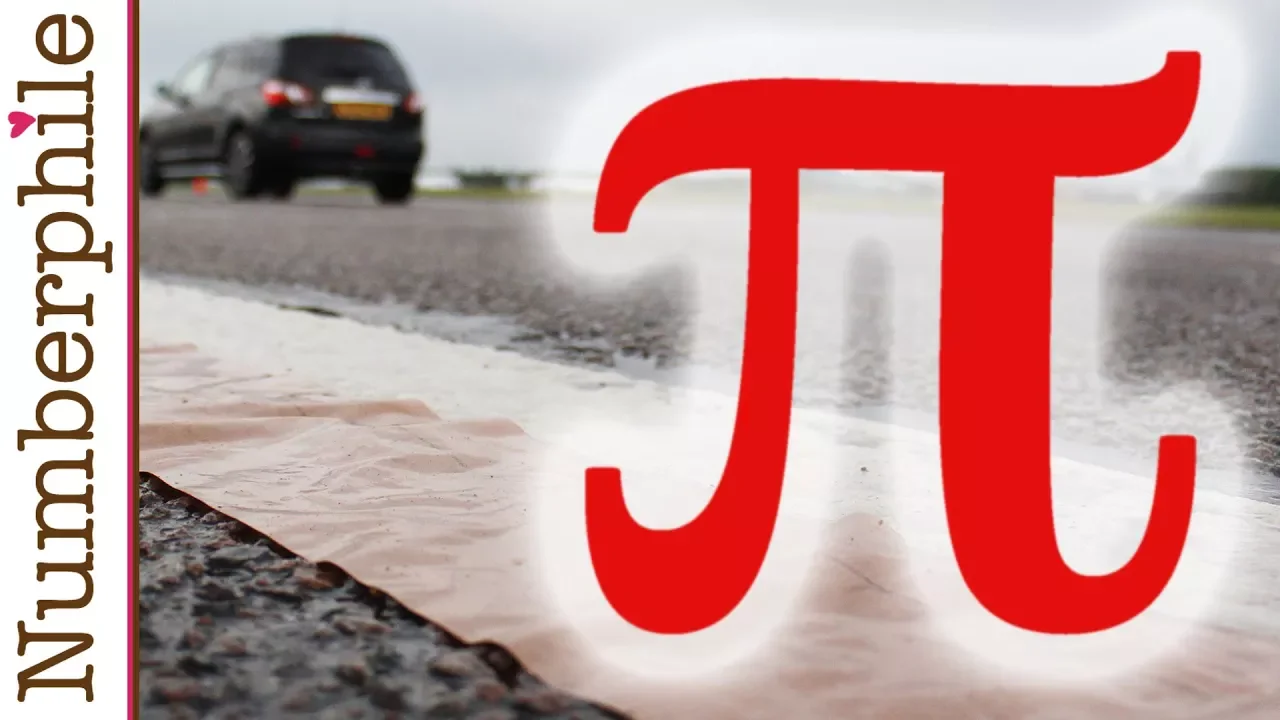
We're here on a runway because for some reason Brady has printed out the first 1,000,000 digits of Pi on a continuous mile long piece of paper which we are going to very carefully unravel today and go for a tour of a million digits of Pi. So here's 3. 14159 which - for a fun fact - that's as far as I've memorised and then it carries on and you've marked every 10 digits so there's 100,000 marker points so we won't get lost, we'll always know where we are in Pi.
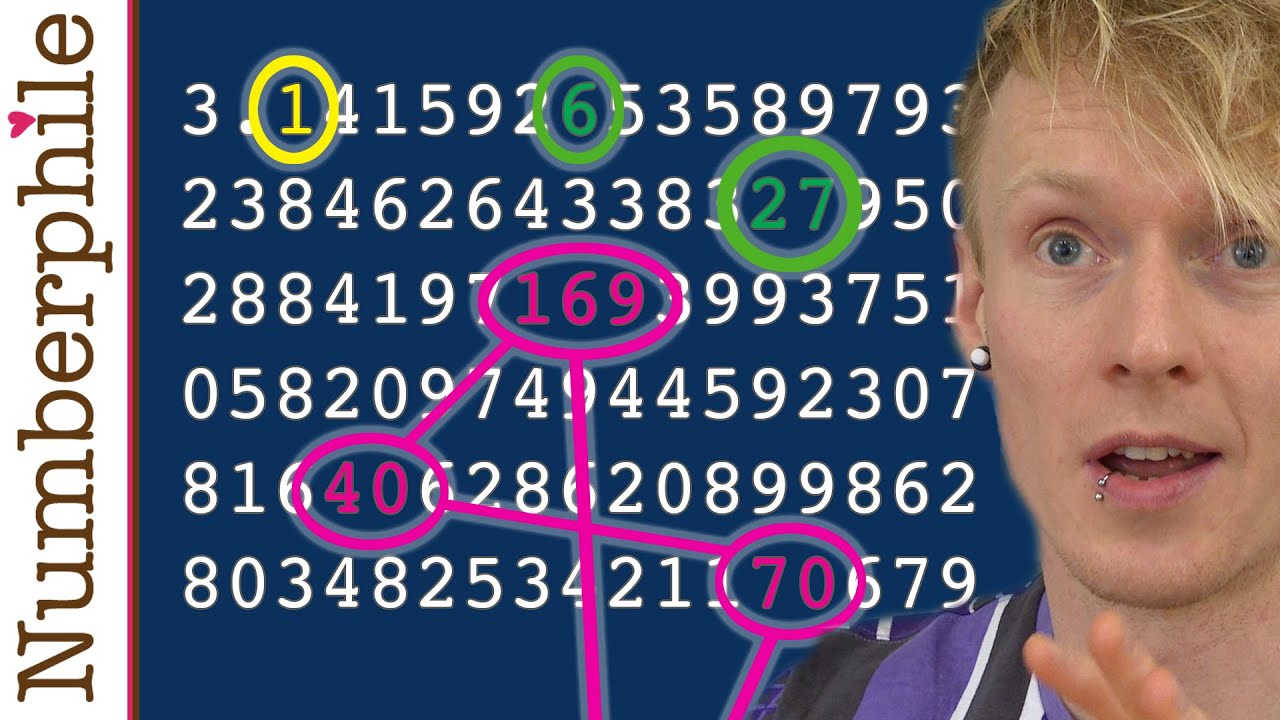
Where's the Feynman Point? Is that seven hundred and something? This the Feynman Point, six 9s, 999999, so that won't be beaten.
. . there is a string of seven 3s, but that takes another 710,000 digits, so we'll be nearly three quarters of the way down the mile of Pi before we find a longer string of the same digit.
And the first one is in the first two metres. Absolutely incredible! BRADY: Do you want these?
For that. HUGH: Bring the staple gun back. We've just hit 123 yards so we're long past the familiar bits of Pi.
So the whole 3. 14159, that is a long time ago. You'd think anyone who has memorised Pi, we're now in unfamiliar territory, apart from one guy.
What is the world record for memorising Pi, so someone recited over 125 yards of Pi, someone memorised all the way to here and couldn't be bothered to remember the next zero. BRADY: Not even a third. There is a run here of seven ascending digits, there it goes, 0456789, that is the first run of seven-digits that go up.
Obviously we're missing 1, 2 and 3, it would have been nicer with them, but nowhere in the first million digits do you get 0 to 9 in order. HUGH: That's nearly three hours. BRADY: I found some heavy bases for cones, I've got them in the back.
. . We're half a mile from the start, and the trolley team, are they on the horizon?
Okay, Pi has just got a horizon. Okay, see that 4 there, it appears every now and then, square number, kind of fun, but then from here you go, wait there's no fours. .
. no four, no four, in fact there's no fours until there, look at that, 157 digits and there are no fours for that entire run. They've just vanished.
And that is the longest run we will have in the first million digits that has one digit completely missing. With a million decimal places of Pi each digit should appear approximately 100,000 time each, that makes sense, but of course it's not exactly even, some of them don't even make it. There are not 100,000 zeroes, zero doesn't make it.
1 doesn't make it. 6,7,8 all don't make it. The champion though, is 5.
There it is, that there is the 100,000th 5. Okay we're four hours into this and we are nearly at a million digits. So they've been coming out a rate of a quarter of a million digits and hour, which is approximately 4,167 digits a minute, and we're almost there.
So you guys have done the hard work, do you want to wind off the last of it. And a million digits is there! There!
Alright so that is, it's one, in case you are wondering. So there you go, we have just, I mean I think a token round of applause. APPLAUSE So that is absolutely fantastic, and now the very quick process of rolling it all back up again before an aeroplane lands.
BRADY: Believe it or not we printed all million digits of Pi using about eight millilitres of ink. There, that's what 8mL looks like. That's because of HP's clever thermal inkjet technology combined with some very clever people here at HSA Systems in Denmark.
To see the whole story of how and why we made this film, check out the links on the screen and below in the video description. It also includes extra footage from our day out on the runway and more curious stuff about Pi itself.