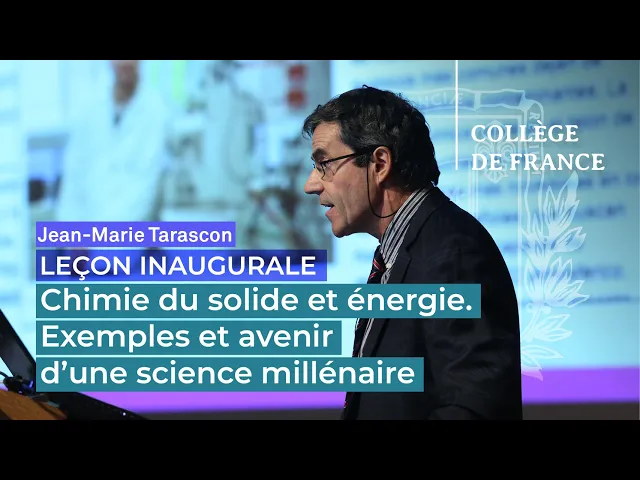
-Man's progress has always depended on the materials they use in their daily lives. Combining atoms in various ways to make alloys with varied mechanical properties, ceramics or dyes used by craftsmen and artists, or drugs useful to doctors, have constituted since Prehistory and throughout our History an empirical activity, sometimes esoteric and mysterious, such as medieval alchemy, long before it became the exact science we know today. Chemistry in the broadest sense has thus from earliest times played an essential part in the adventure of humanity. It has enabled it to build the world in which it lives
and to exercise its power over it. It has also accompanied the development of its imagination by providing the materials that men have fashioned to create their works of art and thus transmit their culture from generation to generation. This deep link between chemistry and life is beautifully expressed in Primo Levi's book, The Periodic System, which gives a profound poetic and philosophical vision of the links that materials science has woven between man and nature and shows how the knowledge produced by chemistry has gone so far as to modify and influence the thinking of humanity. Today, the links
between chemistry and our civilisation are deeper and more important than ever. Chemists are continually making new materials available to us through constantly renewed synthesis processes. Most of the objects in our environment come from this science, which is carried out in a close relationship between fundamental and applied research, between university laboratories and industrial laboratories. And the demands placed on chemists are increasingly numerous, varied and pressing. To meet our needs in the fields of energy, transport, communications or health, we need new materials that are ever more sophisticated, miniaturised, robust, recyclable and environmentally friendly. The synthesis of these
new materials, whether they be electrodes for ever more efficient batteries, photosensitive surfaces converting light into electricity with constantly increasing yields, glass for optical fibres that is ever more transparent or biocompatible materials that imitate living matter more and more precisely, this synthesis is carried out in a transdisciplinary manner, with chemists working more and more closely with solid-state physicists, biologists and even computer scientists and mathematicians. It is therefore only natural that this multifaceted science of chemistry should have a strong presence at the Collège de France, a place par excellence for the transdisciplinary production of knowledge. Up to
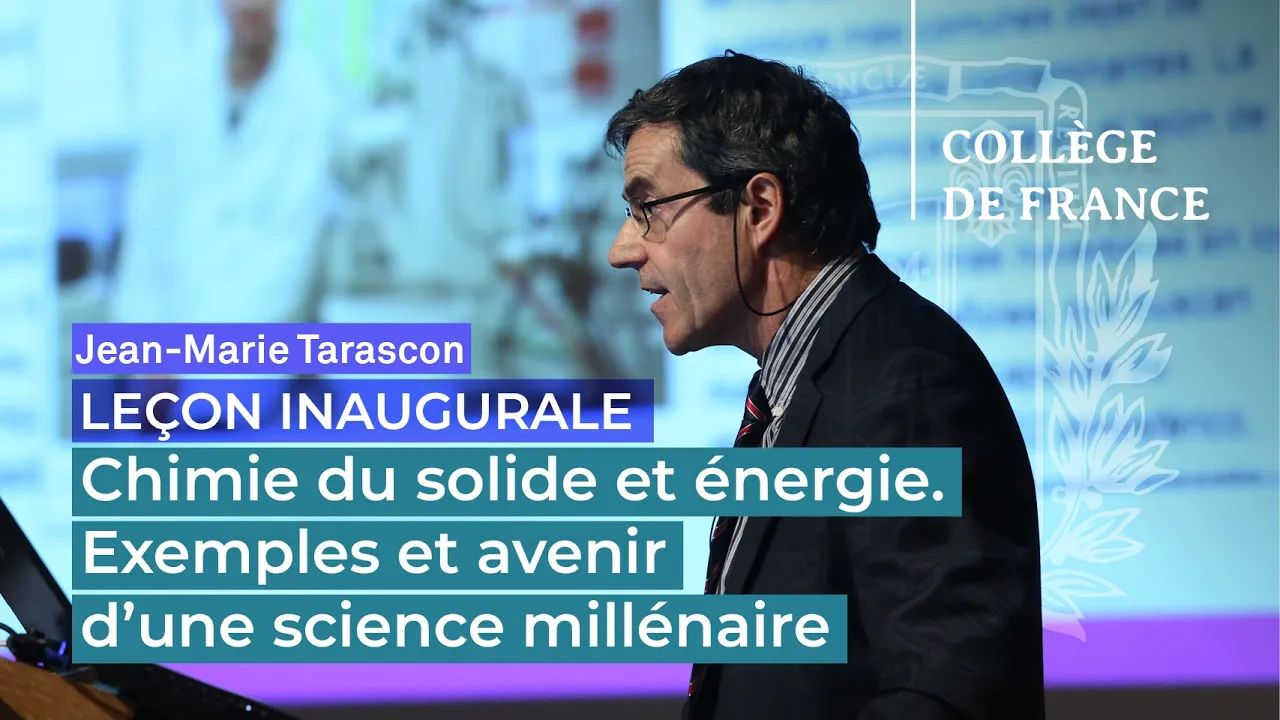
now, it has been represented by two chairs, that of chemistry of hybrid materials by Clément Sanchez and that of chemistry of biological processes by Marc Fontecave. We feel it is important to welcome a third chair of chemistry at the Collège de France today, devoted to chemistry of solids and energy. The problems linked to the production and storage of renewable energies are indeed crucial for our societies, and their solutions will largely come from progress in research, particularly in solid-state chemistry. No one could better embody this chemistry at the Collège de France than Jean-Marie Tarascon, the great
specialist in the chemistry of materials dedicated to battery technologies. He was a pioneer in the development of lithium-ion batteries based on a new all-plastic system, which are now widely marketed, particularly for the propulsion of electric cars. With constantly renewed inventiveness and originality, he is developing other types of batteries, using nanostructured materials for the electrodes, or organic materials from biomass, with the aim of developing energy storage processes that are increasingly less costly and more efficient. Jean-Marie Tarascon's work was first carried out in the United States at Cornell University, where he was a postdoctoral fellow, and then,
for more than ten years, at the Bellcore laboratories, which in 1982 took over from the legendary Bell laboratories. There he began his research on superconducting materials, particularly at high temperatures, before devoting himself, in the early 1990s, with the success I have just mentioned, to the study of electrolytes and materials dedicated to energy storage. Before joining the Collège de France, Jean-Marie Tarascon had been a professor at the University of Picardy in Amiens since 1995. Since 2009, he has been in charge of a national research and technology network on electrochemical energy storage. I will not insist on
the numerous distinctions received by Jean-Marie Tarascon during his career. He has been a member of the Institut universitaire de France, he has been a member of the Académie des sciences since 2004. His list of publications is truly impressive, with an exceptionally high citation rate. He has filed a large number of patents, which are currently being exploited worldwide, and we already know him at the Collège de France, as he held the annual chair on sustainable development, environment and energy in 2010-2011, co-managed by the Collège and the company Total. Dear Jean-Marie Tarascon, it is today on a
permanent chair that we welcome you to the Collège de France. I am particularly pleased that the offer we made you to come and occupy this chair won out over that of an American university. The fact that you had to make this choice bears witness to the recognition you have received for your remarkable work, and the fact that you chose France, first the University of Picardy and then the Collège de France, shows that, on the one hand, our country can retain and keep its talented, renowned researchers, and that, on the other hand, our institution, the Collège
de France, is a unique pole of attraction in the great international competition for scientific excellence. Your arrival at the Collège de France will take shape in a few weeks' time with the installation of your laboratories, in premises whose construction is just a few metres from here. This installation will enable the Collège de France to create, in synergy with the two existing chemistry chairs, a major centre which will be very important for the chemistry of energy and the environment. I am also sure that you will have the opportunity to collaborate with other chairs in the exact
sciences, physics, biology, computer science and mathematics, and insofar as the problems you are interested in concern society as a whole, that you will also have the opportunity to interact with your colleagues in the human and social sciences. I now give you the floor to present your inaugural lesson entitled From the Atom to Materials for Energy via Solid State Chemistry. -Thank you very much. Mr. Administrator, dear colleagues, dear friends, ladies and gentlemen, although two years ago I presented an inaugural lesson in the framework of the annual chair of sustainable development, I can testify that it is
still a daunting exercise. Allow me, however, Mr. Administrator, my dear colleagues, to thank you for your trust and to do me the honour of welcoming me once again in this prestigious institution as holder of the Chair in Solid State Chemistry, Energy. The creation of such a Chair, as you mentioned, Mr. Administrator, marks an important moment in the history of the Collège de France, because it is the first time that the Collège de France has three Chairs of Chemistry. I am particularly pleased with this initiative, and I would like to thank Marc Fontecave and Clément Sanchez
for promoting it. However, three chairs will not be too many to enhance the image of this science, which occasionally makes the headlines, as you can see here, but which is all too frequently decried even though it is the source of considerable advances in the fields of health, agriculture, textiles, food and many others. The International Year of Chemistry in 2011 has certainly raised the profile of this science. However, an enormous challenge remains, and I am happy to take part in it at this renowned institution. Chemistry has several components, including organic chemistry, which relates to the construction
of molecules, biochemistry, which is concerned with the molecules of living organisms, and solid-state chemistry, which relates to the synthesis, structure and properties of materials. It is to the latter that I will devote my teaching and research at the Collège, and which I will now talk to you about. France played a key role in the development of solid-state chemistry from the 1950s onwards, mainly thanks to Professor Paul Hagenmuller and some of his students. I have had some of them as teachers, including Michel Pouchard, who does me the honour of being here this evening. I can only
be a follower of this discipline, which was also taught at the Collège de France by eminent scientists and professors, such as Jean Rouxel, who passed away too soon, and Jacques Livage, both of whom made very important advances, and who are the source of our inspiration. My inaugural lesson today will consist of two parts: in the first, I will first remind you how solid-state chemistry, which was initially a series of recipes, similar to the culinary art, became over time and following scientific discoveries in the 19th century a true science of matter and transformation. Then, based on
a few examples, mainly from my research, I will show how, through experience, the chemist can reveal the secrets of matter, better understand it, so as to be able to transform it in a reasoned way to create materials with added value or functionality sought for energy. I will begin this lesson by reminding you that the history of humanity is closely linked to the history of materials and the history of chemistry. Let us look at two examples from the field of solid-state chemistry. The first concerns the synthesis of high-purity silicon rods in the 1960s, which gave microelectronics
and computer science the boost they enjoy today. The second is the development of optical fibres. These light conductors, through which your telephone, video-conferencing and computer data pass, have also revolutionised the way we communicate and talk to each other. But let's look at the societal problem that chemistry, in general, and solid-state chemistry in particular, must address today. Judging by all the world's authorities, energy appears to be the most important societal problem that our planet will have to solve. And the conditions: this energy produced will have to be doubled, with a lower CO2 content. Of course, there
is a great light of hope in replacing fossil fuels, which are running out, with renewable energies, such as those from the sun or wind power, and so on. However, to make this energy transition a success, we will have to manage, transport, store and convert these energies better, and above all reliably, cheaply and on a large scale. That is the challenge. Therefore, to manage this situation, from the capture to the use of energy, as you can see, there are several technologies: there are conversion technologies, especially wind power, thermoelectric solar panels. There are also electronic or chemical
device technologies, i.e. batteries, supercapacitors, and so on, and also transport technologies with superconducting materials. A common denominator in all these technologies is the lack of materials: material is essential. And this is not new, since as far back as 1960, technology was still limited by the availability of materials, as the Department of Energy in the United States put it. This is even more true today. You can see why in this context the marriage of solid-state chemistry and energy makes sense. However, there is nothing original about this marriage, since it already existed in antiquity. Indeed, if we
believe the archaeological excavations that took place in the Baghdad area, they directly uncovered an object dating from the 3rd century BC, which consists, as we see here, of a pottery, a copper cylinder, an iron bar. From this assembly, electricity could be produced. Of course, there are many questions today about the real hypothesis, about the use that the ancestors made of it, and this remains controversial. However, thanks to this information in itself, you can see here that our ancestors knew how to master pottery and how to produce metals such as copper, iron, according to processes that
we will see, which really link the chemistry of the solid to the origin of a civilization, and nothing better than the gesture of the potter to have this link. Indeed, this potter, as you can see here, transformed a vulgar mixture of clay and water into a paste. Once shaped, he used the power of the fire to cook it and obtain this dense pottery. This same potter, in doing so, could directly combine fire and pigments, to give an aesthetic character to this pottery. By doing this, he was only reproducing what we do today when we use
our high-temperature ceramic methods. Of course, he did not understand at all the reactions involved in this action of transforming clay into terracotta, but he was operating according to empirical recipes he had learned over the years. In the same way, this power of fire was mastered by the craftsmen of the foundry, who also prepared metals at high temperatures, certainly less abundant in nature, by reducing certain minerals, the formula for which, of course, they did not know, but they referred to them by colour. And this is how copper can be prepared from malachite, or bronzes from a
mixture of malachite and cassiterite. And it was only with time that one learned directly the mastery of this fire, the mastery of the furnaces, that one could go to higher temperatures and widen the spectrum, and obtain iron, and so on. You can see that in this case the Stone Age was replaced by the Copper Age, the Bronze Age and the Iron Age. You see exactly this relationship between materials and humanity. But these minerals could also be used for other applications, for example in cosmetics. Indeed, in this case, the ladies of yesteryear used cinnabar, which is
a mercury sulphide, like a lipstick. They could also use stibine black or lazurite blue as an eye shadow. It was finally the rarity of some of these pigments that prompted chemists to synthesise them. And the first artificial synthesis of a pigment dates back to 5,000 years before Christ. In this case, they used a clever mixture of reddish native shavings, marine deposits, sand and water which, at high temperatures, produced a bluish powder, which was Egyptian blue. The irony of fate was that this recipe was lost over time. It was finally only with the advent of modern
chemistry in the 19th century that it was possible to identify the composition and trace all the chemical reactions that had been involved in this synthesis. All this finally shows us that over the years, the ancestors had been able to establish recipes to make all these materials, but of course, they did not understand the science behind them. Now, the transition from recipes to modern chemistry, which will be based on scientific laws, has been a long process. A long process which was not at all made easier by the alchemists, whose motto is to transform metals into gold,
and who associated magic and spirituality with the word chemistry. These alchemists did not use elementary bricks, as shown here, but they manipulated, in this case, compounds such as fire, air, earth or water to prepare their compounds. And as can be seen here, they certainly already had an intuition of symmetry, of what matter was going to be. It took 2,000 years to go directly from these elements of compounds to the chemical elements they made up, and finally to the 33 elements of Antoine Lavoisier, who is considered to be the founding father of modern chemistry. Lavoisier's work
gave rise to an effervescence, I would say, of chemistry in all forms of the field, with the search for new elements as well, and moreover, certain professors at the Collège de France have distinguished themselves perfectly in this field. Here, Nicolas Vauquelin discovered chromium, beryllium. Louis-Jacques Thénard isolated silicon, discovered boron, hydrogen peroxide and cobalt blue, and finally, we owe bromine to Antoine-Jérôme Balard. Parallel to this method, the chemistry of the solid was a little behind despite the work of a few pioneers who were to lay the foundations of crystallography. Indeed, Romé de L'Isle, was going to
directly lay down the laws of symmetry and the constancy of angles, which were simply deduced from the observation of the facies of the crystals. Next, René-Just Haüy wrote, or proposed, in his book, the Traité de Minéralogie, la maille cristallographique, but this was a time of frustration, because there was no analytical means to really look at matter. And this era of frustration is very well summed up by this quotation from an American physico-chemist, Harry Clary Jones, who wrote: "We don't know the structure of cooking salt or ice, and at the moment we have no reliable means
of solving these simple problems of the solid. Our ignorance is almost total." You will see that this sentence will soon become obsolete, thanks to two important discoveries. The first is Röntgen's X-ray, which made skeletons visible. He demonstrated this brilliantly by using his wife's hand instead of his own, because he did not know what the harmful effects of this radiation were. The second was Max Von Laue who had the idea of using this radiation to illuminate a crystal, and to obtain the first diffraction picture containing spots. This is the first revelation of order and symmetry in
the society of atoms that form the crystal. Thus the X-ray diffraction technique was born. It was quickly developed by the Bragg father and son, who in addition to proposing the laws, solved hundreds of structures, for example, as you can see, the structure of diamond and sodium chloride, and many others. As an example, I will say, quite simply, that a cubic millimetre grain of cooking salt contains as many atoms as you have stars in the universe. We knew the position of the atoms. Now, what was the force that would bind these atoms together? Fortunately, at the
same time, atomistics, which is the quantum approach to infinitely small matter, was developing, making it possible to unravel the mystery of the atom by placing the electron in the orbitals. One could then have the direction, the energy and so on, thanks to the Schrödinger equations. This discovery enabled Linus Pauling to lift the veil on chemical bonding, the overlapping of orbitals, and to introduce concepts of electronegativity, and so on. However, at this stage, a step remained to be taken, especially for solid-state chemists. What would happen to this electron, when one went from bonding and went directly
into this society of atoms that is the crystal? Here too, we had to see what was happening: it was the quantum approach of the crystal, applied to that of the molecule or vice versa, which made it possible via judicious approximations to establish the band structure of materials, as we can see here, the last level of which is going to be a Fermi level. And this band structure is going to play an essential role for chemists, and above all for physicists in predicting the properties of materials. Thus, in the 20th century, we had four forces at
work again, which benefited the development of solid-state chemistry. We now knew the structure of the atom, the chemical bond, the crystallographic structure, and the band structure. This has enabled the revival of solid-state chemistry, which is a science based on rational properties-structures, to develop new materials with specific functionalities. However, this boom has largely been driven by the very strong interactions with condensed matter physicists, or theorists, who have a passionate taste for materials. And moreover, this was very brilliantly exposed in 2009 by one of my colleagues, a theoretical physicist, Antoine Georges, in this same forum. Also, this
science has taken great advantage of an industry situation at the time, where we were hungry for materials to develop new technologies. At this point, I have shown you the foundations of this chemistry, now let's see how the chemist will play and directly imagine these materials. We will see what this chemist's toolbox is, and of course, his main tool is the periodic classification, which you can see here. It is finally the chemist's rule to calculate, if, of course, he understands the information behind the canvas of this painting. What is this information? The ionic ray, which will
vary according to the direction indicated here, the electronegativity, which will directly represent the energetic position of the bands in these materials, and so on. And with these values, he will be able to directly manipulate the chemical bond, as indicated here, and choose these elements to, in this case, compose his score and design the new material. As you can see, the design of new materials for a chemist, in the end, is a set of atoms and a set of bands. And, we are going to play this and of course, as in any game, there are going
to be rules. There are certain rules to be respected, including the tailor's rule, which takes into account the respective position or size of cations and anions. Indeed, in this case, you see that the green or blue cation will go in tetrahedral or octahedral sites, depending on the size of the anions. Furthermore, if you reduce the size of the anion, as shown here, you will apply a chemical pressure that will tend to favour a high oxidation state. This is why, when you have metals, you will always have a higher oxidation state with a ligand that is
oxygen, than a ligand that is sulphur, just one size point. And this size will also play an important role, along with the intercatonic distance, in controlling the mode of condensation of the tetrahedra or octahedra of coordination. In this case, we will be able to go from a monodimensional structure to a two-dimensional structure or a three-dimensional structure. This will be used very quickly, to explain natural phenomena that are very much studied by geophysicists, i.e. to see what the different structures of the silicates on the surface of the earth's mantle will be. In fact, you can see
that here, as I go down into the earth, I'm going to increase the pressure, and we're going to go from a structure in which you had SIO4 tetrahedra, SIO6 octahedra, which share summits and edges. It's all simply explained by the "tailor's rule". Indeed, this rule tells us, here are the electronic configurations directly, you see that a +4 silicon and (the antifreeze 2-) have exactly the right number of electrons, and automatically, the biggest atom will be the one that is the most compressed, and you change the cation/anion ratio, and you simply shift from a tetrahedral environment
to an octahedral environment. That's what you can do. What else can the chemist do? They know the size of these atoms, they will be able to play their favourite game, cationic or anionic substitution, and thanks to this, they will be able to directly change the properties of the materials. I take a very simple example, zirconia which is dosed with yttrium. If I replace zirconium atoms with yttrium atoms, I will introduce a gap in my lattice, to balance the charge and have electroneutrality. This vacuum that I am going to create will simply drag neighbouring atoms and
give them some diffusion, to obtain what is called an ionic conductor. This ionic conductor will have a very important implication, since it will be used in fuel cells. The chemist can also make substitutions, and now perhaps a lower level, but in this case there will also be very important variations. Indeed, here I'm going to take two structures, I'm taking alumina and beryl. Take a good look here, the aluminium atoms are going to be in the same octahedral site. I'm simply going to replace the aluminium atom by a chromium fifrelin, I say (inaudible) and you'll see
what happens. You're going to see in this case two totally different colours, ruby here, and emerald here. All this is explained by the ionicity of the link. You have, in this case, an ionicity which is greater in the case of alumina than in the case of beryl. The message of all this is that you have to keep in mind that in solid chemistry, the defect is often more important than the matrix to control the properties of the materials. This is how the chemist can play with these atoms. I told you, he can also play with
band structure, and indeed, if you take a band structure schematically, physicists would not like that too much, certainly. In this case, we have a semiconductor with a gap between p-levels and d-levels. If I change the electronegativity, as you can see, I will simply raise the levels of the sp-bands and go and cut the d-bands, and pass a metal or a superconductor through the semiconductor. I can do the same thing, but in this case it's the d-band that's going to go into the sp-band, if I go from right to left or up and down. That's how
chemists design this material. Designing them is good, how is he going to prepare them? Nothing innovative, the same method as the old ones used to do, that is, the high-temperature method with repeated grinding and baking, what I call the "Shake and Bake" method. Why does he do this? When you want to make two powders react, automatically, you're going to have to transport matter, that is to say, the atoms will have to move to react. I can explain this to you by putting this formula, but hey, not much meaning: look at these two values. For an
atom to travel one millimetre, it will take 320 years at 25 degrees and 11 days at 900 degrees. You have all understood why a high temperature is used. And, of course, you're going to need pressure as well. In this case, we're going to have greater intimacy of the different species, and we're going to promote interface growth nucleation. In solid chemistry, and at high temperature, the nature of the phases obtained is linked to the conditions of temperature and pressure, but thermodynamics will impose its laws. It is this kind of technique and synthesis that the ancients, until
the middle of the last century, studied. As you know, these are very energy-consuming methods. You will see that here too it is a social problem, once again, which will be at the origin of the revival in inorganic synthesis. What is this point of society? It's the energy crisis of 1973. In fact, it asked chemists to reconsider the synthesis of materials, and to include the energy cost of their materials. This is why a lot of work is being done, particularly in France, to modify these methods of synthesis. And, indeed, we have gone from high temperatures to
low temperatures, to arrive at soft chemistry, which was developed in France and whose name is known throughout the world. The two pioneers of this soft chemistry are the former professors of the Collège de France, Jacques Livage, for having used molecular precursors, and Jean Rouxel, for having used solid precursors. What are the reactions of soft chemistry? I am going to focus more particularly on those with solid precursors. They will all be based on a topotactic reaction. What does that mean? It means that in a topotactic reaction, during the reaction, we are going to maintain the structure
of the product at the beginning, that is to say that we are not going to cut any links, and from an energy point of view, we have a huge gain. We will now be able to have this high structure and make reactions, but I am going to make reactions, and I am going to do intercalation chemistry. The intercalation chemistry is nothing other than like a millefeuille, to insert cations inside these sheets. You can also insert molecules, organic polymers, that's what I'll call grafting chemistry. In this case, you have a compound, you have an expansion, and
of course you have a more copious millefeuille. That is, if you want, what you can do. I would say that it was in the 1980s, in a period of profound reworking, of profound changes, we were going to pass from high-temperature chemistry to the process of soft chemistry, with also, as you can see here, a second oil shock, which required a very special effort to lower the costs of synthesising materials, that I took my first steps in research, and, taking these first steps in research, doing a bit of literature, like any researcher, I came across a
very beautiful article by an eminent solid chemist, Robert Collongues, who wrote : "Isn't the role of the chemist to transform matter to adapt it to our needs and make it a useful solid." This has been the motto of all my research since then, whether I work on magnetic materials, superconducting materials, electric iron material, optical or electrode material, that's what I think. I am not going to be able to talk to you about all these materials, but I have chosen, quite simply, the materials that are going to be connected to energy, first of all to save
it, I am talking about energy transport, and in this case we will talk about superconducting materials, which are materials that, below a certain temperature, called the critical temperature, have zero resistance, and of course do not have a joule effect. Such materials could quite simply enable us to save the 11% of energy that is currently lost today, when electricity is transmitted through high-voltage lines. The second type of material that you can study are materials that will be able to store energy, and that will be able to return it when we need it, according to demand. These
materials will be the main components of batteries, fuel cells, and so on. Why did I choose these two materials? It is not pure chance. It is simply because there is a synergy between these types of materials. That is, the same compound can have both functions: it can be a superconducting material and also a material for batteries. Moreover, they are going to be based on a redox reaction, it is a reaction in which there is going to be a transfer of electrons. That is to say, electricity. Now, in this second part, we are going to see
what these materials are, because I am sure that some of you are worried. They're going to think: "What materials is he going to talk about?" I will take three examples. The first example, I'm going to look at Chevrel's phases and superconducting cuprates, seen through the soft chemistry approach, so as to show you the richness of this approach. The second will be the insertion chemistry of lamellar oxides, so as to reveal to you a new reaction mechanism, and also to show you the importance of applied fundamental research. Finally, the third will concern the development of electrode
materials in the context of sustainable development. This is to show you, finally, that this solid-state chemistry is very adaptive. We start with the Chevrel phases. Of course, they were discovered by Roger Chevrel, a Frenchman, in the 1970s, and these materials consist of Mo6Se8 entities, which in this case form tunnels inside which copper and other ions will go. These entities will be remembered for what follows, and the fact that copper is a very weakly polarising atom, and thus (inaudible) is a very reductive atom. What can be done with this? First of all, you will see, we
can take these materials, and by a simple oxidation reaction, in iodine, we can oxidize and take out the copper, to have this open structure. Now, this open structure, it's ideal to do this soft chemistry. Indeed, I am going to be able to put lithium, sodium, magnesium in it, and develop lithium, sodium and magnesium batteries. But I am also going to be able to put in other metals, at low temperature, at 200 degrees, such as tin, indium, thallium, mercury, and at the time, it turned out that when these measurements were made, the thallium phase was the
one that had the highest superconductivity of the Chevrel phases, as shown here. This is what can be done. Another game, just as spectacular, and shown here. Indeed, if I take up these materials again, I will be able to move the copper atoms in this case. By a simple electrochemical reaction, you can see that the copper atom will be moved, and I will have metallic copper. And this reaction is reversible. Therefore, another type of reaction, a displacement reaction, has come to light. But again, for this reaction to be useful, it has to be completely reversible. It
took us seven or eight years, and thanks to a collaboration with Jean Galy from Toulouse, we were able to isolate a material whose formula is given here. Always the same, you always have your millefeuille, with, in this case, not cream, but copper. The material has a very beautiful structure. Now, when I reduce it with lithium, look what happens. You simply create octopuses, with tentacles, whose tentacles are lithium dendrites. Dramatically, when I'm going to re-oxidise this material, as you can see here, I go back to the original material. That means that in this case, you have
perfect reversibility, and this is simply due to the fact that in these sheets, you have atoms in red here, which give a certain pivot to these sheets, and a certain elasticity. By this, it has been shown that these displacement reactions can be perfectly reversible, and can be used for electrode materials. Another richness of these Chevrel phases is simply the fact that it resides on Mo6X8 entities. It is also possible, depending on the temperature, to carry out condensation reactions, and to obtain, by combining two, three, four, five, and so on, as you can see here, materials
of increasingly larger unit dimensions, with the last one, here, being a monodimensional compound. Of course, this is not without reminding us of the beautiful Lego chemistry that Gérard Ferey makes in mesoporous compounds. But in this case, these compounds had to be solubilised. This is what we managed to do. Of course, we started with this material, because the interactions between different chains were relatively weak. If we put this material in polar solvents, as shown here, we will obtain gels, or even liquids, and when we look at these very diluted liquids, we see that we simply have
Mo6Se6 chains, totally solvated. In other words, we have the first example of mineral macromolecules, or inorganic polymers. But the interesting part of all this is that now, as soon as we have these very reactive chains, we will be able to recondense them, by putting various ions, as indicated here. And we obtain a whole series of new phases, as mentioned. And that too, these concepts do nothing other than mimic Jean-Marie Lehn's supramolecular chemistry. Now, if we look at these different phases, and you will see that there is one that is going to be very interesting, which
is the lithium phase, which is the Li2Mo6Se6 phase, which is a compound in (inaudible) we are going to be able to reduce, reoxidise, and this compound was the first demonstration of the lithium ion material, with the same material as a positive electrode and as a negative electrode. At this point, I would not like to leave you with the fact that we can also do these reactions with anions. Indeed, we can use cations, but we will be able to use anions. And to do this, I will simply use the superconducting phases, as shown here. I am
not going to go into the details of these structures at all. This is not the point here, but I simply want to point out, that all these materials are non-stoichiometric in oxygen. This non-stoichiometry in oxygen will influence the Cu3+/CU2+ ratio, which is essential for superconductivity in this compound. When you work on this, you can of course modify (its oxygen) at high temperature, but you can also do it at low temperature. That's what we did at the time with plasma oxidation, and so on. But a very elegant approach was taken by the Bordeaux group, notably Jean-Claude
Grenier and Michel Pouchard, who used electrochemical methods to insert oxygen atoms into these compounds. What they have done with this, in this case we can modify the metallic properties of this compound. We go from a semiconductor to a superconductor. The advantage of these methods is that you can count the electrons you are going to insert. As a result, the properties of the materials we make can be adjusted perfectly. I would like, in this case, to stop here for the first example, hoping to have shown you that by the possibility of inserting cationic and anionic species
into the host networks, or even to exceed the ions or to condense clusters to stabilise new phases, we show that soft chemistry is an exceptional tool for synthesis. And I would say, the most encouraging thing remains, however, that after 30 years of existence, this chemistry still offers vast and original prospects for exploring the synthesis of new materials. I would now like to turn to my second example, which will deal with the fundamental subject in relation to an applied subject. This one will touch you more particularly. Why is this? Because now I am going to talk
about a material that you use every day in your batteries, because they are the essential components of your batteries. I'm going to talk about the lamellar oxides LiCoO2, whose structure is still that famous millefeuille structure. And you see here, these compounds give you a capacity of 150 milliamps per gram. Capacity which is limited for the good and simple reason that you can't get more than 0.5 lithium out between these lamellar sheets, otherwise the structure collapses. Researchers over the last 20 years have been practicing cation substitution within these laminae, and have discovered new compounds. Researchers all
over the world, including Claude Delmas' Bordeaux group, who have actually worked on these compounds, and you can see that here we are able to increase these capacities because we stabilise these materials. And the question I ask here is, what is the science behind all this? What are the fundamental aspects? You will see how we will be able to solve a problem, and I will give you a little story about that. Hence many fundamental questions. The first question we have addressed is, can we get all the lithium out of this phase? If we do it chemically,
as you can see here, we're always going to have residual atoms. We have done this electrochemically, and in this case, we will be able to get all the lithium out, and obtain the CoO2 material as shown here. We have exactly the same lamellar structure, there is just a slip of the sheets, for the good and simple reason: to minimize the interactions. And here, the whole question is asked: what happens to this cobalt when we take out the lithium? There are two possibilities. Are we going to oxidise the cobalt +3, cobalt +4, as is done in
chemistry? Or are we going to oxidise the anion network, which is a very unusual situation in chemistry. And by the magnetic properties, we saw that cobalt was not +4. So we opted for the second solution, and we proposed a model. This model is the following. When you take the lithium out, the d-band goes into the p-band, and in this case, you have a spill of electrons from the p-band to the d-band, with the creation of a hole in this band. This is called hole chemistry. And what do we do in this case? We're going to
create what we call a peroxo species. It's not too complicated: a peroxo species is nothing more than the species you have in the hydrogen peroxide. Whereas O2- is in your normal water. This model, certainly too insolent for the battery community at the time, was controversial. Which was relatively surprising, since it was all the hole chemistry that Jean Rouxel had developed in chalcogenide compounds, in sulphides and so on. Moreover, it was the hole chemistry that had been encountered in superconducting oxides. You see here, by the way, the same type of band diagram in these two materials.
It was when I wrote an article in honour of Jean Rouxel, in 1999, that, based on these similarities, I proposed that there should be superconductivity in the cobalt phases. Four years later, this superconductivity was discovered by a group of Japanese, with the material becoming superconducting at 5 degrees K. It will now be seen that it will take 13 years for this hole chemistry to become accepted in the battery community, thanks directly to the advent of the latest materials shown here. It's these phases, always the same, millefeuille, which is called rich lithium, for the good and
simple reason that you have lithium atoms in these sheets. These materials have exacerbated capabilities. Here, if we could use this material, you would directly have 30% more battery life in your phones. Unfortunately, look at the curves here: when you use these materials, as you cycle, the potential will drop. So you can't use them. Let's go back to the basics, and try to understand what's going on. Let's go back to the fundamental, and as is often done in physics, let's try to simplify the problem. In this case, we will try to eliminate these three redox couples
that we have in the materials at the beginning. And to do this, we're going to replace them with elements from the fourth period. This is not innocent, since these magnets are more voluminous, and one of them has electrochemical activity. We're going from three redox centres to one redox centre. When you look at the electrochemical properties, you see that the lamellar structure has always been maintained. We have identical properties, but the good news is here. That is, this time we don't have a potential drop. We have the model material to try to really understand what is
happening, and what the mechanism is. We are going to study the mechanism by different techniques, by looking at charged materials, and we have simply studied the electron photoemission which will enable us to determine by measuring the binding energy, that in these materials, in the oxygen which comes from the crystalline network, we have a directly different species of electron density which is lower, which we have attributed to this famous peroxo group. And this has been confirmed, moreover, by paramagnetic measurements, where this peroxo group can be detected. This is the direct evidence of this famous group. And
on this basis, the mechanism is relatively simple. It is simply a set of bands. Indeed, when we go in this case to oxygenate the material, we will have the ruthenium band which will go down, which will cut the oxygen band, to, again, arrive at the same level, and have this famous discharge of electrons. Hence the peroxo couple. This is how it took 13 years to demonstrate the importance of this peroxo group. And of course, direct evidence of the participation of the anionic network in the capacity of these famous electrode materials. This opened a new era
in the search for electrode materials, and a new era that has already borne fruit, since a Japanese group has just published this material, which is based on the same principle of anionic redox, which has capacities of 300 milliamps per gram. And note that these materials use niobium, an element from the fourth period, which until then had been neglected because it was too heavy. This is a direct indication that another period of the periodic table is being opened up for chemists to synthesize materials. Now the question that remains is: what is this drop in potential? Because
it's all well and good to understand, but to make it useful, we have to solve this problem of potential. To understand better, as we often do, we will try to see better. To see better, we are going to use electron microscopy. It is necessary to look at the structure of these compounds, and to look at atoms of a few angstroms. That is to say, at distances of a tenth of a millionth of a millimetre. And the atoms that we had seen from the structure, we can now see them. You have these pairs of atoms, which
are pairs of heavy atoms. Of course, lithium has a little bit of electrons, so you won't see it. Now, let's see what happens when we reduce this compound. There is a complete disorder, all the cations migrate and so on, and these cations migrate from sites inside the leaves, between the leaves. And when we are going to charge the battery, we come back perfectly to the given structure. You're going to say, "I don't have a lot of information." What we're going to do now is we're going to cycle 100 times, and we're going to compare the
compounds. Now, if we repeat this 100 times, you charge and discharge your battery 100 times, watch what happens. We take the materials with a redox centre: not much, only in the sheets. Now, if I take the same material with three redox centres, you have the atoms that go outside the sheet and get trapped in other crystallographic sites. What are these crystallographic sites? Let's look directly at the crystallographic mesh. These are tetrahedral sites. The atom is going to pass through them. And when it goes directly into the middle of the sheet, it is going to get
stuck in these tetrahedral sites. And so we were able to correlate that this drop in potential is simply related to the cation that gets stuck directly in these tetrahedral sites. And all this, in retrospect, we should have suspected, since the tailor's rule explained it to us. Indeed, manganese being much smaller than tin, it is manganese which will pass in tetrahedral sites, whereas tin will not pass there. And through this study, we were simply able to understand the origin of this problem, and of course, now, to designate the materials to get around it. This is my
second example, the aim of which was to reveal to you a notable advance in the field of materials, with the aim of also raising awareness of the benefits of pursuing fundamental problems arising from concrete technological problems. And I think it would be more astute to promote a complete synergy between science and technology to respond quickly to our societal problems, than to oppose fundamental and applied, as is often the case. Having said that, I will move on to my third major example. This third major example will now deal with materials for sustainable development. In this case,
if I look at a material, as you can see here, it will be the chemical composition, a process of improvement and a function. And in the case of sustainable development, the chemical composition, it will need abundant elements. The process of elaboration, no question of using high temperature. Low temperature. And the function, of course, will depend on the application you want. If I make an electrode material, we're going to use a high potential. Now, how are we going to designate these materials? There are two methods. That of combinatorial experimental chemistry which is a tedious method, directly
devoted to the law of chance. Or there is the deductive method, indicated here, where we are going to operate by analogy, we are going to take advantage of the structure/properties relationship and also try to understand the reaction mechanisms. I will show you an example in which we will reason in this way. The material I am going to show you is LiFePO4. This is a well-known compound with a potential of 3.45 volts. It contains iron, it contains phosphate. This is what I want as abundant elements. However, I want to increase the potential. I know that, structure-property
says to me, "If you increase the ionic bond in this case, you can increase the potential." We're going to replace oxygen with a more electronegative element, fluorine. And replace phosphorus with a more electronegative element, sulphur. The material that I can design, here it is. The difficulty is that this material doesn't exist. And moreover, if we want to synthesise it, these sulphates are soluble in water. In this case, we have to find another reaction medium. And this reaction medium that we have used is ionic liquids that have never been used before in inorganic synthesis. These ionic
liquids are nothing more than salts, like cooking salt, but they are liquid at room temperature. This is what we have tried. Relatively simple reaction, shown here. We take a sulphate and mix it with fluorolithium in an ionic liquid medium. And we obtain the LiFeSO4F phase which has the structure indicated here. This is good, but often, in solid state chemistry, having a new compound is interesting, but understanding the mechanism is the most important thing. You will see. If I now look at the mechanism, I see that this compound, or at least the precursor, has the same
structure as the compound I have just made. If you have followed me, that is, I am in the case of a topotactic reaction, where the structure has not been modified. And indeed, what happens is that in this case, I will simply have the replacement of water, the water molecule, by Fe- with Li+ as a counterbalance. And having understood this mechanism, we were able to quickly synthesise at least twenty new phases. Hence the importance of understanding the reaction mechanism. Beware! In solid state chemistry, we don't understand everything. Far from it. You are going to see the
example. Indeed, having understood this, we tried to make exactly the same reaction. All the ingredients, the same, but we went from an ionothermal approach to a solid approach. What do we get? A totally different phase. Hence, remember, solid state chemistry can occasionally be at the crossroads of the predictable and the unexpected. Forecasting is very interesting, because it is intellectually satisfying. But the unexpected is even more interesting, because it usually leads to a new reaction mechanism, and new reactions. And in this case, this is not an exception, since this famous unexpected material turned out to be
the compound that has the redox couple Fe+3 Fe+2, which is the highest so far observed in inorganic compounds for iron. And thanks to this material, we were able to achieve relatively good performance. Here is a table in which we put the densities and the potential. You can see that in the case of LiFeSO4F, we have a potential that is higher than LiFePO4, with a much higher energy density. But the advantage of all this is that through this ionothermal synthesis we have been able to uncover a whole family of compounds, hydrosulphates, sulphates and so on, which
were not known, however. And all this has been done with abundant materials at temperatures below 300 degrees. The question that remains is: "Can we now make these electrode materials at lower temperatures", i.e. at room temperature. Generally, when the chemist has to make materials at room temperature, he will draw inspiration from living things. And if we look at the living, indeed, there are a number of examples of biomineralised materials that are precipitated by organisms using the metabolism of enzymatic systems, and the typical example is that of natural algae, which are diatoms. In fact, these diatoms will
concentrate the silicon in the water to make SiO2, which will form the shell of these materials, as shown here. What we wanted to do is to extend these reaction methods by using different microorganisms. In this case, we used bacteria, and also yeasts, which are unicellular fungi. Two examples. First, the synthesis of LiFePO4, where we are going to use this reaction, and we use bacteria, for example Bacillus pasteurii, with urea, as shown here. This urea, or at least this enzyme, urease, will simply break down this urea to create a basic medium. This basic medium is the
medium needed to precipitate the lithium phosphate. And indeed, we can see that in a short time this reaction evolves. And this can be confirmed by microscopic measurements, or microscopic photos. Here you see the bacteria and the biofilm around it, with filaments. And these filaments have been directly associated with the LiFePO4 phase. We can use the same method to go even further and now prepare highly textured materials. This is what we have done very recently, as indicated here, where we now take a ferro-oxidising bacterium of the acidovorax type, which we are going to react with an
iron solution to obtain biomineralisation of the FeOOH phase in the intermembrane wall. You can see that in this case, this material will follow the shape of the bacteria. And then, by rapid heating, we will simply be able to eliminate the organic part, and we will then remain with the inorganic part, which will be transformed into hematite. This highly textured material will directly present very important applications or performances in terms of power. We can, with this material, compared to the non-textured one, have a charging time that is 50 times shorter. This results in a very high
charging and discharging speed. I will now come to the end of this third example, in which I will try to reveal two things to you. First of all, the benefit of the ionothermal approach in inorganic synthesis, with the updating of a new family of sulphates. Secondly, I wanted to show the possibility of preparing certain materials by living organisms, that is to say by biomineralisation. These two aspects show that science and solid-state chemistry are highly adaptive and can provide a direct response to societal issues. I spoke to you about high temperature and low temperature solid state
chemistry. I don't want to leave you with the impression that these are two totally different chemistries. On the contrary, the future will simply lie in knowing how to use these two chemistries judiciously. And I will take just one example: it is nothing other than these gradient concentration particles that have been directly prepared by a Korean group recently, where we can now, to the same particle, give two functions. One can give the function capacity inside the particle. And the surface protection function on the outside. This is what we can do. Of course, you have seen that
all these compounds are intended to be superconducting, and above all to be electrode materials. All this for what? To make better batteries. And, of course, our group, the French network, and many other groups are taking part in this race. Finally, we were able to promote the development of the electric vehicle. Indeed, we went from the Arlesian era to the current boom where, today, a model comes out every three or four months. A question arises. This electrification is certainly interesting, but if we always use fossil energy to charging the batteries, it is absolutely useless. If we
want to have a green car, we're going to have to have a systemic approach, i.e. coupling these batteries with photovoltaic panels, with wind turbines, and so on. Here too, it will present many problems of solid chemistry. Indeed, we will need better magnets for the wind turbines, better composite alloys for the blades. And in the case of photovoltaics, you're certainly going to need better superconductors, but also better contact materials. So many interesting materials, which unfortunately I will not be able to tell you about today. But I have the good fortune to come to the College for
several years to do research, to do science. And then I will be able to tell you about it. And during my lectures, I will try to show you what the challenge of these materials is, of course, the problems, but above all the solutions. And to do this, I will not go far. I will simply, once again, use chemical bonding, which is the common denominator of any sociology of atoms. And that will be the guideline of my lectures. So we have come to the end of this lesson. And I have to conclude. I'm going to conclude,
still the same, with a notion of time. Indeed, I began this presentation by presenting you with the challenge: we have to double this energy production. To do this, we must give the new technologies the means to do so. Chemists, they have capacities. They know how to make innovative materials. But the essential difference with the old ones: we are not hundreds of years old, we are not thousands of years old. We are simply 35 years old. And this is the challenge we face. In addition, as I mentioned, there is the challenge of sustainable development. In other
words, we are limited in the number of materials. How can we do this? Solutions: the chemist has a chance. He has this famous periodic table, and there are a large number of elements. And he will be able to directly design new materials using eco-compatible approaches. But this periodic table is at the same time a nightmare, because there are so many combinations. How are you going to find the winning combination? As a result, we won't be able to do it alone. Great hope is being placed today on theoretical reasoned combinatorial chemistry. That is to say, to
mimic at the level of materials what is done at the level of the genome, of DNA. Beware, DNA has only four nitrogenous bases and five elements. The periodic table has several. But we will simply try to establish a link between the materials. And finally, if we want to better understand, there is more than just theory. If we want to understand better, as I mentioned, there is also microscopy. That is to say, we must really go and see what there is at the level of matter. And throughout this talk, I spoke to you about redox reactions,
which involve atoms, which involve electrons. But today, we know how to look and we know how to see atoms. The question: can we dream of seeing electrons? Because if we manage to do that, we will be able to directly control our reactions, our transfer charge, and so on. I would say that it is certainly difficult, but perhaps we can dream. But the experiments we're currently doing with Hervé Vezin in Lille on EPR imaging show us that we can manage to see these electrons. Of course, we are at the micron scale. We are very far from
the size we want. But I think that in the future, this technique may be important. To conclude, I would say that the theoretical approach is very important for production. But the chemist will always be needed to make these materials, to synthesise them, and to design them. And also, it will take the chemists above all to synthesise them. Here, I would like to recall a quote from Linus Pauling: "Experiments are the air of scientists. Without them, you can never breathe." And finally, I think it's very important, it's that to do all this, to make useful materials,
you're going to have to value cooperation, multidisciplinarity, and so on. And I will simply read this passage from Kenneth G. Wilson: "The most complex problems in science can only be solved with the full collaboration of the entire international scientific community." And this is very important. And it is with these words that I would like to thank all the people with whom I have been able to collaborate and have been fortunate enough to collaborate over the years. First of all, my colleagues at Bell Labs and Bellecore, where I worked for 15 years. Then, my colleagues at
the University of Picardie Jules Verne and at the Reactivity and Chemistry of Solids lab, who kindly accepted me for a few years. Finally, the two clubs we built, the ALISTORE network, and the French network. I think that any person without collaboration is really not much. And finally, I would like to thank all the brilliant and talented researchers that I had the privilege to rub shoulders with. Of course, I would also like to thank my wife, Régine, and my son Adrien, who think that I am often from Mars, and not from Earth. With that, I would
like to thank all of you, and of course, all the foreigners who made the trip directly to come and listen to me. And thank you all. Subtitles: Authôt