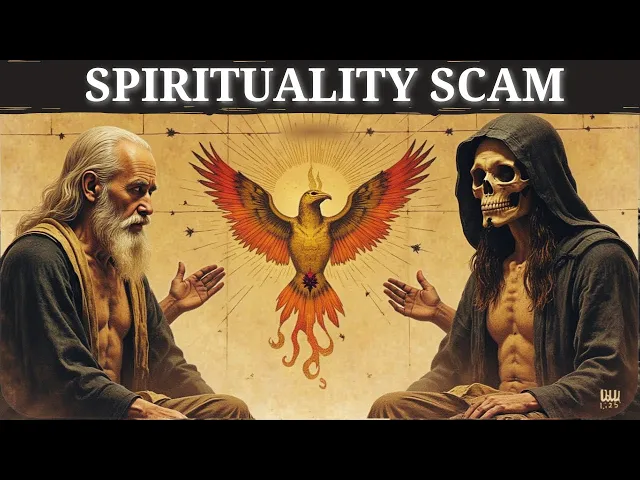
In every age and every culture, there have been individuals who cloak themselves in spiritual garments not to serve but to control. These individuals are not seekers of truth. They are not students of the sacred path.
Rather, they are wounded personalities, often charismatic, intelligent, and articulate, who discover that spiritual language and mystical ideas offer them something they deeply crave. Power, admiration, and a mask to hide behind. These people may call themselves gurus, masters, coaches, healers, or light workers.
But behind the titles lies something else entirely. They are not spiritual leaders. They are psychological predators.
These individuals are often deeply insecure at their core. They carry a sense of inner inadequacy or unworthiness that they have never truly confronted. Instead of healing this pain through authentic self inquiry or therapy, they discover that by adopting spiritual language, they can reverse their inner dynamic.
Rather than being small and afraid, they can appear powerful and wise. By speaking in metaphors about energy, vibrations, karma, or divine alignment, they avoid being questioned. Their followers often become entranced not by what they truly say, but by how they say it.
The performance of calmness, the slow voice, the detached gaze. All of this becomes a costume carefully curated to convey authority and otherworldly wisdom. This is not the path of the mystic.
It is the path of the manipulator. In these spiritual pretenders, the shadow has become their entire performance. They use spiritual ideas not to transform themselves but to transform how others perceive them.
They become dependent on admiration and often surround themselves with people who reflect back a distorted image of saintthood or enlightenment. They do not accept criticism. They rarely admit fault.
They interpret questioning as low frequency energy or resistance from others. In this way, they remain insulated within a fortress of spiritual superiority. The most dangerous of these individuals are those with narcissistic traits or even full-blown narcissistic personality disorder.
These individuals do not simply enjoy being admired. They need it for survival. They lack a stable sense of self and seek to fill that void through dominance over others.
Spirituality for them becomes a theater of control. They often begin with grand claims that they had a mystical awakening, that they were chosen by a higher intelligence, that they were called to guide humanity. They speak in absolutes, offer vague prophecies, and position themselves as the sole bearer of some hidden truth.
But these are not revelations. These are delusions. When others challenge them, they may respond with spiritual gaslighting, accusing the other person of being unenlightened, triggered, or in ego.
The saddest aspect of this dynamic is that many of these individuals began as seekers themselves. They may have experienced trauma, rejection, or failure earlier in life. They may have felt powerless, unseen, or lost.
At some point they discovered the intoxicating appeal of spiritual identity. Rather than doing the deep psychological work of healing their wounded self, they bypassed it by declaring themselves healed or awakened. They buried their trauma beneath mantras, rituals, and teachings they barely understood.
They replaced honesty with image. Over time, the performance consumed them, and they forgot the difference between their persona and their reality. The phenomenon of cults is born from this pattern.
A single wounded ego convinced of its enlightenment gathers followers not through truth but through projection. The followers project their longing for wholeness onto the leader. The leader unable to bear their own shadow accepts this projection and becomes inflated.
A toxic cycle is born. The leader becomes addicted to being woripped and the followers become dependent on being led. Authenticity dies.
Dialogue vanishes. What remains is control, illusion, and deep emotional harm. True spirituality is grounded in humility.
It involves continuous self-questing, the willingness to be wrong, and the courage to confront one's own darkness. The person who is truly walking the path does not seek followers. They seek truth.
They do not demand loyalty. They encourage independence. They do not speak with authority.
They speak with vulnerability and honesty. Those who weaponize spirituality cannot afford to be honest because honesty would reveal the fragility of the foundation upon which they've built their identity. There is a paradox in spiritual development that is rarely discussed and even more rarely understood.
The ego which is supposed to be transcended on the path to awakening often survives by transforming itself into a new identity. The spiritual ego. This is not just a minor detour on the path.
It is the most dangerous illusion one can encounter because it feels like awakening while being the farthest thing from it. It feels like clarity while still being rooted in fear, control, and deep psychological avoidance. The spiritual ego is not obvious.
It doesn't shout or dominate in the way an overt narcissist might. Instead, it speaks in whispers using language that sounds elevated, peaceful, or awakened. It wraps itself in silence, in minimalism, in moral superiority.
It may appear modest on the outside, but inside it is fueled by the same ancient fear, the fear of being nobody. The person possessed by the spiritual ego has not dissolved the self. They have crowned it in robes, mantras, crystals, and wisdom.
This transformation often begins when a person discovers spiritual teachings during a time of deep emotional crisis. They may have experienced trauma, heartbreak, existential fear, or the collapse of meaning. In seeking refuge, they stumble upon meditation, yoga, nonduality, or esoteric philosophy.
At first, this discovery feels like liberation. They experience peace, spaciousness, or temporary relief from the mental chaos that has haunted them. But because their foundation has not been healed, because their trauma has not been integrated, they begin to use these spiritual practices as a form of psychological escape.
This is where the ego adapts. The ego faced with the threat of annihilation does not disappear. It instead chooses to evolve.
It says fine, if I cannot be superior through money or status, I will be superior through consciousness. If I cannot dominate through intellect or beauty, I will dominate through purity, presence, and awakened speech. This is the birth of the spiritual ego.
It is the same structure of identity as before only now it speaks in Zen riddles and quotes Ramana Mahashi. From the outside the spiritual ego may appear serene, wise or evolved. But underneath the surface lies avoidance.
The person may preach non-attachment while running from emotional intimacy. They may speak of oneness while judging others for being asleep. They may repeat phrases like nothing is real or I'm not the body to avoid feeling anger, grief or fear.
Instead of engaging in the difficult work of self-honesty, they hide in abstract concepts. The mind which once constructed a personal identity around career or relationships now constructs it around awakening, energy work or sacred service. The result is the same, an identity built on avoidance.
One of the clearest signs of spiritual ego is the inability to admit ignorance. The person believes they have transcended human limitations and thus no longer need to be wrong, confused or humbled. They speak in absolute terms.
They do not ask questions. They give answers. They see others as caught in illusion while imagining themselves free.
This creates a subtle but toxic hierarchy. The awakened versus the asleep, the conscious versus the unconscious, the high frequency versus the low. The spiritual ego thrives on this divide because it constantly needs to feel above.
Its sense of self depends on separation. Another hallmark of the spiritualized ego is the use of detachment as a defense mechanism. True spiritual detachment arises from an open heart, from the capacity to allow life to flow without clinging.
But when ego hijacks this idea, detachment becomes coldness, indifference, and disconnection. The person avoids emotional intimacy and calls it non-attachment. They dismiss the suffering of others and call it karma.
They refuse responsibility and call it flow. In truth, they are still afraid. afraid to feel, to grieve, to surrender control.
But instead of confronting this fear, they call it liberation. Perhaps the most painful truth of all is that the person in this state genuinely believes they are free. They are not pretending.
They are not malicious. They are simply caught in the most refined illusion of all. The idea that awakening is something one can possess.
But awakening is not an achievement. It is not a badge. It is not a title.
It is the constant dismantling of illusion. The relentless stripping away of every false identity, including the spiritual one. The path is not a climb to the top.
It is a fall into humility, into rawness, into deep inner honesty. There is no greater betrayal to the sacred than using it for profit under the guise of liberation. In this modern age, the commodification of spirituality has reached staggering levels of sophistication with entire industries emerging around ancient practices, mystical teachings, and exotic philosophies.
At first glance, it appears harmless, even inspiring. Teachers offer retreats in Bali, sell courses on awakening, or promote handcrafted tools for alignment. But beneath the serene surfaces and soft marketing tones lies a deeply concerning truth.
The sacred has become a product and many who sell it are not healers or guides but entrepreneurs dressed in spiritual language. The danger is not in offering services or creating abundance. There is nothing inherently wrong with exchanging energy, offering one's wisdom for support or sharing practices that help others.
The problem arises when the primary motive is not service but profit, not transformation but control, not humility but ego expansion. The most manipulative individuals, those discussed in chapter 1, have discovered that by weaponizing spiritual hunger, they can exploit others in ways that bypass rational defenses. People in spiritual seeking are often vulnerable, openhearted, and desperate for relief from suffering.
They are not just looking for information. They are looking for hope. And that is exactly what the spiritual propheteer sells.
These individuals construct entire ecosystems around their persona. They offer online courses with escalating price tiers, claiming that each level unlocks deeper activations or codes. They organize high-priced retreats that promise breakthroughs, ascension, or enlightenment, often in luxurious or exotic locations to create an atmosphere of transcendence.
The environment becomes part of the illusion. The sacred is staged, curated for emotional impact. Participants are often subtly manipulated through group pressure, emotional highs, and complex rituals that create an artificial sense of transformation.
This high is mistaken for healing, and the teacher is credited with mystical power, but the effects rarely last. As the emotional charge fades, seekers are told that they must return for the next level of insight, available, of course, for a fee. This creates a dependency loop where spiritual growth is no longer about inner work, but about purchasing the next revelation.
The teacher becomes the gatekeeper of transcendence and followers begin to believe that their evolution is tied to the teacher's presence or permission. This is not healing. This is addiction masked as enlightenment.
A particularly disturbing aspect of this manipulation is the exploitation of sexuality under the guise of tantra or sacred union. Some teachers claim that intimacy with them is part of the spiritual journey. They distort ancient teachings about energy, condundalini or divine polarity to justify their desires, often coercing students into relationships or sexual encounters that are deeply harmful.
The imbalance of power is masked by spiritual justification. When harm is caused, the victims are often told that it was part of their karma, their shadow, or their soul contract. This is not just unethical.
It is abuse dressed in robes. Financial manipulation follows the same pattern. Many spiritual influencers brand themselves using highly polished images often with words like abundance, sovereignty or alignment.
They present success as a spiritual state and by implication poverty as a form of energetic failure. This is a modern mutation of prosperity gospel ideology. If you are truly aligned, you will manifest wealth.
If you are poor or struggling, you must still be in lack consciousness. The implication is cruel but clear. Suffering is your fault and only by purchasing their guidance can you become whole.
In reality, what is sold is not enlightenment. It is fantasy. It is emotional comfort wrapped in mysticism often laced with psychological suggestion techniques, group think, and consumer psychology.
These healers may encourage followers to invest in expensive crystals, essential oil pyramids, or sacred tools that promise to open chakras, raise vibration, or clear ancestral trauma. Again, the issue is not with the tools themselves, but with the illusion of dependency they create. The seeker becomes convinced that without these objects or the teacher, they are stuck, unworthy, or incomplete.
The spiritual propheteer thrives on two things, your pain and your desire to be free of it. They are often excellent at mirroring your struggle. They may appear warm, compassionate, and full of insight.
But if you listen closely, you will hear the subtle suggestion, "You are not enough as you are, but with me you could be. " This is the lie that sells. It is seductive because it mimics true teaching.
It offers progress. It dangles the carrot of awakening just out of reach. Always requiring another payment, another initiation, another sacred download.
This isn't a journey. It's a business model. Social media has amplified this phenomenon beyond measure.
Spirituality is now content. The most visible teachers are not the wisest, but the most marketable. Authenticity is replaced with branding.
Sacred texts are reduced to bite-sized memes. Centuries of mystical insight are repackaged into sevenstep guides and morning routines. The ancient lineages guarded for millennia with reverence are now advertised through hashtags and affiliate links.
In this digital bazaar, truth becomes performance and performance becomes profit. Please share this video with whoever needs to see it.