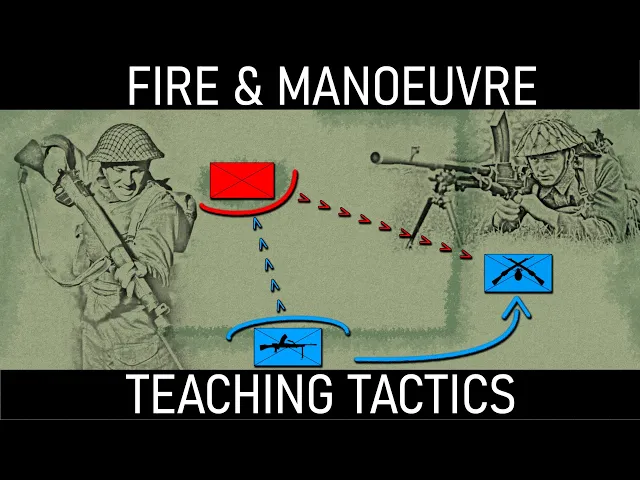
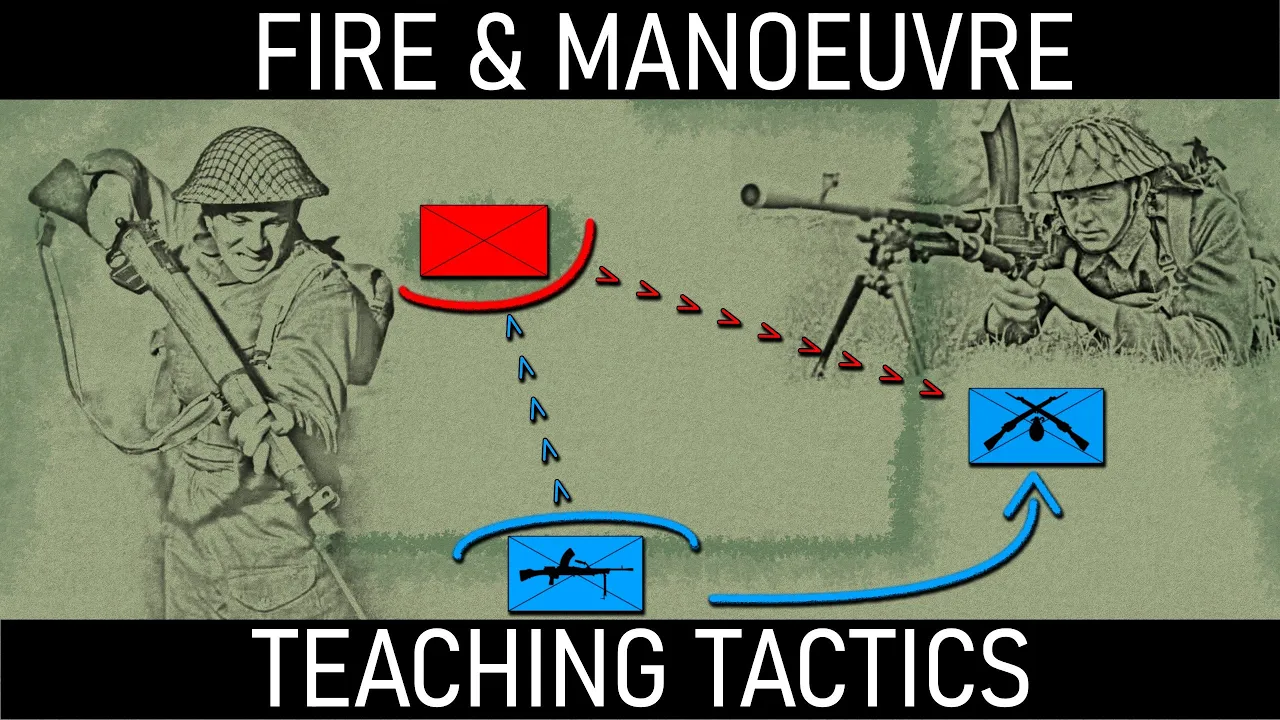
Suppressing fire suppressing fire fire and maneuver these three words are the foundation of ground combat tactics fire without maneuver is a waste of ammunition maneuver without fire is a waste of lives only through covering fire can maneuvers be made in the face of the enemy and only through maneuvers can the enemy be Decisively defeated this episode will explain fire and maneuver tactics using the infantry squad of the second world war as an example it will do so by answering three questions why does the tactic work this part explores the history of fire and maneuver tactics
up to the second world war and delves into the theory behind its success Who carried out the tactic the infarct squad was the smallest unit that could perform fire and maneuver tactics on its own this ability is explained through an examination of its ornament and organization how was the tactic used this part centers on a detailed recreation of a british training exercise that shows a squad in the attack using fire and maneuver to take An enemy position you're watching digital battlefield tours and this is teaching tactics the first question to answer is also the most
important one why does this tactic work why is fire alone not enough to eliminate the enemy or why not move without the fire answering this question requires two steps first a look at the evolution of fire And maneuver throughout military history secondly a step-by-step analysis of the inner workings of fire and maneuver taking a step back in time we see that the use of projectiles to distract or demoralize to injure or incapacitate is as old as war itself the earliest forms of combined arms warfare included arranged weapons such as bows or slings to open the
way for decisive hand-to-hand combat even after the introduction of firearms Their fire served mainly to facilitate a decisive clash of steel bikes swords and other close combat weapons remained a mandatory part of the early modern combined arms toolkit besides the musket without them there would be no shock no decision only harassing fire the pike finally disappeared from the battlefield not because the firepower of the musket made it redundant but because away was found to turn the musket into a Pike the bayonet for centuries the sharp steel on the end of the musket was as important
as the lead board fired a dictating factor in pre-industrial warfare was the limited lethality of early firearms their range was short accuracy within this range poor and rate of fire low making the most out of limited firepower required numbers which is why these Weapons were fired from dense formations in ordered volleys even then the shallow killing fields of these weapons could be overwhelmed by large numbers of attackers charging to bayonet range limited firepower meant offensive mass could defeat defensive fire limited firepower also kept battlefields small meaning the fire and maneuver elements stayed within visual range
of each other thus simplifying coordination Between them the fire elements knew when to start and stop firing because they could observe the progress of the maneuver elements the logic of limited firepower favored mass which led to the use of fire and maneuver on a large tightly coordinated skill concentrated batteries of artillery provided fire columns of infantry to maneuver this logic changed in the industrial age In the last decades of the 19th century firepower increased exponentially new weaponry such as high explosive artillery machine guns and magazine rifles increased combat ranges and lethality units had to disperse
to survive as a result battlefields became wider deeper and seemingly empty as both sides dug into the earth for protection when the first world war made the impact of industrial firepower clear for all to See it brought about a fundamental change in tactics the armies that went into the great war still practiced fire and maneuver from the musket age centralized artillery would provide the fire element and the infantry followed on in a wave conquering with the bayonet what had been cleared by the artillery or so it was hoped this presumption was reflected in the small
unit organization of 1914 There were no dedicated fire elements below battalion level and even there it was only a handful of machine guns the rifle companies of the battalion hundreds of men were precisely that riflemen and nothing else the infantry of 1914 was a lightly armed maneuver element tied to a static fire element the artillery infantry had no portable firepower of their own to carry on the attack with the results were the bloody filled Attacks that came to define the great war the artillery tried to clear a path but he dispersed and dug-in defenders survived
the barrage and emerged to fire on the advancing infantry static firepower tore the attackers to shreds while they elect the portable firepower to respond in kind the old-school fire maneuver elements the artillery and the infantry were simply too far apart to work together on The dispersed modern battlefield the solution was to downskill fire and maneuver to give small infantry units their own fire element in the course of the war fire support weapons became lighter and were feuded at increasingly lower levels at first battalions then companies and platoons were reorganized to contain their own specialized fire
elements to support their own maneuver elements new weapons such as light machine guns Automatic rifles grenade launchers and trench mortars were developed to give these small units the portable firepower they needed in the course of the war the infantry went from a mass of plane riflemen to small collections of specialists such as machine gunners grenadiers and stormtroopers by the end of the first world war the infantry had evolved from a wave of riflemen following on the hills of Artillery fire to small autonomous groups capable of suppressing and outmaneuvering their opposition with the firepower they carried
with them this dispersion into smaller units increased their survivability in the face of modern firepower and made tactics more flexible industrial firepower changed the logic of fire and maneuver away from large tightly coordinated formations and towards a flexible dispersion of autonomous units The smallest of these was the infantry squad of around 10 men which had become a common tactical organization by the second world war and brings us to the subject of this episode fire and maneuver at the squad level moving on from the history to the theoretical underpinnings of fire and maneuver its inner workings
can be explained through the following points fire alone cannot eliminate the enemy maneuvers are needed to eliminate the Enemy maneuvers cannot be made under effective enemy fire enemy fire can be made ineffective by your own fire meaning fire cannot eliminate the enemy but it makes maneuvers possible that can starting with the first point fire alone cannot eliminate the enemy this doesn't mean that getting hit isn't lethal what it means is that getting hit is comparatively rare The majority of potentially deadly projectiles be they bullets or fragments will not hit their target there are a few
important reasons for this and most come down to human factors the first has to do with the target that the enemy will present in war the target is human and chiefly concerned with his own survival the enemy will do everything in his power to make himself a hard target to see and even harder to hit Only a small part of the body needs to be exposed to fire a weapon and even less to observe by digging in making good use of the train shadows and camouflage the enemy can make himself a tiny hidden target his
life is on the line so he is extremely motivated to do so should his position be discovered and brought under effective fire the enemy can retreat completely behind cover making him immune to most fire The second point has to do with the quality of the fire which is also heavily subjected to human influences generally speaking marksmanship under combat conditions is extremely poor even under the best of conditions just hitting the enemy is difficult he is mostly in cover and the little he exposes of himself is camouflaged distance plays an important role too most small arms
combat takes place within a few hundred meters Distance makes the enemy an even harder target to hit and adds ballistics to the equation hitting a target at range requires an accurate estimation of the distance correct setting of the sights and observation of where the shots land so they can be adjusted on target especially this last part is made difficult in the field as the concealment of an enemy position will often obscure bullet impacts Taking into account poor visibility conditions such as mist rain or knight complicates this even further but the biggest factor that ruins combat
marksmanship is by far the stress that comes with life or death situations combat is a two-way shooting range after all you cannot fire at the enemy without exposing yourself to his fire when taking a shot means risking life and limb the quality of this shot will be severely affected Tension leads to uncontrollable physical responses such as muscle tremors and mental such as tunnel vision the inescapable stress of combat severely limits the fine motor control and situational awareness that are prerequisites for good marksmanship these factors help to explain the first point fire alone cannot eliminate the
enemy under most combat conditions small arms fire is too inaccurate and the defender Too well protected for fire alone to be decisive context is important here fire can of course be very lethal depending on the circumstances a column of infantry walking into a close range ambush will suffer heavy losses as well a unit called in the open by artillery fire the points made here are related to the case discussed small arms fire against a defender fighting from good natural Cover or prepared positions perhaps the following quote from infantry training best summarizes this point remember that
if the enemy is dug in covering fire seldom kills him it merely makes him keep his head down so that he is unable to shoot back knowing the limitations of fire leads us to the second point maneuver is needed to eliminate the enemy a maneuver is movement with purpose The purpose in this case to eliminate the enemy the most reliable way to eliminate the enemy is at close quarters this is called the assault fire alone proved ineffective at eliminating the defender because of his cover and the inaccuracy of the attacker's fire the assault nullifies these
factors by taking the fight to the enemy position the advantage of a defensive position is That it protects the occupant while forcing the attacker to expose himself by assaulting into the defender's position these advantages are stripped away the attacker and defender are now fighting on equal footing inside the position but the attacker has the advantage of holding the initiative he can use surprise and speed to overwhelm a confused and shocked defender It is possible for an alert defender to continue the fight within the confines of his position but he will no longer hold the advantage
he is trapped and cannot escape the volley of hand grenades the attacker is sure to use against him more often the defender will flee before facing the assault a defender who has allowed the enemy to close to assaulting distance has already lost the fight and will usually not wait For the bay nets to come to him an escaped enemy however is one who fights another day as the british battle school puts it object of the attack is not so much to capture ground as to exterminate all huns holding the ground this object will not be
obtained if they are allowed to retreat alive the enemy retreat must be cut off if at all possible because the purpose of the maneuvers is To eliminate the enemy he must not be allowed to retreat this is why a successful assault must be covered by so-called extermination fire from the flank or rear this requires additional maneuvers to properly set up but once in position makes escape virtually impossible the use of flanking to achieve surprise and thereby gain an overwhelming advantage is illustrated by the following quote from battle school Surprise is a nasty little packet of
british infantry with a tommy gun and a bren gun who have whistled around a flank like lightning and are now pouring lead into the enemy's rear while he still has got his eyes glued on the place they came from that is fine it is excellent if an english to shoot the enemy in the back that is the best place to shoot them every time If you think it out that is the aim of all sound tactics murder without the loss of casualties yourself to summarize this point maneuvers are made to prepare the assault and the
assault is the final maneuver because it eliminates the enemy the ideal end result is a broom and dustband situation the assault sweeps through the enemy position like a broom driving the enemy into the extermination fire of the Dustbin against such a perfect attack the defender's only escape would be a timely surrender however actually performing any maneuvers is impossible because of the third point maneuvers cannot be made under effective enemy fire this point is fairly straightforward moving means both leaving cover and ceasing fire as accurate fire cannot be Given on the move this would suddenly make
the enemies fire a lot more lethal as he now has an exposed target to shoot at without fear of return fire a one-way shooting range certain techniques can make a maneuver under fire somewhat safer using a covered or concealed approach is a good start then by alternating a crawl with a short rush progress can be made without presenting an easy target This can be done by small groups or individuals by limiting the rush to a second or two the enemy has no time to spot aim and fire before the target disappears again this is exhausting
however and cohesion is quickly lost as men appear and disappear in the landscape with some far forward and others struggling behind the technique also loses its effectiveness as the distance to the enemy gets shorter Individual movement techniques are therefore no solution to the third point maneuvers cannot be made under effective enemy fire a way must be found to make maneuvers possible and this brings us to the crucial next point enemy fire can be made ineffective by your own fire this is where the key concept of suppressive fire or covering fire comes into play As we
know from point 1 fire alone cannot eliminate the enemy but it can suppress him suppressive fire is not meant to do the improbable and actually hit the enemy the intent to saturate his position with so much fire that he no longer dares to shoot back for fear of getting hit by chance one cannot fire on a two-way shooting range without exposing oneself after all so what suppressive fire does is exploit The human instinct for self-preservation by making the cost of return fire so high that it is no longer worth it risking a shot at the
enemy is a lot less sensible if three bullets just impacted around you and the fourth one is already on its way general george patton described the effect of suppressive fire as follows the whistle of the bullets the scream of the ricochet and the dust twigs and branches which are knocked from the Ground in the trees have such an effect on the enemy that a small arms fire becomes negligible what makes oppressive fire so effective is that the target doesn't know its suppressive fire when bullets are striking to the left and right of you passing just
over your head it is natural to assume they are aimed directly at you you think you have been discovered and the enemy is actively shooting at you Tracking your every move you feel as if every passing round missed you through sheer luck while in reality those rounds were never aimed at you the enemy fired at the trees around you or at the edge of the trench you were in they've probably never even seen you because you are safely behind cover but that is exactly the point you are now pinned to that cover you are suppressed
without even having seen the Enemy the majority of ammunition spent in a fight is not aimed at an opponent but this is not a waste fire is a tool a tiny amount of it is a killing tool but the vast majority is a tool that manipulates the enemy it can suppress him distract him or make him disclose his position the latter is called reconnaissance by fire by searching probable enemy Positions with fire the enemy is tricked into thinking he has been discovered and will act accordingly the following line from an american manual illustrates the application
of suppressive firewell fire is not limited to points within the target known to contain an enemy on the contrary all men space their shots so that no portion of the target remains unhit the sight that successfully suppresses Their opponent has won fire superiority this means that enemy fire has been reduced to the point that it is now relatively safe to move out of cover to quote the same american manual fire superiority is gained by subjecting the enemy to fire of such accuracy and intensity that this fire becomes so inaccurate or so reduced in volume as
to be ineffective once gained it must be maintained the gaining of fire superiority also Signals the conclusion of the fourth point enemy fire can be made ineffective by your own fire this leads to the final concluding point fire cannot eliminate the enemy but it makes maneuvers possible that can the conclusion is that while fire on its own doesn't win the engagement neither does maneuver on its own the key word in fire and maneuver is neither fire nor maneuver it is the end That connects the two for this team mutually supporting combination of both fire and
maneuver that makes the tactic work fire without maneuver is a waste of ammunition a maneuver without fire is a waste of lives the way fire and maneuver are connected in practice is in the form of so-called bounce a bound is a maneuver covered by fire by its nature it requires two components A fire element and a maneuver element the fire element maintains fire superiority it does so from a stationary covered position the base of fire the maneuver element then makes their move they must avoid running through the fire of the covering element but also take
care not to advance too far to the point that they are no longer covered by their fire In an ideal scenario the objective can be reached in a single cohesive bound but this is rarely the case the farther the maneuver element moves the less effective the covering fire of the fire element becomes but even if distance is no issue there is still the desire to position the fire element in the rear of the enemy to cut off this line of retreat so a new bound must be made this time the goal is to get the
fire Element forward to do this the two elements must switch walls the maneuver element finds a covered position from where it can provide a base of fire and the previous fire element now gets up and rushes forward once they overtake the current fire element and are at the edge of their field of fire they become the new fire element and the rules reverse again This alternate firing and moving is continued until favorable positions for the assault are occupied this advancing imbalance through alternate firing and moving also called leapfrogging is the essence of small unit fire
and maneuver a good way of visualizing bounds is to compare it to walking one foot is always on the ground providing covering fire while the other foot is in the air Making a move you cannot walk with both feet on the ground nor with both feet in the air the same is true for combat fire without maneuver is a waste of ammunition a maneuver without fire is a waste of lives as the british infantry training puts it one group must always be either firing or down in a position from which fire can be instantly opened
always have one leg on the ground As a final note on this subject the use of fire and maneuver tactics typically leads to an attack that can be divided in three phases the first phase is the firefight this encompasses the first exchange of fire up to the gaining of fire superiority this is a firefight in the literal sense both sides are fighting fire with fire the site with the greater volume and accuracy of fire will usually win the firefight and gain fire superiority Fire superiority then opens the way for the next phase the maneuvers using
bounce the attacker maintains fire superiority while closing with the enemy the end goal is to eliminate the enemy which is usually done through an assault so creating a suitable situation for the assault is therefore the main goal of the maneuvers the assault is the final decisive phase assaults usually take the form of a broom and dustpan An assault element enters the position using speed and surprise while a covering element prevents enemy escape these three phases will return in the final part of this episode first however a look at the organization and ornament needed to perform
fire and maneuver at the squad level part 1 show that fire and maneuver was a complex tactic that required strict coordination between specialized fire and maneuver elements This second part will delve deeper into the kind of organization and ornament that made fire and maneuver possible this is the whole question who carried out the tactic fire and maneuver could be performed on many different levels with many different weapons as discussed in the beginning of part 1 artillery was the traditional fire element an infantry the maneuver element as firepower increased and battlefields Became larger the infantry could
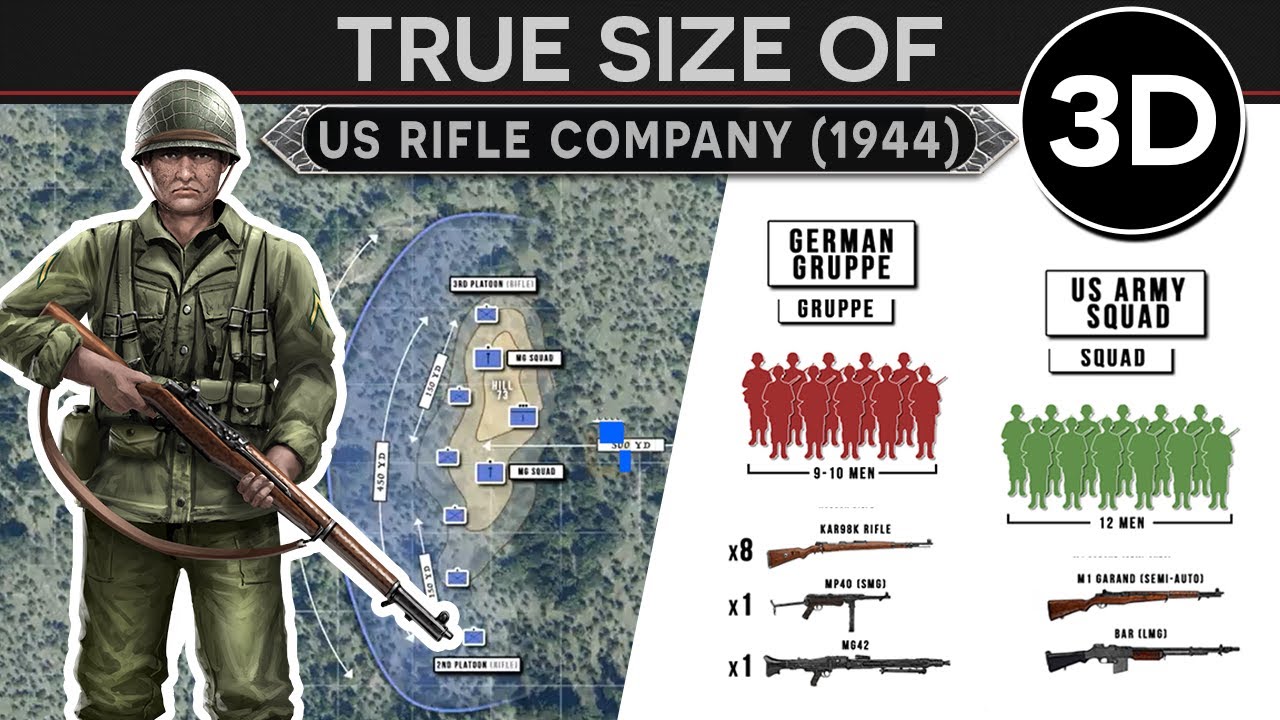
no longer rely on artillery support and had to create its own fire element it did so using light machine guns rifle grenades and other portable weapons and fielded these at increasingly smaller levels that brings us to the subject of this episode the infantry squad the smallest unit that was trained and equipped to perform fire and maneuver on its own By the time of the second world war the squad had become a universally adopted tactical unit while organization differed depending on specialization or nationality some general characteristics of the squad stand out the squad needed to be
large enough to have a tactical impact on its own while also being small enough that it could be led by a single person this meant the average squad size was Around 10 men a common ornament was a single light machine gun with the rest of the men using a standard service rifle the squad leader often had a submachine gun for both personal defense and close quarter fighting the squad's capacity for fire and maneuver tactics is best reflected in its organization a common layout was to use two groups one small fire group that operated the Light
machine gun and a larger maneuver group equipped for close combat in part 3 we will discuss a british fire and maneuver drill so to answer the whole question we will now look at the british and commonwealth version of the infantry squad the rival section while the name is different the tactical rule of the british section was identical to that of the better known american squad A british rival section of 1944 consisted of 10 men and carried three different swarms one bran wide machine gun one sten submachine gun and 8 lienfield pattern bolt action rifles it
was usually led by a corporal with a lance corporal as second in command fire and maneuver tactics were fundamental to the section as stated in battle school every section is designed to provide its Own covering fire within itself it can if necessary rely on itself to get forward this is the primary task of the brand gun in the attack to get the riflemen on to do so it was organized in two groups the brand group of three men with the light machine gun was the specialized fire element the rifle group with the remaining seven men
the maneuver element starting with the rifle group this was The larger of the two consisting of the section commander and six riflemen despite its size its firepower was fairly limited the rifleman carried a bolt action rifle which was slow to fire it held 10 rounds in an internal magazine but required every round to be manually chambered this not only reduced its mechanical rate of fire but also made it heavily dependent on the skill of the user The commander carried a sten machine carbine also known as a submachine gun the light and handy stan was a
fully automatic weapon that fired pistol cartridges it was ideally suited for close combat and consequently very poor at longer ranges in the hands of the section commander it served the dual purpose of being both a personal defense weapon and a specialized assault weapon The purpose of the rifle group was to close with the enemy in the final assault together they would need to bound forward with the vent group using fire and maneuver as the brand group moved the rifle group provided cover by concentrating the fire of their six rifles while the firepower of the lien
field was limited by its manual bolt cycle a skilled user could still achieve an Impressive rate of fire compared to other bolt action rifles of its time enough to maintain fire superiority while the brand group repositioned once in an assault position the rifle group would use shock and numbers to overwhelm the defender a crucial weapon for this task was the hand grenade this could be carried by all riflemen or by one or two riflemen designated as so-called grenadiers The section commander would usually lead the assault making the most of his short range stand gun for
close combat the riflemen were trained in so-called snap shooting walking fire from the hip or shoulder the other part of the section was the bran group a gunner and assistant gunner operated the brand gun while the section's second in command would lead the group despite being the smaller of the two Groups it possessed the majority of the section's firepower thanks to their bren gun looking back at part 1 we know that firepower was crucial the rapid gaining and maintaining of fire superiority through an accurate high volume of fire had to be established before any other
actions could be taken for the infantry section the bran light machine gun made this possible The importance of light machine guns for small unit tactics warrants a closer look at the technical side of this weapon the origin of the light machine gun or lmg for short is closely connected to the firepower revolution discussed in part one the original machine gun that dominated the battlefields of the first world war was a heavy design it was often water cooled belt fed and Mounted on a heavy tripod this meant it could fire near indefinitely great for suppressive fire
but at the cost of poor mobility just like the artillery they could support the opening of an attack but once the infantry advanced the heavy machine guns fell behind what was needed was a way to carry the firepower of a machine gun forward with the advancing infantry a light portable machine gun Design and production of lmgs advanced rapidly during the first world war to the point that they became a familiar side by the end of the war by the start of the second world war a lmg at a squad level had become the norm for
most armies the british had been large skill users of the lewis light machine gun in the first world war but adopted the bran as its replacement just in time for the second Taking a closer look at the brand gun we can identify some of the features that made a lmg special its core design philosophy was to make the sustained firepower of a machine gun portable to ensure sufficient firepower two characteristics were carried over from the heavy machine guns firstly it fired a rifle caliber cartridge to ensure sufficient range and lethality Secondly a capacity for fully
automatic fire to overwhelm the enemy through volume of fire all other features were altered in order to lighten the load the first was the cooling the part most susceptible to overheating is the barrel most heavy machine guns encased the barrel in a water jacket to keep it cool this was very efficient but also added a tremendous amount of weight and complexity to the weapon An air-cooled barrel was much lighter but once it got hot it took a long time to cool down a solution used by the bran and other lmgs was to add a quick
change mechanism to an air-cooled barrel that way a hot barrel could be swapped for a cold one the brand group carried two barrels and the assistant gunner would change them every so often to let them cool down in turns The brand gun had one of the best quick change mechanisms of its time allowing for barrel swaps in mere seconds this allowed for sustained fire on part with water cooled guns but without the complexity and weight of water jackets and steam condensers the second feature of a light machine gun is its ammunition feed most heavy machine
guns used long uninterrupted belts of hundreds of Rounds great for sustained firepower but awkward to load and carry most lmgs including the bran used magazines instead these were easy to carry and quick to load they were also more resistant to dirt and used spring tension to reliably feed cartridges into the weapon the run gun accepted its magazine from the top which was designed so the Assistant gunner could do it while the gunner remained focused on the target a magazine change like that took no longer than a second or two a final feature are the ergonomic
improvements a live machine gun was designed to be carried and fired by a single operator not unlike a rifle this often meant the inclusion of a shoulder stock pistol grip and sling instead of a separate tripod a live Machine gun typically had its own integrated lightweight bipod this gave the light machine gun a broad spectrum of use it could be used stationary with the bipod or we carried as an assault weapon fired from the hip at close range while a bran could be carried and fired by just one operator it was best used in a
3-man team the gunner fired a weapon and an assistant gunner helped with changing Magazines swapping barrels and clearing malfunctions working like this reloads and barrel changes could be done so fast there would be no noticeable pulls between bursts they both ran the risk of target fixation however or could get distracted by the maintenance of the weapon that's why a third man the group commander was needed he monitored the position of the gun its Fire and ammunition consumption crucially he coordinated the fire of the bran with the movements of the rifle group which we will see
in more detail in part three the firepower of the bran was so integral to the section that the majority of the ammunition it carried was reserved for it 700 rounds were carried pre-packed in magazines especially for the brand gun while the total ammunition load for the Section's eight rifles only amounted to 400 rounds in fact every rifleman carried two spare magazines for the brand gun in special pouches on his person meaning he carried more ammunition for the bran than ford's own rifle it should be noted that these were the same cartridge so both weapons could
fire it still given the importance of the bran it would be more common for rifle Allocated ammunition to be given to the bran than the other way around that covers the organization of the british rifle section its armament and its capability to perform fire and maneuver tactics however a very important closing remark is an order it is something that haunts every discussion of tactics and organization namely the difference between theory and practice The organization discussed here was a paper organization it was written down as the ideal organization to perform idealized tactics with reality is far
from ideal however a first reality check is that a unit as small as a section would see extreme fluctuations in manpower and equipment it would suffer losses be reinforced merged with another section or detached for a special mission Leaders and men would be lost and others would take their place with people coming and going it is hard to maintain the necessary group skills and teamwork to perform complex tactics the americans had a great deal of experience with manpower problems during the war and they concluded that squad fire and movement as a refinement which cannot be
applied in prolonged combat when the life expectancy of a trained squad is as short as we found it to be A second point that ties into this is that a section rarely falls alone a section was very much tied to its platoon which consisted of two other sections and a headquarters led by an officer this platoon was in turn reliant on its company for support and the company on the battalion and so on a section acting on its own was rare usually limited to patrols or outposts not deliberate attacks or defenses Taking these two points
together leads to a more messy but realistic version of section fire and maneuver instead of a section fighting on its own using a neat subgroup structure you would have multiple sections fighting closely together in a platoon or company action one section slide machine gun will be covering a rush by some riflemen from another section then an entire section makes a move covered by the other two A machine gunner might receive an order directly from the platoon commander instead of a section leader by the time the platoon reaches its objective all section and subgroup organization is
gone it's a handful of riflemen a couple of live machine guns and whoever is in charge to hold it all together yet they would still have used fire and maneuver tactics tactics facilitated in part by Organization and armament of the sections so while section tactics and organization were a lot more messy and confused than the manuals portray the fact of the matter still is that most armies of the time organized and trained at the section level to perform fire and maneuver tactics it was the principle of fire maneuver that counted the actual application of this
principle Could differ depending on circumstances and often went beyond the capacity of a lone section we will explore this gap between theory and practice further in the following part which deals with the british battle drill for section in the attack this third and final part will answer the how question how was the tactic used it will do so using a recreation of the british battle drill for section in the attack This source has gained somewhat of a reputation however that must first be cleared up this particular pedal drill is frequently misused as an example of
small unit tactics this stems from a misunderstanding regarding its nature as a battle drill what must be cleared up is that battle drills were not actual tactics instead battle drills were a training method intended to teach a basic understanding Of combat through highly simplified and highly repetitive exercises real combat and therefore real tactics was anything but simple and anything but repetitive every engagement was different depending on train forces and counters of other factors therefore every tactic had to be different too battlefields did not set out to teach rigid tactics Instead they developed a tactical mindset
and they did this just like any other drill through repetition drilling with a rifle creates muscle memory that allows a soldier to aim and fire instinctively the battle drill set out to do the same with tactics create familiarity through repetition one of the major proponents of battle drill compared to playing a sport for The first time first a set of techniques must be mastered how to throw a ball or swing a bed for example through these repetitive exercises the necessary feeling is developed that allows the advanced player to depart from these techniques only through subconscious
familiarity with the basics can the experience be gained that allows the advanced student to create his own techniques Battle drills set out to teach combat tactics just like any other skill first combat was distilled into its bare essentials simplifying it to the point of becoming idealized the best techniques for dealing with these textbook situations were then refined into simple steps to be drilled again and again eventually a familiarity was gained that allowed the more talented students to Formulate their own tactics if not they could at least fall back on the drills as they were told
which was better than nothing battle drills were first told in theory using a map or sandbox then they were practiced on the parade ground with the students shouting the different steps of the drill as they perform them next special instruction units who demonstrate the drill in the field using Purpose-built practice courses the students will then practice these few drills until proficient variations were introduced such as fighting in built up areas woods or at night finally live fire exercises were done which the british called battle inoculation like a vaccine this had the purpose of immunizing the
troops to the noise and confusion of battle by first exposing Him to it in a controlled environment the purpose of battle drill as a training method ties back to a point made at the end of part two that sections rarely fault alone the fact that the battle drill for section in the attack does show a lone section but traced its nature as an exercise this section was used not because it was expected to perform these actions independently in the field but because it was easier to instruct a section of 10 men than a platoon of
40. that is how the following drill should be seen not as a realistic situation that would be encountered in the field but as a purpose-built exercise that told the basic principles of fire and maneuver it is precisely because of this that the drill is such a suitable example for this episode we are discussing the broad application of small unit fire and maneuver tactics Here so a drill that is designed to teach these fundamental principles fits perfectly with that settled we can move on to the drill itself the following recreation is based on three versions of
the drill the first is found in battle school from 1942. second in part 8 of infantry training published in 1944 And finally its post-war replacement infantry training vol 4 from 1950 the general outline of this drill is fairly straightforward and reflects the simplified nature of the exercise a single section at full strength is attacking on its own the train is perfectly laid out for a flanking attack the enemy occupies a small crop of trees in an open field with a neat line of hedgerows enveloping their right flank And rear enemy strength is not detailed but
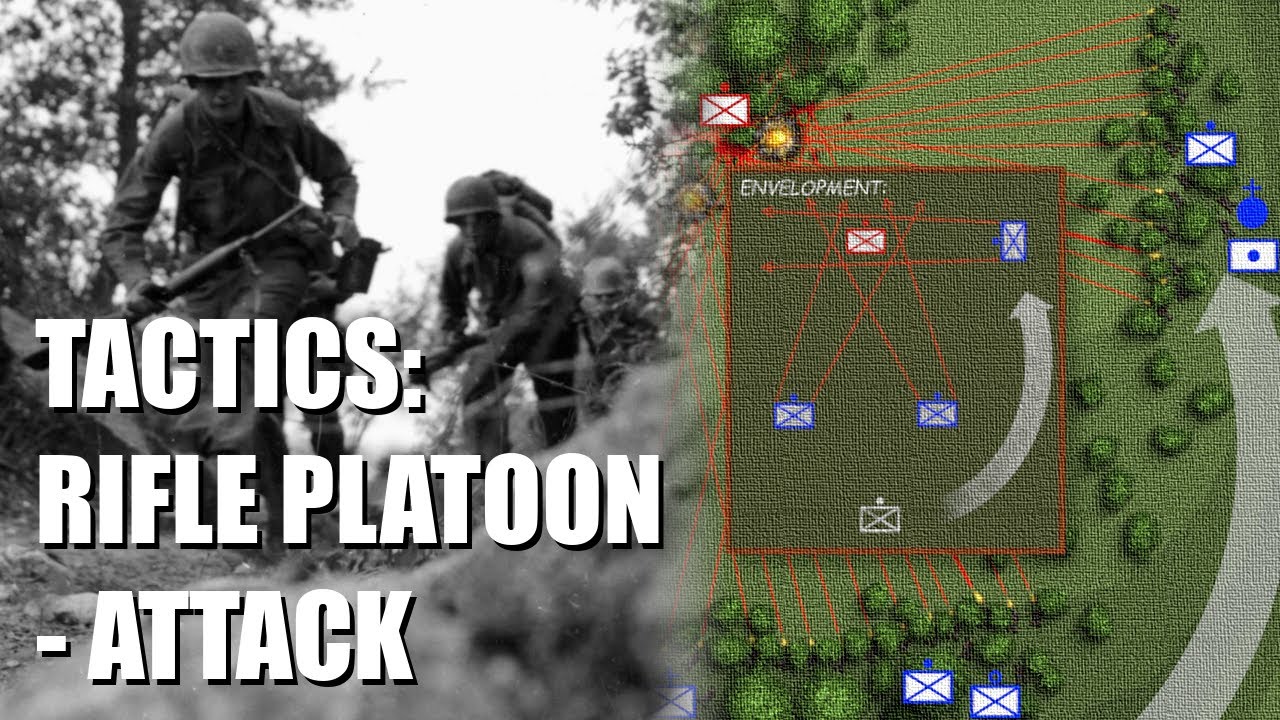
can't be more than a few riflemen without automatic weapons the enemy is all alone with no supporting positions securing their flanks the actions to be taken by the friendly section are advance to contact react to fire gain fire superiority perform bounding movements to a flank assault the enemy position And finally consolidate these actions can be streamlined into the three phases discussed in part one the firefight the maneuvers and the assault the drill starts with an advance to contact the section moves cross-country of voting roads that will likely be covered by enemy fire different formations can
be adopted depending on the train When advancing across open country against unknown contact the section is best off using an arrowhead formation the rifle group is in the lead in a wedge the section commander forming the point the brand group follows in a small wedge of their own a wedge formation allows for optimal observation and fire to the front and flanks while also dispersing the men should the leading wedge come under fire The brand group is in a position to provide immediate support from the rear depending on the train the section commander may decide to
have the brand group stay behind in cover while the rifle group crosses open ground then linking up again once the rifles mated across alternatively two riflemen may be sent forward to act as scouts either to screen the advance of the main body or to investigate a landmark like a Wood or farm while it's a certainly dangerous work the enemy is less likely to fire on scouts knowing they are not a lucrative target to reveal their position for regardless of formation the principle remains that the entire unit must not be called in the same burst of
fire always have an element in the rear ready to support the leading element if it takes fire in this drill the section moves across The bottom field towards the southern line of hedgerows when they come under effective enemy fire an important distinction is made between effective and ineffective fire as was discussed in part 1 fire is a tool the enemy may be firing to draw out a response perhaps they saw a glimpse of the lead scout and are trying to determine the size of his unit they may be firing as a warning to other Defensive
positions or to cover their retreat they may even be firing at another friendly unit they have spotted in the distance effective fire is fire aimed directly at you with the intent of eliminating or suppressing this can be distinguished from ineffective fire by the sound it makes a bullet flying bust makes a loud snapping noise like the cracking of a Whip the discharge of the weapon it came from is only heard later as the sound travels slower than the supersonic bullet when the fire is not directly aimed at you you only hear the distant discharge knowing
the difference is important to quote the manual the section will only go to cover if effective fire is brought to bear on them they must never go to cover just because they hear the noise of fire and directed at someone else The best defense against sudden effective fire is the use of a formation discussed earlier and an anticipatory order from the section commander a dispersed formation like an arrowhead lowers the chance of casualties by the initial burst and has an overwatching element that can quickly return fire an anticipatory order on the other end is given
by the section commander to individuals or groups and is relevant to the immediate situation facing the Section such an order ensures a speedy and cohesive reaction by everyone when they come under fire the example order given in the manual is if we come under fire across here or run forward to that hedge should no such order be given when they come under fire the men are trained to go down crawl observe sides fire meaning they drop to the ground instantly crawl to a firing position and Return fire on their own initiative this is better than
nothing but runs the risk of disorganizing the section as the men disappear on the undergrowth and the noise of fire drowns out any commands becoming pinned down by the first volley of enemy fire is disastrous as the section will be stuck in the enemy's kill zone with or without an anticipatory order the section must move to a suitable firing position In this case the hedgerow at the northern end of the field by rushing crawling or leapfrogging the section reaches the hedge from here the section commander can judge the train the strength of the enemy and
formulate a plan accordingly his first priority is to gain fire superiority to quote the manual no advance is possible unless enemies heads are kept down by weight of metal Covering fire is essential to any advance the first essential is gain fire superiority the enemy position is pinpointed insofar as possible and the firepower of the section concentrated on it reconnaissance by fire is used to probe possible secondary positions it may even prove necessary to move troops around to bait the enemy into firing the section commander takes no part in The firing but observes and adjusts the
fire of a section if needed creative use of the bren gun is encouraged it can be moved around to confuse the enemy and make him think there are multiple sections attacking fire a few bursts from one position then relocate and fire some single shots to mimic a rifle then move again to fire a few automatic bursts the firefight has been won when return fire becomes minimal and is widely Inaccurate the initiative has been gained and must quickly be exploited by maneuvering against the enemy this brings us to the second phase the maneuvers the goal of
the maneuvers is to eliminate the enemy this is achieved by an advance to his flank or rear followed by an assault the broom and dustpan discussed in part 1. setting up the strap requires the brand Group to be in a position to deliver cutoff fire and the rifle group to be in an assault position ideally these positions intersect at a 90 degree angle this allows the brand to fire on the enemy position up to the very moment the rifleman charge in without running the risk of shooting them in the back both of these positions are
best placed in the flank or rear of the enemy this cuts off reinforcements several Line of retreat and generally causes panic the manual places great emphasis on the demoralization caused by flanking fire mentioning the immense psychological value of opening up fire from the rear or the back of a flank the enemy thinks he is surrounded and either retires or surrenders he is particularly liable to do this if the fire comes from an automatic weapon Getting to these positions requires an advance using fire and maneuver preferably along a covered flank the drill is ideally set up
for this with an uninterrupted hetero running along the right flank and into the rear of the enemy position the section commander explains the plan to his men indicates the approach the final position to be reached and the bounce they will make to get there having given his orders the section Commander leaves the brand group in the care of his second in command and leads the rifle group on the first bound bran maintains fire superiority while the riflemen rush along the hedge they must take care not to advance too far as this will open up angles
of fire for the defender that are not being covered by the brem gun having reached the edge of the branch due to fire the rifle group sets up to create a new base of iron The riflemen pick up the fire allowing the brand group to get up and make their move the brand group follows in the footsteps of the rifle group and then bounce past them until they reach the edge of their protective fire bren gun is set up and opens fire signaling to the rifle group that it is once again their turn to move
these bounds are continued until both groups have reached their indicated Positions coordinating these bounds is incredibly difficult yet absolutely vital if confusion were to set in which it quickly does you might end up with both groups firing and none moving which is a waste of time and ammunition even worse is when both groups start moving at the same time with no one firing the hard-won fire superiority is lost and the enemy is Given a one-way shooting range just as moving troops are presenting an easy target the manual gives a few pointers on how to stay
in touch ideally the section is so well trained and experienced they develop an instinctual feeling for it they know when to bound based on timing and the sights and sounds of battle a more realistic method is to stay within the voice range of each other However given the noise of battle this would result in tiny bounds alternatively a visual link can be maintained by having a member of each group keep an eye on the other using hand signals to communicate another option is for the two groups to quickly link up as one bounce past the
other this opportunity can also be used to pass full magazines to the brand group as these are carried by the riflemen One of the more interesting methods of communication is to use the firing of the brand gun to tap a message firing single shots in a prearranged pattern can signal the beginning or end of a bound if all else fills a runner can be sent between the two groups as a last resort the maneuvering phase is complete when the rifle group reaches its assault position and the brand group its cut-off position From here they can
launch the final decisive phase the assault the assault seeks to do what fire alone has not yet accomplished eliminate the enemy and take his position it can only do so by closing with him to hand grenade or even bayonet range still the manual warns that the assault should not be an end in itself before the assault goes in the enemy may be enthused to surrender or forced to flee into the extermination fire of the Bran an assault is an extremely dangerous action and should only be launched when necessary and well supported performing an assault consists
of two steps first the enemy position must be reached this is done like any of the previous pounds the brand covers and derive from an advance the second step is new the brand must cease fire to avoid Hitting the riflemen leaving them to fight within the enemy position unsupported both steps require tight coordination both between groups and within them the brand must keep up a covering fire up to the moment the riflemen charge in seizing fire too early will allow the enemy to recover just as the riflemen are at their most vulnerable ceasing fire too
late will take the momentum out of the assault or even Cause friendly fire according to the manual the ideal is for the brand gun to shoot you right onto and over your objective coordination is also vital for the rifle group they must stick together and hit the enemy like a wave not a trickle of individuals to ensure cohesion the section commander must personally lead the assault as the riflemen fix their bayonets load Their magazines and ready their grenades the section commander makes a final appreciation of the situation the manual gives him a few options for
the assault the most straightforward one is to rush the entire rifle group forward in line formation the section commander in the center with three riflemen on his flanks this ensures concentration of force and optimal control for the commander well suited for overwhelming a weak opponent A viable alternative is to split the rival group in two one group of four including a section commander and a group of three led by a senior rifleman this formation is safer when facing strong opposition as the two groups can leapfrog forward or envelop the enemy a much more methodical approach
is described in the 1942 edition of the drill it calls for the rifle group to send one Or more grenadiers and a sniper crawling to the enemy position on the cover of the remaining rifleman and the brand group the task of the grenadiers is to throw fragmentation grenades into the enemy position while the sniper provides immediate protection against enemy interference alternatively the grenadier may throw smoke grenades into the position to blind the defenders against the coming Assault when using smoke it must be placed directly on the enemy position not between the enemy and the assaulting
troops this would also blind the attackers and silhouette them as they come through the screen however due to the unreliable nature of smoke and the fact that it hinders both sides its you should be carefully considered Smoke may serve a better purpose as a distraction by placing it away from the direction of the assault the remaining riflemen rush forward from the assault position as soon as the grenades go off or the smoke thickens they move forward at the double meaning a controlled run the goal is to reach the enemy quickly and as a cohesive unit
so care is taken that everyone stays in formation especially when encountering obstacles Such as ditches or fences this move is covered by the brand group whose fire lifts when the riflemen reach the enemy position this signals the end of step 1 reaching the position and the beginning of step 2 clearing it if all went well the rifle group has reached the position in a cohesive line with the section commander in the center that way all 7 weapons can be ruled to bear simultaneously when the enemy is Encountered failing to keep formation will lead to a
trickle of attackers not the wave that is needed to overwhelm the defenders as the rifle group charges in they fire from the hip to maintain fire superiority now that the bram has ceased fire the enemy will now be met at short range most likely still hiding from the covering fire at the bottom of entrenchments He may be wounded shell-shocked or ready to fight to the end this is not known regardless the rifle group sweeps through the position without halting firing on enemies as they are encountered rifles are held in the on-guard position meaning the muzzle
was held level and the stock of the rifle is secured under the armpit this position allows for quick use of the bayonet as well as so-called Snapshots at close range fire is preferable to the bayonet although bayonets might still be used to deliver a final blow the section commander's sten submachine gun is in its element during the assault this short range weapon had little use during the previous phases but is now a major asset in close quarter fighting if stubborn resistance is encountered hand grenades are used followed by a rush of attackers The rival group
rapidly assaults through the enemy position and must not linger within the position itself instead they press on some 50 yards to a point where they consolidate preparations to repulse an enemy counter attack are taken immediately the brand group moves up to join the rifleman and covers the consolidation the section commander checks for casualties and redistributes ammunition enemy casualties are searched and Prisoners if taken held on their guard at this point the drill was complete the section has successfully captured the position using fire and maneuver the section maintained its cohesion when it first came under fire
thanks to its use of a sensible formation and preliminary orders it located the enemy position and gained fire superiority through coordinated fire and clever use of the brand gun the section commander read the train Well and ordered an advance along the cover flank to the rear of the enemy the section moved forward in coordinated bounce keeping one leg on the ground as the next step was made finally a well-supported assault was launched that eliminated the enemy and took his position with the why who and how questions answered this final part will now provide some closing
remarks these concluding points are broadly Applicable to fire and maneuver tactics not just the squad level action previously discussed the first lesson to take away is on the nature of firepower its inability to fully eliminate the enemy on its own but also its ability to manipulate the enemy in a number of ways as discussed in part 1 fire alone cannot eliminate the enemy it can cause attrition meaning some of the enemy are taken out of action or Their equipment is damaged fire can also neutralize the enemy fire suppressing it and fire can pin the enemy
in place preventing his advance or retreat but it cannot fully eliminate him under most circumstances if the fire lifts which it must eventually do the enemy is still there manning his position he will be weakened by the fire but if no maneuvers have been made against him while he was suppressed then the Tactical situation has not changed the enemy is still where he was before the fire was opened taking the battle drill from part 3 as an example if the british section had not made use of any maneuver against their opponent but only relied on
fire then they would have never advanced beyond the first hetro they would have continued pouring fire on the enemy even after they won fire Superiority without changing the situation they would have spent their entire ammunition supply shooting at an enemy that was already suppressed behind cover then once out of ammo they would find themselves in the exact same place they started without having changed the tactical situation in their favor but instead of trying to eliminate their opponent through fire alone the section used it as a tool they used it to Suppress the enemy suppression made
the enemies fire ineffective so the section could advance and pin the enemy in place so he could be trapped and eliminated by assault the suppressive fire while seemingly just as wasteful was actually extremely valuable as it facilitated a maneuver that changed the tactical situation more than fire alone could ever do in the end a section that used the fire as a tool to maneuver ends up using it To eliminate the enemy while a section that sold to eliminate the enemy outright without maneuver only wasted their fire by understanding firepower in this way tactics but also
arm's design are seen in a different light effective firepower isn't necessarily about landing hits on target it's just as much about saturating an area with fire sustaining this fire and applying it in such a way that it manipulates the Enemy by suppressing isolating and demoralizing this is why a light machine gun and not a sniper rifle became the backbone of the infantry squad it is not precise eliminating fire that wins an engagement but maneuvers covered by sustained suppressive fire the second lesson is to take into account human factors when studying tactics this episode has been
very focused on the theoretical side of tactics its Logic organization equipment and training yet actual combat is very different from the cool calculated theory it is emotional human business combat at the small unit level especially is as much dictated by morale and instinct as it is by technology and pre-battle planning and it's only by taking into account the human factor that fire and maneuver starts to make sense Its entire logic is based on human self-preservation suppression works because people rightly fear incoming fire the clothes brush with death that a passing bullet impresses upon them when
put under such life-threatening pressure most people will instinctually seek the protection of cover even if it means seizing fire and thus losing the firefight such as the two-way shooting range The same is true for maneuvers most people will not get up and charge into gunfire they are risk-averse only when enemy fire is suppressed will they gain the confidence to move out of cover fire and maneuver would not work in a war between robots they would not fear fire meaning they could not be suppressed nor pin in place the quality of their fire would not be
diminished by muscle tremors or tunnel vision Only outright destruction would stop them this is not true for mortal men he can be defeated by fear desperation and panic the breaking of the will to fight at that place and time it is not even necessary to inflict overwhelming casualties to cause this simply surprising the enemy confronting him at a time or place or in a way he was not expecting can have a greater effect than inflicting losses this too We see in fire and maneuver in the form of the assault the sudden confrontation between a suppressed
isolated defender and a surge of confident attackers a successful assault relies on the determination and speed born out of the confidence of the attacker more than his numbers and it is the primal fear and desperation of the defender that makes him flee or surrender rather than fight it out in close combat more than any other part of the Engagement it is the decisive final assault that puts mind over matter the defender could inflict heavy losses on an assaulting attacker or even repulse him but that is thinking logically everything leading up to the assault the suppressive
fire the flanking have made sure the enemy is no longer thinking logically by the time the assault hits him finally it should be noted that fire and Maneuver was applied along a broad spectrum this episode focused mostly on the squad level primarily because its small size made it easier to explain and visualize fire and maneuver however was much more broadly applicable just two riflemen could perform fire and maneuver between them as could two tanks two squads can leapfrog together or a squad and a machine gun team an entire infantry company of over 100 Men can
maneuver under the protective fire of an artillery battery or under the fire of a platoon of 5 tanks this tank platoon in turn can transition from a fire element to a maneuver element or another tank platoon or artillery to cover them even air strikes can be the fire that covers a maneuver similarly these situations in which fire and maneuver could be applied also varied greatly This episode focused on the attack but its logic was just as sound in other types of combat in the defense for example the defender must maintain fire superiority thereby denying the
attacker the freedom to maneuver for a retreat fire superiority must be maintained while units leapfrog backwards away from the enemy even just the limited case discussed in this episode the squad in the attack was Compiled from multiple sources of different armies and time periods to arrive at a holistic picture this broad approach and the resulting length of this episode was necessary due to the fundamental importance fire and maneuver has for this series as the other episodes of teaching tactics will show most combat was an application of the principles of fire and maneuver to the situation
at hand with the forces available The underlying logic remained largely the same and it is this episode that is laid that foundation for the rest of the series [Music]