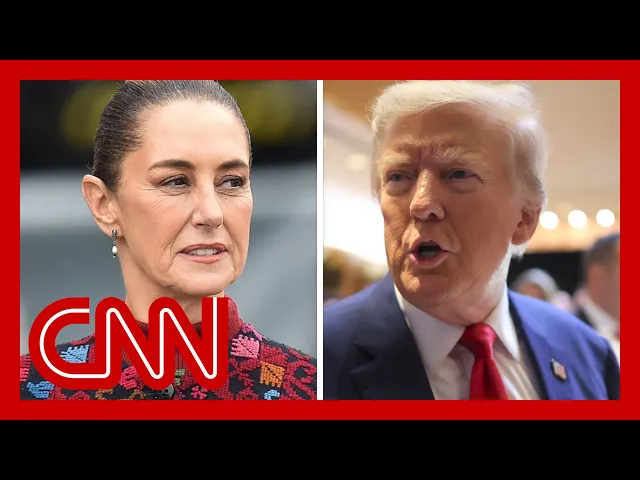
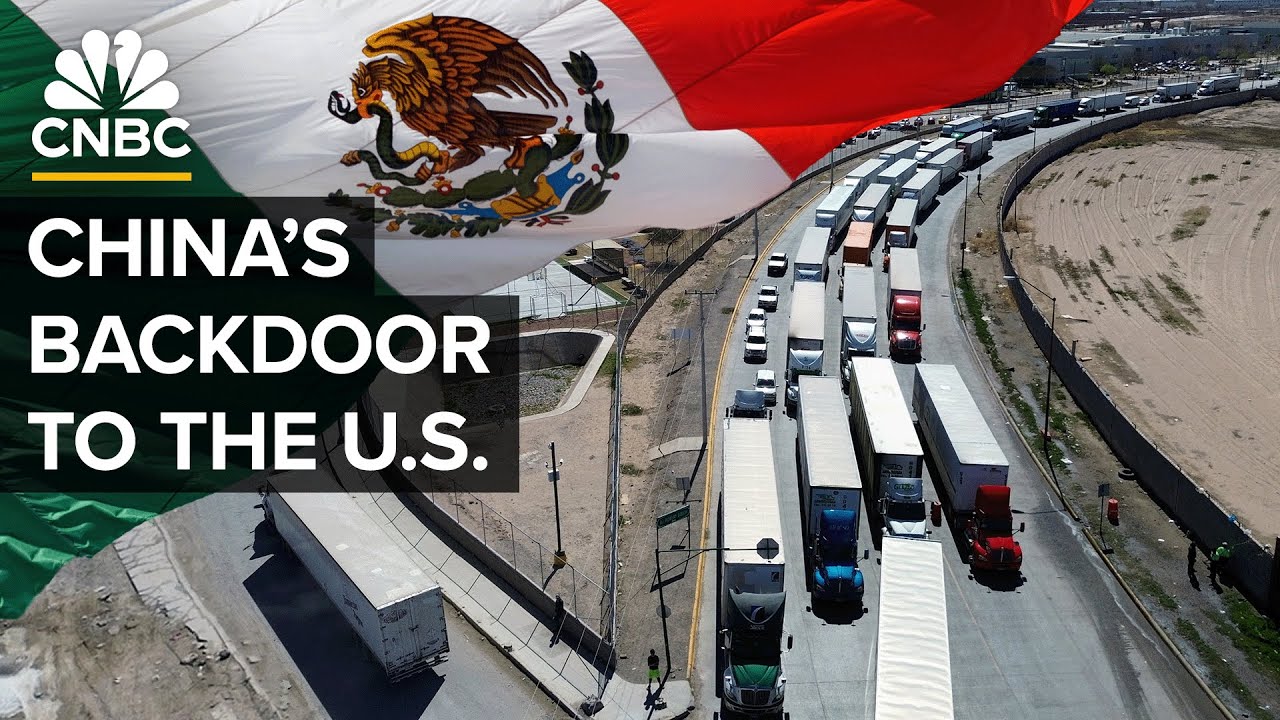
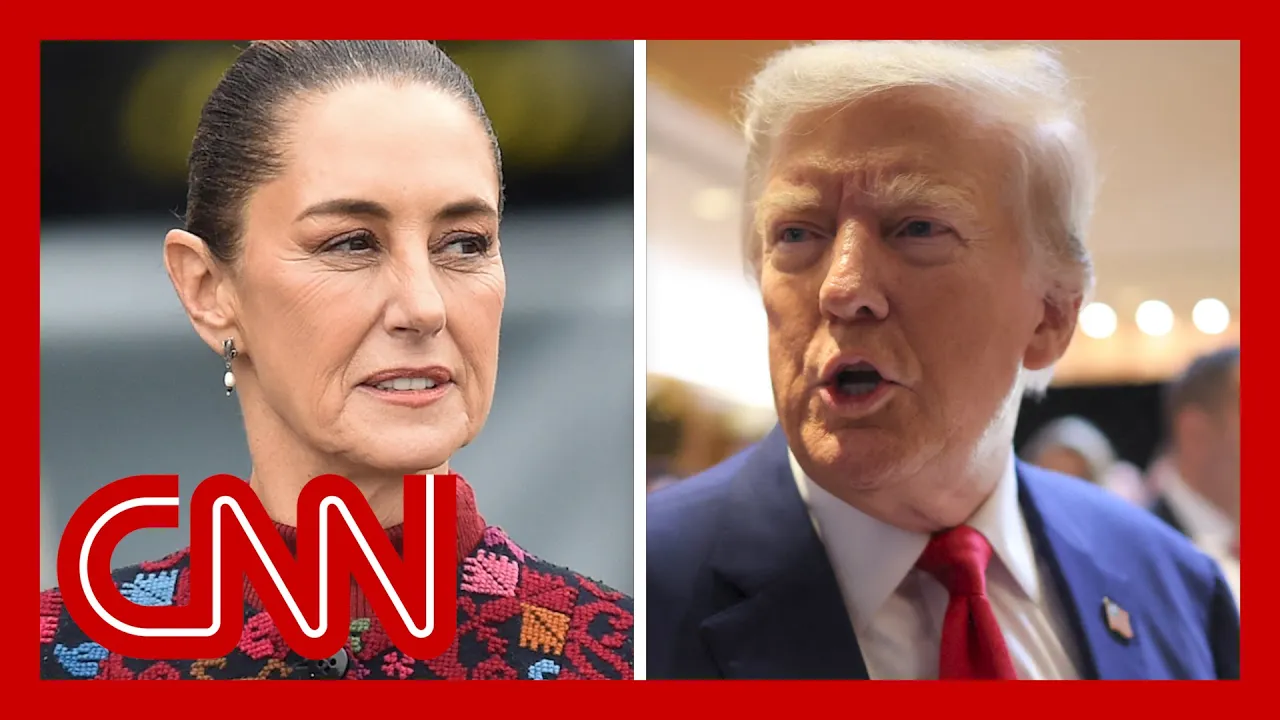
CNN's Rosa Flores is in Houston for us now. Rosa, how is Mexico responding to what we're hearing from the incoming Trump administration about how they plan to crack down on the border and carry out these mass deportations? Well, very sternly, as a matter of fact, Mexico's president held a press conference this morning in response to, president elect Donald Trump's threat to impose tariffs on Mexico, actually.
But, Jim, as you know, all of these things are intermingled. The Mexico's president was very firm. She called out president elect Donald Trump, saying that both Mexico and the United States collaborate on a lot of different levels, including economically.
And in other words, she said that she's ready to respond in kind. Let me read to you a portion of that letter that she sent to president elect Donald Trump. She said, quote, President Trump, neither threats nor tariffs will solve the issue of migration or drug consumption in the United States.
Quote, cooperation and shared understandings are required to face these important challenges. Imposing one tariffs would mean another comes in response. I'm gonna repeat that one more time because these are very important words from Mexico's president.
Imposing one tariff would mean another comes in response. Continuing like this until we put shared companies at risk. Now the tone of this letter is very important because Mexico's president is not just talking about tariffs, about economic and the economic relationship with the United States, but also the border relationship with the United States.
Because Mexico has done a lot to help the Biden administration control the migration that is coming into the U. S. southern border.
Which begs the question about what is happening on the U. S. southern border, given that Governor Greg Abbott and the incoming U.
S. border czar, Tom Homan, are on the border today. Here's the reality.
The migrant apprehension numbers are extremely low. I talked to a law enforcement source, Jim, who says that on Sunday, migrant apprehensions were about 1500. If you compare that to December of 2023, when 10,000 people were crossing the border per day.
That just gives you a sense of the dramatic change. The reality is, and I've talked to both people on the ground agents and also advocates who work on the border. They say it is very quietrillionight now, very low.
Despite what you're hearing from Governor Greg Abbott and the incoming borders are Tom Homan back to you. All right, Russell Flores, important context. Thank you very much.
What do Americans want in terms of what were their top priorities for Trump? This is according to a new CBS news YouGov poll that came out. Their highest priority is lower prices.
79% of Americans want higher or lower prices. Just 26%, say, put tariffs on imports. So his strategy here an undercut what voters want him to do.
Sure. But this you know, threatening tariffs particularly against Mexico and other Central American countries was basically the central pillar of his, approach, diplomatic approach, approach to migration when it came to this region. So, yes, while those economic concerns are true, you know, the president elect, often he does gravitate towards immigration and migration as his primary issue.
This is one of his basically go to steps when it comes to his approach for these nations. The other thing that's not being talked about as much is sort of Mexico's response to this as well. You know, in order to do many of those ambitious plans that the president has been, that the president elect has been talking about, sweeping border restrictions, mass deportations, you also need somebody to take in those people that you're reporting, that being the Mexican government, they've been basically a collaborator.
And one of the prime reasons that the Biden administration has been able to drive down border crossings recently. And today, the Mexican government also issued a response to the president elect. That just before you jump into this, just read that response from him by the Mexican president.
He said, President Trump, neither threats nor Charles tariffs will resolve the issue of migration or drug consumption in the United States. Cooperation and shared understanding are required to face these important challenges. Imposing one tariff would mean another comes in response.
Continuing like this until we put shared companies at risk. Now, pretty stark warning. It is a stark warning.
And it's I think that statement comes from a sentiment that I would hear often in Mexico as well, while reporting there. And that's that there are officials in the Mexican government that also feel as if they have some leverage. You know, with this new administration, we often talk about this, as, you know, the president elect Trump, you know, issues threat to Mexico and has these immigration demands.
Well, Mexico also knows that, you know, the US needs Mexico in terms of many of these plans when it comes to the border. And that was one of the more sort of direct statements I've heard. but it was something that that I think you often hear privately that's now made its way to the public when it comes.
Can I say just a quick word on China? I'm China is a little bit different than Mexico and Canada. Obviously, those two are the biggest trading partners are close allies.
But with China, Trump really has used tariffs as a means. He talks about fentanyl quite a bit and kind of uses that as the punitive measure. But really he's trying to force them into a position where he can get them to negotiate better trade deals.
He says that they take advantage of the U. S. .
And so that's been his tactic all along. And it was very controversial under the first Trump administration. But the Biden administration, when they came in, they did a review and decided not to reverse a lot of those tariffs.
And so actually, both parties have come quite a long way since the first Trump administration. When it comes to China in particular, it is much more controversial for countries like Mexico and Canada. But with China, there's a little bit more tolerance from both parties for for actions like this.
And I think you're going to see that even moving forward. One thing, though, has been, you know, Trump has had a shifting ideology and a lot of issues over the years, shall we say, to put it mildly, on some issues in particular, tariffs has been different. This is Trump from 24 years ago.
There are a lot of things I do if I were elected. But one thing I do definitely is stop other countries from ripping off the United States. They are ripping us like we've never been ripped before.
If you look at Japan, if you look at China, where we lose $100 billion a year with China and they do nothing to help us with potentially our biggest problem of all, and that's going to be North Korea. So I would start right at that point. And at the time, Trump was actually flirting with the presidential run, possibly alongside Minnesota Governor Jesse Ventura on the Reform Party ticket.
A lot has changed, but not Trump on tariffs. We have to think, too. He probably is a businessman and in getting merchandise from China has some experience with it.
Clearly felt like he wasn't getting the deal that he deserved. And this is one of those areas where he does feel like he, you know, has a clear through line. I mean, that's very rarely do you see Trump 20 years ago kind of saying the exact same thing as he is saying today.
Exactly. And he said it obviously on the campaign trail. But I want to actually turn right now to CNN's Matt Egan, who has some new reporting on how the Trump administration maybe we'll see, pick and choose which companies pay for tariffs.
Experts worry it's a process that opens up the door to potentially corrupt decision making. So, Matt, what are you learning? Well, Manu, there is a system in place for us companies trying to avoid paying tariffs, especially on China.
But businesses and researchers tell CNN that that system is broken. So we're talking about tariff exclusions. And U.
S. companies can apply for what amounts to a Hall pass to avoid paying those tariffs on China if they can show that it would cause severe economic harm to them, or that they can't get the products elsewhere. Now, during the first Trump administration, these exclusions were very hard to get.
Between 2018 and 2020, only about 1 in 7 companies that applied with the U. S. Trade Representative were able to get these exclusions.
And lawmakers and companies, they feared that the USTR was able to kind of pick winners and losers by deciding who got these exclusions and who didn't. And business owners feared that there was a lack of transparency with this process. That opened it up to potentially allowing officials to play political favoritism.
And there is some academic research that supports that of some peer reviewed research finds that firms whose executives backed Republicans, they were able to get exclusions 1 in 5 amount of time. So 1 in 5 chance. But compare that to firms whose executives backed Democrats just a 1 in 10 chance.
And to be clear, getting this tariff exclusion was a very big deal for some firms. This was a do or die situation. Is there a sense that this time around, Matt, that this process may be any different?
Yeah, that's one of the many things we don't know at this point. We don't know whether or not the Trump administration is even going to have an exclusion system this time around. I did reach out to the transition, and they said that Trump will protect American workers, but they did not answer any questions about whether or not there's going to be any reforms to the exclusion system, or if and if there's going to be the ability to apply for exclusions in the first place.
But the researchers, you know, they did not allege any wrongdoing by companies or by U. S. officials, but they did say that this tariff exclusion system amounts to a very effective spoils system, allowing the administration of the day to reward its political friends and punish its enemies.
And one business executive told me that the process is potentially corrupt because it allows winners and losers to emerge from a process that is not transparent. And again, there's a lot at stake here. Companies are already trying to navigate and game out how they're going to avoid these new tariffs.
I spoke to a business owner from Los Angeles who in 2018 applied for a tariff exclusion on imports of air fryers from China. And like many other people, that exclusion was denied. And he said his company was on the up and up, and this totally halted their growth, dead in their tracks.
And this business owner, he rejected the argument from Trump that China is the one that pays these tariffs. He told me, and I'm going to cuz my my kids are watching here. He said, bro, that is B.
S. I'm getting the bills. And look, Manu, those bills are going to go even higher.
If Trump follows through on his promise to increase tariffs on China, as well as imposed tariffs on Mexico and Canada as well. Yeah, I mean, one thing is clear. This is going to open up a huge lobbying campaign behind the scenes here in Washington for those exclusions.
Matt Egan, thank you for that. Thanks for reporting.