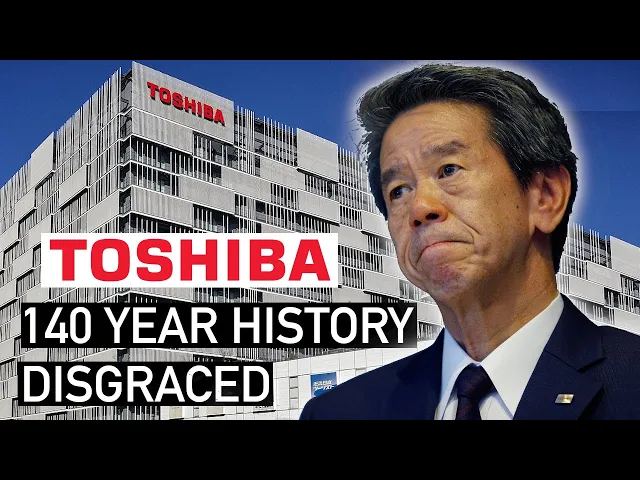
[Music] what's up guys and welcome back to wall street millennial on this channel we cover everything related to stocks and investing in today's video we're going to go over a massive corporate accounting fraud that contributed to the fall of a japanese technology giant many large-scale corporate frauds are caused by incentive structures that incentivize managers to hit quarterly goals this can lead executives to make up revenues or cover up expenses to increase reported profitability this short-termism frequently leads to cases where executives do things that make numbers look good for one quarter at the expense of future quarters for example we've seen companies report revenues in one quarter that actually didn't happen until the next quarter or report revenues for deals that haven't been closed yet in these cases revenues aren't necessarily being truly fabricated but brought forward into the previous quarter other times revenue and expense numbers are completely made up in 2015 it was revealed that the japanese technology and industrial conglomerate toshiba had fabricated operating profit numbers for several years it was seen as a scandal that threatened japan's global image the total amount of profits that had faked was around a billion dollars the scandal was perpetrated by several high up executives at the company who all knew what was going on and created a company culture pressuring police to go along with it in this video we'll talk about what they did and what it meant for both toshiba and japan toshiba is a large japanese technology company that has come to symbolize japan's technological abilities it is a diversified business that engages in producing everything from power systems and lighting equipment to semiconductors and batteries to computers and appliances it was founded in the 19th century as a manufacturer of telegraph equipment in the mid 20th century it expanded rapidly through both organic growth and merges and acquisitions in the u. s it was especially recognizable in the tv market with their cathode ray tube tvs but in the early 2000s this business started to die and eventually led to large losses for toshiba they closed their crt television business and invested in a flat screen tv technology called sed this technology never caught on dominated by lcd and eventually led tvs the tv business was not the majority of the company's revenue but other parts of the business also started declining in the early 2000s and 2010s toshiba was hit hard by the 2008 global financial crisis it's a highly diversified conglomerate but nevertheless was very dependent on industrial demand starting in 2007 it made large losses which did not improve at the end of the recession by 2011 the losses became even harsher the multi-year slump in business was a major embarrassment to the proud company it caused an immense amount of pressure within the company to do whatever necessary to maintain the outward profitability of the company in may of 2015 toshiba announced publicly that discovered and was investigating an accounting scandal that affected the previous three years of financial statements in the end it was found that the company actually inflated profits over the previous seven years the scandal was wide-ranging and affected many different divisions within toshiba in the power systems business there were seven instances found where major projects had their financial numbers fabricated one of the earliest such instances occurred with a project starting in 2007. this project involved producing boilers turbines and generators for a client with a contract worth 54.
5 billion japanese yen that's close to a billion dollars even at the beginning of the project toshiba estimated that the cost of the project would exceed the proceeds leading to a net loss but they went ahead with the project anyway the losses of billions of japanese yen were inexplicably not recorded for many years accounting standards would dictate that a provision for losses on the project be recorded starting as soon as the deficit was discovered it was found by the investigation that a high up executive denied approval for recording the loss provisions in order to inflate earnings numbers for several quarters in another project a us-based division of toshiba received a contract for 130 million dollars to provide electric equipment for use in a subway system toshiba was to design and manufacture the electric equipment after a year and a half it was clear that the project was going to lose money for toshiba they estimate that the total cost of the project would be 207 million dollars about 80 million dollars more than the 130 million that they were being paid the investigation found that the ceo and cfo want to avoid recording a net loss for their project and thus prevented the recording of any provisions for losses the rest of the company was not doing well at the time if they took loss provisions they likely would have had to report a company-wide loss in order to prevent this they postponed disclosing the large losses on the project in other projects toshiba used another financial accounting strategy whereby at the beginning of a project they report cost-cutting measures that they took these cost-cutting measures theoretically improve the profitability of the projects this allowed toshiba to use them to report profits during the quarters when the cost cutting was taken but before the projects were actually completed in many projects these cost cutting measures were overly optimistic overestimating the reductions in expenses by hundreds of millions of yen by the end of the projects when the actual costs were recorded the fake cost cuts would have to be realized as larger losses but it was another way for toshiba to delay reporting losses a final accounting strategy that toshiba used was overstaying the values of their inventories they would increase the price of their products at the end of fiscal quarters even though most of their actual sales were for lower prices before the price increases at the time that the financial statements were prepared the prices on paper at least were higher that allowed them to record higher values of their inventories that effectively gave the impression that they were more profitable during that quarter than they actually were in the end these schemes distort the true costs revenues and ultimately profits of toshiba from 2008 through 2014. starting in 2011 toshiba used a combination of many schemes to avoid posting losses but it became increasingly difficult to use these schemes to avoid financial disappointments on wall street most of the accounting strategies only delayed reporting losses unprofitable projects were put off until future quarters before they were reported by 2015 the amount of delayed reporting of losses became too much to handle without risking outside analysts deducing that something was going on so toshiba preemptively announced publicly that would have to restate its financials the total amount of profits that had been fabricated came to be 1.