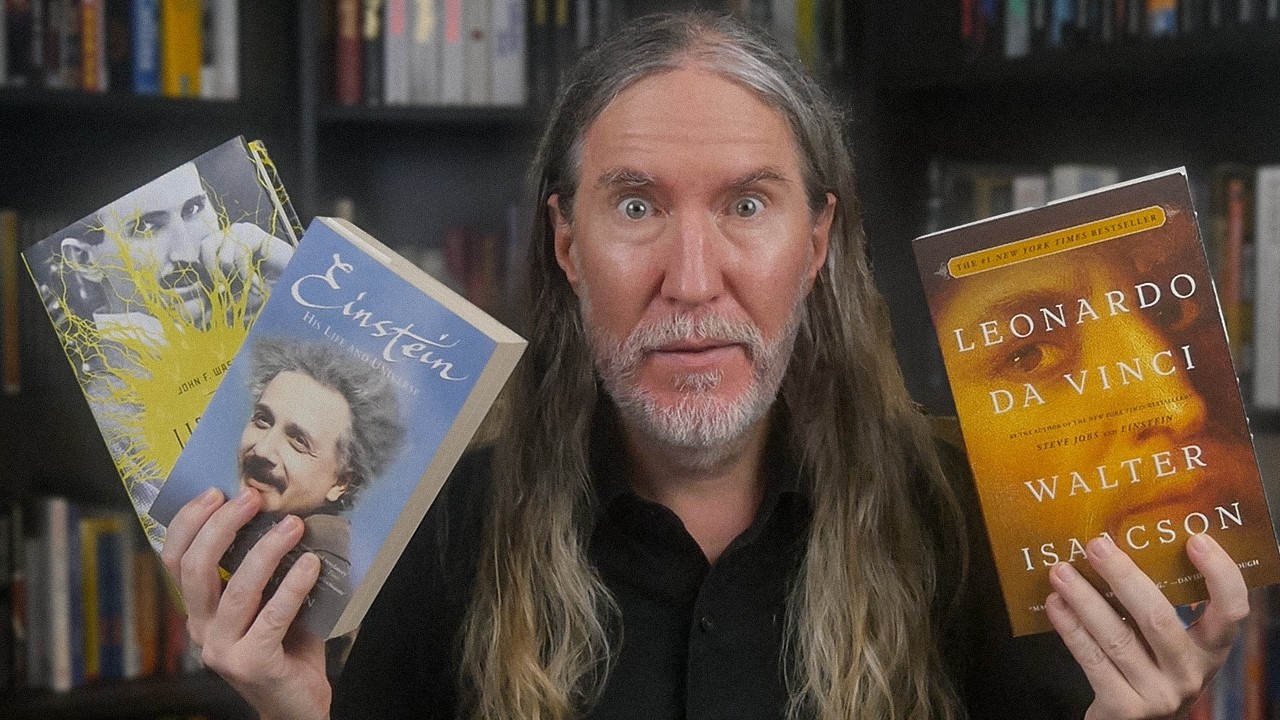
What does being a genius even mean? I personally believe it's the ability to see connections that other people don't see and come up with ideas and solutions that are truly useful. It's solving problems that others can solve because you can make connections they miss.
We've been taught a misleading story about genius people in my opinion. We're told that Einstein just naturally understood physics in a ways others couldn't, or that Darvin somehow magically conceived of evolution, that Da Vinci was simply born with extraordinary abilities. But what if being genius isn't something you born with, but something you build through specific cognitive habits?
When you actually study how these genius people worked, you discover something completely different. For example, Darvin didn't have a sudden Eureka moment where evolution like appeared to him. He actually spent decades meticulously documenting observations around multiple fields like biology, geology, animal husbandry in countless notebooks.
Him being genius wasn't in his genetics. It was in his system for capturing and connecting knowledge across domains. Or let's take like Da Vinci.
Da Vinci filled thousands of notebooks, pages with observations, sketches, and questions. His notebooks weren't just art. You know, there were a systematic approach to understanding how everything from human anatomy to water flow or maybe to light and shadow work together.
He intentionally studied across disciplines and documented the connections. What's fascinating is that none of them were like considered extraordinary as children. For example, Einstein was like famously taught to be a poor student and Darvin's father believed he would amount to nothing.
What's their type of art wasn't the ability or how smart they were, but it was the systems that they developed. I've been like obsessively studying these days around how the mind works and have been experimenting with different systems for developing almost like a genius level thinking I would say and what I've discovered is that there's like a fundamental problem with how most of us approach learning and thinking or at least I used to approach in a wrong way in my opinion most of us are using like fragmented single system approaches when we actually need a dual system method that I call the cognitive synthesis which is like deliberately practicing thing to connect ideas across domains to create new insights basically. So the question isn't are you smart enough but rather are you using the right cognitive systems.
Today I'm going to break down exactly how cognitive synthesis works and how you can implement it using tools that amplify your brain's natural abilities. And both of the tools are free to start with. This isn't about like being smarter than everyone else or I don't know flexing or anything, but it's more about seeing connections that others miss and developing a habit of insight that others can't come up with because I feel like that's the thing that we call as being genius.
Sorry, my stomach is groggling. I'm so hungry. If you want the summary and actually apply what you learn from this video, I actually have a free PDF guide about my method and it's in the link in the description below.
So, don't forget, check it out. It's completely so I basically discovered that we need to develop like two complimentary thinking systems to achieve almost like a genius level thinking or coming up with those insights and I call these the database brain and the spatial brain. Basically the data based brain is your like structured organized and like a very connection rich knowledge system.
This is where information gets cataloged tagged and linked together in a way your mind can easily retrive and connect later. It's like logical, sequential, and focus on relationships between concepts. And the spatial brain is your visual, intuitive, and pattern seeking system.
This is basically where you arrange your ideas spatially and visualize connections and allow your mind to see patterns that linear thinking might miss. It's like more creative and it's more focused on emergent insights. I realized that there were three key mistakes that I was doing.
So first of all I was reading a lot invitly but I didn't have a system for connecting what I learned across different domains like knowledge remained fragmented and then secondly I was relying heavily on just one system. Some people are like extremely organized but lack visual thinking skills and others are highly creative creative but lack structured knowledge. So without both systems working together you'll hit a basically a ceiling.
And the third, most of us don't deliberately practice making connections. Like I wasn't making to practice connections. I used to like consuming information passively rather than actively seeking unexpected connections between ideas.
What I've discovered is that when you combine like two approaches, the structure plus creativity. That's where like genius level insight actually comes because the database brain gives you the raw materials and relationships while the spatial brain reveals patterns and generates insights that wouldn't be obvious otherwise. By like deliberately engaging both and linear thinking and creative thinking you are literally rewiring your neural pathways to think more comprehensively.
I'm going to show you exactly how to build both of these systems using obsidian for your database brain and middle note for your spatial brain and also I'm going to show like some specific practices to train your mind to make connections that other might miss. Let's start with developing your database brain. I started like using obsidian few months ago actually for my personal knowledge management and this is the place where my knowledge can live, grow and most importantly actually connect to each other.
I still use like notion for project management, but that's for another video. For my personal knowledge management, I use Obsidian. And what makes Obsidian powerful for like cognitive synthesis isn't just it stores information, but how it enables connections between pieces of information, which I was like missing in notion.
This is actually really important because like this level of thinking isn't about how much you know. It's actually more about how you connect what you know. And let me walk you through the key techniques that make this work.
So first thing first what I do is that I do brain dump and connect notes. This is basically the foundation of the system. And a common scenario for me would be like let's say like I'm scrolling on Instagram and I see a great reel about maybe I don't know branding that has a useful thing that I could use later.
The old me would just hit like save on the right corner of Instagram and forget about it. But the question is when was the last time that you actually went through your saved items on your Instagram? I don't know about you, but for me personally, the information there just like sits unused and I just like forget about it and it just satisfies my ego momentarily.
But the thing is that learning happens when we do something with the information. You know, if you just know it's meaningless actually. So what I started to do differently is that now I create a new note in Obsidian with the relevant details.
But the crucial part is explaining why I wanted to save that information and why it's relevant to me because I forget why I saved that in the first place. Then I do two important things. I use brackets to link it to bigger notes like this.
And this connects it to my knowledge network. Think of it like an organizing books in a library because you wouldn't put like irrelevant books next to each other, right? Even though I put it here.
Ignore it please. I also use like hashtags for searchability like marketing/branding. Even though it's simple, but it's actually creating a dynamic growing network of knowledge that helped me see connections I would otherwise miss.
The second technique is establishing a regular learning habit. I'm saying regular because some of you might like doing a daily learning session and some of you might want to do it intensely during weekends or some of the days that you pick or even like once a month. I don't know.
The important thing is that you do it consistently. I personally do dedicate time every day to like adding new notes and connecting existing notes because I'm quite bad at sticking habits if I'm not like doing them every single day. Okay?
So, do whatever works for you. you know what's best for you. And the third technique is space repetition.
I regularly revisit my notes on Obsidian and it does two things. First, it cements the knowledge in my mind and it often leads to actually new connections as my like understanding deepens over time. And one of the most powerful features of Obsidian is how it visualizes your thinking.
By the way, I'm not sponsored by Obsidian because like you link your notes to each other and can link the same notes to multiple places. So you basically create a network of ideas that becomes visible through the graph view. Some people have like a cancer looking graph views by the way and it's not like only a aesthetical thing but it actually reveals the architecture of your thinking and highlights connections you might not have consciously realized which is amazing.
It's sort of like seeing the invisible threads between your ideas. And this approach combines elements from the tetle casten method with modern linking techniques creating what some call a map of content. Most importantly though as this like network grows it starts to reveal the gaps in your knowledge because you can see it visually you know the areas that are densely connected and which might need more exploration.
I think this is perfect for directing your learning. database brain becomes most powerful when you develop the habit of asking how does this new information connect to what I already know. It's a very simple question, but it activates the cognitive synthesis by forcing your mind to build bridges between ideas rather than storing them in isolation because like for years I was getting paralyzed when I opened the obsidian because a it was so different than what I got used to, you know, like notion and Apple notes and the tutorials on YouTube are I feel like unnecessarily complicated.
Correct me if I'm wrong, but I procrastinated ages to learn because they were so complicated. But after using it for a while, I can say that like obsidian is not about creating a comp complex system or using its every single future from day one at all. Like you have to start simple with obsidian.
You know, instead of taking like a top down approach, you need to take a bottom up approach where you learn as you go or add futures when you actually need them because the most important thing is building the habit of capturing ideas and deliberately connecting them. Not like I don't know using a very niche thing that Obsidian offers. Now, let's talk about developing your spatial brain.
This is where Milanote comes in, who is kindly sponsoring a portion of this video. I've been genuinely using Milanote for years, and I love how I make creative connections. And I'm not saying this because I'm only like sponsored, but I've been using this thing for years.
And unlike textbased tools, Milanote gives you a visual canvas where ideas can be arranged spatially. And I want to show you how I use Millanote for cognitive synthesis through three key techniques. So first visual organization especially for design related concepts or if you are a visual learner like me like I got to see it visually you know and it actually allows you to understand and retain information better personally for me for some reason when I don't like see how each information is connecting in a visual way I just don't understand it and creating mill boards helps me a lot because sometime like drawing can be really complicated and second cross the main board when I'm like brainstorming on something I clip stuff on internet that is relevant to the topic I'm brainstorming on Millanote and it's basically a free Chrome extension that you can add and I intentionally mix elements from completely different fields like for example combining ideas from maybe psychology design and business on a single canvas when it comes to let's say coming up for my thumbnail ideas and stuff like that and then I organize them visually on Millerote.
It helps me a lot with like connecting irrelevant dots and come up with something new which is essentially what creativity is you know not only is actually good for my like personal thinking but it's also really useful for team collaboration because sometimes like words are not enough to describe something you're thinking about or the vision you're seeing and different people can bring different expertise on the table in just one page because you can collaborate with people. It's awesome. I love it.
And the third thing is that question focused workspace. Instead of like organizing boards according to their topics, I actually create boards around a specific problem or a specific question that I'm looking for an answer or trying to solve. This like shifts thinking from passive collection to active problem solving.
For example, rather than a board labeled marketing, I might create one called how can we make our message board more memorable. Millote is not the place where I store my ideas, but instead I use it to actively think and see new connections. When you can literally move concepts around and visually connect them, you start thinking in a ways that generate deeper insights that you would never have only by writing down in a text, especially in team meetings.
Actually, it's so good. If you're interested, Milanote is completely free to get started. I have a link in the description below.
Okay, so now let's talk about practices and habits that have dramatically improved my ability to absorb, retain, and connect information. So the first one is what information should you actually be consuming. This is where the concept of areas of interest actually becomes crucial and I learned this from a Japanese book titled which translates to there are no geniuses there are only genius level habits and basically the core principle is that you have to cut out the noise and only consume highquality valuable information.
So what are areas of interest? Areas of interest are the specific domains, topics or subjects that you intentionally choose to focus your learning on. Think of them as a thirds on your personal knowledge map that you want to explore deeply.
For example, like my area of interest include cognitive psychology, digital marketing, video production, biohacking and knowledge management systems. And these are the fields where I want to develop deep expertise and want to learn actively. So why do you need to define your area of interest?
First of all, cognitive bandwidth is limited. You know, your brain can only process so much information. By predefining what's important to you, you create a filter that helps preserve your mental energy.
It allows you to connect highquality information as the book says. And as the book says, you should decide on expertise where you won't want to like lose anyone around you and dig deeply into it because true mastery requires focus. And the third of all, connection need context.
meaningful connections between ideas are more likely to occur when you have like sufficient depth in related areas because surface level knowledge leads to surface level insights. And in today's world, we're constantly like bombarded with information and without a filter, you will drown in content without developing real understanding. There's so much noise on the internet.
Here's the practical process that I use to define my area of interest. First of all, brain down everything. Write down all the topics that you are generally curious about or that would be useful for your current goals.
And second, organize into clusters. You need to group related topics together. And you can use Obsidian for this.
For example, for example, SEO, content marketing, and social media might cluster under digital marketing. And third, prioritize ruthlessly. Look at your clusters and ask yourself, if I could only become an expert in three to five of these areas in the next year, which would they be?
because you have to be honest about what truly matters to you. And in Obsidian, create a main note for each area of interest using the brackets, for example, digital marketing. Because these becomes your anchor points of your knowledge network, the main piece.
And for each area, define what like expertise looks like for you. What do you want to be able to do or understand with that area of interest? Like why does it matter?
So, how can you implement this in your daily life? Once you have defined your area of interest, here's how to put them into practice. When you come across a new content, you have to ask yourself, is this in one of my area of interest?
This actually helped me so much asking this question and asking myself like, will consuming this information bring me closer to my goals? That's like really allowed me to filter down so much noise in the world. Please do it.
And the another one that I like is the 8020 rule. It's basically about aiming to spend around 80% of your learning time with your defined area of interest and 20% on exploring other areas because like sometimes you might get a you might learn something that you didn't know that would connect to the other areas. So it brings new insights and every month review your area of interest because some may no longer be relevant while new ones can emerge from the 20% irrelevant things that you were consuming.
And with each area of interest, aim for depth before expanding. It's better to have like deep expertise in one area than cello knowledge in many, especially with AI. Right now, this might like sound overly restrictive, but the reality is that becoming by like more selective, I'm actually able to go deeper in areas that truly matter to me.
And the interesting thing is that once you develop like expertise in one area, it often actually naturally branches out into related fields anyway. Like if you have a depth in one thing, you actually learn multiple things at once. As you build your knowledge, network and obsidian, you start to clearly see the gaps in your understanding.
And these gaps are the important parts at which to focus on because I found that becoming really good at one thing first and then expanding outwards is much more effective than being mediocre at many things. And the database structure of Obsidian makes these knowledge gaps visible in a way traditional note-taking doesn't because you would not know where you lack. It personally really helped me to be strategic about what I learn next and what books to read, for example.
And that really saved me from like random consumption. Now you might be thinking like okay these sound really cool but how the hell do I put this in action? So let me share you how you can practically apply it into your own life and start doing today.
So the first thing is daily practice. Start with just like 10 15 minutes daily and capture new learnings in Obsidian and make at least one meaningful connection to existing notes. And the key question to ask yourself is that what did I learn today and how does it connect to what I already know?
This is so that like you're not storing information passively but processing it through the lens of existing knowledge network. And over the time this habit builds a cognitive habit of making connections automatically like it just becomes a habit to think this way. And the second thing is set aside 20 to 30 minutes once a week or maybe I don't know once a month every quarter something to create a millote board for the current questions and the current projects you're working on.
You go online do research clip things that are relevant to your millote board and you don't have to like over complicate it. Once you're happy with collecting information, dedicate time just for exploring link between ideas that might not seem related on the surface, spend time on trying to solve the problem from various viewpoints. And it doesn't have to be workrelated.
It can be maybe a life problem that you have. Maybe you're procrastinating a lot. And if you are a serious procrastinator like me, you don't necessarily have to identify all the interest of areas to just get started.
Because for example, like for me, I was thinking like, oh, I have to identify it first and I procrastinated on it. I never did it. So you can skip that.
You can just start by adding new notes and connecting them. That can be the first step that you have because the most important thing is to start and think in a new way. And if you start doing these things within weeks, you'll actually start to notice making connections during everyday activities that would have escaped before.
You'll become more creative and you will realize that. I promise. And I think this is what like almost like thinking like a genius means connecting the dots that others are not connecting and coming up with solutions to the problems that people are not able to solve.
Even though people might not let's say like call you directly oh you're an Einstein level genius but I am sure that it will help you so much in your thinking and creativity. This is a skill and just like any skill it's learnable and the tools to support them are accessible to anyone. I mean they're free.
The only question is that whether you will commit to the practice of continuous learning and improvement and changing your way of thinking.