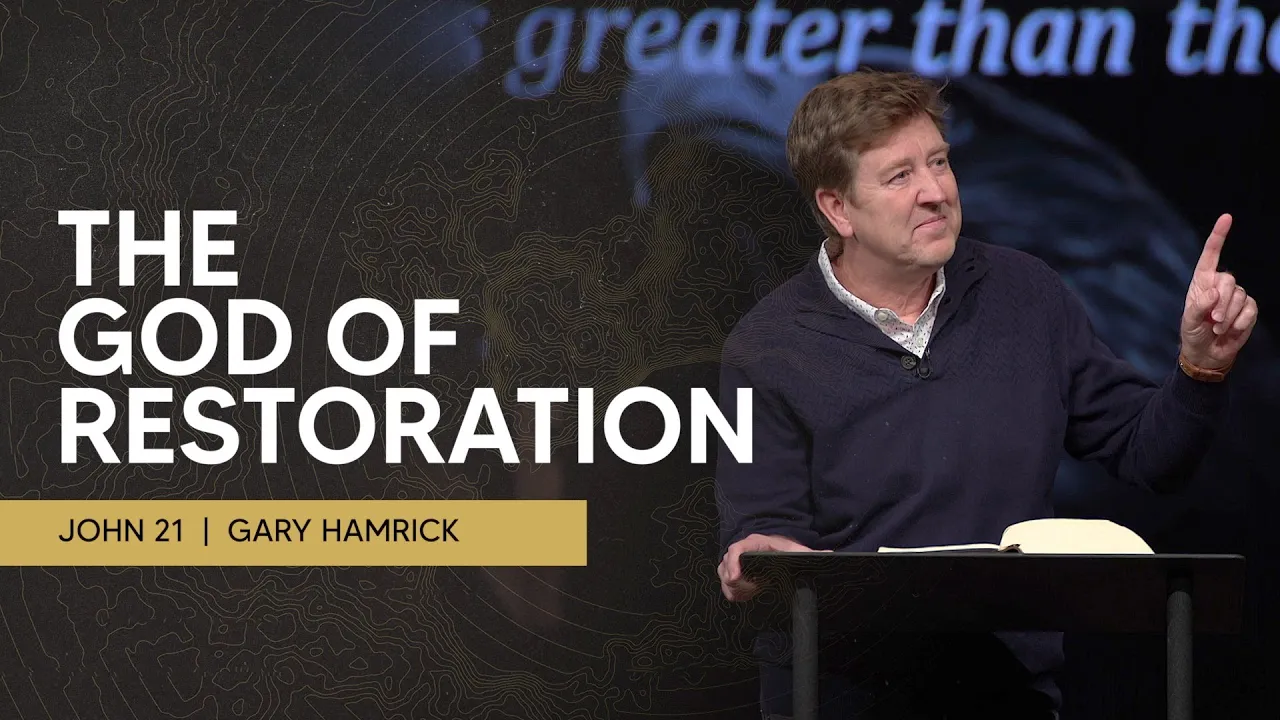
John 21 is where we are today as we bring our study through the Gospel of John to a close today by looking at this last chapter chapter 21 and next week Lord willing will be continuing in our journey right through the Bible we go cover to cover here at Cornerstone so next week we'll be into the book of Acts so you can read ahead but for today since we've covered the details concerning the death and burial and resurrection of Jesus as we made our way through Matthew Mark and Luke and because I will cover pretty
extensively the death burial and resurrection of Jesus around the week of Easter today I've opted instead to look at a conversation in this closing chapter of John's gospel that is exclusive to the Gospel of John a conversation between Jesus and Simon Peter you find this conversation nowhere else in the Bible it is recorded just here in John chapter 21 and so I'm going to read starting at verse 14 down through verse 19. in verse 14 it says this is now the third time Jesus showed himself to his disciples after he was raised from the dead
so Jesus has already risen from the dead this conversation happens post resurrection and so continue reading verse 15 and so when they had eaten breakfast Jesus said to Simon Peter Simon son of Jonah do you love me more than these and he said to him he said to Jesus yes Lord you know that I love you and he said to Peter feed my Lambs and he said to him again a second time Simon son of Jonah do you love me he said to him yes Lord you know that I love you and he said to
him tend my sheep he said to him the third time Simon son of Jonah do you love me Peter was grieved because he said to him the third time do you love me and he said to him Lord you know all things you know that I love you and Jesus said to him feed my sheep most assuredly I say to you when you were younger you girded yourself and walked where you wished but when you were old you will stretch out your hands and another will gird you and carry you where you do not wish
and this he spoke signifying by what death he would glorify God and when he had spoken this he said to him follow me now before we pray and dive into this passage just a little background on that closing a couple of verses where Jesus predicts what kind of Death Peter will die in fact we know historically not from the Bible but history tells us that Peter would be martyred for his faith in Jesus and he would be crucified upside down that was his wish he did not feel worthy to be crucified in the same manner
that Jesus was crucified and so he asked specifically to be crucified upside down history also tells us eusebius the Greek historian records that Peter's wife and we know that Peter was married interesting the first pope of the Roman Catholic Church was married marriage is a good thing friends foreign Peter was married and eusebius writes historically that Peter's wife was also martyred for her faith she was also crucified in the first century and as she was being led off to be crucified Peter uttered just a few words to her remember the Lord remember the Lord so
very interesting one of the very few women that recorded in history who was martyred crucified for her faith in Jesus as was Peter well let's pause and pray and we're going to unpack this conversation today so let's pray first Lord thank you for your grace thank you Lord for this story because this conversation is a reminder of your grace and Lord we just thank you that you were so gracious to Peter and that you're so gracious to us we can disappoint you we can offend you we can sin against you and we can still find
forgiveness mercy and Grace so Minister this story to us Lord to our own Hearts today as we read this Timeless truth and we give you the praise and the glory in Jesus name and everybody said amen well I heard the story about uh an old farmer who all his life had just lived on the farm he had never ventured into the big city so all he knew was farming and milk cows and one day his grown son said to him dad come on I'm going to take I'm going to take you into the big city
and show you things you've never seen before and he took him to a very lavish upscale Hotel this old farmer had never been in one he's standing in the lobby and he's fascinated by what he sees one of the things he's fascinated by is this tiny little room that has two doors that slide open has numbers and lights over the top of the doors and people go on the doors close the lights dance over top the lights dance back down the doors open and other people come out he's just standing in the lobby just amazed
at this contraption and as he's watching this little old lady gray-haired stooped over with a walker comes up to those double doors presses a button the door's open she shuffles in the doors close the lights go dancing over top the lights go dancing backwards and the doors open and out comes this young beautiful well-dressed woman the old farmer turns to his son and says quick go get your Maw I'm going to talk to you today about restoration restoration now Webster defines restoration as a bringing back to a former position or condition all kidding aside I
really do admire people who have a skill set to bring old things that are usually discarded back to its original condition this is an arts and a skill where people are able for example like furniture restoration they take this old piece of furniture they bought at some flea market they start to strip it of all the years of accumulated paint or varnish they get it down to its original wood and you know then some light sandpaper steel wool and some tongue oil and they get it this piece of furniture looking beautiful just like the day
when it was first made people who are also skilled in car restoration some of you love to take old cars and restore them back to their original Beauty people do this with homes people take like an 18th century home some federal house some home and restore it back to its you know period to pieces and period pieces of furniture in the house and make it look like it was original the same kind of thing is done with artwork it is a very expensive and Professional Service that you can get done on a expensive piece of
art here's a picture I've shared this picture with you several years ago but this is a wall mural this is just the the head of Christ it's actually a full-length wall mural in Florence Italy called the crucifixion was painted by fra Angelico in the 15th century and they have a process Now using certain solvents to delicately remove resins and varnishes and grime from oil paintings without destroying the original work and here's a picture post restoration of this same painting and so it really is a skill it it is a it is a professional uh trade
and a skill that people have to restore things and what's important to understand I share all these simply as illustrations because God is into restoration too but unlike the regular dictionary definition of restoration which as I said a moment ago is to return something back to its original condition the biblical definition of the word has a greater meaning of improving something to a condition better than it was before in a biblical sense if you're taking notes restoration is a when God takes something broken and makes it brand new and or be the process of receiving
back more than has been lost such that the final state is greater than the original condition this is biblical restoration and God does this all the time he performs restoration with people with marriages in families among friends he restores Souls he restores broken hearts he even restores broken Nations there was a time in Israel's history when they were so far from God had disobeyed God so terribly that in the days of the Prophet Joel God sent a plague a swarm of locusts as a form of his judgment to get their attention because of their Disobedience
toward him the entire nation was swarmed with locusts which destroyed all the crops and the vegetation which obviously affected their livelihoods and also affected their food supply and God brought these locusts as a way to Devour the land as a form of his judgment to get their attention that they were so disobedient to him but here's the marvelous thing that after the people repented once they saw what God was saying to them and they repented and they turned to the Lord God said to the prophet Joel in Joel chapter 2 25 so I will restore
to you the years that the locusts have eaten God is a god of restoration for broken lives and broken marriages and broken families and broken broken livelihoods and broken Nations God is a restorer of broken and discarded things and he makes those things brand new you see in our culture in our society this is just in general among Americans in particular but this is probably true universally among most cultures we throw away things that are broken we discard things that have deteriorated because we determined that they no longer have value all right not with God
loves broken things and broken people because God will take broken things and broken people and mend those things and make them whole and reclaim them for his glory that those things and those people might live according to his Grand purposes for their lives God loves Brokenness we discard broken things God salvages and reclaims broken things David would write about this when David was confronted about his sin of adultery with Bathsheba by the prophet Nathan David one of the things you can say about David I mean he was a man who had his moments he had
his victories and he had his defeats he had his success stories that he had his failures but one thing that was true about David for which God said about him that he had a heart after God was not that he was a perfect man but when he did Sin and adultery was clearly a sin he was quick to repent he was quick to turn back to God and he writes an entire Psalm Psalm 51 in response to his repentance towards God after his sin of adultery with Bathsheba and one of the things he says in
Psalm 51 is about his own broken condition and how much God received him in Psalm 51 17 he says the sacrifices of God are a broken spirit and he writes a broken and contrite heart oh God you will not despise God loves a broken heart and a contrite spirit because then he can take the person and mend them and reclaim them and mold them for his purposes in fact in that same Psalm Psalm 51 David also talks about restoration in Psalm 51 verse 11 and 12 he says do not cast me this is his prayer
to God do not cast me from your presence or take your Holy Spirit from me restore to me the joy of your salvation and give me a willing Spirit to sustain me restore unto me God is the god of restoration restore unto me the joy of your salvation and create a willing spirit in me to sustain me God is the god of restoration and that is exactly the theme of John 21. Jesus is restoring Simon Peter now why did Simon Peter need to be restored well if you're unfamiliar with his story let me give you
a quick recap right at the time when Jesus needed his friends the most the loyal guys that he had done Ministry with for three and a half years they all abandoned him when Jesus was arrested flogged and crucified all of his disciples deserted him and Jesus predicted this at the last supper at the last passover that Jesus shared with his disciples Jesus predicted every single one of you will abandon me well when when he said that at that Passover meal Simon Peter spoke up and he said well the rest of these homies might abandon you
but not me okay homies is in The Message Bible but anyway he so he but he's but he's like hey these other dudes these other guys they might abandon you I listen I never will didn't your mama tell you never to say never because whenever we say words that are extreme like never and always we get ourselves into trouble because those are exaggerating terms and so but Peter Peter says you know he's got that you know foot and mouth disease and so he's just like you know I I will never forsake you I will never
abandon you and Jesus at that dinner says to him Simon Peter verily I say to you truly I say to you before the rooster crows like before morning you will deny me three times he will deny even knowing me three times and the words of Jesus came to pass because as We Know Peter denied in conversation with people right at the time when Jesus was being arrested and flogged and then crucified Peter pretended like he didn't even know Jesus three times he was asked don't you know him aren't you his friend and three times he's
denied even knowing Jesus you know what's interesting is out of the four gospels Matthew Mark Luke and John Matthew Mark and Luke all record the failure of Peter but not his restoration John does not record the failure of Peter but does record his restoration that's why it's beautiful when you have all four gospels because you get the whole story which is why this epilogue chapter 21 of John is such an important epilogue to the four gospels because you get the whole story the guy who denied Jesus three times is going to be restored here and
God's going to use him in a marvelous way we'll get to that in the book of Acts starting next week because he's not done with him and he's not done with you some of you just need to know today that God is The God Who restores what is broken but here's the thing God restores what is broken because Brokenness leads to repentance do you understand there's a difference between repentance and remorse some of you might always wonder when you when you know this story about how Judas betrayed Jesus Peter denied knowing him why was Peter
restored and not Judas here's the difference because Judas the Bible says was remorseful Matthew 27 3. that's the word that is used Judas was remorseful but not repentive remorse is just having regret that you did something that now you're embarrassed about because it's been exposed or now you regret because it has affected other people but that's as far as it goes Judas was remorseful and so the Bible says he returned the 30 pieces of silver that he had taken as payment to betray Jesus because he was remorseful the ESV translates in the literal Greek language
not remorse it just simply says Judas changed his mind and gave the money back see God does not honor remorse he honors repentance that leads the Brokenness that leads to repentance which then receives restoration and so the difference between Judas and Peter is that Judas was remorseful Peter was repentant and God can take a broken repentant heart and bring restoration and that's exactly what he does here and Matthew Mark and Luke all three when they talk about his failures talk about how broken he was they don't give the restoration story like John 21 but they
all mentioned that after he denied Jesus the third time that he wept a bitterly Matthew 26 75 so he went out and wept bitterly Mark set 1472 and when he thought about it he wept Luke 22 62 so Peter went out and wept bitterly so this describes a man who was broken and repentant and Brokenness leads to repentance because you're sorry for your sin against God and you're sorry for what has led to this broken condition and then God has something to work with to bring restoration and here's how he did it for Peter when
you look at your Bibles again here in John 21 Jesus restored Peter there's an important language um that needs to be understood here in the text because in our English Bibles regardless of what translation you're reading from I read from the new King James version but if you have NIV or ESV or some other version in the conversation I just read the word love in our English Bible appears seven times just in that conversation the word love appears seven times but it's not the same word in the original Greek language because the New Testament was
originally written in Greek and the Greeks have primarily they actually have more than four but primarily four words for the word love in the original Greek language and so this is one of these stories or texts that it's it's it's best to know a little bit about the original language so you can fully appreciate and understand the context of what's Happening here now I will say this as a quick disclaimer because sometimes people like to point out and it is true that Jesus did not speak Greek he no doubt knew Greek he no doubt knew
Latin also Greek was the common man's language Latin was the language of the Roman Empire at the time and he also knew Hebrew because he read from the Old Testament scriptures from the Jewish scriptures but his his native tongue was Aramaic Aramaic today is a declining language only about 500 000 people speak Aramaic in the world today some pockets of turkey and Iraq and Iran but otherwise Aramaic is a language on the decline Aramaic came about when the Jews in 723 BC were taken captive over to Assyria which is modern Iraq and Iran and their
Hebrew dialect got folded into Chaldean and there was this merging of languages that formed the Aramaic language that's a very simplified you know linguistic people would probably torture me for what I just said but that that's a very simplified explanation nation of where aramaiah came from so when the the when when the Jews were allowed to return to Israel they spoke this mixture language of Aramaic today Jews and Israel speak Hebrew the ancient original language of the Jewish people and the language of the Old Testament scriptures but in Jesus day he and the Jews spoke
Aramaic so some would say well Gary you're about to talk about the Nuance of the Greek language but Jesus wouldn't have spoken in Greek he would have spoken in Aramaic and I get that but here's what we need to understand is that if you believe as I do that the Holy Spirit inspired human vessels to pen these words that John wrote in the common man's language of the day which was Greek and he used different words when we come to the word love and I'm going to show you in a moment to communicate the the
god-inspired deeper richer meaning of this conversation between Jesus and Peter does everybody follow that so what I'm about to show you here is important for us to understand because in this original language it is communicating to us a deeper meaning between this between these two individuals in this conversation first here are the four words that the Greek use commonly for the term love storge is the word they use for family love Eros for romantic love we get our English word erotic philia for friendship love uh you like Philadelphia is the city of of Brotherly Love
Agape is the Supreme love now it's good that the original New Testament language is Greek versus English nothing against English English is my own native tongue I butcher at half the time but it is it is the most widely spoken language but it is not as colorful and Rich I'm just being honest with you as some other languages the reason I say that is this is a prime example when in English we use the word love we will use it to describe everything we will say I love cheese and children in the same sentence but
I hope that you love children more than you love cheese okay you will say I love sports and my spouse in the same section in the same sentence but I hope that well anyways you get the you get the you get the point so the idea is in English we just say love for everything I love ice cream I I love my wife and and yet the in the Greek language they're like no no we're going to talk specifically what kind of love that we mean now in the Bible in the New Testament the first
two words on the list they're storge and Eros are not found anywhere in the New Testament there's a form of the word storge once that is used but otherwise storge and Eros are not in the New Testament original language but philia and Agape are and those two words are found in this conversation now Agape again is the highest kind of supreme love and Agape is based on the will of the individual expressing love not on how lovable the recipient is that's an important aspect of agape okay it is not this emotional thing based on how
much the other recipient is worthy of it Agape is supreme because it is a love that is expressed out of the noble heart of the one expressing not based on how lovable the recipient is that's important an Agape is the word that is primarily used throughout the New Testament but so is philia and in this conversation I want to show you now I'm going to put the all the verses on the screen I know it's a lot I'm going to step out of the way so you can see this with me and and I want
you to notice here the breakdown of these words again seven times the word love is mentioned in this conversation I'm going to highlight six of them okay in the conversation between Jesus and Peter Jesus asked the same question three times do you love me and Peter answers three times the first time that Jesus asks the question and I'm going to put the word Agape in red I'm going to put philia and the verb forms Agape or phileo in yellow so you can see this okay here's the key above and here's the first question Jesus says
to Simon Peter do you love me more than these and he uses the word agapea the the verb form now when he says more than these a lot of people wonder what's he referring to and we honestly don't know best guess he's been he's there with other disciples Jesus is probably saying do you love me more than these guys love me as you so confidently asserted back at our Passover meal when you said they will betray you or they would rather abandon you but I never will she's probably revisiting that like do you really love
me more than these and Jesus asks him the question using agapeo do you have the most Supreme love for me and notice Peter's answer he says I love you but in the Greek it's phileo he says I love you like a friend like a brother now we need to actually applaud Peter here because Peter now has more self-awareness it's a more humble Peter he is not overstating his Devotion to Jesus like he did back at the Passover meal so he's being honest he's like you know I wish he probably is thinking I wish I could
say Agape the highest Supreme love but I don't want to overstate my devotion like I did earlier so I'm just going to tell you I love you like a friend I love you like a brother and Jesus says to him feed my labs like there's work still for you to do Peter question number two is verse 16. he said to him again a second time Simon son of Jonah do you love me agapeo he used the same Jesus used the same highest word and Jesus in response to Jesus Peter said yes Lord you know that
I love you and he used phileo again I love you like a brother and Jesus said to him ten my sheep and then Jesus asked a third time and here's where it's important to see because when Jesus asks the question the third time Simon son of Jonah do you love me Jesus uses the word phileo and Peter answers the same way he had answered the previous two times I Love You Lord like a brother now why do you suspect that Jesus used the same word phileo in the third question as Peter had been using all
along and I'll tell you why I suspect and you can have your opinion about this but here's what I really believe is going on here Jesus gets down to Peter's level he is always willing to meet us right where we are and so he Stoops down to where Peter is and he basically says to Peter Simon Peter do you at least love me like a friend like a brother and Peter's a little perturbed that he has to ask him a third time but he says yes Lord you know all things you know that I love
you like a friend like a brother Jesus gets down on his level listen this is Christianity okay hear me on this all other world religions teach what you have to do to get up to God's level try more be better work harder that's every other world religion besides Christianity Christianity is the only world religion that teaches God came down to your level and my level to bring us up he condescended to a human level he took on our flesh he experienced our pain he died on our cross he lived our lives without sin to be
the perfect sacrifice for our sinful lives to bring us to God that's restoration and God did that because because of his love for us so for you note takers there's two quick points I'm going to leave before we have communion together here's the first one Jesus Stoops down to the darkest places of our Brokenness to bring us up I don't know what you might be going through I don't know where you are in your relationship with God I can tell you this he's going to pursue you because he loves you and he Stoops down to
where we are he came to Earth to die for our sins to meet us at that darkest place of our Brokenness to forgive us to heal us to restore us and why do you suppose that Jesus asked Peter that same question three times I tell you it wasn't to annoy Peter it was to restore Peter because as most of you are familiar and recognize why he asked him three times for those of you who aren't it's simply this because Jesus was giving Peter the same number of opportunities to affirm his love for Jesus as Peter
had denied his love for Jesus when Peter denied even knowing Jesus three times and why is this important the second and the last point because God's grace is greater than our sins for every single offense that Peter had committed against Jesus at least in this one context Jesus gave him opportunity to be forgiven three different times to restore him in this way Romans 5 20 says but where sin abounded Grace abounded all the more there's a refrain of an old hymn that we sometimes sing Grace Grace God's Grace Grace that will pardon and cleanse within
Grace Grace God's Grace Grace that is greater than all our sin and on this day in this conversation in this moment Jesus restored Peter he said Peter not only are you are you forgiven but there's work still to be done and Peter will be the first person when we get to the book of Acts the first person of the New Testament Church to preach an Evangelical message and three thousand people get saved because God takes broken people who are discarded and he makes us whole and he reclaims us for his purpose and he uses us
for his glory the Lord is my shepherd I shall not want he makes me to lie down in Green Pastures he leads me besides Still Waters he restores my soul Peter will write two letters in the New Testament first and second Peter and he understood what God did for him on this day in John 21 and he ends First Peter chapter 5 with these words and the God of all Grace called you to his eternal glory in Christ after you have suffered a little while will himself restore you and make you strong firm and steadfast
to him be the power forever and ever amen do you need restoration today maybe for your life for your marriage for a family for your livelihood for whatever might be broken Brokenness that leads to repentance is an opportunity for restoration let's pray together ushers you can come and then we're going to receive communion father I thank you Lord that you are the god of restoration and I pray Lord for those who are here today and those watching online who need a restoration work in their own hearts and lives they have wandered far from you Lord
but just like with Peter you can bring us home you can restore us to yourself for a broken marriage Lord you can bring healing you can bring restoration you are The God Who restores things such that the final condition is better than the original you could do that Lord in families you can do that Lord where there's been sin and Brokenness that has led to repentance because you're the god of restoration [Music] and you know every person here today Lord and you know what they need I pray God you would Minister your grace to them
that you would do a restoring work that is a testimony of your miraculous touch on a life on a marriage on a home on a business whatever has crumbled because of our sinful choices Lord thank you that a broken and contrite heart oh God you will not despise restore unto me the joy of your salvation and give me a willing spirit that will sustain me we give you the glory Lord the praise the things in Jesus name amen