Today we are going to talk about epenthetic vowels! It's not really something that exists in English, and that's where a large part of the Brazilian accent happens in English. RITMO, which is rhythm in English.
RITMO is not spelled R-I-T-I-M-O; it's spelled R-I-T-M-O. But you pronounce this imaginary, or epenthetic, vowel as if there were an I there. Now as a native speaker of English I would have thought, before learning about epenthetic vowels, that this was pronounced RIT-MO.
RIT-MO. Two syllables only. But this is a feature of Portuguese that again I find beautiful.
And on of my favorite words, So you can see that this happens all the time in Portuguese. But now you have to learn how not to do this in English. And it's not just as easy as saying, "Okay, well don't say Facibooki; just say Facebook," right?
And then you're fine. That's the first step, that's good, but it's not all of the way there. So let's talk about an active way to improve your pronunciation of these lack of epenthetic vowels in English, okay?
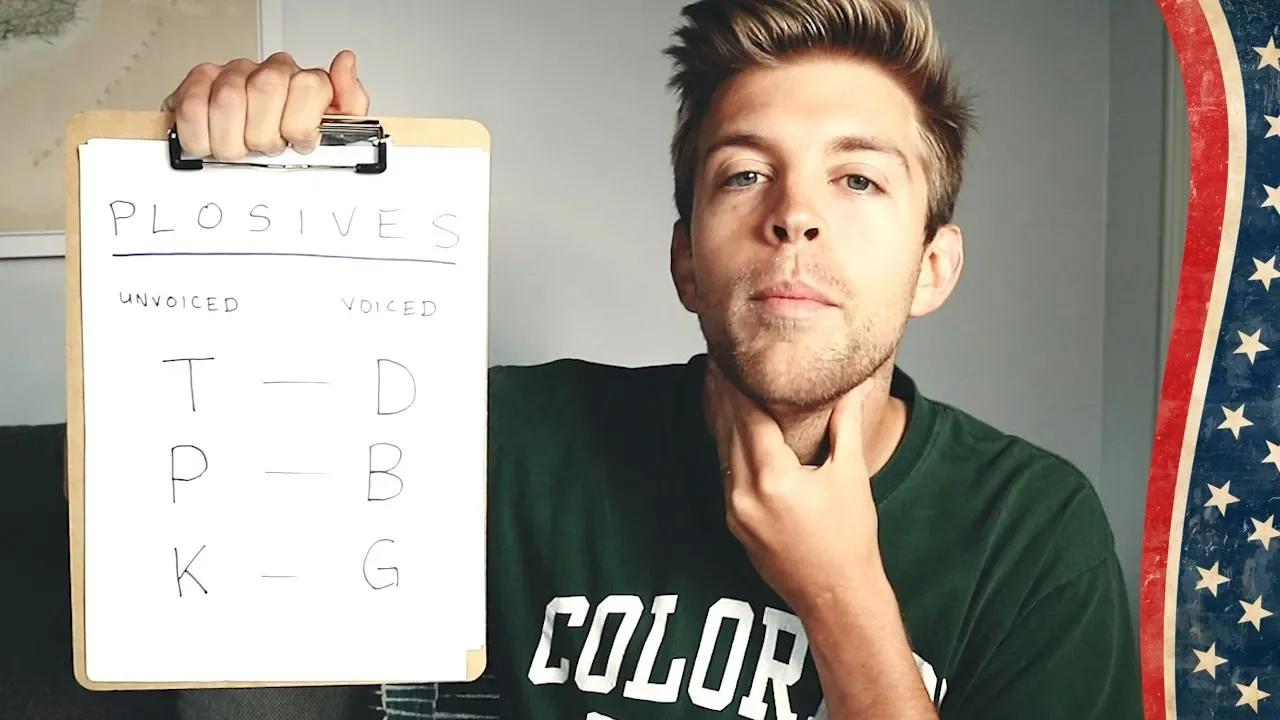
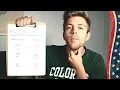
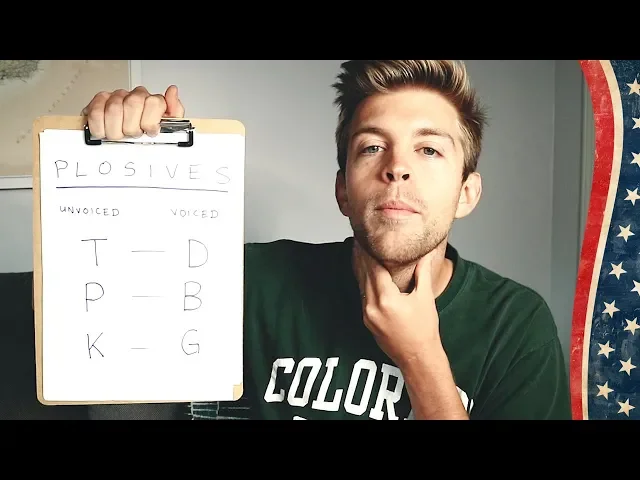
So, I have here six letters that I wrote down. These letters are all examples of plosives in English. And we have amongst these six letters two different types of letters: we have unvoiced plosives and voiced plosives.
Okay, that's great, what does this mean? A plosive is a letter that when you say it, you can hear a puff of air, or feel a puff of air on the back of your hand, right? So let's take Twitter for example.
Twitter ends with RRR. And when you put the back of your hand up to your mouth and you say RRR, you do not feel air on your hand. But Facebook, if you pronounce the K in Facebook, you feel that puff of air: Facebook.
Okay? And it's interesting because we have these letter pairs. All these are the same, right?
. . .
Our unvoiced and the voiced are . . .
So your unvoiced in these pairs, you're making the same sound in your mouth, for example, for both T and D. It's just one you actually vibrate your vocal cords, which is the voiced here, so . .
. Right? Same motion with the mouth, and you can feel it and your throat here when you pronounce the voiced.
Same here: . . .
Same motion, only the B is voiced. And finally, . .
. Right? The G is voiced.
And all of these you can feel . . .
the puff of air on the back of your hand if you put it up. Those are what plosives are. Now, I have examples here of six words where these occur at the end of each word.
But I wanna start with the word hot. Quente, right? Hot.
Okay first of all, it's not the way that a Brazilian learning English for the first time might say it. It's not "róti", something like that. But it's also not "hoT", ending with that TTT, that very strong puff of air for a T, the plosive T at the end.
I do not say hoT. I say hot. One of the ways that I've described this in the past is that I am almost pronouncing the T, but I'm not, okay?
So I'm all prepared, I'm ready to say the T at the end, hot. . .
but then I don't end up saying it. It just stays stuck. It stays blocked in the mouth.
The more technical way you could say this is that every time we're about to say a plosive, our tongue in our mouth blocks the back of our throat, a garganta. So hot, almost saying the T but not, and notice where your tongue ends up at the end of the word: hot. It's on the roof of your mouth, right?
No céu da boca. That's roof like "teto", roof of the mouth. Hot.
And so let's remember this as we practice these six examples of words that end with these plosives in English, okay? And here with the P it's like I'm about to say laptoP, right? Feeling the air.
But I don't. It stops. My tongue, laptop, my mouth actually closes here.
Same thing with job. It's not "jóbi", it's not joB, it's job, almost pronouncing it, but not letting that puff of air go, right? And here it's like the back of the tongue stays in front of the throat, right?
Facebook. I'm trying to show you where it is. Like, my throat really is closed off, but it's the back of the tongue now that's doing it.
Facebook. And same thing with ping-pong. Ping-pong.
It's not pinG-ponG, really pronouncing the G. It's ping-pong. Ping-pong.
So this is great if you can start remembering to do this during sentences. But the problem: sometimes with Brazilians at the intermediate-to-advanced level is, you start to almost overcorrect. You start to correct for your Brazilian accent too much.
What's an example of that? Well the word but, mas, right? In English is but: B-U-T.
And I have a Brazilian friend, she speaks very good English, and you can tell that she's learned not to say "búti" or buT. She leaves but completely open, buhhhh, without the sound of a T. But she doesn't close her throat off or her mouth off at the end of saying but.
So instead of saying but, she says buhhhh, buhhhh, which is okay, we would understand what you mean, but that's also a strong accent. It's just as strong of an accent as saying búti or buT. So just remember, with all of these words, instead of saying .
. . remember that you have to close your mouth or your throat somehow, right?
That last one, again, is with the back of the tongue in the back of the throat, where I really am closing off my mouth. Ping-pong. It's not like ping-powhhh.
I don't know something like that. I believe that this is one of the biggest existing pronunciation problems that Brazilians have, and if you can really work on this, you'll fix a good 20%, right away, of your accent, if you can remember for these six letters to try to do so. So, I think that the more this becomes natural for you, talking about letters at the end of words, you're gonna start to be able to notice that this happens in syllables, too.
Option. "Opção" in Portuguese, right? Option.
I'm not saying "oPtion", and I'm not saying "ahhhtion", completely not saying the P. I'm almost saying the P, ending the mouth as if I were about to say the P, but then going right into -tion. Option.
And that is the English accent with epenthetic vowels. You're not gonna think about the rule as much. You're really just gonna feel that it feels better in the mouth as you're actively practicing.
This will become natural for you guys, I promise. But when you're listening to podcasts, and radio stations, and TV shows, and YouTube videos, try to listen for instances where we have these six letters ending a word, and notice how they're saying them. I once again think that if you can start to dominate this aspect of pronunciation, that 20, maybe 30 percent of your accent will be gone.
This is a big issue. It's a hard one to correct, which is why so many Brazilians still have a strong accent with these epenthetic vowels, or this lack of epenthetic vowels. But if you really start to work on it, learn how it works passively, and pull it into your active knowledge when you're actually talking, you're gonna lose that accent - that accent!
Não é accenT! That is it for this lesson. Work on it!



![SCHWA! [ə] O SOM MAIS COMUM DO INGLÊS | DICA #29](https://img.youtube.com/vi/kNKCOm74pZg/maxresdefault.jpg)