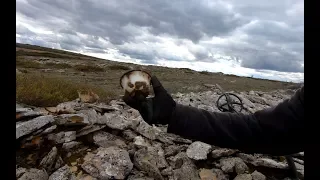
There is a valley In Spain called Jarama. Is a place that many people know very well. A place where there was a fight against fascism.
A peaceful valley that became hell. When i was a child at the age of six, more or less, in the 50s, year 51 i went collecting, with my parents and a brother of mine, that also came with us, the pellets, scraps of metal, or the cartridge cases, that were scattered in the olive groves. After that, these things were sold, so we can buy the daily bread.
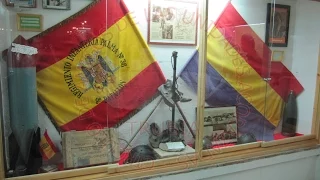
That so bad period of the postwar is ended. now you are grown up, you come back to the fields where your compatriots have been fighting, your parents, your grandparents. there are still so many objects, and is then when one thinks, well, all these things could be collected, keep it in some place, and when possible, make a museum, in order of not forgetting the hardships that all these people suffered fighting for a better life for us, or simply because hey thought they had to do it.
Goyo Salcedo HOLDER OF THE MEMORY A little bit later, i started collecting the objects, and also started to make the museum. There were problems to make it, even political problems. I should say that i spoke with the owner of the resort we have here in Morata, Pilar Atance and she said to me that whatever i would need she would do they confronted her with all the problems hat exist and even more.
Certain authorities of the village demanded from her until the smallest paper they have to demand. So, she said:"well, you demand this from me, i will do it, but, at the end, it will be done" and this is what has been done. All the pieces that you are going to see, or that are exhibited, the ninety or ninety five per cent of it , are collected from the very heart of the battlefields, the olive groves of flat ground, also in Morata de Tajuña.
The rest of it, five per cent, are donations or exchanges. The paperwork, newspapers, safe-conducts, etc. .
mostly was acquired in the "Rastro" of Madrid. Also there have been donations. Here, as you enter, at left hand.
, we have the chronology of the battle. It have beeen written for the museum by Jesús González de Miguel, an important contributor of what this museum is. And, as you enter, at the right hand, we find the empty cartridge cases, after they have been shot.
With these cartridge cases and other scraps of metal, many families from this village, i dare to say, lived to the 60s, selling them later on, in order to survive. Long time ago, people came here without these devices, but nowadays, so many people come here researching these things, that make it difficult to find a thing, unless it is buried. There is a market, I have spoke with many people about this, there is a market, for this Not all people use these things for histories but rather keep it to themselves Shnarpel, .
. . .
aken out . . .
. . of bombs and projectiles.
. . there are thousand and thousands of kilograms of it buried.
Is a pellet, a russian pellet. There has to be thousand of this kind buried. We are not lack of newspapers.
The ABC was edited in both sides. In the one from Madrid, under the letters ABC it is written "left republican daily". The other one, in Sevilla, as one can see from the pictures, is the national one.
Religious medals,. cans food cans there are millions of cans, rotten cans, spread throughout the olive groves. I have only collected for the exposition those ones that have the year written on it.
Look. . .
. . .
. . .
. it is a russian cartridge case. It isn't.
. . It isn't shot, but the pellet has gone.
Well,. . .
. . his objects, if they are in good condition, i keep them for the museum, o but if not, it can be sold as scrap, and after a year, you have enough money to buy an old newspaper.
Kitchen equiments, dishes, glasses, spoons, forks. . .
As something very curious, we have here women's objects. Women's objects that have been recovered from trenchs. Perhaps the women lost it, but it is also possible that the soldier himself carried them as fetishes, or reminders As part of History, is very beautiful to find them.
All the valleys or ravines that ends up in the valley of Tajuña had been taken over by the Republicans We are going to see now a cave where the troop slept After the war it was used to sow mushrooms. Here is the bedroom. Is one of the most amazing caves of this area, in front of the "Pingarrón" In all the caves, without exception, we find this kind of "basal", as it is called: is a hole in the rock of about 100 milimeters, where the lamps were placed, in order to see.
The lamps: we have industrial ones, but there are also lamps made in the trench, generally made with russian ammunition cases. With a bit of oil and any cloth as fuse, they had enough lighting. This place is full of caves, walkways, that ends up in another hilltop that we have 50 meters from here.
There we have the walkway that ended up in the other hilltop. It is completely sunk. You could pass through here with one or another danger.
This is the main room of the museum, where we are not lack of war details. Nor are we lack of human details too, which are the most important ones for me. It is full of photographies of that time, algunas posando.
. Hemingway posando because, as they say, he never fired a single shot. However, here he is with a gun.
You can see different kind of mortars, projectiles, rifles, some watch. . rings, some awards.
. . .
. . .
. . .
. . .
. . .
. . .
This has to be some pellet. . .
yes. . oh, i know what this is.
It is part of a case, it is a kind of safety closure of a case, of a cartridge of some soldier. This at least tell us certain story. .
. some human being had carried this to lock in his case something good, not only things for killing. We have to keep it safely.
Look, here we have the original map. . .
. . .
. . of the military Republicans that were here during the battle of Jarama.
It still have the little holes that the little flags they had. . .
. . on it made.
Behind me is the valley of Jarama. This natural spot where we are now recording, is called the hill of suicide. It is called that way because what military, high ranking republican commanders, did here, was a suicide.
. . .
. The ammunition was not ready, nobody was ready, this was a disaster. 200 english men died in a matter of hours.
On my right hand we have a little popular monument constructed by people, who have gone putting stone by stone. eh. .
. . .
They set it up, and others knocked it over, five times has happened this: some people have destroyed it and others of us have built it again. Now is there, for every one that come here to remember, relatives of those who fought, so they can keep at least a memory. One of the curious things you must see is the olive tree.
The olive tree, beyond feeding us with its olives and its oil, saved many lives. The soldiers, being behind them, were protected, because the wood of the olive trees stopped the bullets, and in that way many lives were saved. .
. . .
I would take it out with patience, but now, for the moment, i can't, it's impossible to take it out. We also have the health sector during the war. a I think the first blood transfusions took place here during the spanish civil war.
Here we have an original stretcher, with certain stains on it. . .
although it could be glum to say so, but that's the way it is. This is similar to a little shelter, you know. In the shelters you could find typewritters, certain arms.
. We have here the graffitis made on the walls by the republican soldiers. Some of them .
. . .
are international. Here i see one that says: "long live to JSU", . .
. 1938 Here "long live to myself", bad written We can find this kind of walkways in several places, and they are architecturally equal. When you arrive to the end, there is a bifurcation to the right which leads you to the exit.
Another bifurcation to the left was leading you to another cave. This one is covered. It has been covered for not letting rabbits and little animals enter here, so they can´t eat the mushrooms.
. . .
. . .
. . This one simply covered, but it was leading to another cave.
. . a bedroom cave.
One of the objects that struck me the most is the inkwell, what it represent, or what the person that writes can do with the ink that is inside. He can write about his feelings, about loves or dislikes, or hates. .
. or death penalty. This little satatue is made from pieces of the battle of Jarama, pieces of projectiles, about 3000 pieces.
It happened to be that in the years of the war, there was a poet here fighting. He made a poem asking the people to collect and then asking them to made a monument with all those things. The AVI the association, noticed that i was doing this, they asked me if i had hear about that poem.
I said "no", and they inmediately made contact with a relative of the poet, telling him: "listen, there is a man that is building a little monument out of shrapnel". So they came here to read the poem. There were about 300 persons here, and it was very curious to see, not 300, but 200 of them crying.
I can believe in the paranormal, but with the quote marks. I am not much of a believer of those things. Being in the 700 mark, upon one of the fortress that are there, i felt a thrill through my body.
The hairs, The hairs, the ones that i still have, stood up. I think that something happened to my body, i dont think that somebody came and touched me I dont believe in those things, but. .
i have to tell this story. These are from Brigade members, very old ones that have visited us. They have signed these little pages.
I have this as if it were a jewel. It is indeed a jewel, none of them is alive. .
but they have come here to see it, they have feel themselves almost as spanish people. They came here, and it was like children, crying. They came back to their countrys with the hope of seeing this again, many of them haven't succeed, because they were very old and now they have died.
The project of the museum is going ahead I have help in doing so. In first place i have to thank the Atance family, specially Pilar and her sons, owner of the resort of Morata de Tajuña. I also thank the Ikenmeyer family, germans, that have come here from so far away to help me.
I must thank Miguel Vázquez, from Rivas-Vacíamadrid i want to thank him for all that he is doing. Juanjo Sánchez Salcedo, cousin of mine, that come here and encourage me to search for things, he also gives out every thing that he finds. I also thank some other people that dont wan't to be mentioned.
Many thanks for everything. We will continue working to make this going the same way, in order to have here in Madrid best museums of the world. Now we are far from that valley of pain .
. . but we never should forget their memory.
So before we continue with this meeting. . .
let's stand up for our glorious dead.