Everyone this is ron viscanti and uh i'm with phase two careers and in the moment we're gonna have uh corey speak about resumes for change or career change and he's always filled with lots of information he's just the job search guru and he's a great guy so we're going to learn a lot from him in the next hour plus just to tell you if you're new to phase 2 we've been around since 2010 we do several things all kinds of job search webinars we also do all kinds of career talks networking recruiting and of course
we have a very large section that does small business activities to tell you a little bit about corey you've given how many talks now for us corey uh maybe a four or five yeah yeah you're you're gonna get your million dollar miles here But he's a fortune 100 recruiter and a career coach and he has his own business called careershakers.com he helps corporate professionals find their jobs find their next jobs he does workshops technology events a lot of radio does has a youtube channel does weekly career content so he posts to entrepreneurs and people changing
careers and he went to a great college i i'm fond of santa clara University and he graduated sumo laude so you gotta show a little respect to a santa clara grad so i'm going to hand it over to you there corey all right well thanks everyone we are going to have a super intimate session tonight which actually i don't mind because then we can really answer all of your questions hopefully you're in the right place uh we are going to learn how to write your resume or update Your resume when you're doing a career switch
i have heard that there are a few other webinars and other events going on tonight so thank you everyone for making the time my goal is to make this as valuable for you as possible and if you're not in the right place i encourage you to stay i promise you'll still learn something either way just by a quick show of hands i think there's like a raise hand button in zoom who Here is like actually looking to change their careers right now one two [Music] just two of you huh wow all right so either everyone
here is just learning some information for the future or maybe we can inspire a few folks who are thinking about changing careers here tonight So just to give you some background on me in addition to whatever ron has already said so i myself have changed careers twice i've changed once in internally within my my previous employer and then i did a total 180 career switch and i moved from management consulting to do recruiting and so after i did that i actually kind of fell into this as like a side side passion project of mine where
other folks from my previous jobs were asking Me how i was able to change careers get a job without any experience work for a fortune 500 company right off the bat how i was able to do all of that and then i ended up coaching people for the last four years about how to do career switches most of the time without having to go back to school so i think one of the one of the main reasons i wanted to cover this topic with with ron and we had brainstormed a few other ideas about what
to cover um I've i've talked about interview prep and a bunch of other stuff already here in the group i think i did one on networking too but when it comes time to writing your your resume when you're one you want to do a career switch there's a lot of information out there right i just did a quick google search if you just type in best resume for career change you're going to see a bunch of sponsored ads at the top you're going to see a bunch of Recommendat a bunch of recommended links here and
if you click on each of these the interesting thing is they will each give you different recommendations and different resumes to use for a career change and so i just thought it would be so helpful for folks to kind of know what i recommend to all of my clients so that you can pick and choose what what you feel is going to be helpful for you and then you can decide what formatting or what what resume ultimately you want To use so hopefully after tonight i can clear up some of this confusion and give y'all
some some some recommendations that i know have worked for me and for my clients so specifically what we're going to cover is i'm going to explain what i believe the best resume format or formats are to to use for a career switch then once you know what those resume formats are i'm going to tell you how to then update your resume and we're Going to have a quick live session and brave volunteer for for that hopefully and then i'm going to talk about some common mistakes that i see some people making when you are trying
to do a career switch because it can be a bit tricky depending on what kind of career change you're trying to make so i just wanted to cover those three topics if there's anything that you want me to cover that i am not going to cover in this feel free to come off mute or put a Question in the chat i just want to make this as valuable for all of you as possible it should be about 40-ish minutes of content and then the rest of the time will be q a and i will make
sure that ron gets a copy of this in case everybody wants these notes and stuff for for later resume formatting this i think is you know the foundation for everyone's resume trying to understand what is the Best when you do that google search they're going to recommend quite a few different things and in terms of what i believe is the best resume formatting to use let's start with a quick quick exercise and poll here so on the left i have the functional resume and i'll explain what that means in a second and on the right
side i have your traditional or chronological resume so a functional resume is one that as You can see here focuses more on the skills that you have aka functions within your career so you can see in this example they don't even list what company that they work at or what their job title is instead they talk about their accomplishments and they've categorized their accomplishments or their skills into different sections or buckets right like educational phlebotomy compliance etc so they're Trying to show that hey i've got phlebotomy experience i've got compliance experience i've got program management
supervision experience etc so this is what's known as a functional resume focusing more on like your functional skills and then on the right you have your traditional chronological resume where you know it's summary followed by work experience chronologically ordered job titles bullets accomplishments etc So between the two what do you think or which format do you think is better to use for a career switch yeah okay and if you do a google search actually they will all almost all of them will recommend a functional resume what do you think is a disadvantage of the functional
resume it doesn't show where you worked when you were what jobs you had Why would that be important sherry well they want to know your experience your actual experience but what about the traditional resume why wouldn't the traditional resume be good for a career switch you can see exactly where you worked you can see their job titles it talks about their accomplishments i can't see it that well but it looks like the functional one the person is aiming to become a phlebotomist And i i can't see what bruce bennett was on his um on his
chronological resume yeah the the person the hiring person has to do too much work with the traditional resume to find um the skills if they're looking for a position that's essentially identical to what they just had then it's easy but if it's different than [Music] you you can't see what the skills the transferable skills really are exactly yep yep so as you can tell already in this short discussion there's pros and cons of each of these different resumes the functional resume is great because it highlights your transferable skills which is good for a career switch
the downside though is i have no idea how recent these skills are i don't know Where you get these skills from right according to to this resume they know phlebotomy compliance program management and technology i don't know like how recent they've they've done these technology implementations or skills right i don't know where their program management stuff is coming from so that's one of the disadvantages of it and then as you guys already mentioned about the Traditional is if you're applying for the exact same job you have it's probably perfect but when you want a different
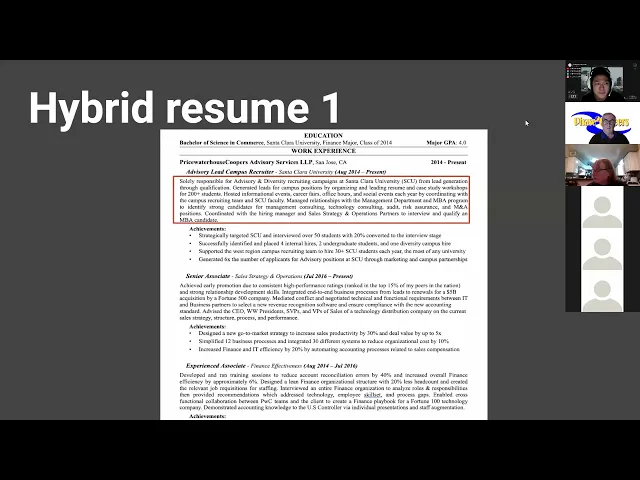
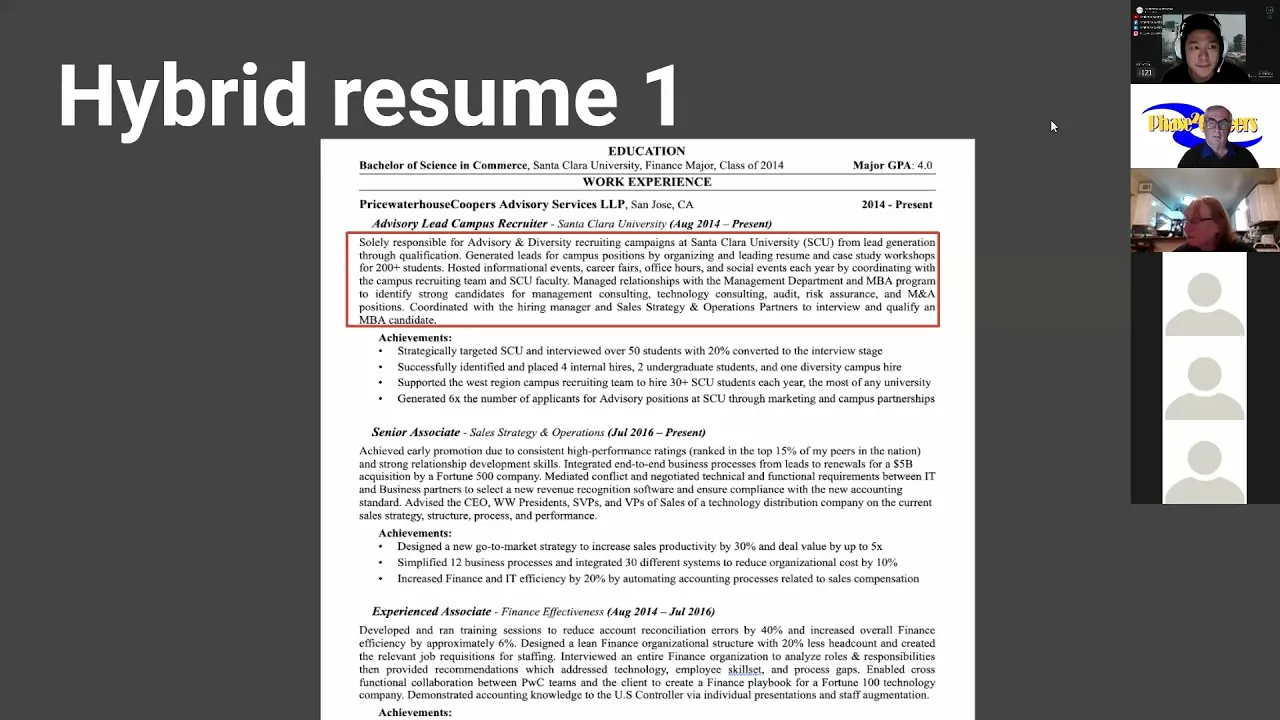
type of job you're kind of branding yourself the wrong way and so the overall format that i like there's there's basically two of them but they're both considered hybrid resumes So what a hybrid resume basically does is it combines both of these together and i'll show you two examples that i actually used so this first one here is one i used uh when i was trying to actually get into recruiting for my management consulting job and this is how i actually ended up getting hired was i use this version and i don't recommend it for
everybody for a few reasons but let me explain about what this hybrid resume does so at the Top you can see i don't have a summary section i just would have my name and then this is like my education and then this is my work experience here now each of my roles have a summary basically paragraph here where i try to highlight my transferable skills in paragraph form basically explaining how this job was somehow related to being a recruiter or becoming a recruiter and then i have my achievements here at The bottom like you would
for a standard resume now the advantage here is that because i have these summary sections if someone takes the time to read it i am explaining basically how this specific role is relevant for what they're looking for in the next position the disadvantage though is that not a lot of people like to read essays and so if they see these paragraphs they may not take the time to read it and Because i have these achievements down here at the bottom and everybody likes looking at bullet points anyways they're only pretty much going to read the
bullet points which is also fine because i've ordered them in a way that shows my transferable skill set it basically reiterates exactly what i talked about at the top so this is a high this is what i consider to be a hybrid resume because it's still chronological i didn't move Anything around this is still the order of the jobs in which i had so they can see exactly what jobs provided me certain skills or gave me certain experiences that may be relevant for what they're looking for but i'm also using the the space here to
talk about how my experience is trans transferable so this is one version of a hybrid resume that folks could could play around with it it worked for me it it may not work if you have a lot of Experience because then you would have to have a lot of these paragraphs and you know it is a lot of writing and then to update these when you're applying for for different jobs it can be pretty labor-intensive but some people do prefer this because it allows you to kind of explain each of your experiences so this is
one version of the hybrid resume and then the second one Is one that i used for a fun exercise actually when i wanted to see if i could get hired in a sales role just just to see like how good my resume writing skills were for a career switch so that's where this one comes from but this one is another hybrid resume because it's still chronological so people know exactly what i'm doing what my job titles are where i'm working where i'm getting my experience but i actually use clever Formatting here to really showcase my
transferable skills so you can see that i use bold to highlight either major accomplishments and or transferable skills or experiences that would match a sales position so i bolded right i achieved 170 of quota um designed and delivered prospecting and closing trainings both of which are sales buzzwords which i bolded to match the job description of What they're looking for right generating new leads that one that one automatically stands out to people right so by a quick glance if you just looked through my resume very very quickly you could see that there's certain things that
will catch your eye that will make you realize that i have transferable skills without having you know to read long paragraphs like i have in the first version this this type of hybrid resume is good For folks who've been working a little bit longer um or if you actually have a lot of these transferable skills that will match over to the job description the first version i think i can go back here yeah this first version is actually also a little bit better for folks who don't have as much transferable or directly relevant experience and
this this kind of helps you in a way like mask it a bit because you can talk over it and give it this Narrative with these paragraphs and these explanations versus with this one there's no narrative that i can give because i'm relying on my experience and skill set to pop out on its own using the formatting and then another version of this like hybrid resume number two is at the beginning of these bullets you can actually write out like an experience or a skill set that they're looking for and then put like a like
a colon and Then put these bullets here to show them that you actually have that so for example i could have put like um as a recruiter for google you know i have i have prospecting and closing experience so i would write prospecting and closing colon and then i would put this example right designed and delivered prospecting and closing trainings for 25 plus recruiters right um Sales i would like sales experience colon facilitated event marketing campaign to generate new leads increase diversity hiring et cetera et cetera all right any questions about these two versions of
the resume and like why why i think they're good for career switches so this one is somewhat like a chronological but instead of just saying what you did you are Focusing on your accomplishments it seems yep but i'm using the formatting here to draw the reader's attention to the transferable skills that would overlap between both roles so in this case i wanted to see if i could become a someone in sales like a transition to a sales role using my recruiting experience now because there is an overlap between both of those jobs both of them
involve Selling they're selling different things but the sales process is pretty similar to the recruiting process in terms of like sourcing prospecting and then negotiating closing there's a lot of overlap there so that's why this version of the resume works out well okay and then you can further enhance it by actually like writing certain skills at the beginning of each bullet to really drive home the point but on your Other resume it said you worked at santa clara university why where is that on here oh it's it's not on here so this one um i
put that i was a campus recruiter for santa clara while i was at my previous employer oh because that that's what that's when i was trying to move from management consulting to recruiting and i had done campus recruiting for my firm at the Time um but now that i'm a act like a full full-fledged recruiter i didn't put my campus recruiting experience on here because it's not relevant for sales okay yeah instead i wanted to talk about my sales strategy and operations consulting experience where i was consulting like svps of sales on like their sales
strategy deal structure Pricing analysis product analysis et cetera so i i kind of picked and choose and chose what skills to highlight and what experiences and jobs i had which we're going to talk about also later on in this webinar cool any questions so far about resume formatting so now that you know what potential resume formats to utilize pros and cons of each and i've seen people get jobs honestly with functional Resumes with chronological resumes with hybrid resumes you can use whichever one you you prefer there are there are pros and cons to all of
them i think the hybrid resume has the least amount of cons but now that you know which one you're going to be using how do you actually update or change or create this career change resume like what do you need to actually update and edit Well one of the first things and i i honestly believe everyone doing a career switch it's mandatory you need to have a summary section there's no doubt about it i think you absolutely need to have a summary section why because you need to explain to the recruiter or the hiring manager
why you're qualified for this role when you don't necessarily match the job title right because if you just apply for a For let's say i applied for a sales role as a recruiter when the recruiter opens up my application they're gonna see corey is a recruiter this is a sales position reject he's clearly applying for the wrong role but if they read my summary statement which i wrote here and i bolded at the top hopefully to catch their attention they'll see wait corey's a recruiter he Applied for a sales role i'm going to reject him
no wait top ranked recruiter looking to become a sales development representative oh okay so he didn't apply for the wrong job he did this on purpose interesting let me read right i don't know i think recruiters could could could be qualified for my role but i don't know let me read seeking to leverage my prior sales Management consulting and recruiting experience to transition into a sales development role so here i have already addressed the elephant in the room that says basically look i don't have any sales experience but i do think my experience is transferable
and i'm going to tell you exactly what experience i think is transferable this is important because if you're applying for a total different job you You already have to address the fact that you don't have the same job title right so right off the bat i've addressed that and i've said hey i'm gonna explain to you in these next few sentences why i'm actually qualified for this then i say my transferable experience it you know designing sales structures right i use a bunch of sales buzz terms i hauled out all of my relevant experience and
or skills that i have That would transfer over to a sales role and i'm saying hey look if you don't read any further you can just see here that i do have some exposure to sales and i've done certain things like cold calling carrying a quota generating leads handling rejection etc that you know makes me qualified for this role even though i am a recruiter and then next i wanted to show that i'm not just qualified but i'm also a top Employee like i'm a great employee to hire regardless of what i do so i
said without any prior experience i was able to become the top recruiter in my organization within six months and plan to bring the same coachability and resilience to your team i i don't like these soft like soft skills like coachability and resilience but i wasn't sure how else to like finish out my sentence so that's what i went with if anyone has any other better ways to have Wrapped that up let me know but here basically i'm saying look i've gotten jobs before where i didn't have prior experience and i've been very good at it
and then i think this is this part is actually going to be really really key is i did a lot of research about the role that i wanted and i knew what's important for them what are some key acronyms what's the verbiage what are some sales buzzwords that sales Development representatives need to know right and so i say i i've also been trained to uncover budget authority need and timing aka bant which is a very popular common basic sales term and how to expand a customer base through zoom info so zoom info is basically their
prospecting and leads database that all companies use discover.org same thing linkedin sales navigator that helps sdr's identify who their main points of Contact are within each company basically who are the decision makers that they need to be talking to to sell these these products or close these deals and other prospecting tools so here in this last sentence i have shown that i've done an immense amount of research and i can talk the talk and walk the walk right i know i know what bant is which means i've done the research i'm taking This seriously i
i actually want this job and i know certain key terminology like bant zoom info discovery.org linkedin sales navigator etc and then here at the bottom are all the all of my res all of my relevant skills so it doesn't have to follow this exact format but this is usually what i recommend for folks you have to have some type of summary statement Explaining how you may have different experience but it is still relevant and then giving them the confidence that hey you should at least get an interview so i'm in sort of a weird situation
in that i'm kind of trained in aspects of what i want to do it's not um but they're Um so i have i have a rhetoric degree and we focus on the form rather than the content um which a lot of places don't understand how that's possible so i sort of feel like instead of um explaining how my previous job was similar i need to be higher level does that make sense I'm not too sure planning this which is my problem okay well we can always dive deeper into that why don't we do this i
think this exercise may be helpful so now that you all know how to what goes into a good summary statement on your resume i want you guys to take five minutes real quick and draft up what you think your summary statement Would be and i would love to get one volunteer to read it with it with everyone and then i'll i'll give you feedback live on on how to update that and so i guess rebecca if you want um why don't you take a stab at it for five minutes and then i'll i'll give you
my feedback on what i think you can update or change Okay i have a question yeah go ahead sherry yeah um my dilemma is different it's um [Music] i would like to go back to a field i did 25 years ago interesting yeah and i've done different work i retired recently but i would like to go back to the field i was in 25 years ago so that's a little Tricky to explain well actually i think depending on how you write your summary it could it could be pretty easy honestly the main thing you'll have
to address is if your skills are still current and still relevant um if you use them 25 years ago for example right that would be my concern if i was a recruiter but i think there's there's a lot of ways to to show that you still have Current skills you can talk about certain terminologies or certain new technologies that maybe have emerged since then but you're still up to date with those things you are gonna also have to probably show i guess more recent experience maybe volunteer work maybe do some side projects where you can
show that that you've still got that that skill set but a good strong summary statement can really help set your set yourself up for An interview rebecca if you would be so kind and so brave we'd love to hear your rough draft of your summary statement and and why don't you just give us all some context what is the job that you are trying to switch into okay so i have sort of a couple of elements one is that um i have been mostly volunteering over the last um 18 years um while i raise my
kids Um but i have um a background i have a um phd in rhetoric and i've taught in rhetoric composition and history um years ago and i published my own um work and i worked in um high tech pr um as well so But what i'd really like to do is um actually part-time work um editing in science and medicine or developing technologies not like the problem is people keep sending me towards oh well what about doing technical editing as in really specific documentation but my skills are really in synthesizing complex material and presenting it
to broader audiences and that's what i'd like to do but they Will look for a degree in the field instead of recognizing that i am trained to look at the information and make the information understandable even though i don't have a background in it what is that job called um i call it editing is there does anything else strike you i mean i'm not sure what the formal job Title is i've never heard of a job like that it sounds like like a technical writer or a uh a technical writer but not in the sense
of like documentation um but in the sense of um it's almost uh i'm going to say it's almost sort of Marketing editing in a technical sense so like a company a company has a brand new product that they want to release and then your job would be to edit the edit the what okay so for instance um my dream job used to be when i lived in the east bay was to work with Lawrence livermore lab and go around to the different labs and say okay so tell me what you're working on and then i
would write it up and present it in a way that investors or incoming students or um uh the general public press release um you know a good uh story in the newspaper or something would understand what it is so Couldn't that be in the corporate communications of of a company that has you know has you know they're on the stock market and they want to have it known to their stockholders what they're all about okay that yes that's true and then i'm also thinking um the product marketing managers of different life sciences companies or Science
they're kind of go-betweens between the scientists and the business development and so you're kind of a translator for them right right okay okay yeah what did you say go between i like that go between between for the scientists and well i have a friend for example who's in business development for a life Sciences company what makes him interesting is he was a scientist and he also he so he could speak their language and doing business development so if you're trying to bridge bridge is a word i want to think of bridging the two worlds okay
right okay so basically i guess to to summarize you're you're trying to Re-enter the workforce um after kind of 18 years off of of raising a family and not being paid right it's not like i mean if moms got paid to raise their own kids that'd be awesome i was doing all the marketing material for the scout troop for the book fair for the robotics team right it's not like i wasn't working right right right but kind of Re-entering the full-time i guess workforce um after volunteering and raising a family and you're targeting like a
corporate communications role for example okay so let's let's hear your first draft of your resume summary well i didn't get complete sentences i just got sort of chunks of it that's okay um a skilled editor looking to explain complex medical and scientific material To general audiences looking to bring my extensive experience in synthesizing technical information with extensive background in research writing and editing um okay so yeah i got kind of stuck Okay so let me go back to mine here so what you have is a good start and that's where i started basically right so
what you're what you what it sounds like you have right now is a job description right you're talking about what you would do in your job synthesize information um make it consumable et cetera et cetera but that's a little bit different right that's That's what the job is what you need to show is that i have the skills if that makes sense like there's a slight difference there so for example instead of saying that sales development representatives um prospect find leads close deals right sell stuff instead i'm saying i'm leveraging my prior experience doing sales
work and then i list specific Things right um i used to design sales structures implemented crm technologies carried a quota did cold calling generated leads handled rejections et cetera so first the first thing i say is hey look i have this experience i have the skills that you need here are the skills that you need that i have boom boom boom boom boom boom boom it's different than saying i know that sales development Representatives need to know how to use a crm comma carry a quota comma cold call comma generate leads right i didn't say
that instead i'm saying hey i know how to do these things then i say okay then i demonstrated that i'm a top performer which you don't necessarily always have to do but then i talk about okay i also have the skills for bant you know how to expand a customer base zoom info discovery.org etc etc so What you i think what you should do for the second version of this is you need to kind of highlight your relevant skill set that says or your your prior experiences like when you were providing stuff for the for
the girls troupe for the sciences fairs maybe what maybe maybe what your phd was on right so instead of saying hey this is what your job is you say hey i've got these skills Which basically says that that that that's what the job is and that's why my skill set is transferable or actually in your in your case it's not really a career switch because you've done it before just just maybe a few years ago right so it's like a field i guess it's a switch in in um fields yeah yeah or industry i guess
is industry but but your primary skill set remains the same which is your strength Here right and then the only part that you would then need to address is how it would transfer over from different industries or from different fields okay that makes sense yeah but it's a really good start and that's how i recommend everyone start right you just kind of write it out like it's a job description and then from there you you kind of level it up one time by saying okay instead of saying You do x y and z as a
corporate communications person you say i have this i have done x y and z that's why i'm qualified to be a corporate communications person okay so i can explain that ex say that i explained um complex cryptological techniques to a general public and things like that right because that's like you showing that you have the skill set as opposed to saying you have it right Right it's like hey i'm smart how do i know you're smart i'm smart i just told you i'm smart versus hey i have i graduated summa laude i had a 4.0
gpa right no nowhere in there did i use the word smart but people would infer that i'm smart okay all right that helps thanks yeah cool all right So after you get your summary statement down the next section is the skills section well skills technologies depending on the industry or job that you want but i do think this is highly highly recommended for anyone doing a career switch you need to have some type of skills or technology section here is where you're going to drive home the point because if they don't read the summary because
it's a lot of words People may not read it at least here they can see what are the hard skills that you have that match up perfectly to their job description and what they want now in this example i just pulled it from google they have these three columns i don't recommend you do that just keep it to two columns because normally these three columns mean that you have like a like a weird formatting thing it's basically a table In order to in order to create something with three with three columns you have to use
a table and for certain ats systems they can't read these tables so i usually just just recommend you either keep it as bullets or you kind of just have like two columns at most but here you want to focus on all of the hard skills that transfer over No soft skills no soft skills now a soft skill is saying like my skill is that i'm hard working or that i'm intelligent or that i'm resilient or that i work under pressure right that is a soft skill soft skills do not go in a skill section that
is not going to get you hired especially when you're doing a career switch so these need to be hard skills only that map or technologies right like if You're applying to be some type of engineer or in your case rebecca maybe you're applying for something very technical or in a new field you may need to know certain technologies or certain drugs or certain scientific methods whatever right maybe certain scientific systems that they use or tools that they use to like document everything i don't know but it can be tools or skills that need to go
in this section Now a common question that i get all the time is well corey what if i don't have a lot of skills to put here well that is actually a good thing because this should be a really good learning and teachable moment for you because if you don't have a lot of the skills that are required to get this job unfortunately it just means that you're not qualified yet but it doesn't mean you'll never be Qualified doing this exercise also shows you okay what are some of the skills that i need to go
and get either through online learnings through certification courses through volunteer work through you know maybe gonna take a class maybe you get a mentor maybe you do something just so you can put this back on your resume and if it's something like a technology that you need to know how to use there's A lot of these free courses on coursera where you can get these certifications you can like play around with stuff and demos so there's there's a lot of quick ways to build up this quilt this skills section next once you do those two
things now we're going to talk about the job titles and the bullets and and the job title is actually going to be the biggest thing that will make a big difference for you and helps with the like resume ats Optimization but the first thing i want to talk about is job titling very very important job job titling so where possible if possible without lying it's best to match up your job title to as close to the role that you are applying to assuming you have the experience and the skill set now sometimes or actually i
would say Most of the time everyone's natural instinct is to take the job title that they were given when they applied for their position and put it on their resume verbatim that's what most people do right well corey i was hired as a financial analyst so i'm going to put financial analyst down on my resume because that's my job title which is true it's 100 true but there are times where your job title Doesn't always perfectly match with the skills or with the with the job that you're actually doing so for example i was coaching
someone whose formal job title was as a product manager but as i learned about what they did day to day in their job they were actually working a lot with their corporate partners and some of their large key accounts their job was to gather feedback from these partners And and major accounts about the product and to understand what certain features they either liked or don't like or certain bugs or what what is not going what what what they don't like about the product and then their job was to relay that information over to the engineering
team and the product manager who actually owns the product to implement and create these new features and then their job was basically to answer questions and to Manage these key accounts and partnerships so even though on paper their job was as a product manager if you think if you looked at their responsibilities they were actually in like a corporate partnership role or like an account manager role or like a sales role kind of like product marketing maybe so even though the job title that they were given said product manager they were in fact wearing a
few different hats And this can easily happen also because if you've been at a company for a while maybe you do wear multiple hats right maybe you do have multiple responsibilities maybe you were hired as a front office desk person but you also handle payroll or maybe you also help with recruiting from time to time right or maybe you help the operations team and logistics team maybe you help the facilities team when they buy new office spaces right You help them set up certain things or you help organize the move so even though you may
have a specific job title sometimes you have roles or responsibilities that may bleed over into the job that you want to have so where possible without lying i would encourage folks to be a little bit creative with their job titles i had a friend who i was coaching who was a finance Analyst and they wanted to get into marketing and so i said well i think the first thing we should do without going back to school is i think you should become the financial analyst for the marketing team so you can get some exposure build
some connections and then now your resume's gonna be a little bit more marketing focused so on paper their job title was finance analyst but on the resume when they're applying For these marketing roles i wanted them to write marketing finance analyst so now when they do a quick look at your resume oh marketing finance analyst let me read a little bit more and then in their responsibilities i told them to get more involved on the program management side you still have to do your your day-to-day job as a financial analyst but if you can get
more involved on some certain programs And then you can work more on marketing reports right talk about key marketing kpis etc etc and then they built up their resume so that they could transfer over into a marketing program manager role so those are just a couple examples of of being a little bit more creative and targeted with your job titles where possible now for some of you that may not be possible if it's a total 360 180 career switch zero Relevant skills or or relevant experiences i understand that's where the summary statement comes in to
help you with that now for the bullets for the bullets normally in a traditional resume you would order your bullets based on impact or like importance basically so normally in a Chronological resume i tell everybody your most impactful your most impressive bullet or achievement or accomplishment goes at the top however if you're doing a career switch the one that goes at the top needs to be the most relevant or transferable skill that you have or accomplishment that is that is related to this new position that you want so the order of your bullets is now
going to matter you're going to want to Change it up a little bit and then as we discuss with the whole hybrid resume thing got to get a little bit creative with the formatting call out the transferable skills or experiences that you have that bleed over between both of the different roles sharing because you're the only one on video i like i constantly keep looking at your face for like validation that like it makes sense or like something to see i see you nod your head and i'm like okay Okay i explained it well she
gets it she gets it yeah no questions now uh when you are applying for jobs i can tell you that the biggest difference that it's gonna make about you getting interviews and getting calls back comes down to your job titles i can speak from pure experience that it's when you play with the job titles you will notice either an increase or a decrease in the amount of responses that You get when you're applying for these jobs and again i don't want you to lie but in some of those examples i've given you there are many
instances where your job title doesn't always 100 match what you actually do which allows you that flexibility and creativity to modify your job title a little bit now i think just because we started a little bit late i'll come back to this if we have Time for for someone to work on this but i want to get through this last section here and then open it up for q a so common mistakes that i see when people are changing careers and trying to update their resume so the first one the first big one is using
the same resume to apply for everything i know it's hard it's a lot of work you have to create different versions it's annoying Takes time i totally get it i understand but it's much better to apply for one or two specific roles that you have a customized tailored perfect resume to to get a better response rate than to spend the time applying for a bunch of random different roles with the same resume with a low probability of getting called back and yes you do need to create a different resume for each type of job right
there are different types of Marketing jobs so so you can't just have a marketing resume right there's different types of marketing jobs you can't just have a finance resume because there's different types of finance jobs you can't just have an accounting resume right you need to make sure that you have a different version for each of the specific jobs that you want that means your bullets got to be moved around maybe you need to change the summary statement maybe you need to Change the job titles a little bit right maybe they're applying for a senior
accountant role and you want to put senior accountant as opposed to accountant or accounting analyst if you're applying for an outlet for an effort for a more analytical role right or if you're applying or maybe very commonly uh data data analysts right you can put data analysts or you could put sales analysts you can put business analyst you can put Operations analyst you can put supply chain analyst right depending on the job that you want i think you should take the time to customize your resume and your job titles and your bullets so that when
you apply the ats system it flags you and puts you at the top of the pile corey maybe it's not the appropriate spot right now but a lot of our people have of course more than 10 years of experience Do you want to impart any tips for incorporating some meaty stuff that goes beyond 10 years yeah so it's going to be dependent on each person's situation but let's say you are applying for the same type of job that you already have not a career switch assuming all of your experience has been in the same field
i think if you have more than 10 years Maybe two pages if if all the older stuff is truly truly relevant and impactful okay two pages otherwise i feel like you can get away with one page for those who have less than 10 years of experience no matter what i think one page is all you need for sure you don't need two pages career switch or not now let's say you are doing a career switch One page is usually what i recommend if it's like a really drastic career change it's probably one page because having
two pages of unfortunately irrelevant job experience for a job that you want is not really going to help your case and when you are switching careers if you do even if you have a lot of experience you're going to want to pick and choose which experiences or which Job titles you want to you want to use to highlight your transferable skills anyways and so it's probably not going to be two pages okay thank you but you know it's it's case dependent it it can fluctuate but that's my general consensus good question though ron thanks All
right now number two i think is really important and this one really helped me and that's asking for feedback and listening to the market i think a lot of people just focus on okay i gotta apply for this job okay i'm doing this interview oh it didn't go well okay i'm so embarrassed i have to get off this phone call oh yeah all right They're not interested you know whatever i screwed up this interview like just get me off this phone already uh you know i just applied for 100 jobs this week no one called
me back like i better apply for another 100 jobs listen listen to the market right ask for feedback where possible that was really big for me when i was networking and when i was even interviewing when i was trying to change careers and become a recruiter I would just ask them like hey thanks so much for speaking with me you know um i know that i don't match the typical profile like what what made you want to speak with me oh okay that that's interesting or if the interview doesn't go well hey you know it
sounds like i'm not a fit i get that there's some skills that i don't have that that are required where do you think i could get these skills like is there is there certain Companies that you hire for are there other recruiting jobs that you feel like would be easier for me to get without experience oh okay interesting cool cool cool and then listening to the market right like if you're applying for 100 jobs a week and you're not getting called back either the resume's not in a good shape or unfortunately you don't have the
skills yet to make this career switch which is okay Which is okay sometimes you have to take a intermediary job to get you some skills to get you to your ultimate dream job where you want to be and that's okay for me one of the biggest things was i originally wanted to be an executive coach that was my dream job when i wanted to quit management consulting was becoming an executive coach and so i was networking with a bunch everyone told me corey you know most Executive coaches they're like twice your age and they're all
former executives and so executives go to retired executives to ask them how they became executives and how they became so successful and then these executives will coach other executives so not many executives wouldn't be interested in hiring a 25 year old executive coach that's not an executive Unfortunately i said okay that makes a lot of sense you know that was me asking for feedback listening to the market that makes sense so i said well you know i that that's my dream job because i want to help people individuals and i want to help people that
have a really big impact in a company and they said well you know what's very similar to executive coaching is executive recruiting because these executives when They're looking for new jobs they will ask you for advice like should i take this job should i take this job which one's better for my career you know like what what about this company have you heard about this company and i said oh that's interesting i never thought about recruiting as a job and i never thought about recruiting or recruiters as coaches but you're right you probably do get
to kind of coach People so that's how i ultimately found my my dream job now was i asked for feedback i listened to the market the market said i'm not qualified no matter what i did no matter how great i wrote my resume there was nothing i could do market said i was not qualified so i asked for feedback and then i discovered this this new career that i absolutely love All right third mistake poor or i would say improper formatting of the resume we already covered you know the general format i recommend the hybrid
resume but avoid these pictures guys and girls no pictures don't use those skill graphs that you see on google right with like that with that with that little bar chart right That says like um you know c coding three stars out of five stars you know or four stars out of five stars don't use any of that stuff um recruiters hate that um ron kind of talked about this earlier but having a resume that's too long when it's not needed or too short make sure you can utilize the full page at least get one solid
page of information don't don't do like those one and a half Page resumes like pick one page pick two page you don't want formatting to be a dumb reason as to why you don't get an opportunity to interview especially when you're doing a career switch when you're doing a career switch you can't take any risks of getting rejected for for for reasons out of for reasons that are within your control now this this fourth one here comes Comes with time and research about the role but a big mistake is not using enough role specific terminology
so if you go back to my summary example here i use a lot of role specific terminology right bant zoom info discover.org linkedin sales navigator prospecting tools right crm quota generating leads These are all sales industry specific terms that i've used throughout the resume including the summary that shows a i've done the research and b i have these skills right obviously i don't have i don't have um like at my job it's not called generating leads it's called sourcing on linkedin right like that's that's that's what my real job is but when i'm changing or
Trying to become someone in sales that same action is now called generating leads so instead of on my resume writing i source with linkedin i say i know how to generate leads does that make sense to everybody so it's it's these slight tweaks which will help your resume of course but these will all bleed over into your into your interviews which is going to be really important because you got to walk the walk you got To talk the talk the last one irrelevant bullets and achievements now this one kind of also leads to what ron
was talking about earlier right if i've got 20 years of experience like how long should my resume be oh you know it's probably going to be two pages because corey said if you have more than 10 years it's got to be two pages so i better put a two-page resume together but when you're doing a career switch things are different now When you're twitching careers you need to show that you're qualified and you have relevant transferable skills and so if you're putting stuff on the resume just to fill two pages or just to get to
one page but it's not relevant to the job then it's not helping you when you're doing a career switch it's better to have less but more relevant than more stuff that's irrelevant And again the common question i'm gonna get is well corey if i'm if i only put the relevant stuff my resume is too short that's okay what does that tell you that tells you that maybe you're not quite ready for this job yet but maybe you can go get some experience quickly and then now you'll have more stuff to put on the resume so
now your your Resume isn't too short and sometimes it is a tough pill to swallow in the beginning because you found your dream job or you think you know what your dream job is and now you're working on your resume you're so excited and then as you write down all the stuff that's relevant you're like wait i don't even have half a page here it can be it can be really disappointing sometimes but honestly it's okay because You you don't want to waste five 10 20 hours applying for jobs that you're probably not going to
get instead take that 5 10 20 hours go out get some skills and experience that you can then put on the resume so now you can get these interviews because everyone came here tonight i just wanted to give a quick free bonus free bonus tip i don't know if it's relevant for everyone but this is my little cheat sheet that i Like to give people these are jobs that i feel like are easily attainable have low barriers to entry you can do them either for free or even get paid sometimes but these are really great
jobs with low barriers to entry that you can get relevant tangible work experience when you are trying to change careers and i've categorized it for folks so if you're trying to get into sales i Recommend you know possibly getting these types of jobs if you want to get into marketing finance etc so this is my little cheat sheet my thank you to everybody coming out i don't know if you guys are interested in these general fields but if you are i think these are great ways to beef up the resume paid or unpaid so what
is mlm multi-level marketing so that's like uh there's like a amway that's like uh um Melaleuca that's like a cutco uh yeah you know uh cory i wanted just to make an observation and just to just get your feedback on that um i see the market being more fluid with millennials and generation z um that they're moving more more frequently and more savvy about moving um Any observations of that for example my son's 35 and he's made four career switches and fairly effortlessly whereas i see more of a more of a struggle with older workers
what why do you what's your observation about that as to why i think it's easier for millennials or gen z to change careers i think one of it is is there's less age bias fortunately or unfortunately There's there's just less age bias now there's clever things you can do with your resume to avoid age biases um but i think that's that's typically one barrier is why would i invest the time to to retrain someone who i know is going to be retiring pretty soon versus i can train ron's son who's 35 i invest a couple
years to train him and then he's still got another 30 years to work right That could possibly be one thing also the the technology moves so fast these days and some people regardless of age are either good or bad at keeping up with all these new tech technologies trends and changes so um that that could be one thing i mean there there are people my age who pick up new technologies new things super super quick they're also people my age who like don't know how to turn on The television right so um i don't think
that one's necessarily age dependent but i do think it is a little bit harder for the older older folks to kind of pick up things a little bit differently and also i think a lot of a lot of uh a lot of roles or skills are what i would say like complementary or supplementary to Each other these days so for example like if you learn one specific skill in marketing it can translate over into certain skills in sales or certain jobs in sales right so even though you may have started in marketing maybe depending on
your interest or where your projects take you you may end up being qualified for a sales role or you may end up somehow being qualified for a product role or you may end up being qualified For something else that you never really thought of because certain certain skills markets industries like startups you wear multiple hats sometimes because younger folks are more open to taking riskier career moves right and we're open to changing jobs a little bit faster that could also be why um career changes tend to happen just more naturally as opposed to Like seeking
it out if that makes sense and i also think generationally it's different so for example the um what's the generation above me rod is it i forgot i gave a whole presentation on this i forgot generation y the ones that are older than me oh um wouldn't that be why um i think i think so right Yeah anyways but um but there is a there's a cultural shift so for example the generation above me i forget are like my parents for example how you were raised and how you were brought up is very different right
you had to work through two three economic depressions and so job stability was so important for them meaning you don't want to take a risk you don't want to go work for some startup that no one's ever heard of you Don't want to go work for the next google because if it doesn't work out you have no money right but us us millennials us gen z we're much more risk-averse we've never had to work through a recession we don't really know what it's like to you know be like financially unstable so we're more willing to
work for these sexy companies or these startups where you just naturally wear more hats Because you work more you work all the time you don't have the well-defined roles and i think that also kind of leads into people getting different experiences which either encourages them to to switch or just naturally leads them into other jobs all right so yeah this is just the time for q a lisa rebecca fire away i'm here to help thank you both for for sticking it all the way through so whatever questions you want me to answer i'm i'm here
can i just Double check that um i have um always believed that you don't have to explain what's volunteer that is what you were paid for what you weren't paid for is that still true um i don't know i don't think you need to explain it on the resume i mean but it'll probably be pretty evident i think what's what's volunteering what's not do you have any questions lisa we you've Been silent um do you have any burning questions it seems like you you're interested in non-profit organizations with the issue that you're confronting in making
that transition i was just going to write something in the chat actually i was taking a lot of notes so i was not being very verbal but I got a lot out of it i mean i knew about hybrid resumes i like some of the verbiage that corey used and i use a transferable put my transferable skills on both functional and chronological and tried to do i'm trying to do a hybrid so i'm for me it's kind of looking at my skills and trying to figure out what i'm interested because I can be picky um
you know retirement's good for me um but i can do a lot of stuff and i i feel like i want to be able to be current which is really more of why i took this than that i was looking for anything in particular i like to stay current and i'm always open to an offer i can't refuse And i'm always open to looking at how i can be more marketable and more contemporary and just to be able to to talk to different people um about my interests and their interests and have a conversation and
you know explore from there so thanks a lot corey and ron well thank you and it seemed like you answered that cory when you mentioned you wanted to be an executive Coach and you got feedback and that led you to something else so that seems to be the same process for you lisa having these conversations right right and you know i always get something from whatever i attend sometimes i'm just not able to put into words how i'm going to use something but i like to i guess um maybe Be able to look at my
own skills in a different way um mine are i don't know if i consider it softer skills but you know i'm a counselor and a social worker so it it's a little bit different but i like to see how people are i guess representing themselves and their skills And a little bit more about what employers are looking for and what skills are important and invaluable but i find all this helpful and fascinating because i want to keep growing as a person and as a professional and you know if i see something i like i want
to be able to apply for it and so this was very helpful me to me That brings up a good question you bring up a good question lisa and i wanted to bounce around you corey you're you're talking about resumes but you're also a you know a coach and a helper um some some of our people come on two ends of the spectrum they think the whole world is their oyster so they're everything's possible and then you get the people that are Very pitch and hold no i'm only going to use these skills what's your
advice for that because i do see that quite often that people they they look at the world wide web as oh i could do that i could do that and that's part of the problem of of you know targeting jobs if you think you have a skill for everything yeah it's a common problem that i run into With some of my um clients all the time uh which is like the over ambitious and and the uh and the and the under ambitious i guess of course the sweet spot is somewhere in the middle but that's
why i have this thing as my number two bullet which is listening to to the market and that usually is what i use for for most people to kind of help gauge Kind of put them in check with their level of confidence either raise their level of confidence or potentially you know redirect their efforts towards specific types of jobs that would also scratch that itch but also give them a good chance of getting hired for so i think if you are willing and open to listening to the market and asking for feedback whether you're on
the too shy side or You're on the too ambitious side if you listen to the market you'll kind of understand okay i actually truly am qualified for this but not for this right now or yeah this these people keep calling me back but these people never call me back why is that right or yeah i'm getting interviews for this but never passing but i'm always getting to the final rounds for this one like why is that so i think if you can Find that balance in the middle um either by talking to people or just
by looking at what what results you're getting uh is it's going to be very helpful for you cory was what i thought was helpful because i do believe in being open to feedback and asking for it is your verbiage of some of the ways that you asked for it makes it easy to ask for feedback Sometimes we don't always know how to say it and so we get flustered but if we know that there's a way that we feel comfortable asking i think then it puts us in a position to be ready for for that
conver conversation when that comes up and you made it very easy for us to do that So thanks what about the problem of having them say that you're overqualified so that's really actually never a real reason for someone to get rejected is for being over qualified it's basically saying that there's something that we didn't like about you but we just can't tell you what it is that's generally what it comes down to um and i mean there are i would say very Small cases in which you are over quiet qualified meaning like you're too senior
for the level aka you're asking for too much money and that's not in the budget for the role or they ideally want to hire someone at this level but based on what they can see you are probably higher at this level and so they just feel like they're like you truly are overqualified but that's so rare like that true true Scenario is so rare because if you were genuinely that overqualified they would have never had you do all those interviews right like they would have told you that at the beginning on the very first call
with the recruiter that hey corey you're great but to be honest i need someone with two years of experience you've got like eight um i think you'd be bored here or i don't think this is you know really something That you want or hey corey i'm going to be honest right like i'm looking to pay somebody this amount right like i'm not sure you your resume says you're a director are you sure like you're interested here so it's almost it's almost never that reason that you're over qualified it's usually that there's something else yeah i
i do appreciate that honesty in that cory because i think that is the case Yeah but i mean if it's like the first phone call and then they're like hey rebecca thanks so much for applying i think after hearing about what you do i think you are a little overqualified then yeah that then that's probably legitimately you're overqualified but if you did like you know the full shebang of interviews and they're like oh so sorry rebecca you're just overqualified then I thought i was over qualified he hired me anyway [Laughter] any questions because really you're
talking about strategy you're talking about the psychology um this this touches many more points than just writing a resume it's really thinking things very thoroughly through yeah and i guess one other one other point that i want to make um is a lot of people get very fixated when They find or hear about their dream job and it's very very very very common right um like hey corey you're great with people i heard this all the time corey you're great with people you're such a good talker you're so social like you're really extroverted you know
you'd be so good as blank and then like for most people when you hear that you're like oh my god you're right i would be so good at that like That's the job that i want and that is the only job that i want and so for the next six months i'm just going to write my resume i'm just going to network with people and i'm going to apply for jobs that are only this job no matter what because i love that job so much and sometimes it works out and sometimes it doesn't work out
and i think that's when you listen to the market but also you got to realize when you're doing a career switch Not everybody gets to make that perfect dream job jump right away and that's something that from a mindset perspective is helpful for people to understand is your career is long and so to take a job that maybe gives you some additional experience so that you're now qualified for that dream job is okay especially if you don't have to go back to school to do it you basically are getting paid to get new skills that
will Get you your dream job that's a win that's a win and so i think that is going to be helpful for some people because i get it when you hear about your dream job or you meet somebody who has your dream job like that's all you want you definitely should apply for it and see if you can get it but if you can't get it it's okay right look at people on linkedin see Okay this person has my dream job what was the job that they had before this oh okay why don't i go
apply and get that job because clearly that job leads to this job and i think that is going to be something that's super super helpful that's something i try to teach people but to your point ron it is so hard to convince them to give up their dream and you're not giving it up you're just Listening to the market you're just setting yourself up for success so that you can ultimately get that get that dream job you you're giving them practical tools rather than it's not it's not an all or nothing thing it's steps yeah
but you be to be honest ron i mean like you'd be surprised how many people are like do believe and treat it like it's all or nothing right because they're like corey that is the only job i want like i'm not quitting this job to Go get another job that's not that job corey i'm not gonna take a pay cut are you crazy you want me to take a pay cut just so i could get some experience so then i can get my job no i'm not taking a pay cut corey that's that's crazy why
would i take why would i make less money i hear that one all the time all the time i'm sure you do like cory i'm only quitting if i get to be you know the director of customer success and i'm Like you have zero sales experience like let's be real let's take a step back the odds of you getting that job less than one percent yeah but corey you're saying i have to take a pay cut to go get that job in three years no thank you okay then stay keep your job no problems just
don't complain to me that you hate your job and that you don't like going to work anymore and that you're not motivated Hey corey one of the things that i like about this is that i like hearing your strategies really good strategies and um and the other thing i like is that i feel like your style and your presentation is very energizing to me it it it makes me want to do more to take that next step so i appreciate That i just wanted to let you know that that's one of the ways that i
one of the things that i use when i go to things like this is that you know i try to sometimes feel like i need to move and not be so complacent about things but um it helps it helps the discussion helps and everything so i appreciate you and ron for that that's very helpful to me and i appreciate the comment because You've created a template for people to get feedback and they can either listen or not and most people kind of just deny what they hear they just quietly move on and go to the
next apply for the next job and not listen any final questions what you you've been very generous with your time i know we had a small crowd today but i'm I would have have liked to have seen more people here because i think a lot more people could have taken advantage of your psychology and your strategy uh corey i really do um so but that they're the ones that are missing out so i really appreciated corey and thanks for sharing your time