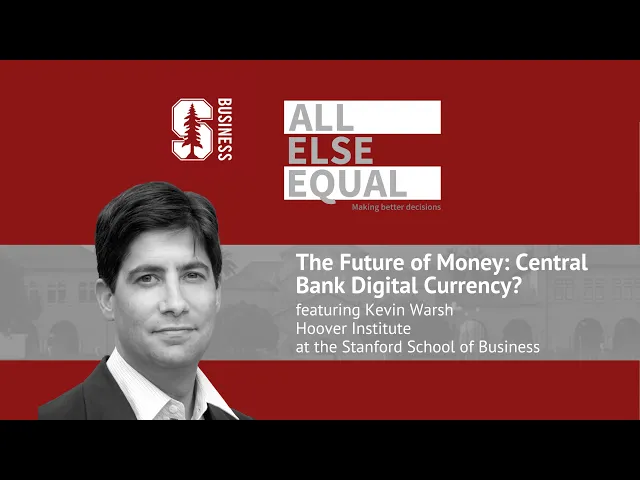
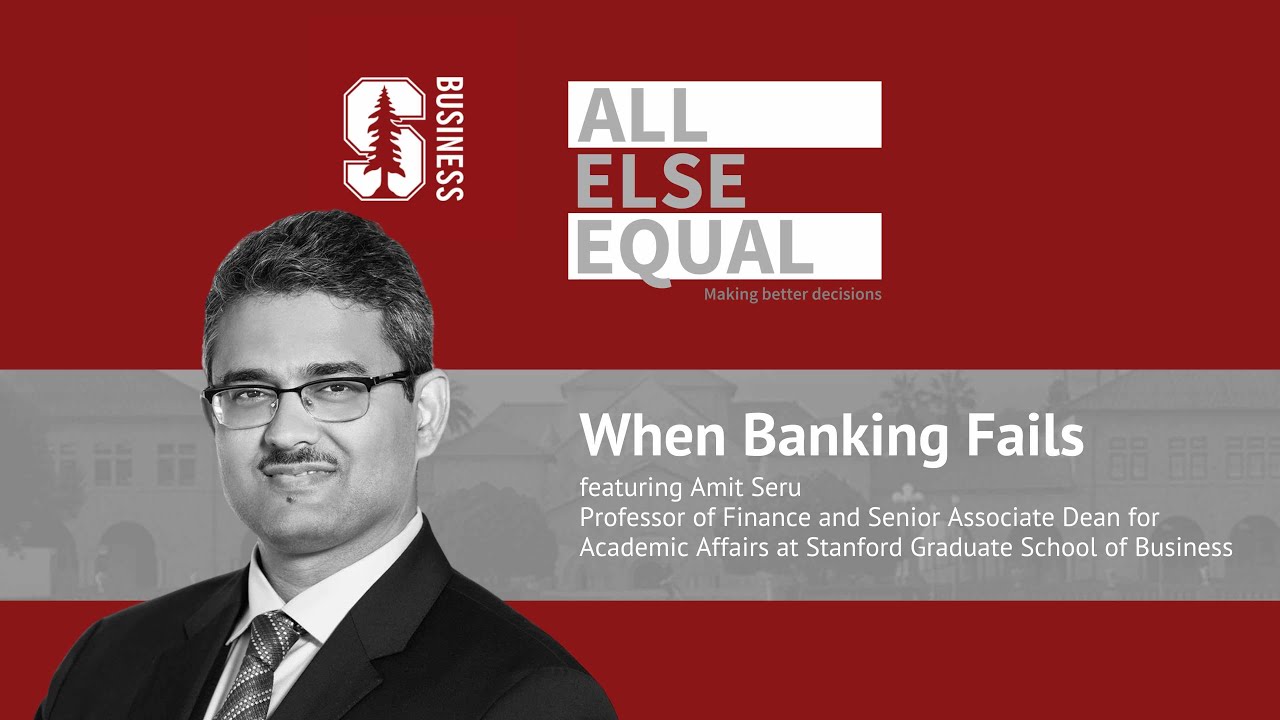
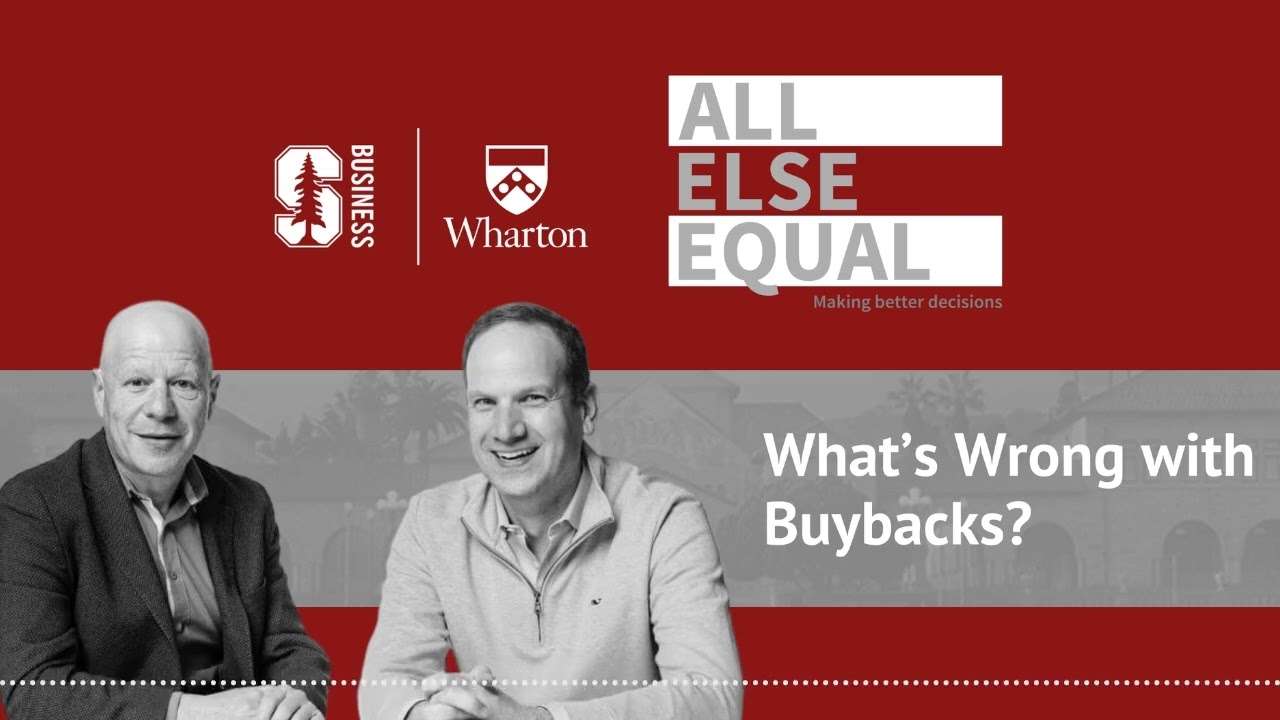
[Music] hi I'm Jules F binur and a finance professor at the warden School of the University of Pennsylvania and I'm Jonathan Burke a finance professor at The Graduate School of Business at Stanford University and this is the all else equal podcast welcome back everybody today we're going to do something a little different neither Jules nor I are experts in digital currencies and both of us are confused by the news and the hype around Central Bank digital currencies so what we decided to do in this episode is ask a world expert one of my colleagues at
Stanford Kevin Marsh to come and talk about it and see if we can jointly learn something about Central Bank digital currencies before we turn to and let's just quickly go over what a currency is well so the first question related to that is why can a piece of paper that has no intrinsic value have any use or any value in transactions why Jonathan are you letting me pay you with a piece of paper that has no intrinsic value and I think that the answer is not too difficult suppose that I wanted to buy your house
and I was going to pay you with an amount of gold of the equivalent value now given the fact that I don't want to be carrying this gold around I just have the gold stored at the bank and the bank has given me a piece of paper that says the owner of this piece of paper can anytime come and claim this amount of gold now given the fact that you have no intention of carrying the gold around either and you just want to have possession of the gold all I have to do is give you
the piece of paper that says that you can go and claim the gold and so we can pay each other with an intrinsically worthless piece of paper as long long as that piece of paper represents a claim to something else the gold that is stored in the bank and I can buy your house with that piece of paper from you so Jules that's a good example and and it works for the gold standard but we're no longer on the gold standard so how does it work in modern economies well so as it turns out what
gives a piece of paper value and the dollar in particular is that through taxes the US government has a claim on all of the production that we jointly make because all of us need to pay a fraction of what we produce as taxes to the government and because you're allowed to pay your taxes with these pieces of paper and because the taxes are a claim on underlying goods and because the piece of paper allows you to pay the taxes which in terms our claim on the underlying Goods we still have something real that backs the
dollar and that is the fact that you can pay your taxes with it and so what backing the dollar is essentially the production of the United States but part of that is a promise by the government not to issue more dollars and change the ratio of how many dollars there are to consumption and so I would say that one of the reasons the dollar is a reserve currency if people have a lot of trust that the government of the United States won't inflate the money supply and devalue the currency indeed I think that the main
thing that we'll have to talk today about also with Kevin is the value of this trust where this trust comes from and whether or not that trust currently is under threat because what we're hearing all the time now today is and that is the topic of today's episode is that we somehow need to go digital and that for some reason digital dollars are different than real dollars I don't really understand it because the US dollar is essentially already a digital currency very little of US dollars is in back notes almost all US dollars are in
electronic form so in what sense would the dollar need to be digital it's already digital no that is true because indeed a very small fraction is only currently held in cash but I think that what people generally talk about is that for some reason we need to record these transactions differently and so the whole revolution of blockchain implies that the way that we do transactions with each other with dollars would be somehow recorded different differently than in the centralized system that we've had so far so how does this centralized system work suppose that I pay
you Jonathan $60 then both of our banks have a list with transactions on it and my bank adds a transaction that says that I have $60 less and your bank has a list of transactions that says that you have $60 more but other than those two Banks there is no record of this financial transaction taking place between the two of us and so the idea of block blockchain which is a decentralized ledger is that there are all these different copies out there of this list so that it can be verified through say consensus mechanism that
this transaction between the two of us has taken place and so when we're talking about a digital currency I think on the blockchain I think this is what people have in mind yes I think you're right Jules I think what they have in mind is a blockchain so it's not just that the currency is digital but that it's controlled by a blockchain and here again I'm like you I don't really understand why we have a need for that because you know I would say part of the reason United States is such a successful country is
because we have trust we have ledgers that we trust and these organizations have been built up over time and I don't see any reason why we need to doubt that system of trust no I completely agree so so when I ask my students how many of you have looked at their checking account recently and have doubted what the amount was that was reported there and does it bother you at all that your bank is the one who keeps track of this and do you really wish that there were hundreds of different copies out there so
that it could be verified through a consensus mechanism whether or not your amount on your account is correct yes or no and I don't think any of my students particularly in the US as you mentioned ever ever say that that is an issue for them although I think we can certainly think of other countries where that might be a concern where record keeping of property rights might have a bigger application than it has in the United States but that said Jonathan I do think you would agree that the United States payment system is quite Antiquated
right that is true that is definitely true and I don't necessarily why this is a solution to that problem but it is true that it takes an enormously long time for me to pay you and internationally it's it's a nightmare all right so with all of these questions because I don't think we've answered anything really Jonathan all we've done here is asked questions but I think that a person who can help us answer these questions would be Kevin wassh so let me introduce Our Guest Kevin wassh is a member of the Board of Governors of
the Federal Reserve from 2006 to 2011 he was also on the short list for Fed chair when ultimately Jerome pal was appointed he's a colleague of Mine He's The Shepherd family distinguished visiting fellow in economics at Stanford's Hoover institution and a lecturer at The Graduate School of Business Kevin Welcome to our show well it's great to be Jonathan with you and Jules so Kevin naely looking at this most dollars are already digital so why bother with a new digital currency uh this is a fertile subject certainly made more fertile by the by the ongoing geopolitical
fights between and among adversaries and allies around the world yes it's true stipulate to your fact Jonathan that commercial bank money is largely digital and Commercial Bank money rather central bank money is dominant but I think that that's really only the tip of the iceberg my suggestion is that there be a central bank digital currency but it'd be quite different from that which is much discussed among government authorities is that is it's confined to the wholesale Market there ought not be a retail facing consumer facing Central Bank digital currency for recent both of politics and
economics but in answer your question I think of the new technology as nothing but amazing new software that every 70-year-old computer scientist that shows up at Stanford will only be working with will be the dominant use and that new software lets us do things at the wholesale level which are faster cheaper better smarter and will give the countries that adopt it a comparative advantage and finally if you have the benefit of having the world's Reserve currency as your as your Tailwind you needn't be at the bleeding edge but you also not you shouldn't be the
last mover and I take more seriously than some in our profession that the US needs to constantly ensure that the dollar as the world's Reserve currency remain so for the next 100 years and I don't want to fall too far away from the efficient Frontier so Kevin it seems that and I think you've also written about this extensively in various places also in the Wall Street Journal that one thing that you're particularly worried about is that the dollar would lose its Reserve currency and particularly that it would lose it to the Chinese R&B and given
the fact that China has decided to already introduce a central bank digital currency that could be a worry that we should all be worried about now you said that there is a competitive battle going on you said it's it's very Advanced software but what do you think it would take for the us to lose its Reserve currency status and do you really think that just not having a central bank digital currency on its own is enough for the us to lose it or would other circumstances be required as well it would probably be other circumstances
too but I worry that the dollar is losing just below the surface some of its credibility some of its strength and that has little to do with the new software that has everything to do with does the world look at the us as the bright shining City upon the hill that knows how to grow its economy that knows how to ensure productivity and I think the world does look at us differently less en than they did the day before the OA crisis the day before the pandemic even during the post-pandemic slog we've been through to
this point and so the most important thing for the dollar is to have good economic policies in place and I think there's huge reforms that could be undertaken second most important thing is to treat our allies well try to encourage them to be part of this sphere of influence dominated by the US that has made the world I apologize for this oldfashioned view a source of peace and prosperity for the globe so that the dollar is a global public good but on the margin these other things do matter and I do think that going to
market with the dollar with a payment system and a set of backbone technologies that are stuck in the 1970s that are unreliable that are slow that are expensive that that have allowed oligopolists to benefit without letting those benefits ACR to the broad users of the system that's an unnecessary asset to be stuck with and so when I see this new technology this blockchain technology being employed by both adversaries and allies in various forms it says this is an easy way to put some points on the on the board and to lead the global economy at
least on this over the next for the 21st century and just as a final Point whether we like it or not Jules and Jonathan the world is breaking into what appears to be at least two spheres of influence yes glibly I'd call them ours and theirs and in theirs China wants to have their own payment system wants to have their own currency for those that want to do business in their sphere of influence and I think they would have preferred people join their sphere of influence out of choice but if they won't join that sphere
of influence out of choice maybe they'll do it out of compulsion if you want to Source Goods in that sphere if you want to sell products to consumers in that sphere they might well say then you need to separate yourself from the dollar and do it in this digital R&B and I view that as a catalyst hopefully for our policy makers to at least move from 197 70s technology and Leap Frog to a new technology so that doing business in the dollar is true not just in our sphere of influence when you're working directly with
the us but continues to be the dominant currency for the world I think that acrs advantages to the US but I also think it acrs advantages to everyone that would be participants in the dollar block around the world I'm not sure I agree with all your arguments I'm not sure it has to do with the digital curency I agree our payment system is a 1970s payment system but why do we need blockchain why can't we just bring the payment system into the 21st century we could and if you asked our colleagues that are working at
the Federal Reserve and the treasury they would say they are making incremental progress in and around things like fed now making settlement faster making the messaging system more apparent so you can track your trans actions Etc a policy of incrementalism is better than the status quo but I think if you believe what I do which is the US and global economy are going to look radically different 10 and 20 years from now the world we grew up with which is one of integrated Global markets integrated trade and capital flows we might have seen at least
for quite a while the high point of that if there were ever a chance to move Beyond incrementalism so that we could have payments settlements programmable money and their new way of doing business and Leap Frog it strikes me this is the moment but in some sense if the other side is going to be using compulsion to try to do business in a particular currency and make it a reserve currency the question is whether these soft measures are going to be enough to stop that in any case wouldn't you say so I don't think we'll
be able to stop what they demand of customers in their block who want to do business with their customers yep but I think what we can do and here I'm going to paraphrase General McMaster which I'll apply it to the monetary context something he applies in the political and Military context but we're saying to people that have a choice of regimes you can choose your own sovereignty versus subservience We Believe believe that if you participate in this new payment system and you continue to use the dollar in your transactions whether the US is directly involved
or not you can build on this system whatever apis whatever programmable money whatever bells and whistles you want and you can have control over your own payments and I think that choice of freedom is a superior choice to these are the rules that you must go down and again that's why I would rather not make the choice between a modern effective compulsery system which might be the future of the digital R&B versus you choose that or you choose a unreliable lazy stubborn expensive system which has been the dollar block going on 40 or 50 years
I want the competition to be a better competition so Kevin I'm going to push back a little bit and let me say this my view is that one of the reasons the dollar is a world Reserve currency is trust that the United States has an incredibly high level of trust and that's built up over a very long time given this current systems and that I don't worry about CH the R&B ever being a reserve currency precisely because that trust doesn't exist so why would you want to replace that with a system we're not certain about
the trust I mean all the institutions in the United States have been built up to ensure their trust how do we know under the new system we would have their trust so if you trying to pick a fight on trust you're not going to find me choosing the other side of that so I like you believe that the American dollar denominated postwar system is predicated on trust I worry that some of that trust in institutions has eroded generally and has eroded in the US particularly so so I don't seek to replace a system based on
trust with something that is fashionable untrustworthy but cool I want to replace that with a system which is more trustworthy I want to build that transaction so it is more trustworthy so it is fully auditable not so that it's in the underground so that it's above ground so that transaction happens seamlessly if there's a bad actor the audit Trail is there for all of us to see so in my view the new system is enhancing of trust and reliability and if the question is well no one has really built out yet an effective scalable digital
currency that is used by everyone or that's absolutely true but that's not a reason to stick with the old technology agreed but I do think there's a deeper question here and the deeper question is this the main advantage in my opinion of blockchain is that it is a decentralized ledger instead of a centralized Ledger and so the question is why do we need many copies of a decentralized piece of information rather than a centralized version of that piece of information and I do think that the basic idea that people would have for that is that
it's harder to commit fraud with a decentralized ledger than with a centralized Ledger if that isn't the main benefit then I would like to know what would be the main benefit and then we get back to what Jonathan point pointed out earlier which was if we just want to bring competition in line with an old-fashioned system up to speed with technology is the the centralized feature really the feature that we should be going after or is it more something about how quickly transactions can be cleared and things like that which of course can be done
in many different ways so I do think that the FDX fraud does make it clear that this system is just as much subject to fraud as any other system and then what was the purpose of doing it this way to begin with then isn't that fair yeah Jules it is fair so let's go into the three levels of that question as I distilled it one is is the FTX fraud about fraud in build out of a decentralized network or was the fraud done all centrally I don't know the forensic accounting to that y but I'd
be very surprised given what I read in the newspaper I have no privileged information that any of this was actually done on the blockchain that any of this is in a perfect auditable Trail when this investigation from the SEC and the justice department others are done I think they're going to see the equivalent of wires written from one account to another and it it will it will have very little to do with the blockchain but that's my speculation that's my judgment I don't think these guys had enough built out it looks uh to suggest that
this was done on some auditable chain if so the prosecutors will have the easiest job to do in the history white collar crime yep so that's a factual question and I'm I'm just asserting a premise based on what I've read secondly on the payment system I mean this is the old joke but it's true it is now faster easier and more reliable for a Brazilian to put a million dollars in cash in a suitcase board a plane from Rio come to the United States go through all the Customs forms and deposited at Bank of New
York melon then it would have been to that transaction through the existing payment system it would have taken days longer would have been more expensive to do it so we're actually still bringing these atoms across borders yeah there's huge benefits the third question I think is a good and important both philosophical and structural question about centralized versus decentralized so here's what I'm proposing in what I describe as a wholesale only Central Bank digital currency it's decentralized in the sense that we're using the blockchain as the base Foundation to conduct this business the trail is auditable
the money can only be sent once and only once any changes the block would have to be seen inside of the block it could happen instantaneously and if some Court had a warrant that it was being done for bad aims you'd be able to see that distributed Ledger perfectly what's the piece of this that in my intellectual model is centralized the fed and the treasury say this is the profer framework these are the rails will'll be using and we will all be using these same rails if you want this to be backed by the full
faith and credit of the US and the dollars Reserve currency you can't build your own thepoke system we don't want there to be dozens and hundreds of these working in parallel I was plenty worried about that direction so Kevin one of the things you've written about is that you favor stable coins and you favor regulation of stable but I wouldn't say Bank regulation is one of our prize and joys I I would say that if anything we're pretty bad at regulating backs so why would you want us to regulate yet another Financial instrument I disagree
with the words you just purported to put in my mouth I am incredibly uncomfortable with the idea which has been gaining Traction in Washington that stable coins are fine so long as they're we regulate them like a bank I think this is a dangerous and bad idea I want to be very clear on that so I think broadly the idea of taking the stable coins that are out and about subjecting them to bank regul is a bad idea why because Bank regulation is imperfect and two when you're regulating something that purports to be the US
dollar and it fails in my view the political economy makes it such that you almost assuredly have to bail it out because you don't want the dollar to be falling in its Prestige and its privilege you don't want there to be people that say I wonder if that dollar is really worth it after all so I am uncomfortable with the idea of a regulatory framework as the Panacea for stable coins and in that at least in the prefx days my voice seemed to be in the minority large number of thoughtful legislators from both parties seemed
positively inclined to that idea and I will say it worried me and continues to worry me tremendously well thank you very much Kevin yeah it was great Kevin so Jonathan I think that was a pretty interesting conversation I learned a lot of new things there you know Jules I was pretty convinced by his argument that the government has a role in setting up the rails so if they set up a digital currency which is just rails and allow private Enterprise to do whatever they want with it that sounds like a pretty good thing for government
to do yeah I couldn't agree with you more Jonathan government providing infrastructure while giving the private sector all the room it wants to be entrepreneurial I think that's exactly what one would want thanks for listening to the all else equal podcast please leave us a review at Apple podcast we'd love to hear from our listeners and be sure to catch our Next Episode by subscribing or following our show wherever you listen to your podcast for more information and episodes visit all else equal podcast.com or follow us on LinkedIn the all else equal podcast is a
production of Stanford University's Graduate School of Business and is produced by University FM [Music]