This is a video about the most important yet most ignored concept in world power. It's the reason some nations fall behind while some get ahead. Why the world is so uneven in its spread of wealth and power.
Every year, more and more people are asking about American decline. Maybe out of fear, maybe out of hope. Yet what none of it talks about that on a planet so random, so different, so spread out.
The physical land under our feet is the ultimate constraint on what choices a country has. Why is China doing that? Why hasn't Africa caught up?
Why is that place on the map always having problems? This video is brought to you by farmland LP. Every feature of land can be positive, negative or neutral for the country that occupies it.
The big flat area stretching from Moscow to Warsaw is a negative for Russia. It's hard to defend Germany and Napoleon walked their armies right through here. The Himalayas on China's western border.
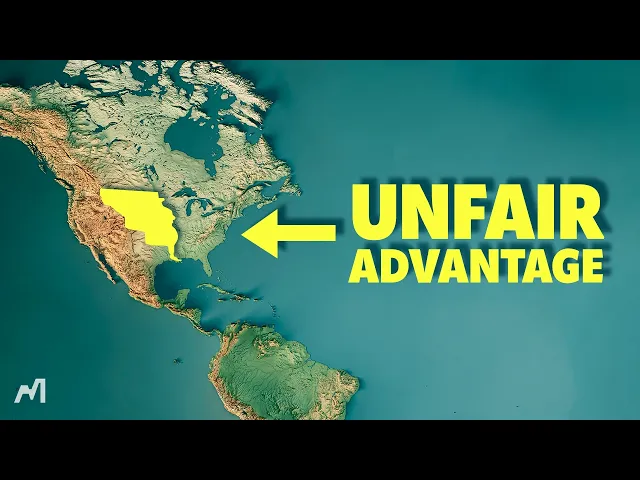
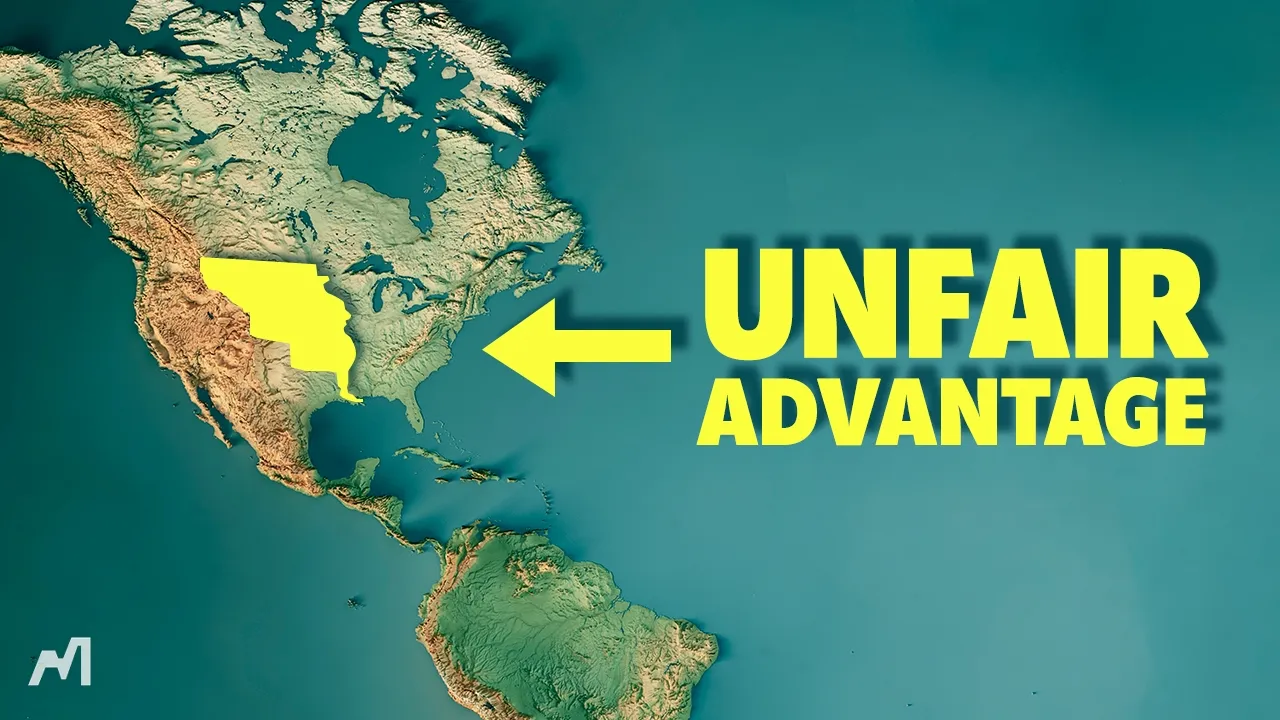
Shake out to be neutral, giving protection from countries on the other side, but denying China overland access to the Indian Ocean, severely limiting trade and military options on the other side of the coin. The Mississippi River basin has more navigable miles of river than the rest of the world put together, giving the U. S.
a major surplus of food and a cheap way to transport it. Look at all these kinds of features over every country, and the ordering of the world looks into place. So let's play a game.
The first known humans evolved out of Southeast Africa, slowly spreading out across the world as they settled into the sixth cradle of civilization. Societies. Olmec in Mexico.
Soup in Peru. Nile and Egypt. Mesopotamia.
Indus in India. Yellow River in China. You want what?
Everybody. Every country wants to be a peace. Growing prosperous for as long as possible.
One of these original sects did far better than the rest, with the outcome largely predetermined by the features of land around them. Knowing that, which would you choose to start as food is critical. A population can't grow without it.
You'll of course, want fresh water, something reliable and plentiful. People and your crops depend on it. A natural barrier would be welcome.
Something invading armies would struggle with. For those that said the Nile, tell them what they've won. Bob.
You won the park. Yes. The 138 pyramids built in early Egypt warrant an accident.
You need stability for that. And the Nile was the most stable society the world has ever known. For three predictable reasons.
One, it had the best river, most reliable, and not flooding to a degree that every so often it kills 10% of your people, making it easy to grow food. Two the flatness of the river made it easy to transport things from the upper down to the coast. And three the people floating down along the river and living by it barely had to think about an invading army, because the desert on either side was the world's best defense against the military's at the time.
No one wants to march across that much desert today, let alone 4000 years ago. Egypt. The last of the six societies to be standing made it 3300 years.
The invasion of Egypt, knocking off the last of them kicked off the great global Shuffle. As the world's population began to boom, going from 200 million in years, zero 500 million by 1500, getting big enough, the people are really starting to bump into one another, wanting that greener grass kingdoms, merging and splitting Europe is one big revolving conflict. China's kingdoms war Japan war.
Africa war by 1801 billion 1945 3 billion. And then suddenly the math changed. Are we really going to invade them?
What if. What if they have nukes? Borders started being redrawn much slower than the previous 2000 years.
Earth geography. Lottery. What it blessed and curse nations with became locked in.
Starting with the United States as governor of Earth's most enviable landmass, stretching one quarter of the way down the globe, glaciers from the last ice age carved deep canyons into the edge of the land. They blanketed deep canyons on coastline, or what create natural deepwater ports. One does not simply make a deepwater port all over Europe.
Natural ports all over North America. Natural ports giving Europe whose ports practically didn't freeze in the winter. By far the best ship design and navies of the time.
Ships and navies that could leave the ports of Europe, but then also easily land and keep landing in the natural deepwater ports of North America, New York, Boston, Philadelphia, Baltimore, quickly establishing highly productive settlements they used as a foothold to push west across North America. Ports. People.
The land along the East coast. Great. But that was not what cemented the United States into an inevitable superpower.
It was the Louisiana Purchase, a legal guarantee that no other European power would colonize or explore. This area of land was purchased for $340 million in today's money. But what would that piece of land be worth today?
I mean, it's a truly priceless section of United States. There is no scenario under which America would sell the middle of the country. But if you had to come up with a dollar value for it, it's worth at least $60 trillion.
And I personally think that's kind of low, but 60 trillion. That would be a 17 million, 640,000% increase on the purchase price. Thomas Jefferson taking the crown of probably the best investment anyone ever has made.
So try as hard as you can. And it would still be very, very hard to overstate the importance of the Mississippi Basin. It's the best farmland the world has ever seen.
It's all connected via a series of very flat, navigable rivers. As I said earlier, it has more navigable miles of river than the rest of the world put together. But then it empties out into the protected Gulf of Mexico, giving the U.
S. an outlet into the ocean from the middle of the country. France knew full well what they were selling.
They knew the land was so good they sold it to the U. S. to screw over England.
They sell Astros forever. The power of the United States, and they have given England a rival who sooner or later will humble her pride. France being at war with Britain.
The money was part of it, but the sale did in fact guarantee that in a couple of short centuries, the U. S. would surpass Britain by a lot.
Building on the strong footing in the East, the US used it to push out Spain and connect the Pacific Ocean to the Atlantic Ocean, forming the greatest military defense still today that exists 3000 miles between the constantly warring Europeans and 4500 miles from Asia. This great blue buffer is the main reason the U. S.
is the only highly developed country that hasn't had to rebuild over the last 150 years. Great. The US has all this cool land, but.
And here's where it all comes together relative to what the Power games nations played. The great game is some call it is largely based on what the land under each country allows them to do relative to other countries. So here are four very specific examples of how major countries lack the geographic power of the United States.
China has access to just one ocean, the Pacific, and that access is gated by the Philippines, Japan and Taiwan and the rest of the countries that border the South China Sea, all mostly unfriendly to China, which historically has left the country in a bad spot in times of conflict. All of its trade passes within an easy plains distance of an unfriendly country, and 80% of its oil goes through the Malacca Strait, a very narrow chokepoint. So for the past two decades and tens of billions of dollars, China has been working very hard to secure overland access to a second ocean, the Indian Ocean, trying to connect the Karakoram Highway to a deepwater port in southern Pakistan, and rail and pipeline over the West Mountains off the coast of Myanmar.
These are the only two ways China may ever be able to drive a truck from within its borders and load the cargo it carries onto a ship, making China's military precision offensive and defensive relatively poor compared to the expansive ocean access provided by the Atlantic, Gulf and Pacific coasts of the US four times the size of Europe, the second largest continental population after Asia. Africa's promise has been so high for so long that the struggle of the continent to field a country able to work up through the global rankings seems to defy logic. Huge natural resource wealth.
But the rivers, the coast, it is all working against the continent. Nobody has ever run the Congo River from top to bottom. 1600 miles from the headwaters, it reaches the Atlantic Ocean here.
Right here is where everyone who's tried has quit. Ten miles long at the four and a half miles wide and littered with 20ft standing waves, building sized rocks and whirlpools that look like they're out of a cartoon. 90 miles from where the river meets the ocean, rapids marks the end of the Congo River in its usefulness to Congo's place in the world.
H. M. Stanley of Doctor Livingston, I presume, after trying to run the whole thing but quitting at Anger Rapids, called it an immense tragedy, depriving the entire interior of Central Africa, two thirds the size of mainland US, from the thing that all great powers need to become and stay great, a reliable flow of water that lets boats go from the interior of the country to the ocean.
If you were to cut away all the ground so you could see the Congo River from the side, how it drops from its headwaters to where it reaches the ocean, this massive step is reveal. This is the Mississippi, for comparison, a boat friendly Paradise. But even if the Congo was as flat as the Mississippi, it would run into one of the worst stretches of land on the entire planet.
For natural deep water harbors untouched by glaciers. The coast of Africa is remarkably smooth, a few jagged indentations too smooth. You see how the Chesapeake Bay is all jagged like this.
It is perfect for trade, but these don't really exist on the coast of Africa. The continent get. This has 20% of all the land on the planet.
But because the coast is so smooth, very few indentations, it has less than 5% of the world's coastline. Europe has 7% of the land, 16% of the coastline. But to make things more difficult, the smoothness doesn't do much to slow or break up the energy of the open ocean like a jagged coast does.
It slams into the continent, creating one of the most powerful ocean currents in the world, very close to shore currents that sweep up the sediment West Africa's two rivers bring to the ocean and spread it out into any indentation where it can fit, like the few natural harbors Africa does have, which makes the task of keeping African ports open deep enough for large ships free from sandbars and shoals that are constantly forming, drifting, reforming, dredging. It always is a sifi and task that was impossible to do before sophisticated machinery. Africa never stood a chance to be one of the premier continents for trade.
Once the oceans became the way goods are moved around the world, Russia sits in the middle of two crushing geographic puzzles. The first is what we're seeing in Ukraine. This area of land is so flat that it keeps Russia's generals up at night.
Not once, but twice. Over the last 200 years, a European army has marched right up to Moscow. Napoleon captured it.
But even if Russia did control that whole run to land, it still lacks the thing any true superpower must have multiple deep, warm water ports that are attached to its mainland. To get to the Atlantic, Russia either has to use its one port in the north of the country, go through the choke point of the Baltic and through the Danish Straits, or down through Turkey, through the Mediterranean and out into the Atlantic. This is why Russia loves, absolutely loves the idea of the polar ice caps melting a little bit further.
If the north coast of Russia can stay warm enough for year round, its north coast becomes a bastion of deep water ports the length of its north coastline, which is very long. Russia's meddling in the Middle East is in part to gain permanent access to a warm water port. They had their eye on the same port in Pakistan that China is currently trying to link to.
When they invaded Afghanistan in the 1970s, very cozy with Syria on the western shore of the Mediterranean. Now, maybe Putin loves the Syrians, but more likely because the Assad regime had been for decades granting Russia complete and total access to their one major port, a wonderfully strategic spot right above the Suez Canal. Russia's ships are allowed to come and go as they please.
And yes, England. The textbook case of how technology can change everything. One of the reasons it was a world superpower for so long was because it's an island, 360 degree access to the ocean.
It had a natural gap between constantly warring Europe and easy access to the flow of world trade. But this this was the day Britain's fate was sealed. And here's the giant an armada Hitler hurls in England.
Plane's flight changed the math from hours to slowly creep across the English Channel and bay by boat to 30 minutes for hundreds of bombers to be over downtown London. That made Britain susceptible once again to be invaded by. I'll only say one more time, constantly war in Europe.
From that point forward, the security of the US, surrounded by its two oceans, made keeping money in US dollars instead of the British pound obviously a safer bet. The reserve currency switched, causing money to flow out of Britain and into the US. There were other things leading up to Britain's fall, but the arrival of the Air Force was the decisive nail in the coffin.
Napoleon was right. On a scale of 1 to 10, only one country today ranks at ten. For the three most important questions.
Can you feed your people? Can you be invaded? Can you trade?
Everything else builds on that politics, the economy, culture. It all has to must sprout from the land upon which it sets. That does not mean it's the only or single determining factor.
Not at all. But it is the point to start from. So when we ask, Is America in decline?
The first mention of American decline that I could find was back in 1930. Yet here we are, almost 100 years later, because the idea that the US is going to spontaneously collapse ignores the thing that's guided human civilization since the beginning of time, until something about the land underneath the nation changes, that country's position of power in the world is unlikely to change. Organic food keeps growing, but less than 1% of U.
S. farmland is certified organic. That's where farmland LP, the sponsor of today's episode, comes in.
Since 2009, they've been buying conventional farmland in California in the Pacific Northwest and transforming it with organic and regenerative farming practices. Crop rotations cover crops, restoring habitat farming the way it should be. So after the successful launch of two prior funds, they're now raising capital for their third, giving accredited investors the chance to add farmland, a real asset that produces food, restores ecosystems and builds long term value to their portfolio.
Check out the link in the description to learn more.