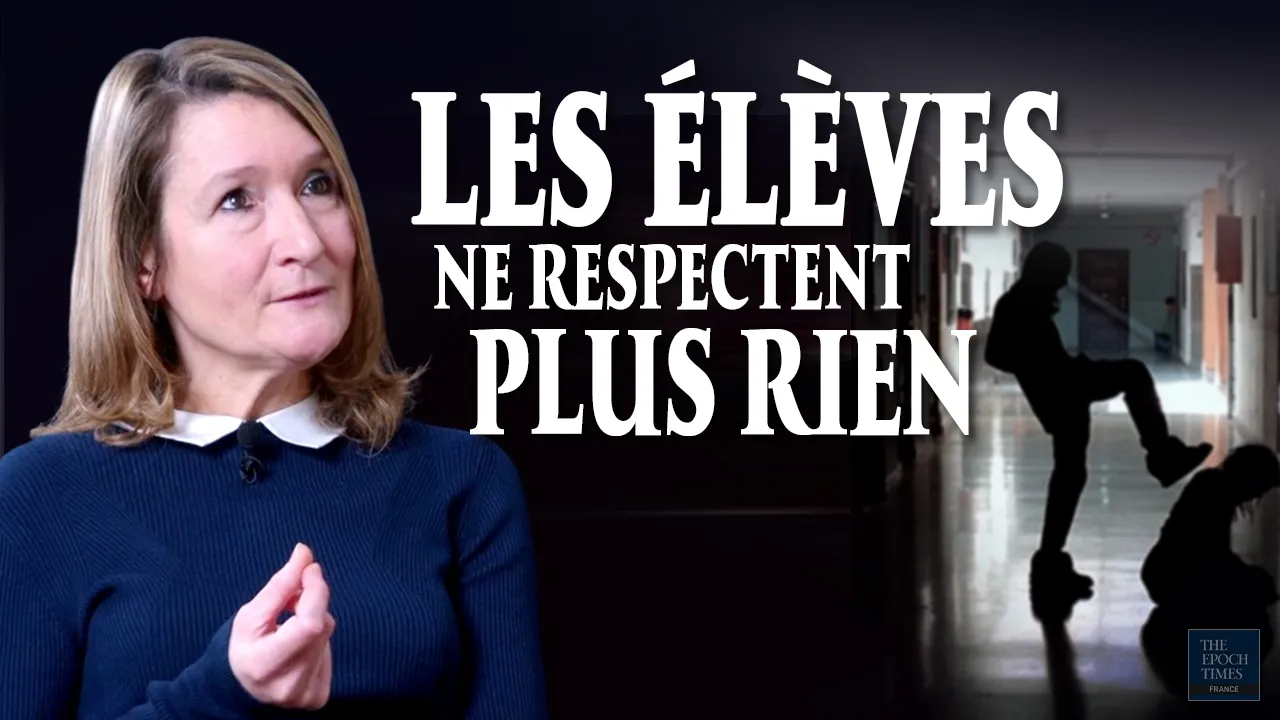
We have questioned the authority of the teacher so much in recent years and the place of the school that we are now paying the price. We have the fruit of years of laxity, and then of benevolence. It's good to be kind, you have to be kind, but by dint of having been kind and having said it doesn't matter, we're not going to take your mistakes into account, today we're coming to at a dismal level. This generation which constantly tells you: “It’s not done, it’s not said”, which lacks culture, which lacks vocabulary, what are we going
to aim for? Towards a totalitarian society? Young people who... who no longer respect anything or anyone? Arrogance plus lack of knowledge is... It's explosive like... like a mixture. What will this produce next? Hello, Véronique Bouzou Hello. Thank you for granting us this interview. Thank you for inviting me. You have a degree in Modern Literature and a French teacher in a public college in the Paris region. You are also the author of several books devoted to school. A few weeks ago, you published “A world without a teacher”. A fiction in which you describe the main problems
that undermine the French school system as well as the difficulties that teachers regularly face. You also begin your book by mentioning the express recruitment sessions carried out by several academies in the face of the shortage of teachers in recent years, recruitment operations called "job dating", during which candidates generally have a few tens of minutes barely enough to convince recruiters. You also mention announcements made by National Education on the Leboncoin website to urgently recruit teachers. Do the teachers recruited through these operations have the sufficient level to teach? Are the National Education selection criteria up to the
challenges? So, before answering this question Precisely on the shortage of teachers, I would like to react to the... on the fact that the Minister of National Education has just left his post. So it's really a... in my opinion, a bad image that we're going to give to teachers and a bad signal. How do you expect us to convince teachers to stay in their position? I think of those who are... who are on the verge of resigning because they can't take it anymore. And how can we make young aspiring teachers want to take up the teaching
profession when we have the minister himself leaving office? So, in spite of saying that he is going to take the school's cause with him to Matignon, it is still a full-time cause that we must... that we must... that we must not neglect. And by way of comparison, it would be a bit like if in time of war, we had the chief of staff who actually left... who abandoned his troops while we were in the middle... in the middle of combat. So, I wonder. I have the impression that the teaching staff is being taken hostage by...
by political ambitions. But behind… Behind Attal, we have Macron and I have the impression that Macron stripped National Education to better dress Attal in fact. And so to return to your question, to answer, in fact, more and more teachers today, in fact, are thinking of leaving National Education and therefore we have a strong shortage. This is what I wanted to show in my book. I listed all the reasons why teachers were leaving, jumping ship, and because of that, more and more teachers are recruited not through serious competitions, but in relation to... to organizations , finally
somewhat arbitrary organizations. So Leboncoin and “job dating”. So these are teachers who don't always have the level, who answer quick questions and who are hired in a hurry. So some still have , let’s say, experience in different fields. But the profession of teacher, as its name indicates, is learned and you must already have solid disciplinary skills and then a mastery of pedagogy to be able to pretend to teach in front of a class. And so it’s… it’s Disastrous. Finally, here I can... Obviously, we saw examples on Leboncoin, I even heard a teacher who came, who
was recruited in a few minutes, he arrived in the teachers' room totally lost. And so these are young contract workers who leave the ship very quickly. And this deplorable level of these teachers also contributes to the decline in the general level of the school. Do teachers who are recruited through these express recruitment sessions benefit from training or upgrading before starting their course? That's what we promise them. We promise them... We promise them that we will support them, that they will have tutors on site, that we will be able to help them, that the training will
come on time. But often, you know, when the school year begins, we are caught up in a rush. All teachers must work and as we are, once again, short of staff, well the teacher who... who is recruited in an emergency must fend for himself. So he can... he can try to rely on experienced teachers Who will help him, but often he is left to his own devices and so there are teachers who really show a lot of good will, who work during the holidays , that is to say if they are recruited in June, they
will spend the months of July and August working , even reviewing the... the... Finally reviewing lessons, if they have to teach French they will review the grammar, they will review the conjugation to be on level. So, it’s really on a case-by-case basis. We will say that the teacher who is recruited urgently and who is conscientious will try to do the best. He will be full of good will. But there, it's a bit haphazard, and if he has a difficult audience, he will lose his means because you really have to be solid to practice this profession
today. And that's why we have a lot of resignations. So, some come from the private sector. You have teachers who are recruited by Leboncoin or via “speed dating” who have skills, who have sometimes been executives in the private sector, who have exercised a profession which required... which required A lot of know-how, but the profession of teacher is different and requires other… other skills. And so now, it also turns out that there are certain teachers who take the competitive examination for school teacher or literature teacher or mathematics teacher, who unfortunately also have slightly tangential levels. I
think of... There was the word, finally there had been... It had been in the media, it was members of the jury who had passed on the information, some of them, precisely, candidates for the professorship test. schools, did not know the word lucky or shaky. There was a confusion, I think, between lucky and shaky. There they were, they had confused the word, they thought that shaky meant lucky, to be lucky. So it is certain that when you do not master the vocabulary, how do you then want to teach it to the students? The level of mathematics
could also be deplorable. Some candidates who were recruited had no more than a four in mathematics. So it is not, Unfortunately, only teachers recruited through “speed dating” or via Leboncoin, some of whom do not have the required level. There is such a shortage of candidates today that we are looking for teachers almost everywhere. And sometimes, it is even the parents of students themselves or mayors, village mayors who... who take the step of looking for teachers because we are so short of them. So yes, the situation is becoming quite delicate. And what is your view on
Gabriel Attal's assessment during these five and a half months spent at National Education? So, can we talk about the results in five months? This is a fairly short assessment. If you want, behind Gabriel Attal, there is… there there is a government, there is a President of the Republic, and how do you expect today that we can talk about results when, in the space of twenty months, we will have had four Ministers of Education? We had Jean-Michel Blanquer, we had Pap Ndiaye, we had Gabriel Attal, we are going to have a fourth. So, what do Pap
Ndiaye, Jean-Michel Blanquer and Gabriel Attal have in common ? When a President of the Republic is capable of appointing... Well, of course, it is the head of Matignon who appoints, but behind there is the President of the Republic, ministers of National Education as different as think about it at the spinal level ? Saying that school is a priority, certainly, but then why is it that we have so many different views? To come back to your question, there are some interesting avenues that have been launched. On the authority of the teacher, it's interesting, that the teacher
can somewhat decide whether to repeat a year, that I find to be rather... rather a good thing. Also ensure that the college certificate can really have an impact and not a cheap diploma. That too could be interesting. The same thing for level groups, why not? We see that heterogeneity, in any case too much heterogeneity in a classroom, poses a concern. But the problem is... Well-established level groups, for that we would need teachers because today we have classes of thirty. I have third grade classes Which number thirty today. So if we divide the class into three
groups, that would mean that three French teachers would be needed to be able to be in front of students with groups of different levels. We won't have the teachers. So it's a simple detail, to be able to set up level groups and provide quality courses, you need small groups. But if we don't have teachers, where will we look for teachers to form level groups? So we look for them from other teachers, from other disciplines, or even from supervisors who are not always competent to be able to transmit knowledge and skills to students of different levels.
Once again, I'm afraid this is an announcement effect. Like the “clash of knowledge”, we have the impression that it is a bit of an advertising slogan. I'm afraid of that. There are interesting avenues that have been launched, but if behind it there is nothing that is being done... So, the same, he brought the cause of the school to Matignon, but who will be responsible for putting in place precisely these measures ? And then we have The unions behind who will not always agree. Once again, I'm afraid that this will be a drop in the ocean
and that the announced revolution will only be... Pschitt once again. But hey, I'm waiting to see, you always have to be optimistic. But it is true that compared to the previous minister, there are ideas which were interesting, which were... which were brought forward, on respect for secularism, on the authority of the professor, all of that, we will to say that these are speeches that we wanted to hear. But... To what extent is it going... Well, is it going... Is it really going to be implemented? Once again, we have a problem of authority and we have
a problem of staffing. You also return at length to this collapse in educational levels. In one of the chapters of your book, a teacher actually deplores the shortcomings of her third grade students, in particular the fact that they do not master the basics of reading and writing. The latest PISA ranking which was published in December, this international survey which aims to assess the achievements of fifteen-year-old students in reading, Science and mathematics among OECD countries, points to a significant and unprecedented drop in results, particularly in reading comprehension and mathematics. France is just at the average level,
a little above the average of OECD countries. What is your view on the evolution of the academic level of French students these last years ? Is there anything to be alarmed about? Yes, there is cause for alarm, really. I even tell my students. They tell me: “It’s not like your time anymore. » They tell me: “ But it doesn't matter”, when they give me a text full of spelling errors, “but do you understand nevertheless, madam? », well they don't say nevertheless, moreover. You understand all the same, ma'am, it doesn't matter. And even in other disciplines,
I have colleagues in mathematics, in history and geography, today who tell the students that they are going to take away points, they are going to take away spelling points because the students are no longer doing at all pay attention to the language. So yes, it’s… I find it worrying. So, for what Reasons did I consider that the level... Finally, for what reasons is the level falling? For several reasons. Already, once again, we have lost hours of French from the lowest grades, that is to say that in the… We have to go back to primary school
normally so that the acquisition of reading, writing, mathematics is really on point, in primary classes students should be able to have at least one dictation per day, lessons in writing, reading, mathematics. However, today school teachers also have to do lots of diverse and varied projects. Artistic, cultural projects, which is good, it allows students to be introduced to art and literature, but when the basics are not acquired in primary school, at the end of primary school, then it's complicated. It's complicated because once again, we have fewer hours. And I spoke with teachers from schools who deplore
precisely... who deplore this. So we should also return to more manual writing , because there are... even... neurologists who have pointed out the problem Of digital technology, particularly tablets from primary school onwards. A student learns to read better when he does it on paper than on a screen. And brain activity also develops more when the student writes manually, this promotes learning, learning to write, to read. So today, National Education, to be modern, absolutely wants to develop tablets. All digital looks good, it looks modern. Except that digital technology can be learned later. I think we need
to go back to old recipes that have proven themselves . So there is already this problem of screens. There are a lot of students who spend a lot, a lot of time on screens, especially on... on short videos that don't last long. So they film themselves, and so it's permanent zapping. So there is also a problem of memorization. We cannot ignore the teacher and I see students who have difficulty concentrating for long periods of time. And one thing that I hadn't noticed in recent times... Well, even five years ago, the student when he is tired
now, He sits down, he puts his head on the table, he sleeps half. So is he sleeping because he spent hours on screens very late at night? It's possible too. So there is the problem of screens. There is also the problem of the place of knowledge, the student says to himself what's the point, it's not of much use. Lack of desire, lack of personal work at home. Everything that is not done at school today is not done at home . There are also parents who expect a lot from the teacher and who do not follow,
not all, but there are parents who do not follow their children at home, who let it happen, who... who wait, who believe that school we do everything. And so the student, once he arrives home, he puts his bag down, he doesn't do much. So there is also a problem of work… of working at home. We don’t repeat the math exercises, we don’t… we don’t read. When I ask students to read books, very… honestly, and there On a reading assessment, less than half of the students read the required book. So there is a problem… there is
a work problem, really. There is then a problem of knowledge, that is to say that there are students who do not master at all even the history of France, the history of their country. Normally, it is in third grade history and geography that we work on the Second World War. But normally Hitler, Nazism, students should not wait until third grade to have already heard about it. Except some yes. In fourth grade, when we approach the theme of dictatorship, who is Hitler? There is still this question that is being addressed. And then it's blurry, when... I
always write a quote of the day on the board with the name of the author and the date. Victor Hugo, 19th, 18th or 17th century, it's a little blurry in their heads. Voltaire, French Revolution, wow what date is that, everything is mixed up. And when we study authors, but he is dead, madam, what is the point of studying an author who is dead? So it's a little bit... The past no longer has any reason to exist for them. So I try to show them that yes, it is important, that French is linked to history. “But
we ’re not in history class, ma’am! » Because when I approach a text with them, of course, I also address the historical context. This is important, since it is intrinsically linked, an author with his century. And the students sometimes, some of them, lack curiosity and that is quite frustrating for the teacher. I tell the students: “You know, the problem is not that you don't know, it's that you don't want to learn. » So, the same thing, in terms of language, what despairs me is when in fourth and third grade, the students have not yet mastered
the differences, precisely, in verbal endings. É, er, was, everything is mixed up. The syntactic construction of the sentence is not there and therefore certain texts mean nothing. And so we have to go back, but that takes time. And so I hold on, I go back. And what is also needed is the systematization of the exercises. So I made them buy a little Grévisse exercise book and we systematize the exercises each time, we redo the exercises. But again, It takes time, and I have the impression that all the time that wasn't... that wasn't spent learning to
write in previous years, it's time that we have difficulty making up for later since they reach an adolescent age. And then in adolescence, there are other worries too. And then there is also the problem of discipline. When we waste time in class disciplining, we don't spend time teaching. And that is problematic. Finally, there is a set of things. And then there is the authority of the teacher which also affects the academic level, since the authority of the teacher which is lost means that we spend time shouting. Some teachers can't get the quiet in the classroom,
so how do you learn in the hubbub? Students who have difficulties, who have gaps, need calm; if they are constantly disturbed by classmates who spend their time chatting, they cannot work in peace. So the screens, the lack of personal work at home, the lack of desire and then the place of school today, It's a bit of aquoibonism. What's the point of working? Yes, well... Now we're going to go on Tik Tok, we're going to become little stars. Finally, there are students who spend more time… Well, some girls putting on makeup than revising their lessons. And
that’s true, it’s quite depressing. It's quite depressing for the future. Afterwards, there will always be very good students, and it is quite paradoxical because the parents of students are nevertheless worried about the level of their students. And when we arrive in third grade and have to choose the orientation, there is a click that takes place. I have parents who call me: “What do you recommend?” What do I have to do ? I took a private teacher to help my child in mathematics, in French. » There, they call for help, they feel helpless. So it's paradoxical.
You also have working parents who don't have much time to devote to education, or at least teaching. So it's a whole, it's also... We also constantly question authority... We have questioned The authority of the teacher so much in recent years and the place of the school that now we are paying the price. broken pots. We have the fruit of years of laxity, and then of benevolence. It's good to be kind, you have to be kind, but by dint of having been kind and having said it doesn't matter, we're not going to take your mistakes into
account, today we're coming to at a dismal level. So, there will always be very, very good students. I always have excellent students, who really have an extraordinary general knowledge, but often these students are students who also have at home... We give them food, spiritual, intellectual food . They have the books behind them, they will be able to chat at the table with their parents, they will have the chance to go to the museum, to visit France, to gain geographical knowledge. And conversely, you have students who, during all the school holidays, well, they stay among themselves,
in their neighborhood and they know nothing else, apart… apart… apart from screens. And then it will be more The influencer who will in fact instill knowledge in them, knowledge at a discount, than the teacher. And I try to be this figure of the teacher who keeps his head held high and who continues to make them study the great authors, so Victor Hugo, George Sand, the great authors of the 19th century in fourth, third... Me, I begins the third year with Montaigne, on autobiography and that goes by. Students understand when we have the right pedagogical bias
to transmit knowledge to them. But once again, I feel like a dinosaur. Because I also… I did hypokhâgne, khâgne. However, I also had very classical training and this training helped me. I had one version of Latin per week, I had dissertations and so I have a very… very strict vision of school in terms of knowledge. And I get the students to write a lot. There are dictations, there is grammar, even if I unfortunately lack time, I would need extra time to... to do what I really want to do. But there are teachers Who are younger
than me and who have not had the same... Unfortunately, who have not gone to the same schools and who are perhaps less... less rigorous than I can be. Do you also notice students questioning the knowledge transmitted by teachers? From the students? Yes. Let's say that you have students who, when you teach them vocabulary, will say to you: “But ma'am, what is this word? Nobody talks like that today. » So you are… You come from the Middle Ages, absolutely. So yes, there is always this doubt: “Ah, but we are… now we are in the 21st century,
what good is that going to be?” » But as far as I'm concerned, as I think that there is also a little bit of... admiration when you speak correctly, when you are able to establish your authority and dissect the texts, they see that it's... Somewhere you have authority at the disciplinary level, they end up trusting you. And then I am... I have been working in the same establishment for several years, So I have been able to develop a relationship of trust with the parents and the students, so things are going rather well. But it is
true that as soon as a professor has an authority problem with his students and wants to punish him, then the student questions it. The student will question a teacher more when he has had bad grades. “Yes, that’s not happening!” » I remember a student's mother who told me that there is no such thing as giving a student a zero during dictation. I replied: "But you know, there's no such thing as making so many spelling errors in third grade." We talked after that, and the question was resolved through discussion. The problem is that if the student
questions the grades... the grades he has, "It can't be done "... When you return a copy to a student who has, for example, a seven out of twenty in writing, what the student doesn't know is that when I return a seven out of twenty, sometimes it's worth four. But the student got seven out of twenty because I made a precise scale: I am able to respond to the subject, I am able to use varied vocabulary, I am able to write In correct spelling. In the scale, the student manages to have seven points when I have
allocated a lot of points to respect for the subject and I value the student. The student who was able to write thirty lines and who made an effort. So the student… And why do I put seven instead of four? No... Not that I want to be lax, I don't want to discourage good will. I know that the student, I will try to motivate him and tell him you see, you were able to do that so I will give you a grade which is not catastrophic and you will be able to catch up in grammar if
you learn your lessons. But some students who get a bad grade sometimes tear up their papers, and then I get very angry. Tell yourself that the grade is only at a given moment. What I'm going to look at is your progress, you're going to understand your mistakes, you're going to try to progress. But that is also the characteristic of youth to want everything and immediately. That is to say, they would like to get good grades without working and that is problematic. And then, in fact, you have The parents behind. This is why the student, sometimes,
feels all-powerful when you have certain parents who don't understand the grades. But once again, I'm not blaming parents. The idea is to discuss. I believe that there are parents who are also afraid of discussing with the teacher. Maybe they have a bad image of the school. He said to himself, perhaps I myself had had problems at school and I had teachers with whom we couldn't discuss. So when a parent calls me and asks me to explain a grade, I sometimes have to explain myself for a bad grade. I explain to the parents that what we
are going to look at is... It's the progression, that behind a grade there is... you have to look at the scale, the skills that I indicated on the copy and that the student will be able to catch up. And so after that it goes, it goes better. Parents actually need to understand, need to understand what is behind a note. So rather than questioning... Students do not question the knowledge that teachers give them, Once again, as much as their poor results. And what they want is to get the direction they want. “Madame, I want to go
on a general route. » But you realize, you have a bad grade in mathematics, you have a bad average in French, how do you plan to succeed? But yes, yes, I will get there, I promise you I will get there. And you have parents who promise you: “But yes, I assure you, once he gets started , it will work. » Except that we tell you that in the third quarter of third year, but yes, yes, he's going to get started, he's going to get started, he's going to succeed. It's a bit of magical thinking. And
I tell the students, stop dreaming about your life, live your dreams, but give yourself the means to achieve your dreams and therefore work. And that, there is a big work problem, I assure you that the Many students do not want to work. And then they have trouble concentrating. This is really a big concern. Work requires concentration. And yesterday, I was doing a grammar lesson which was... We took the words reported with the concordance of the tenses. And Some said: “Oh, it’s too hard, it’s too hard… It’s too hard, we’re not going to make it.” »
Yes, you will succeed because you will… you will make an effort. And hence the problem of vocabulary too. The “too much”, “it’s too hard”. " Gender. » “Like, it’s not done”, “it ’s not done to do that, like”. “The thing”, “you know ma’am, the thing. » The problem of vocabulary to express oneself too. You also say in your book that many students see reading as a chore, especially reading the classics, even though it is also a good way to enrich your vocabulary. To enrich the vocabulary, and then... Vocabulary is also... it's also really the key
when you have vocabulary, to be able to also solve problems of violence. Because today, students who have frustrations and others only have violence as... as... as dialogue. Verbal violence, and then sometimes physical violence towards the teacher and towards their classmates. Yes, there are students who do not master… Who have very, very few words in their bag. Simple words, they won't... they won't understand them. And so it is certain that when we approach 19th century texts, even short stories, we approach Maupassant, Maupassant is an author who is easy to read. Maupassant is easy to read. But
all 19th century authors have a lot of vocabulary and so it's problematic. The student will not make the effort to look it up in the dictionary, very little, but even today, they can look it up even on their cell phone since they have their cell phone with them at all times, but they will demoralize, they will stop reading and therefore they will not get to the end... after ten pages of reading, and that's complicated. And I force myself when the student speaks in class and expresses himself badly, to make him do it again. And I
invite parents, when their children express themselves poorly, to correct them. When the student says "Oh, that's so good", I invite the adults to ask the teenager to rephrase it. What do you mean by “too good”? Is it great, is it fantastic, Is it extraordinary? “Genre”, we remove the “genre”. “Suddenly” too. The “suddenly”. “As a result” which is repeated at the beginning, in the middle, at the end of the sentence: “So suddenly, ma’am, like, you see, that doesn’t happen suddenly. » Example sentence. But if the students express themselves like this, it means that they… Finally, there
is a bit of mimicry. Some adults express themselves in the same way, because the drop in level does not only concern students, unfortunately, it also concerns all adults. Because this reading problem does not only concern the younger generations. You have many adults today who tell you that they read less and less because of screens. They spend a lot of time on screens watching tons of information circulating, but very, very quickly. So everything has to go quickly today, and reading requires a long time, concentrating on a long time. And when I started the science fiction work,
I brought about thirty books to my desk. The students looked at the books and said to me: “Madam, have you read everything? » I told them, if you knew, I could have Brought you a wheelbarrow of books with me. And: “Can we touch the books? » And there, I aroused in them the desire to read. I made them want to read additional books which are not… which will not give rise to reading questions. And that too is... If the students at home, if the children have a lot of books around them, if they see their
parents reading, it will arouse in them, from a very young age, the desire to read. It's also a culture, it's also showing that the taste for a job well done, even when we work on poetry and I ask them to read the poems, when the student pronounces the verse incorrectly, I asks him to start again until it is read correctly, the e is pronounced, the silent is not read, or the... Really, it is important to be demanding, to correct the student when he is wrong, not to tell him all the time it's good when it's
bad, on the contrary to encourage him when he gives the right answer. In fact, really coming back to very demands... Demanding, demanding and benevolent at the same time. And often The student is grateful afterwards. When we wait... When we... When he is going to progress, when he gets a bad mark on the first essay and on the second he gains two points because he took our advice into account and saw that it paid off, then trust is established and it can work. But it works when we don't have thirty students in the class with students
who have very disparate levels. So, in fact, one of the teachers in your book also explains that many students for whom general education is not suitable would not fail to transform into motivated and brilliant students in a sector of activity that would make sense to them. their eyes and could in particular flourish in the professional sector. But ultimately, a certain number opt for a general or technological baccalaureate, sometimes under pressure from their parents or ultimately due to prejudice, on this professional path. Yes, that's disastrous. There are students who tell you that they absolutely want to
work in mechanics or become a hairdresser. And we see that, really, they are motivated. And Then there is sometimes parental pressure, no, no, you will continue. No, I don't see him going professional. In France, that's really a problem... a French problem, there is a big problem with the professional path. This is not the case for our German neighbors. This is really problematic, I thought it was going to change. No matter how much they tell us that things will change, that we will develop apprenticeships and career paths, this is not the case. And worse, last year
I had students who wanted to go on the… pro-commerce track and sometimes even, it's at the rectorate level that we are told that we are going to close positions. So that’s still enough… You’ll have to explain. We have... At the national level, we are told that we are going to open, that we are going to promote the professional path, and then at the departmental and regional level, we are closing positions, we are being told that we are going to close professional sectors . So the student... Are we closing, sorry, are we closing classes in these
vocational high schools? We close classes, and then the student who wants to Do business, we tell him ah no, no, no, it's no longer possible because you understand, there is no more... there is no more of space. On the other hand, if you want, there is still boilermaking. So boilermaking, because you see, we are in deficit, we need... we need technicians in this area. So it's problematic. And we're going to announce that to you around February, when we've already worked hard on the orientation. So that too is paradoxical. We ask the head teacher to work
very early on on the... on the professional path and then, at the last moment, we tell you well no, we have closed positions. And so with the student we will have to work again on what could interest you differently, what would interest you? So we are now also trying to open mini internships, so that the student can go and see different professions for three days. This also helps students to have a slightly broader perspective. And there, it's really... There, it's a long-term work with the parents, a lot, a lot, a lot of discussions. Some parents
understand. And What I also show the students are the salary scales. When they surrender realize that when you become a firefighter, sorry plumber, a self-employed plumber, you earn better than a teacher. Ah yes, their eyes are starting to shine a little, their gaze sparkles. They realize that the professional path is not a sidetrack and that... Because behind certain parents, well behind... For certain parents if you like, there is also this idea of respect. They feel that they are being disrespected and that their child is being neglected if their child is denied the Grail of the
general path. Perhaps there is also a form for some to say to themselves, I come from a modest background, it is out of the question that I cannot , like certain sons of the bourgeoisie, give my child the chance to 'go on the general route. For them, it's really... There's also that, I think. There is a form of devaluation that perhaps goes back a long way. And so if we explain to them that it's not that, that today with a good... We can do a CAP, a CAP then a professional baccalaureate, so in four years,
they have solid training , and then precisely, they have been re-motivated, they are moving on to BTS and they will succeed, we can succeed in other ways. Because what I explain to parents is that the student who does not have the level, who goes on the general track, we will ask him to write, he will then fail, he will find himself then wandering around college and then being demoralized. Success is multiple. But I assure you that there, sometimes, we feel alone. And there, really, we feel demoralized once again when it is at the level of
the rectorate or elsewhere that we close professional positions. There we say to ourselves it's not possible, all the work carried out... For nothing. You also raise in your book the question of ideological interference at school. You also insist on the fact that “the transmission of skills and knowledge cannot in any way depend on any ideology”. What are the main ideological interferences that manifest themselves at school and are there subjects that are more affected? Well interference, there is wokism, of Course. That's... The part of wokism when... Even, you receive from certain unions, emails still with inclusive
writing, which is really an aberration... A most total aberration, where you have to fill in boy , girl or others. So Wokism, yes, entered… entered the school. So for me, honestly, in the establishments where I have worked, there is not much of this problem. That is to say, if I asked, if we asked the students, the boys to come dressed in skirts, there would not be... there would not really be support from the parents. If you want, it's... we... it's not at all the... Today, there are teachers... That's what's reassuring all the same, we're faced
with such difficulties that... I also want to reassure parents, teachers do not have the time to... to... how to put it, to be caught up in this ideology. I assure you that once they have... That they try to establish their authority in the class, to respond to problems of violence, to teach the students, to respond to the grievances of the parents of the students, to return the textbooks, to correct their copies... Ideologies Try to enter today through the door or through the window, but I am still quite reassured, at least at the secondary level, perhaps
in some establishments it happens , well it does, but I haven't really been confronted with these problems. But that's often it, yes, it's... I tell you, it's the idea of non-gender, everything that is going to be transgender too, it's a thing of the past, today we have to take care of the students transgender. Well, there may be students who have concerns, questions about their identity, but once again, we should not make the minority seem like the majority. I think there are teachers today who have bigger fish to fry than that. So we talk about it
a lot, it really makes... It makes the news in the media, but honestly, day to day, it's not really not the daily life of teachers or students today. So maybe all the same... Finally, common sense still governs a good part, fortunately, of everyday life and reality is not always what we hear from certain people who... what would like to be imposed by certain minorities , Certain associations. So, are these associations penetrating classrooms ? Yes, we were able to see certain videos with young children who... who must... who therefore must attend somewhat special shows with drag
queens or others, so the same, is it suitable for the public, again, unwarned? These are questions that can be asked. I haven't been confronted with that. So afterward, it's true that there are teachers who self-censor, yes, on certain subjects. Here, what type of subjects are you talking about, for example? For example, in history and geography, when it is necessary to deal with the Israeli-Palestinian question, there are professors who have the impression of walking on eggshells, who in fact try to accelerate the subject, who are in fact afraid of reactions of some students. And then there
are also teachers who are afraid today when it comes to working on secularism and caricatures. Why are they afraid? Well, there were still two teachers who were still Murdered. So we promised teachers to be protected, not all middle and high schools are properly protected. There are students... There are schools which are open to all winds, anyone can enter a school, it's very easy. There is not a security guard in front of each school, that is not true. So the teachers still take... well, they say to themselves that they don't want to take all the risks.
It's easy today with social networks, to be... to be put in... To actually become the target, the preferred target of mad people. So some prefer to… talk about something else, talk about other subjects. As a French teacher, I think that I am less confronted, however, with this question than my history and geography colleagues. It's true that history-geography colleagues are more confronted with this. Moreover, Samuel Paty was still a history-geography teacher and it was following a civic education course, when he showed caricatures, which then unfortunately led to... led to his death, which which is terrible. He
was also totally let go. So there was even a book that was written, which shows to what extent there were dysfunctions at all levels. So of course, we think about it, we think about all that. And then also, our words can be misinterpreted. And then we lose control because once your name is mentioned on social networks, you lose control, and then you don't know how far it can go. We think about it, but we don't think about it all the time, otherwise we would stop teaching. I know that I may have been confronted with this
a little bit when there have also been minutes of silence in recent years. The minutes of silence, you are always afraid when there is a minute of silence, that there will be students who start to laugh or say something to you… inappropriate comments. Afterwards, if what can also happen, these are the testimonies that I have had, there were school trips which had to be organized and the same, it was a minority, but there was a federation of parents of students which was went to see the teacher who organized the trip saying it's not possible, You
are organizing the trip during Ramadan, it's very unfair because there are some students who are going to eat and others who are not going to eat . So you need to change the dates. So there, there was a person in charge of secularism at the rectorate who intervened saying that no, it didn't happen like that, that it wasn't up to such and such... let's say association or parents of students who had to… That it was not to such and such an association of parents of students to impose a school trip date based on the religion
of this or that person. Secularism also meant protecting everyone and that there was… there was a framework. And so there, it had been... it had been interesting because it was... We had... There, the teachers had been protected by an authority coming from above who had dotted the i's by saying no, it's like that and not otherwise. So we can of course still regularly have... A questioning of secularism. But behind secularism, there is also... Secularism is a protection but is not enough. That is to say, to also make students from different backgrounds want to love And…
and… and to know France, it is also to affirm our origins, our language. Because French is also the language when it is spoken well. So it's... it's the general culture, it's the history, the... The culture of command, it's the general culture. That 's General de Gaulle. So we have knowledge, we master, we master the language correctly, we have a common culture, that's also what makes us French. You have young people arriving... even... So sub-Saharan Africans, who are arriving, who might want to learn, to learn the language, to learn our history and to admire in fact,
to admire the historical figures, Louis XIV, Napoleon, but we tell them that the white man is the bad guy, the slaver, the colonizer, and so we have developed in them a hatred, in fact, a hatred of... of the white man. The white man is at fault. And so the French, the French are bad by nature and that is problematic. You cannot make them want to assimilate, if in essence the world is Manichean: they are the victims and the host country would be the one that has all the faults. And it's true that that has been
the case in certain school history programs where we emphasize the unwelcome migrant, who has accountability and who must take revenge because since the dawn of time, he is a victim and now it is his turn, it is his turn to take power and impose his civilization, and to deny... to spit on ours. And I explain to the students that... I have always spoken the truth to the students and that... By trying to show them that they are lucky to go to a French school because it is... it’s… it’s the language of Victor Hugo, it’s the
language of La Fontaine, it’s the Cartesian spirit, that they will be able to have an extraordinary education, a language… a wonderful language that has been spoken in the courts of Russia, which we envied for years and which we can feel have a lot in common with an African who speaks French and which we must also promote the French-speaking world. And when our eyes sparkle and we show that we love our country and that we must love France, and that the history of France is also the great characters, Joan of Arc, The golden legend , the
students want us to... make them want to. It is also up to adults to make this effort and in particular… and in particular to teachers. And it’s true that for years, there was this whole culture of permanent mea culpa. And that’s problematic. Or even elsewhere in certain children's books. “Me, Félix, 10 years old, without papers”, the poor migrant who was mistreated, and it’s terrible, they don’t want to hear that anymore. I think they want to hear, no, on the contrary, come, finally... This country... This country is proud to be... to be what it is. But
today, the problem is that we have complete ghettoization and that sometimes there is a majority of students from an Arab-Muslim culture in classes and it is then complicated to want to defend a other culture. The mixing, the assimilation takes place less and less. It can happen among certain students who, precisely, who... who want... who want to assimilate, and who... who are... who are supported by their parents. But in certain ghettoized neighborhoods, it's complicated and there it's no longer really the law And it's no longer really the French school that will apply, it will be something
else, there are other rules, that is problematic. It’s true that it is…. But I started teaching in Mantes-la-Jolie where that was already the case. And it's true that what I experienced twenty years ago tends to become widespread in many... in many schools today. It's a fait accompli and therefore... Some, we have the impression, are beginning to discover... finally to discover a reality that I had... that I had already seen years ago. But when we... when we... when we ... when we mentioned it twenty years ago, we were treated as... at best crazy saying but no,
you're exaggerating, at worst racist. When we described facts, we were treated as bad guys, that's it, the bad guy who doesn't want to assimilate, well who doesn't want... who doesn't want... who doesn't want to assimilate students. But on the contrary, I have always had… Well, I have never made any differences between my students. Moreover, I am even well placed to talk about it, because speaking of difference, when there was the crazy period of the health pass, I was still one of the teachers who refused to know the status vaccination of my students and who considered
that it was an aberration to separate vaccinated and unvaccinated students. So if there is anyone who is against any type of discrimination in the treatment of students, it's me. But I don't like this talk of victimization, I tell the students: Listen, you have a brain. The only… the only discrimination that we can do, positive discrimination that we can do, is when you have a physical problem, you are physically ill or you have a mental problem. Otherwise same treatment for everyone. Stop whining, stop complaining, you're young, you have a brain. So stop saying it's because I'm
black that you do that, it's because... Because there are students who use that. In these cases, we stop immediately. “Is it because I’m black that you say that? » Some teachers say it, they told me this again, “It’s because I’m Black that…, ma’am, it’s because you’re racist that…” Stop! Stop giving False excuses. No, if we punished you, it's because you talk, it's because you were annoying . Stopped. Because after a while, it becomes... it becomes laughable, and that means that you consider yourself untouchable and therefore we would need to treat you differently because you have
this skin color, but you surrender. consider what you mean by that? That is to say that you yourself devalue yourself, you consider that you are not as competent as your classmates, so it's a little bit the opposite. Is the racism argument something that comes up often? Who comes back regularly, but... Who can come back, the teachers say it from time to time. Oh yes, the students try to hold on to that. It's because I come from this or that neighborhood, you wouldn't say the same thing if it were others. Or they will tell you “as
luck would have it, as luck would have it, you always punish the same people”. So I take the other students to task, is it a coincidence? How many times have I criticized you for gossiping? How did you respond to the teacher? Well afterwards, he ends up... finally understanding, but it's true that it's tiring. Well yes, that's the excuse, once again... Besides, there was even an Intouchables film. Well, it's a little bit... Ah, I'm untouchable. And you have the obsessed precisely, the obsessed with race, racialized, so the same, it all comes from wokism too. They cling
a little to what they are going to hear. It's... I am... I am the victim, the racialized, the non-gendered. Finally we walk… we walk on our heads. We're going to come back to a little bit of common sense. But they are not not stupid, they know very well that they are playing it. Once again, when we are... when we are fair and we apply the same rules for all students, in any case they end up fitting into the mold, by falling into line. But you should definitely not justify yourself in these cases. So you also
come back to this question of discrimination. You are talking about another subject which is inclusive schooling, therefore encouraged by National Education, which aims to take into account the singularities and particular educational needs Of students, from kindergarten to high school. A laudable policy in theory, which nevertheless generates, according to you, several abuses. What are the main abuses caused by this policy of inclusion at school? So all the same, let my words be clear, let the parents of students who have children who have problems be reassured, obviously that we must take into account the problems, the specificities
of certain dyslexic students. I also took an interesting course where I was put in the conditions of a dyslexic student, and it's terrible what dyslexic students can go through. Some people show a lot of self-sacrifice, and are really very, very tired because they are trying to compensate in order to hang on. So I find it completely normal that the teacher can offer dyslexic students minimally adapted documents. So in terms of calligraphy, air it out if necessary, reformulate the instructions, so I'm not against that at all. Moreover, I find it good to reassure certain students who
perhaps for years Were not taken into account. Moreover, these students can now succeed thanks to that, to this taking into account... this taking into account of their difficulties. So I'm for that, I think it's a good thing. What I find deplorable, however, is that today we are asked to include more and more students who have various pathologies, so it will range from dyslexia, dysorthography, visual impairment, finally a lot of things, but without giving us the necessary means to… to help them. So for example, I have students who can be thirty per class, out of the
thirty students, I will for example have three students who will have to have a computer and therefore with adapted documents, other students who will have other concerns and we will have to take into account their psychological concerns, and I am asked to do differentiated teaching, but with thirty students in the class, so... And among them, out of the thirty students, I will have a third, I will have to have a differentiated pedagogy, another third who have big gaps but who do not have… Today, we call it PAP, PAI, PPS, there are lots of acronyms today
which make it possible to write... precisely, projects, finally differentiated programs, so that also requires meetings with school doctors, the principals of the college, school doctors, nurses, parents of students and in fact, the problem , is that there is then a leveling down since there are students who have a level we will say correct, who would like to follow normally, but we are obliged somewhere to slow down the pace to help these students . And we should normally be helped by what we call AESH. They are AVS, that is to say that they are people who
are in your classes, adults, to help certain students, that is to say that they stand next to a student to help them take notes, during the evaluations to rephrase certain questions if necessary. That's fine, but when you have one adult for every three students in your class, she's going to have to help three students at the same time. Knowing that there are other students who need help too. In fact, the problem Is that today we are asked to adapt without giving us the necessary tools. And the rectorate, well more and more rectorates are eliminating classes,
that’s really, It's dramatic. And so the character that I imagine... I was confronted with that, the students raise their hands: Madam, don't forget, you must not count my spelling, Madam, don't forget, I have the right to third time, Madam, don't forget, I have to finish my work on the computer. Madam, don't forget, you have to take this or that exercise away from me. To actually listen to the inspectors, five different lessons should be planned for each... each lesson time. So you can imagine the number of hours of work up front that would require. And aren't
there also sometimes abuses on the part of certain parents, that is to say parents who take advantage of this inclusion policy to clear their children in the event of academic difficulties which should not be attributed to a particular disorder. It's obvious, but that's the whole problem. How, precisely, can we differentiate between real students Who have... who really deserve, who need this help? And these students, we really need to help them. And then those parents who say to themselves, I absolutely want my child to move on to general education, so for that, it's not complicated, I'm
going to make sure to ask that he receives help, therefore a PAP, of particular help, is an adapted program, and this way it will have adapted dictations. Because what you also need to know, so this is really extraordinary, at the college certificate the students have a dictation which is graded out of ten, most of the students, we will say the average of the dictations three out of ten. Many students get zero out of ten in dictation since one point is removed for a grammatical spelling error, half a point for a lexical spelling error. Many students
have zero, it's quick to get zero, and the students who have the best grades are the dyslexic students. For what ? Because these are students who have adapted dictations. What is arranged dictation? The text is written and ten words are selected, and of the ten words Selected they must surround the correct answer. There are students who... Dyslexic students have the right to this dictation, that's normal, but there are some, we can doubt. We can doubt. So, there are parents who want so badly that their child can pass, let's say in a... the path called for
them excellence, even if it is completely false, generally, they will ask that the child can benefit from third-time work and special arrangements. And then the same, some parents clear themselves, their child is not turbulent, he is hyperactive. You see ? That way, it's very practical. But no, no, you have to be... You punished him, but no, listen, he has attention problems, he's hyperactive. Put him first, help him. I want to put the students in the first row, except that I don't have enough first rows available. Overall, every parent would want their child to be in
the front row. I have thirty students, how do I put them all in the front row? I have no more room. So yes, obviously, There are also the parents who play into all of this. You also talk in your book about the issue of violence in schools, notably through a teacher who takes a blow while trying to intervene during a fight between two students. Have you noticed a trivialization of physical and verbal violence in recent years, since you have been teaching for twenty years? Has violence become a preferred means of expression in the school system?
Yes. I think that... And not even that... not only among the... not only among young people for that matter. You just have to take the car every morning to see how motorists behave, totally... The frustration, the lack. We talk about empathy courses, we say that we will have to develop empathy courses to resolve this problem. This is also linked to the question of violence. This is the problem of empathy, the problem of putting oneself in the other's place. And this is partly due to screens. There is a lack of relationship, of direct communication. Communication Takes
place via screens and therefore we communicate less and less. And so communication happens… goes through violence. There is a lack of vocabulary, so everything is linked in fact, it's a vicious circle. We have no vocabulary to express ourselves, we have no general culture, we lack knowledge, we... Amalgamations will take place, we will take one word for another, we will not... we will misinterpret something because we don't have the knowledge and therefore we will resort to insults. And we can even overhear conversations between students in the playground, in the corridors, they will insult each other. So,
I’m not going to repeat what they say, and they’re used to it like that: “Ah, but ma’am, we’re just kidding! » And so very quickly then we move on to the blows. There are students, sometimes their… even their tone, they will be aggressive in the way they respond to you. “But I’m not aggressive, I speak normally! » you don't realize ... They don't even realize anymore, in fact, that they are going to be aggressive, that they are going to respond to you in a tone... in a virulent tone, in a tone that is inappropriate in
relation to the adult. The same, some towards their parents. Sometimes I receive parents with their children, when I hear the student respond to his father or mother, I am offended. That is to say… Even they respond badly to their parents, how do you expect certain students who speak badly to their parents to then be able to speak correctly to their teacher? For them, it has become the norm. We talk like that. And then, there is also this mimicry, once again, on the level of social networks, certain texts also, sometimes, rap. I had shown… I had
worked with the students on a rap text to show them the violence of certain comments. I explained to them that they could have noble intentions, that is to say, want to express themselves on serious subjects, but that they would never be taken seriously, that they would never be respectable, if they were not capable of making themselves respected, that if the form was not correct the substance would not be listened to, that they cannot demand that others listen to their words if they only speak in rumbles , by onomatopoeia “wesh, wesh, wesh!” it’s not happening ”,
and then with inappropriate comments, they understand that. I told them that we were also a... an era of image and that the form counted at least as much as the substance, and when they should go to job interviews, that if they walk in a certain way swayed and they respond badly to their… to the one who has to give them… Finally, to the one who has to give them a job interview, they will not be taken. There is an attitude to have, in particular... not wearing a jogging outfit when you go... when you appear for
an internship oral too. And then express yourself correctly. That's complicated. Violence, it goes through that, it goes through... through this language we will say, the language of the streets which sometimes has even become a gutter, that is to say by dint of passing... of wanting to play like the little bosses, because that... Perhaps to hide a lack of intelligence and competence, we have gotten into the habit of speaking badly. And yet, this language... this language of the people is not negative. The working language at the beginning of the century, this banter, even Victor Hugo talks
about it in “Les Misérables”, finally this Parisian banter, Edith Piaf, is also what makes the song, this side… this language that speaks. The idea is not to say I am a reactionary professor, I would always like us to use language... very strong language. But once again, we must distinguish between popular language and filthy language where we only speak through violence. But the students are not... It's not just young people who are concerned, adults too. Immediately we When we come to words, we come to rudeness. We are not able to express ourselves correctly, to have long-term
reasoning. And then we are not able to listen to others, we have prejudices about everything. It's also... It's good or it's bad, it's the Manichean discourse. There is never an in-between, that’s problematic today. There is no longer any real listening . The students have difficulty listening, difficulty in… Sometimes, they pass… they raise their hand, they have a question to ask, but they do not listen to the instructions. And so someone who is not ready to listen cannot also be ready to be listened to… There is a big problem with Verbal communication today. And I am
very afraid for the future of what... of what this will generate among the students. Because when you read the texts, the science fiction texts, "1984", "Brave New World", this generation which constantly tells you "that's not done, that's not said", which lacks culture, who lacks vocabulary, what will we aim for? Towards a totalitarian society ? Young people who... who... who no longer respect anything or anyone and who... Because arrogance, arrogance is also linked to... Well, arrogance plus the lack of knowledge, it's... It's explosive like mixture. What will this produce next? Aren't these also citizens who will
be particularly easy to manipulate by political power and who will ultimately also be very, very porous to ideologies? It's already a little bit... Well, we've already seen... I think we had... The manipulation, we were able to see what that gave with... with the episode... the health episode, the manipulation where everyone repeats… Everyone was… Everyone became an expert in science, everyone knew exactly what to do. Yes, It's dramatic. Everyone is manipulated, well everyone can be manipulated because when you don't have the necessary knowledge, when you don't have historical knowledge, you will be able to be manipulated
by the first influencer who comes along. You will be able to be manipulated by the first politician today who speaks through slogans, through advertising slogans. And then anyone who wants to develop a slightly more nuanced argument will not be taken seriously because they will not develop... Finally, they will not have a Manichean speech. It's crowd psychology, crowd psychology is having a primary discourse. It was Gustave Le Bon who wrote this in the 19th century, “Psychology of crowds”, to manipulate the people you have to keep a simple speech. Two ideas: it's good, it's not good, and
then let's go happily. And then we will give pseudo elites as references, either in white coats, or whatever... Who have completed a certain diploma or an average influencer who will be... who will be right about all the others. It's dramatic, I'm very afraid of that. And the question We have the right to ask ourselves is... So of course, before thinking that we are dealing with a conspiracy, that's what Nicolas Machiavelli said, before assuming a conspiracy let's rather think about the incompetence of certain politicians, because precisely, to return to the manipulation, is it that behind this...
ultimately, this loss of authority, this drop in level, this school which is on the verge of collapse, is what we really have... Was it political incompetence that led to this? Or is there a will behind it? This is a question we can ask ourselves. I'm asking the question. So, I'm not saying that there is a conspiracy behind wanting to destroy public schools or even ensure that we no longer have teachers. Perhaps it is precisely linked to the incompetence of successive policies, but still. This is the question I asked in my book, because after a while,
isn't it a desire to ensure that there are no more teachers and that we replace teachers with something else, with a... with ChatGPT, with an artificial intelligence that Will take our place? Not just among teachers, in other professions. So these are the most... the most terrible scenarios. But I think that precisely, perhaps it is because I still have faith, perhaps I am also idealistic and I still believe in it, that I write these books. These may be books that could be considered pessimistic, but they are realistic. It’s to raise awareness and perhaps to make public
opinion react, to say be careful, your voice counts too. If you demand... If you also help teachers to establish their authority, if you put pressure on the government, on policies so that we have a quality school, that will also have an impact. I'm also trying to raise awareness of that, because I think until you step into a classroom, you can't know what's going on. And I allow everyone, the parents, to enter the classroom through different characters who are faced with every problem imaginable. One of the things the characters in your book, the teachers, have in
common is that they all end up leaving National Education in the face of the difficulties they encounter. Have you... Have you ever been tempted to throw in the towel yourself? And what gives you the desire and the courage to continue doing your job despite all the difficulties you describe? At times, these are phases. In fact, what gave me... What gave me, really, is when I wanted to throw in the towel, was when I was wearing a mask. There, I said to myself, it’s not possible, we’re walking on our heads. That was really the last straw.
And I said to myself where are we going next? And they were starting to want to ask us to make a distinction... to ask vaccinated students to be on one side, the unvaccinated on the other... There, it was starting to cause me problems, I said to myself there, we... For me, it was a bit like the point of no return. Sometimes we can also be demoralized when we have the impression of not being taken into account by the hierarchy, but not necessarily By the heads of establishment who, for many of them, are doing their best,
really. by the hierarchy at the level of the rectorate or the authorities above, where we are really left to our own devices. But each time, in fact, what gave me the energy to continue were my students, it was this youth and perhaps it was the relationship I had with them. I don't know if I'm cut out to be a teacher, but I feel good with my students. I tell myself that I still get their eyes that sparkle when I try to pass on knowledge to them and I don't know, my way of being with them,
of telling them that it's important to learn, the demand for knowledge, the demand that I have towards them, and also the feedback that I can get, the feedback from former students who tell me ma'am, don't change anything. We have... Well, we have... how to put it, we are throwing a little seed in fact, and that precisely, unlike the minister who left, I am staying and I say to myself that if we don't stay, if the teachers don't stay no, what will this youth be left with? I believe we have a duty... It's a moral duty,
for me it's a moral duty , for me, morality is important, to stay. And if I had been in the minister's place, I would have stayed, I would have stayed, I would have refused the position at Matignon. I would have stayed and I think that would have been a good signal sent to the teaching staff. No, I consider that school is serious enough, it's too serious a subject to deal with it part-time, I've started some ideas but I want to tackle this problem head on . the body, so I will not resign. It's important, I
think there are students who are counting on us. It's a bit like doctors today, we need doctors, we need police officers, we have... we need a quality public service, even teachers who would teach in the private sector, it doesn't matter, we are a bulwark against barbarism, against ignorance. So I think it’s a duty and that’s what carries me every morning. I think my place is there. I know that I have a role to play and I know that it is a useful profession. So that's why. That's why I stay. Thank you very much for your
testimony, Véronique Bouzou. Thank you.