Translator: Ilze Garda Reviewer: Denise RQ OK, I want you guys to close your eyes for just a second and think about all the contents in your house. I want you to pull them all out and put them in front of your house. Take out your closets, take out the stuff that is underneath the kitchen sink and that bathroom sink, and put it all out in front.
Now open your eyes. Does it look something like this? (Laughter) Maybe it looks better, I don't know, maybe it looks worse, but this is our stuff, this is out middle-class stuff.
We buy it because it gives us comfort and joy in the moment, but I'm not completely sure about the comfort, as you'll see in a second, and the joy eventually starts to look like this. We forget about it, and it gets discarded to the garage or whatever place we have in the back, and the problem is not so much that we discard things, the problem is that there is about to be a whole lot more of us. There is going to be 9.
5 to 10 billion others by 2050, and everyone is going to want their stuff. As a whole, in the middle class, we currently spend 21 trillion dollars a year, - it's a big number, can't even get your head around it - 21 trillion dollars a year on spending. By 2030, that number is going to jump to 51 trillion dollars a year.
The reason why is because we are going to have about 1. 8 billion new people entering the middle class. The problem is not so much just about the sheer volume of stuff, that is a whole other talk, the problem is we don't really know what is in it.
We use some 50 million man-made chemicals in the world, some 60,000 to 80,000 which are used every day in commerce, and we regulate in this country 1% of them. We understand the hazards of 1% of them. And then when we live in dense areas, like cities, all of a sudden, the impacts of that becomes a lot greater.
In 2005, the Environmental Working Group did some tests on newborn babies. They tested their umbilical cord, blood, and they found 287 different chemicals in these newborns. They used to believe the placenta filtered those things out, but now they know that is actually not happening.
What they found were cancer-causing chemicals, mutagens which change your genes, and reproductive toxins, and things that were going to cause abnormal birth defects, and ultimately, developmental problems. And where were these chemicals coming from? They're coming from our stuff.
They're coming from our consumer goods, they're coming from our pesticides, they're coming from the waste that happens when we burn our stuff, our garbage. So it's not really surprising that we're spending, in this country alone again, on one segment of the population, kids, 76 billion dollars a year - this is a 2008 number, so frankly, the number is even higher - 76 billion dollars a year to take care of our toxified kids. The biggest number we'll see in there is actually lead poisoning, and that comes from the fact that houses built before 1978 were made with lead paint, right?
We outlawed lead paint, but the dust is still happening, the dust is coming in and is coating our floors, it's coating our toys, and then toys are going in the mouth. My own personal story actually also stems from paint. In 2001, I bought my first house, - and I love paint color, so it's really painful to talk about paint in this way - and I felt like I was going to go ahead and make my house really beautiful with different color paint.
I'm painting and painting one night, it's cold, so the windows and the doors are closed, and I get this massive headache. I keep painting because I can work through headache, and then I get dizzy. At this point, I'm like, "Ah, I'd better go outside.
" I take this deep breath, and I instantly felt better. I know you're thinking, "Well, of course, you felt better because now you're breathing fresh air. " But the fact that you all know that is the indication that we all realize we live with toxic chemicals every day, but we just don't know what to do about it.
We think we have to choose between things that are beautiful, and things that are safe, but that is a false choice. So the next day I'm at work, and I'm telling my paint story to a colleague of mine, and he said, "Oh, it's not just your paint. It's what is in your couch, in your clothing, in your carpets, it's everywhere, but I have two good books for you.
" He handed me these two books that literally changed my life, "Cradle to Cradle" by William McDonough and Michael Braungart, and that book said that we don't have a population problem, we don't have a stuff problem; we have a design problem. And "Biomimicry" by Janine Benyus said, "Guess what? " Nature has solved most of the design problems that we have today, we just need to look, and learn, and pay attention to what nature does, and we can achieve a sustainable world.
So soon thereafter, I left HP, and I went to work for both these organizations as executive director. Nature is amazing, it is abundant, and it produces vibrant, beautiful things. But nature does it in a very smart way, it uses five polymer classes to make everything you see out in the world.
Five. We use 350. And when we're done with our stuff, we pile it into, you know, big piles, and we let those decompose into our ground water, and into the air, and into the soil.
When nature wants to make something beautiful, it doesn't use any cadmium, or lead, or pigments, or dyes to make that beautiful beetle. We, on the other hand, use 750,000 metric tons - again, an enormous number you can't possibly get your head around - every year, to make pigment that we then flush into the water. The reason that nature can get away with using only five polymers to do everything is because it does everything through structure and assembling.
So the beetle, the beautiful rainbow scarab beetle, is made of chitin. That shell is crosshatched in chitin to achieve strength, and it's got little nano-bumps of chitin to achieve water-proofing, it's got these thin, transparent layers of crystals almost that refract light, and that is what makes it look pink and green. On the other hand, this potato chip bag has seven materials in it.
It has one for water-proofing, another one to keep oxygen out, another one to deal with oils, another one to color it green, adhesives. It makes it hard to recycle. So let's talk about a practical example, let's talk about what is on your pants.
I hate ironing, I've always hated ironing, so when I learned about wrinkle-free clothing, I was pretty excited, until I found out why it is wrinkle-free, and that is because it uses formaldehyde. For those who don't know, formaldehyde has been linked to cancer, specifically leukemia; it is an endocrine-disruptor which means it's going to mess with your hormones; it is a skin-sensitizer, it is also a respiratory-sensitizer, which means the more you are exposed to it, the worse it gets. And again, we use a million metric tons of this a year, which is particularly bad if you work in a factory that makes this stuff.
So we approached Berkeley Center for Green Chemistry and Martin Mulvihill, that is the superhero green chemist you see over there. He and his partner Dr Megan Schwarzman run a class called Greener Solutions. Together we went to a major textile manufacturer, and we said, "Can we help you solve this problem?
" And they were very excited. They said, "Yes. " So let me first tell you how a wrinkle forms, this your little, technical lesson for today.
So pretend these are your fibers in your pants. They are crosslinked together by hydrogen bonds, but those are weak bonds, and when they are exposed to water or to heat, those bonds release, and they break. All of a sudden, your fibers are moving around, and then when they lend and dry, that is a wrinkle.
What formaldehyde is doing is it's acting like a glue and it's keeping those bonds in place. That function again is crosslinking, so what we are trying to do now is figure out how do we achieve crosslinking with benign materials. The problem is that most people don't know what to do with this question, this is the biologized question: how does nature crosslink?
But if you're not a biologist, you're not going to know how to go to the literature and look up this question, so we created a free database that is called AskNature, and it's online. You can type in your question, "How does nature filter? " "How does nature create color?
" "How does, in this case, nature crosslink? " Not with weak bonds, but in this case, with strong ones. And we got some amazing answers.
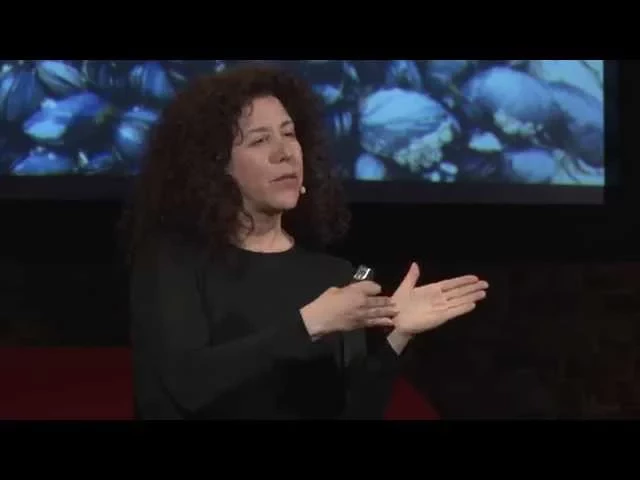
So the sea mussel actually has a life-friendly protein adhesive that is activated just by the oxygen in the ocean water, and that is how it adheres to rocks. And plants. Plants are made of cellulose.
Cellulose contains lignin, and lignin is this natural waterproofing, resilient material that is also anti-microbial, and it is activated just by enzymes. Or the tree frog - his little adhesive discs in the tips of his toes. And then the slug is my favorite because the slug actually emits a mucus that dries instantly, and that achieves the same sort of like adhesive, gluey substance.
And here is the problem that most people think of when they think about biomimicry. They are like, "Ah, but the slug is doing exactly what formaldehyde is doing. That's what you described, right?
Glue. So if I get all those slugs together and build a slave farm of slugs (Laughter) and I threaten them, so that they exude this mucus, I will have a green product. " That's not biomimicry.
So this is how it works. You get these inspirations, these organisms that tell you exactly how to do it, and the students later used it like blueprints. They understood the chemical structure, and went out and sought materials that would do the same function, but in a benign way.
One of the examples I'd like to point to is this really happy accident. It wasn't particularly good at preventing wrinkles, but it was really good at creating color which is also a crosslinking function. This is what happens when you go through the invention process, and the numbers bear this out.
So what Martin, the chemist I introduced to you before, found is that this process uses 1/20 to 1/80 the amount of water, as compared to a normal pigment and dye process. It uses 1/4 of the carbon emissions, there is no residual dyes, no hazardous chemicals, and it dries faster. This is all because we use nature to start off the process.
Nature has been doing this for millions of years. And we've been saying, "No, thank you, I don't need those instructions. I'll figure this out on my own.
" Why? Here is an example where it didn't go quite so well. There is a group at MIT that just created the most water-repellent finish to day; supposedly, 40% more effective than anything that's been created thus far.
They touted it in Nature magazine as being inspired by the butterfly. You can see in this image, there is microscopic ridges that form on a butterfly wing, and those actually broke the water apart into tiny little parts which created a more effective water-repellent surface. The problem was that the material that they used to create it were these CA perfluorinated chemicals which were so nasty and so toxic that if an actual butterfly had been going in the lab at the time, it would have been dead in an instant.
So this is my second point about what is biomimicry and what is not. If your creation can kill the emulated organism that you're trying to model, that is not actually biomimicry. (Laughter) But what is biomimcry is the forest, and the forest is a great example of cooperation.
We used to think - or scientists used to think; this is back in the 50s - that that tree competed with that bush in order to attain nutrients and water, but in truth, it's actually just the opposite. They share all of that material through the mycorrhizal layer, and that is because the goal of nature is a healthy forest, it's not just a single healthy tree. What if we had companies doing the same thing?
Could companies actually stop competing with each other, but cooperate? What would that look like? We're doing that now with our design challenges.
We're bringing together companies and academia to focus one problem at a time, in this case, adhesives and color, and see if we can actually create a healthy industrial ecosystem, not just one healthy company at a time. As consumers, I want us to remember that we have choices too, we have that 21 trillion dollars, right? If we start acting like we're on a team, and we say to industry, "We want safer, healthier products," do you think the industry is going to listen?
That is 21 trillion dollars at stake, I think they will pay attention. So what can you do? I want you to read labels.
When you pay for something, pay attention. What is in it? What do I do with it when I'm done with it?
When you're voting with your dollars, you're actually making an enormous difference. But the last thing I really want you to do is I want you to go outside. There is an immense world out there, and we just have to spend a few minutes a day, - 20 minutes is all I ask - and go outside, quiet that clever mind of ours, and notice things.
It doesn't have to be in a grand place like the forest or a lake, you can go right across the street and look at the branching pattern of that tree. It follows a very specific mathematical sequence called the golden ratio or the Fibonacci sequence, and it's the same thing we see with shells, it's the same thing we see with our hands, it's an amazing secret code to the unlocking the Universe. So what if we use that to make our products, and our buildings, and our cities?
That not only would feel more natural, they would perform better. All I'm saying, don't just think outside the box, I want you to think outside. Thank you.