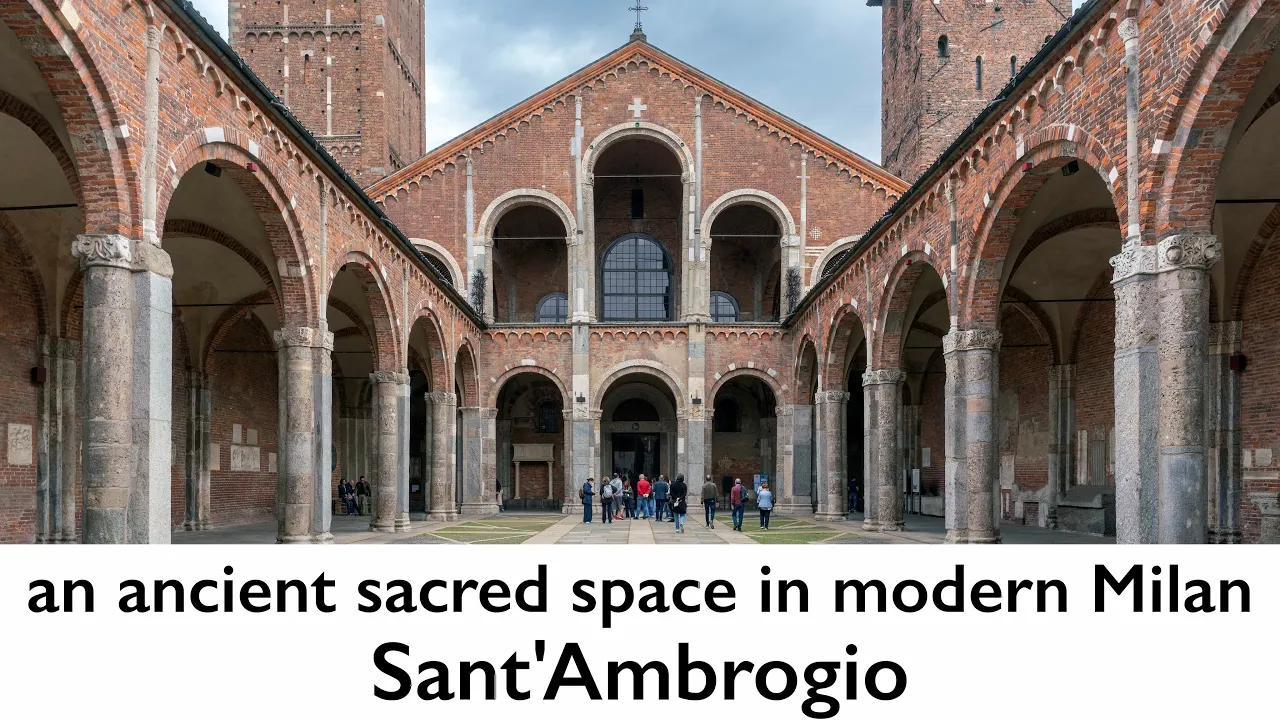
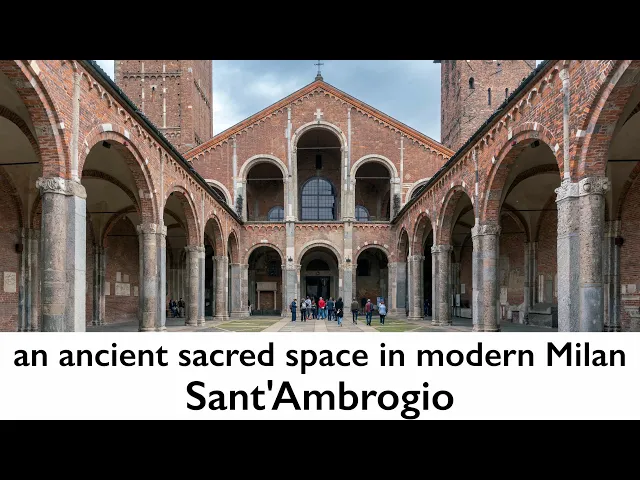
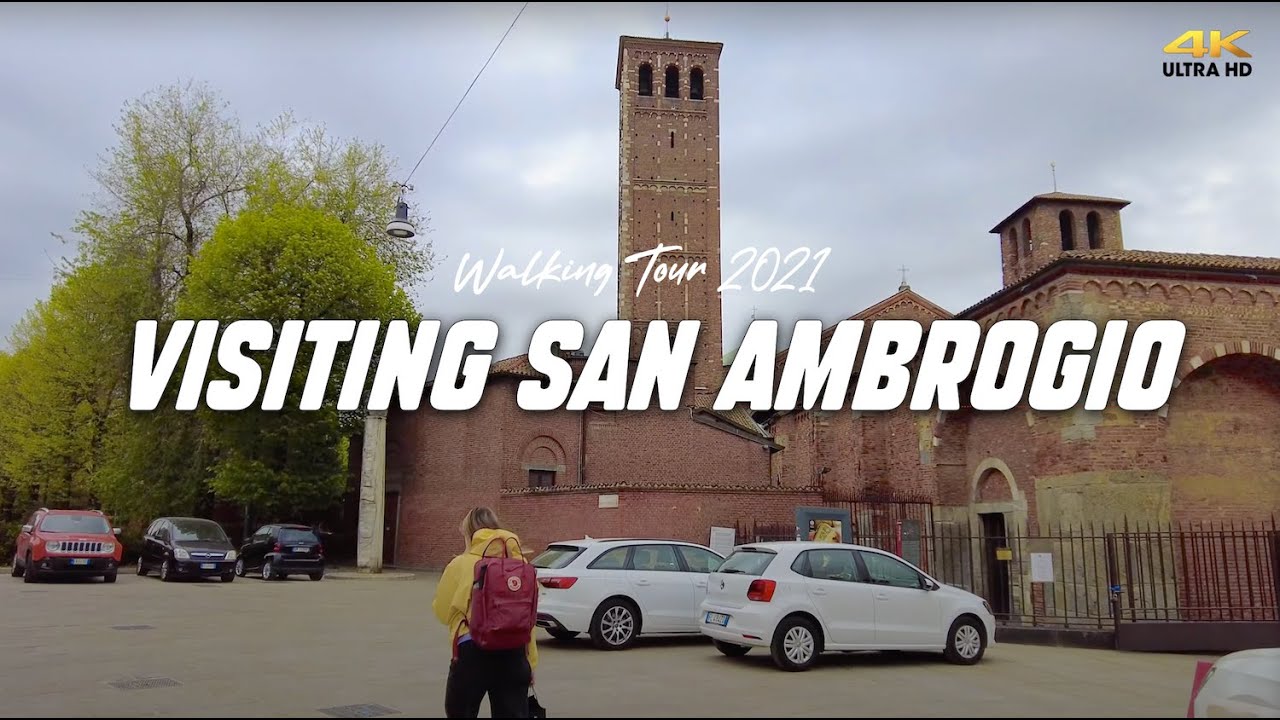
[Music] we've walked into the atrium of sant Ambrosio in Milan this large rectangular space with an open center with vaulted aisles surrounding it and at the far end is the Basilica of senebrosio itself and if we look up the forms as we look toward the Church itself we see what looks like double-storied Roman triumphal Arch I really feel like I'm in an ancient space here in Milan in fact the most ancient Christian site here in Milan Atria are common in early Italian churches and they derive from ancient Roman architecture specifically from domestic architecture but the
way that it's set here in front of the church makes the entire space feel as if we're crossing this threshold into this sacred environment a sacred environment that still houses the relics of Saint Ambrose himself the patron saint of Milan and the bishop of Milan and I'm transported back to the third Century to the time when the ancient Roman emperor Diocletian divided the Roman Empire in order to help secure it and created a new capital for the Roman Empire here in Milan so the city becomes this very important Capital at the beginnings of Christianity and
the end of of the Roman Empire Christianity was a young religion that was still working out which specific beliefs would be followed so here we are in a city that had become the new capital of the Western Roman Empire so let's go inside we've just walked into the Basilica and that word is important because this church is based on the ancient Roman architecture type known as a basilica that were built as large-scale Civic buildings and early Christians adopted this Pagan architecture for a Christian context so although this is one that dates back to 4th Century
to the time of Saint Ambrose what we're looking at dates to the later period of the 11th and 12th century a period we call the Romanesque and so when we think about the Romanesque style we see many of the elements that we do in fact see in this church we see rounded arches that remind us of ancient Roman architecture hence the name Romanesque like the Romans and interestingly we see an early use of the grain Vault and you can see the groin vaults here divided by the precocious use of brick ribs that are then brought
down on these large Piers that alternate down the length of the Nave and separate the central hallway the central Nave from the side aisles and it feels dark the way that we expect a Romanesque Church to feel this is a time when Architects are experimenting with vaulting trying to figure out how to carry the weight of a stone Vault and so the interior is dark very different from brightly illuminated stained glass spaces of later Gothic churches and in fact in this church there is no clear Story the light is coming in instead at the East
and the West ends of the church and also from small windows in the dome and if we look below the Dome we see a bald Aquino a chaborium we see figures made out of Stucco Christ in the center with Peter and Paul on either side on the opposite side the side facing the altar is an image of Saint Ambrose and one of the real Treasures of this church can be found supporting the stone canopy and these are four large purple poffery columns that probably date to the period of Saint Ambrose's own life so dating back
to the 4th Century in the center below the balticino is a magnificent altar with scenes from the life of Saint Ambrose and scenes from The Life of Christ made out of thin walls of gold and silver with enamel work and gems and Pearls it's just magnificent there's also of Mosaic that shows Christ enthroned in the apps so here we are in a city that had become the new capital of the Western Empire that would remain an important center under the Lombards and carolingian anatonian Kings this was one of the great religious sites in Western Europe
foreign [Music]

![Chiesa di Milano - Walking tour inside the Basilica di Sant'Ambrogio [ 4K 25fps ]](https://img.youtube.com/vi/ZnL_3YzSvY4/maxresdefault.jpg)