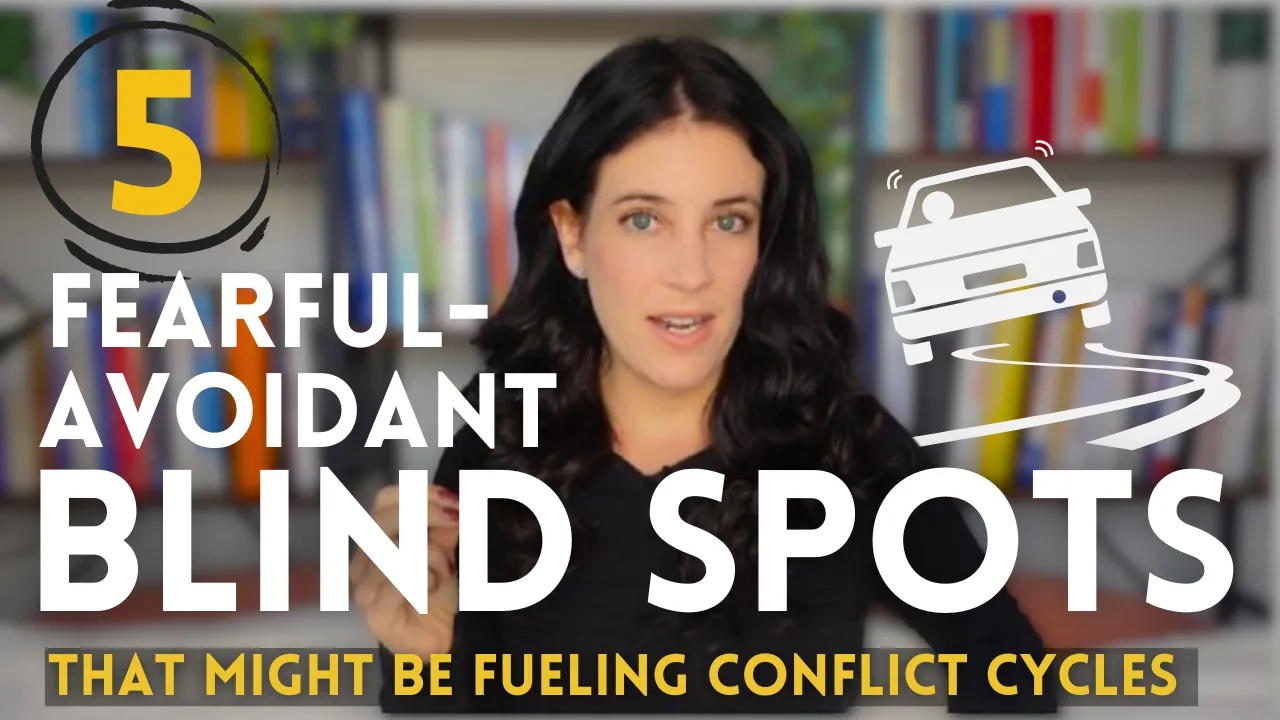
hey guys I'm Heidi PRI welcome back to my Channel or welcome if you're new here this month on this channel we're talking about integrity and specifically this week we're looking at the different blind spots that are inherent to different insecure attachment Styles so that's anxious avoidant and fearful avoidant and today we're doing a deep dive on the fearful avoidance blind spots in relationship now the reason this connects back to Integrity is because it's actually really challenging to be in Integrity with ourselves if a lot of our behavior is emanating from a place in our unconscious
that we are not aware of and this is very often something that happens anytime you have a relationship where both parties are insecurely attached in whatever form both people end up feeling overtime like my partner is 100% of the problem and the reason why it feels that way is because generally one's own contribution is emanating out of a blind spot so out of a part of our own system or our own reactions that we are not consciously aware of so what this video is designed to do is not to shame or blame you for anything
that you're getting wrong in relationships but to just expand our awareness into ways in which you might be impacting your relationship Dynamic much more than you realize in ways that are making conflicts challenging to resolve so there's this famous Carl Young quote that I've always loved until we make the uncon conscious conscious it will direct our lives and what this whole series is about is making those unconscious things conscious for ourselves so that we can make more deliberate and intentional choices inside of our relationships and show up in ways that we are proud up so
you can kind of think of this as just like when you are driving down a road you want to make sure that you are looking in your blind spots before you merge into a different lane or take a sharp turn you want to make sure that in your relationship before you make any big decisions or decide to change course in some way you're checking your own blind spots because ultimately that's going to give you the best chance at avoiding major collisions that don't need to happen it's the first blind spot that I would always encourage
you to check in on if you are a fearful avoidant who is struggling in your relationship is are you making the Assumption unconsciously that you have to suppress major parts of who you are in order to be in the relationship and are you absolutely sure that that assumption is true so a very very common thing that I see happening for fearful avoidance is that they will get into a relationship and over time start to feel kind of deflated and deadened inside of the relationship and lose attraction to their partner and then start thinking okay the
only solution to this is to leave the relationship and what I'm not advocating for is staying in a relationship no matter what right there is of course the time to cut ties but very often this is something that's kind of preventable so a really common pattern for fearful avoidance is that at a very young age you may have internalized a strongly held set of rules that you now unconsciously follow for how you ought to show up inside of a relationship and those rules are the things that kept you safe in your early Dynamics which is
why they feel so important and so strong inside of you so fearful avoidance as an attachment style often forms an environments where the person who you are going to to seek comfort from is also in a lot of cases the cause of your distress so this can be a parent who is quite emotionally volatile or an environment that is not always safe but within which the same person you feel frightened by is the person who is responsible for protecting you so what often happens when we have a system that forms in this type of environment
is there are certain emotions that we learn just do not work to keep us safe in a lot of cases anger is one of those feelings so we might internalize a lot of rules around I cannot ever feel angry at my partner I cannot ever express anger at my partner unless they have done something so blatantly and obviously wrong that it's acceptable for me to let them know we might have rules like I must always take care of my partner no matter what even if it's significant ly infringing upon things that I need to attend
to in my own life we might have rules like I can't set boundaries for myself inside of the relationship it is cruel and unnatural punishment for me to have anything that stands between myself and my partner but the problem is that when we have rules like this that run really deep for us what happens is we naturally start to lose our sense of self the longer we adhere to these rules and this is often why fearful avoidance on aage tend to feel a lot more alive and centered in themselves when they are not in a
relationship again until they start to do this type of work to make this stuff consciously available to themselves suppressing something like anger means also suppressing the part of ourselves that knows how to set boundaries and boundaries are really important for keeping the parts of ourselves that make us feel really alive and energized and engaged in our lives active inside of our intimate relationships the first step is making conscious for yourself what those rules that you've internalized are and then checking to see if it's true that actually you need to suppress all of these things inside
of the partnership in order for it to work so an example of this is there was a point in my life where I was in a long-distance relationship and I had gone to visit my partner a couple of times but they had not yet come to visit me and the first time we had a conversation about them coming to visit me I immediately started shutting down and I noticed in the days and weeks that followed I was running this new program around my partner where I was suddenly seeing all of the things I didn't like
about them all of the things I believed being with them was holding me back from and I really noticed my thinking has changed around this person I was in a deactivation response and what I eventually realized was that I was really uncomfortable at the thought of having someone in my personal space I had this program running that was telling me if your partner comes to visit you you need to have no boundaries in order to make them feel comfortable in your space that means you can never request alone time it means you can never turn
down their bids for intimacy it means that essentially for the entirety of the time that they are there you will be responsible for meeting all of their needs but you will not be allowed to have any of your own and the more I became aware of this the more I noticed how many little things were going into this overall aversion response that I was having towards my partner but what was really happening was not that they were imposing these terrible very strict very self-erasing rules on me what was happening was I was imposing those things
on myself and assuming that that's what my partner would expect from me and I still remember going to have this conversation with my partner at the time and it being one of the best and most surprising conversations I have ever had in a relationship where I just laid out very openly the things that I was a little bit afraid of including my own aversion to setting boundaries because I thought of myself as a bad person if I were setting boundaries with them in my space and we had this very long very honest conversation where they
realized they also had a whole bunch of internalized rules that they weren't aware of and then we were able to put all of that out on the table and what was shocking to me was that I finished that conversation and felt more energized more alive and more attracted to my partner than I ever had at any point in our relationship because I had brought myself into it I had brought my own vulnerability and my own concerns and my own thoughts and feelings into the dynamic in an Unapologetic way which does not mean an unkind way
it just means I brought it in without the sense of nagging guilt that I shouldn't do that attached to it and so because I was able to bring it in in that relatively neutral way my partner was also able to receive it in a relatively neutral way and we were able to get somewhere with it and find some boundaries that worked for us as a unit and as a kind of side note when I was planning out this video and thinking about what I wanted to say within it originally the first blind spot that I
wanted to propose was that you might not be bringing your needs into the relationship as a fearful avoidant that didn't quite sit right with me because when I was really deep in my own fearful avoidant patterning the word need in a relational sense meant almost almost nothing to me like when other people would go around talking about their relational needs I was like I actually don't know what you guys are talking about like I feel very comfortable meeting my own needs and then anything that I get from a partner is just an extra and it
took me a long time to realize that that is not the case because to be in a partnership that actually works it means you're going to need to negotiate the boundaries that you set as a couple and that requires you bringing to your partner hey here's what I really need to feel comfortable in this relationship and also to feel energized and alive in my life and how do we figure out how we can form our boundaries around those things so that both are possible and you cannot do this without help from the other person so
it requires that vulnerability of you being able to say here's what I'm afraid of here's maybe what I'm not very good at and that might be setting boundaries it might be speaking up for yourself and advocating for your own needs but the more you can bring those things in the better a chance you're going to have at allowing the relationship to mold around the two people that you actually are as opposed to this list of rules that you have running in your unconscious mind because a lot of those rules probably don't apply anymore and any
relationship that is actually healthy and alive and dynamic is constantly changing the rules and adapting to fit the needs of the two people who are co-creating it so that's the first blind spot that we want to look at which unconscious rules am I assuming are true here and can I check to make sure that they're actually true before I allow myself to grow increasingly resentful and deadened inside of this relationship and then break it off because I had these assumptions about what was required of me that may not ever have been true blind spot number
two that I would encourage you to check if you are fearful avoidant and struggling in any aspect of your intimate relationships is ask yourself the question am I aware of how my own inconsistency might be affecting my partner and the way that they are responding to me and what we want to do here is not shame ourselves because I know that to be fearful avoidant means to have a pretty strong awareness of your own inconsistency and to have that often be categorized in the bad partner part of your mind but it is genuinely a blind
spot that a lot of us might struggle with because chances are if you have a fearful avoidant Detachment style you never had a home environment that was stable secure and accepting enough for you to be consistently calm and vulnerable with other people and so you're not even aware that this is the felt sense of what secure attachment is it's two people who feel like to a reasonable degree they can trust and rely on each other and because they can trust and rely on each other to be relative ly consistent versions of each other for each
other that doesn't mean that there's never fluctuations in mood or in what's going on for them in life but it means for the most part they trust that their partners are going to be consistently available for them emotionally and physically because you might not have a model of that that you've really internalized in your body it might be really surprising to you that your partners seem kind of chronically disregulated or deactivated depending on their attachment Styles in the relationship and you might not understand at all where that is coming from so I remember in my
more fearful avoidant days I would have so many triggers come online that would have me be deactivated for weeks at a time and then activated sometimes in arguments and then in general just confused and unsure of whether I even wanted to be in the relationship and I had no awareness of how that was impacting the relationship Dynamic itself I just thought it's the other person's responsibility to come to me and be vulnerable with me and if they're not doing that then that's their stuff I didn't realize that it was also in large part my responsibility
to co-create a relationship environment where my partner felt safe and comfortable with me and in order to do that I had to work through a lot of my own stuff and become aware of a lot of my own triggers and how and when they showed up as well as how I was showing up very differently for my partners when I was triggered in different directions and so once again I'm just going to keep repeating this this is not about shaming or blaming ourselves it is just about being aware of the fact that sometimes our partner's
disregulation is not just because they can't handle their emotions or whatever it is it's because we are actually making them feel emotionally unsafe by being inconsistent in our responses to them and the way to have a healthier relationship Dynamic is to find ways to be more consistent in the way that we show up for our partners because that could go a really long way in changing the dynamic of the relationship itself to become a place where vulnerability is a lot easier for both people to access so again that's a blind spot you might just want
to check in on especially if you can't understand a lot of your partner's emotional responses if I'm really honest with myself can I say for sure that this person feels like they are getting a relatively consistent version of me day to day or week to week and if not that might be something that I need to look at to fully understand the relationship Dynamic and why things are happening the way that they are question number three that I encourage you to examine if you are fearful avoidant particularly one who is struggling with committing in relationships
is am I curious about my own fear of commitment or am I shaming myself for it and resisting it when I find it creepy into my awareness so another thing that I see very very often with fearful avoidance is this strong fear of commitment and I believe that the fear of commitment is never as simple as what it looks like I do have a whole video on this that I will link in the description of this one but essentially what we want to be looking at when a fear of commitment starts creeping into our awareness
and we start looking at our partner going I don't know if I want to be with this person 5 or 10 years from now is what is it within that that thing within that commitment that we are so adverse to and this is something that we can't really go deep into the examination of if we are shaming oursel for our own fear of commitment so if we're telling ourselves you are a bad person for even questioning this or you are a bad person for not wanting to commit to your partner 100% for sure really early
on so we might have these rules around once again to be a good partner means to be very committed and to never question my commitment when in reality more secure leaning people are actually quite aware at all times of what they do and don't like about their relationship and what things might need to be worked on in order for the relationship to get to a place where they would feel comfortable in it long term so very often what I feel like is happening for fearful avoidance when they're fearing commitment is that they are actually doing
a lot of self- abandoning inside of the relationship without realizing it so a lot of erasing themselves in their true wants and desires and things that make make them feel alive again refer to Blind Spot number one and when we are erasing ourselves in this way what commitment looks like is commitment to a lifetime of self-abandonment and nobody wants that right the reason why secure people tend to feel pretty comfortable with making commitments is because they know that they are not self- abandoning and that if things come up in the relationship that means the relationship
Dynamic that was once working no longer works for them and they need to find a new equili ibrium they'll talk to their partner about it and they'll find something that works for them both and when you have this kind of dynamic and everchanging fluid approach to relationships and to the boundaries that need to get set inside of them it's not very scary to think about commitment because you know that you'll show up for yourself and the other person in this relationship you'll prioritize both of your best interests and if your best interests ever stop being
aligned in a way that's truly unresolvable then you can also always break up in the future but again because you might have all of these rules internalized around how you have to show up it might actually be that you are afraid of committing to a lifetime of following those rules because you know that they keep you feeling dead inside and so the more we work on shaping our relationships into these Dynamic places that have room to include the whole of ourselves the more comfortable we're going to start naturally feeling with commitment because we know that
we are not going to abandon ourselves in the process of staying with someone and so the first step in this process is once again just try not to shame yourself too heavily for that fear of commitment if and when it does come up for you and instead to get really curious about it what is it about committing to this relationship that has me so Frozen What would have to change for me to feel more comfortable thinking about this person in my future again I do have a video linked below that goes over this in more
detail so if this is something you really recognize yourself in you might want to go check that out next but for now it's just something to keep in our awareness blind spot number four that I encourage you to check in on if you have a fearful avoidant attachment style is ask yourself am I deeply aware of what comes up for me in the moments where I feel vulnerable and I'm not talking vulnerable like you're sharing a difficult part of your history that you have gone over a thousand times in your own mind with someone else
I'm talking about the moments where you feel dependent on your partner or where you are sharing something that you're worried paints you in a really bad light or if you're showing up in some way that you have a lot of Shame around so this often happens actually in the healing process we start realizing there are parts of my identity and parts of myself that I haven't ever expressed in relationships because I have a lot of Shame around them so this could be something as simple as expressing anger towards a partner for the first time and
what we want to be really careful about here is making sure that if we already have shame attached to the expression of certain emotions or to certain ways of showing up in a relationship we might unconsciously be placing a really high expectation on our partners to respond perfectly to the thing that we are doing and we might actually have a bit of an unrealistic expectation on their response this is especially true in situations where our partners might have no idea that what we're doing is a really high stakes and challenging thing for us and so
this is something we really want to keep in our awareness for example let's say I have a really hard time with taking accountability for ways in which I have hurt other people because I have this rule that to be a good partner means I will never ever cause my partner pain or upset and so let's say my partner expresses to me that they've been hurt by something I did and now I have to fight through all of this defensive patterning inside my mind that's going no I didn't I didn't hurt you just don't understand me
to get to the place where I can actually hear them and go okay I know I didn't mean to do that but this person is telling me that I hurt them so I'm going to try to self-regulate around the shame that's coming up here and actually hear that and let's say I do a pretty good job at that and I go away and I process what they've said and I come back to them with an apology and I take accountability and I show them look I've heard what you said I see that I hurt you
and here's kind of an explanation of what was going on for me and now what might happen is I might find myself in a very vulnerable state because maybe when I was very young anytime I admitted I did something wrong I got punished really heavily so my partner might not have any idea that in this moment I am feeling incredibly vulnerable I'm feeling kind of young and scared of what they're going to say in response to me taking that accountability and then if let's say they do not respond perfectly so they say basically anything other
than wow thank you so much for the apology I really appreciate what you did there and now I feel no more anger or no more upset around this if they do anything other than that it might feel incredibly hurtful because it might be hitting on a very old wound that we have had a Band-Aid over for like 30 or 40 years right so when we take that Band-Aid off and we go okay I'm finally going to do the thing I'm going to be vulnerable in this new way then any response that someone has is not
absolutely perfect is going to hurt extra because the skin under that Band-Aid is really raw and so what we want to be aware of here is two things one can we acknowledge to ourselves that we're probably going to be a little bit sensitive in the areas where we are vulnerable and have higher than average expectations on our partner responses so can we be aware of that and ideally can we communicate it to them so let the other person know hey it's actually really hard and vulnerable for me to show up in this way so I'm
going to be a little bit sensitive as we navigate through this and I just want to let you know that so that we don't get confused and lost if things kind of start going off the rails but two can we act as our own coach through these experiences so can we make it really really clear to ourselves in our own mind that just because this is an area that feels very sensitive and vulnerable for me does not mean that my partner is not allowed to have their own full range of responses to whatever I bring
to the table right they don't owe me the perfect response they are also allowed to be human in these moments and to have their own responses so what this is about is just noticing which areas we feel particularly raw around especially in the healing process as we're trying to show up in new ways and making it clear to ourselves and our partners if we can that these areas are really challenging for us which means there's high potential for us to get disregulated as we're navigating through them and the more we can just make that apparent
to ourselves and the other person the more context everyone has on what's Happening holistically I remember one time having an interaction with a partner where I'd shared something that was really personal for me and that felt very vulnerable to share and my partner didn't really pick it up they just kind of brushed past it in conversation and started talking about something else and I started feeling really resentful about that and really angry and so I brought it to them a couple of days later and and they were extremely surprised to find out that sharing that
thing had felt vulnerable for me and they told me that just wasn't the read that they were getting based on the way that I was talking about it and so once we got clear on that then we were able to return to the conversation with the sense of intention that I had wanted to have placed on it but again it required me to Advocate a little bit for my experience inside of the relationship and go hey I actually really need some attention on this thing this is really important to me and again if we're fearful
avoidant that can be challenging for us to do so we just want to keep all of this in our awareness as much as is possible as we navigate through our close relationships and the fifth and final blind spot I just want us to draw some awareness to if you are fearful avoidant and you're struggling in your relationships is am I looking at fault in this relationship as a very black or white thing so once again to be fearful avoidant means to have triggers that send you into activation responses which puts you in more anxious patterning
as well as deactivation responses which puts you in more avoidant patterning so essentially what you're chronically doing is switching world viws because in anxious patterning you have the worldview of I am not okay other people are okay and so if you're in that patterning and you're feeling very vulnerable in all of your relationships you're going to naturally assume it is the other person's responsibility because you assume that other people are okay and are able to take care of themselves and their own needs in that that state it's going to feel like well why are these
other people not coming along to help me get back into regulation because clearly I'm the one who is not okay and needs help here and so it's going to start feeling like the onus is always on your partner when you are in this state to fix the problems in your relationship and to check themselves because clearly you are not okay and they are AO they ought to be the one to fix things but then when you are deactivated your worldview is going to switch and you're going to start feeling like I am okay I am
capable of taking care of myself and attending to my needs and staying regulated but other people are not okay my partner is not able to show up for themselves and take care of their own needs so it is my responsibility to fix everything that is wrong inside of this relationship including checking my own behavior and figuring out where I have not been showing up perfectly and when you Ricochet back and forth between these two different worldviews it's a very disorienting experience because you're always trying to figure out who is the person who is doing everything
right and who is the person who is doing everything wrong when in reality to be secure means to be aware of what we call in attachment circles awareness of complex causation so in awareness of how both people are in a lot of cases doing the best they can but wires are getting crossed or triggers are going off in ways that are leading to unnecessary forms of conflict that are really challenging to resolve but it's not because either person is inherently malicious or bad it's just because relating human to human is a hard and complex thing
and it requires a lot of unpacking of everybody's unconscious programs as well as their conscious ones and everybody's unconscious and conscious expectations and doing a lot of negotiating around how to figure out how to make a relationship work for the two unique people who are inside of it so this is just another one to stay a Ware of if you find yourself ricocheting between I am the person who does everything wrong and needs to fix the entire relationship and my partner is the person who is doing everything wrong and the onus to fix the relationship
is 100% on them this is a false dichotomy and what actually needs to happen is probably that both of you need to expand your awareness about both what's happening for you inside of the relationship but also what's happening to the other person and how you can navigate around each other's triggers and defense mechanisms as best as possible so that you can actually start repairing the relationship and growing together instead of holding either yourself or the other person to these ideal standards of perfect behavior that do not meet either of you where you are actually at
all right that's all I'm going to say for today on this topic but as always anything coming up for you as you've been watching this video so any questions any thoughts any unique theories feel free to leave them in the comments section below I love you guys I hope you're taking care of yourselves and each other and I will see you back here again really soon [Music]