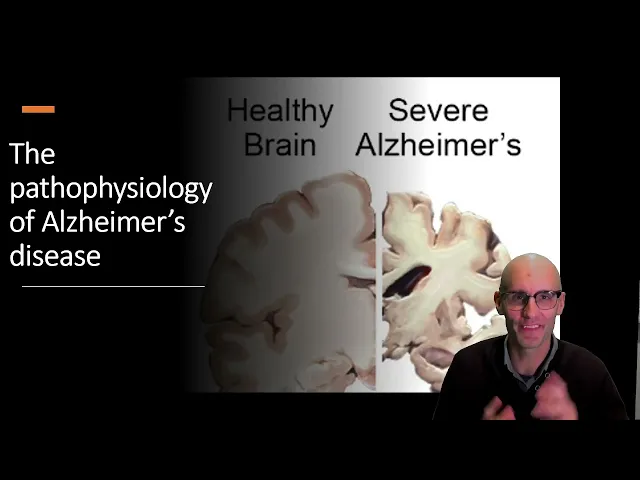
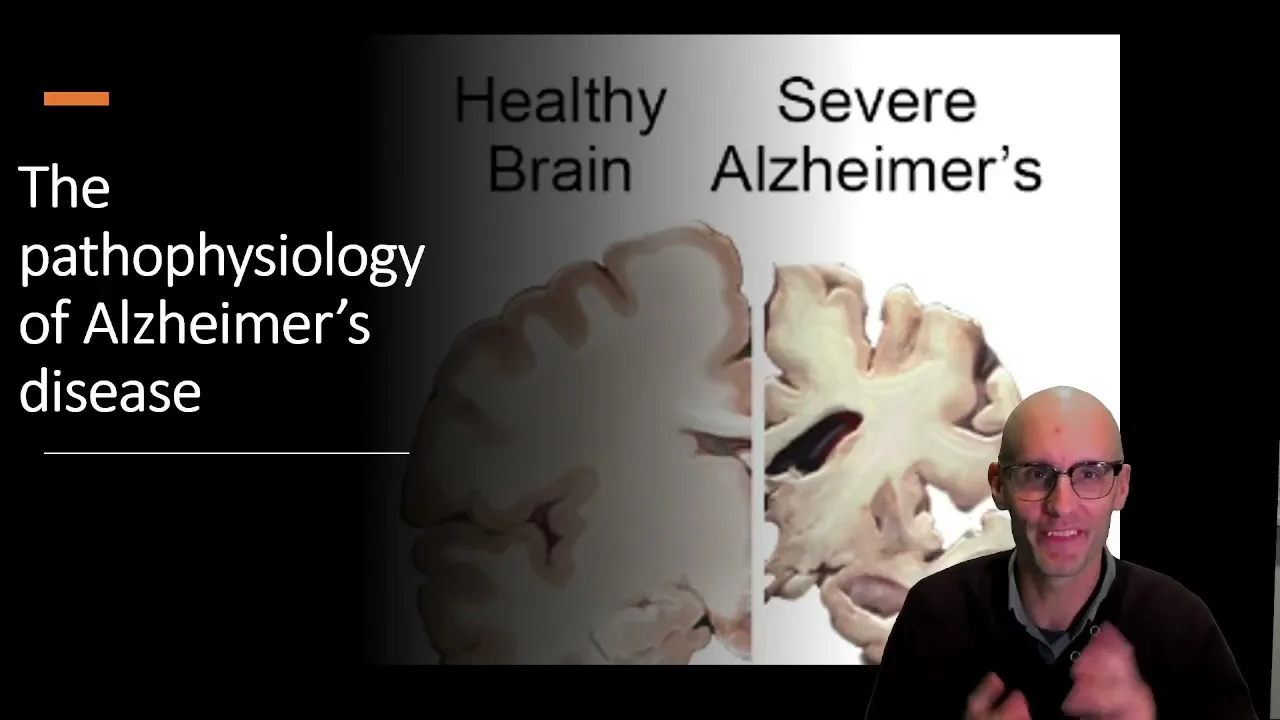
hey everyone DrJack Audi and in this video I'm going to be jumping into the pathophysiology of Alzheimer's disease now if you haven't seen my introductory videos into Alzheimer's disease I really recommend going back and watching those because in this video I'm going to jump into the deep end a little bit now behind me you can see a couple of sections of brain one from the healthy human tissue which is full and plump and what you expect to see when chopping a brain and one is of the Alzheimer's disease tissue here now what you can see it's shrunk away and it's shrilled up and that's tissue atrophy caused by neuronal death so it's really a loss of all your functional brain cells which causes memory decline cognitive decline and eventually motor Decline and eventually death now pathophysiology essentially means bad physiology or bad molecular cellular and systems biology it's kind of what physiology means so it's the molecular and cellular mechanisms that underpin the disease of Alzheimer's disease so let's jump into it here we have a synapse this is the connection between two neurons this is where your thoughts are held within the synapse within the connections between your neurons now these connections are formed with the help of hundreds of proteins but one of those proteins that helps synapse formation is the amyloid precursor protein it's a transmembrane protein like this and it sticks out into the synapse to help the synapse form now like all proteins that's chopped and cleaved and cleared and recycled and it's chopped up into fragments to help that recycling process now an Alzheimer's disease for whatever reason we end up with excessive beta our successive fragments of this amyloid precursor protein that we call beta amyloid this is all in the previous video so I jump into it a bit more detail in those videos but essentially the speeder amyloid has a unique property of being a very sticky protein and it starts to stick to itself now first it comes as a monomer which means a single amyloid then it sticks together to form an oligomer which means mini amyloids tucked together and then those oligoms stick together to become insoluble fibrils now these fibrils become the amyloid plaques is one of the most notable histological features of an Alzheimer's brain now what enzymes are cleaving this amyloid precursor protein well first up we have beta secretes and it chops it just in the extracellular domain outside the cell on the protein there so it chops off this a big chunk of the amyloid precursor protein next we have gamma secretes which you know it's an enzyme that helps secrete a protein so secret Haze is not a bad name for it so next we have gamma secretes now these enzymes actually sit within the membrane and they have um membrane spanning domains within the complexes and they're made up of many proteins so the game of secretes will then cleave it below and we'll end up with the small fragment of 40 to 42 sometimes 43 sometimes a little bit 50 I mean amyloid fragment and this is that amyloid fragment that can then stick together to form those damaging oligomers and fibrils in Alzheimer's disease now there is a non-emyloid genic pathway so this is a way to process the amyloid precursor protein in a safe way and it involves Alpha secretase now you're probably already imagining drug targets if you're like me you're thinking hey why do we inhibit those enzymes to help promote the non-emyloid genic pathway so leave it up to Alpha secretase to chop up the amyloid precursor protein and give drugs to inhibit the amyloid preg the uh the beta secretes and the gamma secretase now they have tried this many times in clinical trials and every time it's failed and I might jump into why a little bit later on the videos when I start to cover amyloid versus Tau because there's a bit of a complicated story going on here I'll just give you a preview it's likely that you have a lot of amyloid and amyloid plaques in your brain at the age of 50 or 60 even though cognitive decline doesn't typically hit until 75 80. so you've got 20 to 30 years of this amyloid building up so if you give the drug too late in the disease you've probably you know shut the gait after the horse is bolted as we say so the disease is already on its way and so stopping the production of amyloid is probably ineffective at this stage okay so let's zoom in this is the amyloid precursor protein now I've got a string of letters along the top each of those letters correspond to amino acids so remember proteins are just long strings of amino acids so you can write out the protein code a lot like a DNA code just the string of the small subunits that make up the polymer that is the protein so this is the long string of amino acids and we're looking at the crucial zones where those enzymes actually cleave suppose we have beta secretes at Cleaves over here and I don't want you to it's not important to remember the specific amino acids here it's just important to visualize what's going on at the protein then we have gamma secretation now gamma secrete is connected cleave in a few sites it can cleave here between the A and the T and that creates the 42 amino acid amyloid fragment so that's the a b to 42 that we call talk about the most famous amyloid fragment associated with Alzheimer's disease and if you count it up there'll be 42 liters between those two cleavage sites now gamma Securities connection cleave here as well which is just two amino acids to the left and that creates the um that's 40 amino acids and that creates the a b to 40 fragment now you'll see why I'm talking about these two fragments coming up because it's quite important when it comes to uh biomarkers for Alzheimer's disease now the gamma security secretes right in the middle here and so you can see you're not going to get the generation of that pathogenic a beta 42 fragment if you chop the amyloid precursor protein right here and split it in two so Alpha Secreto is there's a potentially very helpful enzyme in avoiding amyloid buildup so we had that non-amyloid DNA pathway with Alpha secretes and the amylogenic with beta secretes and Gamma secretos those are the key takeaways and you can end up with the amyloid genetic pathway you can end up with two main types there are other subtypes but two main types of amyloid fragments being produced and that's the a b to 42 which is 42 amino acids long and the a b to 40 which is the 40 amino acids right so this is the amyloid genetic pathway and this is that super important one for the disease now let's have a look at how do we know that amyloid is involved in this disease now I'm going to go into the amyloid hypothesis I've already gone over it a little bit I'm going to go over it a lot more later on um but one of the main key pieces of evidence that amyloid is the initiating factor of Alzheimer's disease the egg should actually it's necessary in order to get Alzheimer's disease it's amyloid pathology is the evidence under human mutations so there are some human mutations out there that guarantee you to get Alzheimer's disease and if you inherit this Gene from a parent you will go on to get Alzheimer's disease and typically you get a quite young and when I say that I mean in your 60s which we deem early onset Alzheimer's disease so this is um 50s or 60s and this is familial Alzheimer's disease because it's handed down through the family compared to sporadic Alzheimer's disease which just pops up in individuals which is by far the most common uh there's very few we know the families that have familial Alzheimer's disease so it's very rare that's familiar with Alzheimer's disease but let's have a look at the mutations now many other mutations are in the amyloid precursor protein that causes familial Alzheimer's disease so that's a really good piece of evidence that amyloid is involved in Alzheimer's disease because the familial Alzheimer's disease is caused by mutations in the MLA precursor protein and there's a few of them there so a lot of them around this side here so here how this diagram works is instead of this T you now have an i or instead of this V you have an m and each of these mutations typically live in isolation so you I you either have this mutation or you have this mutation or you have this mutation and if you have those mutations so that's a change in your genetic code which will change the amino acid sequence of the amyloid precursor protein in order to induce this amino acid change so if you have just one of those you end up guaranteed to have Alzheimer's disease now what it turns out is all of these mutations increase gamma secretase cleavage so it promotes the cleavage of gamma secretes and specifically it promotes the cleavage of the uh the cleavage using gamma secretes to generate the a b to 42 fragments so when we look in these patients cerebral spinal fluid which is the fluid that your brain floats in we find a higher ratio of amyloid 42 can be to amyloid 40 so we find more amyloid 42 compared to amyloid 440 so gamut secret has promoted that cleavage site through that mutation now you'll notice some of these mutations are just beside the cleavage site and not at the cleavage site and that's because enzymes are quite complicated they're like um a key going into a lock and then you chop the key in half all the key is important in terms of fitting into the lock so the protein has to fit exactly in the right cleavage side and then the cleavage will take place so structures and amino acids outside of the cleavage site are critical to the protein actually getting into the enzyme where it will be cut now that's even more evident in this Next Mutation so this is a mutation that promotes beta secretes as one of the first mutations we ever found it's a very famous one it's called The Swedish mutation and it's down here and it's swapping out these two amino acids the K and the M4 and n and an l and that's nowhere near the B well it's of quite a few amino acids away from the cleavage site but as I said the protein has to fit into the Beta secretes and so obviously changing these two amino acids promotes it fitting into that but uh beta secrete site to increase it um the 42 uh uh the 42 fragment so it increases the amount of ye cleavage and so it increases uh amyloid B to 42. ratio to m140 I should say now there are a few other mutations that cause familial Alzheimer's disease and again this all supports the amyloid hypothesis those are in the enzymes that cleave the amyloid precursor protein so gamma secrete has quite a few mutations out there that cause familiar Alzheimer's disease and all of these mutations pretty much promote the cleavage and generation of the amyloid 42 fragment so you can see by promote any mutation that promotes the generation of the a b to 42 fragment causes as a direct cause of Alzheimer's disease which is a strong argument for the amyloid hypothesis that is that this amyloid fragment is really the initiating factor of Alzheimer's disease and so you end up with the overproduction of these fragments so here we have the synapse we've got too much amyloid protein and we've got too much enzyme activity that's generating all of these fragments so overproduction and the clearance mechanisms can't keep up with clearing these fragments and so you're going to get a ligamerization and fibrilization now from everything I've just seen you would expect Alzheimer's patients to have a higher level of a b to 42 in the cerebral spinal fluid compared to control right so all these mutations cause the overproduction of amyloids so therefore you should have more amyloid 42 particularly in the cerebral spinal fluid right so if we look at this graph here let me just explain these two graphs over here on the y-axis we have a b to 42 levels so this is if we take a sample of your cerebral spinal fluid we actually do it down here in in your um or quarter Aquinas yeah there you go in the bottom of your spinal cord where it's not really a solid fleshy tube it becomes like a horse ponytail which is where that term comes from um that's where we take the cerebral spinal fluid now if we measure we're looking for amyloid just a single monomer the protein that is that 42 fragment their peptide the amyloid peptide fragment right now oh so on the y-axis we have the concentration each of these squares in each of these dots is a patient as a person and down here we actually have the ratio on the x-axis we have the ratio of 42 to 40.
so you remember that you generate both the 42 fragment and the 40 fragment from gamma secrete's activity and so here we have the ratio of it so if you have more 42 compared to 40 that means you you're you're promoting that cleavage site to generate that pathogenic uh amyloid fragment now if we were to guess which graph corresponds to a cognitively normal person a healthy person and which graph corresponds to an Alzheimer's person from everything I've just told you you would probably guess that this is the Alzheimer's group because there's High a b to 42 levels and there's a high ratio of a b to 42 to a beta 40 and you would guess that this is the cognitively normal group because there's low a b to 42 levels and there's a low ratio of a b to 42 to a b to 40. but unfortunately would be wrong the blue is the cognitively normal and the Orange is the Alzheimer's disease so there's a bit of a peculiar result right why do Alzheimer's patients have lower levels of a b to 42 fragments so that's a very important question it's kind of puzzling when you're learning about Alzheimer's disease you're like wait what that's the best biomarker that we've got for Alzheimer's disease and the answer is this right so this is the critical component of Alzheimer's disease is the oligomerization and fibrilization of amyloid now whether it's the oligomers or fibrils that are the most damaging are still debated I would say the evidence is pointing to the oligomers but the presence of oligomeric and fibrilla amyloid is more associated with Alzheimer's disease then the monomers floating around so if you imagine you've got this amylo floating around and a healthy person but in an Alzheimer's person they're all sticking together and clumping I should also mention that this process is kind of a term that we use autocatalytic which means that once you get a little bit of it it it accelerates that reaction so it causes more of it and more of it and more of it so if you take a mouse and you inject fibular amyloid into their brain more amyloid will Clump onto it at an accelerated rate it's kind of like um uh a little seed that promotes the oligomerization of amyloid so there's less free floating amyloid around the place because it's all a ligamerized or fibrilized into the plaques and oligomers and so that's why when we sample your cerebral spinal fluid down here not on your brain but down there we find lower levels of a beta 42 and a low ratio of a b to 42 to a beta so they're probably overproducing it which causes verbalization and ligamerization and that's because it's autocatalytic it accelerates and accelerates accelerates the oligomerization and fibrilization process causing the concentrations in the cerebral spline of fluid to drop okay so that's what's going on there okay so this ratio the a b to 42 to a b to 40 is actually our best biomarker for Alzheimer's disease so here we have memory performance and low um low a b to 42 a low ratio of a b to 42 to 40.