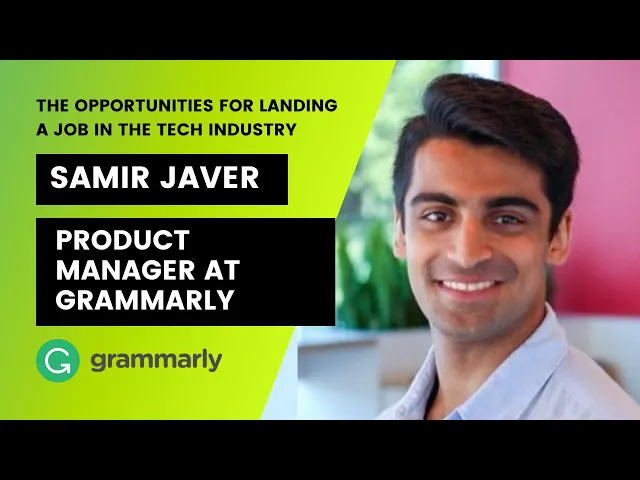
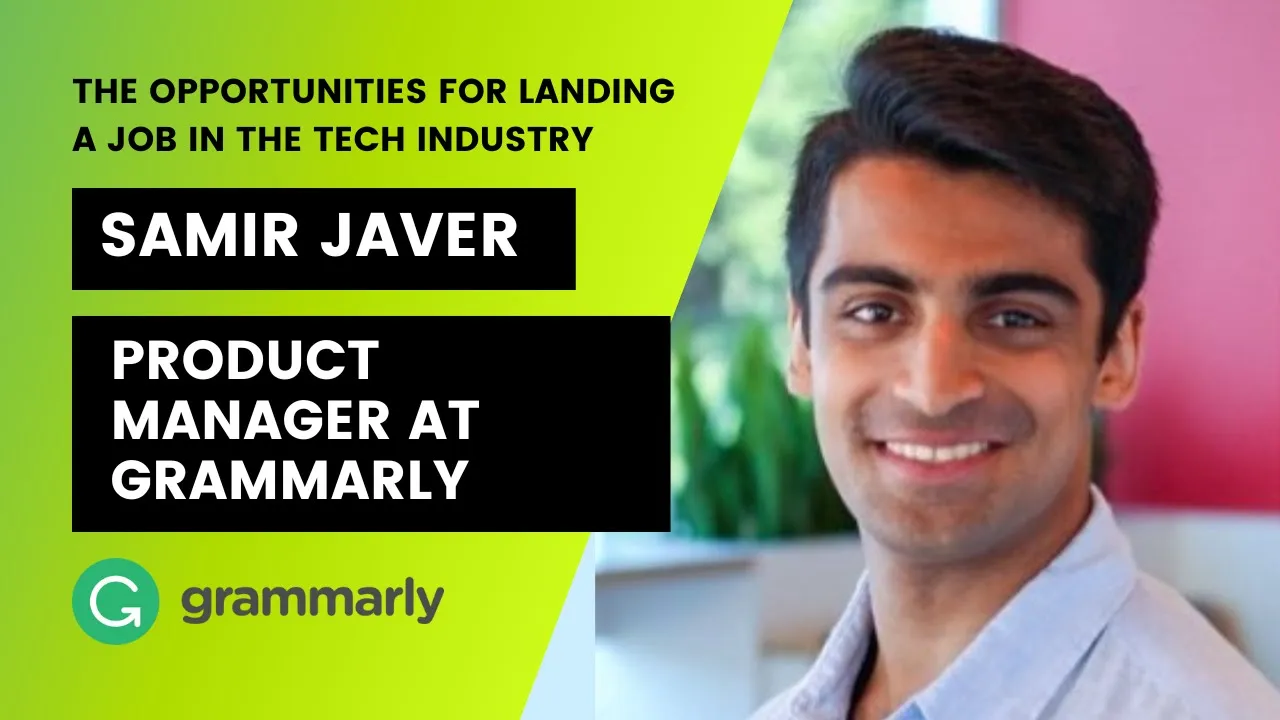
hi Samir we're so excited to welcome you to today's episode and to learn more about your career Journey I'll just jump right into the first question Samir we're really intrigued by your career journey and your professional growth let's start from the very beginning how did your experience pave the way for your present position as a product manager at grammarly and lead you to where you are today so I started out in working in the tech industry about nine years ago now so back in 2014 when I was actually a student I was a university student
at UBC I was studying political science and I thought I wanted to go down the path of going to law school but ultimately through a bit of happenstance and some great kind of things working out timing wise I ended up Landing an internship at an early stage startup and I was doing things like product marketing customer success uh sales we were like a small four-person company and so it was through that that I first got this exposure to the world of tech and startups product management which is what I now do today um my former
boss at that time he was a former product manager himself and so I got a lot of exposure from him he was also acting as like the head of product um so I got a lot of uh exposure from him as to like what is product management how does it impact the business what does the day-to-day look like I then transitioned over into like a formal product marketing role at another company a few years later when I was there I worked alongside some actual product managers it was a much larger company with like 500 employees
and so I got more of what the ins and outs of the job look like and then yeah I really made it my goal to that I wanted to become a product manager and so in 2018 I joined Clio as a product manager and I've been at PM ever since so about for five years awesome yeah that's a really great story and thank you for bringing us along on that Journey it's great to get a little bit of a backstory before we ask questions on a more current note so thank you for sharing that and
I'd love to reflect a little more on that so I would love to know how your journey differs from your initial expectations I understand you initially were getting a law degree did you always anticipate pursuing this specific career path or how have your Ambitions evolved along the way yes I mean I I wasn't even at in law school or anything at the time I was just in my undergrad studying political science and so I was thinking about applying for law schools I think the thing that really appealed to me about the tech industry once I
started working in it was how you could make such an impact despite having minimal experience or not even being that old or like I was a student and I was making this great impact on this this small company and so what I felt was you know relative to other Industries or occupations where I felt I would have to go to law school for example for four years and then do articling and then kind of start at the bottom and work my way up I felt that this was a way to kind of fast track yourself
into making a lot of impact on the world and on customers and creating value for people but despite how old or experienced you were so I think that was one of the things that kind of pleasantly surprised me was the amount of responsibility that I was given and the cool things I got to do and the great companies and people I got to work with and that was at such a young age wasn't even graduated yet and so that's what I tell a lot of people now is you know if you're at that age try
and get a job at one of those small startups because you too can have like a similar experience and have like an outsized uh impact yeah definitely I would say that's really great advice as well and it's definitely interesting to compare what you thought you might achieve and then what you did achieve the other thing that pleasantly surprised me with that kind of differed from my expectations was I think in University I had this misconception that in order to work in the tech industry you had to be a software engineer or you had to know
how to write code right and because that was kind of the the thing and that's all people really knew about tech I think at the time was like oh it's all these like coders right but then for myself I was an art student I had no real coding experience whatsoever but there was all these non-technical roles at tech companies so the thing that it sounds obvious in hindsight but the fact that there are non-technical roles at tech companies they're just like any other businesses they're just selling software right or they're selling Hardware so they still
need people to do customer success Marketing sales HR you know Business Development recruiting everything right like it's just like any other business and so that was the other thing that really caught my appeal yeah definitely I'm glad that you brought that up as well I'm sure there's a lot of listeners that might be interested in technology but aren't aware that that is an industry that they can pursue with their current undergrad degree so that's awesome yeah cool so yeah you've achieved success as a product manager as you mentioned in various companies so from what I
heard you were product manager at do.com and thumbtack Clio and now grammarly as well so I love it if you could share how you manage to transition from one role to the next and how you knew that it was time and you were ready for the change I mean when I was at do.com and thumbtack I was working more in like product marketing I would say and then Clio and grammarly were a formal product manager roles so what I would say is how I transitioned between the two so at do.com we were a four-person startup
I was wearing a bunch of different hats you know like my job title wasn't really reflective of what I was actually doing on a day-to-day basis because there was so many different responsibilities and I loved that the company actually ended up getting acquired a few years in and so through that acquisition I was kind of at a standstill of like I have to kind of pivot and go all in on one particular direction because you can't just be like a generalist forever unless you stick with doing early stage startups forever but I knew that I
wanted to go to like a bit more of a bigger company right anything bigger than four people right and so I chose product marketing because that's when I felt I was doing the most of and it was what I was enjoying I had a bit of background in it I liked marketing I thought that might be what I wanted to do so I chose product marketing and so then I went over to Thumbtack the second company so they were about a 500 person company really well established huge huge marketing team and lots of product marketers
and so when I was there the product marketing function worked very closely alongside product managers and so I was sitting in meetings with product managers I was talking to them I was shadowing them just being like hey like let me trying to understand what these people do because this actually sounds really cool and interesting maybe I want to do this and so the thing that appealed to me was the fact that they were able to work with the engineering team and designers to deliver value to customers and make an impact and solve problems for customers
and it just seemed like a really fulfilling impactful role because you were in that seat where you could actually make impact on the product itself and the benefit and the value that customers and end users are getting from it you weren't just supporting it you're actually making that happen and obviously there's other functions that play a role on that it's not just the product team or the PM on their own by any means but you're really close to the customer and so that's when I decided I wanted to go into product management which is when
I ended up at Clio and so Cleo you know the first two three years was really about like learning the ropes and the fundamentals of being a product manager we had um we had a team of about I think 15 20 product managers some really great leaders and mentors who were there that showed us the ropes and then over time we had more Junior product managers come in and I got to start mentoring them and training them and coaching them on how to do the role which is a really cool full circle feeling and to
answer the second question about how I knew it was time to move on and make a change I think for me you know when I was at Clio Clio build software for law firms uh and clients to kind of manage their illegal matters and so it's a B2B vertical SAS right business to business software and I think the learning I had was that B2B product management is very different than say doing b2c product manager that's what I thought I hadn't done it yet but that's that was kind of my mindset was like let me go
try and become a different type of product manager so like that it can be a more wholesome product manager so I have a bunch of different skill sets and so that was really the main reason I wanted to change was to try a different business model a different user base a different type of business so that's what brought me to grammarly which you're hopefully familiar with because I know a lot of students use grammarly but grammarly is a b2c so business to Consumer subscription-based business the scale of the business also appealed to me a lot
um they have about 30 million active users that's a very different ballpark than video who had about you know I think 150 000 customers which is still really big but 30 million is just like a different ballpark and so again when you're managing a product that is used by tens of millions of people versus 100 000 people plus a different business model and user base it's a whole different job altogether and so that's what brought me to grammarly and I've had a ton of great learnings here about how to do things like a b testing
experimentation growth Etc um there's a lot more like psychology and design principles that you incorporate and so it's been a really great um transition where I've learned a lot yeah that's great to hear I think it's a really good insight to provide to youth sort of how to move across jobs within the same industry and navigating that which isn't usually touched on very much so I'm glad that we covered that and thank you for sharing so I'd love to take a closer look at your current role as a product manager at grammarly specifically and seeing
as you worked as a product manager in many different companies I would love to know whether there's similarities or differences between your sources of motivation at each of these companies so I know you mentioned working closely with the customer and things like that is there anything else you want to touch on that's a really good question I would say again when the business models differ and the user base is different and you're at this scale I think the feedback cycles and the the motivations can differ right so at Clio you know we work super closely
with customers because it was a smaller customer base you had Direct relationships with some of these customers you could literally you know email them or have hop on a call at them or sometimes you would meet them in person at their office or at a conference and so there was a very close relationship there so the types of things you're often doing were things like user interviews or feedback or focus groups usability testing and whatnot so it's a very one-to-one relationship in a lot of cases and so the motivation often was the qualitative feedback you
would get from customers when you shipped or built something that brought a lot of value to them or solved a problem for them so you would say they had made a request for a certain feature within the product or left some feedback you and the engineering team then built it and then a few weeks or months later you follow up with that customer to let them know that hey we've actually built this thing that you were looking for and the responses we would get were just like that was just like my ultimate source of motivation
was hearing this outpouring of love and appreciation from customers that was what really kept me going and got me motivated if I contrast that with grammarly we have such a large user base that it's difficult to have a one-to-one relationship with a lot of these folks also a lot of grammarly users are the younger students who are in say Middle School High School College University it's difficult to have like a one-on-one relationship with them both because they're younger and their relationship with the company is different they're not like a business that's buying your software they're
just someone who signed up for some on a website maybe they pulled out their credit card if they're a premium user but maybe not so what I would say is that because the type of product management is different for me a lot of my motivation here is around metrics and so what we mean by metrics are like quantitative indicators often referred to as like analytics or data so a lot of what we do at grammarly is we try and move our metrics or like kpis because at a at the type of scale we're at you
know even a one percent increase in a particular metric or a one percent change can have a massive impact on the business that could mean you know tens of thousands or hundreds of thousands of dollars in additional revenue or tens of thousands of users who stayed with the product rather than uninstalling or churning um it could be more people converting to premium and that has Revenue impacts and so at grammarly we run a lot of experiments and AV tests and well for me what motivates me is being the results of those tests and those experiments
where you can with statistical significance isolate the change that you have made and see the impact that it has on your users and the business so it might be something like we increased retention by X percent or we decreased the percent of people who uninstall the product by y percent or we created this much an additional net new Revenue because premium upgrade rates rent from X to Y right and so you can really easily then quantify the impact that your changes are having on the business and so for me that I get really excited by
that I love waking up first thing and refreshing the experiment dashboard to see the results that's what really gets me going yeah that's awesome that's a really great answer and I'm really interested to hear how that different aspects motivate you I think it's really important to follow and listen to energy drainers and energy drivers and then following those drivers can result to so much more job satisfaction so that's awesome so we have one more question for you today Samira and it's sort of a difficult one to answer at times but I think it's a really
important one as well to address for our listeners so if you're given the opportunity what's something that you feel you would have done differently in your career path and what advice do you wish someone had given to you at a young age just looking back like I wish when I was younger I'm still like relatively young but when I was younger in school or fresh out of school I wish I had taken even more risks I feel like I did take risks by moving to San Francisco to join the four-person startup that's somewhat risky still
right but I feel like there's more risk I could have taken and I think I got really comfortable and complacent at times I have a good setup here I don't need to like make a change or do something different right so I wish I had taken on some risk to try some new things because at that age that for my money is the best time to learn and take risk one there's not a lot of obligations or things tying you down and I wish I had expanded my skill set and obviously this can be done
whenever but I think at that age when time wasn't as much of a luxury as it is now I wish I had taken up upon myself to learn about other skill sets within the tech industry or try other roles or just experiment with learning some new things and obviously those are things I can still do today but it's just it's easier when you're younger I would say so yeah I wish I had taken a bit more risk I wish I even had moved around a bit more just to see a bit more of the world
maybe abroad internationally because the way that business is done there and people and culture is totally different so that those would have been the things I would have done differently then the advice I would give to someone who's younger or just starting out is I would say don't be afraid to try something that is unknown to you or seems risky or is risky and don't be afraid to Branch out oftentimes we go to university we study a particular degree then we get internships in that field within that degree every summer and then we go full
time for a job within that degree and there's nothing wrong with that by any means but I think it would just help enhance just your quality of experiences in life and overall well-being if you just expose yourself to things that were outside of your core domain right so speaking as someone who works in Tech I love seeing people who come from adjacent Industries or degrees try out Tech because they're like hey I want to try this out right so maybe they go and get an internship at a small startup maybe they try and build something
on their own so my advice would be to just get your feet wet a little bit it doesn't mean you have to even work a full-time job in that thing it could be an internship volunteer for a company do a side project build something talk to people who are in that space just to see if it interests you and if it doesn't there's no harm right but I think from such a young age we lock ourselves in to this prescribed mentality of I studied this therefore I gotta do this internship this full-time job right and
so that would be my main advice is to just try something and especially go to something small because I think for me I feel that having worked in a four-person company has made me a more well-rounded product manager or just contributor to my industry as a whole because I've I had to wear so many different hats at that small company because we were you know we were for people so you just end up having to do a little bit of everything and what that translates over then to the real world or the Working World of
larger companies is you can resonate with those people who are in all of those roles because you can speak their language you understand their motivations what they care about how they like to work rather than if I had just been a product manager my whole career all I knew was product management I'm sure I would still be a fairly good product manager but I might not be able to relate well to the other people that I work with and that is a key competency of product management is like the cross-functional aspect of all the people
you work with so going back to the original question I would say my biggest advice would be try and go somewhere small where you can wear a bunch of different hats see what you like and don't like and you'll get to make like a really big impact yeah those are all really great insights that you've just mentioned one of which as I mentioned our listeners are mostly youth they might not have obligations on the table and that's why it's so important to encourage them to take risks now and working in a small company I think
it's just as important to learn about what you don't like as it is to learn about what you do like so I agree with that inside a lot and that's the last question that we have for you today Samir thank you so much for being a guest on the cast I'm sure our listeners will really benefit from all of the advice that you've shared today and we really appreciate your time awesome thanks so much for having me I I really enjoyed this