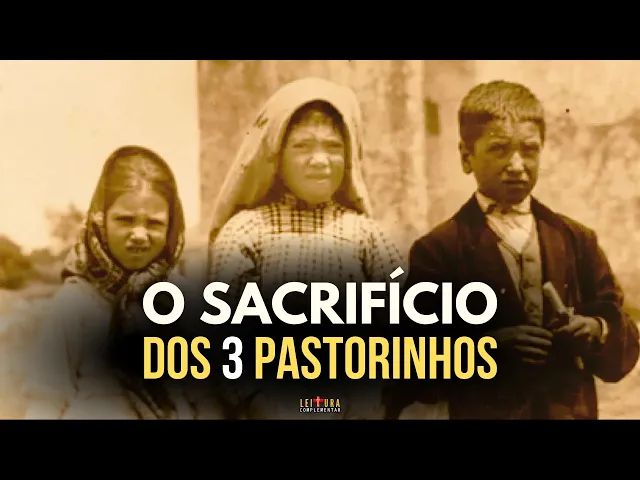
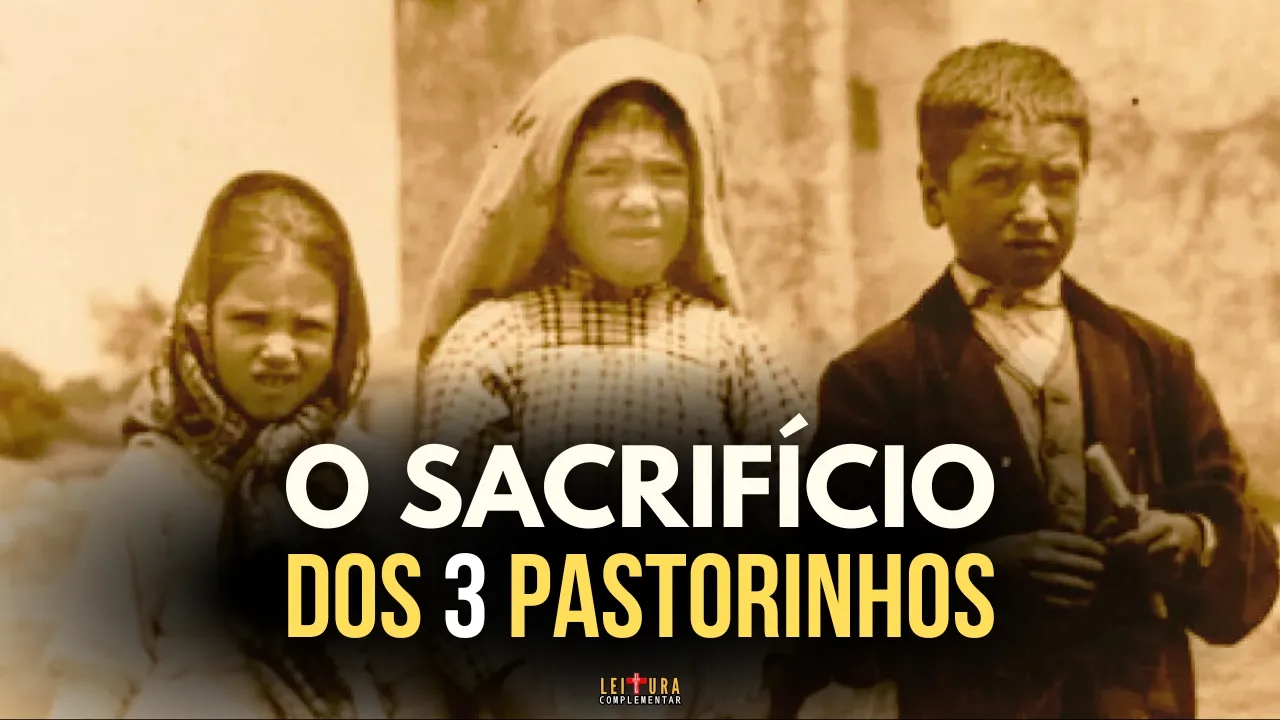
On May 13, 1917, in a small valley in Fátima, three humble and innocent children — Lúcia, Francisco and Jacinta — were called to live an experience that would change their lives and touch the hearts of millions of people around the world. These children lived surrounded by a scenario of war, poverty and disbelief. Suddenly, the three little shepherds said they had received a visit from heaven.
They said she was a Lady of Light and very beautiful. This Lady, brighter than the sun, presented them with a mission of faith and sacrifice, something that would require unusual courage and dedication for children of her age. That Celestial Lady asks the three little shepherds: “Do you want to offer yourselves to God?
” The response of those three children was immediate, without questions, without requiring conditions or further explanations. “Yes, we do. ” And so the heart of the story of Fátima began to beat.
A story of Faith, Hope, Mystery and Charity. At the beginning of 1917, the world was plunged into much suffering. The First World War devastated nations, bringing pain and despair to countless families.
In Portugal, for example, politics was not easy at all. The government was strongly influenced by anti-clerical ideas, and it tried at all costs to make the Catholic faith disappear. The churches were monitored and the people lived under great uncertainty.
It was in this scenario that, in the village of Aljustrel, close to Fátima, three children received a mission from heaven. Lúcia dos Santos, along with her cousins, Francisco and Jacinta Marto were children who lived happily, despite the harsh life in the fields. They herded the family's sheep.
But they also took advantage of the time to play and pray. Lúcia was the oldest, just 10 years old. She was the youngest daughter among the seven children of the couple Antônio dos Santos and Maria Rosa.
The family was simple and deeply religious. Maria Rosa was a devout woman, who dedicated her life to teaching her children about the Catholic faith, the importance of prayer and doing good. António, in turn, was a very hard-working, responsible and respected man in the village.
Although initially skeptical about his daughter's views, Antônio's heart was touched by Lúcia's sincerity and firmness. The brothers Francisco Marto, aged 9, and Jacinta Marto, aged 7, were born into a deeply virtuous home. His parents, Manuel and Olímpia Marto, were people of very firm faith.
Olímpia was especially devout and it was she who taught her children Christian values from an early age. Manuel was a man of few words, but he had a very kind heart. From the beginning, he firmly believed in his children's words.
In fact, their parents' trust and faith were fundamental in supporting the children during the difficult trials that would come. These families, although very humble, lived with great faith and sincere devotion, and this was transmitted and communicated to the children. From an early age, Lúcia, Francisco and Jacinta learned to pray the rosary daily, and this simple practice would become the center of their lives from the moment they received a special mission.
Then, on May 13, 1917, while taking care of the flock in Cova da Iria, (this was a vast piece of land that belonged to Lúcia's family), there the three shepherd children had an extraordinary vision. A woman, they said, "brighter than the sun", appeared before them. She was dressed in white and radiated a heavenly light.
The children were amazed at her presence, and she spoke with a voice that was soft yet filled with divine authority. At that moment they still did not know that they were before Our Lady, the Mother of God. That Lady asked the children if they would be willing to offer their sufferings to God as an act of reparation for the sins with which He is offended and also as a form of supplication for the conversion of sinners.
That question was clear and direct: “Do you want to offer yourselves to God? ” The children, with their innocence, responded promptly: "yes, we want”. Then, the Lady of Heaven said that the children would suffer a lot, however, they could count on the comfort of God's Grace.
When she pronounced these words, the Senhora do Céu opened her hands for the first time, radiating a light so intense that, according to Lúcia later, that light was communicated to them, penetrating the chest and the most intimate part of the soul, making her, Francisco and Jacinta see clearly themselves in God himself, who was that light. Then, by an intimate impulse, the three children fell to their knees and prayed continuously: – “O Holy Trinity, I adore you. My God, my God, I love You in the Blessed Sacrament.
” After those first moments, Our Lady added: – “Pray the Rosary every day, to achieve peace for the world and the end of war. ” The Lady asked them to return to Cova da Iria, on the 13th of each month, for the next six months. After that first appearance, the children began to tell what they had seen and heard.
At first, there were many mixed reactions among those closest to him. Lúcia's mother, for example, Maria Rosa, took a long time to believe her daughter, as she thought the girl was making up stories. However, Francisco and Jacinta's parents, especially Dona Olímpia, had no doubts about the veracity of their children's reports.
Manuel Marto, father of Francisco and Jacinta, trusted what his children said, even though many in the village had their doubts. As the news spread, crowds began to gather at Cova da Iria on the days of the apparitions. However, it wasn't just the curious and faithful who showed up there.
There were also skeptics, journalists and even local authorities began to question what was happening. At the beginning of those apparitions of Fátima, in 1917, Portugal was experiencing a period of great tension between the Church and the State. The country, fresh from the Republican Revolution of 1910, had adopted a strongly anti-clerical policy.
The new republican government aimed to secularize society, promoting a series of measures that restricted the power of the Church, including the separation of Church and State. The Government's plans were also to close convents and definitively expel religious orders. And it is in this context that the apparitions of Fátima to the three little shepherds are received with skepticism and even hostility from the authorities.
The republican government, which saw Catholicism as an obstacle to social progress, tried in every way to suppress the growing popular devotion to that phenomenon. The government feared that this would strengthen the Church's influence, evidently. The shepherd children themselves were interrogated and pressured by local authorities to deny the visions, while pilgrimages to the site of the apparitions were strongly discouraged.
Members of the clergy were also afraid that it was all just a big hoax, designed to discredit the Catholic religion. That is why at the beginning of the apparitions, the official Church newspapers did not comment on the case. Despite attempts at control and repression, popular fervor around the apparitions continued to grow, and Fátima became a symbol of religious resistance at a time of strong confrontation between secular power and the Catholic faith.
The delicate relationship between the Church and the State during this period reflected the Church's challenges in maintaining its relevance and influence in an increasingly secular and politically divided society. In the second apparition, which took place on June 13, 1917, it was revealed to the children that Francisco and Jacinta would be taken to heaven very soon, while Lúcia would have a different mission, remaining on Earth to spread devotion to the Immaculate Heart of Mary. .
Francisco accepted the news with serenity, and Jacinta, although younger, demonstrated remarkable spiritual maturity, offering herself as a sacrifice for sinners. In the third apparition, which took place on July 13, 1917, Our Lady made an even more impressive revelation: she showed the children a vision of Hell. That was a moment that deeply impacted Jacinta, who, since then, began to pray and make sacrifices incessantly for the conversion of sinners.
The children learned that many sinners do not have anyone to pray for them and that these souls fall into Hell due to a lack of intercessors. Lúcia, Francisco and Jacinta then began to offer the Lord all their daily mortifications and, with that, they began to endure any suffering with the desire to save souls. It was also in this apparition that Our Lady revealed a Secret.
This secret is made up of three parts, and to this day it remains one of the greatest mysteries in the modern history of the Church. Each part was interpreted in various ways over the years, fueling debate and controversy. The first part of this secret describes the vision of Hell, a terrible revelation of the consequences of the perdition of souls.
The second part talks about the consecration of Russia to the Immaculate Heart of Mary and the warnings about wars and persecution of the Church. While the third part, which was kept secret for decades, until its official release in 2000, when it revealed the vision of a "bishop dressed in white" and the suffering of the Church. The fact is that, despite the various interpretations, the true meaning of the Secret of Fátima remains shrouded in great mystery.
The fourth apparition was supposed to take place on August 13, 1917, but the children were prevented from attending. They were actually kidnapped by the administrator of Ourém, who suspected that Our Lady's revelations had a political nature, something that could threaten the young Portuguese Republic. The children were interrogated and even threatened with death, but they stood their ground, refusing to reveal the secret that Our Lady had entrusted to them.
The apparition, however, did not stop happening. The children were later released, and on August 19, Our Lady appeared to the children in Valinhos, near Fátima, reiterating the importance of prayer and sacrifice for sinners. It was in this apparition that Our Lady revealed that in the last month of her apparition, She would perform a miracle so that everyone could believe.
The fifth apparition occurred on September 13, 1917. On this occasion, there was a crowd of around 30 thousand people gathered in Cova da Iria, eager to witness the phenomenon. Lúcia presented to Our Lady numerous requests for healing on behalf of the faithful present.
Our Lady, serenely, replied that some would be cured, but others would not, as She was reserving a great miracle for the last apparition. And finally, the long-awaited day of October 13, 1917, arrived. More than 70 thousand people were gathered there under heavy rain to witness the last apparition of Our Lady.
In truth, no one knew what was going to happen, but everyone was there to see something! Our Lady appeared to the children and announced that the war would soon end, but also asked them to continue praying the rosary every day. And then, the sun began to rotate and pulsate in the sky, it seemed to lose its natural stability.
It emitted lights of various colors and descended towards the people. Many fell to their knees, ecstatic and deeply moved by what they witnessed. Others, overcome by fear and the consciousness of their sins, cried out loudly, begging for forgiveness.
The phenomenon lasted about ten minutes, and, when everything stopped, something even more surprising occurred: the rain stopped, the sky cleared, and the ground, previously full of mud, as well as the crowd's soaked clothes, were mysteriously dry. Among the murmurs of astonishment, the cries of regret and the reverent silence, a certainty dominated hearts: the certainty that something truly supernatural had happened. Even the reporters from the anticlerical and Masonic newspaper "O Século", who had gone to Cova da Iria with the intention of denying the miracle, even they had no choice but to report what happened with words of astonishment.
The phenomenon was described in the headlines, and what would have been an attack on Faith ended up confirming what thousands of people had witnessed: the miracle of the sun. Despite the magnitude of that miracle, the children still faced challenges and disbelief. Even after the sun phenomenon, many refused to believe it.
The republican authorities continued to oppose the devotion surrounding Fátima, and the local clergy themselves were hesitant to recognize the events immediately. However, time would reveal the veracity of the apparitions and the spiritual strength of the three shepherd children. Each of them, touched in a unique way by Our Lady's message, matured in their faith and spiritual understanding.
Francisco, with his contemplative nature, dedicated himself to consoling the Heart of Jesus in his prayers. Jacinta, deeply affected by the vision of hell, offered intense sacrifices for sinners. And Lúcia, chosen to be the messenger of the Immaculate Heart of Mary, remained faithful to his calling.
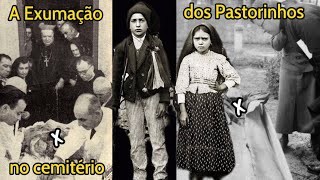
As Our Lady had predicted, Francisco and Jacinta would not live long after the apparitions. Both died young, victims of the terrible Spanish flu pandemic, which devastated Europe at the beginning of the 20th century. Francisco accepted his illness with great peace, offering his sufferings in silence, as Our Lady had taught him.
His greatest joy was being able to spend long hours in prayer, especially before the Blessed Sacrament. On April 4, 1919, at just 10 years old, Francisco passed away at his home, surrounded by his family. He left with the serenity of someone who knew his place was next to God.
Its message is an invitation to contemplative prayer in communion with Christ in the Eucharist. Soon, Francis would become one of the Church's newest saints. Jacinta, on the other hand, suffered even more intensely.
she also had the Spanish flu, but she also offered all of this to God for sinners. Jacinta, a little younger than Francisco, was just 9 years old when her health began to deteriorate rapidly. Our Lady already told her that she would go to two hospitals and that she would die alone, but that God would be with her.
Jacinta was then taken to the Vila Nova de Ourém Hospital, and was then taken to the Dona Estefânia hospital, which is in Lisbon. In the weeks leading up to her death, Jacinta revealed several times that she knew her end was near. On February 20, 1920, at 10:30 at night, Jacinta died alone.
His body was laid to rest in the Church of Angels, in Lisbon, before being transported to Ourém and, later, buried in Fátima. Jacinta's last words reflected her deep union with God and the love she had for sinners, for whom she offered her pains and sacrifices. Lúcia, in turn, would continue her religious life, first joining the Doroteias Sisters and, later, becoming a discalced Carmelite.
She dedicated herself to spreading devotion to the Immaculate Heart of Mary and witnessing the secrets that were revealed to her. We observed that that act of offering to God made by Francisco, Jacinta and Lúcia lit a flame of hope in many hearts around the world. There are those who say that the message of Fátima is not over yet, and that perhaps it is the most impactful text dictated by Heaven since the time of the Gospels.
However, Fátima, by its nature, does not require to be a dogma of absolute Faith. Every year, millions of pilgrims visit the Sanctuary of Fátima. Each with their own reasons and intentions.
Deep down, what everyone seems to seek, in their own way, is to answer that question that Our Lady asked the three shepherd children — a question that still echoes strongly in our hearts: 'Do you want to offer yourselves to God?