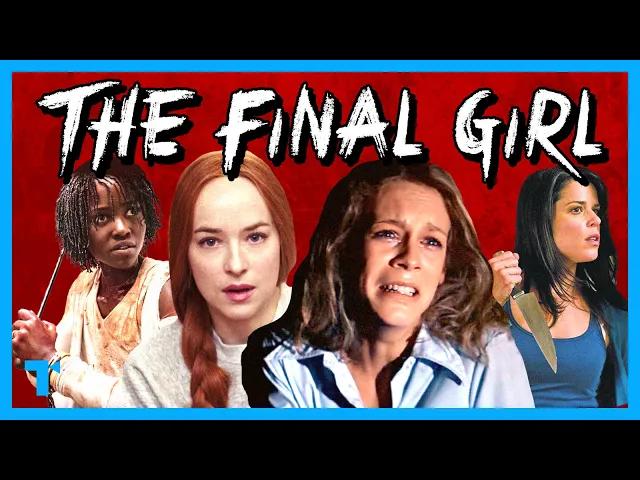
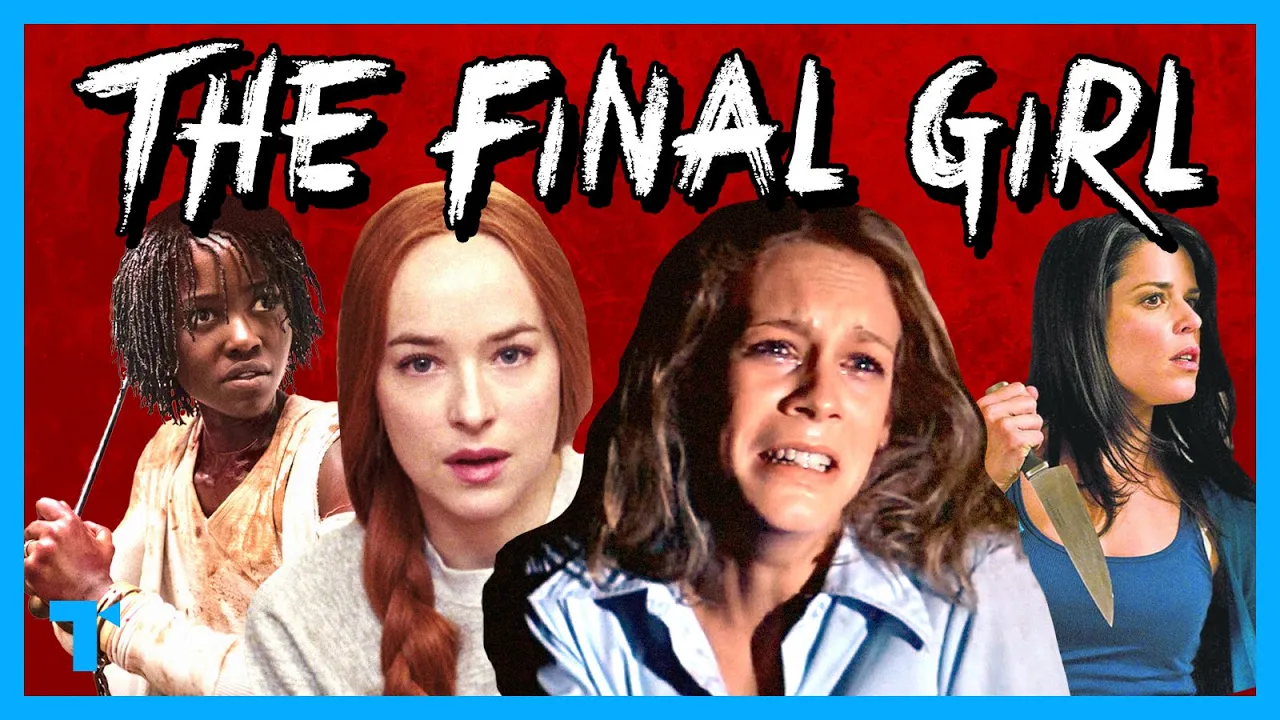
“What the media really loves, baby, is a sole survivor. ” Almost every horror movie ends with one person left to face the villain alone— one final showdown full of catharsis and bloodshed. And usually, this last one standing is a woman.
“You won. ” “What does that mean? ” This phenomenon is so common, it even has a name: The Final Girl.
Coined by professor Carol J. Clover in 1987, the Final Girl has been a staple of horror since the slasher films of the 1970s. And while she may come in many different incarnations, she’s united by a few common traits: The Final Girl is usually a virgin or otherwise doesn’t engage in sex— which often dooms her peers.
“He has been so patient with me, you know, with all the sex stuff. How many guys would put up with a girlfriend who is sexually anorexic? " In fact, she might be a little bit different from other girls.
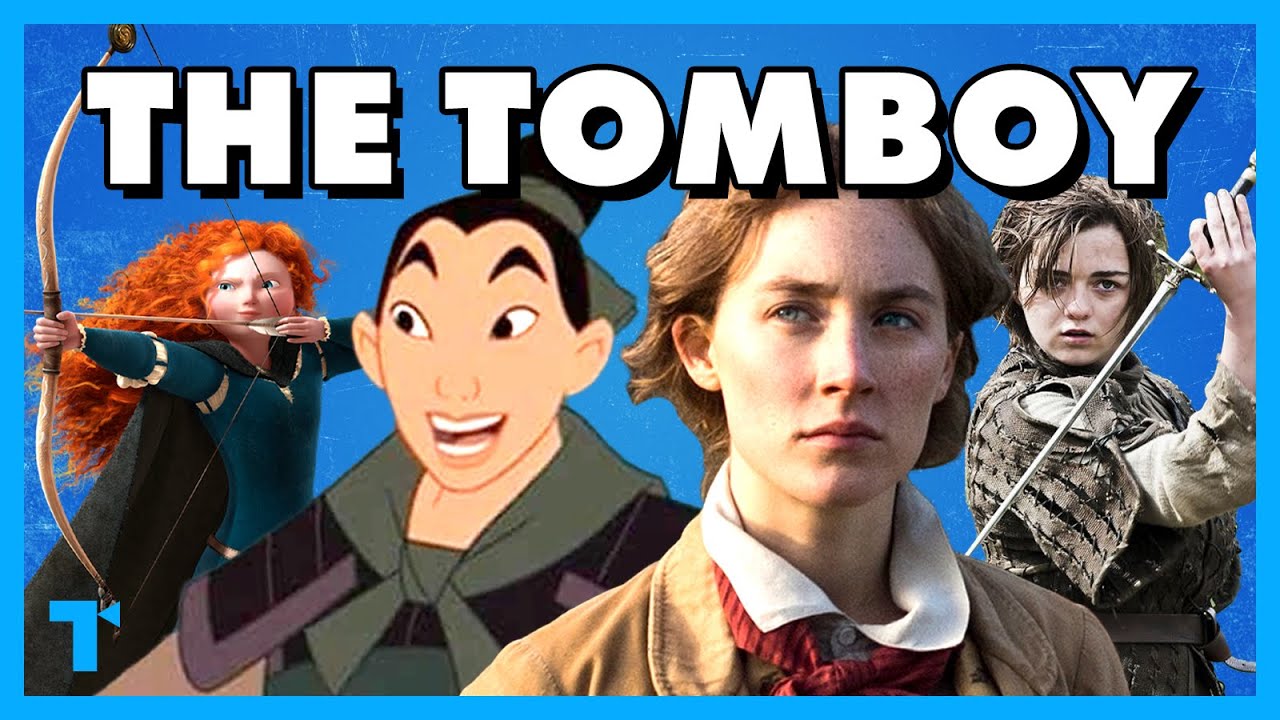
She’s socially awkward, or even a bit of a tomboy. "What if I get bored? ” “These will help?
Soviet Economic Structures? ” She also doesn’t engage in other illicit activities, like drinking or drugs— which leaves her clear-headed and ready to run. Or fight.
In all, she exhibits what Clover calls the “active investigating gaze” of the film: She’s smart, curious, and vigilant— and that’s what makes her a survivor. “We will never be broken. ” The Final Girl can be cunning and clever, outsmarting her enemies.
Or she may just barely make it out alive. Her victory may be short-lived or ambiguous: She may live only to be left forever traumatized. But either way, she vanquishes the killer— at least until the sequel.
“I have to finish this. ” So why do we keep putting the Final Girl through this? What is it about her that makes her special— and is she a symbol of female empowerment, or a victim of regressive attitudes?
“Sex equals death. ” Here’s our Take on the evolution of this trope and what she symbolizes, and how some recent subversions have caused us to rethink the Final Girl— for however long she survives. If you’re new here, be sure to subscribe and click the bell to get notified about all our new videos.
This video is brought to you by Mubi, a curated streaming service showing exceptional films from around the globe. It’s like your own personal film festival, streaming anytime, anywhere. In the early days of horror, women were almost exclusively victims— damsels in distress who were destined to die, unless they were saved at the last minute by a man.
They were vulnerable— and helpless. In F. W.
Murnau’s Nosferatu, the main female character Ellen is clever and tenacious, using her own purity to lure the vampire Count Orlok to his doom. Still, Ellen dies, sacrificing herself to save the world. It would be decades before women fought back against these horrors— and lived to tell their story.
“This is Ripley, last survivor of the Nostromo, signing off. " Carol Clover traces the true dawn of the Final Girl to the slasher films of the 1970s, which gave us young women who stood up to their would-be killers, outwitting and sometimes even subduing them. In 1974’s The Texas Chain Saw Massacre, Sally manages to evade the deadly Leatherface— even escaping her bloody confines twice.
But Sally becomes a Final Girl largely through endurance, and she’s only rescued by chance. Jess in 1974’s Black Christmas became another prototypical Final Girl for fighting back against a murderer targeting her sorority house. “What do you want?
Why are you doing this? ” She was the rare, fully realized woman in a horror movie, one who provides the film’s narrative point of view— yet Jess didn’t totally fit the Final Girl mold, either. For one thing, she’s far from virginal: “I’m going to have an abortion.
” “You can’t make a decision like that. You haven’t even asked me. ” “I wasn’t even going to tell you.
” And although Jess survives at the end, it’s far from certain that she’s won. “It’s me, Billy”. Most of our ideas about the Final Girl were established by 1978’s Halloween: Laurie Strode, played by Jamie Lee Curtis, ticks all the main boxes of the trope.
Laurie is the only one of her friends who’s not interested in sex— or even dating. “Poor Laurie! Scared another one away.
It's tragic, you never go out. ” She’s smart and observant, especially compared to her oblivious friends. “Look.
” “Look where? ” “Behind the bush. ” “I don’t see anything.
” And she’s resourceful, eventually fighting back against a rampaging Michael Meyers with anything she can get her hands on. Although we start off looking at things from Michael Meyers’ perspective, we experience the horrors he commits through Laurie’s point of view. As Clover writes, “By making the Final Girl the film’s POV and de facto hero, even male viewers are forced to identify with her.
” And in a genre that so readily indulges in violence against women, this can be read as a small step forward, forcing men to transport themselves into the psyche of a victimized woman. “You messed with the wrong sisters. ” Still, the representation and empathy the Final Girl provides doesn’t negate some of the trope’s more sexist aspects.
“There are certain rules that one must abide by in order to successfully survive a horror movie. For instance, number one: You can never have sex. ” In Halloween, Laurie’s friends are killed because they’re distracted by sex.
Laurie only survives because she’s far more conservative— and largely sexless. “Guys think I'm too smart. ” The Final Girl is usually the only one who doesn’t give in to her body’s desires— "Glen.
. . not now.
" and as critics have noted, there’s obvious symbolism in the fact that slasher films usually find men trying very hard to penetrate them with phallic objects. When Laurie strikes back at Michael with knitting needles, wire hangers, and knives, she is what Clover calls “phallicized,” effectively becoming masculine— and erasing her female sexuality entirely. The Final Girl did represent some progress from those early horror heroines.
In the ‘80s, women became fighters, not just victims— and in the wake of Halloween, they only became more proactive, cunning, and deadly. Yet in many respects, these women were still being used symbolically. Like Ellen in Nosferatu, they were visions of purity, and their femininity was conflated with abject terror.
As Carol Clover wrote, “Angry displays of force may belong to the male, but crying, cowering, screaming, fainting, trembling, begging for mercy belong to the female. ” “Please, I'll do anything you want. " The Final Girl was a tool: She was used because audiences, presumably, wouldn’t identify with male characters in similar danger.
The Final Girl could fight back, and she lived to tell the story— but it would be a while before she controlled it. “There's a formula to it. A very simple formula!
” Horror is a genre built on formulas— and it wasn’t long before the Final Girl became one as well. With 1996’s Scream, director Wes Craven offered a meta-commentary on the many slasher tropes he’d helped to create through films like A Nightmare on Elm Street— including the concept of the Final Girl. Scream sets Sidney Prescott up to be a typical Final Girl: She’s sweet and chaste— “Would you settle for a PG-13 relationship?
” and she even sees herself as the opposite of a horror film’s usual victims. “They're all the same. Some stupid killer stalking some big-breasted girl, who can't act, who is always running up the stairs when she should be running out the front door.
” But Scream also shows us Sidney isn’t quite as demure as she appears. She may not be totally innocent, either. "During the trial, you did all those stories about me.
You called me a liar. " "I think you falsely identified him. Yes.
" And the film even takes away her purity by allowing Sidney to have sex with her boyfriend. “Now, you're no longer a virgin. You're not a virgin.
Now you got to die. Those are the rules. ” Sidney proves to be a different kind of Final Girl.
She exerts total control over what happens to her— knowing the rules allows her to bend them. “This is the moment when the supposedly dead killer comes back to life, for one last scare. ” “Not in my movie.
” Like all good horror formulas, Scream inspired its own imitators. “Nancy, you can’t be the final girl. You’re the shy girl with the clipboard and guitar.
You get laid and then you die. ” Films like 2015’s The Final Girls and 2011’s The Cabin In The Woods made similar inquiries into why these tropes persist— even as they reveled in them. “The Whore.
She is corrupted, she dies first. Leaving the last, The Virgin” But more importantly, Sidney Prescott helped to usher in a new era for the Final Girl, one where the heroine doesn’t just survive, but thrives. Joss Whedon’s Buffy the Vampire Slayer, both the movie and the TV series, further upended the trope by making the Final Girl a blonde, unabashedly feminine cheerleader— the complete opposite of the virginal tomboy.
Buffy not only defends herself against the monsters— she hunts them. “I've been going out a lot. .
. Every night. ” “Patrolling?
” “Hunting. ” And you can see her empowered descendants in films where Final Girls no longer cower and hide, but run toward the fight. More recent films have taken this agency a step further, giving us Final Girls who are revealed to be in greater control than we— or they— ever suspected, causing us to question our gendered assumptions about their innocence.
In Ari Aster’s Midsommar, Dani seems like a quintessential Final Girl: She spends most of her time isolated from her friends, who indulge in drugs and sex— and meet the deadly fates we’d expect. “I’ll be back. I guess she’s gonna show me.
” Dani also fulfills the role of the active investigating gaze: She’s the only one who seems to suspect that something sinister is going on. “What about Josh though? I'm honestly not too concerned.
” Yet she’s not just the last one standing. In becoming the Final Girl, she’s finally granted the control that her abusive boyfriend has repeatedly taken away from her— and she uses it to punish him, becoming a killer herself. A similar subversion occurs in Luca Guadagnino’s 2018 remake of Suspiria, a tale of witchcraft, dance, and the meaning of authority.
In Dario Argento’s 1977 original, Suzy is a classic Final Girl, snooping in the shadows as a coven of witches kills off her classmates at a dance academy, and escaping through a combination of vigilance and pure luck. But the Susie in Guadagnino’s film has real power: As the witches prepare to sacrifice her, Susie exposes herself as the true leader of the coven, who has returned to exact retribution for the women abusing their power. “For whom were you anointed?
” “Mother Suspiriorum. ” “I am she. ” It’s a reversal that shows Susie not just taking control of her fear, but revealing that she was the source of it all along.
"I came here for this. You've all waited long enough. " Beyond just offering meta-commentaries on the trope, this new era of Final Girls poses a challenge to the structures that have defined them.
The Final Girls in It Follows and The Witch triumph not because they’re virgins, but because they accept and use their sexuality. Jay in It Follows is tracked by a supernatural entity that’s transmitted by sex— a literal manifestation of the Death by Sex trope— yet rather than defeat it by shedding her sexuality entirely, Jay actually embraces and weaponizes it, using sex to free herself. “All you can do is pass it on to someone else.
” Thomasin in Robert Eggers’ The Witch is a virginal, naive teenaged girl who’s repressed by her religiously strict 17th-century society— ”the final girl laced into a Puritan bodice,” as Salon’s Eileen G'Sell puts it. Fear of her blossoming sexuality causes her family to treat her as a villain— “You bewitched thy brother, proud slut! ” until at last Thomasin gives in and becomes one.
“Wouldst thou like to live deliciously? ” “Yes. ” This allows her to claim full agency over her body, in a notably orgasmic climax.
Rather than being “phallicized,” like the Final Girls of those early slashers, the modern Final Girl is empowered by her sexuality. It’s a feminist update to a trope that has long been mired in subjugation. "I am that very witch.
When I sleep my spirit slips away from my body and dances naked with the devil. ” Even as the modern Final Girl may have more agency than those girls of the ‘70s and ‘80s, she remains confined by at least one outdated trapping: The Final Girl is still usually white. “A Black Final Girl?
Sweetheart, they kill folks with my complexion off first. ” Director Alfred Hitchcock once mused, “Blondes make the best victims. They're like virgin snow that shows up the bloody footprints.
” And this attitude has prevailed even in modern, more enlightened horror films, which still depend on the empathy for female victims whose purity is conflated with whiteness. In many ways, this reflects real-world attitudes. PBS anchor Gwen Ifill coined the term “missing white woman syndrome” to describe the disproportionate panic that surrounds imperiled white women.
And we see this reflected in horror films that repeatedly foreground white women in danger, while treating minority characters as disposable: the flip-side to the Final Girl, after all, is the Black Guy Dies First trope. “I’ve seen this movie— the black dude dies first” While audiences are expected to be terrified for the white girl, the deaths of black characters are regarded as just part of the show. As Nerdist’s Tai Gooden has pointed out, “Black women and girls weren’t perceived as vulnerable people whom an audience could identify with as victims of violence because we were barely seen as people at all, much less valuable ones.
” “All I'm just saying is that the horror genre is historical for excluding the African American element. ” Horror films also reflect this in their settings, taking place in the familiar confines of high schools and safe suburban neighborhoods— showing terror invading an idyllic, often lily-white community that believes it’s not supposed to happen here. “Doctor, do you know what Haddonfield is?
Families, children, all lined up in rows up and down these streets. You're telling me they're lined up for a slaughterhouse? ” Films have long treated violence against black people as commonplace— and not especially terrifying.
The black woman is therefore almost never the Final Girl— she is, at best, the close-to-Final Girl, there to offer her support and common sense— “Look, look, stupid people come back, smart people run. We're smart, so we should just get the f-[BLEEP] out of here! ” before she is inevitably dispatched to teach the Final Girl a lesson.
But the recent rise of social horror has begun to challenge this aspect of the trope as well. Jordan Peele’s Us subverts horror’s predominantly white perspective through Lupita Nyong’o’s Adelaide. She’s the rare Black Final Girl, one who’s been assimilated into those safe confines of white society through her wealth.
“Anyways, we should go back to our place. ” “Sure. ” “I think it’s vodka o’clock.
” When that comfort is threatened by a mysterious other— a group of murderous doppelgangers known as the Tethered— it highlights just how much Adelaide has participated in creating the horror she now faces. “If it weren't for you, I never would've danced at all. ” But the film’s twist— that Adelaide is a member of the Tethered, while her doppelganger is the one who really belongs— challenges us to ask who we side with.
“What are you people? ” “We're Americans. ” Adelaide is both villain and victim, monster and Final Girl, and by making us both empathize with her— and feel terrified of her— the film forces us to confront the social constructs that are the film’s true source of horror.
A similar social commentary underpins 2018’s Assassination Nation, in which a group of diverse high schoolers— including transgender model Hari Nef and black singer Abra— become a collective of Final Girls who find themselves under attack by local men over their supposedly loose morals. "So here’s the thing that really bothers me. Who sees a naked photo of a girl and their first thought is, 'Yo, I got to kill this bitch?
'" They not only survive— they violently turn the tables on their attackers, calling on all the other girls to join them in overthrowing the patriarchal terrors they face. And in Sophia Takal’s loose, 2019 remake of Black Christmas, one of the original sources of the Final Girl fully enters the 21st century, as the film’s protagonist, Riley, fends off zombie-like fraternity brothers who seek to keep women in their place— and who targeted her for refusing to keep silent about her own sexual assault. “Women who are willing to be obedient, like your friend here, will be spared.
Those of you who refuse to be compliant will face the consequences. ” In the film’s climax, Riley is joined by an army of multi-racial, multi-gender survivors— no longer alone. The terrors in these films are systemic, affecting more than just one kind of girl.
And they take more than one Final Girl to defeat them. Even as the Final Girl has evolved, she’s remained rooted in ideas about women as inherently innocent— a waiting vessel for the violence the world cruelly inflicts. The Final Girl still feels sadly relevant because violence against women is still rampant in our world.
But whereas former Final Girls were defined by their victimization, today’s Final Girl is a far stronger, far more complex character. She’s a more intersectional representation of not just gender and sexuality, but of race and class, and the many ways in which we are made to live in fear. Today her journey isn’t just about defeating the monster, but finding the strength in herself.
“I can’t change what I’ve done, but I can start trying to be a better person today. ” Tellingly, in the 2018 version of Halloween, Laurie Strode is no longer just a survivor— she’s a warrior, forever prepared to fight. “Happy Halloween, Michael.
” The terrors that women must endure haven’t subsided, but the Final Girl will continue to stand up to them— to the bitter end. “I take back every bit of energy I gave you. ” Hi everyone.
I’m Susannah. I’m Debra and we’re the creators of The Take. Please subscribe and tell us what you want our take on next.
This video is brought to you by Mubi, a streaming service we love. Mubi is a treasure trove of films. Every day Mubi premieres a new film.
Whether it’s a movie you’ve been dying to see or one you’ve never heard of before, there’s always something new to discover. So in this world where it’s very easy to spend hours debating what you should watch, Mubi is like having a really cool friend with amazing tastes in movies, making it so much easier for you. They feature hard to come by masterpieces, indie festival darlings, influential arthouse and foreign films, lesser known films by your favorite famous directors, and more.
Plus you can even download the films to watch offline and there are no ads, ever. This October, check out Trick or Flick: Halloween Horror in the Mubi library, a collection of timeless horror films from throughout film history. The selection includes classics like Mario Bava’s Black Sabbath and Dario Argento’s Inferno, as well as innovative genre-bending titles like Claire Denis’s Trouble Ever Day and Bill Gunn’s Ganja and Hess.
We can’t recommend Mubi highly enough. You can try it out now for free for a whole month! Just click the link in the description below.