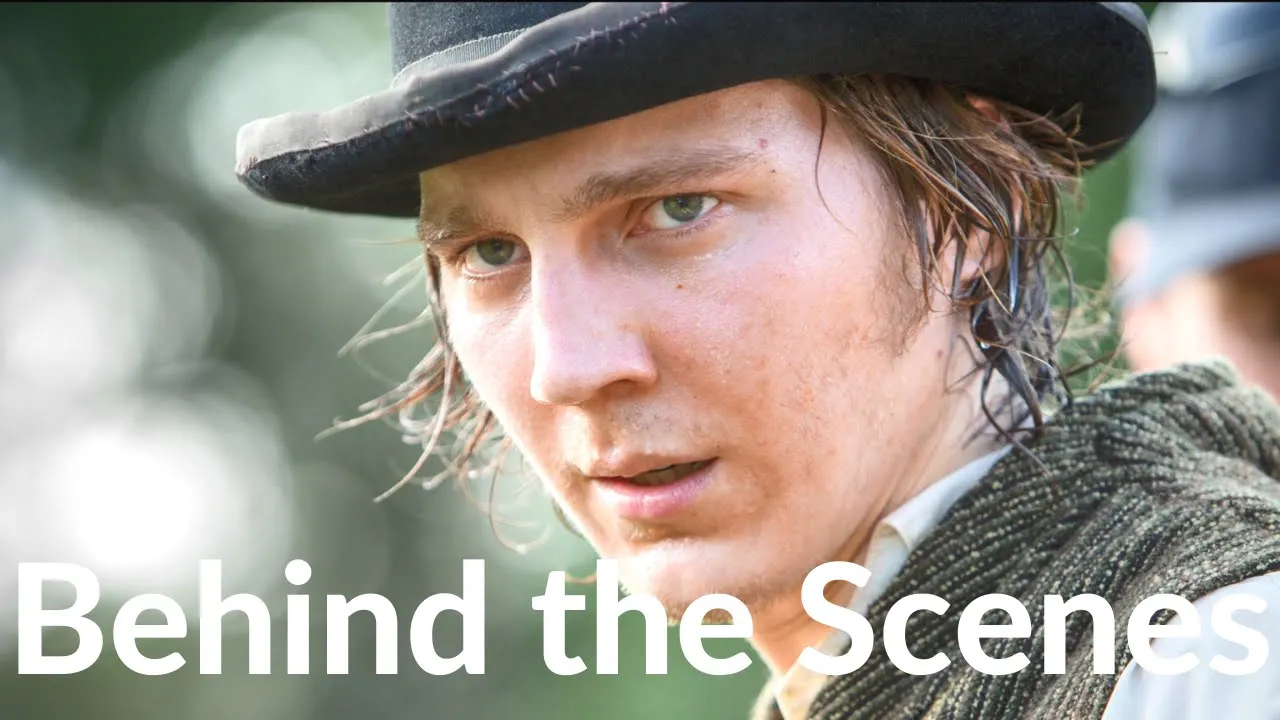
hi I'm sure a Taleggio for we're here in London at the Young Vic Theatre or I am performing at the moment doing a play called the season in the Congo playing Patrice Lumumba today however I'm going to be reading excerpts from the book 12 years of slave by Solomon Northup I can speak of slavery only so far as it came under my own observation only so far as I have known and experienced it in my own person my object is to give a candid and truthful statement of facts to repeat the story of my life
without exaggeration leaving it for others to determine whether even the pages of fiction present a picture of more cruel wrong or severe a bondage [Music] Oh big this guy's big there's gotta my ancestors were slaves babe from the Caribbean and I wanted to let story about slavery and I wanted to find an interesting angle in into the narrative and I thought about a free man a man who has a family who is kidnapped into slavery and the reason why to his ankles I wanted that person to be everyone in the audience and I was I
was thinking about the idea my wife Judy why don't you sort of look for an actual story on slavery I thought okay that'd be that'd be great I did cause a millions about out there and my wife found this book for 12 is a slave so I was so excited about it was when I open the book I read it and it just couldn't stop it just grabbed me the birth of this will just make a great film and there it was having been born a free man and for more than 30 years enjoyed the
blessings of liberty in a free state and having at the end of that time been kidnapped and sold into slavery where I remained until happily rescued in the month of January 1853 after a bondage of 12 years it has been suggested that an account of my life and fortunes would not be uninteresting to the public between 1760 in the end of the Civil War there were 101 books written or dictated by people who once were slaves and then escaped to the north and of that 101 the only one that addresses the experience of a free
man or woman in the North who was kidnapped into slavery in the south and then made it back to freedom in the north is Solomon Northup whereas originally published in 1853 before the Civil War of course and it's very interesting because his attention to detail in the book shows just how curious he wasn't what an intelligent person he was because he records every little detail that happened to him I could spot a fictional slave narrative a mile away and there are a few of those but this has a level of verisimilitude Solomon Northup obviously had
a photographic memory the level of detail is incredible no white man writing in upstate New York could have fabricated this there I really have no doubt that the story is true the vast majority of everything in his book checks out and holds up to historical study it's such an extraordinary story and it's so moving and it's got a real structure to it and it instantly gave us the perspective we wanted which was a period of time long enough to really understand or investigate what slavery was and what it meant sort of on a day-in day-out
basis and so then we embarked with that as our starting point mr. Northup I have two gentlemen whose acquaintance you should make misters Brown and Hamilton sir Steve did hunger and then he did shame but it almost feels like he's been working you know for a much longer time it has a much bigger body of work his vision you can see it in the way he constructs the movie in the way he approaches the film Steve initially rejected the concept of voiceover because it's told in the first person that that certainly was one possible way
to go Steve and he immediately knew he didn't want to do that I think he had a very clear vision about how certain things were supposed to be and there were certain emotional elements he knew he wanted for example he was obsessed with the notion of writing a letter putting us in a place where the act of writing a letter is life or death we live in an age now where communication has just taken for granted I mean we communicate every little thing so easily to our friends or to a co-workers even to people that
we never met before that's the whole idea this was a time in a space where freedom and family was separated for want of a pen and ink and a piece of paper and as a writer as a communicator the idea that that was the difference between freedom and slavery that was some that really really attracted me to this story if we could persuade you to accompany us as far as Washington we could give you $1 feed state services and $3 for every night plate adapter lawrence's I had once accepted the tempting offer both for the
reward it promised and from a desire to visit the metropolis they were anxious to leave immediately thinking my absence would be brief I did not deem it necessary to write to an whether I had gone in fact supposing that my return perhaps would be as soon as hers [Music] welcome to Washington so I knew it was shoot oh I knew it was him and I've been watching him for a long long long time and I just felt that he was able to sort of reach that kind of performance he's it's an ability and nobility to
sort of hold the camera and hold the whole film together I was sent to unruly script of 12 years of slave by Steve McQueen and that was the first time that I've become in any way familiar with Solomon Northup obviously when I found out that it was a base to my autobiography and I read it and found it to be standing absolutely staggering and was amazed that I hadn't come across it before there was just a very deep honesty to the writing as well as poetical flair generosity is extraordinary and your talents are undeniable to
Solomon cheers Cheers Solomon's story is not a pure slave narrative he was a freed man he was an incredibly educated man the language that he used the things that he talks about the way that he documents his store in the way that he documents the people that he interacted with is so incredibly well-written you will feel as well and refreshed as if the earth were new again but for me it was an honor a privilege to make the book into a film every turn of the page you saw the images you saw a yearning and
the unfulfilled month and the hunger and the ugliness and the cruelty ruined it I read like a very sort of dark fairy tale in a way and in fact at the time I thought myself this is like the Anne Frank book of America well boy how you feeling now dick from the beginning if you sign on to make a movie with Steve you know he's not gonna pull any punches he's really not interested in making things more comfortable for a viewer and I really appreciate and admire that yang free man you know but a Georgia
runaway and the research that we did which we did a ton of to attest to it it was this horrible it was this unrelenting it was vicious it was deeply violent I thought I must die beneath the lashes of the accursed brute even now the flesh crawls upon my bones as I recall the scene I was all on fire my sufferings I can compare to nothing else than the burning Agony's of hell to me I was just very conscious that he would never have forgotten those first moments of violence and they would be imprinted on
his memory throughout the rest of his life so it was important to me it was important to Steve obviously it was important that we feel it the violence of it I don't want to hear a word after 18:08 the importation of slaves from Africa into the United States had been banned by the federal government that meant that the supply of slave labor was limited and consequently people with criminal minds or alcohol we realized that if they could kidnap a free black person and get them into the south they could make a lot of money days
ago in my home now you tell me all is lost the book was a very strong starting point for understanding the background of Solomon's journey but I felt that it was important as well to understand slavery in its full context and the history of it and how it became an incredibly fully functioning and extraordinarily sophisticated way of dehumanizing people by putting them through a kind of milk to really become property and there can be no intellect no rebellion there can be no sparks of individuality amongst the owned people the description given I didn't you insolent
called your name is Platt fool Jumanji is a real actor that's okay go for it and he was like a tornado he's like no whizzing around all these rooms and doing these things I mean I had living things adding things you know and work on it I sake do this to this and he would take it in directions amazingly do this - this was dick he's just taking any stride follow me please yes inspector actually sure but I asked you to pay particular regard to young as right here and then the confidence he had to
to manhandle people was very important - very very important but the people will be maybe nervous to slap someone at someone no he wasn't I said this is what I'm humble we need to go in there and watch sort of you deal with them in the way that they would be dealt with then he was amazing I don't need any punches as women tell the truth so it's livestock it's like animals it's like anything else and that's what I wanted to do so it was very brutal I mean yeah all the time the trade was
going on Eliza was crying aloud and wringing her hands she besought the man not to buy him unless he also bought herself Emily she promised in that case to be the most faithful slave that ever lived the Matt answered that he could not afford it and then Eliza burst into a paroxysm of grief we paint plaintively Freeman turned round to her savagely with his whip in his uplifted hand ordering her to stop her noise or he would flog her the selling of Solomon Northup analyzer to must afford was a very interesting sequence to shoot customers
going into this building and people trying to set up a store and you know a guy in the kind of manner of a sort of used-car salesman trying to present his wares to various people and there is something polite about it there is something formal until the children are taken away from Eliza which is when the veneer snaps and it becomes a very revealing moment obviously a heartbreaking moment but also very revealing of the psychological damage that is happening on every level of the whole society Steve in my opinion he's an actor's director and he
really loves working with actors talking with us and asking questions and so he set up rehearsal time like every week if we at first things were coming up in that particular week it just more so just to get together and just talk and you know be with other actors and we actually had meals together and shared laughter and talked and but then we went to shoot those really hard seeds I don't know because of those funny experiences they made all the difference to do that character Eliza is very difficult because gestured to be in a
state of despair for most of her performance and the pull that off is pretty I mean feat but also at the same time to turn and to create that disband into strength and also to have a discussion the argument was almond can really ask morning have you stopped cry for your children that's what I had to keep reminding myself of during shooting when it was really challenging is the fact that we're portraying people that actually lived I read a lot of slave narratives particularly those that were written by women researched a lot of pictures especially
of children had a lot of pictures of slave children and anything I can do to just immerse myself in that time period and get first-hand accounts that's pretty much I was interested in let me wait for my sword it is really challenging to step into those just really complex deep places really painful but is what I love about acting in it and it really pushed me I learned a lot about myself as an actor and I especially learned what can happen if I just trust I am the God of Abraham the god of Isaac and
the God of Jacob there never was a more kind noble candid Christian man than William Ford the influences and associations that have always surrounded him blinded him to the inherent wrong at the bottom of the system of slavery he never doubted the moral right of one man holding another in subjection I can only see must afford in the context of the way that Solomon sees obviously for anybody to have slaves you know disqualifies them from my affection even retrospectively you know but through Solomon's eyes I think it opens up a very fascinating picture which again
speaks to just a collective humanity great thanks master thank you very interesting to try and understand the world through Solomon's eyes initially through the book and then to try and see it from from my character's point of view through through other research I've been looking into how and why land was cultivated what kind of grants were handed out by the government and food was one of the first actually to ever get a grant in Louisiana I discovered so he's obviously a very trusted capable man so that was a good key into being as someone who
has pragmatism on his side well I'll admit to being impressed even if you won't there's some sensibility about bandit which translates very very very well for that character fort because it's a duality there's a moral dilemma you know this is what's going on with him all the time all the time and he has to he has to type somehow make sense with it with it with himself [Music] Solomon's journey is an odyssey and it spreads over twelve years and he encounters all these different people and these different lives and these different experiences and what that
meant was as an actor is that I was going on a journey week to week with different actors coming in to play all these different parts and it was kind of great fun it was always exciting at the end of every week that new people would be coming in to then have these completely different experiences with for all you wrong [ __ ] that don't know my name is John Tippy's William Ford's chief carpenter you will refer to me as master my character is not likable and when I first read it it felt a little
daunting just because treating people this way is hard but you just look into the person and try and find why they might be like that I got the impression and appalled about it that tipis know it's a person who it's been brutalized - I thought he's someone who's a very hard father and he was brutalized because it was just too easy playing this bad guy without some kind of background sound or some kind of idea who and why that person was doing what he's doing other than the fact that he hates black people I mean
you know I have to be a little bit more interesting than that once you step foot on the set a lot of the work starts to happen for you just because you see the plantation and see the buildings and the extras and what Solomon looks like in those clothes and we're out there in the heat working away your dog Paul then it was terrific great to work with and mean as tibeats you know mean which I thought was probably just very honest of their relationship that he was threatened by somehow as soon as she started
to realize that the guy is sort of more than the slave if there's something wrong it's wrong with the instruction winding the lash around his hand and taking hold of the small end of the stock he walked up to me and with a malignant look ordered me to strip Master tibeats said I looking him boldly in the face I will not I was about to say something further in justification but with concentrated vengeance he sprang upon me seizing me by the throat with one hand raising the whip with the other in the act of striking
Solomon feels his name to lose so at that point erupts it he explodes let me explode in a way which when I read the book for the first time my jaw dropped and this was one of those moments where I think the whole audience figured oh no I will when I first read the script the one scene that stuck with me and from from the first time I read I thought this is the pivotal scene of the whole film is when Solomon is hung and is left hanging for the better part of a day and
it really from a visual point of view I thought this is just so powerful to see a person on the edge of life so cruelly suspended and the whole world just moves around him as if he doesn't exist as the Sun approached the Meridian that day it became insufferably warm it's hot Ray's scorched the ground the earth almost blistering the foot that stood upon it but I was yet bound the rope still dangling from my neck and standing in the same tracks with tibeats and his comrades left me I could not move an inch so
firmly had I been bound for the hanging sequence I think as you can see in the film its ort of took a while of being up there and it was a brutal shooting day but again I felt that it was so important to Solomon's journey and to really for me it was good to really get into understanding some of what that must have felt like and some of the tension some of the fear some of the uncomfortableness and there was something that I felt after that that I was connected to with him which was very
strong for me there was a silence and said there was a some seriousness onset which we needed of course get it done but as far as emotions are concerned and physical reactions to certain things are that that often happens after the fact because I'm so focused on getting it done that is a conversation I had with Steve before we started that he was very deliberately thought that that long shot would be held without music there would be no comforting music to kind of make it tick past any quicker that there would be a slightly hallucinogenic
feeling and we used the cicadas we recorded them specially so that they became the kind of insect Orchestra and rosin fell and that was one of the amazing things about working Louisiana is you just hear this enormous 360-degree swell of insects and later in the day they have different sort of patterns that you get used to so we wanted to use that as a sort of oppressive environment just at sunset my heart leaped with unbounded joy as Ford came riding into the yard his horse covered with foam Chapin met him at the door and after
conversing a short time he walked directly to me poor Plant you are in a bad state is the only expression that escaped his lips thank God said I thank God Master Ford that you have come at last whatever the circumstances you are an exceptional [ __ ] Platt but I fear no good will come of it there's definitely a break in the film at that point after the hanging which is when everything takes an accelerated kind of leap forward you know a deeper Louisiana where cotton-picking as well we're into a real sense of the complex
and brutal reality of slavery with somebody of the nature of Edwin Epps and that servant which knew his Lord's will and prepared not himself neither did according to his Will shall be beaten with many stripes that Scripture you