The Milky Way is home to millions of potentially habitable planets. Our observable universe likely contains billions more. Many theorists believe that at least a few of those planets are inhabited by intelligent life, perhaps by a species far more advanced than humankind.
In science fiction, we imagine aliens flying at light speeds across the cosmos, living in supercities and megastructures floating through space. These fictional empires paint extraordinary pictures of the most advanced civilizations in the universe, but if a hyper-advanced civilization did exist, how would they actually behave? — and how powerful might they be?
For any civilization, energy is among the greatest drivers of progress. New energy sources historically spark periods of rapid development, leading to intelligence explosions and critical innovations. Greater energy consumption is also correlated with increased production, efficiency, and societal development.
In multiple areas, energy is a significant driver of progress, so we sometimes classify civilizations on a scale based on their total energy consumption. This scale was developed in 1964 by Russian astronomer Nikolai Kardashev. While experimenting with radio waves, Kardashev wondered how powerful an extraterrestrial signal must be in order to reach our devices here on Earth.
Moreover, what kind of civilization could create such powerful waves? On this foundation, Kardashev designed the famous Kardashev scale, which classifies advanced civilizations as one of three types. Type I civilizations can harness all major forms of energy on their home planet, like solar, wind, and nuclear energies.
Type II civilizations can extract much of the power of their system’s star, using and storing energy at the scale of their solar system. Finally, Type III civilizations consume a significant portion of the energy from their parent galaxy. As far as we know, humanity is the only advanced civilization in the universe, but we’re nowhere near the highest level on the Kardashev scale.
Compared to theoretical Type II or Type III civilizations, humanity is a young, developing species. According to astronomer Carl Sagan, humanity measures approximately 0. 7 on the Kardashev scale.
In other words, we are effectively a Type 0 civilization, but we may achieve Type I status within the next few centuries. According to optimistic predictions, humanity is trending toward higher-order systems necessary for advancing our species. For example, a Type I civilization may possess a universal communication system, like the Internet today.
A universal system may empower the rapid spread of knowledge, driving that species toward cultural and scientific evolution. Humans may be progressing, but there are still countless obstacles our species must overcome. For example, humans are facing environmental barriers that threaten the long-term habitability of Earth, a problem we must solve if we want to continue to grow and flourish as a species.
A theoretical Type I civilization may have near-complete control of its planet, modifying the climate and neutralizing natural disasters like hurricanes and tornados. A Type I civilization may also consume diverse sources of planetary energy, harnessing the power of volcanos and mastering nuclear fusion. It may take centuries or more for humanity to reach these critical thresholds and finally become a Type I civilization.
But what if another species in the universe has already climbed to the highest level on the Kardashev scale? At this point in the video, it’s important to point out that the following hypothetical scenario will be highly speculative. The technological advances mentioned represent popular ideas in the modern futurism discourse, and they’ve been theorized by real experts.
However, that doesn’t mean these advances will ever be achieved, or are even possible to achieve. And yet, there’s something in all of us that seeks to imagine the future – so let’s do it. In a faraway galaxy containing billions of star systems, let’s imagine a hypothetical species called the Devorian Empire.
The Devorians are not only a spacefaring, highly intelligent species, but they have advanced to the level of a Type III civilization. They have conquered much of their galaxy, harnessed the energy of thousands of stars, and transformed into the most advanced civilization in the universe. Like humans today, the Devorians were once bound to a single planet.
Over time, they exhausted all the energy from their terrestrial host, so they began gathering energy directly from their parent star using massive theoretical structures in space, like the famous Dyson Sphere. A Dyson Sphere is a conceptual megastructure made of rotating platforms that encircle a star and capture its total energy output. These gigantic energy collectors may also function as artificial habitats, where millions of spacefaring creatures live around their parent star.
To advance from a Type I to a Type II civilization, the Devorians constructed their version of a Dyson sphere at the center of their solar system, harnessing most of their energy from a single star. This kind of mega-engineering is far greater than anything we can accomplish today, but for a higher-order civilization, Dyson spheres may be within their reach. Any civilization capable of cosmic mega-engineering has likely mastered space travel.
They may navigate between planets and stars inside hyper-efficient spacecraft with advanced propulsion systems. These systems may resemble theoretical concepts like photonic engines and fusion drives, thought to produce enough power and thrust for interplanetary travel. With such powerful craft at their disposal, a civilization like the Devorians may efficiently harvest resources from distant planets, moons, and asteroids.
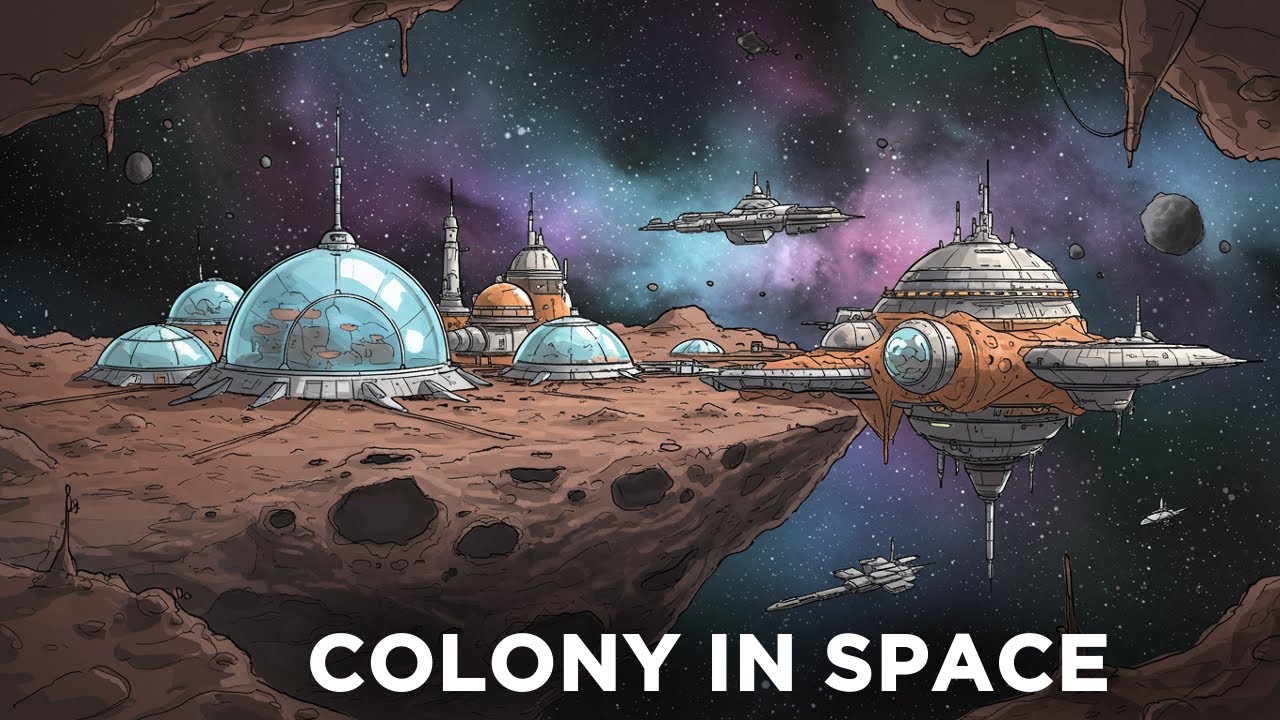
They may journey to planets and stars outside their home system, reliably transporting resources and settlers between interstellar colonies. In each new system, they may construct additional Dyson structures, harnessing even more energy and influencing diverse regions of the galaxy. The powers of such an advanced civilization may far surpass the limits of our comprehension, solving incredibly complex problems and designing technology that would baffle the greatest human scientists.
Over millions of years, a civilization like the Devorians may have experienced multiple explosions of innovation that irreversibly accelerated their physical and technological evolution. Breakthroughs in biotechnology and artificial intelligence may have led to the convergence of organic and cybernetic forms. Joining their brains with artificial intelligence, the Devorians may be a globally integrated society, pooling their intellectual resources into a collective consciousness or hive mind.
The Devorians may think and act as one expansive entity, enabling higher forms of communication and problem-solving. As a collective, the Devorians may overcome critical obstacles limiting the development of interstellar civilizations, like traveling some fraction of the speed of light. According to Einstein’s theory of special relativity, no object can travel faster than the speed of light, as doing so would require infinite energy.
Even if an object could travel closer to the speed of light, it would take years to journey between stars and hundreds of thousands to traverse entire galaxies. However, a hyper-advanced civilization may discover ways of more efficiently colonizing the cosmos. To enable rapid expansion, the Devorians may create fleets of self-replicating robots, like Von Neumann probes, that autonomously explore distant star systems.
These probes may land on faraway planets and moons, using local resources to build factories, which create more probes and other robots. Like a virus spreading inside a body, a single probe may generate thousands of copies of itself that disperse throughout the galaxy. Some probes may create maps and gather data, while others may occupy planets or assemble megastructures around distant stars.
One of these probes may discover evidence of other life, perhaps a Type 0 civilization like humans. A more hostile empire may destroy young civilizations before they become spacefaring, but the Devorians aim to nurture diverse life in the universe. So, the probe becomes dormant on a nearby moon or planet until the emerging species reaches the first level on the Kardashev scale.
Imagine an alien probe hiding in our very own solar system, waiting patiently for us to evolve and expand. As Devorian probes collect information and encounter new species, they send data back to a massive supercomputer, similar to a Matrioshka Brain. As large as a star, this theoretical mega-scale computer contains multiple, nested layers of Dyson spheres, which convert stellar energy and heat into computational power.
A Matrioshka Brain would operate on a scale of computational power unimaginably greater than today's most advanced supercomputers, perhaps simulating virtual universes where other intelligent species unknowingly live and die. While theorists have proposed many different extensions to the classic three levels of the Kardashev scale, these extensions live in the realm of pure speculation and pure science fiction. We can hardly begin to imagine the capabilities of civilizations harnessing energy on the scale of multiple galaxies.
Such profoundly advanced beings may engineer structures as large as solar systems. They may alter the geometry of the cosmos, creating unnatural shapes like the Klemperer Rosette. They may somehow bend, warp, or tear the fabric of spacetime, creating wormholes to traverse the universe.
These would be godlike beings when compared to humans. But in all likelihood, such extraordinary ideas will only ever exist in the mind. Still, we can dream about these astonishing technologies and the advanced civilizations that may wield them.
If a species like the Devorians did exist somewhere in the universe, their powers may be greater than anything we can possibly imagine.