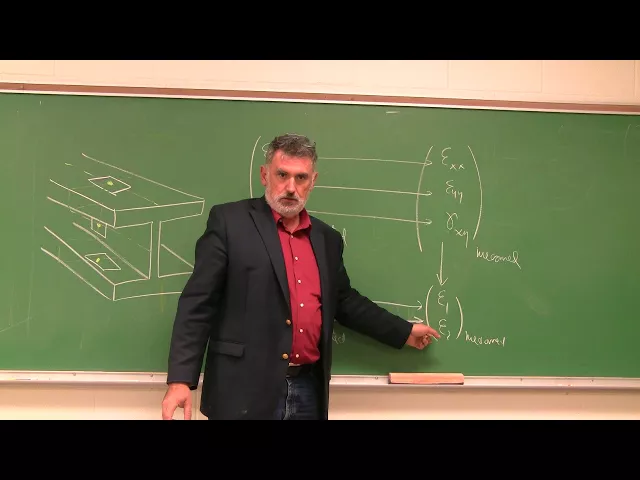
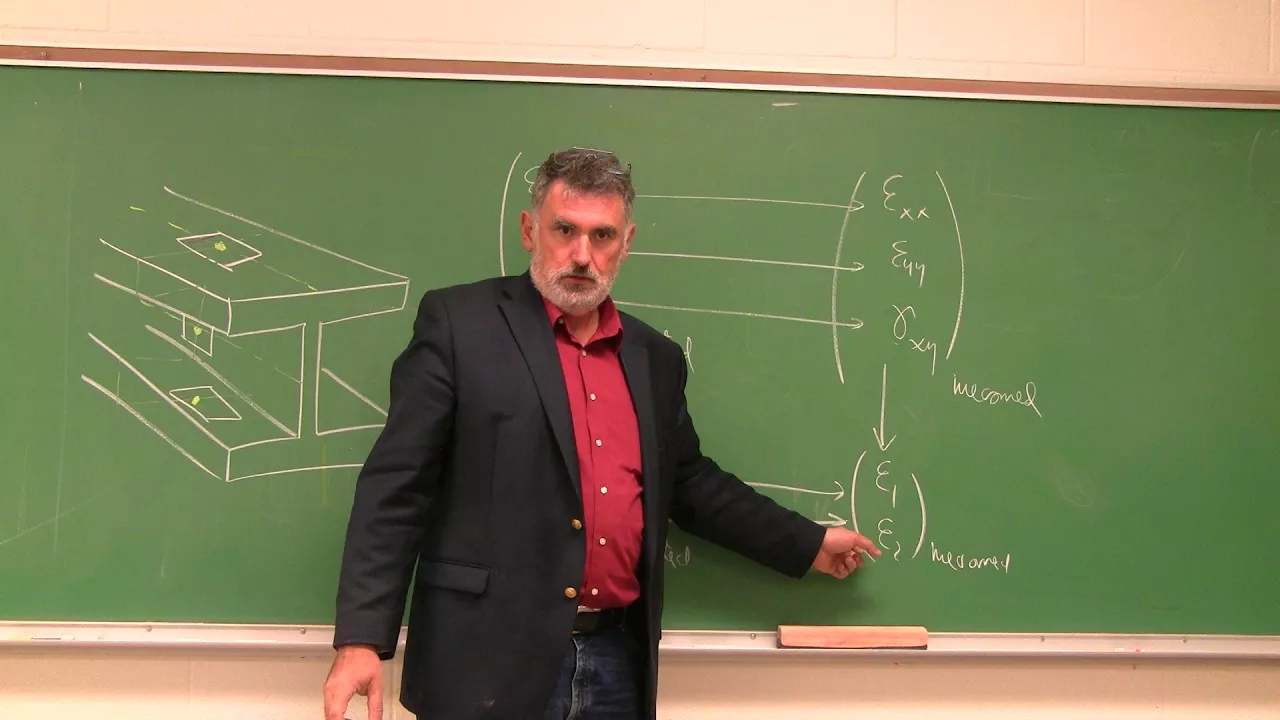
things that you're going to get from your theory you're going to predict epsilon 1 and epsilon 2 the predicted principle strains and from E is measure stranger then compute epsilon 1 and epsilon 2 measure and that's what you're going to compare one by one so the comparison in your lab report is going to be performed between the principal values of strain predicted and the principal values of strain measures and the location Center location and bottom location for the cross section where you have bending which shear and the for the cross section where you have pure
Bend and from this comparison you're going to be able to accurate endure conclusion as to how well your predictions are validated by your measurements so here's an example of you using your abilities to measure strain using a transducer a wire resistance based transducer to accurately measure strength and therefore verify that your predictions in terms of strain are correct which involves Hookes law which assumes that linear behavior of the material now you know that the for low stress levels the material behaves linearly from strength you go back to stresses that are predicted and from stresses you
go back to the hypothesis that's formed the prediction basis which is Bernoulli's hypothesis and you very verify draw some conclusions about that so that's the plan for the expert that's the plan for what you're going to do we'll stop here we'll continue in a second from the a machine to see exactly what your computer