In the world of elite mathematics, there is a standard script. You show brilliance by age 5, master calculus by [music] 10, and claim your place among the legends before your 25th birthday. It is a young person's game, a sprint.
But Jun Ha didn't follow the script. He threw it away. In high school, he wasn't a mathematics star.
He was a dropout. He wanted to be a poet, [music] not a professor. In college, he spent his time wandering, unsure of his path, failing more mathematics tests than he passed.
To any observer, he was a late bloomer at best and a lost cause at worst. Yet at age 39, this failed poet stood on a stage in Helsinki to receive the Fields Medal, the Nobel Prize of Mathematics. How did a man who started serious mathematics at age 24 [music] solve a riddle that had paralyzed the world's greatest minds for nearly half a century?
How did he find a hidden bridge between two mathematical universes [music] that were never supposed to meet? Today we explore the incredible journey of June Ha, the man who proved that sometimes to see the pattern you have to be willing to look away from the numbers. To understand the brilliance of Jun Ha, you first have to understand his silence.
Born in California but raised in [music] Seoul, June grew up in an environment where academic excellence wasn't just encouraged. It was the [music] baseline. But for June, the rigid structure of the classroom felt like a cage.
He once famously recalled that he tried to learn mathematics by wrote memorization [music] because he simply didn't find it interesting. In high school, he didn't just struggle, he checked out. He dropped out to write [music] poetry, seeking a form of expression that felt real.
Even when he eventually returned [music] and enrolled at Soul National University in 2002, he didn't major in mathematics, he chose physics and astronomy. His college years [music] weren't a victory lap. They were a crawl.
He was, by his own admission, a depressed student. He skipped classes, received poor grades, [music] and felt like an outsider in the very halls where he was supposed to find his future. He spent six years as an undergraduate drifting through a sea of equations that didn't yet speak to him.
Then in 2007, everything changed. Jesus Hiaka, a giant of the mathematical world, a Japanese mathematician who had won the Fields Medal [music] in 1970 for his work on the resolution of singularities. He arrived at SNU as a visiting professor and most students were too intimidated to even look at him.
But June June didn't have a reputation to protect. He didn't have a deep mathematical foundation to be proud of. He was simply a journalist aspirant who thought he might get a good story out of a legend.
He walked into Hanaka's classroom [music] not as a prodigy but as an observer. Hiaka's teaching [music] style was unconventional. He didn't lecture from a textbook.
He talked about his own research, the problems he was currently failing to solve. For the first time, June didn't see mathematics as a series of tests to pass. He saw it as a living, breathing process of discovery.
Hanaka saw something in June that others had missed. A blank slate. Because June hadn't been trained the traditional way, he didn't have the same mental blocks as other students.
Hanaka took him under his wing. They began eating lunch together every day. Hanaka talked.
June listened. In those quiet lunches, the failed poet began to see that mathematics wasn't about numbers. It was about structure.
It was about the very thing he loved in poetry, finding the hidden rhythm of the universe. Under Hanaka's mentorship, Junha didn't just catch up on mathematics. He began to see the world through Hanaka's eyes.
A world where singularities weren't just errors, but gateways to deeper truths. But the academic world is skeptical of late bloomers. When June applied to a dozen American PhD [music] programs, almost every single one of them looked at his transcripts and his unconventional path and said no.
In 2009, Jun Ha arrived in the United States. He was a 26-year-old PhD student, an age when many top mathematicians are already finishing their most famous work. To the admissions committees at the universities that rejected him, his transcript looked like a mess.
But June had a secret weapon. He wasn't thinking like a mathematician. He was thinking like a poet who had been trained by a master of shapes.
Within his first year at Illinois, June stumbled upon a problem that had remained unsolved for 42 years. Reed's conjecture. To understand Reed's conjecture, you have to understand graph coloring.
Imagine a map or a network of dots. Your goal is to color every dot so that no two dots connected by a line share the same color. Mathematicians use something called a chromatic polomial to count how many ways you can do this using a specific number of colors.
It looks like a standard algebraic equation, a string of numbers and variables. In 1968, a mathematician named Ronald Reed noticed something strange about these equations. If you look at the coefficients, the numbers in front of the variables, they always seem to follow a specific pattern.
They would increase, hit a peak, and then decrease. But more importantly, they were unimodal and log concave. Log concave is a fancy way of saying that for any three numbers in a row, the middle number squared is always greater than or equal to the product of its neighbors.
It sounds simple, but for 40 years, no one could prove why this happened for every possible graph. The world of combinotaurics, the mathematics of counting discrete things, simply didn't have the tools to explain it. This is where Junha's aha moment happened.
While most researchers were looking at the dots and lines, June was looking at the shapes behind the dots. Now, before we get into how Junha cracked a long-standing mathematical mystery, a quick reality check. Over 80% of you watching right now aren't actually subscribed to the channel.
It's a small click for you, but it's the only way we can keep telling the stories of these legends. If you enjoy deep dives into the minds of the 1%, [music] hit that button. Let's get back to the math.
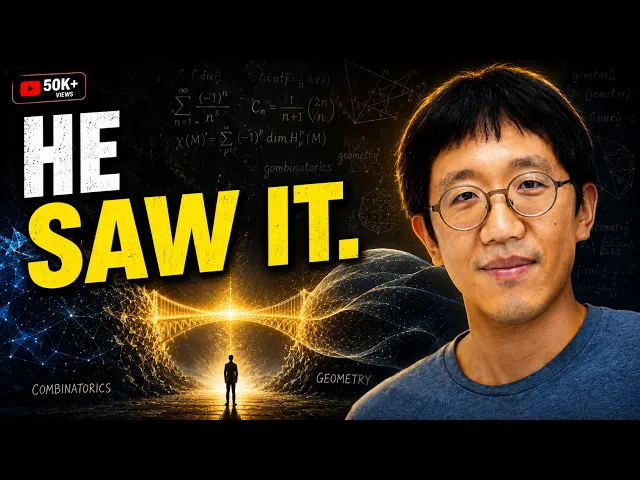
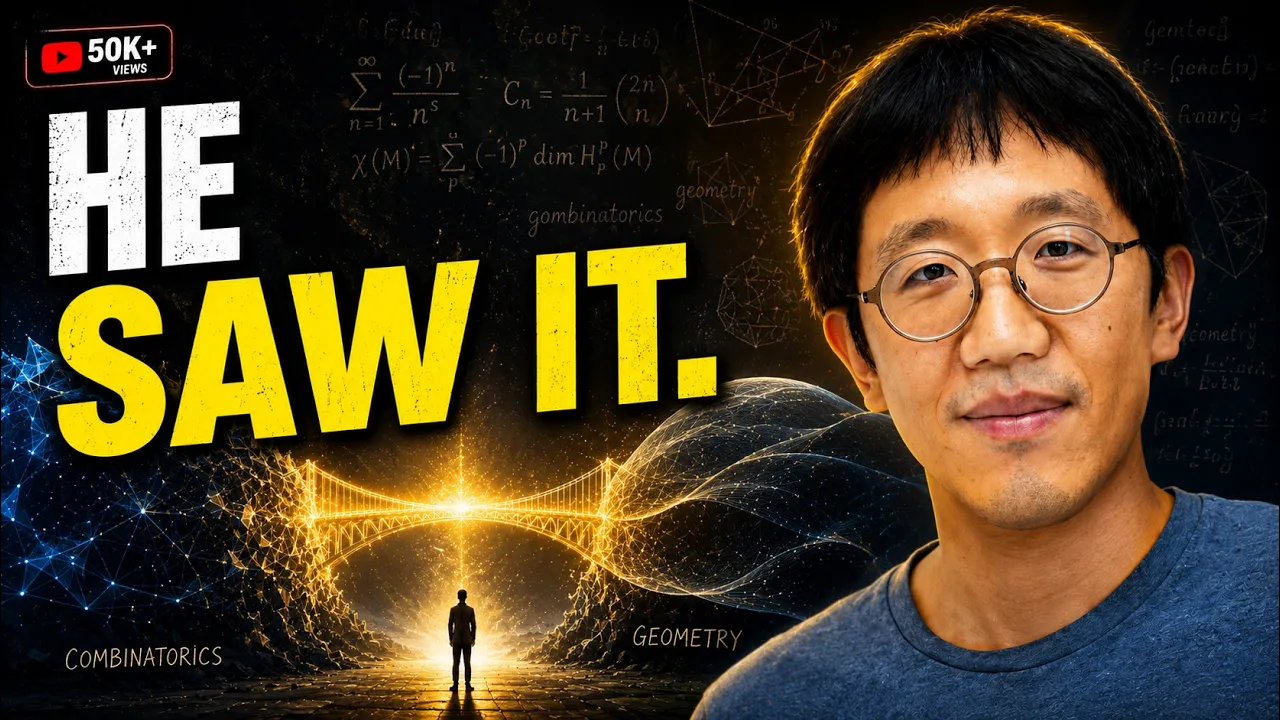
He realized that these discrete counting problems in combinotaurics were actually shadows of much larger, smoother structures in algebraic geometry. He saw that the log concavity Reed had noticed wasn't just a coincidence of counting. It was a fundamental property of how highdimensional shapes are built.
June used a powerhouse of geometry known as Hodgej theory. He treated the graph's properties as if they were the physical features of a geometric shape. By proving that the shape had to be concave due to its geometric nature, he automatically proved that the numbers in Reed's conjecture had to follow that same bell curve pattern.
It was a revelation. He hadn't just solved a puzzle. He had built a bridge between two islands of mathematics that had been drifting apart for decades.
When he presented his proof, the mathematics world was stunned. A firstear grad student who had barely passed his undergraduate mathematics classes had just closed a 40-year-old case using a language almost no one in that field expected him to speak. [music] But June wasn't done.
Reed's conjecture was just the beginning. Now that he knew the bridge existed, he wanted to see how far it could take him. Success in mathematics can often be a solitary spark, one solution to one specific problem.
But June Hur had discovered a permanent highway. He now set his sights on a much larger target, the Heron Rotor Welsh conjecture. This wasn't about simple graphs [music] anymore.
It was about matroids. Think of a matroid as the DNA of independence. Whether you are looking at a set of vectors or a network of neurons, a matroid is the mathematical structure that tells you which parts are essential [music] and which are redundant.
Working with collaborators [music] Eric Katz and Kareem Adipracto, June did the impossible. They [music] realized that even if a matroid didn't have a physical shape you could touch, it still obeyed the internal logic of one. They applied the Hodgej Reman relations in the world of geometry.
These are like the laws of gravity. They are the hidden skeleton that ensures a shape stays [music] balanced and stable, preventing it from collapsing into mathematical nonsense. June and his team proved [music] that these same laws of gravity exist in the world of pure counting, even when there is no actual shape to look at.
Think about how profound that is. It's like discovering that the laws of harmony used to compose a symphony are the exact same laws that govern how a beehive is built. This wasn't just a solution, it was a birth.
It created [music] a brand new field, combinatorial Hodgej theory. June had turned a 50-year-old hunch into a mathematical certainty. This unification changed the game.
It gave mathematicians a new toolkit. Suddenly, problems in discrete mathematics that had been stuck for generations could be solved by borrowing [music] tools from the world of shapes. Junha had moved beyond being a late bloomer.
He had become a unifier, a mathematician who could see the hidden skeleton holding the entire universe of numbers together. But as his fame grew, the world began to wonder. How would the mathematical establishment recognize a man who had broken all their rules?
The mathematical establishment which had once been a gatekeeper [music] now threw its doors wide open. He was named a clay research fellow. In the world of highlevel mathematics, this is like being handed a golden ticket.
It provided [music] June with something more valuable than money. 5 years of absolute freedom. Then in 2018 came a definitive signal of what was to come.
June was invited to be a speaker [music] at the International Congress of Mathematicians. An invitation to this stage is more than just a speaking slot. It is a global [music] coronation.
In 2019, he was awarded the New Horizons in Mathematics [music] Prize. In 2021, he received Korea's highest honor, the Samsung HOAM Prize. Then came 2022, a year that would solidify his legacy.
He was named a MacArthur Fellow, receiving the legendary Genius Grant. But even this was just a prelude to the ultimate recognition. In July [music] 2022, the journey that began with a high school dropout writing poetry in Soul reached its pinnacle.
At age 39, June Hu was awarded the Fields Medal. The citation praised him for bringing the tools of algebraic geometry to combinotaurics. But for June, the medal wasn't [music] the point.
In interviews, he doesn't talk about winning. Instead, he speaks of beauty. To June, a proof isn't just a logical argument.
It is a poem written in the language of the universe. He famously spends his days in quiet contemplation, often working only a few hours of intense focus, believing that patience is more important than speed. Jun Ha didn't succeed despite being a late bloomer.
He succeeded because of it. His wandering years gave him the unique perspective needed to see bridges [music] where others only saw walls. So whether you're a student struggling with a theorem or someone feeling behind in your own career, remember the poet who became a pioneer.
Your path doesn't have to be a straight line to lead somewhere [music] extraordinary. Because in mathematics and in life, the most beautiful solutions often come to those who aren't afraid to take the long way home.