Hello this is a lecture topic video discussing veilance Bond Theory and hybrid orbitals so we've been talking a lot about Kum bonding and more or less it's been in terms of our Lewis theory of bonding and then we expanded on that when we started talking about the Vesper model and kind of looking at the three-dimensional shape of how some of our molecules will look all right well This was really good because it was a simple means all right of predicting the overall con activity and shape of our molecules in other words again it's really great
for visualization purposes right but the problem with it all right because it does not come without limitations is that doesn't explain why bonds exist between atoms all right so why do we get bonding in the first place and it also doesn't explain like why all bonds are not created equal and so I've Given you some examples here H2 F2 and HCL well if we draw the leis dot structures that's our datomic hydrogen we can draw datomic Florine as well okay and then we can also draw hydrochloric acid okay so we have three Le do structures
for three different diatomic molecules all right and what do we see they all have single bonds okay and so but this Lewis kind of theory of bonding in this Vesper model all right they Don't explain like why these three different bonds are actually different because in fact on paper yes there're a stick that stick representing two electrons right um and those two electrons are being shared between those two uh atoms that are being joined together by that Bond all right but in all actuality these bonds are very very different all right they have different Bond
lengths all right and they also have uh different Bond strengths right and so this model this bonding model doesn't explain that okay and then another thing is it doesn't give us this obvious relationship to the filling and the shapes of our Atomic orbitals all right it has nothing to do um with that right and so we have to come up with another way of kind of explaining our bonding and then and here comes uh this model called the veence bond Theory all right so it's a model okay again just a model U of chemical bonding
in which a calent bond is form between two atoms by the overlap of orbitals now we've been saying this uh the whole time right I've been telling you uh throughout all these electr toopics and and our during our discussions during lecture that uh bonding occurs when we get overlap of orbitals okay and then what do we do those those electrons that are within those orbitals uh actually end up being shared between those two nuclei that are Being bound together all right but now we have a name for this whole idea okay and again this is
the veence bond Theory so this is all about calent bonds being formed between two atoms by the overlap of their orbitals and again we're talking about the orbitals that are in their veence shell so we can't forget about that all right and it's an approximate Theory okay to explain the calent bond and it tries to do so by using quantum mechanics now we're not Going to get into that um all that much okay um into the n-r details all right but this again is based off of quantum mechanics all right and if we go back
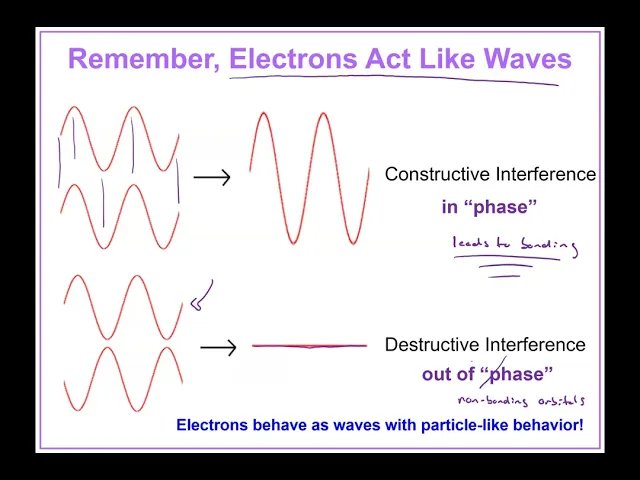
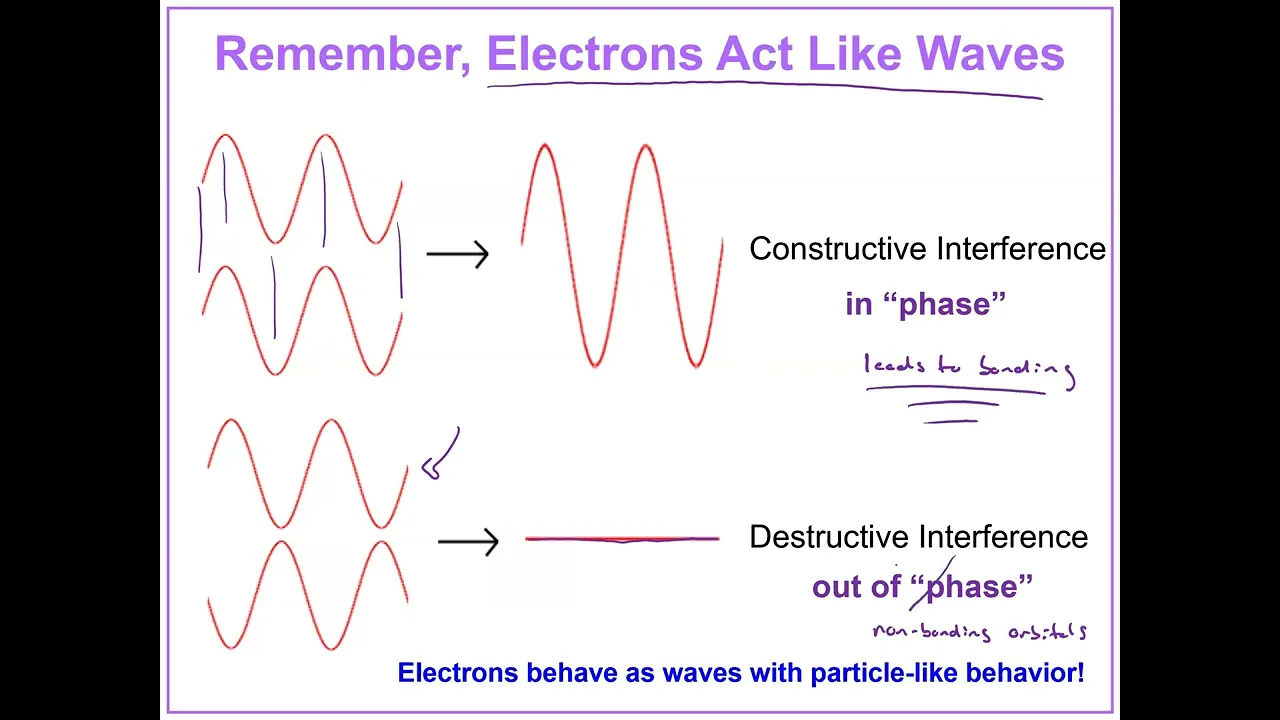
to Quantum Mechanics we have to remember okay that when Schroeder came up uh with this idea right again this is modern-day quantum mechanics all right Scher took the perspective that electrons are not particles all right but behave as waves that happen to have particle like Properties okay so again remember when we're talking about quantum mechanics we're talking about electrons acting like waves all right and so with that all right we know that waves going all the way back to like the first or second week of class all right waves can interact with each other and
they can do so uh constructively or destructively all right and in order for a wave to um interact uh constructively we need uh Those two waves all right to be in in Phase which with one another and what does that mean well to be in Phase means they have the same frequency in other words the same number of waves will pass a given point all right in space all right um in the same amount of time all right so again we we count say we're going to count to 10 we're looking at one uh point
in space and time all right and we count how many waves go by if the same number of waves go by in that 10 Seconds that uh that go past that particular point they're they have the same frequency okay they have the same frequency and if those two waves all right that have the same frequency and they're perfectly aligned okay so we can see here that these guys are perfectly aligned with one another all right what they can do is they can essentially add together they can undergo constructive interference where what you can see now
Is a resulting wave all right that has a much greater amplitude this is in Phase okay well when we're talking about the the wav likee behavior of electrons and we're talking about bonding when we get constructive interference all right of our orbitals our Atomic orbitals this leads to bonds okay this leads this leads to bonding okay now on the other hand all right we can have two waves that are essentially out of phase all right so Right here what you can see is essentially these guys we're looking down here these two guys are mere images
of each other all right and so what they're going to do is they're going to add together but when they do so they do so destructively because again they're out of phase and so if we're looking at the addition of those two waves what do we get we get a straight line now again in terms of our bonding model these out of phase uh kind of Interactions this destructive interference between our Atomic orbitals what this leads to are things we call non-bonding orbitals all right non bonding orbitals all right and that's essentially all we're going
to say about that we're not going to be dealing with any of these nonbonding orbitals okay we want to talk about uh the orbital over AP that actually leads to bonding and we're going to leave uh this kind of Scenario out of the picture for now okay it's kind of beyond the scope of the course all right but again takeaway Point here is that um our electrons when we're talking about quantum mechanics they're acting like waves okay therefore they can interact with each other either constructively or destructively all right and it's the those constructive kind
of interactions all right that's where we get this this very fruitful overlapping of of electron density in Our orbitals that leads to our coent bonds and so let's talk about some of the basic concepts all right of of our veence bond Theory okay well our first basic concept down here you can see one two three right is that calent bonds are formed by overlap of atomic orbitals again we've been talking about this all right um and Each of which contains one electron of opposite spin okay and that's really important okay we need those electrons to
have opposite spins Okay um and then these two overlapping Lopes okay must be of the same phase again in order to get some constructive interference some constructive interaction they have to be of the same phase all right and so when we get bonds all right formed from this head-on orbital overlap all right this head-on orbital overlap these have a very fancy name all right a very special name called Sigma bonds all right so Sigma bonds all right that's head-on orbital Overlap all right and so um what we can see here is we can go up
to the top and we can see that we have um two hydrogen atoms all right and you can see uh the spins are opposite from one another remember hydrogen all right being in the first period all right so n equals one uh remember our angular momentum uh value our quantum number excuse me equals z and that tells us that we have an S subshell an S Subshell and our magnetic quantum number tells us that we have all right one orientation we have one orbital okay one orbital and it has a single orientation so again these
are this is an S orbital within an S subshell okay and again our spins we got to remember our spin quantum number can be plus or minus having a lot of pin issues here plus or minus 12 all right so again when within an orbital when you're Pairing electrons okay they have to have opposite spins remember every electron has to have its own unique set of four quantum numbers that's again why when we're mixing orbitals or we're getting orbital overlap all right to make what we call these Sigma Sigma bonds all right those two electrons
have to have opposite spins of one another okay that way when we make this new uh kind of shared space this Bond all right uh Those two electrons still maintain their own unique quantum numbers all right and so that's really really important but again what we can see is that we have two hydrogens okay and what we want to do is say make a bond between those two things to make diatomic uh hydrogen okay well what we can do is we can get orbital overlap okay of those two on S orbitals all right and so
um and then what we can say is that these two electrons all right um are now being Shared okay they're being shared by both atoms so that takes us to point number two each of those bonded atoms maintains its own Atomic orbitals okay in this case we only have one to deal with but they maintain their own Atomic orbitals but that electron pair that's within that now that Sigma Bond just draw a sigma there okay and those overing orbitals that is shared by both atoms okay now we can also extend this to trying to make
di datomic Florine Okay So F2 well in this case what are we going to be doing we're going to be um remember let's look at the Lewis Dot symbol for Florine okay so it's a hallogen it's got seven veence electrons all right and we can think about drawing its um uh excuse me my goodness the ground state orbital diagram for that so we can look at the veilance Shell it's got 2s and then it's got 2 p all right and we have again seven veence electrons so we can fill our two s's up first they're
lower energy than the P's then we put we half fill first okay so that's five and we got six and we got seven all right and so what does that do that leaves us with one okay one unpaired electron in a 2p orbital okay again which is why these Orbitals that are being depicted on these Florine atoms okay are these biob structures these are P orbitals and so what we can do is think about bringing two Florine atoms together all right and what they can do is they can share uh those unpaired electrons in their
in their 2p orbital all right so they can come together and they can make a sigma Bond okay where now again these two electrons they have opposite spins all right but they've made this Bond all Right and this bond is between their two P orbitals okay and that 2p orbital again from each Florine had a single unpaired electron all right that they used to call their own but now what you can see is again they're going to be sharing okay they're going to be sharing uh those two electrons that are within that Sigma Bond okay
but all the other orbitals okay all the other orbitals um they take ownership of okay so all their other Atomic orbitals maintains or or Are still their own okay but that electron pair in that in those overlapping orbitals is being shared by both of those atoms okay and so now all right um these first two examples all right what you can see is that we have the same orbitals that aren't the same energy okay um and so what do I mean by that well in this case we had two um s orbitals okay and again
in terms of our Energy remember s orbitals are a lower energy than our PS then our D's and then our FS okay um and so we had two 1s orbitals interacting so two of the same orbitals of the same energy Interac this is also the case all right with our datomic Florine all right in this case we had 2 p orbitals one 2p orbital from each of those flines interacting those two P orbitals were both at the same energy all right and they're the same type of Orbital all right but that doesn't have to be
the case all right so let's take example of HCL okay uh let's let's create HCL well in this case again hydrogen has its 1 s orbital right and chlorine against the hallogen right it's in the third period but it's got SV valence electrons right and so again we can draw this orbital diagram this ground state orbital diagram so we got 3s we got two electrons in there then Our three PS all right and so it's got one 3p orbital all right left over all right that's where this comes from and so what you can see
is that we can get overlap orbital overlap from a 3p orbital along with this 1s orbital okay to give us this HCL molecule okay and so again in this case we have two different types of orbitals and again remember in terms of the energy there are different energy States right and this still works okay so again this is a veence bond Theory we don't have to have orbitals or or or similar orbitals overlapping and our orbitals can also be at different energy um values okay and it still works all right but remember the Lewis uh
theory of bonding all right didn't tell us anything about why these single bonds because they're all single bonds okay again this is a sigma Bond Sigma Bond start to kind of associate that with Being a single Bond because that's really what it is all right you can see here why the bond links and the energies of these three molecules because again if we go back a slide or two remember our Lewis bonding Theory did not explain why these single bonds between these molecules were different in terms of their energies um or in terms of their
lengths but now you can see why that might be the case okay because we got different types of Orbitals that are overlapping all right and sometimes those orbitals all right so different types of orbitals and the orbitals can be are at different energies this case we're talking about 1s orbitals okay in this case we are talking about 2 p orbitals and then we have a 1s orbital plus a 3p orbital okay and so you can see that this veence Bond Theory can start to explain why we see differences Um even though we have single bonds
why there's differences in within those bonds okay and then it takes us to to this basic concept number three okay the greater the amount of orbital overlap that you have the stronger the bond okay greater amount of orbital overlap the stronger the bond and we've talked about this before as well okay and so now what we've done here all right is we've shown shown why we might see that not all single bonds are created equally okay And and again uh We've introduced this concept of a sigma Bond okay that's again uh equate this to being
a single Bond all right uh it's got this fancy name called a sigma Bond again this is uh happening because of direct over orbital overlap okay in the sharing of of electrons all right so we have another type of bond that we will see okay this is called called a pi Bond all right and this is a bond formed from P orbitals That are overlapping side by side okay these are called piie bonds all right and so again you can imagine uh two P orbitals kind of coming together in space all right so here's one
of them remember P orbitals are bilobed and again let's say that these guys are running parallel to other because remember all right if we're thinking about this we have y x and then we have our Z plane all right those three p orbitals there are Three p orbitals and the difference between them they're all energetically the same but they have different orientations all right so there's this biob structure on the Y there's this Bob structure on the X and then there's also this biob structure on the Z axis as well all right but if we
get two of them come together on the same plane or on the same axis all right and they get kind of oriented side by side right what They can do is they can start to overlap all right that's what we're trying to show here all right and that's got a fancy name a special name and that is called a pi Bond okay and it's important to remember that both loes okay both Lo overlap all right and these Pi bonds are necessary for forming multiple bonds okay and so let's take a look here so we have
multiple bonds remember when we have a single bond that is called a sigma Bond all right and so then what we Can do is we can take a look at this molecule here where we have a carbon carbon double bond well what is that made of well one of those bonds again is from direct headon orbital overlap all right so so a double bond includes one one Sigma Bond plus the other Bond all right is coming from those those uh side by side okay this overlapping side by side interaction from two partially filled P orbitals
all right and so a double bond consists of one Sigma Bond Plus one of these Pi bonds that we were just talking about now we can also extend this to uh datomic nitrogen all right well one of those bonds again is from this head-on orbital overlap it's a sigma Bond all right whereas those other two bonds that's within that triple bond all right those are both Pi bonds all right so a single Bond always contains a sigma Bond all right a double bond always contains one Sigma Bond and one Pi Bond whereas a triple bond
always Contains one Sigma Bond and two Pi bonds okay so those are the two types of bonds that you'll see us or see me talking or referring to um in this presentation all right so the veis bond Theory all right it helps us overcome some of those limitations of the Lewis bonding Theory all right in Vesper but it does have limitations all right in other words all right take a look at bcl2 there are no singly occupied orbitals available for bonding okay and If we go back to our kind of General description our basic concept
all right Cove valent bonds are formed by overlap of atomic orbitals Each of which contains one electron of opposite spin all right so we have a partially filled orbital okay well let's take a look at be all right well burum it's group two all right it's an alkaline earth metal all right so it's in like I said group 2A and so if we look It has our electron configuration to S2 okay and so what you can see here again what we can do is we can draw our orbital diagram all right for our veilance shell
we'll just focus on this okay both of those electrons are within the 2s orbital okay the 2s shell and so there are no singly occupied orbitals available for bonding okay so there's one limitation how does That work all right how does that work uh if this molecule in fact exists which I tell you it does exist okay so how does the bonding work all right and then the other one is CO2 all right there's inconsistent bonds angles all right well if we're thinking about our carbon and our oxygen interacting all right we might think because
again carbon oops excuse me carbon is 2s2 2 P2 all right so it's got two again let's look at the the uh orbital diagram for that so here's our 2s our 2p it has in fact okay two unpaired electrons that it could interact with oxygen pretty easily okay but remember our P orbitals run like this they're all perpendicular to each other 90 degrees all right so 90 degrees from one another and so What you might expect all right if we're overlapping with some of those two P orbitals and oxygen all right is that those Bond
angles would be 90 degrees okay well if we drawing the Lewis Dot Structure of this all right and we see that we have two electron domains all right the both bonding and so what would the shape of this guy be we' predict that this would be linear okay with angles of 180 degrees Bond Angles of 180 degrees which is in fact what we actually have all right so there's inconsistent Bond angles that also result from this model so there's limitations okay and in order for us to kind of wrap our brain around how this works
what we need to do is come up with some extension to the ve veence Bond Theory and that extension is called the hybridization of orbitals and what do I mean by the hybridization of orbitals it's the mixing of different Types okay of atomic orbitals to produce a set of equivalent hybrid orbitals all right and then usually this happens only on the central atom and again that's that's usually all right and so so when we hybridize or when we mix these different orbitals to make these new hybrid orbitals okay um we get what we call hybrid
orbitals out of that and again that those are the new orbitals that result from the mixing from the hybridization okay um again usually on That Central atom okay and so we're going to go through this to kind of make this make a little bit more sense but there's different types of hybrid orbitals that we can make all right um and so they're listed here so SP SP2 sp3 sp3d and sp3 D2 all right and what we're going to see is that these different types of hybrid orbitals line up really nicely with our electron cloud geometries
all right so let's not forget Our geometries because they're important all right remember we have five of them first one's linear all right second one's trigonal planer then we have tetrahedral and then we got trigonal by peramal and then finally we have o octahedral okay octahedral so what you're going to see is that these Different types of hybrid orbitals and again we're going to go over how we actually make these things but they line up with these different geometries that we've seen for our electron cloud geometries all right and again those electron cloud geometries if
all those electron domains are bonding also equal the molecular geometries but in this case that doesn't necessarily have to be uh true now what's important about this all right and here are some Examples over here of different molecules that have these different types of hybrid orbitals the important thing to remember is that this is not predicted in other words we use hybrid orbitals to explain geometries that are already known okay we don't use hybrid orbitals to come up with geometries on compounds all right so again it's not predictive these things this whole idea of hybrid
orbitals is used to explain geometries That we see in molecules that have a known geometry okay so again it's not predictive and so that's really important to to keep in mind all right so there's steps involved okay and they're fairly straightforward we know uh how to do all of these things more or less all right except for some of the ones towards the end where we're actually getting into this whole idea of a hybrid orbital all right but the first step when we're trying to describe these Hybrid orbitals you have to be able to draw
Lewis structures okay um you have to be able to draw leis structur just remember that's so important uh for this module that we've been in all right everything builds off of that the geometries build off of that uh geometries determine the molecular polarity of molecules which again are really important for determining the properties of those molecules both chemically physically and biologically All right um and so this and and of course now we're talking about hybrid orbitals right it also depends on your ability to be able to draw Le structures okay you also have to be
able to count the number of electron domains on Central atoms all right this again is going back to to Vesper all right and again a big thing here is to remember that um multiple bonds only count as One all right only count as one all right so the number of electron domain two all right this ends up being the number of hybrid orbitals that are necessary to be able to account for the mole the molecues electron cloud domain geometry again going back uh to these guys that we just listed out all right so again the
that number all right is the number of hybrid orbitals necessary to account for those electron cloud geometries this number okay again these Electron domains all right is also the number of atomic orbitals that you must kind of mix all right or the number of atomic orbitals that have to hybridize all right so that's important to keep in mind then you have to be able to draw the ground state orbital diagram for a central atom and I've been drawing those that's these guys all right these are orbital diagrams okay ground state orbital diagrams for the central
atom okay and again I say focus on the Veilance shell you don't really need to do this for every layer for every shell um of a given uh atom all right I would focus on the veence shell then you want to maximize the number of unpaired veence electrons by promotion and we'll see what that means here in a second all right and then after that all right we can combine the necessary number of atomic orbitals to generate the required number of hybrid orbitals right that goes back uh up to here all right um and Then
finally the last thing is we need to place electrons in those hybrid orbitals putting one electron in each orbital before we actually start to pair them okay and again this goes all the way back to when we're uh talking about electronic configurations of our different elements we always fill the orbitals uh uh one at a time before we actually start to pair these things together so let's take an example okay let's think about the structure of CH4 Okay so how we going to actually form these hybrid orbitals so let's just go through all right again
we have to draw the L structure so it looks like this we've seen this many times before all right it's methane all right the electron cloud geometry so we have we can count we have four single bonds all right so we have four electron domains all right all of them are bonding in this case so our electron Cloud geometry or our um electron domain geometry whatever you want to refer to it as is going to be tetrahedral in this case our molecular geometry in this case all right because all those electron domains are bonding is
also tetrahedral it's also tetrahedral okay um and so let's look at the uh actual um ground state orbital diagram for carbon and we've already drawn this in a previous slide okay um it's one S2 all right and then 2 S2 and then 2 P2 All right so here's our ground state orbital diagram and what we can see right this should automatically raise a flag right when we're talking about U our veilance uh bonding Theory all right is that we have two unpaired okay we have two unpaired electrons in these two P orbitals okay so we
have two partially filled P orbitals well what's the problem well this carbon needs to make four bonds all right so it needs to Make those four bonds to those peripheral hydrogens all right but it only has two unpaired electrons to do so okay so how do we get around this problem all right again this this is a problem all right this is why we have to introduce this idea of hybrid orbitals because if we're just thinking about all right the standard the standard veilance uh Bond Theory all right it doesn't quite work out all right
and so what's our next step all right so we've drawn Our ground state orbital diagram for the central atom all right and again we can focus on the veence shell the next step is to maximize the number of unpaired veence electrons by promotion okay so let's just look at this well what can we do all right well we have a pair of electrons in that 2s orbital all right so I say why don't we promote one of those into this empty 2p orbital all right and that takes us here okay and so now what you
can see again Bonding always happens with our veent shell all right maybe I should write that bonding happens with our veence shell which equates to our veence electrons all right so really really important all right well now we have four unpaired veence electrons all right and we want to make these bonds with those hydrogens all right so you might Think okay well we're done right uh let's make our bonds of hydrogen and be done right but I'll tell you that again let's draw our leis structure people know that each one of those carbon hydrogen bonds
is equivalent all right well if we use these four unpaired electrons that we have down here okay again at our Aster right there they're not going to be equivalent remember this electron and This 2s uh orbital is at a lower energy than then now these three electrons in the two P orbitals all right so when we make those bonds to hydrogen they would not be equivalent all right so what do we need to do what we need to do is start to think about making uh some hybrid orbitals all right let's start mixing all right
mixing this 2s orbital with these the three 2p orbitals all right and what when we do that what we can start to do is we can start to get The creation of these new hybrid orbitals and these new hybrid orbitals would be called sp3 all right sp3 all right now where does that name come from well we're using an S orbital to do it all right to make these hybrid orbitals and we're using three 2p orbitals all right so that's where the SP P3 comes from again we what did we use we used four Atomic
orbitals four Atomic Orbitals and if we mix Four atomic or for Atomic orbitals we should get four hybrid if I could spell hybrid orbitals that results okay four Atomic orbitals mixing should yield four hybrid orbitals now all right the special thing the important thing here is that all of these sp3 orbitals all four of them all right these sp3 hybrid orbitals they're all equivalent they are equivalent all right Equivalent in terms of their energies so when we get bonding all right with those hydrogens those 1 s orbitals of the hydrogens all right what we're going
to get are four equivalent bonds okay and we can think about how uh we might get equivalent energies all right so we can draw an energy level diagram so remember what we want to do is we have energy Kind of on our y AIS and we know that our s okay orbitals that are lower energy uh than our P orbitals and we got three p um three p orbitals all right so these are our two P orbitals all right again the difference between them they're all energetically the same they're degenerate that's the name for it
all right but they have different orientations so but what we're doing is we're mixing these orbitals together all Right and what we get is something that is intermediate in terms of the energy all right and so these would be our sp3 orbitals okay our sp3 hybrid orbitals and again because we're in the second shell the second period of the periodic table they would be our 2 P3 um hybrid orbitals all right so how do what do these things look like okay well again what we're doing is we're adding All right an S orbital with our
three p orbital all right so we're mixing these guys together all right and the resulting shape of these things again this is idealized this is not exactly what they look like if you really want to see kind of what they look like the book shows you an image of what they actually look like but this allows us to kind of see what's going on all right so visually it's much more appealing okay And much more easy to kind of follow but what you get are these these new orbitals these new hybrid orbitals again they're called
sp3 hybrid orbitals that again they're bilobe very much like P orbitals except for in this case one of those lobes is much much much larger than the second lobe okay and again the nucleus of our atom okay in this case it's it's carbon all right is dead center okay it's right in between those two those two loes all right so we get This big orbital all right and we get this little orbital and we get four of them all right why do we get four hybrid orbitals because we used four Atomic orbitals in order to
create them we mixed four Atomic orbitals to give us four hybrid orbitals okay and they're oriented in space very much like what we see with a tetrahedral a tetrahedral geometry okay so essentially all those angles between those different hybrid Orbitals is going to be about 109.5 all right so they adopt this shape okay they adopt this shape of a tetrahedron they um adopt essentially a location of a tetrahedron where those angles are what we would expect for a tetrahedral uh kind of geometry all right and again really really important they're now all of similar energy
all right so that when we make those bonds all right with our uh 1s orbitals of our hydrogens again we can kind of draw Those in we know what those look like you can draw them right here these would be our head-on interactions all right these would be our Sigma bonds if you will okay light there all right right there where they're overlapping that would be our Sigma Bond okay so we' get four Sigma bonds that would result now the last thing I want to say All right is that down here when we're when they're
kind of showing how these four different uh hybrid orbitals are kind of merging in three-dimensional space they tend to leave off this little lobe all right this little lobe is missing from that image down there and that's okay because again remember our electrons are behaving like waves all right and and so we can get constructive and destructive interference remember constructive interference leads to Bonding and that destructive interference all right when those when we get destructive interference that's essentially non-bonding okay and so that's this is where the constructive interference would be the constructive interference occurs in
those big lobes so I'm just going to write constructive interference all right so they're essentially in Phase all right and because again this is where we get Destructive and that's essentially non-bonding all right that's the fancy term for that U and we don't really care about that for this class all right we're just going to forget about them okay but they are bopes biob structures or biob kind of shapes if you will all right all right so what we can do is we can make these four carbon sp3 hybrid orbitals all right and we did
this on the previous slide and then we get these four 1s Atomic orbitals uh all right for The hydrogens all right and what we can do is we can start to overlap them so we can take our again our hybrid orbitals our our four sp3 hybrid orbitals we can take our 1s atomic orbitals and we can start to do some headon overlap all right headon overlap and again that head-on overlap these are where we are making our Sigma bonds okay again really important all four of these hybrid sp3 orbitals have equal energy now you might
think all right That lone pairs would cause a problem all right loone pairs do not cause a problem okay so this still works with things that have non-bonding pairs all right and so you can think about that with again with water all right so water is H2O all right again our Central okay our Central uh El uh atom here is oxygen so we draw a a a perfectly valid Le do structure all right we can count the number of domains Are four okay we have four electron [Music] domains and so our electron cloud geometry suggests
that this should be tetrahedral okay tetrahedral all right so what we would expect all right is approximately 109 degree uh angles all right from 109.5 degree angles now in fact we know we don't see that because those lone pairs take up more space all right and our molecular geometry ends up being bent because two of those electron Domains are non-bonding pairs all right but this still works all right so let's draw the orbital diagram for oxygen well remember our electron configuration for oxygen 1 S2 2s2 2 P4 and so we can focus on our veence
shell all right and we know we have two electrons in our 2s and we have four uh P electrons let's put them in fill up half first and then pair all right and what you can see is that we have our two Unpaired electrons okay now what do we want to do we want to kind of mix these guys together all right and so we don't really need to promote any electrons in this case all right because we have two unpaired electrons but nonetheless what we can do all right is we can kind of mix
all four of these orbitals together and we can get four sp3 hybrid Orbitals all right again those four uh sp3 hybrid orbitals are going to orient in this tetrahedron okay that's what we're kind of showing down here you can see that all right so that's where we're getting uh that's the geometry okay remember they're adopting this tetrahedral remember two of those all right contain a single electron so that can perfectly overlap or through make this headon overlap with The hydrogen 1s orbitals all right so we can get these Sigma bonds okay we get our two
Sigma bonds all right then remember our two other hybrid orbitals all right they have paired electrons okay well that means that two all right two of those hybrid orbitals two of these sp3 hybrid orbitals that are on oxygen are actually home to those two pairs of Lone pairs electrons that are on the oxygen so again this works um even for molecules Uh that where that Central atom is containing some non-bonding pairs okay again like water all right so that was sp3 all right let's have let's talk about formation of SP2 hybrid orbitals okay and what
we'll do is we'll take Boron Tri fluoride for example so the first thing again is to draw a Lewis Dot Structure oops sorry about that all right so we got Boron again it's connected it's Central and we're going to connect it uh via these single bonds to the three flines right and we're going to fill in the octets and again if you do your electron counts which I've kind of left off uh for Speed sake all right you'll see that after we fill up the octets of those flines we're not going to have any electrons
left okay all right then the next step all right was to draw the Ground state orbital diagram on the central atom all right well Boron all right again being uh the Fifth Element all right so it is in group 3A on the second period so it has all right it has uh its 2s orbital filled and one of its 2p orbitals filled okay all right so here's our problem right we only have one unpaired electron in order to make bonds with Florine all right but yet we need three of them so here's where we need
to promote an elect We need to take one okay one of these 2s electrons and promote it into the 2p all right and that gives us this all right now this again just a reminder this is called the an excited state all right it's not the ground state this is the ground state just trying to throw in a little review here okay so we excite one of those electrons into a higher energy orbital okay and so now what we want to Do is we want to hybridize these okay remember we only want to hybridize as
many orbitals as it takes to match the number of electron domains and in this case we have three electron domains okay three electron domains so we only want to hybridize three orbitals right and so what we're going to do is we're going to hybridize all right that 2s orbital and two of those 2p orbitals okay and then what does that Give us it gives us SP2 and again we're in the second period so we can put a two here we're going to have three three of these hybrid orbitals and these three hybrid orbitals are called
SP2 hybrid orbitals okay and so again where does that number come from again uh we have mixed an S and two two of those PS that's where SP2 comes from all right and again conveniently that also tells you that you should expect three different orbitals All Right One S and Then two PS so add one plus two that gives you three all right and so what do these things look like well again what we're going to do is we're going to mix one of our s orbitals all right with two of these P orbitals all
right and in fact when you do this they look very similar to what we see with the sp3 orbitals and you'll see that this uh essentially this bilobe structure where one of those lobes is much larger than the other is essentially what all these Hybrid orbitals look like that we're going to be talking about today all right but when we start to hybridize these things we get three of these all right again we've mixed three Atomic okay these are Atomic orbitals all right we've mixed three Atomic orbitals so therefore we should get three hybrid orbitals
and we put th when we put those three SP2 hybrid orbitals together kind of in space again we're only going to show the Big lobes all right this is where we can get constructive constructive interference all right or bonding all right this is where um our our waves if you wear our electron waves will be in Phase with each other all right so that's why we're showing the Big L again okay so because that's bonding all right again remember these little guys these are non-bonding so we're we're going to kind of ignore them all right
but when we put these Guys together in three-dimensional space all right what you see is that they form this trigonal planer structure or trigonal planer structure all right and so but what's interesting here all right is that we had one atomic orbital that was left over that we didn't mix all right that two 2 p okay and so what you see is that in one plane kind of shown here by this gray box all right that gray box contains our our trigonal planer uh kind of geometry okay because That's how they're oriented all right and
then that that leftover 2p orbital again is running in this case in our y AIS all right you can imagine this being our our y AIS right there okay and so what you can see now is that we have these three hybrid orbitals these three SP2 hybrid orbitals that can very easily overlap okay with with the uh the the 2p uh orbital of Florine okay and so because again remember Florine period number two it's a Hallogen all right we can draw its orbital diagram so 2s 2p all right and so we will get this one
electron in that 2p orbital overlapping with these hybrid orbitals um that we got from the Boron Central atom okay and again what does this do this leads us to this uh idea that we're going to have this trigonal planer or trigonal planer uh geometry again about 120 degree uh angles between our different bonds which Is in fact what we see all right so now what can we do with that empty 2p orbital all right let's extend this idea here so let's think about ethylene all right so what can we do we can draw out the
Le Dot Structure for Ethylene all right we got a double bond okay so there's our Lewis Dot Structure and again we got two Central atoms two Central carbons so let's just focus on one because it's symmetrical All right so let's focus on this side okay and what you see is because the next step is we got to count our number of electron domains is we have three electron domains all right then our next step all right so that tells us that we're going to need three Atomic orbitals that we have to mix together in order
to get three hybrid orbitals okay and okay so the next one is to draw our ground state orbital diagram for the Central atom all right again Carbon Let's draw a bigger box here all right well carbon as you can see as we've already seen it only has two unpaired electrons all right so it's got two partially filled P orbitals all right again though what we need to do is we need to make three at least three bonds right and so what can we do let's promote one of those Electrons into this p orbital okay and
then that takes us up here all right it takes us up here all right so now we have an electron do uh uh three electron domains around that carbon so again remember we only want to mix all right we only want to mix uh three of our orbitals okay and so what we can do is just let's finish this off down here don't know why my pin keeps doing that so now we would have Our four unpaired electrons but we only need three all right to mix three orbitals so what we would do is want
to mix these guys all right and that would lead us to three times we get three SP P2 orbitals okay and we would have an extra p orbital with a single electron so again that's what we're showing up here okay and so and so let's think about the actual bonding okay the bonding that we see all right well again now we have These equivalent SP2 orbital again we showed back here that they form this Trigon when we merge these guys together right they form this bobe structure again the big lobes are the ones we really
care about and those big loopes form this trigonal planer uh kind of geometry in the center so we have the center plane and we get these three SP2 orbitals that we're kind of showing down here um in green okay and now what we can do is we can start to form our bonds Okay well we can get head on bonds all right with our our hydrogens okay on two of them so we can think about making our hydrogen all right here and here okay so we get that that head-on orbital overlap again these would be
our Sigma bonds here all right and then we can have the two carbons again they're symmetrical they're going to have the same sort of hybrid orbitals all right we can get Overlap between these two guys all right and so we would get another Sigma Bond also in between the two carbons all right now remember we still have a singly occupied or a partially filled 2p orbital that we have to deal with well remember this guy is oriented it's a bilobe structure all right in this case we'll just say that this is in the Y on
the Y axis all right both of those carbons have that so as we start to come and we form these Sigma bonds All right between these two carbons what we can do is start to bring those two P orbitals those partially filled P orbitals in close enough proximity that we start to get this this side on kind of orbital overlap okay um and so the sideways overlap of these P orbitals and what does that do that leads to the creation of our our PI Bond okay and remember uh when we're talking about multiple bonds you
have to have Pi bonds all right and so what we also get Here with this double bond it's not only one of those is a single Bond but the other one is our PI Bond okay and again that's because we had one of these P Atomic orbitals that was left over that was partially filled all right allowing it to be able to make these Pi uh these these these these this Pi Bond okay and again it's both loes both loes of that p orbital have to overlap that's why you see this kind of pink color
up here all right and you see this color Down here now again you can see that the electrons are up here in this red lobe all right but again this is all probability based okay so the electrons are equally likely to be found in this blue region down here as they are in that red region up at top okay and so again this is how we start to form our multiple bonds all right we get this head-on overlap all right that forms these Sigma bonds and then what we've had to have if we're going to
start Making um multiple bonds is we have to have some partially filled P orbitals to work with all right and when those partially filled uh P orbitals get this sideways overlap all right that's when we start to make these Pi bonds all right how about SP hybrid orbitals okay so let's look at burum D fluoride so the first thing we want to do let draw a stop structure then what we want to do is Fill the octets of our flines all right and what we see is that we have a uh a structure all right
that has two electron domains right the fact that there's two electron domains means that we have to be mixing at least two or mixing two Atomic orbitals in order to give us two hybridized orbitals okay and so the next thing to do is to draw the ground state orbital diagram for the central atom Well again brillium is in the second period it's an alkaline earth metal so it has uh its 2s orbital filled with two electrons again this is a problem right because there are no unpaired El R in order to share to make these
calent bonds these head-on interactions that help us form these Sigma interaction these Sigma bonds okay and so what we need to do is we need to promote one of these guys all right into one of those empty 2p Orbitals and that's what we get here all right here in the middle and then what we can start to do is think about hybridizing all right those two guys together so that we get two equivalent again two SP hybrid orbitals and two empty 2 p orbitals okay so two hybrid orbitals that are called SP and two empty
Atomic orbitals which are the 2p orbitals okay and again what we can do is we can start to think about what these things are going to look like and Like I told you before we're essentially adding this s orbital with this p orbital and we get again two SP hybrid orbitals resulting and they have the predict icted uh shape that I've been telling you about this bobe structure where one of those lobes is much much larger than the other okay and that much much larger lobe is the one where we're going to get uh essentially
constructive interference it's essentially inphase so we can start to make our Cove valent Bonds all right and again because there's only two these guys Orient uh as far away as they can from one another all right which is essentially uh 180° opposite what another all right and so this SP when we're talking about SP hybridization we're talking about a linear molecule and in fact that's what we would have predicted all right from our vest bur all right we would expect something that's linear but now with this idea of These hybrid orbitals okay it allows us
to start to think about how we can actually make those Bonds in the first place okay because again looking at the the electronic configuration of burum you might be like how does this work all right but by making these hybrid orbitals now you can see where our unpaired electrons are coming from and those unpaired electrons are within these hybrid orbitals and so what we can start to do is mix these SP hybrid Orbitals all right with the 2p orbitals of Florine and what do we get we get these Sigma bonds okay we get these Sigma
bonds all right well what can we do with those two empty 2p Atomic orbitals all right well let's look at ayene okay ch2 or excuse me c2h2 all right and so in this case we have a triple bond all right between our two carbons and then these single bonds between Hydrogen all right so that's our Le Dot structure we can count the electron domains again this is a symmetrical molecule so let's just focus on one carbon there are two electron domains remember again multiple bonds only count as one electron domain all right so we got
two electron domains all right and so then the next thing we need to do is draw the ground state orbital diagram For the central atom all right and so we can just come back up here and we're talking about carbon again we've drawn this several times at this point all right again here we have two unpaired electrons okay um and so let's promote okay let's promote uh one of our 2s into a 2p and that's what we' get we would have a so 2s 2p okay and so now we'd have four partially filled Atomic orbitals
all right but in this case we only have two electron domains so we really only want to mix two electrons okay or two two of these Atomic orbitals all right because we only want two hybrid orbitals that result so what we can do we can mix these two guys together and that leaves us to this all right where we have two of these SP hybrid orbitals and two partially filled Atomic P orbitals okay and again remember that these P orbitals are oriented okay so if this is X this is Y and Z all right they're
oriented uh Bop structure is oriented along those three different axes all right and so as we already saw with our SP hybrid orbitals all right these guys kind of adopt this this linear geometry all right and so you can see that down here you can see that's one of our hybrid orbitals this is a second one of our hybrid orbitals And then you can see those two partially filled P orbitals are lying okay in this case this would be our our y axis and that's our z-axis you can see those Bob structures on along those
axes okay and so what we can do is we can start to bring these two carbons together again they're going to be hybridized similarly all right and so they're going to start to overlap all right and so we're going to get this Sigma Bond being formed here all right But now what we're also doing okay is we're bringing those partially occupied Atomic P orbitals in close enough uh proximity to one another that we can get this side by side overlap okay the side by side uh overlap all right and what do we do we get
the these loes being forward right so we get one here okay and it's match is down below all right and then there's one coming out at us and its match is going back into the page all right and so you Can see it's like there's these four loes okay that are going around in each one of those each pair of lobes is a pie Bond okay and so in this case we have have one Sigma Bond and we have two Pi bonds okay and then these other hybrid orbitals one on carbon number one and one
on carbon number two so this guy here and that guy there are free to overlap all right with those hydrogen 1s Atomic orbitals okay to form Additional Sigma bonds all right so what you can see is that we can use these partially filled Atomic P orbitals essentially to make our PI bonds okay awesome and so at this point you may be saying well we've only been mixing S and P orbitals so at most what what can we make we can make four hybrid orbitals all right but in fact I want to tell you that you
can actually make more than that okay um and this typically happens All right when we're seeing molecules uh with Central atoms that lie in the third period of the periodic table okay because again when n equals 3 our angular momentum equals 0 1 and two again remember that that's s it's p and that's D okay and so uh usually what we see these this these expansions okay we're talking about um atoms all right or elements that are in the third period okay and then what can we start to do Well even though we typically don't
fill them we can start to think about promoting electrons into those empty 3D orbitals okay again generally we don't see this uh um uh these 3D orbitals being filled all right but this these 3D orbitals are also the reason why uh we can have like phosphorus and sulfur getting forming these molecules that have expanded octets okay so like pcl5 all right when we draw that out which we're going to in a minute you're GNA See there's 10 electrons around phosphorus that's an expansion of the octet all right well the reason it can do that is
though is because even though it typically doesn't use them it has these empty 3D orbitals just like sulfur when we're making sulfur uh hexafluoride all right again that in that case we're going to have um a lot of electrons around it that are it's it's going to be much expand over the octet okay and that's because it has these empty 3D Orbitals at its disposal okay so let's take a look here all right let's take a look at pcl5 well stroll our Lewis do structure at this point we'll start to draw it semi correctly we
trying to indicate its geometry this is our Lewis Dot Structure all right Next Step again all right is to figure out how many electron domains we have we have five electron Domains okay and if we were thinking about assigning an electron cloud geometry or electron uh domain geometry to this all right it would be trigonal by paramal or trigonal bipyramidal however you want to say it okay but because it has five electron domains all right what do we need to do we need to come up with a way of making five hybrid orbitals okay and
if we want to make five hybrid orbitals we need to Mix five um um five Atomic orbitals excuse me all right so what we can do is we can draw our uh ground state orbital diagram and that's done for you right here all right and what we can start to see is that we have this pair of electrons and it's 3s uh orbital and we got three unpaired uh electrons in it's three p orbitals well what can we do all right we need we need to make five um orbitals all right we also need to
make five bonds all right but we only have Three unpaired electrons so what we can start to do is think about taking one of these 3s orbitals and populating one of those 3D orbitals okay and when we do that what do we get all right we get this guy right here okay this guy right here and so now what do we have we have these um essentially five unpaired electrons and now what do we want to do we want to start to mix these guys together All right and when we mix them together what are
we going to get we're going to get s p 3D okay so again there's five orbitals so there's an S orbital three of these P orbitals and One D orbital so that's five all right because again our electron domains that we have was five right so we need to mix five um Atomic orbitals to give us five of these sp3d um Sp3d hybrid orbitals okay and when these guys come together in space all right again they're this uh bilobe structure where one lobe is much much smaller than the other all right um what you can
see is that they come together in this um trigonal bipyramidal geometry okay um where again each of these loes represents an sp3d hybrid or orbital okay and again they're all in Equivalent positions all right they're all in equivalent positions so we get these 180 degree differences between those again you can think about this as being the our aial positions and then our equatorial positions in the middle all right so we get 180 degrees between those two axial loes all right we get 120 between these trigonal planer loes all right that are in our equatorial positions
all right and we Get 90 degree separation when we're talking about an axial all right an axial to an equatorial all right and so this explains the bonding quite nicely for pcl5 how about can we go even further essentially so let's look at s six all right so let draw a Le do structure let's put in our lone pairs feel free to speed me up here as I put in my Dots okay and so we have our Le do structure we can count our electron domains we have six electron domains okay and we can look
at uh think about drawing our ground state orbital diagram all right for for this and then so let's do that real quick let's come down here this be our 3s our 3p and our 3D and so sulfur has six veence Electrons and that's where we're at so this is our ground state okay our ground state orbital diagram for our Central atom again which is sulfur in this case and so again what you can see from the L do structure is we need at least six bonds right and so what do we have we only have
two unpaired electrons so we need to think about how can we get at least six unpaired electrons and what we can do is we can promote one from that 3s orbital and one from the 3p orbital Okay and then what's the result going draw it up top and our 3s okay so now you can see we have our our our essentially the correct number of unpaired electrons so that we make these bonds all right and we can start to mix these orbitals together all right to give us our hybrid orbitals and so that's what we're
showing right here and what do you see We get 1 2 3 4 five six we get six of these hybrid orbitals all right again that matches our six electron domains it also matches the six Atomic orbitals that we mixed all right and these orbitals these hybrid orbitals are called sp3d2 okay sp3d2 orbitals again they have the same exact biob structure that we've been talking about we tend to focus on the large lob all right and again how do you Know that there's going to be six of these things well just count up the different
orbitals that we have within the name there's one s then there's 3 p so that's four total and then two D's all right so that's five and six so we have six sp3 D2 orbitals and what you can do is imagine that those 2p orbitals uh from Florine can come all right and essentially interact um at each one of these loes so we can get this head-on overlap and we can get our Six Sigma Bonds resulting from that overlap all right so now let's do some sample problems and then I'll cut you guys loose so
that you can do some participation questions all right so using the Lewis structure all right for each of the following molecules all right give the expected type of hybrid orbitals found on the central atom okay so again what we need to do is figure out all right we need to go through our steps we need to draw the Lewis Dot Structure all right and we've seen all these structures before okay and what you can see is we have four electron four electron domains all right so that means we have to essentially mix Four Atomic orbitals
to give us four of our hybrid orbitals now there's a couple ways you can think about going about figuring out what this is well one thing you can do is what you've noticed so far through all this is that we're mixing Starting with the lowest energies going up all right so remember in terms of our energies our s orbitals are lower than our P orbitals are lower than our D orbitals and of course we don't have to worry about the fs we haven't really T we haven't talked about those um but you can see that
we're mixing an S and then we started to mix three p orbitals and then finally we got a to two D orbitals right okay and so if we Have four electron domains we need to mix Four orbitals together all right so you can think about it as one two three four all right well if we're mixing an S and three PS what are we going to get we're going to get four S3 orbitals that result so this carbon atom would be sp3 hybridized okay so it would be SP 3 hybridized the other way you can
think about doing it is again these different hybrid orbitals line up really well with the geometries the Electron cloud geometries that we've been talking about uh for the last couple weeks where again SP where there's two that's a linear all right SP2 is trigonal planer sp3 is tetrahedral sp3d is Trigonal by paramal and sp3d two is octahedral so that's the last one we talked about okay and so what you can do is you can think about assigning the electron cloud geometry or the electron domain geometry and then come over to your little trusty table and
see that it's and we see that it's tetrahedral and tetrahedral geometry Have sp3 hybridization all right so however you want to think about it whichever one works for you I suggest that's the one that you do okay so it's sp3 let's look at nh2cl so we'll come over here all right and what we can see is that we have again four electron domains now it's different right because up here they were all bonding all right and down here we have one non-bonding Pair but again remember this model accounts for that really nicely all right we
just need to be able to count up our electron domains and in fact we have four of those so if we're thinking about our electron domain geometry all right or electron cloud geometry what's this going to be this is going to be tetrahedral so this would be sp3 hybridized all right where one and again how many of those would there be There would be four of these four sp3 hybrid orbitals right and one of those four would be kind of reserved for that lone pair all right or you can think about again going back up
here into the order of energies all right and knowing what we need to mix together we need four to mix Four of our uh Atomic orbitals together you can think about taking Again the S orbital and then those three p orbitals and making hybrids out of them and so that again would leads you to the conclusion that we have sp3 hybridization how about ch2o so we can draw the Lewis Dot Structure again keep reviewing all right we've drawn this one a few times at this point okay and let's count up our electron domains we have
three remember the double bond only counts as one so we Have three electron domains okay three electron domains which means we need to mix three Atomic orbitals to give us three hybrid orbitals and so what you can come and do is either think about it in terms of its geometry all right again this is uh going through our Vesper this would be trigonal planer and trigonal planer is SP2 or you can think about the fact that we have three electron domains which Means we need to mix three Atomic orbitals the three Atomic orbitals of lowest
energy and what would those be that be again lead you to the same conclusion that is SP2 all right so we would get essentially three SP2 hybrid orbitals okay in that case okay again so this would be SP2 Hybridized all right um and again let's take a closer look at this because again this is the first time we've seen a multiple Bond uh Within These examples right this would be a a sigma Bond so two of those would be Sigma bonds and then the third one would be a sigma Bond here and of course we
have a multiple Bond now which means that one of our uh P Atomic orbitals has to be uh freed okay so that it can do that sideways orbital overlap Of that p orbital so that we can get at least one Pi Bond okay and so this molecule would have three sigma bonds and one piie Bond okay all right how about sf4 okay and so what you can see here is that we have five five electron domains again in this particular structure the electron uh Cloud geometry would be trigonal B pyramidal and that's Why again we
put that uh lone pair in that equatorial position remember it can be accommodated there uh much more easily because of the 120 degree angle between those equatorial positions all right and it also perturbs fewer bonds by being in that equatorial position all right but our electron cloud geometry or electron domain geometry again would be trigonal by Pyramidal if I can spell pamle all right and so we can go up here and again realize that that means that we have sp3d hybridization all right or you can know that again that you have five electron domains which
means you need to mix five Atomic orbitals and you mix those orbitals in terms of increasing energy all right and so if we do that all right it would Be an S the three PS and One D okay so again this would be sp3d hybridized we would have five sp3d hybrid orbitals okay and then finally let's look at O3 oone okay and what we can see here is that when this case we have three electron domains again remember that double bond Only counts as one all right we got a double bond a single Bond and
the lone pair so we got three electron domains all right and if we're thinking about the electron cloud or electron domain geometry all right then would essentially correspond to trigonal planer that' be SP2 okay again that should make some sense because we need to mix three Atomic orbitals all right and to get us Uh essentially three of these hybrid orbitals and that's SP2 there's one s and then two of the PS that essentially adds up to being three Atomic or or hybrid orbitals right and then we could also go back up here the idea that
we need to mix uh three Atomic orbitals all right of the lowest energy and again that would be our SP SP2 okay so SP2 so we' get three SP2 Hybrid orbitals so that'd be SP2 hybridized that's how we would say that okay now I know that um ozone has a resonance structure it works out um either way okay so you can draw either resonance structure and this should end up being the same okay and again just to remind you we have a sigma Bond here and a sigma Bond here but we also have a pi
Bond as well okay all right so here's a Participation question for you guys using the L structure for each of the following molecules give the expected type of hybrid orbitals found on the central atom okay so this is again very similar to what we just did in this previous question okay so follow those examples uh make sure you ask me questions if you have them okay all right so here's another sample problem so we can also apply this to larger molecules like this biomolecule This is glycine it's the simplest of the 20 amino acids that
many of you will learn one day when you get up to your biology classes or the biochemistry courses all right and so what we can start to do is start to ask ourselves these different questions okay what are the hybridizations okay of those orbitals on each atom on each Central atom we can put that there all right what's the total number of Sigma Bonds in the molecule What's the total number Of pi Bonds in the molecule all right so let's do this all right so again remember you can think about the types of orbitals that
we've been mixing all right or you can go back to our list okay over here ends up working out the same okay and so let's look at this nitrogen this nitrogen has four electron domains all right well when we have four electron domains that lines up with Tetrahedral okay and tetrahedral is sp3 three hybridized okay or you can think about again four electron domains which means we need to mix Four Atomic orbitals and what are those lowest four energy Atomic orbitals it's those SP um those SP orbitals okay so we get sp3 either way you
do it works okay so we got sp3 hybridized how about that carbon all right again the carbon has uh Four electron domains again okay so again it's just like the nitrogen all right except for in this case they're all bonding but that doesn't matter all right one of those sp3 hybrid orbitals on that nitrogen is going to be kind of home for that lone pair well in this case um all those sp3 hybrid orbitals are going to be used to make Sigma bonds okay all right how about this carbon here well in this case We
have three electron domains all right three electron domains okay corresponds to trigonal planer and trigonal planer is SP2 so it's SP2 hybridized or you can think about again we have three of these electron domains we have to mix three um Atomic orbitals to give us three hybrid orbitals and what would that be it' be our SP P2 okay it'd be only two of those uh P orbitals so we get SP2 how about this oxygen okay well this oxygen has four electron domains okay four electron domains two of them are bonding two are nonbonding in this
case again that doesn't matter four electron domains means if we're thinking about our electron cloud geometries that we have tetrahedral and tetrahedral corresponds to sp3 hybridization or again if you like to Think about four electron domains that means we need to make four hybrid orbitals which means we need to mix Four Atomic orbitals what would those atomic orbitals be it would be sp3 okay sp3 comes to the same conclusion Okay so so that's that question how about what is the total number of Sigma Bonds in this molecule all right well let's count them up how
many single bonds do we have we have one 2 three four five six seven eight we have eight single bonds and then let's count up our double bonds all right in this case we have one double bond okay so remember every single bond is a sigma Bond so there are eight Sigma bonds from our singles and then remember a double bond includes one Sigma Bond and one Pi Bond okay so the double bond all right There's one Sigma Bond there so we add those things together and we get nine Sigma Bonds in total all right
okay what is the total number of pi Bonds in the molecule well again you can only have Pi bonds when you're talking about multiple bonds so you need to find all the multiple bonds within that molecule all right if there's a double bond remember a double bond is made up of a sigma and a pi Bond all right if it's a triple bond it's a sigma Bond and two Pi bonds All right well in this case we have one double bond and that's one Sigma Bond and one Pi Bond so therefore we only have a
single Pi bond in this molecule okay all right so here's another participation question for you consider the Lewis structure for caps all right so you can see this molecule all right and what you can see here is that there are three centers that are Highlighted with okay this purple Arrow all right we're going to call that oxygen carbon one and nitrogen all right the question is what's the hybridization on those orbitals okay on those atoms with those arrows okay and then there's a fourth one that's with a green arrow all right so that's that guy
right there that is called Carbon 2 all right tell me what the hybridization is on that carbon as well all right so just like what we did here okay just like what we Did there and then all right for this caps molecule how many Pi bonds are in the molecule okay and how many Sigma bonds are in that molecule okay so go through count up your single bonds all right count up your number of multiple bonds all right whether they be doubles which in this case they're all the multiple bonds are double bonds so figure
out how many double bonds you have and then again start tallying everything up give me the total Sigma Bonds in the molecule and give me the total Pi Bonds in the molecule all right with that if you guys have any questions don't hesitate to reach out I'm happy to help and I hope you have a great rest of your day