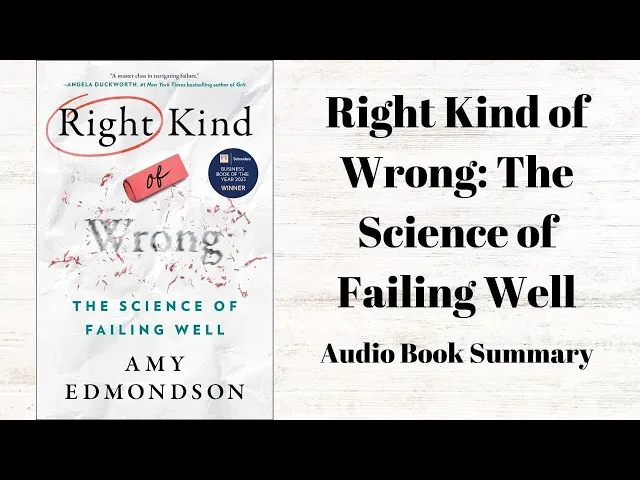
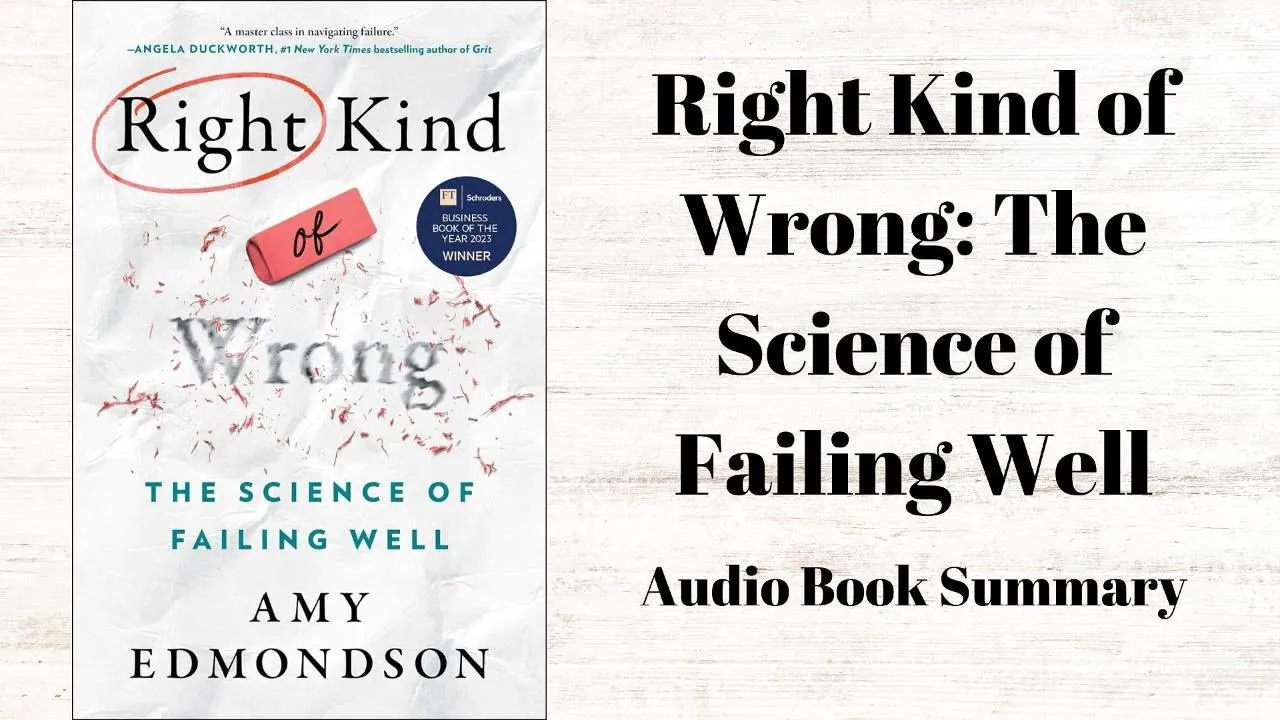
hello welcome to book Journey the book I'm going to interpret for you today was published in the United States in 2023 it's titled right kind of wrong the science of failing well we can call it how to fail well it made the financial times 2023 best business books list and the author is Amy Edmonson a professor at Harvard Business School what is failure the definition in this book is that anything that deviates from the expected ideal outcome is considered a failure for example an athlete who aims for a gold medal but wins a silver medal
has also failed other examples range from small things like burning a dish while cooking to larger events like a company going bankrupt a giant ship sinking or a financial crisis all of these naturally fall under the category of failure no one likes to fail yet people often say failure is the mother of success is failure truly the mother of success not necessarily when we fail to learn from our failures they become meaningless this book reminds us that learning from failure is much more difficult than we imagine it is counterintuitive moreover even if we are willing
to learn from failure we often do not know what to learn or how to learn it can be said that learning from failure is itself something that needs to be learned this is the main issue the book focuses on how to learn from failure to become a stronger person so let's start with why learning from failure is so difficult the first reason is our aversion to failure this may seem obvious however in reality humans aversion to failure often manifests as an overreaction that is instinctive and uncontrollable a friend of the author once shared a small
incident from his life this friend was driving his three-year-old child to school he was in a hurry and driving quickly through a narrow Street when he suddenly collided with another car less than a second after the bang his child suddenly lifted his head and shouted dad I didn't do anything of course we know that the accident had nothing to do with a three-year-old child sitting in the back seat the author's friend is not a strict father in his daily life but you can see that even such a young child instinctively has a deep aversion to
making mistakes which is failure this is exactly what the famous behavioral Economist Daniel Conan calls loss aversion in human nature because for ancient humans an unexpected loss or failure could mean a threat to life moreover our aversion to failure applies equally to both big and small failures we do not become more accepting just because the failure is minor this aversion to failure can close our minds and prevent us from learning from our failures the author shared a personal story he still remembers the humiliation he felt when he didn't make the high school basketball team on
the second day of the tryouts the coach posted two lists one list had the names of all the players who were accepted onto the team and many of his friends were on it the other list had the names of those who were not accepted and he was the only one on that list he felt very embarrassed and ashamed he hated being rejected so he didn't want to analyze why he didn't make the team or where his skills were lacking he resisted learning from the experience do you remember what we mentioned in the book the efficiency
brain science about the two states the brain has when facing new things approach State and avoidance State the approach state is an open receptive State conducive to absorbing new information while the avoidance state is not conducive to learning or collaboration so our aversion to failure can instantly switch our brain to the avoidance State blocking us from learning from our failures so how do we combat this aversion to failure this is a counter instinctive behavior and is certainly not easy but we have indeed heard stories of people who have successfully overcome this Instinct for example Charlie
Munger whenever he realizes that he has been proven wrong in practice does not feel ashamed or angry instead he feels happy this is because he views the process of failure and making mistakes as a way to gradually eliminate ignorance and become wiser the book refers to this kind of approach as reframing failure there was once a study that found that athletes who won the bronze medal at the Olympics ranking third were happier than those who won the silver medal why is it's because they reframed the outcome silver medalists think they were just a hair's breadth
away from the gold but bronze medalists feel that they were just a hair's breadth away from getting nothing and now they at least have a medal in hand this is reframing the result turning failure into a gain this is the most effective way psychologists have found to help us overcome our spontaneous aversion to failure and is also a skill to improve the quality of life we previously discussed the book Feelgood productivity which also talked about reframing failure even using the same term reframe your failure we didn't cover this point in the interpretation of that book
but it fits well here once NASA recruited 50,000 people for an experiment they divided these people into two groups to try programming along the way whenever they failed they would receive a prompt message the first group received the message you have failed please try again the second group received a slightly different message you have failed you lost five points you now have 195 points please try again this subtle difference made an astonishing difference the first group averaged 12 attempts to solve the coding puzzle with a success rate of 68% the second group averaged only five
attempts with a success rate of 52% the reason reason for this difference is that the two groups were guided to view failure differently for the first group failure led to another opportunity while for the second group it meant punishment and loss so the organizer of the experiment Rob concluded that what ultimately affects the success rate is not the number of failures but how you define your failures the author of feel-good productivity also proposed an idea based on Rob's research what if the experimenters added five points for each failure instead of deducting points perhaps there would
be an even higher success rate he said that if we view failure with an experimental mindset failure and success are equally valuable because they generate new information for those who are good at reframing failure failure is never just failure it is an invitation to try something new a gateway to new knowledge this is not a form of self self- Comfort but a way to break the brain's avoidance State and is the first step to truly learning from failure now let's continue with the reasons that hinder our learning from failure the next reason is called interpersonal
fear what is interpersonal fear it is the fear that failure will make us look bad in the eyes of others and be rejected by the group this is a deeply rooted fear in our human nature because in ancient times if an individual was rejected by the tribe he might face death even in modern times our brains still cannot distinguish between the fear of social rejection and the fear of a survival crisis when our brains think about being rejected by the group it feels the same kind of fear as when we see a bus speeding towards
us on the street there is also research that shows the neural circuits in the human brain that process social pain and physical pain overlap moreover this fear can also put us in an avoidance State inhibiting our ability to learn new things and fear can also consume physiological resources diverting some of the physiological resources in our brains that are responsible for processing working memory and new information in summary when we are afraid it is very difficult to learn well especially from failure so how can we reduce this interpersonal fear it is very difficult to do this
on our own the author's research shows that creating psychological safety in organizations is very important that is creating an environment where you do not have to fear being rejected by the group because of making mistakes in the author's research he collected a lot of evidence to show that psychological safety is very helpful in improving performance when teamwork problem solving or innovation is required to complete work these studies date back more than 30 years at that time he wanted to study the correlation between error rates and team efficiency in hospitals the study lasted for 6 months
at that time the author was about to graduate from graduate school and he actually just wanted to prove what he thought was an obvious conclusion good teams make fewer mistakes get this result graduate smoothly and the job is done how however when the author got the data analysis results he was stunned the correlation between error rates and team efficiency was indeed significant but the direction of the correlation was the opposite of what he thought better teams did not have lower error rates on the contrary they had higher error rates this made the author very anxious
however this unexpected data result led him to a more meaningful Discovery at that time he he spent a lot of time thinking about whether better teams really made more mistakes after excluding possible errors in the study and doing various analyzes he found that it was not that good teams made more mistakes but that they reported more mistakes that is to say they were more willing to expose their mistakes and speak openly about them moreover the reason behind this is that better teams have created an open and inclusive atmosphere making people feel that they can speak
freely here admit mistakes and learn from them or to put it in our previous words good teams provide psychological safety for their members and it is this psychological safety that leads to better team performance a few years after this study the author began to use the term psychological safety to describe this difference in the working environment and thus developed a subfield of organizational behavior research and to this day more than 30 years later thousands of research papers in fields such as education business and Medicine have proven that organizations with high levels of psychological safety have
better performance lower burnout rates in the medical field there is even a lower patient mortality rate but we might wonder does high psychological safety also mean that the team is indifferent to mistakes will this lead to team members relaxing their self requirements this is where psychological safety's best partner comes in high standards setting high standards for team members encouraging them to pursue high standards while also providing them with sufficient psychological safety is the most motivating organizational environment for achieving results on the contrary in the absence of psychological safety insisting on high standards is the environment
most likely to lead to failure psychological safety can help people overcome interpersonal fear in this rapidly changing interdependent World pursue Excellence bravely and learn and iterate more efficiently from failure however working in a team with high psychological safety does not mean more Comfort because to protect ourselves hiding the truth is a human instinct but here people need to be honest with each other need to overcome human weaknesses to directly discuss failures but come to think of it which cocoon breaking process does not come with pain all right so we have just talked about two factors
that hinder our learning from failure the first is the aversion to failure and the second is the interpersonal fear of being rejected by the group the third factor is called confusion about the type of failure this means that many times we are not clear about what type of failure we have experienced whether it is worth learning from and what kind of knowledge we can gain from it also what kind of mistakes and failures should we try to prevent what kind of failures should we welcome these questions may have never been considered by many people for
example in Silicon Valley's startup companies there is a popular slogan for celebrating failure fail fast fail often but if this were on a car assembly line would frequent failures and quick failures also be worth celebrating obviously not so even though they are all failures there are many different types the book categorizes failures into three types the first type is called good failure the second type is basic failure and the third type is complex failure the reasons for these three types of failures are different the appropriate attitudes we should have towards them and the lessons we
can learn from them are also different next let's discuss them one by one let's first look at the first type of failure called good failure which is also the right kind of wrong mentioned in the book title intelligent failure these names all point to the same meaning a failure that is conducive to our learning and growth and is worth celebrating how to determine whether a failure is a good failure the book provides four key criteria for judgment it occurs in a new field it helps helps us move towards an ideal goal for example it can
provide us with some new information new connections New Opportunities it is preferably hypothesis driven the failure is as small as possible it may sound a bit complicated but we can think of a typical example scientific experiments for example we know that Thomas Edison tried thousands of different materials in his search for a suitable filament for the light bulb after trying more than 2,000 materials without success his assistant complained all our efforts have been in vain Edison replied we have learned a lot we now know that more than 2,000 materials are not suitable for filaments it
has also been said that during the development of the storage battery he said something similar I have not failed I have just found 10,000 ways that won't work so what Edison experienced is exactly the good failure mentioned in the book you see first it occurs in a new exploratory field second it moves towards an ideal goal with each attempt providing some new information third it is hypothesis driven we know that this is a basic idea in research and experimentation that is to propose a hypothesis first and then verify it through Empirical research in Edison's case
the hypothesis was clearly that the material would work and then he verified it through experiments finally the fourth point is that the failure is as small as possible in the case of the filament this is obvious each experiment does not require a large cost the fail fast we mentioned earlier or the minimum viable product often talked about by Tech and product companies to verify ideas are all aimed at keeping failures as small as possible many companies pay attention to this for example alphabet Google's parent company encourages teams to develop ideas while also encouraging them to
overturn their ideas once there is evidence of failure after overturning them the company will celebrate for them and it is not uncommon for people to get promoted and receive raises for cutting losses in time MC a pharmaceutical technology company introduced a project termination fee for its R&D staff reward in those who promptly terminate failing projects and move on to new ideas Eli Lily a well-known pharmaceutical company introduced failure parties as early as the 1990s to encourage scientists to promptly acknowledge failures and free up resources for the next steps all right we just talked about the
four criteria for determining whether a failure is a good failure if it meets these criteria we should not be upset about it but should be happy because it means we have gained a valuable learning opportunity speaking of which we can recall the author's example of not making the basketball team you will find that it actually meets the conditions of a good failure you see it occurs in a new field that the author is involved in there is a meaningful opportunity worth pursuing it is a validation of the author's previous assumption that my level is enough
to make the basketball team and this failure is also a small one causing no loss to the author this could have been a good failure a great learning opportunity but the author wasted it because of the aversion to failure this turned the failure into a meaningless one so whether a failure can be a good failure the four conditions we mentioned earlier are just a basic judgment and ultimately it depends on our attitude towards the failure the book gives three wrong attitudes and the corresp responding correct actions the first wrong attitude is called skipping analysis which
is simply saying okay I'll try harder next time this is equivalent to not doing any thinking at all the correct approach should be to review where the problem occurred and what factors caused it there is also a second wrong attitude called superficial analysis which is simply saying okay this way doesn't work I'll try another method but just realizing that this way is not feasible is not enough you also need to realize why it is not feasible just like Edison if he simply excluded an option each time he failed to test a filament the efficiency would
be very low only by analyzing the properties of these unworkable materials and the reasons why they don't work can he continuously narrow down the selection range for the next steps that is to say the reasons for this failure should guide the next actions and the third wrong attitude is selfish analysis for example some people might say the problem this time is not mine I did the right thing it was XXX who messed up this kind of completely absolving oneself does not allow us to learn anything from failure the correct attitude should be to deeply understand
and analyze the extent to which one's own factors contributed to this failure whether it is large or small it needs needs to be clear all right we just talked about good failures the next type of failure is called basic failure it is somewhat similar to what we often call Basic mistakes for example forgetting to put the half drunk milk back in the fridge forgetting to add sugar when making a cake forgetting to charge your phone before going out or reversing too quickly and bumping the car these are all considered basic failures basic failures have two
characteristics first they all occur in known and familiar Fields second they usually have a single cause the examples we just mentioned might make you think that basic failures are just minor mistakes but that's not the case sometimes basic failures can lead to huge catastrophic consequences in August 2020 there was the largest bank loss in history three City Bank employees were supposed to transfer $8 million to several companies managing loans for Revlon but they accidentally transferred $900 million when they tried to retrieve it the other party refused to return it City Bank sued but the Court
ruled in favor of the other party this small basic failure led to a loss of hundreds of millions of dollars let's take another example on a Halloween night a hospital in the United States received a patient who had been stabbed on how Halloween many people get injured in fights the patient arrived looking stable breathing normally and not shouting he was just drunk and mumbling they found that the patient had a 5 cm long wound on his stomach so everyone started preparing to treat the wound without panicking but suddenly the patient's condition took a turn for
the worse he stopped talking didn't respond when pushed and his blood pressure dropped sharply later when they opened the patient abdomen a large amount of blood gushed out they then realized that the wound although small in appearance was actually 30 cm deep and had pierced the aorta next to the spine it turned out that the patient's wound was caused by a bayet and he was stabbed by someone dressed as a soldier on Halloween night but the doctors and nurses seeing the small wound forgot to ask the patient how the wound was caused so from these
examp examples we can see that sometimes basic failures can lead to very serious consequences clearly basic failures are a type that we should try to prevent and reduce what we can learn from this type of failure is essentially how to reduce the occurrence of similar events the most classic and effective solution is to make a checklist listing the checklists for typical scenarios where mistakes are likely to occur just like the pneumonic we often recite for going out reach out for money ID card mobile phone Keys wallet this is also a kind of checklist the bank
and Hospital examples we mentioned earlier actually happened because they did not follow the checklist in the bank incident it was because the senior manager approving the loan did not verify all the relevant checklist items in the hospital example they conducted a head to toe basic check but forgot to routinely ask what instrument caused the patient's wound we often underestimate the power of checklists thinking that we can remember these things with our brains and do not need a checklist but many times basic failures occur precisely because we overestimate the reliability of our brains brain scientists have
found that our brains can actually only remember four memory chunks at the same time and the brain is prone to errors when things are complicated or when we are nervous using a checklist is is like Outsourcing the brain's memory work avoiding errors caused by the brain's memory limitations but it doesn't end here the book reminds us that having a checklist does not mean that every time we encounter a similar situation we can just use the checklist directly we also need to ask ourselves one more question is this checklist fully applicable to the current situation the
book talks about a famous aviation accident in history in 19 1982 a US aircraft crashed into the Frozen pomac River later the cockpit recordings of the pilots were found and it was discovered that the co-pilot read out each item to be checked from the checklist as usual and the captain responded after checking however they found that when it came to the deicing device the captain's response was off this was because the aircraft usually flew in warm climates but they forgot that the flight conditions this time were different it was cold so the deicing device should
have been turned on it was precisely because they did not review the checklist and blindly followed it that led to disastrous consequences resulting in 78 deaths so to prevent basic failur we not only need to make checklists but also need to constantly review and update the checklists next let's look at the third type of failure complex failure let's start with a true historical event on a March evening in 1967 a giant ship carrying approximately 119,000 tons of crude oil was sailing at Sea in the early morning the chief mate woke the captain and reported that
the current and wind had pushed the ship off course so he had readjusted the ship's Direction the captain was angry that the chief mate had changed course without permission so he wanted to bring the ship back to its original course all though on the way back they would pass through a very dangerous place called the seven stones Reef but the captain assessed that if they were careful it should still be safe who would have thought that two unexpected things happened in succession first two lobster boats suddenly appeared blocking the ship's progress second there was a
mechanical failure on the steering wheel causing the ship to turn inflexibly and with delay the combination of these series of situations led the ship to crash into the reef at full speed that morning tearing 14 cargo holds and causing a devastating oil spill of 13 million gallons the largest in British history this incident is a typical example of complex failure complex failures have several typical characteristics first they occur in a familiar environment not in an exploratory environment like good failures second they occur within a complex system where multiple factors interact third the causes of complex
failures are not singular like simple failures but often involve multiple reasons possibly a series of unexpected events similar to the oil tanker spill mentioned earlier other examples include the collapse of a large building the failure of a large it system the occurrence of a financial crisis Etc which are often complex failures Scholars have proposed a Swiss Cheese model to describe failures in complex systems each hole in the Swiss cheese can be seen as a defect in a complex system when we are lucky the holes in the cheese are scattered and limited but occasionally these holes
line up to form a tunnel this means that a series of defects combined to pierce through the cheese this is the moment when complex failures occur today in the offices of some Hospital administrators you can still see a small model of Swiss cheese its presence is to remind everyone that a complex system is likely to fail so it is necessary to pay attention to early signals and press the pause button before a major mistake is made this is the common lesson we can learn from complex failures first is to pay attention to early warnings for
example in 2021 the United States experienced one of the deadliest engineering failures in history the collapse of the South wi of the Champlain Tower which took 92 lives this was also a complex failure it is difficult to identify a single culprit geological environment developers Property Owners government climate change Etc all seem to be responsible but before the building collapsed it had already sent out signals and engineer while inspecting the building saw erosion and small cracks but this signal was ambiguous it might lead to a problem or it might not to prevent complex failures we must
pay attention to such early warnings even if they are ambiguous the book also reminds us to welcome false alarms we have all heard the story of the boy who cried wolf and many people say that the message it conveys is that children should not lie but in the author's view it also implies another reminder that unless you are sure that an alarm is real you should not easily speak out but the author believes this is wrong if we want to prevent complex failures we should encourage the shepher boy to shout loudly every time he suspects
the wolf is coming and we should take his every shout seriously for example any worker in a Toyota factory can pull the andon cord to report a risk to the leadership before a product fails even if out of 12 times pulling the cord only one time there is a real problem we cannot say that the other 11 false alarms are not worth it later this Anton cord mechanism was also adopted by Amazon to prevent fatal product problems how can we apply this idea to a team or family it's simple encourage members to voice their concerns
encourage them to take the risk and speak up loudly even when they are not sure and value every faint signal just like for fire prevention smoke detection before the fire is as commendable as firefighting after the fire all right that's all the key points I wanted to share with you from this book How can failure help us become a stronger person the book's answer is to welcome good failures prevent simple failures be vigilant about complex failures and most importantly not to fear failure at after all as we have said today every failure is actually an
opportunity to add points to our future life and the key is whether we can seize it