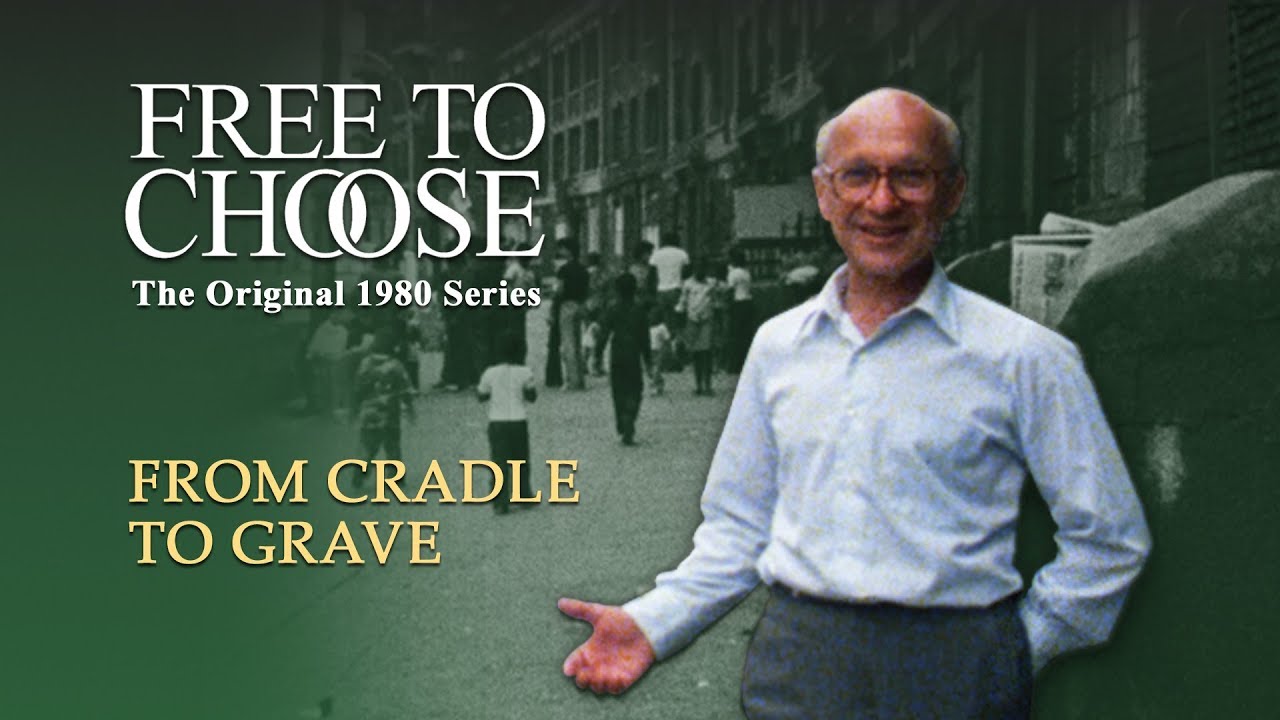
i'm david friedman a few days ago i found myself in a conversation with a stranger defending my father's views about getting the government out of education the man i was arguing with responded that education was too important to be left to the free market it seemed to me he had it exactly backwards if i had my choice i'd like to get the government out of both delivering the mail and running the schools but if i had to choose i'd leave them with the mail after all if the government is in charge of delivering the mail
all that means is that some of our letters get lost if governments are in charge of running the schools that means that some of our children never learn to read education is important it's not the only important thing consider the same argument applied to food surely food is a very important thing and so if important things should be done by government it seems to imply that the government ought to take over the supermarkets and the farms the experiment has been tried in the 1930s in russia stalin collectivized agriculture the government took over the schools and
several million ukrainians starved to death it reminds me of a conversation i had more than 20 years ago with a couple of czech students in vienna that was the summer that czechoslovakia tried a little prematurely to move away from communism and the russians invaded them the students i was talking with had been caught outside of the country at the time of the invasion and were in vienna trying to decide whether or not they should go home and they were trying to explain to me what the czech reformers were trying to do as they described it
they wanted the best of capitalism out of socialism and part of that was that they wanted to have free market prices for most goods but have the government control the prices of a few essential commodities such as bread and milk and my response of course was that if the free market was really better for the other things then it was even more important to use the free market for essential commodities i may have misunderstood them at that point because i don't speak czech and their english wasn't very good but i think they said was yes
that's what our professors say too and i figured at that point i knew why the russians invaded so i guess what i'm trying to say is that i agree that education is important and it's far too important to be left to the government human and political freedom has never existed and cannot exist without a large measure of economic freedom freedom is making choices what's best for me what do i want to do we all want to be free to choose no government official is telling these people what to do parental control parents choosing the teacher
parents monitoring the schooling free to live your own life pursue your own goals chase your own rainbow without the government breathing down on your neck or standing on your shoes most of us would choose prosperity if we could but what's the best road to that goal free trade set off a process that revolutionized japan and the lives of its people the pilgrims tried a form of socialism over 300 years ago unfortunately for their fair-minded plans they prospered only after they were allowed to keep for themselves all the food they grew who says economic institutions don't
matter we may dream of a perfect world but we all know that's not possible hong kong is very far from utopia life is unfair there's nothing fair about one man being born blind and another man being born with sight i do not know any exception to the proposition that if you compare like with like the freer the system the better off the ordinary poor people have been dr friedman has spent a lifetime studying freedom and prosperity to him the lessons of history are clear people are better off making their own choices better off not relying
on government free to choose is a survival kit for you and for liberty these youngsters are beginning another day at one of america's public schools hyde park high school in boston what happens when they pass through those doors is a vivid illustration of some of the problems facing america's schools they have to pass through metal detectors they're faced by security guards looking for hidden weapons they're watched over by armed police isn't that awful what a way for kids to have to go to school through metal detectors and to be searched what can they conceivably learn
under such circumstances nobody is happy with this kind of education the taxpayers surely aren't this isn't cheap education after all those uniformed policemen those metal detectors have to be paid for and what about the broken windows and the torn school books and the smashed school equipment the teachers who teach here don't like this kind of situation the students don't like to come here to go to school and most of all the parents they are the ones who get the worst deal they pay taxes like the rest of us and they are just as concerned about
the kind of education that their kids get as the rest of us are they know their kids are getting a bad education but they feel trapped many of them can see no alternative but to continue sending their kids to schools like this to go back to the beginning it all started with a fine idea that every child should have a chance to learn his three r's sometimes in june when it gets hot the kids come out in the yard to do their lessons all 15 of them ages 5 to 13 along with their teacher this
is the last one-room school house still operating in the state of vermont that is the way it used to be parental control parents choosing the teacher parents monitoring the schooling parents even getting together and chipping in to paint the schoolhouse as they did here just a few weeks ago parental concern is still here as much in the slums of the big cities as in bucolic vermont but control by parents over the schooling of their children is today the exception not the rule increasingly schools have come under the control of centralized administrations professional educators deciding what
shall be taught who shall do the teaching and even what children shall go to what school the people who lose most from this system are the poor and the disadvantaged in the large cities they are simply stuck they have no of alternative if you're well off you do have a choice you can send your child to a private school or you can move to an area where the public schools are excellent as the parents of many of these students have done these students are graduating from weston high school in one of boston's wealthier suburbs their
parents pay taxes instead of tuition and they certainly get better value for their money than do the parents in hyde park that's partly because they've kept a good deal of control over the local schools and in the process they've managed to retain many of the virtues of the one-room schoolhouse andrew greene margaret students here like barbara king get the equivalent of a private education they have excellent recreational facilities what is his how does his plan differ they have a teaching staff that is dedicated and responsive to parents and students barbara nice to sison there's a
red there's an atmosphere which encourages learning yet the cost per pupil here is no higher than in many of our inner city schools the difference is that at western it all goes for education that the parents still retain a good deal of control unfortunately most parents have lost control over how their tax money is spent ava bell goes to hyde park high her parents too want her to have a good education but many of the students here are not interested in schooling and the teachers however dedicated soon lose heart in an atmosphere like this ava
bell's parents are certainly not getting value for their tax money i think it's a shame really that parents are being ripped off like we are when i say i'm talking about parents like me that work every day uh scuffle to try to make a you know to try to make ends meet uh we send our kids to school hoping that they'll receive something that will benefit them in the future for when they go out here and compete in the job market unfortunately that none of that is taking place out at hyde park children like ava
are being shortchanged by a system that was designed to help but there are ways to give all parents more say over their children's schooling this is a fundraising evening for schools supported by a voluntary organization new york's inner city scholarship fund the prince that have brought people here have been loaned by a wealthy japanese industrialist events like this have helped raise two million dollars to finance catholic parochial schools in new york the people here are part of a long american tradition the results of their private voluntary activities have been remarkable this is one of the
poorest neighborhoods in new york city the bronx yet this parochial school supported by the fund is a joy to visit boys and girls we're going to start the workshop now you start out with chance one put the words in alphabetical order the answers are online the youngsters here from poor families are at st john chris systems because their parents have picked this school and their parents are paying some of the costs from their own pockets the children are well behaved eager to learn the teachers are dedicated behavior assistant contrary destruction how old are you honey
six what are you working on the cost per pupil here is far less than in the public schools yet on the average the children are two grades ahead that's because teachers and parents are free to choose how the children shall be taught private money has replaced tax money and so control has been taken away from the bureaucrats and put back where it belongs this doesn't work just for younger children in the 60s harlem was devastated by riots it was a hotbed of trouble many teenagers dropped out of school groups of concerned parents and teachers decided
to do something about it they used private funds to take over empty stores and they set up what became known as storefront schools one of the first and most successful was harlem prep it was designed to cater to students for whom conventional education had failed kennedy was a very dangerous president in the sense that he was excessively popular many of the teachers didn't have the right pieces of paper to qualify for employment in public schools that didn't stop them from doing a good job here a lot of the students had been misfits and dropouts here
they found the sort of teaching they wanted after all they had made a deliberate choice to come to harlem prep it was a very successful school many students went on to college and some to leading colleges but after some years the school ran short of cash the board of education offered ed carpenter the head of the school and one of its founders tax money provided he would conform to their regulations i love him and we got along and he i know you're busy but sometimes after a long battle to preserve independence he finally gave in
the school was taken over by bureaucrats and i i i know he doesn't i was a little bit hurt and basically we have uh three i felt that a school like holland prep would certainly die and not prosper under the rigid bureaucracy of a board of education we had to see what was going to happen i didn't believe it was going to be good i'm right what has happened since we've come to the board of education is not all good it's not all bad but it's more bad than good now again we divide things into
categories but the categories really what the school may not look different yet but 30 of the former teachers have gone ed carpenter has resigned the school is being moved to a traditional school building no one except maybe the bureaucrats is very optimistic about its future unfortunately the strangling of successful experiments by bureaucrats is not unusual the same thing happened in california at a place called alum rock for three years parents at this school could choose to send their children to any of several specially created many schools each with a different curriculum the experiment was designed
to restore choice to those who were most closely involved the parents and the teachers probably the most significant thing that happened was the teachers for the first time had some power and they were able to build the curriculum to fit the needs of the children as they sought the state and local school board did not dictate the kind of curriculum that was used in mccullen school the parents became more involved in this school they attended more meetings also they had a power to pull their child out of that particular mini school if they chose another
mini school at least in my opinion giving parents greater choice had a dramatic effect on educational quality in terms of test scores this school went from 13th to second place among the schools in its district but the experiment is now over when school resumed after the summer vacation this was just another public school back in the hands of the bureaucrats giving parents a choice is a good idea yet it always meets with opposition from the educational establishment this is ashford the town in the south of england for four years there have been efforts here to
introduce an experiment in greater parental choice parents would be given vouchers covering the cost of schooling they could use the voucher to send their child to any school of their choice i have long believed that children teachers all of us would benefit from a voucher system but the headmaster here who happens also to be secretary of the local teachers union has very different views about introducing vouchers we see this as a barrier between us and the parent this sticky little piece of paper in their hand um coming in and underdo that you will do this
or else we make our judgment because we believe it's in the best interest in the best interest of every willie and every little johnny that we've got and not because someone's going to say if you don't do it we will do that it's this sort of philosophy of the marketplace that we object to in other words mr g objects to giving the customer in this case the parent anything to say about the kind of schooling his child gets instead the bureaucrats should decide we are answerable to parents through our governing bodies uh through the inspectorate
to the kent county council and through her medicines her majesty's inspectorate to the secretary of state these are people professionals who are able to make professional judgments but things look very different from the point of view of parents jason walton's parents had to fight the bureaucracy the professionals for a year before they could get him into the school that they thought was best suited to his needs as the present system stands i think we virtually parents have got no freedom of choice whatsoever they are told what is good for them by the teachers they are
told that the teachers are doing a great job and they just got no say at all if the voucher system were introduced i think it would bring teachers and parents together i think closer a parent that is worried about his child would send would remove their child from the school that wasn't giving a good service and take it to one that was and if a school is going to crumble because it's got nothing but vandalism it's generally slack on discipline and this children aren't burning well that's that's a good thing from my point of view
even good schools like this would benefit from a voucher system from having to shape up or see parents take children elsewhere but that's not how it looks to the headmaster i'm not sure that parents know what is best educationally for their children they know what's best for them to eat they know the best environment environment they can provide at home but we've been trained to ascertain the problems of children to detect their weaknesses to put like those things that need pudding right and we want to do this freely with the cooperation of parents and not
under under any undue strains well i i can understand the teacher saying yes it's a gun at my head but they've got the same gun at the parents head at the moment the parent goes up to the teacher and says well i'm not satisfied with what you're doing and the teacher can say well tough you can't take him away you can't move him you can't do what you like so go away and stop bothering me that can be the attitude of some teachers today and often is but now that the positions are being reversed and
the roles are changed i can only say tough on the teachers let them pull their socks up and give us a better deal and let us participate more in america there is one part of education where the market has had extensive scope that's higher education these students attend dartmouth college a private school founded in 1769. the college is supported entirely by private donations income from endowment and student fees it has a high reputation and a fine record ninety-five percent of the students who enroll here complete their undergraduate course and get a degree the students here
pay high fees fees which cover most of the cost of the schooling which they get most of them get the money from their parents but some are on scholarships provided either by dartmouth or by outside sources still others take out loans to pay the costs of schooling loans which they will have to pay back years later still others work either during the school year or during the summer to pay the costs many students work in the college's own hotel this girl is helping to pay her own way which is pretty good evidence that she's serious
about getting an education sure it's a lemon and butter sauce would that be okay parents of prospective students come here on shopping expeditions to check out the product before they buy what you have here is a private market in education the college is selling schooling the students are buying schooling and as in most such markets both sides have a strong incentive to serve one another for the college it has a strong incentive to provide the kind of schooling that its students want if it doesn't they can simply pick up and go elsewhere for the students
they want to get their money's worth they are customers and like every customer everywhere they want to get full value for the money they are paying i really would like to know where the chromium is binding on these nucleotides there is some stuff here full programming the students in effect earn part of their keep by helping to solicit alumni for contributions knowing full well that they will be solicited in their turn we could get any sort of pledge for you would be greatly appreciated it's another way in which the real value of education is brought
home right but i can't tell you how much the alums um really it's because of your donations and people like you that i'm able to go to dartmouth otherwise i'd be paying more than twelve thousand dollars well thank you you pay about fifty percent of our tuition i know if you're aware of it that's fine this may not be the usual idea of an economic market but it is nonetheless the marketplace where buyers can choose and sellers must compete for customers what happens when the educational market is distorted look at state colleges and universities their
fees are generally very low paying for only a small part of the cost of schooling they attract serious students just as interested in their education as the students at dartmouth or other private schools but they also attract a great many others the university of california at los angeles for those students who are here as a pleasant interlude going to class is the price they pay to be here not the product they are buying we frequently wind up with people who cannot compete favorably with with even the average person here the justification for using tax money
to support institutions like this is supposed to be so that every youngster regardless of the income or wealth of his parents can go to college a few youngsters from poor families are here but not very many most of these students are for middle and upper income families yet everybody whatever his income pays taxes to help support these institutions that is a disgraceful situation it's hardly what public education was all about these students are being subsidized by people who will never go to college only about half of those who enroll at ucla complete the undergraduate course
compare that with the 95 percent of dartmouth who finish the work for their degrees what a waste of student time and what a waste of taxpayers money what should we do about this disgraceful situation we must have a system under which those who are not able or do not go to college are not forced to pay for those who do as we've seen the market works in education when people pay for what they get they value what they get the market works in higher education the state of being uneducated you don't know enough it can
also work at the level of primary and secondary education ignorance right until we change the way we run our public schools far too many children will end up without being able to read write or do arithmetic that's not what any of us wants the system is not working and it is not working because it lacks a vital ingredient the experts mean well but a centralized system cannot possibly have that degree of personal concern for each individual child that we have as parents the centralization produces deadening uniformity it destroys the experimentation that is a fundamental source
of progress what we need to do is to enable parents by vouchers or other means to have more say about the school which their child goes to a public school or a private school whichever meets the need of the child best that will inevitably give them also more say about what their children are taught and how they are taught market competition is the surest way to improve the quality and promote innovation in education as in every other field welcome to free to choose joining dr friedman tonight for a discussion on what's wrong with our schools
are dr gordon tullock who is professor of economics and politics at the university of arizona and dr henry levin who is professor of economics and education at stanford university dr levin let's start with you what's wrong with giving parents the choice where to send their children to school oh i like the idea of giving parents the choice of where to send their children to school within the public sector and schools that are concerned about the the social benefits of education that is creating a society where there's a common sense knowledge social cohesion and so on
so that would be my goal dr friedman what's wrong with public school choice there's nothing wrong with public shoot school choice there's something wrong with limiting choice to public schools public schools should not be in a monopoly position they should have to compete with private schools if you want to know what's wrong with public school choice tell me just look at the post office and see what's wrong with giving the government a monopoly and delivering first class mail why should why should a parent be restricted to using his tax money and the tax money that's
signed to him by others simply in those schools that are run by the government first place the last letter that milton friedman wrote to me took five days to get from san francisco to tucson i this is a byproduct but nevertheless true but secondly you've got to remember we let the the parents make a lot of choices with respect to education by voting in the school boards or voting the people who elect to vote boards we let the parents decide whether we should have military forces in iraq this being a democracy i don't see why
we shouldn't let them make their decisions by themselves instead of indirectly well um yeah my concerns here are the following by the way i should mention to you that in palo alto where i am a member of the school board so i can be your bureaucrat here um we have just uh voted in a policy that all graduates of palo alto high schools we have two of them will be proficient in foreign languages that will be a requirement for graduation there's no private school in the country to our knowledge and we've made an extensive search
that sets that kind of standard why shouldn't there be and why should why should you be able to tell john and j and jane that they necessarily have to be proficient in a foreign language maybe they'd rather be proficient in music or in mathematics or in something else i don't see that that's anything for you to boast about it's just an it's just a demonstration of your willingness to replace their judgment by yours but then you'd have to tell me what are your social concerns about schooling because to justify public funding for elementary and secondary
schools surely there are social benefits that are worth paying for otherwise no one should expect the government to pay for schools well you've raised a very good question because in fact i have become increasingly doubtful whether there is any case for government funding in schools but the argument has always been that you need people who can read write and do arithmetic who have some knowledge of history and of the of the society in order to have an educated citizenry which can in which a democracy can operate and i think there's a great deal of sense
to that should we agree on ways of making decisions in the public sector that is should people have some notion that in fact we do have a system of government that in fact we do debate issues ultimately we take voting tell me how it works tell me how that's related to being proficient in a foreign language oh well that's not that's the foreign language is one concern in other words that's a concern that where does that how does how is it justified on the ground knowledge of government no no excuse me i agree with you
that you need some knowledge and i agree that in any system in which the government is going to provide money for people to go to school it is not inappropriate that they should specify certain minimum requirements and spending that money and i would agree with you that one of those minimum requirements would be some knowledge of the mechanisms of government but it certainly doesn't include proficiency in a foreign language and yet that's what you're proud of but then what you say that we're in agreement on the principles that we should specify certain criteria for schools
but on the other hand you're saying that parents should just have a choice of a school regardless of what it does and that's my understanding no i'm not saying that could i could i interrupt uh in the latter part of the 19th century uh the schools were subsidized it was in england you could send the children anywhere you want but the subsidy depended on how many children passed certain specific examinations uh if 90 passed you've got a high subsidy of ten percent passed you've got a very low subsidy you could have complete private these may
a lot of many of these were church schools and private schools you could have a very large degree of autonomy uh and a control of what is actually taught just by this examination very simple procedure doctor do we have exactly the opposite of that now we now fund schools uh schools that have disadvantaged students uh who may in fact not be doing well get more money well no that that that would have been true in england too the special problem of disadvantaged students is is a very real one and you don't i don't think anybody
feels that they should be treated exactly like students who aren't the question really is is the technical way of dealing with them and that's not a that is not an easy question he's an education educator let him answer that one but i want to go back to this other question you can you can provide the government can provide money without producing the product on which the money is spent in fact most of its money is spent that way the government gives people food stamps with the requirement that it be used to buy only food but
the government doesn't run the grocery stores in which they buy the food there is no contradiction between saying we give a parent a voucher which may be used only for buying education in schools which satisfy these minimum requirements there's no contradiction between that and saying that schools may be privately run they may be run by churches they may be run by corporations for profit they may be run by nonprofit organizations of parents or whatever sure as long as you set the common standards and the question is this if you set the common standards high enough
you're going to get schools precisely like the present ones you won't even allow public choice among schools wait wait you set the standards high enough you'll get you'll get schools like our present ones i would say if you set them low enough you'll get schools like in terms not the specific criteria what i'm saying is if you've set them in great enough if you insist that they must be able to read you'll get a different kind of for example i hear you talking about perhaps a national examination and yet what we're hearing is that we
ought to have choices and i don't always agree on everything even if we're both wearing atoms but no i get very confused by this because people like bill bennett like ellen bloom and e.d hirsch talk about we need a common culture and we need to get greater comment content in schools and they even talk about a national curriculum and national examinations but after all bill bennett was secretary of education i do not expect the secretary of education to be in favor of private schools any more than i expect the postmaster general to be in favor
of giving up the monopoly of distributing mail but but yet he is he feels that he is in favor of private schools and he certainly is in favor of choice between the public and private sector in favor of choice between them i agree but of course the problem is what we mean by high standards i i believe that marketplace produces higher standards than government does in every area i don't know any area the marketplace produces higher standards in delivering mail as we have found out from federal express and from the other private mail companies and
the more than the government does the marketplace if left to itself if not hindered if not restricted too much will produce higher standards in in schools that's why i want them that's why i'm in favor of the marketplace let me ask you a question then in a recent period uh 34 of the babies born in san francisco general hospital which as you know is the largest public hospital in san francisco were crack addicted babies tell me about their parents and how they'll make educational choices for their children and in the interests of their children can
i ask if they make educational choices by voting for the school board would it be just as bad well my concern right now is i do have an alternative if you go to the daniel webster school again right here in this city you'll find a school in the public sector with decentralized control and accountability with the largest gains in test scores this past year in the city of san francisco so i would maintain that reform is possible within the public sector you need vast decentralization and the only issue is whether that's possible politically and i
suspect we could discuss that well with these mothers these children you were talking about if it would be they go to daniel webster yeah that's very important because see daniel webster is in the area where there is a public housing project the portola the portero hills that housing project and it's precisely those neighborhoods that produce these crack addicted babies are the mother would they with their crack addict you were concerned about the crack addicted the crack addict mother producing crack not being able to choose a private school why can she pose a public school well
in this particular case i think they're fortunate to be in that neighborhood where we've tried to start this kind of decentralized approach aren't you really sorry in education aren't you really saying that the choice has been made for them and that you're therefore confident of that not only has been made for them but i think it's a very good choice that's been made for them because these particular families are under tremendous stress and simply do not seem to place a high priority on educational decisions but i think the great defect in the kind of talk
you're we're hearing from you is the attempt to treat 100 of the people one way because five percent of the people have to be treated differently there are disadvantaged children like the crack babies and as gordon was saying before they cannot be treated like everybody else i quite agree no question but i would like to have a system in which ninety percent of the parents that ninety percent which will make sense which which we do trust in every other way to be responsible for their children that 90 percent has the greatest opportunity to provide their
children with the kind of schooling that they will benefit think will benefit their children most and we have special treatment for the 10 falling out now you take your your your public school public school or government school in san francisco of course there are exceptions in the public school system there always have been we showed one in the film of the school outside boston which was a very good school for a different reason the problem is they don't less and the problem is that they cannot become general because there is no mechanism for getting rid
of the bad schools there's no effective accountability and the only effective accountability you can have it's the right of the customer to say i won't buy or i will buy let me ask another question dr friedman um what about the schools will they be required to take all children uh once the parents have made the choice no not at all any more than restaurants are required to admit all customers well they are required to admit all customers on the basis of race yeah certainly i would in that case again i'm saying that the use of
the voucher can be contingent on certain requirements and i think it is generally agreement agreed that non-discrimination with respect to race would be one of them now it's an interesting thing in fact that in the private religious schools the catholic religious schools they tend on the whole to have a larger mixture of minorities than mo than most so-called public schools and the reason is very simple the minority parents get such bad schooling in the areas where they are that even though many non-catholics for example there are the proportion of blacks in catholic primary schools is
very high i've forgotten what it is but they get a better schooling there they feel they have better distance they're willing to pay for it and they're willing to pay but if that's true it's interesting that the coleman results show that although the private schools that perform the public schools academically it's by a very small amount that is the private schools adjusting for race and social class are about the 52nd percentile relative to the public schools being at the 50th percentile and what's interesting to me is why is it that 48 percent of private school
children are performing below the average for public school children the answer to that is that you have probably you have only a very limited degree of competition in the private schools the catholic schools and the parochial schools in general have a comparative advantage over strictly private schools here you have somebody down the street who's giving something away for free and you're going to try to sell it it's kind of difficult to do the catholics or the christians i mean the other forms of christian schools are jewish schools any of the parochial schools are part of
an institution which is willing to subsidize that process and therefore there is very only a very small area of strictly private profit market oriented schools and if you had that i think the performance would go up enormously if you look at certain areas where you do have private schools like in training television technicians and the like they perform extreme no no we have to talk about that sector because that's a very interesting sector the guaranteed federal loans as you know apply to the post-secondary proprietary schools as well as colleges and universities and a whole sector
has risen to serve the poor and that sector but those guaranteed loans have become a scandal that's absolutely right they become a scandal mostly in this post-secondary sector post proprietary institutions that serve the poor they get them to sign these forms and there's 70 to 80 loan defaults that all of us at this table are paying for of course a very small relative to the savings and loans uh debacle but in fact there's a market and people are making choices as you know i'm not in favor of that system as i said before i'm not
in favor of the government subsidizing the people who are going into higher education that's a very different question but it does show how a market would work when people are given the power of a voucher yes but the point is they're not spending their own money they're not spending the money that is being provided to them but let's take a very different case credit if you don't if uh people who are permitted to borrow money and not pay it back will do badly in any place that that or i think we can agree there is
a government function which is making people who borrow money repay their debts uh whether whether the debts are borrowed for that purpose or to buy a car what is the distinction between higher education and elementary and secondary education very simple elementary and secondary education is compulsory and you would favor that no i don't at one point i did favor it but the more i have studied it the more i have believed that the extent of schooling that would be voluntarily attained would be large enough so that there would be no additional advantage in compelling the
small number who were left as if without compulsion only 50 percent of children would go to school then i would have to say compulsion can be justified because of the importance of having a school population but i have become persuaded that if there were no compulsion 90 of the kids would go to schools and therefore i no longer see the necessity this in fact was true in england before they introduced the public school system ed west damage i think it's higher than 90 i think it's 95 or 97 percent and it was his work that
persuaded me yeah well it's okay but he also looked at the united states and it's very hard to get this in the united states because of the state different states the schooling of children occurs at the intersection of two basic rights one is the right for me to bring up an i5 children and a grandchild but right for me to bring on my children the way that i see fit the other right is the right of a nation to school its children or to reproduce values and attitudes and knowledge that help to sustain the particular
things including respect for these various amendments that the nation stands on it would be wonderful if there were no conflict between the two but the fact of the matter is we know historically there has been conflict between the two and the question is how we're going to resolve that conflict but at the moment i think the conflict is produced by the public school system i think it is disgraceful that this is as i understand it the first generation in american history that is going to be more poorly schooled than his parents and i see no
way you can defend and say that somehow this conflict you've described can justify the kind of school system we have and you don't well i'm trying to look for your insights into how we solve this because we agree on the problem the question is the solution now american children apparently watch 19.5 hours of television a week according to one of the gallup polls that i saw japanese children watch about two and a half hours uh i think we agree that commercial children's television is not what we'd like it to be educationally and yet they're very
they usually walk out of television that's even worse are you talking about more control rather than less control well the question that i have is this the same parents now who simply derogate responsibilities for most of the education of their children outside of the school to a tv set that's showing inane kinds of experiences are the same parents who are very sensitive and concerned i think we have to help them to become better parents i think we have to work with them but i don't think that if we sit here now i think that all
educational professionals are responsible for working with parents and for children the the educational professionals who are going to make any decisions of this sort are those who either directly or indirectly been selected by the parents you've got to remember this a democracy we vote for these things we all agree on the critical importance of education i hope you've enjoyed our discussion and that it will continue to provoke your thoughts on who should choose our children's school next week on free to choose we'll be discussing an issue of critical importance to the founding of this nation
equality and the rights of the individual much of the moral fervor behind the drive for equality comes from the widespread belief that it is not fair that some children should have a great advantage over others simply because they happen to have wealthy parents of course it's not fair but is there any distinction between the inheritance of property and the inheritance of what at first sight looks very different you