This program is presented by University of California television like what you learn visit our website or follow us on Facebook and Twitter to keep up with the latest uctv programs the work I'm going to talk about today um is a is at Georgetown University it's highly collaborative the dyslexia work I'm going to talk about this in collaboration with my colleague Lyn Flowers flowers and Frank Wood at Wake Forest University and uh I'm not going to talk about it today but we also do some collaborative work with gaet University which is a university for death students
in Washington DC and today I'm going to talk about reading and uh it's probably obvious to most of you but of course reading is tremendously important because it is the the gateway to learning and children who learn well who read well read more often And and have therefore the ability to learn more through print and it it's not just reading English but of course it's access to all areas of knowledge and that's why it's so important the thing that makes reading so special is that it is a purely cultural invention and so when we think
about reading with you have to remember that this this is something that's come to us very recently uh language has been around for hundreds of thousands of years whereas Reading has just been with us for four to 6,000 years as shown here on as evidence on these early images from the logographic writing system in Asia and the alphabetic writing system found um just west of the Nile the early indication of of written symbolic representation and so of course we don't have animal models to study reading and uh uh so when brain Imaging came along of
course that was a tremendous boost for understanding of the reading brain And here's just an example of what when the the very first Imaging study looking at people reading inside the scanner uh this was pet and you can see the visual cortex lighting up of course these days we have better images uh mainly through the magnetic resonance emiting technology that we use and here's our scanner before it was dropped into the Imaging Center and of course these have popped up all over the country uh literally falling out of the sky as this One from a
crane uh and being put into research facilities so that we can study skills uh such as reading and begin to get a good understanding of the areas that are involved in the reading brain and of course what's especially important to understanding the reading brain is to be able to scan children and which is what uh functional magnetic resonance imaging allows us to do to non-invasively get at the the um neural signature for reading in children but Also track it over time and scan children at a young age a and try and figure out what it
is that we use in our brains to become a skilled reader and what I'm going to talk about today are two kinds of uh MRI data there there are many more but I'm going to show you um studies that we've done to try and evaluate bread Anatomy using MRI technology and also brain function uh and particularly of course brain function because we're interested in Understanding how the brain is organized for reading but as you will see during my talk uh learning to read doesn't just change how the brain is organized for reading but it also
changes the anatomy of the brain and I always tell this to teachers that I remind them that when you teach children to learn to read you are truly changing their brain um and so these are the two kinds of Technologies we're using the thing where this research has really benefited from is That we are using Imaging in the context of a very rich uh field uh people have done extensive research into reading and we have a lot of understanding of why is children succeed with reading we know for example that there are certain skills that
if children have those they go on to be good readers such as the alphabetic principle and phological awareness and I'll explain these as I go through my talk background knowledge vocabulary having good understanding of Words having many words in your vocabulary understanding of sentence structure these are all things that set up children uh for successful reading but we also know that the acquisition of reading changes depending differs for different children depending on certain things such as the language in which you're learning to read uh some languages the the mapping between sound and print is very
direct so for example in German there's a very Direct mapping the letters always have the same sound but of course English is a harder language in which to learn to read because we have so many exception words the orthography different writing systems um and if you have to think about the idea that the brain is organized for reading it is probably Moonlighting somewhat it's doing a task that it was was n directly designed to do and as we ask our children to become skilled readers in these different Writing systems they probably draw on slightly different
brain areas in order to become uh skilled at that task and we also know that other things such as social class and sex and all these things um influence the rate of reading acquisition in children now reading involves um certain skills uh we often talk about uh three concepts that are important for reading so I want to explain them to you now which is understanding how there are Patterns in words um the spelling patterns or the visual word form and that's often referred to as the orthography within words and we we map that onto the
sound structure that we hear in Words which is the phology and when we read we we look at the orthography we access the phology but we also have to access the the meaning or the semantics and of course that is the the reason for reading is so that we can access meaning and all of these um are Skills that we um house in different parts of our brain but sometimes in similar areas of the brain and people have been studying for a long time and and it's uh their key aspects of learning to read and
even though we think of them as separate it's also known that they somewhat hang together uh people have studied them for example using computational models and have found that there are network there seem to be networks that work together to to Bring this information about reading uh the sound structure the word form and its meaning uh to bear so that we can actually make sense of what it is that we learn uh that we read now as I said we we know a lot about reading and a lot about reading development so for example L
AR uh some time ago described stages or phases of reading so when you look at young children who are beginning readers you can see that they have certain skills That get better and better and uh are the phases that they have to go through to become a skilled reader so for example children young children kindergarteners recognize certain letters that are common in our environment like the the yellow M sign for McDonald's because we have a lot of exposure to that they recognize that often or perhaps the stop sign on the street that you see a
lot that you stop at all the time so they begin to Recognize certain frequent letters in their environment and they begin to understand that letters have a sound that goes with them and then as they become more skilled they understand that that uh the principles of decoding and decoding is really sounding Out words and they also begin to understand that certain letter combin ations exist again and again in our language uh and they can read those by analogy as soon as they get a hang of understanding that They repeat in the language and so there
are these stages that occur in early readers and a little earlier than the children that we have been scanning uh but we also know that there are skills that if you have those skills you are more likely to succeed in becoming a good reader than if you don't have those skills and those skills have been described uh under this umbrella term of phological processing but there um there are specific skills under the umbrella Umbrella term that I'm going to introduce you to but the bottom line is is that there's certain um aspects about children's understanding
or uh sensitivity to the sound structure of our language that if they recognize that our spoken language is made up of units of sounds that then helps them later on to map those units of sounds onto their symbolic representation I.E onto the written counterpart of those words and so one of the first questions We set out to do is is ask the question how how does reading uh what is the neural signature for reading in the brain of children who are typical readers and what is the relationship between the brain errors that they use for
reading uh and the age at which they are and also the relationship with their phological skills that we know are so uh important to producing a skilled reader and so before I do that I would just want to introduce you to the areas in The brain that I'm going to be talking about today and you'll you'll get fairly used to them by the end of my talk um and these are areas that we've known for some time that are involved in Reading uh so they're the areas that we focus on even though we we scan
the entire brain and they also map very nicely on models that have been put forward by people like Ken Pew that talk about areas that we use for reading and and how these areas May differ in children who Struggle in learning to read children with dyslexia and so the first area I just want to mention is this region here which is at the intersection of the occipital and temporal lobe it's often referred to as the visual word form area because it plays a role in recognizing words that we see very often in our environment so
the words that we don't sound out like words like the and and that we commonly encounter seem to be processed very rapidly by this part of The brain giving us direct access uh to its meaning when we come across the word that we've never seen before we have to actually sound it out and apply sound correspondence rules we see engagement in the area here at the top of the temporal lobe and the inferior parial cortex and so it's referred to as an area that's involved in phological assembly it's putting together the sounds of that word
and the same area also seems to be involved in access to Meaning of those words or semantic um representation and then in the front of the brain in the inferior fontal gyus there seems to be uh again that dual role for both phonological assembly and semantics and slightly different parts of that uh area but again uh meaning and uh assembly so when we study children in the scanner when they're reading we have to um of course be cognizant of the fact that they are novice readers and we have to give them tasks that they can
Actually do in the scanner and so one way we do that is by sort of um tricking the brain a little bit with using a a um a mechanism that's sort of interesting which is this so let me just demonstrate to you how this works I'm going to show you a sentence on the screen and I want you to look at it and tell me how many words are in the sentence but I don't actually want you to read the sentence okay so I'm asking you don't read the sentence just tell me how many Words
and here you go uh you you most of you are skilled readers and and as you read you cannot inhibit yourself from accessing the meaning it's impossible to dissociate those two things and this is actually what's behind the stro effect and this is something that scientists have used to the advantage of reading studies which is that if you show a person a word they automatically not only look at the word form but they access its phological or sound Representation and its meaning like you just did even though I told you not to do that and
and this is the the principle that Cathy price developed a task on that she used and then we have used for many of the studies because we thought it was such a nice uh uh uh Paradigm to use where we ask people to look at words inside the scanner and tell us if the word they're looking at has a tall feature like the L here or not and depending on if there is one you Press one button and if there isn't you press the other button and then we take those scans um that we acquire
when people are doing this on a different word every few seconds we show a different word and we compare it to a task where you're also determining if there's a tool feature yes or no but this time we're presenting you again with visual symbols but they have no meaning and they don't have a sound a a corresponding sound because they are Pseudo fonts and what Cathy price showed is that when you subtract the real words from the pseudo fonts even though you're not reading aloud inside the scanner you you can see activity in the brain
areas that we typically see during a loud reading and we don't like people reading loud in the scanner because it also induces head motion and other artifacts and so this is the task that we've used for many studies and we used it here in a case to study children uh starting at Age six all the way to Young uh college students at Georgetown to ask the question when they all do this task what do we see across the brain and how does it change this is the cross-sectional study it was done by my then uh
student Peter tolop who's now at Georgetown on the faculty of Neurology and what we found is that the earliest readers ident they use the this region here in the superior Temple sulcus and this is an area that has neurons that code for Information from both vision and audition and particularly sensitive to um sensory information from more than one modality so it seems like a good choice for the reading brain to pick those areas that can code for both the visual information that obviously we need for reading and bring it together with the auditory information and
that that we see that in the children between six and nine and then when we go to slightly older children up to young Adults 9 to 18 year olds you will begin to see activity here in the inferior prial lobe and in the inferior frontal lob and then in our college students you see what's sort of considered the neural the typical neural signature for reading engaging all of these areas and then what we did next is we asked the question well how does this signal that we get get in these brain areas correlate with the
person's skills measured on standardized tests outside Of the MRI machine and we went to three measures of phonological processing and so um what we're interested here is really tapping into primarily this skill which is phic awareness which is a person's ability to isolate and manipulate the sounds that we have in words um and then there are some other skills that are somewhat related to this but but also slightly different and what's interesting about these three skills and I'm going to show you how we Measure them is that they all if you give these tests and
beginning readers they're all strong predictors of children's later reading outcome and they all make an independent contribution so when you combine them you can really estimate who will be a good reader down the road as opposed to who might be at risk for having a reading problem down the road so here's just one example of a test that we use there are many others this is uh a test Where you associate sounds with colored blocks that you put in front of the person whose uh phic awareness skills you're measuring and you do things like this
uh show if this says e and you're representing two phones show me if and what you're looking for is for the person to take off the first block and replace it with another block to indicate that you've just uh changed the first sound and measures like this are very good at um predicting later reading Outcome another measure that is a good predictor of later reading outcome is the this test it's called the rapid automatized naming test and it was devised by Martha denler and Rita Rell and you first make sure that children or whoever you're
testing they know the the letters that you have here but then you ask them to say them as fast as they can and the speed at which they do this is highly predictive of children's later reading outcome and it's also an area Where just like the previous test I showed you children with dyslexia have difficulties with and then the Third test that we give is this one which is a measure of working memory this is a digit span it's a subtest from an IQ test and it's really the same thing that you do when you're
trying to memorize somebody's telephone number where you um somebody says to you I'm going to say a number uh several numbers and I want you to tell them back and then at some point Point in the test it gets even harder where they say I'm going to tell you some numbers and I want you to say them back to me but in the reverse order so you have to put them online in your working memory and what we did is we met measured these are all standardized tests and we measured this in our participants and
then asked where do we see positive correlations in the brain between these measures and the brain activity and so for a working memory we See it in left parial cortex uh and for femic awareness at this at the pH level we see a correlation in the top of the temporal area here in the back and in the inferior frontal gyrus and the rapid naming of uh is in red here we see correlations also in the inferior frontal gyus but it behaves somewhat differently uh in that it correlates with erors in the right Hemisphere and it's
very interesting because in dyslexia research not only do we know That these um are different between children with and without dyslexia but but the children who have difficulties with both rapid naming and phic manipulations are the children who tend to be the most severe cases of Dyslexia and that's known as the double deficit um uh group so what we've shown here is that you can see brain basis for reading early on in children the areas that they use are also the same areas that we know are are are correlated uh with skills That we know
predict later reading outcome uh and so this is also a way for us to bring together um clinical tests or tests that are also used uh in the testing environment at school with the brain Imaging data as a way to fuse that because you can't do everything inside the scanner there's only so much time that you have inside the scanner or so much time that you can ask your participants to be in the scanner so it's another way of tapping into Something some additional skills that you might be interested in and so what I've shown
you here are results that give you a sense of what happens in children and adults and since then people of course have done many of these studies and here's a metaanalysis that was just published earlier this year from the ads book group showing brain activity in children and tasks that involve reading and brain activity here in blue in adults and some of the Differences uh between them and they also again speak to these developmental changes the idea that children more than adults engage these Superior temp temporal portions uh that and that in adults you see
more activity in the frontal loes uh and also in this area in the visual word form area perhaps with the idea that as you become more skilled and more automated that you rely on on very automatic recognition in this part of the visual Stream and people have also done studies looking at different languages where we know that the mapping between uh the spoken language and print is somewhat different so this is a very interesting study study that was done some time ago by R Palo first of all showing areas involved in reading that are common
to Italian readers and uh and uh readers uh in English in England but also looking at differences and finding that the Italians where the mapping is much more Consistent and where you can you can apply sound correspondence rules quite easily because they always uh follow use uh temporal lob areas up here in the superior portion of the temporal LOB whereas in uh English you rely heavily more heavily on the visual area the one that you use for for um recognizing the word by site as well as some of these frontal areas so even though there
are many many commonalities and people talk about Universal features of reading There are some differences depending on the kind of uh language that you're reading and and also uh the orthography in which you read so here is a metaanalysis now showing you the brains at a slightly different angle this is an axial section looking at people who either read in an alphabetic language like uh Italian and English but now here is the same data for people who are reading in in Asian uh writing systems logographic languages and what people Have been struck by is the
use of the left hemisphere uh visual system in alphabetic writing systems but this becomes either bilateral or maybe even more right hemisphere when it comes to reading these characters that have very a lot of information that's phos spatial has all these strokes and and would make sense that it would maybe invoke more right hemisphere function given that the right hemisphere is more assigned to spatial um analysis and so again you Have to just remember that in in much of this we think of the brain as uh having to tackle this rather complex skill and and
deciding what resources it can use or as ster ha describes it this in his neuronal recycling hypothesis is that you take brain areas that we're doing something different but similar enough and you train them to become involved in this reading network of the brain and depending on what the demands are of the writing system in which you're learning To read they may be somewhat different even though in large part they are shared and then I just want to mention another thing that's become very interesting in the last few years which is that when you learn
to read uh it seems that the act of doing that changes the brain quite dramatically and this became very evident in these studies that were done in Colombia comparing people who are illiterate who've never learned to read with those who used to Be illiterate but then later on as adults learn to read and comparing the brain anatomy between them so this is a measure of gry met gry mattera volume and what you're looking at here are areas in the brain where there's more volume more brain volume in people who as adults learn to read this
was done in people who were engaged in gorilla Warfare and then later on as adults learned to read and what you see is that the of learning to read uh increase gray Matter volume in their brains uh and that has very important uh implications when we think about reading and reading disability and here's sort of a very complicated slide but I just want to give you the gist of this this is sort of a a study looking in this case a brain function from the work of standand De Haan and looking at how people respond
to different stimuli and using a range of participants that range all the way from being illiterate uh and those Who were illiterate and then became literate to those uh who are very fluid uh readers and so what you see here essentially is that as your brain responds more to to words um you do that obviously the more skilled you are the more literate you are but if you uh look at things like faces those uh the same brain area now responds to faces if you are illiterate so the idea here is that maybe areas that
were engaged pre before we became skilled readers for faces now Get hijacked and get reassigned to processing this kind of object class which is words because it's important to us and by doing so we are essentially rearranging the functional specialization in in this case of the visual um stream so let me turn to dyslexia now which has been the focus of our interest and first of all let me just tell you what dyslexia is I'm going to show you three slides with the official Definition that that came out of the uh a panel from the
international dyslexia organization and it was uh supported by by the National Institute of Health and really when we talk about dyslexia we're talking about children who from the very beginning are struggling readers and who have difficulty uh in roing accuracy in the accuracy of words it is the most common learning disability of all learning disabilities and we know that it's uh neurobiological in origin they Often have difficulties also with spelling but the real the real problem is decoding some countries emphasize the spelling so for example in Germany the spelling is an important uh is emphasized
when you talk about dyslexia and the idea here is that the reason they struggle to learn to read is because of their difficulties with phological processing so even before learning to read understanding that words are made up of sounds that even Though we we squeeze them we coar articulate them we make them all sound like they're all connected they are actually somewhat disc they have to be disconnected for us to map them onto print and that children with dyslexia have difficulties with recognizing that and that these difficulties are really quite unexpected because they're doing so
they're doing just fine in other areas of learning and cognition and then the secondary consequence of this Decoding problem is that they also then often have difficulties with comprehension but their comprehension problems are really driven by their decoding problems um because when you ask them to comprehend uh through the oral modality they don't have difficulties there um and of course uh they also have reduced reading experience and by doing that you also then reduce their background knowledge and growth of vocabulary inside word Vocabulary dyslexia is highly heritable so if you have dyslexia the chances that
your child has dyslexia are about 40% so we know who's at risk for having dyslexia based on their family history and also based on how well they do on these measures of phological processing even before they go into school uh it's highly prevalent the actual rate depends on how you define it uh it also is is somewhat higher in English-speaking countries but possibly because of the Mapping in English uh and it's and you see it more in males than you see in females we know that there's a biological basis and we've known that for some
time because uh this is the very early work by Al Galera showing in in brains of uh individuals who had dyslexia during their lifetime when examined a postmortem they found these ectopias that are indicative of some early uh neuronal um differences in migration that happen in utro uh when The brain was developing and this was very important uh for people to recognize that this really had a brain basis and it wasn't because the children uh weren't trying or were were stupid or the parents were being difficult but really showing that in areas that we know
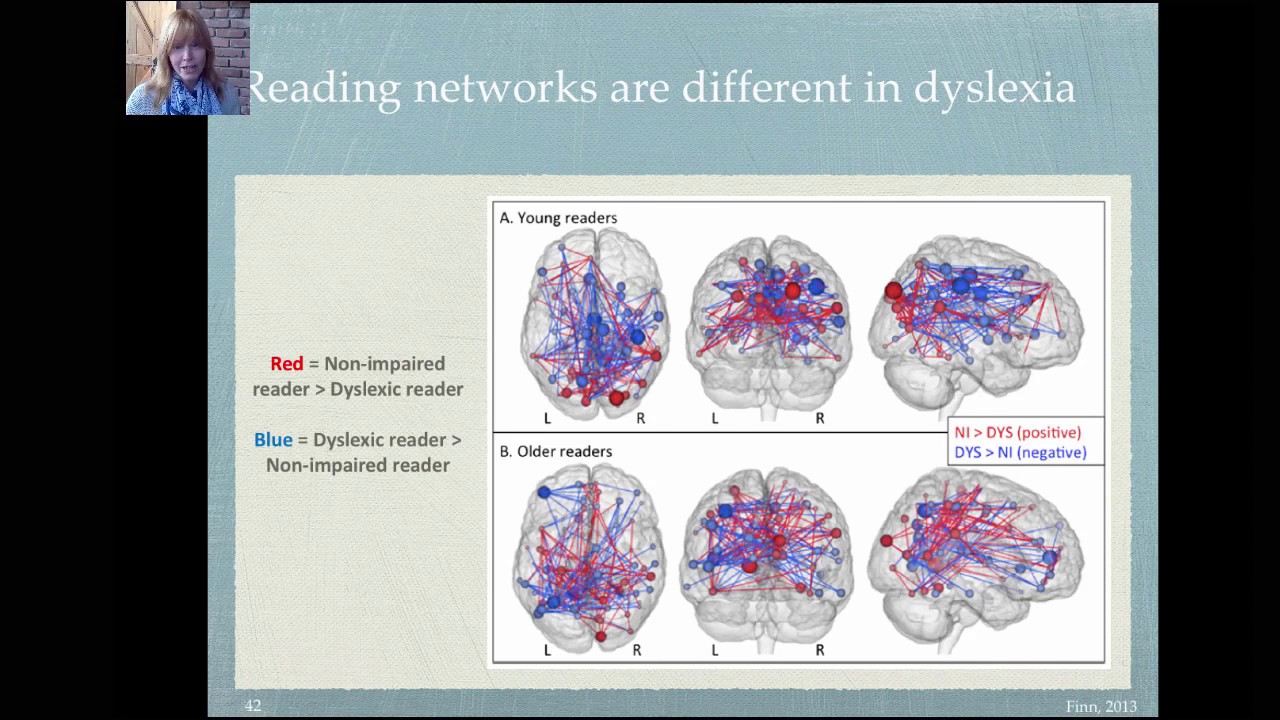
that are involved in language there seem to be uh at the microscopic level some differences and so when people started having brain Imaging uh technology of course they looked to ask Questions well what are the areas that we see that are engaged in Reading uh in people who have no difficulties in learning to read and how do they differ in children and adults with dyslexia and largely what people have found is that areas in this occipital tempor portion and parietal uh temporal areas are under activated in people with dyslexia even if they're engaged in the
task and you can see this summarized here this is a metaanalysis out of our lab showing that Across a range of published studies if you look at where the you see the most um Salient findings across studies they bow down to these areas this extra ST visual area top of the tempor lob and inferior parial cortex um and so it's really quite striking that independent of which lab or which country the work is done that you see these common findings in these met analyses and here again is an example looking at Cross linguistic studies this
Is again from AR Pala showing underactivity in the occipital Temple portion here in people with dyslexia in France and in Italy and in the United Kingdom so even though they're all reading in different languages uh when they're engaged in Reading in their language they they under activate this part of the brain and so of course one of the important questions is what happens first of all you know can we can can People with dyslexia become more skilled readers and if they do what happens in the brain what is the neural corlet of successful reading intervention
and that's a question that we asked a few years ago and we studied in a a group of adults uh doing a task this is a slightly different task we had people listening to words and taking off the first sound of that word or the first phoni and saying it back to us and here are adults who are typical readers and When they're doing this task they largely uh activate the same areas that I've been showing you all along for reading uh in this left hemisphere reading Network and here's a group of adults with dyslexia
who we know have had dyslexia since they were children uh doing the same task and then we have to do a direct comparison between the two and we find is that in the adults with dyslexia we see less activity in parietal cortex for this particular task And remember this is not a task where they're um reading so much but it's that they're hearing a word and they're manipulating the phone and so what we then asked in these adults is what happens if they undergo a reading intervention and they make gains in reading so the idea
would be we scan them before the intervention following the intervention and then compare those two to see what changed and the expectation may be that they now engage Areas that we see in typical readers and that by the time the intervention is over they look more like a non-dyslexic reader but it could also be that they use other areas that help them compensate for their reading difficulties so kind of more the model that you see sometimes in stroke patients where you see compensation in other brain areas and we did this in the context of giving
an intervention um to these adults we had 20 adults uh we used An intervention for which we could find in the peer reviewed published literature evidence that it worked um and it's a it's a combination of approaches and it's there's a lot going on in these interventions but our goal was really to see not so much which aspects of the intervention worked but but could we um improve on their reading and the dyslexics that we saw uh came from North Carolina they were sown by seen by June Orton who's a very famous Clinician or was
a very famous clinician in in the field of Dyslexia her husband was Sammy Orton who was a a lead person in dyslexia and identifi and recognizing the biological basis for dyslexia and uh Jun Orton would keep records of the children that she saw and those records were um retrieved by the WG Forest um investigators in the 80s before Hippa uh from Columbia University where where um um where Dr Orton had a faculty appointment and so these are Adults who we know that have had lifelong reading problems and we assigned them into into one of two
groups one group received the intervention and the other group did not receive the intervention but they could have the intervention afterwards if they wanted to and that was to have a control group and so the differences that we're looking at are now all in comparison to the they're both dyslexic uh groups but only one group received the intervention And the very first thing that we look at is what what what happened to their skills so on again using standardized tests we asked things like well did they get better at things like phic awareness you're manipulating
sounds within words test like say blend now now say it again without the uh sound and on a task like that we see marked improvement in the group of dyslexics who um received the intervention and statistically more than those that did not receive the Intervention we also had them do tasks that look at uh symbol imagery or visual imagery or making a uh seeing in your mind's eye the words that you're processing and and again there they made um significant gains and the reason we're interested in these measures is because this is what the intervention
really targets and of course you would expect to see changes here because that's what they're doing during the intervention the real question question Is does it generalize to reading and so here are some measures of uh non-word reading uh where you know you have to decode the word because it's a word that you've never seen before so the only way you can read it correctly is by sounding it out and again you can see that the dyslexics who received the intervention made significant gains so uh the intervention worked and so now the question is what
happened in the brain and what you're looking at here is the Result from the increases following the reading intervention in the dyslexic group that received the intervention but by comparison with the dyslexic group that did not receive the intervention so it's a control design and the first thing you'll notice is that there's an increase in parial cortex the area that I showed you before that was actually under activated in the dyslexics compared to the non-dyslexics and also activity now greater in this frontal Area that we know that's involved but what's somewhat striking is all this
activity in the right hemisphere that really speaks to a compensatory mechanism so another area that got involved D to help out perhaps uh and these are areas that if they were in the left hemisphere we would think about them as being involved in reading but in the group of adults here and these are people in their 40s and 50s we see them in the right hemisphere so there's a Sort of a compensation model here so from this we we um uh learned that we see increases in activity in both the left and the right Hemisphere
and that in adults and it turns out also in children we see these um right hemisphere increases that seem to indicate that other part parts of the brain can be roped into reading particularly uh when reading acquisition is somewhat difficult so I've shown you changes in in in brain function but we Were also interested in seeing whether there were whether you can measure differences in brain structure when when um people with dyslexia undergo this kind of intensive tutoring and the reason we were interested in is because people have shown in our field that uh in
in the field of cognitive Neuroscience that when you train on certain skills you can naturally uh show that not only do people get better at the task but areas of the Brain Change In terms of gray matter volume and this was a study that was done where college students learned to uh juggle balls and as they did so uh certain areas of Cortex that are involved in visual motion processing uh plumped up and got bigger and then when they stopped they shrank again and so this paper um received a lot of attention of course it
becomes much more meaningful in the context of learning and here's now a s a study by the same authors but this time Looking at medical students who are studying for their medical exams and where again you see uh increases in brain structure brain gry matter volume and this time they're actually maintaining uh the gry matter volume which is good because these are medical students and you hope that they it sticks a little bit uh and we wanted to ask a similar question in our dyslexic students and so this is now a study that was done
in children where we did Intervention and asked do we see gray matter volume changes in our dyslexic students who are undergoing the same kind of tutor in that I just described to you um earlier for the adults which is a tutoring with um you know in small groups uh really sort of enhancing their understanding for phones uh and so on the kinds of things that people uh typically provide for students with dyslexia and we had a subset of children with dyslexia who we scanned and then They received a reading intervention again the tutoring after which
they were scanned and then we also rescanned them after the same amount of time to have a no intervention period and that sort of fit the same design as the ones that I've just shown you uh in that you can now see whether they maintain any gains um and whether they maintain any changes in in brain uh Anatomy that may have come about by the reading intervention in the first place And so first of all let me just show you what happens to reading and these are all standardized measures of reading in the solid bars
that you can see go up from uh before the intervention began to after the intervention was completed and all the dotted lines are measures of skills that we know that support reading things like phic awareness rapid naming working memory and you can also see that after the intervention was over and we saw them again for the third time they They maintained all their um skills so it didn't go away and of course it's reading so it's not that they stop reading they continue to read and so they maintain uh the the gains and this is
what we saw in four brain areas that um increased in Gray matter volume as as a result of the intervention you can see them going up and you can see that they um maintained and even continued going up even when we no longer provided the intervention and here's where these Areas are they're in the left and right hippocampus and we thought this was somewhat interesting because we were actually rooting for the areas that we see and activity in during the functional task and and and those areas that we know that are involved in phological processing
but instead what we found is is areas that are involved in in learning and memory and have also been shown change in other studies that in that include um skill acquisition as Well as the cerebellum and um the left prunus so what we learned from this is that not only do we see changes in brain in behavior and Improvement in Reading I showed you in the earlier study that we look at uh differences in brain function but what we see in terms of structure um that happens in other areas and it's sort of interesting that
it's in the hippocampus which is one of the areas where people suspect there may be some Generation Um of of new Uh tissue and and that could be uh the reason why the hippocampus is involved and importantly these differences are maintained rather than just going away so um based on that it may not dawn on you that I've just shown you that when uh children learn to read their brain changes and when children with dyslexia undergo tutoring and make gains their brain changes and I've already pointed out to that learning to read changes the brain
and this actually now Presents a little bit of a dilemma for Us in research because when we look at the brains of people with dyslexia it's a little hard to know whether the differences that we see are due to their dyslexia or if they're more a reflection of the difference of their reading experience compared to the other children to which we compare them so you know you have to remember that children who go to school and learn to read essentially their brains we think are Changing because of that process then we take children with dyslexia
who haven't enjoyed that same reading experience because they're struggling and now we're comparing them um to that population and we may see differences and in fact we do here's another meta analysis from the zburg group by fav Richland these are areas uh where people most commonly report an anatomical difference the same Anatomy that I've been describing in gry matter volume in studies of of dyslexics Compared to non-dyslexics where they see less gray matter volume in these uh structures here in the temporal lobe um but the question is is this why they struggle to learn to
read or is this the consequence of their altered reading experience and so to ask that question we um took a slightly different approach which is to not just compare our dyslexic children to their peers who are matched on aged but to compare them to Children um who are younger but reading At the same level so they're matched on reading level um and that's what's demonstrated here so this is sort of the traditional design you compare your dyslexic to your non-dyslexic children they're matched on aged but now you take younger children who are equated to the
dyslexic group on their reading level even though um they are they are actually older and when we compare our children with dyslexia to their chronological age Matched comparison group we find differences in gry matter volume in the right hemisphere also but also in these left hemisphere regions that have previously been reported but when we repeat it in the children who are younger and matched on uh reading level we can't reproduce the results it goes away uh only one finding is maintained and that's in this right hemisphere so so that really does suggest that maybe part
of what we're Seeing here has to do with the reading experience itself rather than the dyslexia and of course that's going to be very important in terms of our understanding of the iology and dyslexia and the Brain mechanisms um if we can't uh reproduce um it in these reading level match designs and of course we need longitudinal studies to really be certain also what's going on but from this we deduce that we have to be somewhat cautious about interpreting These differences in gry matter volume um and also um we are somewhat struck by this right
hemisphere difference which is the only one that seems to uh maintain across the two experiments so we have to think about not only what do we does the brain bring to the process of reading to become a skilled reader but the experience of engaging with books and texts on a off on a regular basis how does that change the brain so we really have to think of it as a as a Two-way street and we know that because we know I showed you early on that as you become more skilled as a reader the erors
that you use uh increase and change and since we're sort of on the topic of uh areas of study that you know make us uh pause a little bit about our understanding of dislexia and how to interpret the findings um I want to introduce this idea and I know people here are very interested in this is the role of sex and I told you that dyslexia Is is more commonly found in males than it is in females but in reality most of the work has also been done on males and we don't know very much
about females and so um here's another meta analysis This Time by another group looking at nine studies that were done in and and published looking at published studies in dyslexia and seeing what are the the areas that uh come up again and again as being different I'm showing you the same areas as I showed you in the previous Study plus some additional ones but these are nine studies but when you look at the studies that that fed into this metaanalysis uh the dyslexics uh only 16% of them are females the majority of them are males
because the original studies are all done in all male samples or male dominated samples and so what does that mean for for females with dyslexia so my uh graduate student Tanya uh Evans looked into this and I I don't expect you to to be able to read this But the point I really just want to make here is that we studied um men with dyslexia and compar them to men who don't have dyslexia and women with dyslexia and compar them to only women in dyslexia and that hadn't actually been done before because nobody has just
looked at females and then we did the same in a group of children again just boys uh with and without dyslexia and girls with and without dyslexia and what we found is uh is summarized here and That and what we found is that in boys for example or in men we see differences in The Temper lobe like I described to you before in the boys we see differences in left hemisphere um angular gyus super marginal gyus but when it comes to the women the differences were in the right hemisphere they were they were around the
Central sulcus and the girls too and the girls also we saw differences in early visual system and so they don't don't map onto The literature at all and so I think it's really critical that we start studying uh females separately when it comes to dyslexia and probably other disorders and we were also struck by this finding that was published by um samon Baron Koh and his colleagues showing the relationship between testosterone levels in utero on later gray matter volume and showing that there are negative correlations in these temper lope areas where we see Differences in
dyslexia and males and positive correlations uh in these other areas so the idea that the early uterine environment and these hormones uh may play an important role in how uh the brain develops and we already know that there are very um striking differences between men and women when it comes to brain structure um people have studied that quite extensively and we also know that when it comes to uh language function also we see some differences in Brain how the brain is organized uh for language T particularly tasks that are critical to reading like phological processing
has been shown uh in one study to be uh represented bilaterally in women but unilaterally in in men and uh so clearly there are differences to begin with and then if you if you on top of that put dyslexia you're likely to see some sex specific differences and of course it's also very interesting when you contemplate this in the the context Of what we know about the the the role of sex hormones in neural injury um and and how it may be um play a different role in in women and also in the outcome of
Dyslexia so uh really my point here is is to say I think people are beginning to recognize now that we really have to study females with dyslexia separately and there are two other papers that just came out recently also again showing that some of the differences that you see in the dyslexic Brains of males with dyslexia are not the same as what you see in females so um I I urge you to you know pull your your data apart so from my talk now you've sort of gotten the sense of the sort of interest in
dyslexia on phological processing people refer to the phological deficit hypothesis here theory that there are differences in the left hemisphere that we think that they impact phological processing and that they are the reason Why children with dyslexia struggle to learn to read this is really one of the most prevalent theories and and and when children uh need help for reading people do try and address their phological deficits primarily but I should let you know that there there are other manifestations of Dyslexia and there are other theories about what may be the cause of Dyslexia and
another one is this one which is this magnos cellular deficit hypothesis which spans across The auditory system and the visual system as well as the motor system and the idea here is that there are some impairments uh in these systems that result uh in a number of uh Behavioral manifestations one for example difficulties in auditory processing and that these um directly are are related to these phological processing problems that children with dyslexia have so kind of a low-level uh iology that then percolates up to these phological Problems that then impact the reading problem as part
of this kind of a larger magnos cellular deficit hypothesis uh there's been some work looking at the visual system and I want to um use that as an example uh to to show you how I think brain Imaging can help in clearing up some of these really what are competing theories about the iology of Dyslexia so I'm now going to orent you to the visual system and the magn cellular theory is is based on Observations in uh behavior of children when they have to purs visual tasks uh and the the differences that you see in
children with dyslexia seem to be on visual tasks that are thought to be pursed by What's called the magnet cellular system which is a division of the visual system that begins actually as early as at the the retin gangan cells but is noticeable in the thalamus but then is uh projects into different streams with the magnell system uh often Being sort of thought of as the dorsal stream um and uh as opposed to the vental stream which is more interested in in object processing the dorsal stream is engaged in visual motion perception area V5 Mt
sits here helps us identify where things are moving in space and and generally uh this part of the brain is thought of as a spatial and spatial um Orient orienting uh of the brain and so what was interesting is that many years ago there were studies Using visual psychophysics showing that there are differences in children with dyslexia when it comes to processing uh stimuli of low spatial and high temporal frequency which are attributes that are thought to be subserved by the magnell visual system and uh later people built on this by looking at visual motion
uh detection because that's thought to be part of the this magnet cellular stream and it's showing very simply that when you ask children to look at dots and ask Them to see what direction they're moving in children with dyslexia need to have more dots moving in that direction before they can detect what the direction is compared to children who don't have dyslexia and it seemed to fit quite well with other works so for example we published some findings showing that if you put people into the scanner and they process motion you see activity in this
part of the brain this is called V5 Mt It's it's sort of a grape siiz area that helps us uh process visual motion and in the in the and this and in the dyslexics we did not see activity in this part of the brain so really the these the sort of Behavioral work seem to have a neurological basis in in the functional studies and it was very specific to the stimuli because we didn't see it for example in response to patterns where the responses were very similar between our dyslexic and non-dyslexic Sample and It fit
very nicely with anatomical work that again was done in postm um by the by the group in Boston showing that if you look at the thalamus and you look at the neur the cells and the magnos cellular layers you see a difference in between the dyslexic and the non-dyslexic tissue but you don't when you look at other parts of the same structure so it all seem to sort of fit um the only thing that's problematic is in part to understand how does this Impact reading how does the visual motion system or the the system that
deals with these fine um uh visual attributes how does it impact reading and so it's it's a it's a as I mentioned it's a somewhat controvers controversial Theory some people saying you know it's just it doesn't exist it's not the cause of the reading problem others have argued that it really does contribute to reading problems because it's involved in eye movement and uh accurate eye Movement is important in accurately seeing the the letters and the words that you see um and others have suggested that maybe it's an epip phenomena of Dyslexia that it coexists perhaps
because what changes in the brains of people with dyslexia um leads to secondary changes in the visual system and then manifests as things that we that we can see and test in the laboratory uh but how they actually impair reading isn't clear more likely It's the phological problem that impairs reading but we measure these in the laboratory um and what what we are now arguing is that perhaps what we're seeing is really a consequence of not having the same reading experience with if you have dyslexia compared to the peers by which you compare you them
to and so just to make that point what I'm showing you here is here's the activity in this AA V5 Mt and this is in a group of uh typical readers and the amount of Signal that you see when they're looking at dots that are moving and detecting the direction the amount of signal that you see here is directly correlated with their performance on reading on a standardized uh SC scale which is sort of surprising I mean why would this part of the brain be related to your reading ability and this is for real word
reading uh and and uh we see it in both and this is for non-word reading and we see it Both in the left and right Hemisphere and it's this sort of a finding that's been so compelling to say look there's a there's a relationship between these two but of course correlation doesn't mean causation and so to get at the ISS issue of causation we again went to this idea of a reading level match design where as uh proposed by oakos Swami you have to show that the deficit is not just there in children with dyslexia
when compared to their Chron ological aged matched Peers but also in children who are younger but at the same level of reading and so that's that's exactly what we did just like we did before uh but this time we did it in the context of looking at activity in this area V5 Mt this visual motion area that's here at the back of the brain and showing that in both the left and the right side of the brain when we compared dyslexics and non- dyslexics matched on age we see these differences just like we had in
the Adults but now when we instead compare the dyslexics with children who are younger and reading at the same level the difference disappears so that really gives you the sense that maybe it's not the cause but it's it follows uh not learning to read quite as much and so we Then followed this with another uh study which is we looked at what happens following an intervention and typically in studies um the reason why the sort of a phological deficit hypothesis is well Accepted is because not only do you see the differences in the children with
the dyslexia and not only do you see that in typical children phological skills predict later reading outcome but when you provide a phological intervention you often see gains in reading and they generalize to reading just as I showed you before now in this case we didn't do an intervention on visual motion perception we did a an intervention on phological processing and we asked what Happens in this area in the visual system following the intervention and again I'm showing you here activity from both the left hemisphere and the right Hemisphere and this is a change score
again from comparing before the intervention with after the intervention and so what you see here is that in our children with dyslexia there was a significant increase in the signal in response to visual motion perception in the right Hemisphere the the increase was also there but not statistically significant in the left hemisphere so as they underwent intervention and as their reading improved their visual motion system went up a notch and it's specific because when at a time when they received either no intervention or a math Intervention which was sort of our control we didn't see
any such changes so it's not because they were scanned twice or something Else but under very controlled circumstances you see this this change so what that really tells you is yes there is a relationship between visual motion perception uh or in this case a relationship with the activity in the brain area that we uh know subserves visual motion perception and reading but when you look at the level match design it suggests that it doesn't hold up when you look at at children who are matched on reading uh and also when the Dyslexic children becomes more
skilled at reading uh we see this increase and actually there is behavioral work um that's that's um consistent with this and has people thinking that perhaps learning to read mobilizes some of these areas in the in the visual system and it's also been shown that people who are uh illiterate uh do process visual information somewhat differently from those who are illiterate so again it's this idea of what happens when we learn To read that changes the brain um in ways perhaps much more far fetching than than one might uh imagine so I just want to
in the last few minutes turn to a slightly a different area that we started to become interested in but again it goes back to why uh the the phological problems uh and the language problems in dislexia uh are so interesting and that is uh the area of arithmetic uh because uh arithmetic uh like reading uh is Something that the children learn in school um and again there's this idea of what are the brain areas that we use to do arithmetic and again in our culture being good at math is really very important just like it's
very important to become good at reading now many of you know that there is uh what's called high comorbidity between dyslexia and discala so you see math difficulties in children with dyslexia more often than you see in non-dyslexic children Suggesting that perhaps they hang together and it's been suggested that the same phological awareness difficulties that hamper with children's reading problems and dyslexia may also be important to some but not all arithmetic problems and it's the kind of arithmetic that involves retrieving things from memory kind of these left hemisphere retrieval mechanisms that we use for doing
small number addition and multiplications so when you add numbers Or multiply small numbers you do it by retrieving it from from memory um and it's thought that maybe your phological processing is important for that and people have also shown in neuroimaging uh as in this study by pra and booth and others is that when you do this kind of retrieval based arithmetic you engage areas in the left hemisphere in the same regions that are active when you're doing a phological uh task and so here's some evidence for this correlation Between phological awareness this is a
measure of phony Mal so deleting sounds within words and this kind of retrieval based arithmetic so for example doing 4 + 5al 9 if you do a a procedural kind of arithmetic such as subtraction you don't see this relationship with phological awareness it's very specific for this kind of retrieval-based arithmetic and so we ask the question well what does that mean for children who have dyslexia even though they don't Um have uh math difficulties certainly not on standardized test of math and not enough that they meet the clinical criteria so uh I I'm not going
to go through the details of the slide but what what I just want to show you is that these are children with dyslexia identified based on their reading difficulties compared to children who don't have dyslexia uh and in fact on standardized tests of Calculation uh do fairly well and and are actually match to our sample of of uh controls but these measures don't pull up apart this sort of fine level uh that I just described in terms of looking at tasks that involve retrieval based arithmetic like addition and multiplication versus subtraction and so what we
did here is we essentially had our children uh perform these kinds of small number arithmetic tasks that we think tap into retrieval based Arithmetic and then we also had them perform these more procedure based operations that are thought to be more involving of the right hemisphere as opposed to the left hemisphere spere and we scanned the children with and without dyslexia and what we found is that even though the children with dyslexia do not have a math disability based on sort of standard um identification we see underactivity in the children with dyslexia when they're Doing
these math tasks in the left hemisphere this is in the left super marginal gyus so in the same area that we know that's involved in reading and phological manipulation when you look at the both these kinds of arithmetic Tas tasks you see underactivity in the children with dyslexia compared to the non-dyslexic controls and then what's interesting is that we see that in the right hemisphere um there are also some differences so typical um readers use The right hemisphere for this task that involves um subtraction so I think of subtraction as the right hemisphere task but
they wouldn't engage um it so much for addition because that's more a left hemisphere task but the children with dis don't show this dissociation they are trying to use the right hemisphere for the addition task which is not the right strategy uh but at the same time they're not able to access the right hemisphere As effectively for doing the subtraction task the way the typical children do and this fits very very well with the behavioral data uh that has shown these differences in these different kinds of tasks again really making the point that even though
dyslexia by definition is a reading problem it's probably much more uh than that because some of the same underlying difficulties that contribute to their reading problems also subtly in a very subtle way contribute to some of Their math uh problems and it's sort of interesting to use brain Imaging to show that they really actually are in the same areas of the brain whether you're doing a phological task or a reading task or actually even a as I've shown you here an arithmetic task so let me just sort of summarize what I've told you in the
last hour which is that we you know we and other many others now have uh utilized brain Imaging as a way to understand how the brain is organized For reading what are the earliest areas that become engaged and and we know that of course there are differences between skilled and and novice readers um and we also know that there are differences between children who are struggling readers because of their dyslexia and adults also and we know uh that they very reliably are in these areas that I've shown you in left um parial Temple and occipital
Temple uh as well as um uh uh sort of other uh areas that I've Shown you in these slides but mainly in these areas in the left hemisphere um and that when reading Success reading intervention is successful and they are able to make um substantial gains in Reading we see changes in both brain activity uh and in brain anatomy they don't necessarily colocalize to the same brain areas and I think that's very indicative perhaps of us being able to understand what happens during these interventions why these areas and and uh What is what is mechanism
um and I think I've also shown you that we're beginning to become more cautious in terms of how we interpret these brain images because when we see differences in the brains of people with and without dyslexia we we we're not we can't be certain uh and we still need to pull apart how much of this is due to their dyslexia um to begin with versus their very different experience that they've had particularly for adults who have have a lifelong Experience that is quite different from uh those who don't have dyslexia and that there are of
course many things that we have to take into consideration but particularly sex because it may be that the the the brain-based model for dyslexia in females may turn out to be somewhat different than it is uh in males and I just want to thank my collaborators who've um uh done this work and and I want to thank you for your attention and again for having me Here and you is this issue that there's some overlap really fundamentally between the experience and uh difficulties in reading and math so I was wondering if you intervene with one
do you show Improvement in the other area whether it be behaviorally Andor and a a brain functional or structural way yeah I think that's a good question and actually uh maybe you'll have me back in a few years because we are uh going to start studying exactly that Question going forward you know um it's sort of very interesting that within arithmetic there is this sort of um specificity for some tasks to one hem to one to some brain areas and others uh uh other task for others and so what we're trying to do uh in
the next few years for the new grant that we're getting from Ni is to ask the question because people have argued about whether the reason you see dyslexia and dyscalculia the same children is because They have some common underlying cognitive shared difficulties or if they're separate and it's just the two of them coming together and there's some there's some discussion about that but what we're trying to do is is to do exactly what you asking which is to say when you um introduce a a reading intervention that that in increases your phological awareness skills shouldn't
you then benefit from that in this particular aspect of arithmetic Processing and we don't know yet because nobody's actually done that yet and and the real problem uh is is really sort of a simple one which is when you look at these standardized tests for for math as I mentioned earlier they don't pull them apart in that way so so people have done work like Linn fuse and people like that in in Texas where they come up with new tests that look at these constructs very separately whereas they're all sort of merged in these standardized
tests that We use and that's part of the reason we don't know so we have measures of uh uh of math performance and reading performance actually before before both math and reading intervention but we don't know we can't tell if if they influence math uh in a differential way the way I just described I had a question regarding your research that showed that there's increased brain activity in Gray matter volume with successful reading Intervention um is that correlated with the amount of improvement so in other words if children improve a lot with reading intervention they
have more increased um Gray volume compared to if they make a modest Improvement yes that that's a very good question in fact we wondered the same and I didn't show you the slide um but in the uh in the study we we looked at exactly that we said you know is there if you look at the amount of change or you know the degree of Benefit from the intervention and the amount of brain volume is there direct relationship and we did find it again not in the areas that we expected because we really thought we
would see these changes in these classical reading areas um we saw it in areas such as the cerebellum which actually there are lot of people are very interested in the role of the of the cerebellum in in Reading um you know it's this structure at the back of the brain where we did See the kind of correlation that you just described so yes it's there did it answer our question no it sort of it opened new questions which is why why in those those brain areas and this question might not be very very interesting but
um hyperlexia you know we see a lot of children here who have the ability to recognize the alphabet so early in life even before they can talk except for to label it do you have thoughts about that I I do and you know I've I've been regretting all day that I didn't include that in my talk um because we did have uh as I discussed with with students in postdocs and some faculty here today we we had we did a a case report on hyperlexia and it's a single case but it's it's very striking for
the reasons that you just described which is that these children are so striking and and really they they really go sort of against what we think about and everything that I've just told you Which is to become a skilled reader you have to good have good oral language skills and you have to have good instructions and it's a task that's not doesn't come to us naturally yet here you have these children who out of the blue and in the presence of delayed language acquire spontan mously it seems um very good decoding skills uh and so
we did do a study um on a child um who we scanned when he was 10 years old who has who was on the um has a diagnosis of PDD non no and he uh was a precautious reader the first spoken words he had when he was three and a half um but his mother had noticed long before then that he was reading because she would read to him at night time and she would put her finger under the words that she was reading and he would move them when he saw that she was not
on the right words so she knew he was reading long before he was um talking and so we asked exactly the question that I'm sure that You're asking which is which brain areas does he use for reading and um we did the same uh experimental design where we compared him to children that were matched to him on chronological age but of course he's now doing the reading his reading is at the Other Extreme which is that he's reading well above them and so we also compared him to a group of uh children who were 15
years of age even though he was 10 to match on his reading ability which was you know around five Or six years ahead of his age and what we found is that he literally um showed more activity uh in both those um comparisons in the left hemisphere in the same sort of superior Temple areas uh and in Fair frontal areas that I showed you that people have been focusing on in dyslexia so it's almost like these areas are like a dial that they're under activated in dyslexia overactivated in hyperlexia now this is a single case
report and I think it's Still the only uh study and we need more studies of these children because they are um very interesting because uh in the context of of struggling readers you want to know how are these children doing this and which other what other brain areas are available to them and when we did the study we did it in the context of asking is it a truly a left hemisphere Advantage versus a right hemisphere Advantage because some of the thinking about how hypoxia had been that These are children with heightened uh kind of
visual memory uh skills and that they're recognizing the words but they're sort of processing them as objects um and and we really had more evidence for the the first which is that they um that in this case he was using left hemisphere regions and this particular uh child was also very good at phological awareness skills but of course as you know they're not all the same um and so we really need some more Studies looking at that population um when it comes to attention issues um for me it's and for parents I counsel it seems
like another chicken and egg for in some people's mind um whether the attention issue might be causing difficulties in reading or the reading difficulty is causing an attention deficit because they're not as interested um can you speak to that issue yes so um you may have notice I didn't mention ADHD or attention at all And uh what what we've done in our studies vares a little bit so for some of our studies we don't include children who have ADHD because um you know we worry that that we want to since we have small samples we
want to keep the the sample as homogeneous as possible for some studies we haven't done them and we have included them and uh to some degree we say well you know the areas that have uh implicated in ADHD don't really uh colocalize to the areas that we're Interested in Reading um but your your point is a is a really good one which is this problem that I think when you you have a child who may look like they're not paying attention but it's really because they're bored because all their peers are reading uh and they
can't participate in that process so they start thinking of other things to do to entertain themselves and they look like they have in attention problems and and vice versa um uh it it it requires I Think a careful clinician to to to disambiguate those two so that you come up with the right treatment plan because as you heard the treatment plan in dyslexia is very much a a one that involves tutoring uh very making it very explicit uh uh you know it involves teaching the same kinds of skills that you teach all children to learn
to read but it's really the intensity and the repetition and and making it very very explicit that is important and doing it In a smaller group you know one-on-one or small groups and uh with many examples and you know I think in in the field people also like to combine it with um the kind of approach that I showed you which involves visual imagery but also involves multisensory intervention so teaching phones and not just through audition but also the motor system and you know all those kinds of approaches and uh that's of course very different
from you know treating a child With ADHD where of course you also have behavioral but also pharmacological interventions so so you really need a good uh clinician to to pull those two apart now of course you may have both in the same child in which case you have to do both um and so I'm not sure if your question is leading to this idea of could brain Imaging you know help pull those apart and I think a lot of people are very interested in whether we can use these brain scans perhaps as a Better way
of identifying you know what what actually is going on with the child but as you saw um all the scans that we do are based on groups and so everything that we do is based on group data interpretation now there are efforts on the way to try and use individual scans and I did tell you even though I didn't show you the I I told you that we had a case report uh on this child with hyperlexia but you know to to the degree that people are comfortable making a Diagnosis on a single person's brain
scan uh we're just not quite there yet um but it that may change and and hopefully it will change and that's perhaps where um you know that kind of data could be could be put together with a careful behavioral assessment uh but but it's it's really critical I think to to tell those two apart because you can lose so much time in the meantime uh but again I think you know if if you if you look at these Phological awareness skills and you look at them early on you you and and you take the history
into account uh it you should be able to distinguish them so one of your a fascinating story you presented about the gray matter volumes increasing with your fmri Imaging after a reading intervention so what do you think that increased volume represents is it more synapses or more larger neurons more neurons extracellular fluid asites any ideas so the short answer is I don't know and notice anybody else um and there's a lot of uh uh there have been a lot of discussions about this uh and you know I'll be very honest with you there are some
scientists who really worry about these kinds of findings in fact there are some who are concerned that it may be more to do that that what we're seeing here are are changes uh that are somewhat a side effect of the the technology and the analysis of of the data um and so that's One extreme to that there are people that are concerned that when you scan people twice and you see a difference it may be uh kind of more of a methodological issue but I think in areas where you have reasons to believe there could
be such a biological change there is more confidence and the hyppocampus is one of those areas uh because you know there is this is an area that's involved neurogenesis and so it actually sort of makes sense Biologically but nobody knows what these changes are um and every paper that looks at changes in Gray matter volume over time or even looking at people with particular skills you know there've been these studies looking at people who by profession do certain things that uh create larger brain areas because they're musicians or taxi drivers or so on every paper
at the end in the discussion you will find the standard text saying you know what what the Origin of this difference is we just don't know um it's something that that is addressable I mean you can do these studies in animals and and and you can get to the bottom of this but nobody really knows what it is proba are I read about a study in which it indicated that the people in countries that are using a visual system um for reading like in the Asian languages that they Have very few dyslexics because they're able
to access the information both through the phological system because there's a part of the uh characters that are telling you a phon as well as a part that is telling you uh an actual word so they can utilize both parts of the brain and so it kind of looked like that would make sense according to your graphing because it showed that there was a lot of lit up in both sides of the brain when you were showing that part I'm wondering then if it doesn't predispose those children also for learning arithmetic because they would already
be utilizing both sides of the brain uh for for reading and so therefore it would also assist them with mathematics you know I think that's a really interesting question and and there is some work to address exactly what you're asking so people have done studies looking at um dyslexia in China and the first study showed that the areas that are different between children with and without dyslexia in China are not exactly the same areas that have been shown in alphabetic writing systems and and the idea here is this idea exactly what you alluded to which
is when you when you read uh in a pictoral logographic writing system like that you may use different brain areas and so um the finding there was that that there were actually um it wasn't a Direct comparison between alphabetic readers and logographic readers but it was just showing the differences in the Chinese children and then you know by comparison with the published literature arguing that the areas are different and the areas that have been implicated in uh reading in Chinese this particularly an area in the front of the brain in Robins area 9 that has
been of interest because it seems to pop up in studies of reading in Chinese but not so much in in Reading in alphabetic languages and it's an area that could be involved in it's not quite clear if it's an era that brings together sort of semantics and phology uh or if it's an era that's involved in the motor program that children would use to produce that Chinese character because children in China you know spend a lot of time copying uh these characters when they're learning to read uh so there we're getting sort of into another
part of the Brain um and it's a very strong predictor in China in China is is how good you are at copying Chinese characters is a strong predictor of later reading outcome and so uh that study seem to suggest this idea that dyslexia May manifest somewhat differently which sort of makes sense and would also be important for intervention because the kind of intervention that is practiced here may not be what's needed for children in China and actually the same is true in um even in other languages and within the alphabetic system but since then others
have done studies and there was a study by Cathy prices group actually directly comparing uh uh children with and without dyslexia in in alphabetic and logographic writing systems and not finding these kinds of differences so I don't have a really good answer for you other than to say you know people are looking at it and the jury is out and It's exactly for all the reasons that you just sort of summarize which has to do with what erors do you use for reading and then how does that also impact other skills you mentioned arithmetic um
and people you know have these case reports also for uh children who uh have dyslexia in one language but not in the other there was a famous case report showing uh of a boy who had dyslexia in English but not in Japanese and again it speaks to the the role of The writing system so it's it's still uh needs some more studies I think to to fully know the UC Davis MIND Institute was created in 1998 with a promise to find cures for neurodevelopmental disorders every day our physicians and researchers come closer to fulfilling that
promise they are groundbreaking research on autism fragile X syndrome chromosome 22 q11 point2 deletion syndrome ADHD and other brain disorders are helping Children achieve their fullest potential please visit our website to find out more about current studies upcoming events and how you can help make a [Music] difference