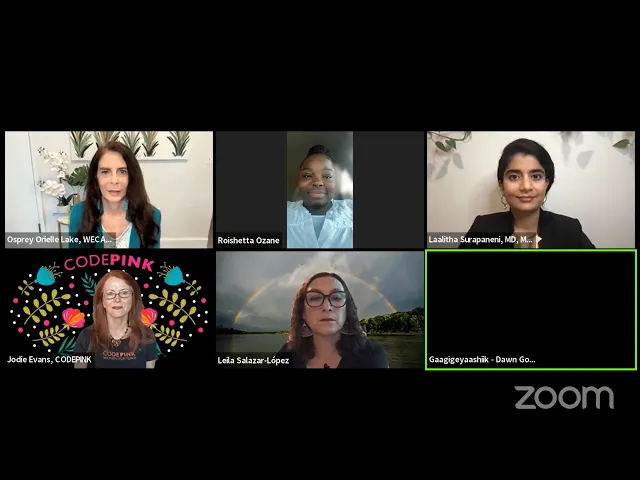
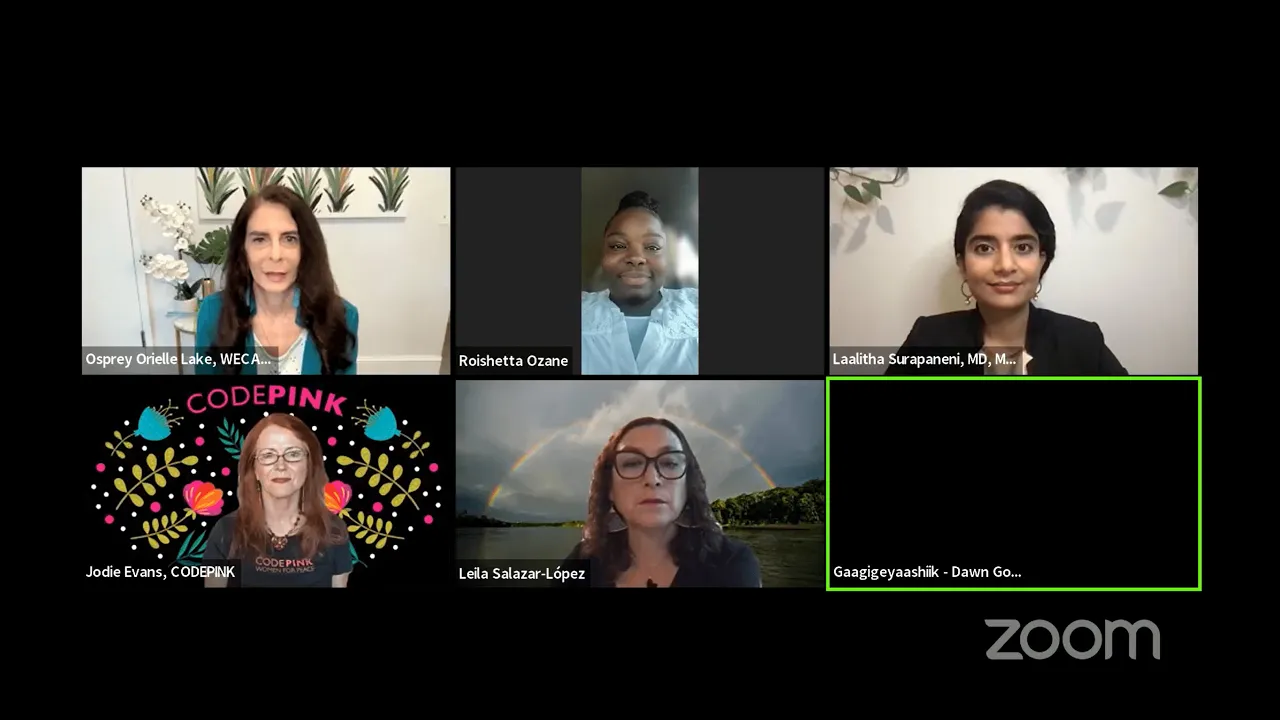
Welcome everyone to day three of the weekend climate Justice Forum visiting the climate emergency on the road to cop27 Solutions and perspectives from Global women and gender diverse leaders which we're hosting during climate week and the U.N General Assembly here in New York my name is Osprey Royal Lake and I'm the executive director of the women's Earth and climate Action Network we can and I'm really honored to be here On the Napa territory here in Manhattan I'm getting a little Echo I think someone needs to go on mute thank you um I wanted to welcome
all of you to our panel women leading fossil fuel divestment and resistance and for those of you who are just joining us now please be welcome to put your name and where you're from in the chat we're really excited to have this conversation with you and and uh hear from all these really amazing women about the work They're doing Frontline women and Global Advocates are building critical strategies for National and international divestment from harmful extractive Industries and militarism while we're also calling for justice and accountability from financial institutions it's really past time for Investments to
move toward a just transition that puts people and Planet first and not continued destruction many groups are organizing For strategic campaigns to call for divestment to stop fossil fuel pipelines stop fossil fuel infrastructure and extraction at the source and to supply stop Supply chains that lead to deforestation at we can we've been really honored to work um on many different divestment campaigns uh some with the speakers on this panel which we've been very honored to do and also with Michelle cook who's the founder of divest invest protect And given the escalating climate crisis I mean
what we're seeing all over the world now from Pakistan to what is happening in Puerto Rico I live in California we've had incredible forest fires as many of you know most of us in in the Bay area where I live are our lungs are damaged from this and we know that the escalating climate crisis is going to cause more harms to our communities and we need to urgently stop the flow of money to the fossil fuel Industry and companies engaged in deforestation Commodities we cannot lose any more forests and uh our panelists will be also
speaking about this and instead we need financial institutions to invest in renewable regenerative energy and community-led solutions while also respecting indigenous rights we know that it's really key that if we want to protect High biodiverse areas like the Amazon rainforest which the entire world depends on for Um our air our water um we we need to really look to the indigenous peoples who are the best custodians of their own lands 80 percent of all the biodiversity left on Earth is in the hands and lands of indigenous peoples so protecting their rights is key to the
solution that we're facing that we need to face in terms of the climate crisis and um you know it's it's something that a lot of financial institutions talk about Having human and Indigenous rights policies but then they don't adhere to them or they don't have any indigenous rights policies at all so we're going to get into that a little bit as as we go forward today I'm really excited because we can is releasing the second edition of our report gendered and racial impacts of the fossil fuel industry and complicit financial institutions we name names and
go after the financiers of dangerous and dirty projects and we're Really honored that several the women featured in the case studies in the report are on the panel today as well as one of the medical professionals who reviewed the report the report is being delivered to financial institutions around the world because the harms and health impacts from the fossil fuel industry really need to stop harms from air and water pollution impact pregnant women there is sexual violence against indigenous women Due to man camps which are temporary housing units for men at sites of fossil fuel
development there are harms to communities all over the world and on top of this there's the accelerating climate crisis that financial institutions continue to invest in and what we're doing is we're saying no more sacrifice people no more sacrifice zones divest now and with that I want to welcome this Powerful panel of leaders and thank you all for the tremendous work that you are doing um and uh really wanted to thank you for taking the time to be with us and uh right now in the chat we're putting uh the link to the divestive report
that we released today and I also just want to acknowledge that um Layla who's on the panel we're a little bit fired up because we actually just came from an action right here in New York City during climate week uh where we got to um deliver uh the report right to the front door today so um with that let me introduce these amazing women and then we will hand the floor over to them first we're going to be hearing from Don Goodwin she is Ojibwe white Earth she's a representative of the indigenous environmental Network and
co-founder of Rise coalition Uh then we'll be hearing for Rosetta ozane she's a community organizer for Southwest Louisiana and Southeast Texas um from the healthy Gulf and then we'll hear from Lolita Surah Panini she's an MD assistant professor General Internal Medicine at the University of Minnesota and then we will hear from Jody Evans who's the co-founder of code pink and then last but not least we will hear from Leila salsa Lopez who's the executive director Of Amazon watch so truly an incredible group of women leaders I'm really honored to have you here and I'd like
to hand the floor over to Don uh to to tell us about what's happening in your community do due to fossil fuel extraction and and what you'd like to share with us foreign and we'll be opening up um Nutrition Center for a social justice at the United Philadel teaching class there so that's what's happening um as a name um yeah so I live over by white Earth and we um because it was renamed once it was um relocated into my homelands and um and it's actually you know I live um like 20 I would say
about 20 miles From the the new line there in Clearwater County Minnesota and actually some other existing lines uh so just a little bit uh last year was just a whirlwind um front lines um I did not um actually tie myself down to any Machinery however I would have loved to um we had a different atmosphere in my coffee with some work That was done prior to an educational center we invited the mayor of Bagley and police and all the County Commissioners and uh let's see just uh seeing something there on the screen um I'll
just keep talking I think somebody maybe can't see or hear me so I think maybe Don maybe you could turn your video off and we could hear you better it's a little bit choppy let's turn your video Off and just hear the sound okay let's try that but we can hear you it's just a little floppy okay all right how is that a little better yes foreign last year we had a line three front lines um we named it 93 after was put in um it did create a lot of division Within our community before
during and after um a lot of people were afraid to come in and get involved just because of um police presence and whatnot although we did have um a different scenario in Clearwater County and that was promised by our Sheriff prior to during an educational Summit that we put on in 2019. And at that Summit the sheriff was invited the mayor the commissioners of each um the county or the township what are those called well anyway that the people of the townships they were all invited none of them came the biased newspaper reporters showed up
so that's a whole another story but um at that time the sheriff who I actually was a year younger than me and a family friend I'm the mother and his wife I have worked with them at the school and he promised me that he um would protect our first amendment that was his oath that he took the to protect our right to assemble peacefully and um and he did he protected that and so last year we had the treaty people's Gathering and if you're not uh familiar with that um we all know understand about uh
well I hope you do um and if you don't I hope I'm educating you some Um the treaty treaty people we are all treaty people with that notion that the United States was created under the guise of treaties negotiations with the native peoples so our treaty in particular that I live in and it's the 1855 treaty and that treaty is a War and Peace Treaty and so our ancestors assigned that agreement to let the settlers come in and move and live In the on the lands and that we agreed to live in peace together um
so with that we retain our inherent rights but we gave rights to the settlers to come and live so that is where that we came up with the treaty people that we are all treating people and so our non-native allies were supporting us and on reading Um that's the right to hunt and gather and also to protect the lands travel and occupy so that led with it day in um treaty encampment on one of the easements where um we stay until we control that negative and we stayed on the bridge for eight days and um
talked with the sheriff every day until we got an eviction notice from Enbridge that was full of lies we counteracted that um with our own press conference and the sheriff knew it was lies and we did not accept it but we did agree that when we were done with ceremony that we leave and we wanted to leave this place in basketball day even before we came and so when the sheriff reported after we left he said he found not even a gum wrapper uh so that is a good way in the Relationship that worked and
so that helps people that are moving forward um that's one thing that was in Clearwater County but it was a little different narrative um oops Don we've lost you I'm Ashley can you go ahead and text her and let her know we'll bring her back in again later I'm back oh here I am okay but I'm probably up on my minutes Um but now we have seen some different things happening in our own climate and we understand um well you know what that pipeline was about wasn't just about a pipeline it was about tar Sands
oil and our climate so how it was equal to 30 new power plants um that oil that they could be like putting the new power plants in and so we know how that affects our climate and So we have just noticed different changes in our climate as far as extreme um uh heat and also drought especially last year when we had um it was actually Beyond extreme it was uh what did I call that extraordinary drought it was beyond an extreme and then um Enbridge was allowed to actually up their water um the watering permits
from five million gallons to 5 billion gallons and that was we figured it's because of the Aquifer breaches um three aquifer breaches um that were reported by Ambridge however we were able to do a thermal fly over and it indicates possibly up to 40 different aquifer breeches throughout line threes slash 93's new line and so they coined that um a replacement project but what they weren't saying that was that it was also Um not only a replacement but a relocation and a different kind of oil so it wasn't conventional crude anymore but they always failed
to mention that it was tar Sands oil and that is sinks in water going under 22 rivers and through across and we've seen many many Frack oats and witnessed it at the Mississippi River and we were told to guard the Big River with our lives and so that is why I was there Um so yes climate change and it's affected our rice crop too this year in in different areas all through Minnesota uh the boys Fort reservation closed their large lake that Lake and then also Fond du Lac actually closed all their Lakes within the
reservation boundaries and there's some strange algae blooms and some of the rice Lakes just outside of the reservation so just some effects from climate change And me glitch thank you for listening thank you so much John for joining us and uh we have a beautiful photo of you showing uh on the screen since we couldn't uh see your wonderful face with the video um but we do see you on the screen just so you know and um you know I just wanted to thank you for your incredible resistance work your leadership um not only during
line three which I Know is an ongoing fight and struggle but also all the work you're doing to support all of the front lines on line five with the same company Enbridge and all the same financiers um and um it's really been wonderful to work with Dawn and learn from her and her community um also about the not just the um the health impacts and impacts to the rice which he was talking about and the climate impacts but also during the Construction of line three there were reports that um we have put into the report
I mentioned earlier that we released today around trafficking um of indigenous women and girls and violations and some of those uh violators were workers along the line three pipeline so this is also why we've been talking about um the issue epidemic of missing inverted indigenous women in relationship to the fossil fuel industry And line three is one of the deep case studies in the report you can learn about um so this is like really important another reason why we need to get the financiers out and with that I would like to hand the floor over
to Rosetta ozane you have the floor picket lines and picket signs don't punish me with brutality come talk to me so you can see what's going on good afternoon those were words Made famous by the artist singer songwriter Marvin Gaye many of you probably have heard I am rashetta ozan I am from Southwest Louisiana I'm currently in Westlake Louisiana home to several petrochemical Industries some of 66 Sasson Westlake chemical all of those Industries are right in front of me I'm sitting in the in the parking lot of the high school this homecoming week so as
many of you may know I have six children I'm a single mom of six and that they Are part of the reason why I am fighting the way that I'm fighting um to stop fossil fuel divestment we here in Southwest Louisiana were hit by two major hurricanes in the last two years hurricane Laura and hurricane Delta many of us lost our home we lost our residents a place where we had been living for years and our children had grown up we lost all of that and had to relocate I had to move out of West
Lake and move to sulfur Lived in a hotel for several months and then in a FEMA trailer for almost two years and I just recently moved out of that FEMA trailer into a permanent home that I was able to purchase for myself and my children not only were we hit by two hurricanes but we also had a winter storm Yuri which was a record-breaking freeze for our area and shortly after that we were hit with what the mayor of Lake Charles has called a 100 year flood we had never Seen flooding like that in Southwest
Louisiana before and if you didn't lose your home during the hurricanes or during the freeze when everybody's pipes Frozen burst then you lost your home during that flood so all of the residents here have been impacted by some sort of natural disaster that was caused by climate change which is increasing due to the amount of oil and gas industry that we have here in Southwest Louisiana And to add insult to injury there are more than 24 proposed facilities along the gulf coast along the Southwest along the Louisiana Gulf Coast with more than 10 of those
industry being proposed right here in Southwest Louisiana enough is enough we're tired we are fighting every day for our lives and now we have to fight against the oil and gas industry to ensure that we can breathe the air that we breathe every day to ensure that we can drink Safe Water we Should not have to fight for things that are Necessities water is life we should be able to go to our finances fill our glass with water and drink it without worrying about it yet we have to add to the Plastic industry by going
and purchase bottles of water because we can't drink the water that comes from our faucet when are we going to stand up and say we will no longer take this in our communities historically and disproportionately These industries have built in bipart communities specifically low-income black communities it's as if they don't care about us and we remain sacrifices long ago and they continue to power on crap that does not benefit us they tell us when they come to our homes they come into our communities that they're going to employ us that they're going to make our
lives better and that's simply not the truth if that is the case my organization The Vessel project would Not exist The Vessel project is a neutral Aid organization that I created after all of those storms because so many people needed help and I was determined to get folks the help that they needed my organization helps folks with their most emergency needs as barrier-free as possible there is no red tape and that's how the government needs to look at helping people when you call me and say I need my rent Paid I find the money to
pay your rent when you call me and say I need my light bill paid I find the money to pay your light bill yesterday I had an event where we gave out 150 gift cards to a hundred people I had to turn over 300 people away because the need is so enormous I could not meet the need alone we are calling on government officials we're calling on local groups on bigger organizations on big non-profits anyone who can come and Help the citizens of Southwest Louisiana who are very much still in recovery we're begging you to
come here to our community I will bring you on a toxic tour so you can see the industry we already have I will bring you to see where industry is proposed to be built and I will let you also see a social justice tour an environmental justice tour a climate Justice tour so that you can see which neighborhoods are hurting the most and you won't be surprised to See that it is the bipart communities that are hurting the most these communities don't have grocery stores they don't have access to public transportation their schools don't have
the uh resources that they need for all of their students but yet they continue to give industry permits to continue to build here and when they get these permits and bills here they don't pay taxes they have so many tax breaks imagine if industry paid a portion of The taxes that they saved these communities could have some of their basic needs met housing clothing food War yet we've found out that our government officials don't care about us so it's up to us to take care of each other and that's what I deal with that's a
project I started off my speech with words from the famous Marvin Gaye but I would like to end it with a poem that I wrote myself give me that uh that text And it's called breathe take a deep breath sounds easy don't it well easier said than done when the air that you breathe in your very lungs is the same air that will have you on the run to the ER without insurance waiting for hours with no Assurance gasping for air and needing water but not from your own faucet no that's not in order to
live water to drink but not from your Own kitchen sink the kitchen sink attached to the house and your very own corner of the Dirty South where you can't afford to pay your rent because on the lights your money was spent and now you're sitting here in a waiting room thinking you'll be dying soon all because you decided to breathe breathe sounds easy don't it it used to be not long ago that you could walk at your Very own bed though yes though not door you know the lingo you could walk outside and see the
trees climb the trees and breathe their leaves before your neighborhood was taken over and all the trees were cut down because oil and gas was the new mayor in town came to town promising to better you to make your life worth living but it seems like they're the ones doing all the killing promise you jobs but you're still the cleaning lady promise you will But you're still robbing Peter to pay Paul promise to uplift you but you still fall fall short of welfare Section 8 and food stamps and now to the ER you set up
camp waiting and waiting all because you decided to bring breathe found leaving on it well it ain't thank you oh my goodness Rashida I'm um having to catch my breath speaking of breath because that just brought me to tears actually um thank you thank you for your powerful words Rashida and your poem and the incredible dedication and work that you're doing it's it's um deeply moving and it's also uh brings about I would have to say for myself Incredible inspiration but outrage just outrage at the Injustice and um you know thanks for breaking our heart
open to hear your story and it's one of the reasons that you know we're so dedicated to this divestment work because this is wrong there are no disposable communities there are no sacrifice people or zones and zip codes it has to stop and this racism and Colonial um system that we're in produces exactly What Rashida is talking about and we have to say no and draw a red line and say no more no more not so that these fossil fuel companies continue to make gazillions of dollars and their financiers at the on the cost of
people's safety and health it has to stop and Rashida you are a Trailblazer and and we love you and we lift you up and I'm going to ham the floor over now to uh Lolita sura paninelli sorry syrup and any Who um is a medical doctor and I think she has a lot of other uh different ways of describing her background I'll let her speak for herself but um I wanted to mention that both Dawn and roshita are in the new report we have quoted them we were given the great opportunity to interview them so
that their voices could be a part of that document and then Lolita was able to peer review it so that the research we did on health impacts was uh Professionally reviewed and we thank you for that and you have the floor thank you thank you so much uh for having me here today and uh don thank you so much for um laying out um the line three uh struggle as well as Rashida my God I'm I'm still trying to catch my words um uh after having uh listened to you um I with our time today
I wanted to share a little bit about the various Health impacts that uh fossil fuel pollution and climate change uh have on our health and the disproportionate burden that women take on uh both because of the Care roles that we play in our families and also direct Health impacts um the uh you know in my work I'm a hospitalist so that means I take care of people when they get admitted to the hospital when they're very sick I also work with a incredible group of health Professionals both in Minnesota and nationally to Advocate and work
work with Frontline communities Elevate Frontline voices and advocate for you know policies that will benefit both our climate and our health um I did want to share my slides and please let me know when you can see them you see a blank screen okay perfect now we see them great uh so we know that worldwide air pollution causes about 7 million Premature deaths and um more than four in ten Americans still live in places with unhealthy levels of air pollution um even though we've made significant improvements in air quality in the U.S as Rashida was
just saying um these benefits are not for everyone people of color are 3.6 times more likely to live in counties with failing grades um and typically when we think about air Quality and the health impacts that come from it we think of you know um asthma but there are so many other um health problems that come from um air pollution virtually every part of our body is impacted by it um and we know that there's actually uh what we call a causal link so uh that's the Holy Grail of science we have so much evidence
that we can definitely say that air pollution causes um childhood asthma it causes lung Cancer and also deaths from heart disease in addition air pollution has been associated with high blood pressure Strokes um you know dementia brain development for children as well as impacts to um pre uh pregnant women I have pregnant people where uh you are at risk for preterm birth Um and uh many of these um impacts while I'm explaining them to you as like you know these organs that are being impacted and these individuals being impacted we know that they don't happen
in isolation uh these impacts happen to families and when that happens uh we know that even today uh based on the um American time use survey we know that women still take on a disproportionate uh role in care so that's both child care and Elder Care in families Um and so that burden falls on women in addition to direct Health impacts because there's new research that's looking into increased risk of um air pollution increasing the risk of breast cancer as well um and this is not just an outdoor air pollution problem uh even indoors and
we know that when we use let's say natural gas which is actually methane gas for cooking or heating our homes that causes dangerous pollutants to show up inside Our our kitchens and our homes as we know outdoor air pollution is very strictly regulated and you can see in this picture from a report by physicians for social responsibility that there's safe levels of outdoor air pollution but the same you know methane gas if you burn it in your house and um let's say bake a cake that increases and causes really high levels of toxic pollutants once
again because women are you know involved in uh disproportionate unpaid Um you know household work which includes cooking um that increases exposure to harmful pollutants to women as well um and I next another big health impact that comes from fossil fuels is of course climate change which is the biggest Global Health threat in the 21st century uh and has disproportion impacts to the low-income communities communities of color indigenous communities and those in the global South and as Rashida has just mentioned this is not just a you know future far away problem these this is happening
to communities right here right now while there are so many Health impacts that come from climate change and they're very different for geographically specific Health impacts we know that you know extreme heat is very deadly um just this year we've seen that heat waves in India and Pakistan which were Made 30 times more likely by climate change we've seen record high temperatures in California just this month and as you can see here heat has many you know both physical and mental health impacts on your heart your kidneys but once again um you know uh extreme
heat can pose risk to pregnant people where it increases the risk of pregnancy loss so that includes both spontaneous miscarriages as well as preterm birth And low birth rate in children and we know that you know children who are born preterm can carry a lifelong health risks as well and this is of course then also happening in the context of Reproductive Rights being erased all across the country we know with wildfires again you can have lung problems heart problems uh however women are at increased risk during their pregnancy because there are studies that are linking
development of What we call gestational hypertension and diabetes so that's high blood pressure and diabetes that develop during pregnancy but can carry lifelong risks for throughout the life as well and it's not just you know climate change and air pollution that happen by burning fossil fuels we know that from the entire fossil fuel life cycle does impact Health right so we know um whether that's oil and gas drilling or coal mining and workers having black Lung whether that's Transportation through pipelines refineries and as well as you know disposal of toxic waste like whole Ash those
are all going to have held them impacts and once again disproportionately towards you know bipart communities and low-income communities um and um we are going to share this link for the Cradle to grave uh report but I did want to mention a couple of these health risks of living next to oil And gas drilling sites um children babies can be born with congenital heart defects children are higher risk for leukemia again lung disease heart disease as well as kidneys being affected among many other health impacts and we know that oil and gas molds are twice
as likely to be located in a historically redlined neighborhoods and this I wanted to share some of the work that's being done um both in Minnesota and nationally and Internationally within the Health Community because we need to be you know it's no longer that we are just going to take care of you know an asthma attack or a heart attack and take care of people coming in with extreme heat effects we have to work Upstream so we're stepping outside of our clinics and our hospitals and working with communities so this is uh some of the
work that we've done around line three as you can see many uh doctors as well As nurses public health professionals we were involved in speaking with our governor's office giving public testimony as well as participating in demonstrations um this was a day of action where we had health professionals from you know across the country um showing up and calling on President Biden to stop Lane three even though construction proceeded with lengthy we continue to work with our communities I Wanted to share a toxic tour that we recently did with one of our incredible um environmental
justice organizers so that you know medical students as well as doctors were caring for patients from the community can actually go witness and see where these health effects are you know coming from we're working with farmers in our community to talk about heat safety because even up north here extreme heat is having an impact we're also working to Um you know participate in the public process and advocate for healthy policies and I'm going to leave you with this last slide which is um most recently you might have seen that the World Health Organization um has
endorsed the call for a fossil fuel non-proliferation treaty um and I was able to work here through Physicians for social responsibility and Global Climate Health Alliance and uh this is a very critical step to Acknowledging the root cause of uh all of these health problems and um calling for Rapid phase out of fossil fuels thank you so much and I'm going to turn it over back to you aspirating thank you thank you so much for that really powerful uh presentation Lolita and also thank you so much for your leadership in um organizing with other health
experts um and those working in the medical profession to highlight um the fact that you know the fossil Fuel companies um you know obviously know of these reports they are aware of the health impacts that have been going on a long time and then on top of that we have the climate crisis and um we it is just provides even more um foundation and reason for our argument that we must move off of fossil fuels and the era of fossil fuels must be over um just alone because of the health Impact so thank you for
that really powerful analysis and presentation I also just wanted to add um in our report and I think Catherine's going to put a link in the chat again for those of you who just joined um one of the other things that we saw uh in addition to a lot of the uh data that Lolita just presented to you it's in the report uh in the case studies is also for women that are are responsible for the care economy meaning the unpaid Unseen labor that goes on in caring for children uh elderly and all of that
work that um makes capitalism possible um is that um a lot of there is a grouping of women we talked to in the Gulf South that were also letting us know you know due to poverty and bipod communities which piles on even more difficulty as Rashida was mentioning is that you know their parents grew food and that was at least a way that they Could also provide um substance for their families you know in their Gardens and just grow extra food and now um the women we're talking to primarily in Black communities were saying we
can't grow food anymore because the soil is so toxic from fossil fuels that we cannot give this poison food to our family so that has been taken away and is also impacting women and their ability to care for their families Because they can't grow their own food anymore so um this is this is definitely a crisis that we need to call attention to um and with that I would like to now move us into another part of the conversation which is equally important and another component of the need to divest from fossil fuels uh we
are going to hear from Jody Evans co-founder of code pink you have the floor you're on mute Thank you um thank you Osprey for including weapons and War in this conversation um I want to thank Don and Rosetta for bringing us to the front lines of the war economy and its destruction to our lives our communities and our planet and how each of you are responding with what I call the peace economy and Lisa for raising up the violence to our lives and our health and inspiring Us with your work I'm coming to you from
the lands of the oh holy and the coast miwak in Northern California so militaries and Wars are one of the leading Global users of fossil fuels while countries hide this from their emissions report at all the convenings that discuss how to reduce carbon we call this the military emissions Gap created by pressure from the United States government to exclude them from The Kyoto Protocol this while many of the wars in the last 40 years had been for the control of fossil fuels from the first Gulf War to Iran Iraq Sudan Iraq II Yemen and now
Ukraine I was in a rock before and after the US invasion and it was clear to the Iraqi that U.S soldiers wondered while pointing their weapons what is our oil doing under your sand one of our actions in Baghdad before the War was a banner that read we have found the Smoking Gun and behind it we were holding gas nozzles now I know many of you don't remember that the US went to war on Iraq with a bunch of Lies Smoking Gun being one of them but the US public was also frightened into supporting that
war with Bush's color-coded Terror alerts orange red and yellow it was then that we called could pink for peace Part of our message and work since has been that war is not green so with this eight minutes I want to end that the peace sign means more to you than just peace but the saving of the planet the elephant in the room of a missions and fossil fuel usage is the Pentagon it is the largest industrial consumer of oil and therefore largest U.S emitter of greenhouse gases it the Pentagon exceeds those of many Industrial Nations
such as Denmark Sweden and Portugal and with the 20-year war on terror alone produced 1.2 billion metric tons of greenhouse gases the carbon equivalent of a 12 million pound mountain of coal Netta Crawford of cost of War project estimates that 70 percent of that is specifically from aircraft a Humvee gets between four and eight miles a gallon which is Criminal but an F-35 requires 2.37 gallons per mile and the Pentagon has some 585 000 facilities spread over 27 million acres in 160 different countries you might wonder what is U.S military doing with 800 bases around
the world they are supplying Global repression the support and cover for extraction and destruction of those in the Middle East and Global South it could pinkly are well aware that war just serves the war economy it is the Enforcer for hegemony and corporate greed just as with ending the use of fossil fuels we have all the answers the same with worn weapons diplomacy and negotiations are never in the conversation or funded as we are witnessing tragically in Ukraine and soon with Taiwan the addiction to fossil fuels places energy security and climate action at the mercy
of geopolitics Governments cannot claim to stand for peace or the planet if they continue to finance and drive War but just recently we saw every Democrat in Congress vote for a 40 billion dollar weapons package to Ukraine saying it was humanitarian Aid somehow forgetting that weapons kill people the US is killing people with 65 percent of our U.S tax dollars the same as they are fueling climate crisis with that 65 Percent of our tax dollars while we witness extreme floods fires typhoons droughts and more deaths The Awful Truth is that even if every person every
automobile and every Factory suddenly emitted zero emissions the Earth would still be headed head first and at full speed toward total disaster from one major reason the U.S military where there are no regulations accountability or blame it could be where directing our Engagement to weapon cells primarily planes since they are the greatest users we have just launched a program to stop the F-35 the poster child of all that is wrong with weapons manufacturer a program that costs 1.7 trillion dollars just to put that in perspective that is the student debt of 45 million U.S citizens
of 35 Joint Strike Fighter jets are designed to carry both conventional and nuclear weapons they have a significant Impact on the environment with their high carbon emissions and pollution on local bases I mentioned the 2.37 gallons of fuel for every mile travel but this is around 1 340 gallons of fuel per hour F-35 pollution is also an environmental justice issue as they are disproportionately tested trained and deployed in low-income communities of color we are currently engaging with Working-class communities in Vermont and Wisconsin where health and quality of life have been deeply affected by the F-35
trainings there if an F-35 crashes it's 10 000 pounds of combustible material would burn in The Inferno created by 2 700 gallons of jet fuel I hope you will think of joining us and the other 200 organizations calling for an end to the F-35 last week is a response to flooding Devastating Pakistan what did Aid look like from the United States government 450 million and F-16 fighter jets and as with the F-35 the principal beneficiary is Lockheed Martin this is an insight into what dealing with climate change looks like at the Pentagon and State Department
let's just throw more fuel in the fire there are plans around emissions is not to reduce them but to create more opportunities to sell more weapons and Make the rich richer poor countries poorer and more dependent the catastrophe in Pakistan was a direct result of climate chaos and the greatest suck of fossil fuels is fighter jets that's what we responded with all white people are starving have no place to sleep or cleaning water to drink the effects of storage of fossil fuels by the US military has been destructive To many ecosystems and people who live
in them just last year the fossil fuel containers on Oahu at Red Hill and navy fuel facility above oahu's biggest fresh water system that has been flooding the surrounding landscape with toxins for decades leaked yet again contaminating the water of 90 000 residents in Honolulu including approximately 9 000 Army Navy and Air Force families Thousands of those affected sought treatments for nausea headaches rashes and other conditions Tuesday of this week we joined protests outside the EPA in DC calling for the closure of Red Hill most attending were members of the military who had been horrifically
affected for now it remains full of fossil fuel and a threat to the community Stephen dunziger was on hand to speak and finished his remarks with the Pentagon is Earth's biggest polluter to Riff Off the film Abby Martin is currently making earth's greatest enemy ultimately we must downsize our military budget to meet the crisis congresswoman Barbara Lee has a bill to cut the Pentagon in half a good start you can support her at code pink we must demand that the cost of war is counted and exposed so we can affect it we must pressure our
government to de-escalate demilitarize and call out Our leaders who are driving more but say they care about the planet that's a lie peace is necessary for the health of the planet so join us in our work to cut the Pentagon because it is pivotal to divesting from fossil fuels thank you thank you so much Jody for the years and years of dedication you have to this work and to to um really exposing the military and the military's relationship to these Intersecting crises that we're facing uh so thank you for your incredible work and Leadership and
we are putting links into the chat to connect with um Jody's organization so thank you for that um and with that I would like to hand the floor now to Leila sarza Lopez who as I said is executive director of Amazon watch the floor is yours foreign thank you sisters for all your interventions and Everything you've shared so far um I am calling in from Lenape territory also known as New York City where um I am here joining our Frontline Community allies climate Justice allies youth um indigenous peoples from the Amazon to the Congo to
Asia um and also global leaders who were at the UN um and I say it that way because you Know I think usually we we say we're here for climate week and we're here for the UN General Assembly and we are and I think we're all just so happy to be together after so long it's been three years personally since I have been to New York and so it's it's good to be here with everyone and see people in person and and also glad that we can share what we're doing here with um all of
you who are not here in New York um we're your delegates we're your representatives um and so we're doing everything that we can to speak truth to power and to uplift and amplify uh brothers and sisters from the Amazon um from tropical forests all around the world um in solidarity also with many of our community allies we've heard from today And um I um I would be remiss um if I didn't mention that my heart is really with um with the people of Puerto Rico and with the people of Pakistan right now um I know
we're all very busy running around um or going to lots of events and really trying to make that this time that we're together meaningful we're here for climate week in the midst of Climate crises and I don't know what else we need to see then these images coming out of Pakistan um these images and these stories coming out of Puerto Rico to to get I know we know but to get our global leaders to declare climate emergency um it truly is heartbreaking and distressing to see these images and For um so much talk to continue
so um we're we're in this this Spirit right now of really knowing what's at stake seeing it happen right in front of our eyes and as Osprey mentioned um you know we actually live in California Maloney territory and for the last few years we've been feeling really the the effects of the fires um and when I think of the fires taking place in Northern California it does Make me think of the fire taking place um in the Amazon which are not accidents which are not wildfires they're intentional and the Amazon rainforest um the heart of
our planet is on fire the Amazon rainforest is in a crisis it's in a state of emergency um the highest record number of fires highest deforestation record in 15 years has brought the Amazon rainforest to a Tipping Point um and it is it is serious and it is dire um what is being faced in all across the Amazon rainforest um you all have seen the images of fires um you've seen the the trees falling you've heard the stories of indigenous Earth Defenders Forest Defenders on the front lines under attack and being killed for standing for
their rights And why why why is this happening why does this continue to happen when we know the Amazon reaching the Tipping Point affects us all it doesn't only affect the forest it doesn't only affect indigenous peoples or peoples living in the forest the destabilization of the Amazon rainforest directly impacts our entire global weather system we will not have snow or rainfall In the Rockies or the Sierras if the Amazon rainforest surpasses a Tipping Point and the flying Rivers divert from their course so we have time I know that's dire but we do have time
to turn things around um and as Osprey was mentioning earlier well we what we have to do is stop any further destruction and the theme that we're talking about today Is finance so we have to stop the financial flows that continue to allow investments in the destruction of the Amazon so what I'm talking about in in the last few minutes I'll just mention a few things that we've been doing this week we went to block Rock today with our partners and friends from wecan and sunrise project and New York communities for better for change and
Friends of the earth and Frontline Community allies from the Amazon to New York from a PB from koiabi from the Brazilian Amazon um and we were out there to tell BlackRock the biggest investor in climate destruction only one of the biggest investors in Amazon destruction that you cannot have you can't talk about environmental policies or climate policies if you're not really putting it in action those are just words Those are just words and even after indigenous peoples Frontline communities have written and requested meetings this company has failed to answer and so that's why we were
taking action in front of BlackRock and we're calling upon BlackRock and all of these other asset managers to stop investing in Amazon and climate destruction and it's not just Black Rock it's Vanguard it's State Street these massive Financial institutions are investing in the fossil fuel companies that are destroying our peop our communities our people and our planet they're investing in companies like geopark they're investing in companies like Petro Peru and this week we actually released a report called the risks I don't know if you could see it foreign there we go yeah oh Yeah we'll
share the link but this report um talks about what Petro Peru is is has done and what it's seeking to do in the Peruvian Amazon in the territory of the Artois and the Wampus peoples which are autonomous Nations that say we do not want any fossil fuel industry in our territory they've kicked out geopark They've kicked out Talisman and they're gonna kick out petrol Peru with all of our support and solidary and um this week we had invited some colleagues some of the presidents and leaders of the autor and the Peru um and the wampi's
peoples um and Fisher folk who are also affected by um Petro Peru on the coast to Peru um we had invited them here but due to Some Visa issues they weren't able to make it but they'll be here in a few weeks and they're going to be meeting with Vanguard and they're going to be meeting with HSBC and Chase and Vanguard and hopefully BlackRock to tell them that they do not want these financial institutions these Banks to be investing in Petro Peru Petro Peru's license to operate is null they don't have permission to go into
the Ottawa and and want these territories And so that's what we need to continue to tell these Banks um of petrol Peru and any other fossil fuel industry fossil fuel company um and any other extractive industry we also um I know my time is up so I'll just mention briefly that we also released a report on blood gold I know it's not fossil fuel but it's the extractive industry it's these drivers like the mining industry like the fossil fuel industry the oil and gas industry The agribusiness companies all of these industries are causing havoc and
causing Amazon destruction and they need to be held to account and so that is really what we're doing at Amazon watch is standing in solidarity with indigenous peoples Forest peoples um who are on the front lines who are protecting the forests um and all life in the Amazon for our future for our climate And we're standing with them to call upon these corporations these governments and these financial institutions to be held to account so um thank you all for listening thank you all for having me and um I'll share a couple links in the in
the chat and look forward to to the discussion thank you thank you so much Leila for your incredible work and dedication and and these reports just you know we've been Putting them in the chat as you speak you're welcome to put them again but just so you know we've we've put them in the chat for everyone those are really important reports and they've been very effective um in in supporting Frontline leaders and and just to say that these reports that Layla's mentioning uh the reports that um Jody and others are mentioning Lolita you know we
we put these out because we Know their Educational Tools and also a form of exposure so that people can understand what is going on and be able to expose these injustices and harms give people details but it's also an advocacy tool um we know we want Frontline communities to have this research and that's really important to them and also it's a tool that we then give to the financial institutions that they can look at the research done on them and the impacts That they're having so um just just uh I got a question that I
that I want to respond to is um in the report that we can't put out today um we could name a lot of companies uh we kept the scope of our report to the United States and parts of Canada because it's such a large topic to talk about the gendered and racial impacts but it applies um to the world really but some of the worst actors are here in the United States in terms of financiers and we address Vanguard BlackRock Vanguard and BlackRock are Asset Management firms then we address Banks Captain uh uh also another
asset management firm um and we have JPMorgan Chase um we are addressing Royal Bank of Canada Bank of America and Liberty Mutual which is um an insurance company so when we're talking about Finance institutions it's across the board with Asset Management Firms Banks and insurance companies and all the different ways that they contribute to being complicit in this destruction by financing companies and sometimes people asking what are the insurance companies how are they involved well you can't put in a fossil fuel pipeline as an example unless it's insured so if you can pull insurers out
of projects you also have the opportunity to to shut down a harmful project Um I would love to get some questions going here in the chat from those of you who are listening in I will be looking for your questions in the chat uh to ask the panelists for any Clarity or thoughts that you have we'd love to hear from you um and while uh we're looking for um some questions coming out of the chat and uh Catherine and Ashley can help me keep track of that thank you Um I would like to go around
and and just um maybe hear from each of you what you have seen being the most um strategic um approach to your divestment work and if we could just go around and just hear like what have you found to be effective in your divestment strategy um I think that we are trying to get um rashita and Don back online I know Ashley's probably working on that because they both were in remote areas So I hope we get them back so they can respond to some questions but maybe we could start with you Lolita and then
go to Jody and then go to Layla for with some just short short responsive on what you have found to be effective in your divestment work yeah I I could probably not speak to financial divestment but we have definitely you know uh what I found most um compelling is to have that public health impact uh come through because You know we all are impacted by air pollution um no matter where we are um you know while Frontline communities get the first and worst of these impacts um and like so many of uh as either personally
have like um asthma or a lung condition or know someone who has it and so really making sure that we bring that public health lens into that conversation Um and at the same time I think just being able to uh work with communities not this like very Ivory Tower approach of you know like we're we're scientists or doctors and we know everything and rather like flipping that uh Power structure and making sure that we actually listen to the communities and respond to the need where it is I think that's been most um fruitful in our
work great thank you that's good to know Jody Yes you know I say that it's really been the research the Deep research that people have done in universities and the scientists across the world that have decided to shine a light on this missing place so super grateful for the research and there's two websites that came out of us bringing this issue of military missions to the streets at cop and Glasgow and those are the conflict and environmental Observatory it's c-e-o-b-s dot org and Military Emissions.org it's like you know the governments have wanted to keep this
in hiding for a very long time and it's their Brave work and important work um of getting it out and they they're continuing to do this research and then it's those that when they learn are Furious that this has been hidden and its enormous cost that this is the greatest contributor and we don't know I remember you know handing out the stickers in Glasgow and 100 and you know 10 000 people marching and here you are Marching for the planet and not a person knows that you know about this greatest cost so education um but
then we see inspires action and then of course as we've seen today raising up the stories of those who have felt the cost of War you know those in Red Hill those around the world that um you know like right now um Guam Guam is a beautiful island and um The U.S is already born in China um using the islands in the Pacific um Asia Pacific Guam the Mariana Islands their their lives their health and their pristine ecosystems are already being um destroyed I uh Julian aguan is on tour with his No Country for eight
spot butterflies to tell the story of what's happening there so definitely raising up the stories of what the cost of War are and I want to say about the cost of war that is what the U.S media avoids the U.S media which is a propaganda machine mainstream media is the promoters of War and what you can see is that they hide all the costs of war and as we've heard today you know eloquently that we're all paying the price of the costs of of war and fossil fuels and we need to keep raising up those
intimate stories thank you so much Jody really helpful thank you Leila hope you're on mute could you repeat the question again I'm Sorry that's that's all right it's a lot going on here the question is what have you found to be most strategic um most effective in your divestment work what has been a successful strategy or um you know something you want to uplift about your approach to divestment work uh yeah um I mean the first thing that really comes to mind is um is bringing the the voices of Um our partners to the boardrooms
to the meetings of these companies and you know starting with BlackRock I think just reflecting on you on on the first meeting I think was the first shareholder meeting that um that we went to with some of our partners from Ecuador after the blackrock's big problem campaign launched and I don't think they realized they didn't know what was coming and they I mean it was actually kind of Easy to get into the BlackRock shareholder meeting the first year easy relative to other companies like Chevron and others that you have to work really hard to get
proxies to get into the shareholder meetings but this one was relatively open um I just don't think BlackRock really realized how much of a impact um having the Frontline Community members there at their shareholder meeting and having their shareholders And their board of directors here directly from um communities that were directly impacted by the companies they were investing in so that's I mean that's always um super important I mean and that's one of our strategies that Amazon watches to ensure and amplify indigenous peoples voices Solutions and resistance and um so that's super powerful um you
know we didn't used to write a Lot of reports I have to say and part of the reason we even do Finance work was because we had been researching um the untracing the oil from the Amazon and where it's going and we found um we caught we we already knew but our research was confirmed um a few years ago when we were looking at The Bluebird terminal over at um at the offices of our friends at Rand and our some of our volunteers and um And team members were looking through the bloopberg terminal doing Financial
research and they found a lot of data about Amazon oil coming to California and tracing the oil back to California and we did an initial report and then just last November we released another report confirming that over 50 of Amazon crude comes direct to the account of California and so we in that process of looking Into the crude and tracing the crude we started actually digging up who's who's like financing where are they getting the money to do this because I mean Ecuador's in debt they're in debt to China how how are they getting the
money to do this well we started looking at the asset manager started looking at the private Banks and the public Banks who are who are funding this and so that was how our finance work and um and our on the on the private Banks And the asset managers began and then we worked with standoff Earth we launched a campaign called the exit Amazon oil and gas and that is specifically around demanding an exclusion policy similar to how companies have exclusion policies for the Arctic we will not drill in the Arctic we're calling for an exclusion
policy for the Amazon so you shouldn't be Amazon investing in Amazon destruction it should be one of the last places we should continue doing any kind Of drilling we shouldn't be drilling we should stop extraction and we need to say that every single time we're in these spaces and in the spaces at cop for example we need to repeat and repeat and repeat are you know what we call our tagline keep it in the ground and stop extraction um if we want climate Justice thank you thank you so much Leila and uh Dawn I'm so
glad that you're back with Us um we're having a discussion about you know effective strategies um you know for divestment and I've been really honored um out of um when we took a stand at wecan at Standing Rock during the Dakota access pipeline I had the honor of meeting Michelle cook who is a Danae human rights attorney and I mentioned her earlier she's the founder of divest and Best protect and she invited me to to work with her on indigenous women's divestment delegations and we too find that it's most important to um have impacted communities
and in our case uplifting women Frontline women speak for themselves to these companies and arrange engagements for them to um be able to hear what it is or Investments are doing I think there's that uh impact from hearing from people on the the ground that removes it from You know looking at a check box and just reading about human rights violations to actual human beings who are being harmed by the very people they're sitting in the same room with um I think is very important and and then also a lot of information we see missing
around um you know what what is the understanding of Human Rights what is the understanding of indigenous rights what is the understanding of free prior Informed consent or as Dom was talking about the lack of knowledge or respect for treaty rights um in the United States as an example but also indigenous rights all over the world and uh the right to say no and not give consent to these companies I think it's really important and many times these financial institutions um need to become aware that they are actually violating rights by investing in these companies
that are are doing These harms and not respecting indigenous peoples wishes so so I think that you know it's really important to one have these stories from Frontline communities um and have indigenous-led leadership Frontline leadership in these spaces um and then as many of you mentioned um you know all of this research that's being done that can back up a lot of um the details around um you know the health impacts and the Harms to the Earth um both for people and planet and with that I'd like to give the floor to you Don because
I can see her back online and just wanted to we're coming up to to the close and I maybe we'll give you the final word here on just your thoughts about you know strategically what do we need to be doing how we can support you in protecting your community and and what you see with these companies both like Enbridge but also the the banks That that that invest in them oh sorry maybe turn your video off again how is that much better better thank you yeah so things how you could help us is to um
Elevate What's Happening Here in on line three um there's a science team that I'm a part of uh we're a group of uh people that have come together that bring what what they have to the Table and we're um what we are doing is uh it's called and those who help beaver and so when the breeches and the frackots happen we noticed the Beavers were taking Red Willow and filtering uh the Mississippi River and so we wanted to keep an eye on things so we a group of us has been Going out on the lands
and um discovered a lot of different things in the frackout zones and so we have a web page um we can get the exact spelling for you um in the future and so there's different ways to use your own talents um so help us get that message across to Wisconsin and Michigan uh what has happened with they call them sheet filings and that's what's pounded down into the Earth and that is what has Ended up reaching the aquifers and uh so get that messaging out for us what were some other questions there uh osprey uh
Maybe yeah go ahead what was the other question you asked um I just um you know just hearing any closing thoughts that you have for us you know just as someone who's been really on the front lines and is doing this incredible work just you Know something to to help us uh you know close out our session here our closing thoughts that you have which yes now I recall my brain was thinking too when you were asking those questions so two things I'd like to highlight here is what I learned um whereas we were on
the front lines with flying three is about relationships and relationship building and unity so I had this notion of unity is how everybody's getting along and all this Unity well human nature it's impossible for everybody to get along but what we need to do is you can still have Unity and it's um some may call it clicks or whatever groups of people um we can still be United in our cause and do our own things and but respect each other across those groups of people so the respect part is very important moving forward Um what
else and also um women women are the ones to take care of the water that is our in Duty as women and uh but within that do not lose sight of the importance of our men and keeping the balance that is one important thing I want to bring to the table is to ensure that our men are being asked and being part of what we are doing so uh Thank you so much thank you Don for joining us and um I look forward to continuing our work on line three and line five with you and
uh thank you for your courage and your dedication um showing such great leadership and with that we're really closing in on the end of our session here and I just wanted to thank all of our panelists for your really powerful work and you know it's really interesting because when you tell people you're doing you know uh Divestment work on fossil fuels or deforestation Commodities it is not sexy definitely not like oh this sounds really interesting we're going to talk Finance here and numbers and get into the nitty-gritty health issues um but actually it's very powerful
the divestment work we've seen literally billions of dollars being moved out of these sectors because of the collective work of divestment campaigners around the world and we are creating pressure And we have seen policy changes we have seen there you know the industry having to respond even though it's very skittish um we're here we were outside Blackboard Rock today we're everywhere really confronting them with being a part of the solution instead of investing in the destruction and I think that this is gaining incredible momentum and I really want to thank everyone for our Collective effort
because it is working And it needs to become louder and the window of time is small but I'm always really encouraged when I hear from all of you and um thank you so much for your work Don I see your hand up but I don't know if that was intentional did you want to say one more thing but please go ahead I have one last in but um we are having a fire light Clearwater River at the airport road and Bagley Minnesota October 29th through October 2nd it is in solidarity with treaty days And [Music]
um also to commemorate the year that we were there for 26 days and to be in community uh yeah it's gonna be a good time thank you Dawn and what a great example of a powerful organizer never leave a meeting without inviting people to another activity so thank you Don for showing the true Spirit of an organizer Which is you just keep organizing um and with that um sending everyone best wishes with your work and look forward to continuing to collaborate and thank you all for listening in we really appreciate uh you participating in the
panel with us thank you everyone thank you Osprey and we can thank you thank you thank you onward to peace without fossil fuels yes