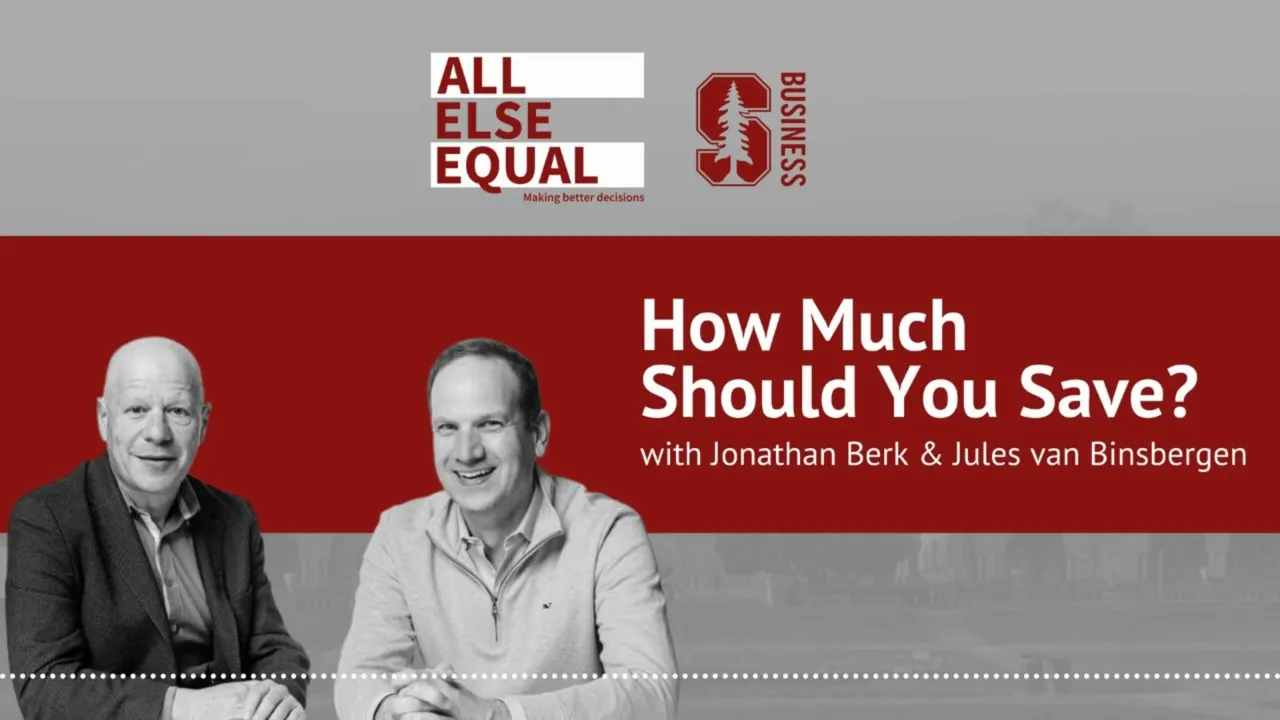
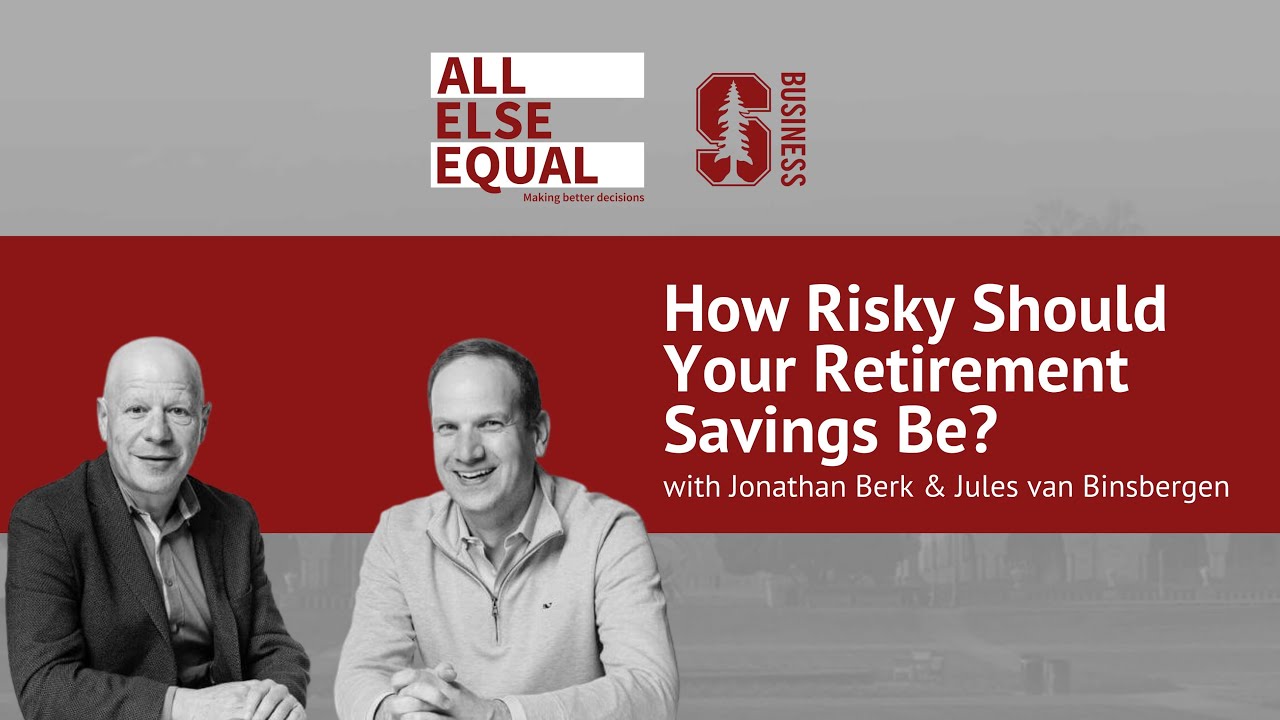
[Music] foreign [Music] binsberg and a finance professor at the Wharton School of the University of Pennsylvania and I'm Jonathan Burke a finaster professor at The Graduate School of Business at Stanford University and this is the all else equal podcast welcome back everybody today we are going to talk about how do you accumulate your wealth over your life cycle particularly with a retirement objective in mind so we're going to talk about things like how much money should you be putting away every year and what are reasonable rates of return on your Investments so that you can
achieve a particular retirement goal that you have in mind say retiring at 45 or at 55 or at 65 and so that is what today's episode is on just as a reminder if you go to the link in the show notes you can click there and you can submit ideas for big problems that you think should be covered in future episodes of all else equal so if you have a good idea for an episode please click on the link in the show notes and fill out your idea there so Jules I also like the idea
of what we're going to do today because I think it illustrates a pretty productive way to approach an economic decision so in this case the economic decision is how do I save for retirement and the best way to approach a complicated decision is to simplify the decision and by doing that get a handle on exactly what the important inputs are that determine the decision so what we're going to do today is think about a simple economic model and once we've explained the economic model we can use the economic model to figure out what are the
implications of saving for retirement as I like to say to my students an economic model is really just a way of making an argument in other words we're not physicists no economic model is going to work like a physics model so then why do economists and practitioners build models it's to make an argument if the model is consistent then we know the argument is consistent and so then the question is what assumptions lead to what conclusion so really an economic model is all about the assumptions and that's exactly what we're going to do today the
other thing we're going to do is simplify the problem in the sense that we're not going to talk about the best portfolio to hold like the ratio of stocks to bonds to hold because that is another episode all to itself so today we're going to step away from the best investment strategy and just concentrate on the question of how much money do you need to save in order to retire all right so then let's lay out the basic ingredients of the model and after we've set up the model and see what it implies we can
debate each of these assumptions in turn but here are the basic ingredients first you are going to be working for a certain period of time that certain period of time can be 20 years 30 years or 40 years let's start off with the simple assumption that you start working at 25 you work for 40 years and you retire at 65. then at age 65 you're going to retire and you will have to live off your retirement savings for the next 20 years that is between 65 and 85. now during the 40 years that you work
you're going to be putting a fraction of your income into your retirement savings account that retirement savings account is going to be invested in some investment vehicle that's going to deliver a certain percentage real return per year and when we say real return we mean the return that you make after correcting for inflation so if you make five percent nominal and the inflation rate is three percent then your real return is two percent per year and so now the key question that we need to ask is which fraction of your income should you be putting
away in the 40 years that you're working but this of course depends on how much you want to consume in retirement a common assumption is that in retirement you want to consume 70 of your last earned salary but and this is important it is the salary left after the contributions for retirement have already been made so if you make a hundred thousand dollars in the year before retirement and you are putting away twenty percent of your income to save for retirement that means that you had eighty thousand dollars left and so then what you want
to consume during retirement is seventy percent of that eighty thousand numbers so that's fifty six thousand per year and then the last component of the model is what about the fact that your income is likely to grow over your life cycle so if you look at the data what you find is the median person's income Grows by about one and a half percent a year and the 95th percentile grows it's something like five percent a year so we need to make an assumption so let's just assume that your income will grow at some rate over
your life cycle and those I think are the basic elements of the model so now let's see if we saw that model and look at the numbers what's one of the most common advice that we see will lead to so a lot of financial advisors will tell clients something like just put away 10 of your income so the fraction that you save is ten percent of your income and what you then find is is that if you want to have enough money to retire on so that you can consume 70 of your post contribution income
in retirement then you will have to assume that you can make five percent in real terms per year assuming an average income growth of one and a half percent and again we're working under the assumption that you will work for 40 years between 25 and 65 and retire for the 20 years after now the question is is that realistic just to be clear on the Assumption of how much you're going to retire on so if you are making a hundred dollars and you're putting twenty dollars into your retirement savings account then what we're saying is
you're going to live on seventy percent of the eighty dollars yeah so given that assumption as Jules pointed out you need a five percent real return which is an exceptionally High number to put this in perspective if you look at the real return on tips which would be a riskless investment in U.S treasuries the real return on tips to really exceed two percent so to expect a return of five percent is exceptionally optimistic well so one way in which we can get that return up would be to take more risk and as we said risk
will be discussed in a different episode but let's just say one short thing about it if you take a lot of risk that also means that the distribution of possible outcomes you're going to get is going to be quite wide and therefore you will have to be willing to live with the possibility that you need to live off much less than that 70 number that we've just mentioned and so let's not go into that in this episode but risk in the end is something we will not be able to avoid we will have to have
that discussion at some point and we will but the point is I don't like it when financial advisors say oh we'll just put it in the stock market and you can earn a higher return I mean return doesn't come for free if you want to put in the stock market then you have to entertain the possibility of losses and therefore you won't have enough money to retire on me one of the things the Great Recession the crash of 2007 that annoys me is everybody's like act as a complete surprise what the stock market could go
down I mean what I think the biggest problem was people were allowed into believing that you could just get these higher Returns on the stock market without ever encountering any risk so the summary is simply this if you want to make sure that you're going to have the money that we're planning for you will have to invest it in a risk-free investment alternative if you're going to take more risk yes your average return will go up but it also means you'll have to deal with that and indeed return doesn't come for free if you want
to invest all your money in the stock market be prepared to have to do it much less so if we then take a realistic real return of two percent then what you need to save for a time but it is twice in other words more like 20 of your income you have to put into retirement so I think one of the first insights this model delivers is if you really want to retire at something like 70 percent of your post retirement income it's going to cost you at least 20 percent a year of a money
that you need to put into savings now if real returns are zero which is the number that we had for quite a bit particularly during the covert period right I mean real rates of return were exceptionally low if you have no real return then you have to Triple that so you have to put away 30 so now let's talk a bit about growth Jonathan we have a variation in the population how quickly your earnings will grow as we said particularly for our listeners it's probably closer to the higher end of the distribution so say that
growth rates are around five percent now our intuition would be and I think a lot of people will have that intuition is how can growth in your income in any way be bad meaning if my income grows faster shouldn't that make it much easier to reach my retirement goal but it's not quite that simple yeah the issue is since your retirement is a function of your final income the more your income grows the more you have to put away this is basically a habit formation model that says when I get used to being rich I
want to stay rich and that means you have to put more away not less away so let's just give you an example let's go back to the five percent real return calculation where the market you have to put away is 10 if I change the rate of growth from one and a half percent to five percent of the rate of growth of your income then what you find is instead of having to put 10 away you have to put 20 away of your income in other words because you have so much more consumption when you
retire you have to put away much more in order to maintain that level of assumption and if we drop the return from a five percent real which none of us think is realistic to a two percent real then you have to save almost a third of your income now of course many people people would say Well when you've got five percent growth rates in your income you'll be exceptionally wealthy when it comes time to retire and therefore you can take a hit to your retirement easier and so that is perhaps true but it goes against
the idea that we don't like to take a hit to our consumption and it illustrates another point right which is from a retirement point of view there is value to not getting used to too lavish a lifestyle too quickly right so there is this whole movement going on now and I don't know whether you've heard about it where people say let me work really hard consume very little save a very large fraction of my income and then retire early and of course this approach helps in two ways first because you save more a very large
fraction you build up your savings quicker but secondly you don't have this habit formation effect that you describe because you learn to live off a very low consumption level and therefore in retirement you can continue that same lifestyle that you had during those working years quite easy you know this is really a more General point one of the biggest beasts I have with retirement advice is when people say you should start saving for time and as early as possible now ignoring the Habit formation just think about this if you're saving early and his income growth
what you're doing is you're moving money from your poor state in other words early in your life when you don't earn a lot to your Rich state which is late in life when you have a lot of money we don't often think that's a good idea to move money from your per estate to your Rich state so the basic idea that you should start early saving for retirement I think we have to think about carefully and especially now let's put into the context of habit formation and getting used to consuming I actually think the advice
is that out wrong so John there's two arguments to add to that one on each side of the argument right so the first one is this as you grow your income over time what is the normal standard of living of the people around you is also going to be growing right so in other words the general standard of living of the economy is going up and so I'm not sure that you want to stay behind in that as you go over time you want to keep up so we call this external habit formation you want
to keep up with the rest of society which means that you do want to be able to grow your consumption pattern over time and so that is probably something that our model misses a little bit out on because we're going to be assuming also that through the entire time of your retirement you're going to be consuming the same amount and so we have to think that through a little more perhaps the other thing is of course the fact that what you're getting used to is that over time as you consume more you don't want to
scale back on that consumption all the evidence suggests that it's incredibly painful for people to scale back their consumption levels and by the way I'm not so sure that I agree with you that that is all that different for richer people than for other people I think that getting used to Lifestyles happens to everybody really quickly and it becomes normal before you know it and scaling back is just painful for everybody yeah I agree Jules but I also disagree with you that these two things actually work against each other and I'll tell you why I
think who you hang out with is a function of what you make and what you choose to spend so that you can control how much you need for retirement by choosing a lifestyle that the people around you choose agree so in other words I would say rather than start sailing early don't start saving early but as your income grows you put more and more into retirement so you're after retirement income doesn't grow as much which means when it comes time for retirement you haven't built up this exceedingly High living standard that you didn't have to
keep to so I would say you can achieve both by putting more away in retirement in the rich States you can both lower your internal habit formation since you're not spending as much you haven't gotten used to a lavish lifestyle but also because you're not meeting a lavish bar style you don't even pick friends that have had a lavish lifestyle yes I see your argument although I think that you know the way that we pick friends to let that depend on your retirement contributions seems a bit no no no on your lifestyle not your time
and contributions on your lifestyle I think agreed agreed but so I think the important point is to really understand the implications for retirement on how much you choose to spend on your lifestyle versus what you choose to save the other thing that you know you talk about a lot of jewels is in this model we've assumed 4020 we have assumed that the day of retirement is fixed but of course that's not true yeah there are a bunch of different things that we can discuss here the first one is what if you simply want to work
for fewer years and we already discussed that a little bit that's one but the other one that we need to discuss which I think is a hugely undervalued point is the following re-entering the workforce after you've been out of it is a very difficult thing to do and so in the economics literature we call this an irreversible decision now before you take an irreversible decision you better be sure that this is the right decision because you are giving up value by pulling that trigger to say it differently if you are not committed to say retiring
when you're 65 and you're willing to just see how things are by the time you're 65 and depending on your wealth situation you simply decide to retire later or maybe if you've reached a retirement goal better you can retire earlier than 65 by making this a flexible thing I think we can add a lot of value to people's lives and therefore I've always been surprised that in many countries and in many pension systems it's being presented as if being able to retire at 65 is somehow a good thing that that's a fixed number that everybody
can focus on and that there's no negotiation about where that number exactly is we're now talking about in European countries to make it from 65 to 67 and you can see for example in France how many protests that leads to but the whole idea that this needs to be a mandatory fixed number I've always found that strange and also Jules getting back to our discussion of your lifestyle you know some people may say to me Jonathan I want to have a fancy Lifestyle the way I'm going to finance it is I'm just not going to
retire right I want to live work hard and play hard and I think you're right people have the choice to make that so of course if you retire later you have much fewer years in retirement to finance and therefore you can have a bigger lifestyle and you don't have to put a third of your money away so I think it's very important to understand that people approach the problem differently and have one size fits all is I think a mistake and as you say it ignores the real option I mean that's the other thing you
could imagine that although you've got an average growth rate in income for many people the actual growth rate of the income is very uncertain right some people make it well some people don't and so working on averages is in some way hiding the huge role of this uncertainty one way of dealing without uncertainty one way with dealing that at risk is to understand that the point of retirement is a function of how well you do for sure if you happen to do really well you'd get to retire early if that's what you want to do
and if you happen to do less well well you just have to work hard no for sure so one movement that I think you've seen a lot is that the the entire pension sector even when it comes with its defined contribution or defined benefit seems to be focused on the desire to do this uniformization where we have the same Target date fund or the same pension plan or the same investment strategy or the same contribution rate or the same retirement age everything is about making everything the same for everybody whereas I think that depending on
the profession that you have depending on the success that you have throughout your lifetime depending on the preference that you have for the social context that you get out of work relative to other jobs I think there's huge heterogeneity that is being ignored and so I think that maybe the biggest takeaway of this episode is that this one size fits all is probably something that we should get off of well you know Jewels Target date fans and just for our listeners don't know what a Target date fund is it's a fund where you start with
a lot of investments in equity and fewer investments in bonds and then over your laptop the fun moves from equity ready to bonds and this has become a hugely profitable sector for money management companies and these were introduced during my lifetime as a finance professor and I remember when they were introduced originally I was very much against this and I'm still very much against this because there's no such thing as one size fits all people have very different risk preferences they have very different retirement preferences and often the target date funds are presented as one
solution and I think it's a huge mistake to approach retirement that way and I think it's pretty self-serving in the industry to try to pretend that one size fits all so one another example where I know Jaws you have strong feelings well one fast fits all are the pension contributions of companies right yeah so in the Netherlands there was this whole debate on a reform of the pension system and one key thing there was that a large group of people that were independent entrepreneurs were not yet in a pension plan and so the new law
proposal had in it that what they wanted to achieve is that even people that work for themselves so they're independent they don't work as a worker for a company that they still should be mandatorily participating in these pension arrangements and I never quite understood why that's a sensible thing to do particularly because again this comes to a large cross-sectional variation between people once we know that somebody wants to take a lot of risk is interested in swinging for defenses by starting their own company do you really want to force the those people to not use
all the money they have to try to make that work but rather force them to take money out of that entrepreneurial activity and put it into a pension Arrangement couldn't that potentially even lower the amount of entrepreneurial ideas and firm creation that we have in the economy by imposing such system-wide changes yeah I mean it just ignores the fact that people are different and it's one size does not fit all so that's I would say very bad public policy the other thing I know you have strong feelings about is the mass contributions of employers right
yeah so we talked a little bit about substituting money from poor states to Rich States and I think that that argument has a lot of bites particularly for the people that really can't afford to make the contributions right so many employers have this matching plan and the matching plan implies that if you contribute say three percent then the employer will match it with three percent but it also means that if you cannot make to three percent contribution you don't lose out on three percent to your retirement contributions you lose out on six percent of them
and so for those people that already have such low salaries that they're so liquidity constrained that they can actually not make that three percent contribution in the poor state do we think it's good public policy to give the incentive to try to put that three percent away and only then match it don't get me wrong we did a whole episode on incentives I understand the power of incentives but incentives only work when the person actually has a choice that they can make if the choice is not really a choice you can provide as much incentives
as you want and of course you can just see it in the data right you can see that for the lowest earning groups that is already struggling to make ends meet we're seeing that putting the incentive in place makes no difference if putting the incentive in place makes no difference then why are you putting it in place you know I always think about this in terms of buying a house so you know this huge transaction costs in terms of selling a house and buying another house and so the optimal thing to do is to try
to buy as big a house as you can so you can stay in the house for the longest amount of time and if that's the optimal thing to do given all the transaction costs of changing houses never mind the human costs are moving and the fact that your kids have friends in the neighborhood ignoring even those costs if that's the optional thing to do you don't want to have to force we will put money into retirement which lowers the size of the house they can buy initially so again this idea of one size fits all
is a pernicious idea which I think we really have to think about in terms of this public policy of how we approach the retirement decision all right so let's wrap up and let's talk about what I think are the key takeaways of the episode today and I think several of these takeaways are actually non-trivial things so the first one which I think is an important one is that getting used to a particular lifestyle implies that you need more money in retirement if you want to continue that lifestyle after retirement so what we call habit formation
the second important Insight I think is that rates of return are actually quite low right now particularly in real terms and so if you want to make retirement goals with a relatively High degree of certainty the 10 number of savings that we had in place so far as the recommendation may actually be too low and numbers closer to 20 or 30 percent may be warranted the third one is that retirement decisions because they're irreversible are not to be taken lightly and so you give up what we call and finance a real option value because returning
into the labor force is very difficult after you have retired particularly after you've been retired for say a year or two and so maybe therefore particularly in countries that have part-time working Arrangements part-time retiring may be a better strategy so that you can scale back up your labor contract if it would be needed and then finally and I think we hammered this one a lot is the one size fits-all broadly speaking in pension land may lead to not optimal outcomes the last thing I would say is on the amount that retirement where 10 we're saying
10 is too low and you need a close to twenty percent I think many people would react by saying it's twenty percent of my income I can't afford to put that aside and I think my answer then is to say okay put 10 aside but then if you put 10 aside you should be accepting of the fact that you may not be able to retire as soon as you think you'll be able to retire yes that the 4020 rule is probably not right I mean we have medical advances so you can it's more like a
50 10 rule that you may have to do with and again the real option and the flexibility to retire is important like if you get to 65 and you're in very poor health well obviously it's going to be harder to work but by the same token you're probably not going to live as long so there are these questions you can do later on in retirement and so that allows you to put less money aside so long as you understand though that the implication is that you're probably gonna have to work longer thanks for listening to
the all else equal podcast please leave us a review at Apple podcast we'd love to hear from our listeners and be sure to catch our Next Episode by subscribing or following our show wherever you listen to your podcast for more information and episodes visit all else equalpodcast.com or follow us on LinkedIn the ol SQL podcast is a production of Stanford University's Graduate School of Business and is produced by University FM [Music] thank you [Music] foreign [Music]






![Bob Sutton: How to Outwit Workplace Jerks [Entire Talk]](https://img.youtube.com/vi/wFTkQmPw2Gk/maxresdefault.jpg)