The whole program the whole program is based um upon some work by Deans for impact um on a deliberative practice model and it it's this this underpins the whole program and particularly around what we're saying to you earlier that Blended learning has a high a High um in high level importance upon self-direction Self-evaluation and self-reflection as well and it's important that you identify for yourself the things that are pushing you checking your understanding of different things and within the relationship that you build within this group and alongside your online tutor to really be honest about
areas of understanding some things that you need Clarity with sharing situations at school or in your own thinking about uncertainties and Clarity perhaps things that didn't go as well and talking about how they could be improved next time so if you do what you've always done you'll get what you've always had in essence so push yourself through this whole program don't opt for the things that you know really well but put up for those new areas of knowledge that you really want to build up for yourself so that's where the whole program sits to start
with on pushing beyond our own comfort Zone seeing what it is and then really naming that very clearly and program thing and finding out further information about what it is that that that that new knowledge is asking us to do how is it challenging me personally my personal leadership capacities and skills and understanding and importantly how is it challenging my leadership behaviors because our leadership Behavior strongly influence other people and we need to Get those right and how do we get to know that is the relationships that we build with other people so after you've
named it really you're probing and then putting it into practice not just thinking about it this whole program is not intended to be a research-based program it's intended to to Really impact upon you as leaders and output and other members of staff to build their leadership capacities and obviously upon pupil outcomes in its Broader sense so you know try things out um get feedback from one another get colleagues to give you some um Insight knowledge put it in the mirror up to your own practice about what it is you're doing and how it could be
improved and or how well it's gone and how you can really embed that practice and by getting that high quality feedback and adjusting your own mental Model it gives you something that you have a very firm understanding and you have that you've developed a mental model that you can articulate but also show the impact that it's having uh with other people as well so that's the model that we always keep coming back to and the model that you need to bear in mind whenever you're doing any pieces of work when you're working with one another
and so on at the same time so what we want you to do is to we're Going to give you the opportunity to explore that a bit yourself the the deliberative model is is clarified there in those five bullet points there but what do you want and how do you see working together effectively how do you want these sessions to go how can you be best prepared and how can your colleagues be best prepared to get the most out of these sessions you've invested you and and or your school have invested a lot Of money
and a lot of time in this program so how we we want to make sure as facilitators we get we do the best we can for you just as your online Mentor will do but how do you want to work together so if we put them into just two groups Lois if that's okay they've done yep um if we give you a couple of minutes to introduce yourself to say who you are what your role is where you are in your country and I'll share this in the room As well so you can see this
at the same time um and um and and what you're hoping to gain from the program and just share that with one another and and then with the rest of the time you've got a good 10 minutes then to have a look at these questions and explore between you what sort of things you would like to have um in terms of effective ways of working together Is that okay and if you can ask one person to be the spokesperson for your group uh who could give us bring back the Salient points of your discussions uh
and briefly and succinctly put those across to to the other group okay is that all right and um so Lois thank you and I'll see you in 12 minutes or so foreign are we recording still no running I get shot Um so um that's really good uh really thoughtful answers around uh pulling back the ways we wish to work together just another couple of things to just to remind ourselves please be timely um in the work that we do um and summarize um um be succinct in the responses that we give back to one another
as well so some really helpful uh suggestions of the way forward so let's let's move on To the next part now and this is really just to check how familiar you are not a test just to check how familiar you are with the whole program and with your access to canvas with that as well so what we want you to do in in we're going to put you into two groups again and be different groups again so if you haven't met anybody else we'll have a quick introduction time again just for two minutes but I
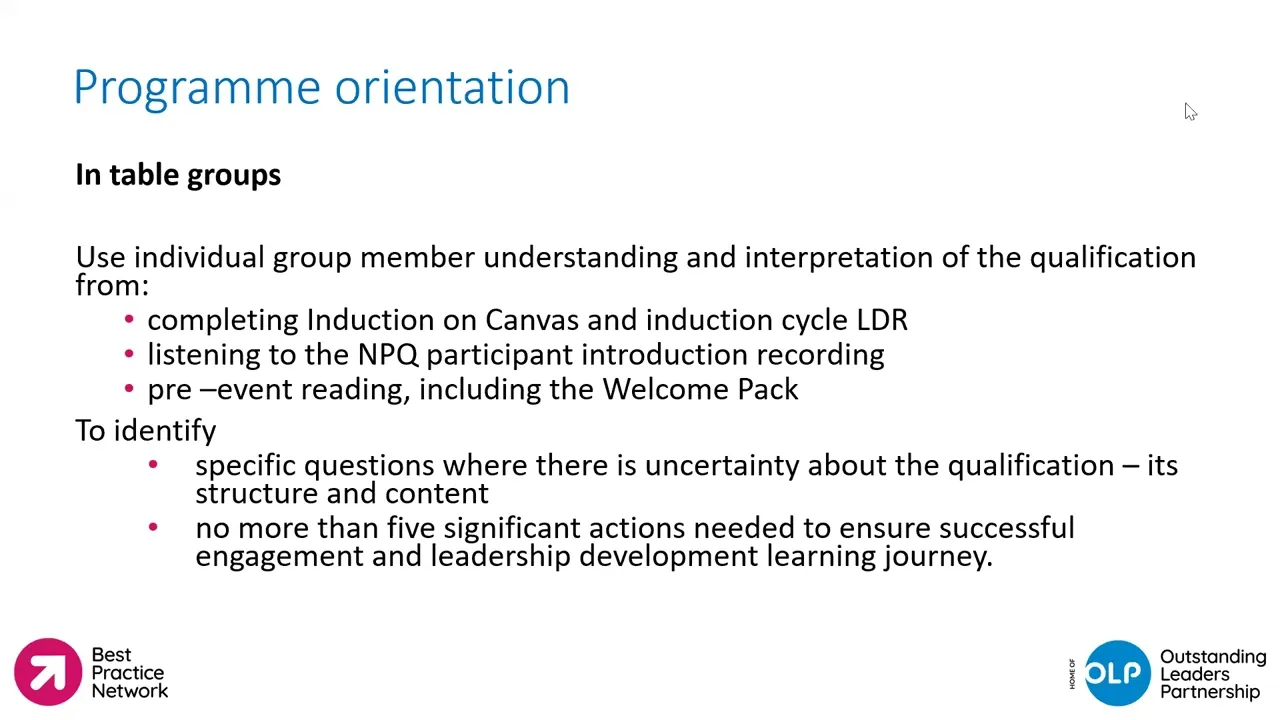
want you in your own groups to discuss The slides from 10 through to 17 which give you that overview of the whole program and if anybody's got any questions see if you can resolve them within your own group so you know what what's the compliance figure do we have to attend every face-to-face day and what do we do with practice activities and formative assessment tasks how are they marked type of questions so try and answer anything yourself about the program and And your access to to Canvas and the overview of the program that's in your
slide pack and if you can't answer them please make a note of them and we'll have a different spokesperson for the group make a note of anything you can't answer yourself about your your involvement in the program and secondly have a think about what sort of things you've picked up of ways of working that enable you to successfully sort of complete something so if any of you have Been working on Masters or another program what did you do to ensure that you worked your Learning Journey Through as successful as it could be all right how
long please um so we have um we have 15 minutes on this if that's okay and then we'll come back and have a question and answer session so that I don't want you to leave today without having some of those fundamental questions answered if you haven't done so in your groups All right okay see you soon hey and the timer as well oh yes fast learning me you know and our main sort of steps forwards um because the big one was organization to be successful was really as it spread out okay um over a long
period of time we're all busy have you fell have you found the schedule Um tab in in canvas yeah because if you if you press the schedule tab that gives you the dates that things are coming out um when uh work is open um and also it provides indicative times for you to submit your work by now do remember they are indicative times all right because they are flexible if you're going to be really late with anything all you need to do is let your online tutor know so that they're aware that you've got a
hiccup and and we all Know that there are great unknowns in education um so if you know you're going to be late with anything just like your online tutor know but other than that they're indicative time so you know a week or two either side doesn't really matter yeah yeah so it was it was sort of organizing when you know pre-tasks you know the reading Etc all that sort of stuff so being aware things don't creep up on you You know when there's a bit of a gap between things so how would you best organize
things then and who would help you with that who yeah um apart from yourselves I mean I'm lucky we've got Cheryl and myself working in the same place so we are keeping each other oh that's always helpful organized that in that way yes one to one tutor was really helpful in giving us guidance right yeah on that one Um and you can also as a group um you know we always advise you to try and set up a WhatsApp group as well so you can you can chat with one another what does this mean um
um how are you getting up how have you applied this type of thing so that's always good if somebody wants to set that up we we can't organize that for you because of GD yeah it's really helpful uh within the group as well okay I was thinking more About uh sometimes you're asked to think about a non-line in school coach or Mentor um perhaps your senior leaders or your Governors if you're already a head teacher just to make them aware of what you've got to do and you know wherever possible to provide some some time
in school time because it's still part of the job but no great expectation expectation that it should have all the work should be done during school time By any means but did you have any questions about the program itself any sort of um questions about timing or marking or anything no nothing maybe resolve them yourself did you yep right yeah the only thing was when um the first Activity The implementation activity yeah and we had to submit the 400 words about one of the three activities to choose it was a bit like in the dark
where there isn't like A format am I supposed to have like a referencing at the end is there a citation is there a form to write the name and the course like all right okay the basic answer to that one is no there isn't a set format you you write in what you feel is the best way to represent your synthesis of the reading and the research and what it's asking you it does ask or usually though in the formative assessment tasks it gives you some clear guidance about what needs to Be included how you
put it together is is what suits you best so we're not dictating a particular style of writing or approach and you will find over the over the different cycles that you will be forced in some in some senses you you have to produce a chart sometimes so you have to produce your evidence in a PowerPoint but how you do it is entirely up to you Dahlia yeah a good question okay what about the other group then Now um we didn't get around to the organizing section but we had a really productive conversation around clarification um
of things so we had a good discussion around clarification of where to find things and we were discussing between the um canvas versus the online platform and and those two intermixing with the dashboard and we had a clarification on groups and we realized we're all in Different um or some of us are in different groups for them yes you are yeah that's true yeah so we had we also looked at the clarification on structure and assessment and when it's due and what's coming up and we also discussed references and expectations as well so do you
have any on on answered questions great okay good evolved on your homework well and what about oh okay how what would you think Stacy then on best ways forward to be you know a successful way of approaches to completion I think that the best way forward is to make sure that your school understands the expectations as well as you and I think that without community and collaboration I don't it's not always possible with how busy our job is yeah we think it's having that understanding and again like setting up the WhatsApp Group which I can
see Dan is doing at The moment is really beneficial as well so to have that Community piece that can support and to also have this whole piece that can support that's great and and that bit about the school knowing your expectations is really important for everybody because when you come to do practice activities informative assessment tests you will find that there is engage you have to engage with other members of staff and therefore um it's important that you are clear About where the timing of any suggestions or ways forward fit in all right and that's
why the course is spread over 18 months so that it it's going to be it would be virtually impossible for every online piece of work that you have to do for the practice activities in the formative assessment tests to do them before the next summative the next cycle starts because you can't pick up something that you want to change as you Will have found out from your work on implementation and impose it upon anybody else it's got to fit in at the right time you've got to set your timetable for implementation of the research and
change that you want to bring about sometimes it involves training other members of staff and making sure it's the right time and that implementation work has been done properly um so um and you can't it doesn't always Fit in linearly uh with the the cycle work as well so some things may fall in and some quite often say we're looking at that at this moment in time and it fits in really well others you may have to wait a term or half a turn um to to actually put those things into practice so that's why
there's a good time spread but also the importance of Staff understanding uh that you need to put these things into practice as well That's great so we've got if anything comes to mind as we work our way through we'll stop on at the end of the session today and answer any uh direct questions or individual questions from each of you unless there's anything that needs to come up now okay just a housekeeping thing really just on time these sessions that they will run from two to six today and tomorrow well Um yeah you've got half
an hour than anybody else in the world I'll tell you I don't know how you've got four hours it we will be working definitely for three and a half hours um if there's any and if we finish earlier we finish earlier if we can finish a bit later sometimes we may need to do that all right but our our timing really is three and a half hours but if we if uh but having that extra rollover may be helpful at some point okay but That that three and a half hours is what we're working to
okay great so let's um let's press on then and move on to on the next part here I can't see I've got so many bars on here okay sometimes I can't see so these are the slides that we've you've all gone through um and looked at those so here we are so let's check in and review Lois And that's where we are on our schedule and you're on mute as well you're on mute Lois yeah that's the phrase that has been said more than any other phrase in the world over the last three years okay
it has and I'm always determined not to be that person but you know the thing okay brilliant yeah okay the next section is the section that we're going to look at to do with your ldpr and your induction Cycle now if I some colleagues have already mentioned that they've been through things with their coach which is fantastic to hear and it was also good to hear you saying oh they're incredibly helpful and supported that two of us that's that's really great what we want to do is to kind of focus in as they may have
also done with you on some of the key questions in that induction cycle and they are to do with what significant learning have you had when you started The course and what have you taken away from that so we're going to ask you shortly to discuss that and hopefully we'll be able to put people with people they've not been with before we we want to also think about not just the learning that you've done which could be academic could be research Etc but could you how have you then taken that and applied it in the
short time you've been on this course to your particular school and Your particular context and have you done anything specific that you wouldn't normally have done in order to be able to kind of evidence that you are implementing things on the course we're just interested to look at that and then we want to kind of look and disc you to discuss whether or not and how effective the tools that you've been given have been for you to assess your leadership practice within your a school is that clear so the questions are on The slide um
you've got a copy of those um if you kind of get through those we're all also interested in really you know your leaders many of you are senior leaders in your organization in that position how Have you communicated things like the vision and the direction for change that you've implemented in your school did you consider how you went about that um and if you're putting in a change Project how are you encouraging the leaders who work with youth to feel that they've got faith in what you're doing how do they trust in you to be
able to move things forward how are they going to kind of respond because there might be mistakes along the way how are you anticipating that how have you set it up for already if of those perhaps um little bit they'll do on the journey and then what are you going to use and to know whether Or not what you're implementing is successful have you thought about your quality assurance and your monitoring criteria so a little bit extra if you have managed to and do manage to get through these questions with your partner quickly we will
take feedback for this so how long are we going to put in the groups for let me just check this individually yeah and then 10 minutes in a paired conversation as you were going To say all right so um if you've got resource four you can make your notes on there or add to them um and or just turn the screen off for five minutes and then after that five minutes we'll put you into the into the rooms for a five minute conversation each foreign yes Foreign I can see Stacy still working then look you
look as if you're finished it's about that's it my timer says time's up now anyway but you can think and talk at the same time all right so I'll put you into rooms now and you can now one of you will have an additional person join them mustafa's just joined us so I'll just explain what's happening and then my staffer will join the room so if you can just Adjust your time uh accordingly if I give you an extra couple of minutes so if you haven't met one another you can introduce yourself yet if you
haven't done that but um and then focus on that that coaching type conversation with one another okay I Mustafa hello everyone I'm sorry for being late we'll let you off from this organization Mustafa Thank you if you turn to Res have you got the resource pack today I'm having something yeah yeah I can't access them right now so you can just give me some time you can I think it's best if you can continue because I'm having some technical difficulties what we'll do is um uh if you you need to look at resource for Um
you may have you may have already put some notes in that as well and then I'll put you into a room and they are they they will already started their conversation so basically you're talking through these questions that you can see on the screen which are exactly the same as in resource for all right okay okay let them the two I put you with uh do the first two sessions and then they'll give you a few minutes just to add in what you can at this moment in time you Haven't missed a great deal so
there's no problem uh with that as well so you get yourself sorted and then you'll be able to join in as you can okay all right thank you very much put you in the room to join the others all right thank you Bill you're still recording thank you fantastic and welcome back hopefully you've had a chance to talk about your ldr and your learning um Dahlia I wonder whether you can kick Us off in your group when you talked about what the significant learning you've taken away so far what kind of things did you cover
and discuss yes we thought that it was a very good opportunity to be exposed to other schools and other leaders experiences and how they acted upon things that they want or change that they wanted to implement in their own schools and then me and Bill agreed that it was a very good like eye-opener to a lot of Different strategies and techniques that other leaders are using and how they are doing it in their own schools and it was a very good opportunity to make us like stop think and reflect how can we really apply uh
implementations of specific things that needed to be changed or specific things that we wanted to implement in our schools has that come out through the group sessions and their group tasks is that where that kind of thing has come through Yes with the case studies of how the other leaders implemented specific things and how they did it this was very like um inspiring with different ideas as well like um different things that they have implemented um this was the main thing or the significant learning that we actually took away from implementation yeah yeah And it's
really nice isn't it in those group sessions to you know have colleagues empathize when you're talking about a difficult situation that you dealt with or as well as your learning so that you bring build up a sense of camaraderie with your your fellow people in the cohort that's really good um Cheryl Lynn what about the application of that learning we've heard a little bit there what kind of thing did you discuss Um so Stacy now we're talking about how useful the short course had been um for me in my role and kind of the school
that I'm at actually applying it as a little bit challenging at the moment because I'm not in um like I'm not a head of primary or things like that so um a bit challenging but I feel I've got a lot of knowledge to take away and um apply when the time is right Stacy said how useful she'd found it and actually she's been applying elements of it and in particular um the book where you're reflecting on your re reviewing an implementation the change once you've introduced it actually coming back with the staff to find out
how things are going and kind of tweak things um she'd found that part really useful um no that's really helpful thank you And Dan in your group did you get around to talking about any impact you felt you and your colleague Vicky had already made from the things you'd implemented as a consequence of doing this well we we talked about the it was interesting that that we felt our schools have some uh similar characteristics in in terms of implementation or things that we need to consider in terms of implementation and That that in a sense
was already having an impact in the way that we're thinking about strategic development and um trying to be cognizant of pace of change and the console level the consultation needed and how that compared to previous schools we'd worked in um and uh acknowledge that the need to be more consultative and a bit slower than excuse me that we might have been in our Previous settings and also postcode as well I think that's a a factor okay yeah yeah and why a bit slower um because of the the and I don't mean this sound a little
negative but the the embedded nature of existing processes and systems and the fact that that there are large numbers of Staff who 've been in the schools for a long period of time um who are you know very connected uh Perhaps even invested in some of those systems and processes and so the process of change um can feel more disruptive to to colleagues in that sort of situation than say in a school where the staff turnover is much higher and there's um there's you know the the pace of change or the connection to uh some
systems is less strong yeah yeah and that's a really important point isn't like recognize you're saying the impact Of change on people and which things are your early adopters to in terms of people and the things that you can move in terms of processes and that takes us really nicely onto the next section which is about implementation and then further looking at priorities and how you prioritize what you do and take that through and we're going to do some thinking on that later the good news is it's now time to have a break we're going
to have a short Break um and we've always got the issue of what time is it really so at the moment we're thinking that it's nearly 33 34 minutes past the hour um so if we could aim to be back here um no later than 50 but preferably between 48 and 50. we would we would appreciate that just give you the 15 minutes to um do what you need to do stretch your legs and then rejoin us Before you go could you could you put if you um teach predominantly in the primary could you put
a p after your name and if you're secondary put an S after your name if you work all the way through um but both and if you're happy to sit in either because we're going to do some phase specific work shortly um Mustafa it's possible could you turn your camera on as well Um I know you've had some technical issues but anyway if you could do to do that you don't know how to do it in the screen dots on the top Corner if you put go on your screen yeah yeah uh well not yeah
everybody else yeah my confidence just broke down but I will I will try to fix it when we are back all right thank you thanks so how are you going to change our names again how you do that is hover over your picture and you'll see three dots if you click On the three dots it says rename so you just add an S onto that that's it okay just turn your cameras off don't leave but turn the screens off and we'll see you at in 10 minutes to the hour or just before Lois Matthew are
you okay okay no worries where as as many of you are senior leaders that implementation is actually a process that takes place over time it's not a one-off event and you're Constantly refining it as you go along you'll also know if you've worked in other schools and many of you will have worked in more than one institution what works in one place you can assume at the first time you move schools will work in another place and it takes doesn't take you too long to notice that actually you have to do whatever you're doing to
adapt it to context over time because you just can't lift things from one to the other in its entirety because every School's slightly different every school's got different nuances and different cultures so while we're going to be looking at the process we need to kind of bear that in mind as we go through and it's not unique to the UK but you'll also see that in a lot of international schools there's initiative overload sometimes and new head teachers come in and want to make their Mark and Implement something without planning it through properly and you
know what Happens don't you um yeah it never works as well as it could do yeah and and you know they often say when you move institutions or when you're kind of considering what to do next you should take some time to listen and you should take some time to consider the environment and I think that is all part of you getting your credibility as a leader because you've got to accurately diagnose what the Problem is before you then take the next steps and using research and looking at evidence informed practice to look at how
other people have unpicked it and then rebuilt it is a really good tool and a really good discipline um to have as part of the process of putting in a strategic plan as well as identifying who what your team strengths are as well and where they need support at the same time absolutely absolutely and then it's the thing where you know You could end up with kind of we've just talked about initiative overload it's really difficult when you can see you know metaphorically speaking all those broken windows that you want to get fixed and you
want to kind of show the impact and you can feel the difference that you are making in your institution um but you know as I said to a group earlier this morning you know I work with a head teacher she moved into school my first thing I did I was Arrived and she'd got like a page and a half of all the things that she wanted to change and change immediately and actually I said to her that's not a priority is that's a list and there is a difference between making a list and actually thinking
strategically and diagnosing what your top priorities actually are and we need that skill to be refined by all our leaders so that we can actually move forward on the key things and the things that matter most And are going to make the most impact on the most people with what they're doing when we kind of look through that list I've kind of and Bill's kindly joined in and talked to us about some of them I suppose it'd be really interesting just to pause for a moment and perhaps consider and let's ask a couple of people
you know what drives Improvement in your school and in your Institution anybody want to volunteer or do we just kind of Randomly pick on somebody who wants to earn more brownie points all right darlia can you repeat the question again yeah what what drives Improvement in your school okay the good thing about my school that we have a very good school culture with the sense of because the we have like the family of learning and this sense of uh ownership that the teachers sometimes most of the time feel for whatever we Change is actually what
drives whatever we want to change and Implement and have it successful because when they feel it's part when they understand and they have the sense of ownership and they feel like it's the reason behind it and and they're part of it and they're part of like why we're changing like it's a whole team decision of course with the senior but they get the sense of ownership of it this is what actually is a very true key success on whatever we Want to implement and it can also be the other way around because if they didn't
feel the ownership we will find a huge resistance of change so it's um it can go but the success is when they have the ownership of it which most of the time they do as a team it's very successful yeah yeah it picks a lot of supports out there Rob anything you want to add to that yeah I mean I think that in in our school it's um been a sense of um Bride um and uh yeah pride and willingness to to to want to work in the institution and work in the school that's kind
of kept everybody uh driving together to to to make improvements and make progress and and grow the school um as opposed to Quality implementation process from the uh said head teacher uh namely me um who who who who potentially has um is Is not given us much time to the the the buy-in and the exploring and preparing aspect of pretty much um as Bill said new head teacher comes in wants to make changes Etc but um the teaching group are incredibly committed they've nearly all been here for uh eight to ten years together and I
think it's that commitment to the to the school that's driven uh change in Improvement but looking forward on this Course and looking forward to maybe the next 10 years uh that's not necessarily sustainable yeah because they're now reaching their point in their career where they're seeing a broader aspect of education and a broader concept of their abilities and Leadership skills as well and it's it's definitely a poignant time to take this course and to to look at implementation first to to to assess how they're going to be involved in in in this and how I'm
going to to lead it in A definitely in a different manner yeah yeah interesting so both of you have picked things up you know like the vision and the ownership and understanding and sustainability you know some some real kind of interesting words that we've looked at as we go through Stacy what does effective implementation actually look like can you tell us something that you've seen oh something that I've seen of effective Implementation I was discussing this um with my partner just a moment ago and I've seen it really done effectively when a new head went
into school I was Deputy head at the time and they asked the staff to identify and something that we could start doing something we could stop doing something we could continue doing and and that then built the School development plan of actionable points and and it was a really good model to have and to follow because the staff Were the ones who identified the actionable points we then use data to reinforce what they were saying and then we made a school development plan from there because the head was very clear that we would wait a
year to listen to what they needed and and to reflect on it but that they would know best their school and what was needed sounds like a really interesting strategy about things Lois I uh the about a few weeks back I picked up a Poster on LinkedIn and it said a good leader is not a good leader until they've created another good leader who has created another good leader who has created another good leader so part of our role in leadership is actually supporting others to do the best job that they can and in so
and then themselves become leaders who support others as well and that's how we get continuity and the succession and sustainability in the whole process of Education absolutely but thanks Ian I was going to ask you I was going to ask Ian to just give us have you got any examples of really effective implementation or Ian if you can't think of that you know implementation that you've seen that went wrong because we learned from that too um um I think for us as what we've been through a very Growth cycle from a small school so we've
had um various phases where you know we've had to just throw things into place and just crisis management Ian crisis management but also um of starting a new school with from nothing with very few staff you know you just and you just got to make the place work um and so by the by some of those Pro You know some of those things have had to disappear and as we've got bigger learn to just always talk we was talking earlier to learn to give time for things to happen rather than the you know having to
feel that things have to change now so this this last two two years I would say we've been more successful you know being able to empower a bit like you've been talking about Empower our subject leaders who are new to take on projects Um and giving them the space and time to develop them and guide them in the change process you know um our English lead you know looking at why our data for English was a bit up and down um and inconsistent between different types of reporting who we were able then to you know
look at why and ask the staff why and you know what their insecurities were about assessment Etc and then put something in place which They now feel more comfortable with and you know starting to see the fruits of that but that takes time and and patience um which we well I have been here a while have had to learn and change with is to let the reins go a bit and um and give a bit more time to things yeah excellent thank you for sharing that in there are many models out there to do with
um School Improvement that you will have seen this is just one example of Which many of them can say in the same thing I think essentially they talk about the things that we have just been through so it's not just a one-stage process you've talked about over people have talked about number two here leadership environment and the school environment Dalia mentioned you know the climate that it was in their school and make sure the leaders were actually on board and ready and equipped and had the capacity to be able to deliver that Particular plan that
you've got and then you know we've talked about how we have to explore the problem to come up with refine the practices that we've actually want to see in place and then of course once we've gone got that to be able to have the resources to deliver it and also I think Rob talked about sustainable as you go through so that model you've got in your pack um and it is just a very nice reminder of the stages that we go through and the Components within that particular stage I'm just conscious we need to move
on then and look at the task that we've got to do okay so this is a task that has got various stages in we hope that you have got with you your school plan your development plan or what you call it we hope that there is one for your school or if there isn't we hope there's one emerging because we we've Discovered different contexts as we go through you're going to need that you're also going to need Resource number five from your pack so you need to be able to access that so that's the two
bits of information that you need at the start as you go through you're also then going to come across and need the implementation plan which is Resource number six so before we go any further can we just give you a minute just to check you've got all your resources to Hand good I could see some people moving I know some people will have it electronically okay so we are going to um initially put you with a colleague and we are going to ask you to give them and share with them your school Effectiveness plan your
school development plan and we're going to allow you to read that and and go through and then we are once we've got that sorted we're going to ask you to Both talk about your improvement plans you will have identified your four main priorities across both schools and then we're going to ask you to choose one of those as the key priority that is in both plans and one that you agree is the most important so the the pivotal priority plan and we're actually then going to ask you to present that to another group of people
but we're going to allow you time to practice that and we hopefully Will get that done I think bill today won't we the presentation done today okay so there's various stages to it just to recap like a typical teacher does are you going to give your plan to the person nominated to be in your group and you're going to read through their plan then as a two you're going to meet together agree four prioritize and then and then refine that down into one ideally if you absolutely can't two of The most common important priorities that
you've got and then that will lead to you then preparing a presentation to present to other people write any questions sorry sorry I wish you can say that yeah go unlock Rob uh the presentation is it's it's coming back to the group here and uh it's going to go to another pair rob a subgroup Rob another pair Yeah okay so you you put it together as a presentation in PowerPoint form with no more than um four four slides if I move you on and Lewis is that okay so that they can actually see what it
is they're presenting what your priority is and why because it's a giant one um what what you're going to do so what are the interventions and then what are you what are your implementation Strategies and all those you work on on resource six okay so that's what your resource five is for you to help to identify the problems the issues that come from your partner's School and then you share those with one another to identify as Lois is saying the one priority that is common to both or two if if you if you if you
can't find a common one one from each and then you use resource six to put that plan Together and then use that that plan to to put to either to use that to help you talk to your uh your partner group or to put into a PowerPoint if you wish okay and you've got 55 minutes to do the whole lot not to present but to get it all ready to present all right any other questions Lois did you want to Add anything as well sorry uh nope I'm just looking at the resource pack that I
have and the the resource for planning on looks like it's resource seven eef implementation okay okay I don't know I'm just asking because that's the one that has the EF on it so resource five is the analysis grid right that's step six in our pack is it it sits in your pack yeah okay and then an implementation plan then is That seven in seven on the pack I have all right okay okay well yes the answer is yes Source seven we have I have is the ethical leadership principles and behaviors oh I don't do that
then that's okay it's five and six I will fix it not six and seven that was a slip of the tongue okay okay all right then thank you very much off you go well done Lois that was spot on Apart from your muting are we going to stop recording I am doing that okay so uh just keep an eye on the time to one another and listen uh so you can ask questions of the presenters about the the what the why and the how um and uh uh and use that time to inquire deeply into
the strategies and the priorities that they've set for themselves so keep the timing for yourself Um Lois has put the rooms together and we'll see you in 24 minutes because we've got you a minute change over time for one another as well is that okay do remember that both of you uh need to present um uh yeah both of you've got to be part of the presentation to the other pair apart from Cheryl Lynn who's got a unique position right okay um so I've moved room two to room one and room 40 room three but
the Participants that were in room three I can't see where they are at the moment but hopefully I'll be able to solve them oh yeah because they they came out of the things all together by accident I think yeah well so can room three return to room three let's see we'll they'll hope it works they'll put them all together uh yeah without any problem okay right well so we'll see you shortly it tells me that I'm waiting to be assigned yeah we'll put you in um You left the room so you're going to room three
I'll put you in it all right that's it so thank you okay so 24 minutes okay so um you've had opportunity to um uh share some initial thoughts on your on your plans together so thank you for that and some really good questioning and some presentations uh to go on uh within that and it it's not Easy is it um having to think very quickly decide upon things um to perhaps compromise on what it's going to be but I'm wondering thinking back to those uh first discussions at the start of our session today around those
leadership behaviors that um to make the groups work you would have to to work on and um I hope that has been a first taste of how that proceeds through the program as well it's interesting isn't it when you have to decide upon Something that is really important because you know to get buy-in from people in your school the the rationale and the vision about why you want to bring about change is really important it's really clear around what it is that needs to be changed and why and just as important about what it will
look like when it's successful so whenever you look through your school development plans or planning on work for the future do Bear in mind a couple of key things one is around that to avoid initiative overload as you're planning your whole school development plan and all the associated training and monitoring that goes along with it if you look at the the areas that you you're planning to bring about change within there should be no more than 20 percent of new initiatives taking place over the year because if you get close to 20 you're Getting very
close to initiative overload the rest of the time should be devoted to developing and deepening evaluating and measuring the impact of what it is you want to change um and I'm looking at planning your years activities of in service training and support and professional development um it should be based around that deep and in the developing all right so no more than 20 on new initiatives the Other bit is a we're really good as a profession of identifying what needs to change quite often and what sort of things we do to support that change process
what we're not as clear as doing is is identifying what the outcomes will be look like if that if they're successful so at the beginning when you're talking through a change activity always be clear about the why and the what so be very specific the number of school Development plans I've read was improve the quality of teaching and reading or improve student outcomes well they're so big it where do you actually start so be quite specific in the area of what it is you want to improve teachers at and remember not all teachers will need
that Improvement so you use those good teachers to support those others who are wanting that to be developed it's not always every aspect of reading it may be Something very specific like the culture of reading within the school as somebody picked up and therefore you can you can be more focused upon those things or is it about um you know in Reading ensuring reading is planned for throughout all curriculum areas right so that children enjoy reading specifically in geography for for example and the fiction and non-fictional work that goes along with It so what I'm
really trying to put across is be really really specific about what it is and plan how you're going to articulate that right at the start because if you get people's buy-in they're more likely to engage fully in the whole process at the same time as well right we've come to the end of the day thank you very much for for joining in with everything Um Lois did you want to add anything from the two groups that you you listen to as well and and to those General points no I think you covered it very very
well bill okay so just in preparation for tomorrow remember you're going to give a five minute presentation about your own understanding of ethical leadership what what does it mean to be an ethical leader and again you can you can just have your own notes to talk to if you Want to use the PowerPoint you can do all right it's just making sure that you address those the key issues I'm just moving us on to that that session there and that's what you're going to be asked to do you've got this this pack in your this
slide in your pack anyway so there's the present the focus on what it is you're talking to and it's only five minutes so you'll pick out the most Salient points for you and your understanding about what it means to be An ethical leader and how that is um expresses itself in these questions as well okay so if anybody's got anything unanswered today about the program and moving forward with um with with that then we're more than happy to stay on and ask individual questions where Tomorrow there's a a session about um engaging with the online
activity work as well and how you best choose Practice activities and the formative assessment tasks as well so we'll come to that uh in in tomorrow so um without further Ado thanks very much um and we'll see you at the same time uh tomorrow and and look forward to following through with the rest of this Cycle One a short course on ethical leadership and behaviors okay so any questions Um more than happy to to talk it through and um if not we'll see you tomorrow thank you bye bye now thank you Bill I've got a
question if I may that's okay um I want to ask you which school where which country is your school in uh Portugal oh you're in Portugal as well Okay so you can catch up with Stacy at some point well yeah she's she's in Porto and I'm in Lisbon but it's not a million all right okay not too far apart yeah okay Dan yeah um I've got a question about hang on tomorrow's Thursday um that I've been asked to to join a meeting from about 3 30 to 4. but we'll be we'll be going from two
till about 4 36 at sorry 5 36 again yeah Um and I'm wondering if that's a possibility I've been um if you've got to go you you go um will you be able to come back and join in yeah okay okay you you do that and uh we'll adjust things as much as we can to allow that to happen these things happen so a little bit yeah all right appreciate that thanks have a good evening all right see you now cheers Good we're through oh let me just still recording I'm just stopping that now good
afternoon folks and welcome to the afternoon session we hope that you have had a good break and we are delighted to see you back with us we are going to break up the sessions we're going to give you breaks where possible and we are also going to make sure that we give you plenty of time to do reflection and talk to each other Our first session then today is about ethical principles and behaviors and in order to kind of unpack this we're going to look at some of the two key statements that kind of frame
this session that we're looking at today and those two statements are on your screen now and when you're scanning through them you will see that there's some really key words within those particular statements and the first one is a good Word to just unpick for a moment or two so when we're talking about school culture many of you will have experienced different types of school culture you will have worked in different countries you will have worked in different kind of schools and you'll be aware that cultures don't just sit in isolation the school culture that
you have sits within the culture of the country or sits within the culture of the organization that you're working for The larger trust for example that then you have to see how that then fits within your school context but how is that culture articulated how have you seen it done well have you seen deliberate and intentional use of language are people careful about how they phrase the beliefs the values and the mission statement do people unpick the words that they use and deliberately then choose Words which they want to see or feel reflects their Particular
culture is it deliberate is it intentional and then once you've gone through that process do you hear that consistency of language is it a language that just only the principal uses or do you hear other colleagues in school also using the same terms and the same words and do you know that your colleagues actually understand what the words mean and there's a common and shared understanding of those particular key Language words that are describing your culture but then modeling what do you do how do you know that you are modeling those behaviors do you deliberately
do you consider how you speak to colleagues the way that you walk down the corridor what your facial expression is what kind of language that you are using but also what behaviors you are doing in terms of the phrase behaviors we are Aware that you know what do you actually do can be as powerful if not more powerful than what you say why do people want to copy you why do they want to see and do what you do how does that then affect the culture in the organization and are you rehearsing it with your
middle leaders and what does that look like in that rehearsal in your one-to-ones with them in the informal And the formal as you're going through okay thinking and considering those we just want to set up for you the next exercise there are nine of you we're going to put you into three groups of three we're going to ask one person to present they will stop we'll stop there I'll stop the recording to a cloud um I need to admit this person that was really good you got better as you went well I need to fight
where's she gone she disappeared oh you're still recording do you want to top it off I thought I'd stopped it I've sold I've paused it because oh no I haven't started pause the recording so the next activity then in groups of three we're going to ask you to consider the questions that are on the screen in front of you of which there are four questions all focused around your ethical principles and behavior we're Going to ask you to take three different roles within this particular session one you're going to ask to be the presenter then
we're going to ask you to be coach and then your third role will be to take notes while other people are enacting the two roles that are above so you will do all three in this particular session and each time you'll have about five minutes for and the questions so in terms of what we would like you to Do in the meat of this presentation we want you to think about what we've just said about ethical leadership and the culture within your organization and consider your role so how do you as a leader demonstrate and
model ethical behaviors and principles in your professional life and that of course means your work at school but some of you have also spoken about working in international schools and actually the private life and the Professional life merge really tightly together and you have to be aware of that in your behaviors and your role as the leader how are you supporting and demonstrating behaviors and principles to others in the broadest sense of us here and then how do you articulate these to others and how consistent is your language that doesn't necessarily mean the same language
to all people it might mean that you have to use different Words different phrases different tone to different people but as Bill Clinton said you need to have the skill to be able to communicate communicate communicate to different people different times so they all get the same message and then finally you know in terms of those ethical principles a lot of it is about standards and what your expectations are how do you promote them how do you hold them as you go through So lots to think about okay let's go okay they're all back fantastic
thank you so much for participating in that and taking on the various roles as you go through we're not going to take any feedback from that particular activity however we are going to give you three minutes of reflection time and you may want to use your ldr to be able to do the reflection so that it's all in the one place and we are Actually going to ask you to just take a minute and can you individually reflect on the discussions at any learning point that has taken place for you in the last session um
you might want to link it towards some of your own specific goals that you've got or you may just want to use this as an exercise um as it's kind of outlined in the deliberate model about how do you Receive and respond to high quality feedback how did you interpret it how are you going to reconstruct that for yourself with what you're doing did any thing you last session make any difference or will make any difference to your practice going forward so just a few pointers for you to consider and we'll give you a couple
of minutes yeah and it's ldr uh one cycle one cheers ldr like that which one Way to put it [Music] okay last minute okay if you can just be drawing your thoughts together to a conclusion foreign thank you so much for that we're going to move on to the next session okay we've had you've had the opportunity to have that initial consideration around um the whole issue of around uh ethical Leadership um and it's always an interesting one to to start to look at because it's not an area that we tend to have meetings about
to discuss um what are the ethical principles by which we're leading our schools and you know how do they influence the the behaviors and the values that we have as well and um and sometimes it's actually quite hard to articulate some of the terminology that we use quite a lot but Actually don't spend a lot of time um exploring our own thinking around the whole process but it is very fundamental to how schools operate to have a clear ethical framework by which we should be um considering and how we adapt ourselves to those ethical principles
that are uh put through that come from research and other Frameworks that support our thinking about the importance around ethical leadership so As we go through this next section what I want you to do is just to think about and what is ethical leadership and what is an ethical leader what does an ethical leader look like and if I am the leader of a school or intend to be a leader of a school what are the implications of all that for my own personal thinking my own understanding of what schools should be like and to
lead others in that process as well so and that's where we're going To link ourselves again into the deliberative model we're going to see it through the Frameworks that we are going to present in this session and then we're also going to see it in action in terms of what um how one leader Andy shekhov has interpreted the uh how he sees a way forward for his own school as well and how he uses those principles in action how they are seen in his own behaviors and the Integrity that he adopts and develops and Exhibits
as well And then helping us to you know keep have a good firm mental model of what ethical leadership is all about particularly in our own context as well so this is where we're up to in our learning narrative for the this afternoon session as well so um ethical leadership comes in four of the content areas um that we we look at particularly the one around school culture as Loris has um uh intubated in That and that first look some of the statements uh in there as well to add to the two that she covered
as well in terms of organizational management how we have that duty of care to all within the school context and then around governance and accountability um and if you haven't quite got used to the idea about the notation that goes with each of the statements um all the learn that statements are numeric and all the learn how-to Statements are alphanumeric so in this context here there's just one of the learn how to and that's uh 10 e at the bottom there and all the learn that statements have a strong research base behind them as well
so so you can always refer to this in in your any work that you do for your practice activities and particularly your formative assessment class um you can refer to the research as a learn that statement okay or learn how To statement so that's um that these are the ones that we're going to be particularly focusing on in this session as well so um it was um some time back um and uh I think I've moved on wrong to run to uh I think there's a statement missing so anyway we'll come on to come on
to Disney so one of the um the main areas that set up uh the the principles in Public life came in 1994 with John Major's government where there was a lot of issues around how politicians were um engaging and using public money in perhaps in the wrong way um and even more so over the last month last year in the UK um the issue around Nolan's principles have really come to the Forefront about how politicians and anybody in public office should be upholding the principles of what should they should be Exhibiting in public life a
lot of these if you haven't come across them before probably quite obvious but it's good to have them uh really clearly stated I don't intend to read through them all but it's good to to look at these Nolan principles in particular because they under underpin a lot of the work that now moves forward that we're moving forward with so selflessness Integrity Objectivity and accountability have a read of those and a continuation of those in terms of openness honesty and what leadership looks like and helps to promote and support are there is there anything in there
that you haven't come across before are they really Standalone statements it all makes sense Chevrolet anything do They make sense to you it's just obvious yeah I think they're all quite obvious and straightforward okay to what extent then would you where where do you see these happening within your own school with uh your own principle uh and or or perhaps somebody in a previous School were these were these being exhibited clearly um I think that on the most part yes I think I've been in schools and situations where they've not necessarily all been in place
right um and what happens when they're not well I think the teams aren't as effective as they could be I think particularly um in the honesty and the openness yeah you're not then developing that trust and that's really integral to being able to be effective Right okay and and they're all equally as important aren't they and interestingly enough you they underpin uh a trust in an organization or an individual and that develops um High a high sense of collegiality and what people wanting to work towards the the aims and vision that the school wants to
uphold let's have a look at another set now and these are from the ethical leadership Commission in 2017. Um uh have a have a look at these and and read them through and see if there's anything that stands out to you perhaps that is a bit different from what you anticipate uh them to be because we've we've already got the framework at the dfes framework and they were the statements that we started off with on school culture organization and governance and they are uh start to present a picture of what is expected of us and
then we have the Nolan principles And now we've got this framework here are there any ones that stand out for you so just have a read some of them are follow through aren't they from the Nolan principles Mustafa welcome to the group and uh what do you what do you think um are there any um ethical leadership um areas here that you that stand out for you that may be different the to what you may have originally thought of Well I think most of them are are obvious and yes all of these and I think
what spends out for uh for me is optimism that leaders uh we should be positive and encouraging and we should lead basically the team white vehicle model so I think that's optimism stands out for me yeah yeah and and any for any particular reason is it something that you you feel all leaders should have what's the outcome of high levels of Optimism well I think the outcome of pilot of optimism is having a positive School culture since we are talking about having the school culture I think it's important you have to have an encouraging uh
school council the whole uh staff and parents and students are able to uh basically tell their ideas and provide feedback right yeah yeah thank you I I think uh you know high levels of of optimism are quite Important you know have you ever worked with somebody who is half empty all the time glad you know what we want somebody who's really Keen uh to show that that there can be change and the glass is half full and we can bring about what we want to despite circumstances that we find ourselves in as well rather than
give up okay anybody else anybody else sees something in there that um may be a bit different to normal Dahlia well it's not different to normal But it just opened an eye when we get who's that has potential of leading leadership skills and then wisdom and optimism sometimes you can have the others ready but then wisdom and optimism sometimes not everyone could have but then things about that actually this can be something that's a target for them or something that they can work on are in a term of an action plan or coaching yeah getting
them ready to the post that you Are preparing them for whether it's like a year group leadership position or um head of department or subject leader or things like that because sometimes you can have someone that's really good academically but they're not that optimistic or they're not fine not deal with staff members with them uh with being kind sometimes they might be too firm or too rigid or they giving feedback is not as nice as it should be Like they're they're too harsh so these are elements that actually things that we can choose while we're
choosing leaders and get them ready for them and preparing them right okay so as as a leader how do you get to know whether you are being wise or whether you are being optimistic or whether you're being openness how do you how do you develop those capacities it's two different questions how do I develop them or how do I know that they have Them both then yeah and how do I know that I have them it's always from feedback from um teachers parents people and how they react to specific um situations or whether they can
be grateful for a specific situation that you have done or parents talking or teachers saying that you always have the open door policy or or whatever or you okay are they are they always the positives Do you get um you know trusting relationships from colleagues and and parents and maybe students as well that actually say um Dahlia I think you should be doing this in a slightly different way you came over a bit too harsh here and it upset a few people do you do you get that element as well yes of course I do
because sometimes in some situations I can be too harsh sometimes if there's something that happened that was like For me a bit alarming and maybe my reaction on the spot was Too Furious and then I know myself that students have acted like that but I just couldn't help it but then when I reflect on the whole situation I can bring the teacher and can have a meeting and I can apologize and sometimes I apologize all your group and say you know what maybe I shouldn't have reacted this way but it just went out of control
okay creates this Um I don't know how to say it but it creates this family vibe that we can always and we can always learn from this and that's where trust comes in isn't it that you trust people to actually give you some honest feedback back at the same time it reminds me a bit about Richard boyaz's model of self-directed learning where he talks about um knowing where we are now and what our ideal self should look like and how do We get from where we are to what ideally we want to be as a
as a school leader as a person as an authentic leader at the same time Richard boyatsis um it's a self-directed model and it goes through very similar to the deliberative model around um practicing when we know we need to do something different when we're practicing it but getting feedback from trusted colleagues to say how well it is Going exactly what we were saying earlier whether it's worked really well and to encourage further or it needs to be adjusted accordingly and then deliberately practicing those until we intuitively start we respond to different situations with that wisdom
from from previous work as well okay let's have a look at the next model now and uh some of you may not be aware of this at the moment um and these are the head teacher Standards that are expected to be worked towards for all teachers in England anyway um and you'll see there that the seven principles of public life Nolan's principles are embedded within the expectation of the headteacher's standards this is just one section of them around ethics and professional conduct so if you haven't come across them before have a quick read of of
these High expectations of personal behavior and conduct because we have a high level of influence both within our schools and within the communities that we serve building relationships rooted in mutual trust so acknowledging lots of other people have different contexts different situations showing tolerance and respect you may or may not want to pick up on upholding fundamental British values in Your context if you're going to do BSO British schools overseas in ofsted some type of inspection you do have to bear these in mind alongside the expectations of the cultural awareness in which you are working
and and obviously [Music] there will be some that you have to be wary of Legally depending on the culture in which you are working um and that's to do with equalities and Sexual orientation but um it's it's good to to raise those for BSO anyway for British values but also the values and our Global values that you uphold within your schools anyway within your country so let's have a look at the rest of them so no mean job being a head teacher in the UK or anywhere actually because these principles are actually very fun Universal
aren't they and then interestingly down at the Bottom there the sphere of influence at you as a head teacher have and expectations around how we contribute to the wider education system around collaborating with other schools but also the community in which we serve as well understanding the needs of the community and bringing that in well there and if we went back to that previous framework where it talks about courageous leadership Some of you will find as in the UK as well um the community that you serve the stakeholders within your school can be very um
what would be the right word to say their expectations are very high and they may be quite different to where you want your school to be working towards and sometimes that need for courageous Leadership to hold on to knowing what is right is required of you as well is there anything that stands out from this page and the second one about the headteacher standards for uh from the DFE department for education it's no easy job is it when you've got to think about these things as well any comments on those are there any that you
would find difficult to work with or that you feel as though actually They're going well within your school or you see them in the the principle you're working with or for those of you who are already principals do any of these offer a challenge for you anybody wants a comment yeah I can comment if uh please yeah thanks Rob um yeah um uh yeah there's uh the the there's a lot to consider in the role uh I'm currently in in the role of a principal so these are the standards that are always on your mind
but one of The things that you mentioned um that really sticks out that I I think is often not considered as you move through from middle leadership to to senior leadership and then to uh management is is that the power of your words your actions and your um your expectations grow and therefore you need to uh consider your adaptations uh uh quite considerably because of the sphere of influence that you have as well Uh certainly myself now I'm I I don't recognize all parts of me comparatively to the initial teacher that I was teaching year
six children for National tests Etc um and certainly as a deputy head I don't there are lots of things I don't recognize anymore there are some core values but as your sort of influence gets more and more uh uh uh the influences is greater and then the power is the word and every action Is Multiplied it's really important too yeah to consider how you must adapt because the weight behind everything you do is greater than it was in a different way and do you find these Frameworks quite helpful for you to reflect upon where you
are now and where you want to be yeah if I find them um really useful I mean I spoke in my group about how they also fluctuate over the Years I mean this is now the 11th year we enroll and uh what an error I would consider stronger aspects uh I wouldn't have five years ago or six years ago yeah I consider areas that I probably haven't uh considered as much recently there may be I used to I think as you go it's quite hard to pack everything in and keep on top of everything so
I think it's a case of continually reflecting um back to these standards and saying Which areas have I not managed to do so well in this half term um because it does change it depending on the school's needs the community's needs at that time you have to right good thank you thank you for that and and the last uh task you did and going through these slides now are helping the intention is that you reflect upon what it is that they're saying so what we're going to do now is just um reflect upon how a
a principal a head Teacher has um actually worked within the school and promoted ethical principles and professional conduct so you will have watched hopefully watched the video um from Andy chekhoff about the joys and challenges of headship what I want you to do now is just to work in a group together to identify um perhaps some of the ways in which he's gone that done that and these questions here are there to help to Prompt that discussion between you remember it's just how he does it this isn't necessarily presented as an Exemplar for you all
to to copy and do the same things but to you may agree with some of the ways his work you may want to do it slightly different and remember context is everything the application of theory into practice and moving it into context is the real meta thinking that you have to engage in all the time As a school leader so we're going to put you into groups now to have a discussion for about 15 minutes um if somebody could act as a spokesperson for the group to pull out the Salient points from from these questions
and what you saw Andy uh presenting that'd be really helpful when we come to some group feedback after this as well so Lois is going to to send you off into groups now Um all okay with the task okay there'll be different groups to the one you had uh previously so you get to work with different people as well okay thanks Lois I hope yeah so you've had a chance to to discuss Andy shakoff uh there in your groups and hopefully uh you know picked up some uh and had a discussion around pros and cons
of different approaches and how They link to your own understanding of of ethical leadership as well so let me just ask um um I hope hopefully you've got a spokesperson otherwise I might cold call somebody in room one we had Andrea Andrea sorry uh Dahlia Cheryl Lynn and Stacy who was going to speak on your behalf I want to ask you the question um really related to that first point on there you know what what did what did Andy do to really promote ethical Principles and and professional conduct what did you pick out that sort
of stuff out for you one of the things that we talked about was the positive memory reference points um and we we were discussing that about where you care you show up which was really nice yeah and we talked about the sphere of influence that you have and has that grows it gets higher in leadership and we also talked about the fact of the Modeling relationship and staying in touch with your ego which is often same I read a great book called leaders leading without ego um which it really reminded me of and resonated with
um can I just ask you about that first point what was it about that reference points that that stood out for you why why was that a a you know a a really strong point you wanted to make that was the one for me and so that was my that was The one of my key takeaways from it and the what I really liked about it was it was a scientific way to highlight to other leadership members perhaps that weren't showing up okay and I thought that it was really important because it he showed how
that valued the student yeah and he made a really good reference to actually you know that was a great ballet exam or that was a great being there for the kids to be at the Forefront of everything we do and by Having that it should be leading by example and for me that's that's the most important thing of my headship is that I'm there and did you find that link well to that what you were saying about the you know uh the ego aspect of it all in terms of um was a an authenticity about
what he was doing and what could it also be that he was able to articulate things that we don't necessarily always write down or talk to anybody else about Completely and I think because actually when I was my in my first headship my the CEO spoke to me about that and said actually Stacy like these are the tricks that you that aren't in books these are the tricks that you that you pick up from other people and I think that's one of them and remembering those those touch points for kids and touch points for staff
to be able to say you know oh how's your daughter or I know you've got this today So that you can maintain those relationships yeah and I think that that also comes down to the importance of trust because sometimes we look at the aspect of we have to have um trust in our teams but we also have to have trust from the community and that we're doing the right thing and so those relationships are vital right it was really helpful you're saying um and saying that the point before around that because Um the outstanding leaders
program wants to make this program at Leadership Learning reality the reality of it all and actually really pinpointing and articulating those Hidden Truths uh ever written down uh it's a hit and miss approach we want this to be a reality program and not just research based but actually the application of that and and these tips and hints about what leadership should be like related to leadership uh behaviors is really Important because our behaviors influence our our actions and our actions influence our relationships with others so it's quite important we get these right and start to
be aware of them so thank you thank you Stacy and what about the next group then uh Ian oh there's only two of you left at the moment Ian and Matthew um what what did you pick out um either Pros or cons about how he built the relationships and how he built Trust um in his community um it's one of the other of you yeah yeah we've been talking on that point really about how open and clear he was and consistent in his messaging um that would build that trust um in terms of building relationships
similar to the to the first point really those touch points that the Um those really knowing his children um in depth and being able to recall facts about them that he could use as a um as a way into them at difficult times not just good times um so that he um would would be able to bring that that any discussions he needed to have um to uh to a higher level really okay yeah so Ian um building trust is a very Multi-faceted approach isn't it um uh so were there any particular things that you
you heard him say that actually really supported that development of trust in him and trusting one another as well um Matthew can help you out as well if he needs to yeah it's a good leadership skill to let people have chance to think but you can Help others as well it was it was really nice where he was celebrating their successes you know he was it was very much like um it's a it's a big part of it I mean the accountability it was I think we've spoken about before Cuts both ways it's not just
about a stick to beat you with it's also to celebrate successes so more so more so not stick to beat with more so yes but yeah I mean I remember the being in the UK accountability was more of a dirty word Whereas now it's yeah and it should never be accountability is helping people to um to to be accountable for themselves and supporting them to do the job that they have decided to take on and all the responsibilities around that that's what accountability is to our job is to hold people to account to enable them
to do what they can do to the very best of their ability there's a time and a place for the stick I'm not saying that but Majority of our time is around supporting others yeah so we did that really well didn't they he did he had some thinking time do you want to add it that was one but he talked about something of creating leaders that can have the confidence to bring ideas and make decisions and challenge the status quo without fear which was the important bit lovely and that one that's great thank you thank
you Ian and Matthew um and what about the last group Mustafa Rob and Vicky um what about this element of Integrity it's probably quite a hard word to Define but how did he show Integrity in the way he worked with his staff in the broader community well we we actually spent less time uh discussing uh the um the the video because we haven't managed to all watch it so okay yeah yeah it was a case of um reflecting selecting more on on on our own head Teachers that we'd worked with or people yeah Integrity um
so one of them the the Integrity is to is to is to make sure that you're you're continuously giving uh responses and feedback to to questions and when you ask for something to to to um hold the value to it to all of your colleagues otherwise it becomes meaningless then everything that you ask of somebody needs to have meaning for somebody for it to come back in in in The format that you would like to so it we talked about how he had really reflected on all of his life story at the very beginning and
that was purposeful uh in the video to set up how he then become who where he'd become in these values and his integrity and his objectivity based on his life story I think it was very purposeful that he'd chosen to spend some time on that so it was to to to be open and fair at all times because when The the tough times came yeah to to stand firm and also uh have uh support yeah from those but be able to hold himself thank you and one of the things that um if you didn't get
to watch it one of the things where he showed his real true integrity and objectivity was around he he said he would support his staff to the hilt but don't ask them to put themselves before children um I I may not be the exact words but that that was the intent you know the Children are always at the heart of everything he does but you can't develop the children without developing staff at the same time and it will support them to do that but don't ask him to place them before you um and um I
liked one other thing he said which was the the if if it's not good enough for my own children yeah then it's not good enough yeah yeah actually good yeah it makes it reminds me of the work by Jeff Southworth about how leaders influence others in school and um he said to do it in in three ways you influence through modeling which we've discussed earlier the second is around monitoring hey you know how you go about finding out how things are working well uh and whether the whether they're achieving what you want them to do
and the third is around dialogue getting people to talk about the important things around pedagogy and practice and You using resources and and how we interact with one another and building high levels of trust at that and he said you do all those things in two ways you're doing them either directly or indirectly the direct approach are the formal activities that you have you know the staff meetings the uh the inset days the one to one um talks about Performance Management or anything in in terms of structural organization within the school And if you think
about those times you could probably be less than five percent of the week's activity and the because the rest is done informally it's through informal discussion and dialogue and modeling informally how you interact interact with one another how you respond under times of pressure how you respond to questions from others how you encourage other other people and um you know I I think it's a really good it's it's a Salient thing to know the power Of modeling how when a lot of you said earlier about being watched and seen by others that um you know
how do we come across to others and part of that is being authentic not that we're perfect that we do make mistakes and we acknowledge we make mistakes and we don't know everything and we utilize and build and support um our other other members of staff and all those within school and particularly students by modeling all those active it Is at the same time that's great thanks very much we're just going to move on to a final session and then we'll have a break um around your ethical leadership do you all know how to use
um jamboards by the way if you use jumbos before as long as we as somebody in each group knows how to we'll be okay with it so I'm gonna hand you over to Lois now and it's going to take you through this last Session and that will will stop for a break yeah okay great so thank you for even so far we're going to kind of pull this together now in the form of giving each group a different question and if we could ask you just to kind of just recap and think about what people
have said as they've gone through so Stacy's talked about trust and actually you need trust from the community I think she said so trust From the Community Trust from your local Society for something to actually work Ian talked about open and clear messaging and rehearsing practices with what they're doing but rehearsing practices with colleagues so that it enables colleagues to function without that sense of fear so building on what we'd said earlier and talking about that what we've had and then Rob's just talked about the fact that we do have to hold people to account
even when we're Going through the tough times we still have to hold those people to account with what they're doing so quite a lot there where we're talking about a culture of mutual trust and respect we're talking about building alignment with staff and the surrounding community and again we are reiterating how we're rehearsing practices so that we get that intended culture so with that thinking in mind we're going to have three groups and we're Going to say group one do question one group two do question two and group three do question three and we're going
to give you 10 minutes to actually answer this question and we it's termed on there put your answers on a flip chart and I think the flip chart bill is um it's going to be a jamboard yeah it is if our technology works it's uh group one is Dahlia Cheryl not Cheryl Lynn and Stacy group room two Andrea Ian Matthew Mustafa Rob and Vicky are in Room three so page one for room one page two for room two page three for room three so um group one having question one group two are having question two
and group three having question three and just put Post-its on there about your main points that you discuss as you go along all right okay hopefully hopefully hopefully the jamboard will open it's in the chat room now okay and So I'll open the rooms and then hopefully you can access the jamboard through the chat room and if not come back and we'll we'll go for a different method okay okay so it's 10 minutes and then we're going to minutes into break or you're having a 10 minute break Bill well we're 15 I think 15 minute
break so if you want if your group needs to go into break and use break then feel free to do so oh so we're going to put it all together so we're going to give you 25 Minutes then to have a 10-minute discussion and 25 minute break and a 15 minute break 15. 25 all together you work out the timings yourself folks you've got 25 minutes enjoy I'm still recording it was it's my school system and these are my are my rules and this is my vision and then parents who choose to enroll their children
into the school eventually they have to abide to your rules and to the School systems and vision and Mission even if it does not agree to their Societies or completely traditions and Customs but if it's a national school then you'll have to abide to the country's traditions and customs and rules and behaviors and you wouldn't have to like you won't have the upper hand or control in or implementing even if you have a different Vision so then can we open that up a bit does does how do people feel about that is there any Difference
between independent and state schools um and the accepted Norms uh in whatever country we're in because I I'm just thinking of even in the UK there are some um a lot will depend on how you want to Define virtuous all right virtuous Behavior because some things are accepted in some spheres of life and not by others as well sometimes it's to do with political or religious or other Other beliefs as well Stacy what do you think uh this was something we were talking about in our group I was in group one and about with the
exception of like safeguarding and the legal rules that come within it okay we have quite a thing with them when children come to Portugal with snacking and you know as soon as you smack a child here it's straight to Social Services and so I think that we have a duty of care Which we put on there as even whether you're in state or International to make sure everything is is there okay thank you okay sorry yeah it's it's well I I can imagine it's uh it's it's an area that is well worth discussing at length
um and your staff understanding communicating what is acceptable what isn't when in an international setting you get people coming from all different cultures and all have to agree on what Is going to be acceptable and what isn't so you have consistency within the school as well okay that's that's great um did you have anything else you wanted to add to um to what you were saying um earlier yeah well I think we said we have a duty to build alignment with staff and the community to develop the consistency with behavior expectation and build practice with
intended culture ensuring that there are Designated and targeted lessons planned the expected culture so this is mainly right thank you thank you for that thank you group one for your contributions in there as well did anybody want to ask them a question about that I know it's a lot of deep thinking is it are you focusing on your own group so let's move to group two and your question was about how well do we fulfill our roles as trusted Educators Oh no sorry not how well yeah well how well do we do it what do
you do to ensure that it's done well who wants to talk his through yours I mean we can see what you've written but do you want to pick out something uh I'll talk about this at all in any way yeah don't be shy now and you did it last time in Matthew I can start ink and shipping it's fine um well we we started talking an awful Lot about obviously the things that we've just looked at right putting children's news first um following through on promises um but what was quite interesting is it it tooks
a while to actually then go actually you know we being trusted Educators is all this but it's also having non-expert knowledge of the curriculum and and it was I suppose it was interesting because we were thinking of you know uh obviously All the um things we've been looking at before so the Integrity celebrating wins we were thinking of all those things but actually the nitty-gritty of it going and actually was still as a trusted educator people have got to believe that you know what you're talking about in terms of Education oh yeah and and you
know how you communicate that um is is is important as well because parents have got to understand they've got to Believe in you because it's not just trust from your colleagues it's trust with the wider Community yeah and so being a trusted educator is more than your four walls of your classroom it's it it expands past your school and then further afield and influences upon the reputation of your school and the reputation of your school in the independent sector means um admissions You don't stay open if you haven't got any admissions and so reputation is
really important but a reputation for what is it is it just good standards or is it pupils who behave themselves or is it all of that I think it's a bit of everything I think um talking with parents because obviously you know a lot of times um they want a school that is going to support their child uh is and for their educational purposes but they also want Somewhere which is going to support their child as a person and that holistic approaches everything which some schools uh we don't always look at first there are certain
schools where it is academics academics academics and and actually for more than that isn't it it's just so much more it's such a wider thing to be you know you can throw academics that's on but you know you won't make a whole person and you want to make them you Know into that into a person that's going to go out into society and Thrive yeah I think you know that's something that you you know you build on and it's through all of these things we've come up with and tons more educator thank you with with
that um from what Matthew has just said um Andrea does that apply to you within a faith-based school as well because you're in an Anglican College aren't you Yes we are yes are there other principles all the same or is there anything different you would add in uh the principles are the same basically but I I would like to Echo what Matthew was just saying that you know some schools they just focus on academics you know student outcomes uh but actually uh good schools should be you know looking at developing the whole child and one
of the things that you know uh parents maybe our parents uh you know really Consider is they consider you know the safety the safety and the happiness of their care is very very important the academics the grades it can be secondary but the first and foremost is is my child safe he's my child happy because a happy child is a happy learner and that needs to be you know sorted first before we go into the academic so I do agree with what yeah what was saying yeah you're right and I think all the evidence shows
that if children's pupils And students uh feel safe in an environment that supports them and their challenge they're happy and they're more likely to be as successful as they can be we're not talking about everybody getting a star at GCSE but actually they're achieving the potential that they are at this moment in time yeah and and maximizing the application yeah and knowing how to build upon it as well great thank you let's just move into the last group now and in a similar way in a Similar vein there um uh you've got a difficult question
here and it follows through to to previous ones around getting the balance right between the good education and the accountability imperatives um it applies itself definitely to Independent Schools um but how do you do how do you get that balance right so what did you come up with in group three Um said already that this balance between the right of the child to a good education and accountability is about what is this good education like going back to what is the why and it's about the child and then in terms of that it's about the
holistic education so it's not just about the results that we're talking about but it's all elements of your mental well-being your happiness your Broader skills that you are are looking at we said how to do this is to make sure that you do have a long-term plan and it's followed and it's checked and it's gone back to to ensure that you're not kind of wavering from what that long-term plan is and that you within that you have these agreed areas to focus on for the holistic education and we said also how the school leaders can
do this is to make sure that they're getting the feedback from the Stakeholders to ensure that what we think is the best for the children and for the parents is actually turning out to be the case and continually going back to putting the students at the center and therefore making a rationale or giving a rationale for any decisions that are being articulated so if you um we were talking about an example of you know in a particular department or a particular year group money might have To be spent on a particular thing and then a
different part of the school thinks well you know that's not fair and why are they doing that in that area making sure that you are kind of giving the rationale for what that is yeah and we all we also talked very briefly about the difference between like for-profit schools and non-profit schools because we'd worked in a variety of those in terms of you know what those Accountability imperatives are of the school okay thank you does anybody want to ask a question of Vicky and her group around this did anything come to mind as you were
you know um looking at this question as well that you'd like to ask you did cover it very well though Vicky okay anything at this point Lois okay Right then so what we've done uh now is we've actually had a preview of all the work that you are going to address in your cycle one online work um that opens on the 8th of May I believe um so you can access the online work then um so that's a preview of what we're going to do what we're going to do now is to is to just
spend some time Preparing you and preparing yourselves for the pathway that you want to take through that online work making choices around which leadership skills and behaviors you want to sort of focus on a bit more in doing so so if I just bring up um the right screen and it will share that with you and then move on with you no you can't have another break so we're at the last latter part of the day here and if you Could have handy please your leadership development record cycle one okay um and also uh at
the back of the resource pack that you've got you'll find resource nine and resource ten and then on in a separate document in the folder that you were sent and you'll find the performative assessment task pack um and it may just say the fat fat guidance or fat information So if you get those handy what I want to do is to to go over all of this with you and then give you some time to explore it um yourself and with a partner as well okay so if we uh first look at resource nine resource
nine is the content areas that you're going to experience um uh and have access to trying to find mine as well during the um the the course of um The online materials so you will cover all of the content areas that are in there as well so you're going to cover ethical leadership induction introduction to ethical leadership ethical leadership and so on so you will all do that and the reason why we're just looking at it now is is just to give you a bit of a heads up about what is coming online so because
some of these you may want to spend more time focusing upon and giving more time too As well but you will cover all of those areas now Cycle One ethical principles and Leadership is another short course like the induction implementation one is and with that you will only have to do one practice activity but there are three there that you can choose from so in resource 10 it gives you a brief outline of the different practice activities and you only choose one of Them there are links there to Audits and think pieces and surveys they
won't open now from your resource pack they will open when the online course starts as well but it does give you a bit of an overview and again what we want you to do is to look at these three and see which one matches um your lower scoring areas in the leadership development record which I'll come to come back to in a minute as well So even though what you you do is try and find one that matches the development of your lowest scoring areas but it doesn't commit you what you put down now doesn't
commit you to doing that you can change it after going through the online work okay and then finally the formative assessment task you will all be doing the same one all right and it is to do with a critical incident and if you look at That it explains what a critical incident is it's not about somebody attacking the school or it being burnt down although that may well happen um but it's more about what gets in the way of uh the the learning sequences that are going on within School whether it's to do with short
staff uh somebody's leaving quickly not enough resources some Strat staff training whatever it is working with a group that have been a bit awkward Um ideally if it fits in with something that you're doing in your own school this moment in time and you can recall that's fine but you can go back into a previous experience that you can draw upon the the formative assessment test lays out really clearly what you have to do um and how to put that together all right the hardest thing people find is sticking to the word count So the
these the practice activities are only about 200 250 words as a summary um and when you get into cycle two and onwards you will have nine practice activities of which you can choose three and there will be three forms assessment tests of which you choose one uh and that person that enables you to personalize the learning for you uh in respect of what you're doing can we have a quick look now at the cycle one now make the most of this Because this is the shortest um ldr of of everything that you do all right
and basically um it's a repeat of of resource seven and it it just highlights in here the leadership behaviors but um how I want you to approach some of you may well have already done your initial ratings in here because I think the the one of the pre-learning pre uh preparation task was to to complete the Initial rating in here if you haven't done it and when you do further ones go for a gut feeling of where you are against the descriptor for each of the statements and in this case it's the descriptors for each
of the leadership behaviors now this is your personal learning pathway you don't the only people who will be looking at this is your online um leadership coach um it doesn't get handed in at the end Um this is for you to be honest with to use it to help you to go back to that deliberative model approach the first thing is there is pushing beyond what your comfort zones so really looking for those areas that you want to develop and improve upon and what we've asked you to do is is to be honest in the
rating that you give yourself all right we're not looking for all threes and fours all the time okay because um this is to represent your experience You may put down a one because you haven't had the opportunity or any um anybody feeding back to you about how you are as a leader uh in terms of your leadership behaviors and when we come on to the other ldrs around some of the experiences you may not have had chance to really uh participate in or develop or explore further so you know you can put a one down
simply because this is where you are now and there's a lot more development that you want to do and the Same for whether it's a two or three and there's nothing wrong with putting threes and fours acknowledging that you have a particular strength in an area but how how do I move my three to a four how do I move my two to a three and how do I move my level one to a two or a three and if you've put Force how do I then share that sphere of influence and and uh with
the with the area of strength that I've got how do I grow that sphere of influence using those Skills and competencies so be honest with that so if you haven't filled it in you can quickly do that uh now and then highlight your lower scoring areas and once you've highlighted your lower scoring areas see if you can identify a practice activity that will enable those to be enhanced more by working on one of the practice activities okay now if you yeah and you can write that into the next column in your ldr Which is goals
to improve the behavior so you can write our practice Activity one two or three against your lower scoring areas and then if uh just given a bit more time you can start to write down some things that you would see as being useful to help you improve um that that behavior as well so you there are there's a lot of information that will come through online as well and you can draw upon That as you work your way through and you can gain for information from all sorts of different sources as well from parents from
members of staff from feedback forms 360s or whatever okay so what I want you to do is I just want to give you uh 10 15 minutes looking at these materials completing your ldr finding a practice activity that will be useful for you you might like to even write down which of the the content areas you would be Helpful for you to improve particular leadership behaviors as well okay are we all clear on the the activity so all you need to do is just turn your cameras off remain mute and I'll draw you back in
around 10 to 15 minutes and then we're going to do something together okay if you've got any questions in that period of time as well please or any clarification on what to do then please just ask away Foreign okay let's um let's move on to this uh onto the next part of this and we're going to give you the opportunity to uh to work in pairs so that you can have a a mutual conversation about why you've chosen your particular pathway forward um which of the the behaviors you feel you have strength with and which
uh ones that you want to to to work upon and share Um it's a good opportunity to build a trusting relationship with other members within the group as well and you've got these these guidelines of how I want you to use this time properly so you've actually got a good 10 minutes each so you can really explore a number of things around your way forward through Cycle One um at the moment we've got one group with three people in um so that Um because you just adjust the timing accordingly then Dan has had to nip
away but if he comes back um Rob I'll move you into a room with Dan so if you could actually have your coaching conversation last within your group just in case uh Dan comes back and therefore you can explain to him what he's got to do and have um use the rest of the time between you but um uh you can you could obviously be part of the coaching conversation until He gets here if if not um use that time between the three of you as best possible and then at the end of this I
don't want anybody to go away but with any unanswered questions about what they're going to do next in in cycle one so do come back uh after this session with anything that you want clarifying or further advice about um after we do this as well so um I've already set the rooms at lowest if that's okay and you've got 20 minutes Everybody and then we'll see you back for a final summary uh and close down of the day okay right okay are you still recording I um now oh hey stand right now that goes you
always have a second marker okay okay welcome back everyone and um as I said earlier I'm not going to take feedback from this Um but just open the session now um to see if there are any questions that you that are for revision as a consequence of your discussion any clarification um any anything you want answering about um Cycle One work or or going on to the summative assessment task itself so any open open Forum now can I be the first to ask then Rob thank you I left the long pause I apologize everybody The
um the resource nine yeah in the resource pack yeah outlines the the structure I'm just trying to bring it up in my yeah it's the content areas of the uh online work of which we'll go through all of those you will yeah absolutely and then we will choose one of three although we I did hear that we could do three but only submit one Activity yeah so yeah so you go through the online course first yep and then the practice activities will open up okay and there and in that you look at the three and
choose one you want to do but um as Dahlia was asking um there may be other ones that you're interested in and that's entirely up to you you can do all three if you want but your online tutor your online uh leadership coach will only review one and you should only Submit one but you can do the others for your own personal development if you wish to thank you okay I I was gonna ask something similar along those lines because when you read through the descriptors on there they mention other practice scenarios are they just
unofficial ones as you're going through the modules yeah yeah they are yeah thank you okay and when you come into cycle two you Um you will have three practice activities to do all right um out of nine and it makes it easier for you to personalize those two again your lowest scoring ldr uh grades that you've given yourself okay make sure you choose one that offers you the most challenge um but you can kill three birds with one stone all right one is one that offers you the most challenge try if it then matches something
that You're doing currently in school then that's uh uh even better outcome and if it's um covering something that you are your whole school is doing or your department or you are doing this part of maybe your professional development as an object objective within your professional development then you can kill three birds with one stone as well all right the more you link it to what you're currently doing the better and um uh it Is and offers you more reflection uh to to help you through that process as well okay any other questions well you've
all helped one another really really well so um well done uh with that as well so let's just move on now just two more things before we finish the day um and we're going to look at the next steps now this is probably more useful for you When you go on into at the end of cycle one and into cycle two but there's a short video here for you to um sign into when you come uh you can do this in your own time as well and it just helps you through canvas as well so
after you've clicked on your group so npqh cohort four 2023 this dashboard will come up and there are two things in here that are useful to to look at Um one is the syllabus that tells you what you've got to do and when it's going to come about and the other is keeping an eye on your grades and that's what basically the instructions on the right hand side here um help you to do so because you haven't had much work to submit yet um this is just it's more useful after you've got to the end
of this cycle so you can check that everything is completed before you start and move on To cycle two you will find also you may have already done but with all the pieces of work that you have to do there's an indicative date to complete and buy now note the word indicative all right um it's that they are there to help you spread the workload out if you can't finish by that date don't worry at all and if something comes up as marked late please don't worry about that as well because it doesn't affect Your
grades at all it's just the way canvas is set up however if you know you're going to be two or three weeks late in completing something please let your your online uh coach know that it's going to be late so that they can be prepared for that and they'll stop sending you reminders to to send it in all right so again just to don't get anxious about this at all the dates are there just to help you plan through the completion of the work okay and there is One useful thing that where for you to
get the most out of when you have a group activity a group reflection task you should try and do it within the window that it it tells you to do it in and that's because you are going to post something in a reflection on the work that you've done on on the cycle one and you're going to ask other people to make comments on it just as much as you will make a comment upon other people's posts so you are Expected to write your own posts and then comment on at least two others now the
I we've found these to be a really useful learning activity and a signpost to um good pieces of research that you've read good activities that you've used in your or strategies that you've used in your own school and you can build up a a link between sharing some of that information between yourselves that doesn't come through the program but it Gives you uh it helps you to share what you're currently doing in your own experience in your own context as well so try and do that piece of work particularly in the window that is open
so it's called a group reflective activity okay and um and that comes through on your online modules as well okay so you can watch this in your own time as well so just move on we'll come back to the evaluation in a Minute um but these are the next steps that you are going to to go through so they're self-evident there so read through those yourselves and if there's anything you want to ask a question about we can do that as well okay your uh leadership performance coach will have already set up your next date
for your next one-to-one meeting or they will do that and before you start to set Up the uh send in the practice activities and the formative assessment tasks okay have you all had your initial coaching sessions anybody not had no initial coaching session you've all had them that's great good because I'd like the office know if if you haven't have your goal got your dates for the next one and because yeah great that's that's Really good if you haven't don't worry it's in the syllabus page the window in which um those take place okay anything
any questions about your next steps anybody got any questions at all all okay right I'm just going to go back now to the evaluation you will have been sent because I've received mine and evaluation uh for today you were Probably what sent one yesterday uh which I mentioned to to you it's today's one which is the most important because you have completed the whole day's activity um so please uh complete uh that if will you do that now because you're not we won't let you leave until that's done it may be in your spam or
your junk box okay so as everybody can everybody find it okay and if you if you could complete That now um after which you are uh free to leave okay um so thank you very much for your engagement uh some really good responses to questions here I hope there's been challenge in uh yesterday and today and um uh you enjoy all that's coming for you on on cycle one as well um if you want to stay on to ask any questions you could do that if anything Comes to mind as you're completing the evaluation form
just pipe up and we it's probably interesting to other people as well uh if not thanks very much Lois do you want to to add anything as well to our thank yous no not really but just thank you very much indeed um for your contribution it's been really nice working with you yeah and if you need to ask any questions please do stay on don't go off the call wishing that you'd ask that Question make sure you try to get it answered before you go okay Mustafa I'm just about to answer your question before you
even mention it um yesterday's session you will need to do so if you haven't already done so please contact the office to say you were unable to take part in the vast majority of yesterday morning and they'll either get you into another group a morning group or you could stay Uh or to a full day group and you could just stay for the morning um if the worst comes to the worst there was a recording of yesterday so you will be able to uh join uh do that you will have to do that because everybody
has to have a hundred percent compliance on the event days the face-to-face days so um I'd get on to that as soon as possible if that was the question you were going to ask yeah thank you very much so that was my question uh I'm Going to email to the uh for the office yeah mpq at bestpracticenet.com just interested which which country are you in well I mean I've been there Albania Albania Wow first ever in Albania yeah right good to see you thank you great okay everyone so we'll leave you to it so please
stay on uh until it's finished don't feel any peer pressure because somebody finishes before you um just to As You Wish and please put in Any concerns that you have about um uh the materials and the timing of the materials as well okay do you need to pause recording Bill ah thank you very much
![Kaffara Episode 83 - [Eng Sub] - Ali Ansari - Laiba Khan - Zoya Nasir - 11th October 2024](https://img.youtube.com/vi/N8MSUp2Lebs/maxresdefault.jpg)
![Jafaa - Ep 21 [CC] - 11th Oct 2024 - Sponsored By Salai, Masterpaints & Ujooba Beauty Cream - HUM TV](https://img.youtube.com/vi/nOhpsRj4M80/maxresdefault.jpg)

![Be Rung - Episode 84 - 11th October 2024 - [ Sukaina Khan & Agha Talal ] - HUM TV](https://img.youtube.com/vi/ml2E1sSF2Kw/maxresdefault.jpg)