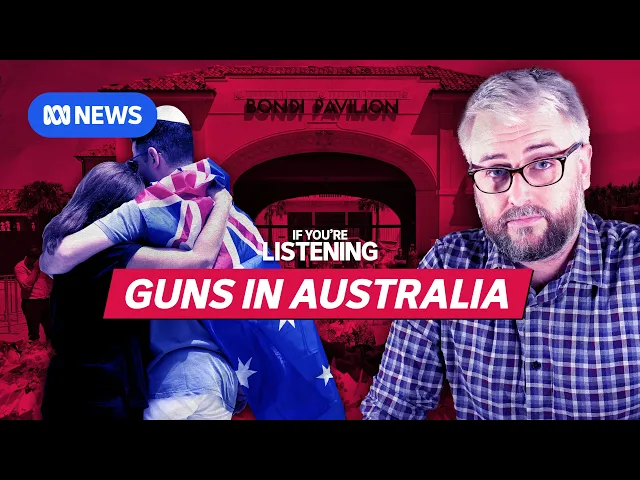
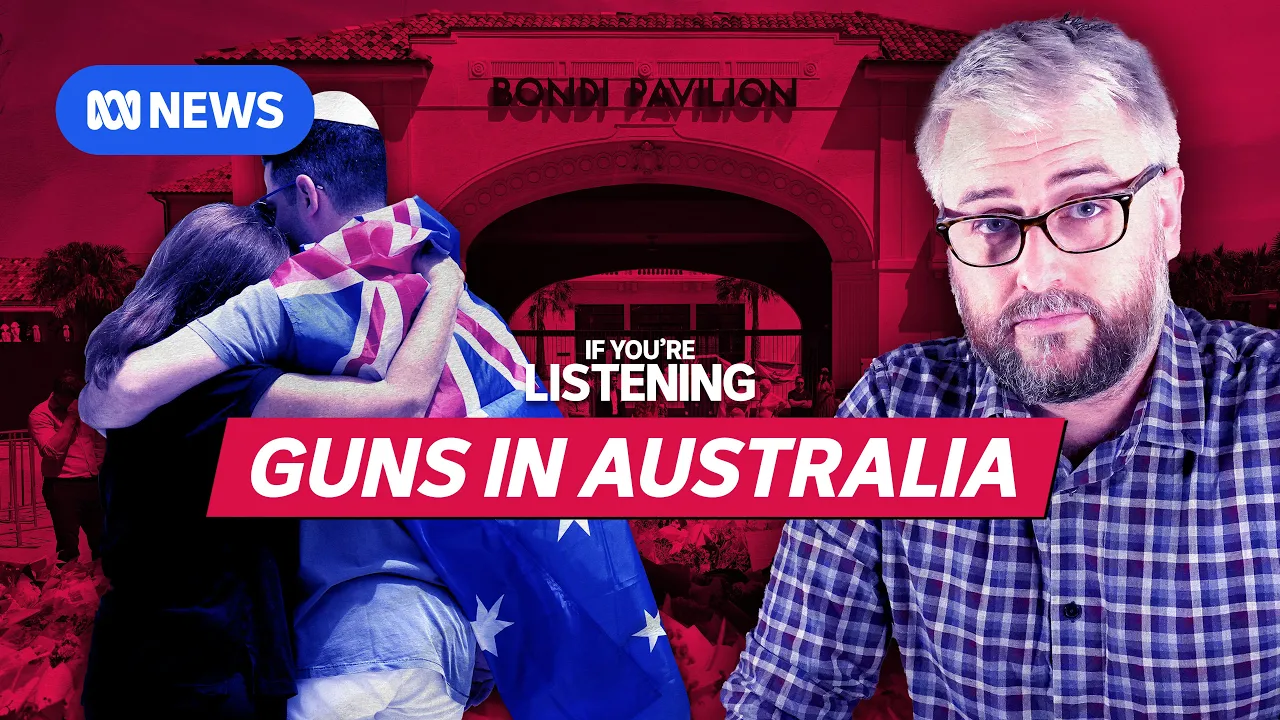
The first video footage I saw of the horrific attack on Australia's Jewish community in Bondi was of one of the gunmen being disarmed by a bystander. >> Oh [screaming] man. >> Ahmed Al Ahmed, a Sydney tobacco shop owner, tackles the shooter from behind and wrestles his gun out of his hands.
In an unbelievable scene, Ahmed then points the gun at the shooter, forcing him to retreat. He stands his ground as the second shooter advances on his position, firing as he goes. We've all had a lot of different emotions this week.
Shock, horror, incredible sadness, anger. But one thought that I've been dwelling on since seeing that video is what on earth is that gun doing in Bondi. It's a big gun.
He's firing over and over and over before he's finally forced to reload. >> Shoot him, but where are the cops? >> This happened in Australia.
I thought in fact the world thought that a shotgun capable of firing so many rounds so quickly was banned here. Even former Prime Minister Malcolm Turnull thought so. >> I read a report that there was a pumpaction shotgun involved.
Now I thought pumpaction shotguns were not were not available. So I wasn't I was very much of the impression that they were not available. >> And yet according to New South Wales police apparently the gun that the shooter had was legal.
He had a category AB license which entitled him to have the long arms that he had as registered firearms. >> The government is now talking about tightening our gun laws to restrict firearms like this. >> If you're not a farmer, if you're not involved in agriculture, why do you need these massive weapons that put the public in danger and make life dangerous and difficult for New South Wales police?
>> Australians are very proud of our gun laws and we have good reason to be. They are world famous. The laws are frequently referenced in the wake of almost every tragic mass shooting in the United States.
And yet we've now seen two men terrorize Australia's Jewish community with legallyowned highpowered guns. There are in fact more guns in Australia now than there were before the famous gun laws were introduced. So what are the specifics of Australia's gun laws?
Are they really as strict as we all like to believe? And if they are about to change, what could that accomplish? I'm Matt Beavenon and this is If You're Listening.
Something that you don't see much anymore is a high-profile politician deliberately seeking out a hostile crowd to speak to. >> Can you just tell us why you're here? >> Why?
mainly because people's rights are being taken away from them. They've done nothing wrong and they're being victimized. >> On the 16th of June 1996, [music] a cricket field in the small Victorian town of Sale was filling up with [music] rather angry people.
>> Can't stick up for our rods. >> Why? Why?
Why do you need to >> Why do we need to? Because if we don't make a stand now, we lose everything. >> The headline speaker was set to be the prime minister, John Howard.
>> What are you here for? >> Meet Mr Howard. Let's see what he's got to say.
>> What do you do you think you'll be happy with what he's got to say? >> I doubt very much. >> The issue at hand was whether people should be forced to give up their highowered firearms.
>> All I'd like to know is he keeps saying that 95% of the public don't want guns. Where does he get his figures? Just answer me that.
That's all I want to know. >> Ahead of the event, the police became concerned that the prime minister was in danger. >> The AFP tell me they've had a quite explicit warning.
The local police have had a quite explicit warning that somebody's going to shoot you. He was urged by police and one of his top advisers to wear a bulletproof vest. >> I don't know if they're right or wrong, but I have no idea how I would go and tell Janette and your family that we were warned for you to wear this black jacket.
You didn't. And you got shot. I have just no idea how I would say that to your family.
>> When Howard arrived wearing the bulky vest under his suit jacket, he was greeted by a local gun control activist. >> Thanks, Mr for coming to sail on behalf of 10,000 Victorians. I present to you these petitions which strongly support your view on gun control.
>> But as he climbed the steps to the grand stand, the crowd let him know that they were not happy to see him. Now, national leaders don't usually do this. They don't usually organize big events where they know they're going to face a furious crowd.
A crowd so furious that police are advising you to wear a bulletproof vest. But John Howard was determined to do it anyway because of the importance of the policy he was trying to implement. >> If the political process in Australia turns against me because of the decision that I have taken, I will accept that decision.
His conviction to get this policy over the line was because of something that happened 7 weeks earlier. >> A lone gunman armed with a highpowered rifle entered the Port Harour historic site and began firing randomly. >> I'd only been in the job of prime minister a few weeks and I was at home at Curbilly House that weekend.
I flicked on the television and before long I I knew we had this unbelievable disaster. The Port Arthur [music] massacre, the worst gun massacre in Australia's modern history, took place over the course of 20 hours. But most of the fatalities took place in less than 2 minutes.
>> It was all over in 90 seconds. He murdered 20 people and a number of other people were seriously injured. [music] >> The shooter was able to do this because he had an AR-15 semi-automatic rifle, a lightweight gun that can fire a lot of bullets very rapidly.
This was the weapon that was used in the cafe where 20 people died. >> Despite not having a firearms license or even a driver's license, the shooter had been able to buy the gun from a local dealer. In 1996, you technically needed a license to buy a firearm, but some gun shops just didn't bother asking for them.
High-powered rapid fire rifles like this one were easy to get. There were hundreds of thousands of them across the country. I was totally and utterly um thunder struck that there could be such an appalling loss of life at the hands of one man that uh it affected me.
>> In the days after the massacre, John Howard attended the memorial service for the victims in Tasmania and met Dr Brian Walpole, an emergency specialist from Royal Hobart Hospital. And there was a doctor who'd been treated a lot of the people with horrific injuries and he started explaining what had happened and he broke down and I embraced him and seemed the most natural thing in the world to do. >> Howard listened to several tragic stories about what had unfolded that day.
>> Wagg of course had lost his two beautiful daughters and wife and he wanted me to do something to stop it happening again. >> He returned to Canra determined to do just that. I can remember discussing this issue with some of my staff and one or two of them said to me, "You're not really thinking of banning all semi-automatics, are you?
" And I said, "Yes. " I said, "We might as well go for broke on this. " >> The barrier Howard faced wasn't the opposition Labour Party.
He'd just won a landslide victory. And the new opposition leader immediately threw his full support behind gun control. Those who would resist him have got to understand that 90% of the public believes in the propositions that he put forth.
The barrier was from inside his own conservative coalition. Howard, a lifelong resident of suburban Sydney with no background in agriculture or hunting, was surrounded by rural colleagues who were opposed to his point of view. >> And you know, sitting around the cabinet table were um people who actually owned a lot of guns.
>> Howard knew virtually nothing about guns. So he called his primary industries minister and asked him for advice. >> Said your [music] job is to explain to me and convince me uh as to what sort of firearms [music] farmers need and legitimately uh must have access to uh [music] what sort of gun do you use?
And I hesitated for a moment because I thought I don't quite know how to tell the prime minister that I have what he would regard as an arsenal. >> He was asking for fine detail though. He wasn't interested in his colleagues arguments against banning guns.
>> We realized that Howard wasn't going to change his mind. I mean, you could give your arguments [music] against the gun control and you knew he would listen to you politely and he would be patient with you, but you knew you were talking to a [music] brick wall. He was not going to change his mind.
>> Consultation inside the government was brief to say the least. >> I have not changed my views. I will not be changing my views.
Within two weeks of the Port Arthur massacre, Howard had consulted with police commissioners and state and territory governments and come [music] up with a final plan. >> I'm very happy to announce that the Commonwealth and the states and territories have agreed on a uniform and much [music] tougher approach to gun laws which uh will in our view make Australia a much safer place in [music] which to live. >> The decision was that identical laws would be introduced across all Australian states and territories.
The laws would organize guns into categories and implement a licensing [music] and registration system for their use. Handguns, pistols effectively, would be category H. Long guns like rifles and shotguns would be split into four categories, A, B, C, and D, with A being the least restricted and D being essentially banned with very few exceptions.
purposes. I clearly have in mind the police and the armed services. >> But already you can start to see how this gets complicated.
The police and military need exceptions. So do some farmers and some professional shooters who are charged with controlling feral animals. And figuring out which guns go into the most restricted category is difficult.
The problem is that it's like drunk driving. You have to set a threshold. And that threshold has to be somewhere.
What you want to be able to say is nobody can have guns that can kill large numbers of people very quickly. But how do you write that into a law? There are thousands of different models of guns with hundreds of different mechanisms and dozens of different types of ammunition.
Where's the threshold between very, very dangerous and still dangerous but okay for people to have if they've got a license? What goes into category A and B which are available to most people with a gun license and what goes into category C and D which are only available to people who >> can satisfy the police that they have a genuine need for them which [music] cannot be bet met by any other methods or any of the non-prohibited weapons. [music] >> The government eventually decided to make these guns essentially illegal.
all other self-loading center fire rifles, all self-loading and pumpaction shotguns, and all self-loading rimfire rifles. >> This was effectively a restriction on all guns that can fire lots of bullets quickly. Self-loading or semi-automatic guns are guns that can fire like this quickly.
The action of pulling the trigger is both firing a bullet and loading a new bullet into the chamber. Those are all highly restricted in category D. Meanwhile, a pumpaction shotgun is your classic boom type of shotgun.
You need to pull a slide on the barrel to load each cartridge, but they can still be fired very quickly. Those guns would be put in category C, which would be available to some farmers, but only if they have a magazine capacity of less than five rounds. If the gun was capable of firing more than five rounds without reloading, they would go into category D.
If a gun met any of those criteria, self-loading or pump action, they were not available for gun enthusiasts, amateur hunters, or most farmers. [music] They were very strictly controlled. People who already owned the newly banned guns would be able to hand them into the government in exchange for the market value of the gun.
As for the firearms that remained legal under the new guidelines, they would be registered on a national centralized database and checks would be carried out to make sure that people were storing their guns safely. Another element that was introduced was that all gun owners would now be required to demonstrate that they had a legitimate need for a gun, either for work or because you were a member of a gun club. You couldn't just get a gun license because you like guns anymore.
>> Needless to say, this represents an enormous shift in the culture of this country towards the possession, the use, and the ownership of guns. It is an historic agreement. Public support for the agreement was enormous.
Polls at the time indicated that around 90% of Australians were behind the prime minister's law changes. Of course, 90% isn't everyone. >> You can send a message all the way down to Canra to that sornoff little [ __ ] Jack Boot Johnny.
>> Around the country, there is serious anger among gun club members in particular. >> The only currency that you can purchase freedom back with is blood. And yet, despite the resentment, John Howard decided to tour these gun clubs to speak to people about the decisions he'd made.
>> GET OUT, YOU CLOWN. >> He made it clear to the crowd at Sale Oval that this was not a consultation. It was an explanation.
>> I haven't come here to negotiate the government decision. I've come here to explain it. I've come here to try and justify it.
>> John Howard has never been a physically imposing man. His small stature and flinty voice were a constant subject [music] of ridicule during his political career. The oversized jacket that day in sale didn't help, nor did the obvious bulletproof vest underneath.
Howard says he doesn't regret anything [music] about his speech that day except for wearing that vest. >> I'm sorry I did. I really am.
I felt a bit of a goose afterwards for having worn it. But the image of this small man shouting a defense of his policy over the furious jeers and booze of the crowd with a plane circling overhead pulling a sign saying stick to your guns was seared into the public memory. There come occasions for any government to take decisions which can only be effectively implemented in the interest of the overall national good if they involve some disproportionate inconvenience and some disproportionate deprivation of one section of the community.
I'm sorry about that but there is no other way. There is no other way. John Howard was willing to face people who had supported his election, stubbornly shrug off their anger and ignore them doing Nazi salutes at him.
>> That is the reason behind this decision, ladies and gentlemen. >> And that's because this policy was really important. He wouldn't have gone through all this otherwise.
And the proof was in the pudding because the reform was an exceptional success. During the 12 months after the legislation was passed and the government's buyback scheme was implemented, Australians turned in about 650,000 guns. In the years since Howard's policies have been heralded by gun control advocates all over the world since they were passed, Australia's gun homicide rate has gone down by more than half.
Australia remained mostly safe from mass shootings of the kind we see in the United States. Which is why the Australian community was so shocked by what happened on the first day of Hanukkah celebrations in December 2025. Two shooters, Sarjid and Navidivid Aram, a father and a son, arrived at Bondi with a cache of guns and started shooting at the large Hanukkah celebration at the crowded beach.
Video evidence shows the father, Sajjid, firing a shotgun rapidly. I count at least eight shots between reloads. Police say that he owned this gun legally with a categoryAAB license.
But how is that possible? Rapid fire shotguns capable of firing more than five rounds between reloads were put into category D all the way back in 1996. >> In Australia, if you're wanting to use a shotgun for hunting, um it has been difficult uh to get a gun that has more than uh two shots.
Well, despite the fact that pumpaction shotguns were in category D and essentially banned, it turns out that some gun makers have been sliding through the cracks by changing the firing mechanism, the way that the shotgun loads each shell into the chamber. It can fire eight shots in as many seconds using a firing mechanism straight from the Wild West. In 2015, a company in Turkey started making shotguns that use an outdated lever action mechanism, which is not nearly as good as a pump action, but fits into category A instead of the far more restrictive category D.
>> This weapon is clearly not far off a pumpaction shotgun, and we severely restrict the use of those because the speed with which they can be used. The ABC was given a demonstration of both a pumpaction shotgun and this leveraction shotgun being fired by the same person. And look, it's definitely slower, about half the rate, but it's still around being fired every second.
When these new guns started entering the country, proponents of gun control were extremely concerned. If you're a mass shooter, which [music] is what the Port Arthur laws were designed to curb, then [music] that's the type of gun you go for. You go for something that's going to just fire and fire and fire and fire and fire.
Gun importers argued that these were very different. But some users of online gun forums [music] clearly see this as a way of getting around the 1996 gun laws. Somehow someone managed to sneak in lever shotguns with 7 plus >> the restrictive and draconian legislation enacted in Australia.
>> The lever action loophole was closed in 2017 when these shotguns if they had a magazine capacity of more than five were restricted. But the reprieve didn't last long because soon after new shotguns with different types of firing mechanisms were designed to take their place. This has meant that over the last decade, there has been a cat-and- mouse game between governments and gun importers as different types of high-powered shotguns are introduced into the market and then restricted.
This is how the Bondi shooter was able to legally own a shotgun that can fire so many shells in rapid succession without reloading. Both of the shooters can be seen using guns with straight pull mechanisms, which have only been recently introduced to Australia and are therefore still available to category A owners. High-powered weapons like this creeping into the more accessible categories A and B is just one of several examples of how gun laws have been neglected since 1996.
A few gun owners have contacted us since the Bondi attack to tell us that they're shocked by how easy it is to get a gun license in Australia. They've also told us that they think that audits by regulators are too infrequent. People smuggling guns into the country has also become a serious issue.
There are now an estimated 260,000 unregistered illicit firearms in circulation in Australia. Another issue is there's no cap on the number of guns you can own, which has led to growing instances of people stockpiling guns. Police conducted weapons inspections have been met with heavily armed and very angry people.
>> Last week, [music] police searched 70 properties throughout the state. They seized 135 firearms and canceled or suspended 44 gun licenses. >> Police came [music] here at 7:30 this morning to conduct a firearms inspection.
They say that when officers arrived, they were threatened. >> In my opinion, those officers did not stand a chance. >> A candle lit vigil was held in Touumba for the young constable shot dead at William last December.
>> Most Australians are proud of our gun laws, and most think that they keep us safe from the horrors of mass shootings that we see around the world. But clearly, that's no longer the case. And now in the wake of this attack on the Jewish community, Australia's biggest mass shooting since Port Arthur, the government is looking to update laws that have been left fairly dormant for three decades.
>> Today, I'm also announcing that the government will establish a national gun buyback scheme to purchase surplus, newly banned, and illegal firearms. The largest buyback since the Howard government initiated one in 1996. In the days after the shooting, New South Wales Premier Chris Mins announced that his government would be specifically addressing the loopholes in the law that allowed these guns to be legally bought.
>> We are proposing a bill to reclassify straight pull-up and pumpaction shotguns to look at reducing magazine capacity for shotguns for prohibiting beltfed magazines in those shotguns. The laws are likely to pass quickly as there is still strong popular support for gun control measures. But John Howard, author of the 1996 reforms, says tightening gun laws isn't the only answer.
>> Focus on guns. It's welcome always. Provided it's designed to tighten existing laws to eliminate loopholes.
But I do not want focus on guns to be used as a pretext to avoid the broader debate about the spread of hatred of Jewish people and anti-semitism. >> And of course, he's right. There's no doubt that further tightening gun laws will make Australians feel safer in their communities.
But figuring out how to stop gun importers finding legal loopholes is going to be complex. What's even more complex is figuring out what to do about the fact that there are people in our society who are willing to attack a religious celebration on a sunny summer afternoon in a beachside playground.